What Makes a Business Sellable with David Barnett
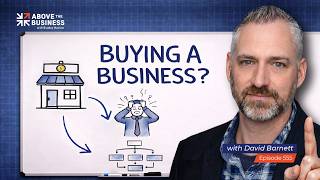
In this Above the Business podcast episode, host Bradley Hamner interviews small‑business transaction expert David Barnett. Barnett walks through his personal journey from corporate roles to becoming a consultant who helps buyers and sellers of Main‑Street businesses. He explains why most buyers are corporate leavers seeking a stable cash‑flow lifestyle, and contrasts them with growth‑oriented entrepreneurs. The conversation demystifies valuation, using real‑estate cap‑rate analogies to illustrate cash‑flow multiples, and clarifies when to use Seller’s Discretionary Earnings (SDE) versus EBITDA based on business size. Barnett stresses that a business’s sellability hinges on documented systems, delegated responsibilities, and clear KPIs – the “Big Bird” symptom of chaotic, undocumented operations signals a low‑value asset. He outlines how deal terms (seller financing, earn‑outs, forgivable notes) can mitigate buyer risk and often matter more than price, and why his fee‑only consulting model avoids the conflict of interest inherent in traditional brokers. Throughout, he shares practical advice for owners: ask the right questions, build repeatable processes, and think “above the business” to envision future exit scenarios. The episode concludes with resources – Barnett’s blog, podcast library, and ten Amazon books – for listeners who want deeper education on buying, selling, and scaling small businesses.
Chapters
The most common kind of buyer out there trying to buy a small business is somebody who is leaving a job they don't like.
In today's episode, we have David Barnette.
When you're in a big corporation, it's easy to let yourself believe that you are good at business because you're the master of your one thing. But there's a huge amount of administrative duties that all fall on the owner.
David has been in this business of buying and selling and helping other people buying and selling businesses for a really long time.
Some harried, frustrated, anxious business owner would call me up and say, yeah, I want to sell. One of the first questions I would always ask is, when was your last vacation? Often, oh, I haven't taken a vacation in years.
If you are in a business that you can't sell, don't want to sell right now, stay tuned, hang with us, because I think the things that you begin to learn in this episode can help you in running a great business.
As well.
David Barnett, welcome to the Above the Business podcast.
Bradley, I'm excited to be here. Thanks for inviting me.
Excited to have you. We'd love to start with background and origin story about kind of how people's journeys led them to where they are today. Tell us yours.
Well, do you remember that show Family Ties on TV back like in the '80s?
Yeah, long time ago.
Yeah. I was a huge fan of that Alex P. Keaton character. Like he was all about making money and having businesses and stuff. And I was just, I was inspired inspired by him. I know he was kind of like the villain of the show, but I thought it was great. And I just grew up being one of those kids who was always interested in business and was always trying to figure out how to make some cash. And I would go into businesses and see things that weren't run the way I thought they should be, and it would frustrate me. And I would always have all these ideas. And so naturally I grew into all those childhood businesses that people have and thought I should go off and get a business degree, thinking that what they do at business school is make you into a business person. But They don't actually do that. Did you know that, Bradley?
Yeah, I do know that because I got a business degree and they didn't do it for me either.
Yeah. So about 3 years in, I found out they were trying to turn me into a middle manager at GE or something.
Yeah.
And I got out of there and I ended up working for the Yellow Pages and it was the best—
I did too.
Well, it was the best thing that ever happened to me because my job became visiting the owners and managers of these small everyday businesses and talking with them about how they made money, what kind of customers I wanted. Wow. And it allowed me to just, as you know, learn this broad, uh, amount of about all these different businesses and how they make money. And that's where I say kind of my, my main street business education came from. And, um, in the late '90s, uh, we could see that the internet was coming along. Like it wasn't hard to say to, it wasn't hard to, to realize that the Yellow Pages days were probably numbered. So, so I left. Around early 2000s, 2007, I think. And I started my own business. A couple years into it, I sold it. That was the first business I ever had a hand in selling. And then I started another new business and eventually became a business broker. And so, I've helped people buy and sell companies. And business brokerage is an absolutely awful business because you have to convince someone to sell their business with you. And that can take years. And then you have to get all the information from them to present their business for sale, and that can take months. And then you have to find the buyer, which can take years, and the whole thing's based on contingency. So I literally had files on my desk, some of them 3 years before I earned any money, and I had other files on my desk I didn't earn anything on. So I eventually got out of that and became a banker for a while, but I came back into helping people buy and sell businesses with a different business model. So since 2015, I've been working full-time as a consultant agent, helping people buy and sell small businesses. And I've broken down the process into steps and I simply borrowed the business model of attorneys and CPAs. So I basically take people through each step and I just charge them a fee for what I do. And at the end of the process, there's no commission. So I'm still working on helping people buy and sell businesses. But the great thing is I can really work with the buyers in a straightforward, honest way because I'm not conflicted anymore because business brokers get paid by sellers when the business is sold. When a buyer hires me to look at a deal, I'm strictly working for them. And, um, and when I do work for a seller and help them sell, they, they don't face the big commission bill that they would with a business broker. So that's what I do today. And I, I'm online on YouTube creating videos to, to promote that and to teach people about how to do these small business deals. And I've written a bunch of books on Amazon. So that's what I do. That's my background.
Yeah, that's great. We're gonna have a lot to lot to talk about. Let's kind of level set for some of the people that maybe have never really kind of ventured into this. Maybe they've started a business, they're a business owner. Obviously, almost all of our listening audience are that, or aspiring business owners. Um, but maybe they started it from scratch, right? They didn't buy a business, they didn't buy then go build the, the business, and, and maybe they haven't had an accident at some point. But, um, one of the things I learned kind of early on is I didn't know that businesses often traded based on multiples, you know, multiples of revenue or multiples of, we'll say, profit. We can get into EBITDA and SDE and all that stuff at some other point down the road. So I didn't realize that, and that was really helpful for me to even get an idea that different types of businesses will trade at different kind of ranges. And for the most part, those are fairly similar. And so it almost helped to demystify for me and my own understanding of that, I don't know, a decade ago. Or, uh, whereas before that I was like, I don't even know how— I mean, how do you even price a business, as an example? I'll turn it over to you. How do you help people even begin to understand that, walk through that journey?
Yeah. So have you ever been part of a conversation about investing in real estate?
Yes.
Oftentimes people in that world will talk about cap rates, capitalization rates. And so real estate appraisers will look at what buildings are selling for. Let's say a commercial property in a second-tier city, little strip mall or something. Real estate appraiser, and I'm just making this up, real estate appraiser might say that's selling for a 10 cap. Meaning if you buy that property, you need to get a 10% return on your investment for it to make sense. So if the building is producing $100,000 a year, you would pay a million dollars for it and you'd earn 10%. Okay. So if we take that 10% cap rate and we simply move it around, if you remember back to grade 6 math, what that 10% cap rate is also telling you is that buildings sell for a 10x multiple of their cash flow.
Mm-hmm.
So when somebody says that a business in a certain industry is selling for 5 times its cash flow, what it means is investors demand a 20% yield.
Mm-hmm.
So these multiples are simply a different angle of looking at the same kind of question is what kind of rate of return does someone need for an asset like this given its risk profile? And different kinds of businesses in different industries are going to have different risk profiles. What makes the multiple— the big reason why you look at it in that direction is because the multiple tends to transcend inflation. So 10 years ago, bakeries were selling for 2.3 times SDE. Today they still sell for 2.3 times SDE, even though the numbers are all going to be different. And a bakery in a small town is going to pay lower rent than a bakery in a big city. But both of them are still going to sell for 2.3 times SDE, for example. And so it's a rule of thumb methodology. It's not the last word in valuation. There's 101 other factors that people look at when they're buying a business. But typically when people are first looking at the business, they'll run that kind of math just to see if the price seems to make sense.
That's such a great analogies there to be able to kind of make sense of this and demystify it. At what point do you switch over, uh, and maybe you don't, maybe you don't, but when do you switch over from looking at a business from the perspective of a multiple of SDE versus EBITDA?
Yeah, it's, it's, it's when people start to think of the actual work of running the business in a professional way as being something separate from being the owner. So that line between SDE and EBITDA at one time, I used to say pretty confidently it was around half a million dollars of EBITDA. It could be a little bit different in different industries, but basically the smaller the business, the more likely you're going to have a person look at it and say, if I buy this business and run it full-time, how much money do I get?
Yeah.
And that person's mixing two roles. They're mixing the role of the manager and the investor owner role together into one.
Often sometimes people will use owner operators.
Yeah. And because that SDE figure is the owner, is the manager's salary and the profit of the business kind of combined. The EBITDA level sets aside the fair market value of that manager's wage or salary. And so you look at it from that point of view when you're getting into a little more sophisticated crowd who understand, hey, My Monday to Friday, 9 to 5 is worth a certain amount of money because of who I am and what I bring to the table. I can't mix that in with the investment returns from borrowing and investing equity into buying the business. And so basically as you get from the small little Main Street businesses up into sort of bigger businesses, people's mindset will change as to which measure of cash flow they're looking at. Both of those measures of cash flow, by the way, are what we call notional cash flows. They're not real. You will not find STE or EBITDA on a government tax form or anything like that. They are made-up methodologies designed to allow you to compare two peer businesses against each other. And because here's the thing is EBITDA literally stands for earnings before interest, taxes, depreciation, and amortization. If you have a good profitable business, you're going to pay taxes. If you borrow money to buy the business, you're going to pay interest. And if the business has any amount of equipment or machinery, you're going to have to replace it. And that's how accountants represent depreciation. Depreciation is a representation of stuff wearing out. So you're going to have to bring those things back into your calculus when you're looking at the business. And this is, this is why they, I say like those multiples of cash flow are the first pass. I've seen many people get excited about a deal because it was a certain multiple of EBITDA. And then when they get into the business and realize there's, you know, over a million dollars worth of heavy equipment that has to be replaced every 4 or 5 years, they realize, hey, wait a minute, I can't pay a multiple of EBITDA for this. I have to take into account the reinvestment that needs to occur. And that comes out of your cash after that EBITDA calculation. And so that's kind of like one of the one of the particular areas where people make mistakes.
How often does a buyer look at— how often— and this may be a sophisticated buyer that does this, and maybe not, I don't know. But how often would you say a business owner comes in and— is the— to set this up, is the average business typically doing maybe a million in revenue that you're doing, or are you in the upper, like, 10 million in revenue and they're throwing off 15 million in, or 1.5 million in EBITDA? What range typically do you operate in?
Yeah, so, so there's— I work myself with businesses in the Main Street and lower middle market space. So I'm typically working with people generally under that half a million of EBITDA, although I do work with some people getting up to a million, 1.1, depending on the industry.
Okay.
And with respect to what percentage of revenue does that EBITDA or STE represent, the bigger the business, the harder it is to get that percentage to be higher. Because when you have a small owner-operated business, imagine like a Main Street business with 7 employees, the owner goes there every day. This is probably a conversation you have a lot with your audience. The owner goes there every day, they run everything. Every one of those other employees reports to the owner. That individual owner is the owner, they're also the manager, they're also the supervisor, they are all the middle management all in one, in one person. That's right. So that business can probably do $1 million in revenue and those people can do their jobs and customers will be happy. That owner could end up taking $200,000 out of that business every year. That's 20% SDE. But if they grow to $3 or $4 million, Well, guess what? We're going to have to increase headcount. Now we got a lot of people. They all can't report to the owner anymore. Now we need like maybe a supervisor or some other kind of manager. And what ends up happening is you start to build out that middle management category in the business. And that usually comes out of the money that's being taken by, by the owner. And so that as they get bigger, the percentage of what ends up leaving the business, whether STE or EBITDA, ends up getting smaller. Until you get to the ultimate extreme of your big public companies that struggled for single-digit cash flows or earnings to their owners.
Yeah. Okay. So that's helpful. Do people typically come in that are— that's a buyer, are they coming in and evaluating deals to go in and see it as a lifestyle cash flow thing of like, all right, I'm going to go and you know, buy this business. We'll get into how the, how the, how it's structured in a little bit, like owner financing, SBA loans, personal money into it. We'll get to all that in a little bit, but either way they're looking at it, are they typically looking at it and saying, all right, I'm gonna buy this business. It's throwing off this amount of cash flow. That makes sense for my lifestyle. Or are you typically seeing somebody going, wait, this is doing how much? Million dollars, it's throwing off $150,000. No, we're going to take this bad boy, we're going to scale it to $10 million. I know how to do that. And we're going to get that thing throwing off $1.5 million, and then I'm going to exit that. And then we're going to do that in, in a little 3 to 5 year chunk. What, what, what level of buyers are you working with?
So, uh, it's a, it's a great question, by the way. Thank you very much. Um, it depends on their experience. And, and what they've been exposed to. So, so there are people out there who have built and grown businesses in the way you describe, and, uh, they exit and they get a big payday, and then they go looking for opportunities to do it again. And they might realize that buying an existing small business is a quicker start than starting something from scratch. And so that's why they're in the market, right? Um, they are not that common. The, the most common kind of buyer out there trying to buy a small business is somebody who is leaving a job they don't like and they are looking at becoming a business owner, but they've got responsibilities in life. They're married, they've got kids, they've got a mortgage, they've got college education costs coming up soon. And they say, hey, I would like to start a business, but I'm at the point in life where I just can't take the risk of it not working out. And so what they do is they finally come across the idea, hey, if I buy something that's already cash flowing, I can step right into having an income right away. And so, they usually though bring with them the elements required to create growth even if it may not be their driving plan. So, let me give you an example. And this probably jives with a lot of stuff that you talk about. If you imagine a small 4-bay auto repair business, it got started with a mechanic who was fixing cars and then he got too busy and he hired another guy. And then the two of them fix cars, but the first guy is still answering the phone, ordering parts, dealing with the advertising, all that kind of stuff, paying bills in the evening. He grows a bit more, adds a third guy, but he's still doing all the administrative burden, all the overhead. And by the time he gets to the fourth guy, he just is maxed out from an admin point of view because he still picks up wrenches from time to time. So that guy then will spend the next 20 years doing just that. Because he fails to implement the systems, delegate responsibility to other people. He doesn't want to let somebody else have a company credit card for whatever reason. He heard a bad story one day, et cetera. So that guy will run that for a long time. And then some guy who's like a middle manager over at the power company or something decides he doesn't like his job anymore. He is a bit of a hobbyist with cars. He understands how they work, how generally mechanics fix them even though he's not a mechanic. but he exists within this hierarchy where there are standard operating procedures and processes and checklists and forms and all this kind of stuff that keeps the power company organized. That guy comes and buys the garage, starts to implement those kinds of processes and systems. Now he can move to a bigger location because he can now grow to mechanic 5, 6, 7, 8, and his systems allow him to manage the whole thing and know what's going on. In ways that the other person could not. And so even though he may not have bought it because he wanted to grow it, he bought it because of the cash flow it delivered. He'll end up growing it because of the talents and skills that he brings to the table. And this is a big thing because in the world of public securities investing, so stock market investing, a lot of the formulas that you will look at that talk about how to value a stock will have some kind of component to them that looks at the growth. So people might buy Coca-Cola because it's growing very quickly and they think it's going to grow again next year. Because when you're buying the stock of a public company, not only are you getting the plants, the trucks, the secret formula, all that kind of stuff, but you're also getting the leadership team who knows what they're doing and they have the plan. But when you're buying a small business, all of that IP about how the business runs, all the drivers behind its growth, all that kind of stuff, that departs when the owner sells. And now the buyer has to step in and take that role. So buyers of small businesses are very— they will not typically pay anyone for the growth that they see in the opportunity. They're going to pay for the business they receive. Because any growth that's achieved will be on their watch. They're the ones that have to do the work. And I know you talk about organizing and systematizing businesses here all the time. That is a tremendous way for somebody to add value to a business once they buy it to do as I just described, create all the systems and processes, et cetera, so that you can then grow when the opportunity arises.
Do you ever feel a sense of, um, obligation about where you're placing a buyer of a business? Let me give you an analogy. My son's 15, uh, he turns 16 in September. We're not putting him in a Ferrari, okay? We're not putting him in a, in a super fast car. Like, nope, you're not, you're not doing that. Have you ever had situations— and obviously you don't want to name them— where you've had business owner, or excuse me, uh, highly paid executive coming out of the corporate world. I don't want to do this anymore. I'm gonna go into small business. They end up buying a business and you're like, I'm gonna help you get set up with this thing. I'm not so sure this is gonna be the right fit. Okay, within that, I know obviously you're going to help them prepare and do whatever they're going to do, but I'm sure you've got some stories of people where it's like, man, I don't know if auto repair shop really is up your alley, Bradley, or maybe a bakery. Like, you've been doing this over here and you're going to go own a bakery?
So this is the big advantage I have over like a business broker because a business broker would take that executive and sell them the bakery because that's how they get paid.
Yeah.
And I'm working for that executive trying to help them do a deal that makes sense. And, you know, a lot of people, get confused about what they're getting into in the world of small business. They'll look at a presentation from a broker or they'll look at financial statements. They'll see 10 years of pretty consistent earnings and they'll trick themselves into thinking that it's like they're buying something that runs like clockwork and it doesn't. Like that the current owner is in there in a boxing match that lasts 8 hours every day.
Yeah, every day. Shoot, 8 hours? 8 hours, you being generous.
Well, you know, you ever heard the joke? You should own your own business. You only have to work half days. It's up to you which 12 hours it's going to be.
Right. Exactly.
So I try to give people an idea of what they're getting into, and I do it by coaching them to ask the right questions. Because people who have a business background will tend to focus on the numbers, the results, the spreadsheets, and they'll look at the numbers and the P&Ls and the balance sheet and all that kind of stuff. I'll get them to ask questions like, "Hey, Mr. Owner, what time do you come in in the morning? What does your day look like? Can you walk me through an average day?" I've had fast food restaurant owners describe how only they will be the ones who clean the french fry slicing machine because they're afraid of a workplace health and safety claim. And the thing is just so dangerous, right? And then they'll show you scars on their hands from when they got bit by the machine, right?
Oh my gosh.
I've had fried chicken guys show me the burn marks on their forearms from the hot grease. Yeah. This is the reality of what they're getting into. And Uh, one of the things I, I like to point out to people that come from a corporate environment is that when you're in a big corporation, I, I liken it to a beehive. You imagine the bees are in the little cells of the hive. When you're in that job in the corporation, you are very focused on the one thing that you are doing every day. And you can be really great at that one thing and get it done very efficiently. It's easy to let yourself believe that you are good at business. Because you're the master of your one thing and you are totally unaware of all the other things that all the other bees are doing.
Yeah.
And when you get into the world of small business, you know, you've got maybe some other employees that are helping with the big workloads, helping customers and stuff, but there's a huge amount of administrative duties that all fall on the owner.
Yeah.
And they've got to be addressed. They can't be ignored, you know. It's— the reality is very different from a large, large company. And I've seen this firsthand in talking with business owners who've tried to leverage growth by hiring people from corporate environments. Like someone's got a big track record as a VP of sales at a bigger company. Someone in a smaller company tries to bring them in to sort of do the same kind of thing in their business. And that person is not effective because they're used to being in a place where they have these teams of experts and people they can call upon to get things done. Done. Whereas in the small business, it's often the person, the manager themselves has to get things done and they often are limited to an existing tech stack that the business already has where there may not be the money to invest in other new things and stuff of that nature.
Yeah, that's so true. Well, I mean, you speak in the world we know. I mean, we know this is the world we know is that that business owner that's doing initially early on, $300,000, $500,000, $750,000. I mean, they, they're all the things, you know. And, and they, you know, they, they're— I don't want to say C-suite stuff, but I mean, you know, they do all the things. They're the bookkeeper, the janitor, the sales, sales manager. See, and they— it's why entrepreneurship is such a challenge, because you have to have this enough collection of enough things. You got to know how to be able to build a sales team initially and build a customer service team or account managers, and then understand a little bit how to manage the financials and make the investments. I mean, it's why entrepreneurship is the ultimate personal development course, because I mean, you got to know, you got to know about all the, all the things. And I think like, you know, Dan Martell, he's came on the podcast before, love his book Buy Back Your Time, and he's right. But early on in the smaller businesses, they don't have the funds to buy back the time. Now, whenever you get up to the higher levels, you can do that. But I think that that's where people can get the concept, but they get kind of hard— it gets difficult to know actually how to go about executing that.
Okay, we're going to flip the whole thing for a second.
We spent some time on the buyer side. I want to talk about it on the seller side of this. Okay. So before we hit record, I mentioned to you, I said, I philosophically believe that a business that is attractive to an acquirer is also a great business to own and run. Even if you are not where you want or, you know, currently can sell the business today, that's a great business and it's a great approach to be able to take. David, can you talk about what are the elements? And I know these are big rocks I'm asking. What are the big elements that make a business sellable?
Sure. It all comes down to two questions that a buyer is going to ask. Okay. Question number one is, what is the cash flow? We talked a little bit about that. The cash flow is going to determine the price. Question number two is, Will the cash flow continue under my new stewardship? That question opens up a whole bunch of different cans of worms. Now we're talking about, can the buyer learn how to run the business? Are things written down? Are they documented, et cetera? You know, back when I was a business broker, I used to have what I call a Big Bird experience every once in a while with one of my business owners. So I, someone, I would send out advertising. Hey, I got people that want to buy a business. You want to sell? Some harried, frustrated, anxious business owner would call me up and say, "Yeah, I want to sell." And I would go in there and I call it a Big Bird moment because they would be sitting at their desk entirely surrounded on every visible surface by little yellow sticky notes, all with scribbles on them of things they're trying to remember to do because the central nervous system of the entire business was between their ears. Right. And you look at them and you're like, one of the first questions I would always ask is, when was your last vacation? Often, oh, I haven't taken a vacation in years. Yeah, I can see why. You can't get out of here. You're stuck.
Red flag. Wrong answer. Try to sell the company.
And I would ask them, I would say, what do you think is going to go through the mind of a buyer if I bring them in here and see how you live every day? Do you think someone would pay money to live and run the business the way you do? What kind of example are we going to set? So I actually coached a few people through the E-Myth book and you got to get things written down, you've got to start putting things on paper, et cetera, et cetera. And here's the incredible thing that happened is when people started to get themselves organized and then they started to be able to let go of certain things, they were able to delegate responsibilities and tasks to other people, suddenly they weren't so anxious to sell the business because they started to get an idea of what the business was actually going to be like. And it was the kind of thing they imagined when they got going, but they just didn't know how to get there and what the path would be. And so if you are properly organized, you've got your systems in place, et cetera, you are going to have a business that is easier to operate. You're going to be able to offload responsibilities and tasks onto others. You're going to be able to put KPIs in place to be able to keep an eye on what they're doing and what the results are from their efforts. And you are going to end up with a business that's easier to manage and it's going to be easier on you. If you don't do those things, here's also what's going to happen. When it comes time for you to want to get out of the business, you may be able to sell it even in its bad condition. But here's the problem. You will only be able to sell it to someone who is just like you with just the same kind of experience, except they're younger. So I always draw the example of like a roofing company, right? You're out there replacing shingles on houses. And if you've got all of your systems properly in place, you can sell that business to a guy who wants to leave his job at the post office. Because he's going to come in and say, well, how do I do quotes? And you'll say, well, here's the process. How do I organize the crew? Here's the process. Here's the safety manual. Here's this, here's that. Here's how we buy shingles. Here's how we do up the quotes. Right. It's all in the systems are there. But if all that stuff is in the roofer's head, the only person you can sell the business to is another roofer who's 20 years younger. Right. And so the audience, the potential field of buyers shrinks when you are not able to demonstrate to someone that they will be able to continue the cash flow under their stewardship. You will be limited to people who don't worry so much about running it because they already kind of know, maybe because they're already in the industry. But yeah, yeah, if there are 5 potential buyers out there versus 10, it can have a huge impact on not just the price, but the timeline. The timeline it takes to actually connect with one of those people and to make a deal come about.
Yeah.
So good. Somebody may not have heard this, but I think it's good to talk about both sides of this part. I think Warren Buffett's credited with this. I'm sure it's not something super original, but I've heard him credited with saying, "You name the price, I'll name the terms." Can you just talk about in buying and selling businesses why everybody gets fixated on the price and nobody's— they don't tend— I'm sure you coach people on this, on making sure that, hey, yeah, price is one thing, but terms is— that's more important even than price. Can you talk about that?
Yeah, sure. So an owner of a business who might sell one day has perfect knowledge of what's going on in the business. They've been running it forever. They know what's going on. They know what the risks are. They know what needs to be managed, et cetera. Someone who's on the outside who wants to buy it, they have very little knowledge about what's going on in the business. And what they tend to see is risk everywhere. They know that small business is risky. They worry about customer concentration, supplier relationships, your head foreman quitting, whatever it is. And so a buyer is always trying to manage that risk. And if as a seller you say, "I will only accept a deal in which I'm paid 100% of my price on closing day," what the buyer is going to start to imagine is they're going to imagine all the potential risks of what could go wrong after. And if they borrowed money from a bank, they owe the bank. Doesn't matter what happens after they borrow the money from the bank. And so that buyer is going to want to try to manage those risks they perceive. And if you, if they have to pay all cash on closing, the only thing they can do to mitigate risk is to change that price. So there's plenty of examples out there of people who've agreed to a certain price and then they've gone through due diligence and they come back and they've got all these things that they see that aren't not quite right and they want to adjust the price because they're trying to manage risk. Now, if you want to keep the price high to wherever it was, wherever it was set, then all you have to do is help the buyer manage the risk. And the way we do that is through the terms. So there's all kinds of different ways. There's many varieties of ways that you can sell a business but where you do not get all the money on closing day. So a common example is seller financing, which would be a debt for a specific amount of money. There's also what we call an earnout, which means you get money after closing based on the performance of the business. There are forgivable seller notes where, for example, if certain targets are met in the first 5 years, then you get this extra lump sum of money. If they're not met, then you don't get it, right? So these are all different variations on pay me some now, pay me some later. Those pay me later methodologies always have mechanisms involved so that if it turns out after the deal closes that you lied to the buyer, you misrepresented something, you weren't clear or transparent about something important, that they end up effectively buying the business for less. And so what you've done is you've basically said, I'm putting my money where my mouth is. You can trust everything I've said to you because if it turns out I've lied, I will end up with less money. And what you're doing is you're infusing the buyer then with confidence that yes, you have told them the truth, but a few other bits of confidence too, because when you are agreeing to get part of the money after the transaction, you are acting a little bit like a banker. You're underwriting the buyer. You're saying, I believe in you, Mr. Buyer. I think you've got what it takes to run this business. You're also underwriting the industry and the business. You're saying, I know this business and I think it can be successful under your leadership. And I know the future is bright for this industry. I can see continued growth and profitability. So you're like giving all these different stamps of approval on your own sale of your own business to the buyer who then realizes, hey, this guy's selling me the business. He's got an interest in my success moving forward. Which means if I have a question in 2 years' time, I can probably call him up and he'll probably want to help because he wants to get all of his money. And he believes in me, he believes in the business, and he believes in the industry. Now, once you examine it from that point of view and you realize just how powerful some degree of earnout or seller financing might be, then you have to ask the corollary. So when I'm standing in front of a room full of buyers, I will say to them, if a seller absolutely refuses to finance any part of this deal, they're either number one, lying to you about something. So they're willfully trying to convince you to do this deal when they know something isn't right and they want to get their money and run, or they don't believe in you as a potential operator, or they don't believe in the business, or they don't believe in the industry, or they know something they haven't shared, which is going to negatively impact this business. A new competitor's opening up next year. And so the fact is that almost every business out there that sells does not sell for cash on closing day. And here's what people don't— this is why people don't understand this. Everyone at the golf club, when they hear that Joe sold his business, they might say, "Hey Joe, how much did you sell your business for?" And Joe might say $1 million, but nobody ever follows up with, well, how much did you get on closing day? Is there a note? Are you holding a note?
Right?
Nobody ever dives into the details. And often the details are subject to some kind of contract for confidentiality that people don't want these details out there.
Yeah, sure.
This is the reality of small business deals. They, small businesses are a risky asset class. And if you want to get the highest price, Show the buyer that you are helping them to manage the risk. And then the onus is on you to pick the right buyer.
Mm-hmm. Yeah, that's good. That's good stuff. You know, one of my favorite podcasts that's really helped me learn a lot about business and kind of use— the more you hear the numbers, the more you start to pick up on patterns, and that's Built to Sell. I really like John Warrillow's work. I like his book Built to Sell, and I like kind of hearing the stories of some of the people, the exits that have gone really, really well and other exits that have really flamed out and kind of everything in between. Dave, this has been great. People want to learn more about you. They want to find out about your work, your books that you've published, and how you can help them and coach them through the buying and selling part of their business journey, where would you point them to?
Well, my blog site is davidcbarnett.com and there's a tab there called Work with David where you can learn all about the different options for helping with buying or selling. But if you're just interested in learning more about these deals, just look up David Barnett Small Business on any podcast app or YouTube and you'll find me. I've been producing a podcast for 11 years, so there's like 800 episodes out there. I've got 10 books on Amazon. So, there's all kinds of free content or really low-priced content. Join my email list. I send emails all the time. If you want to learn about this stuff, I've got just a ton of content for you to dive into. Awesome.
David, what does working above the business mean to you?
It means being able to take some time where you actually lift your eyes up to the horizon And you try to stop and think about what the business should be looking like and behaving like maybe in 3 or 5 years' time. And I think that can be a real challenge for some people who are busy every day dealing with customers, dealing with employees. But it means, you know, being able to stop and say, what should this look like in the future? Love it.
David, I've picked up a lot. You've helped given me some education. I know our listening audience is super helpful whether you're looking to buy or sell. I think even having that mindset of getting the business and thinking about it that way, that you're going to exit in the next couple of years, you're going to exit at some point in the future. I think it's just such a valuable mindset to be able to kind of approach it from that perspective. And then, of course, if you're looking to— you feel like you've got the skills of business and entrepreneurship to start going in, and owning, uh, a, a portfolio, uh, of companies, that is certainly absolutely on the table as well. David, thanks for coming on.
Thanks, Bradley. It's been great.
Well, I enjoyed that episode with David. Make sure you subscribe to his newsletter. Go and check out his podcast if you want to learn more about buying, selling businesses. I think he's got a really interesting business model, whereas, you know, he now sits more on the side of helping you to have the right kind of deal. So like that, go check him out. Shout out to our podcast and brand sponsors: Autopilot Recruiting, DirectClicks, and Coach P Consulting. You need help with your marketing, want to understand some of the marketing metrics? DirectClicks can help you do just that. DirectClicksinc.com/above-the-business. If you want to help with growing your team, Autopilot Recruiting is one of the best out there. Autopilotrecruiting.com. Autopilotrecruiting.com. You know how much I believe in putting yourself in the room with other small business owners that are trying to do the same thing. Well, what about also your team? What if you could do both with one low monthly payment? You can get behind the scenes of exactly what David and his agency is doing to have so much success. Go to Coach P Consulting. Com. Hey, and also, have you come to one of my Above the Business workshops yet? In 2 hours, we— it's not an event, it's not a presentation, it's an actual workshop. And in the month of April, we have Matt Jones coming on from DirectClicks to help you to understand your numbers. If you ever felt like your marketing is spaghetti on the wall versus a math problem that you can actually solve, this workshop is for you. Go to workshop.blueprintos.com. workshop.blueprintos.com. We have a brand new registration site that I think is phenomenal, easy to use, going to find out a little bit about you and your business. Would love to see you there. It is completely free. Myself and Matt are going to help you through the numbers of marketing. Go to workshop.blueprintos.com. Com, workshop.blueprintos.com. And I look forward to seeing you at the April Above the Business workshop.










