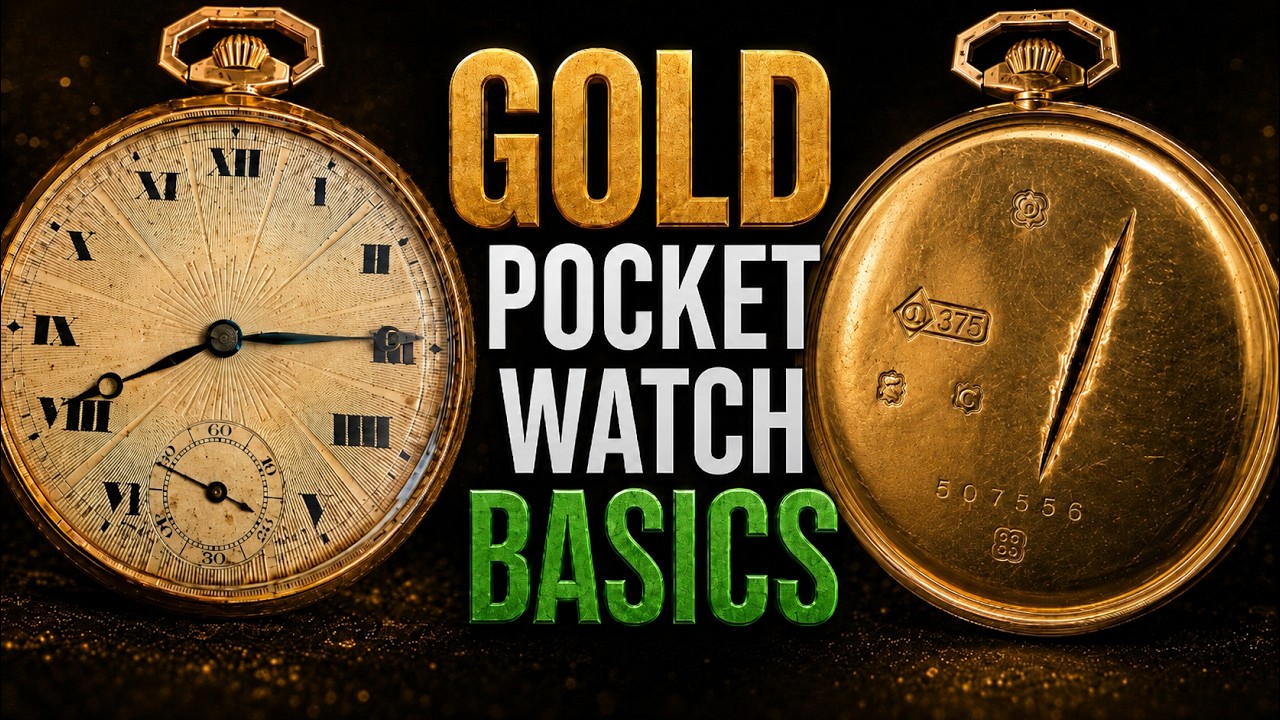
In this explanatory video, Adam Zimmerman clarifies the common misconception that the headline spot price of gold (e.g., $2,300 per ounce) directly applies to all gold jewelry. He walks through the typical karat purities found in consumer pieces—10K (41.7% gold), 14K (58.5%), 18K (75%), 22K/916 (≈91.6%), and 24K/999 (≈99.9%)—showing the hallmark markings used to identify each. For each purity he calculates the melt (spot) value of one ounce of that alloy, demonstrating how the value drops proportionally with lower gold content. He also notes that when a piece is sold back to a dealer, the seller usually receives only a fraction of the melt value because dealers need a margin. The video’s purpose is to give viewers a realistic framework for estimating the worth of their gold items before buying or selling.
Chapters
So today I'm going to be speaking about the price of gold. Everyone is telling me the price is so high, $2,300. So people are going into their cabinets and their drawers and they're looking for gold because they think if they have 1 ounce of gold, they think it's $2,300 because that's what the stock market says. That's what it says at the bottom of your screen when you're watching the news. So I'm going to explain today exactly what that means with the gold that you have, because most likely you're not going to have 1 ounce of pure 24-karat gold. So here we have 10-karat gold. 10-karat gold is 41.7% gold, and these are usually like college rings, high school rings, some antique pieces. These are normally 10-karat gold, so you might see the mark 10K or again 417 on these pieces. So in the current market today, $2,300 per ounce for gold, 10-karat, 1 ounce, which is right here, would only be $959. Now over here, this is most common in the United States. You'll see a lot of this. This is what you get at like maybe Bloomingdale's, presents from family. This is 14-karat gold, and again, this is 1 ounce, 14-karat, 58.5% gold. So you might see the number 585 as a mark on this for 14K. Now at the market right now, $2,300, 58.5% of that, this 1 ounce of 14-karat would come out to $1,346 in today's market. Now here is 18-karat. 18-karat gold are things made in Italy, could be high-end brands like Cartier. Tiffany likes to use 18-karat And over here you see a few of these pieces. Now 18-karat is 75% gold, so you might see either 18K or 750 representing 75%. So at the current market, $2,300, this would come out to $1,725. Now over here, now this is 22-karat or close to it. It's actually 21.6, but just to give you an example, let's figure it round up to 22-karat. So this would be 916, that's 0.916. So you might see on some jewelry 916. You see that on Indian jewelry, some other countries, they use high karat, which would be 916. So at the current market, 91.6% comes out to $2,107. Again, $2,300 is pure, $2,107 would be if this is 1 ounce of gold. Now the last thing we have here is 24-karat gold. Now this is the only exception to the rule where if you have 1 ounce of this gold, this would actually be the full price of $2,300. Now this is a Chinese piece In China, sometimes they do tend to go pure gold. So with pure gold, you could see 24-karat or the number 999, which represents 99.9% pure gold. Even though all these things will give you an example of what you might expect, that's just to tell you what the price of gold is for these pieces at 1 ounce. When you sell these pieces, most of the time you're not going to get the full price. You're going to get a percentage of that price because everyone needs to make money, and there's no reason they would give you the same price that they would end up up selling it for. So even though these might be $2,300, you're probably going to get a percentage of that number.