What is leadership? - With David Marquet
This is a YouTube video titled "What is leadership? - With David Marquet" containing a leadership talk delivered by David Marquet in May 2014. In this talk, Marquet shares his experience as a submarine captain who transformed his crew's performance by shifting decision-making authority to those with the information, fostering initiative and ownership among team members. The content focuses on leadership philosophy and organizational empowerment.
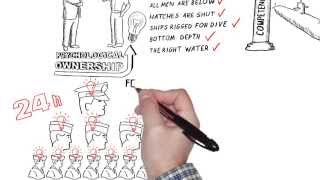
I was trained for one submarine. My guys were trained to do what they were told. That's a deadly combination. We all know organizations where. Where people just followed the leader into disastrous situations. So I got my guys together and I said, hey, we got a problem here. I was trained for another submarine. You're trained to do whatever nonsense comes out of my mouth. That's right, Cap. I mean, they knew. They already knew. I was pretty much talking to myself. So I said, what are we going to do? What are we going to do, guys? And we talked about it, ok? What I really wanted to do was get ready for the inspection. But we were sitting in the wardrobe, we spent a couple hours, we were talking about it, and we came up with all these different things. And, well, you, Captain, you just gotta be smarter. You gotta give better orders. It's like, well, how am I gonna learn a whole nuclear summary? Miles of valves and pipes? I spent a year learning Olympia. Two weeks over here. How. I mean, so, okay, so in a year, we'll be safe. That's not gonna work. We had to deploy the submarine in six months. So we talked about it, and they said, okay, there's only one logical solution. We figured it out. You. They're pointing at me. You shut up. What do you mean? That's not what captains do. That's not what captains of nuclear submarines do. They walk around, they give orders. They sound like Russell Crowe. Head two thirds, dive. Make it up 500ft. How? I'm left 15 degrees rudder. Steady course two five. Five. Load torpedoes in tubes one, two, three, and four. Flood down, open outer doors, right? And I thought about it, and you know what? They were right. So at that point, I vowed never to give another order. And if you came down on my submarine, it would have been very confusing because you couldn't have pointed. It would have been hard to say, well, who's the captain here? Because you wouldn't have seen me giving orders. I did retain one order. The final order to launch a weapon, a torpedo or a missile, I kept with me because I felt that since that was going to result in the deaths of other human beings, that I didn't want that on anyone's conscience but mine. That was my moral and ethical responsibility. But even though everything else in the Navy, there's long lists of things that says the captain has to authorize. Captain should authorize. You got a couple nukes in your group, they'll tell you it's true. Captain authorized. Submerge the ship. Get underway. Start up the reactor. Shut down the reactor. Connect to shore power, divorce from shore power. On and on break, rig for dive. On and on and on. Pages of these things. I just refused to give those orders. What we replaced it with was intent. Instead of giving instructions. If you want your people to think, don't give instructions. Give intent so they would come to you. Hey, what do you want me to do? Well, left full rudder, steady course 255. No. So what are we trying to accomplish here today? Well, we're trying to get in position so that when the enemy submarine comes through. Okay, so where do you think we should position the ship? Maybe over here. Good idea. Go there. You give intent to them, and they give intent to you. So my officer stopped requesting permission. And every other submarine captain request permission to submerge the ship. Submerge the ship. Submerge the ship. Aye. On Santa Fe's captain, I intend to submerge the ship. Very well. And they did it. And it might seem like it's a very small, nuanced change of language, but it was hugely powerful because the psychological ownership now shifts to them. They need to discover the answer. Otherwise, you're always the answer man. You can never go home and eat dinner. And so we started doing this, and it was hugely powerful. Actually went another step. Then I got smarter. And I said. When the officer said, captain, I intend to submerge the ship, I would ask him, well, what do you think I'm thinking right now? And he'd look at me. Hard to tell. I'm guessing you're wondering whether it's safe. Bingo. I said, well, convince me it's safe. He's a captain. I intend to submerge the ship. All men are below. Hatches are shut. Ships rigged for dive. I check the bottom depth. The submarine's in the water that's been assigned to us. Then later I would ask them, is it the right thing to do? And they would say, well, yes, sir, because our mission requires that we. And these are the two pillars that I think support this idea of giving control. These are the two pillars that need to be in place. The technical competence, which is represented by is it safe? And the organizational clarity, which is represented by is it the right thing to do? And you put those things in place, and then you can give control, and you give control and you put those things in place, and you are off to the races. So think about what's happening now. My officers are starting to think like me because I have to think like, where should we do the ship? And so the guys below them now, this took 24 hours to happen. It took a couple years for the full implementation, but immediately there was change. The officers are thinking like me, so pretty stuck. I'd go in the engine room, find the engine room, lower level, watch who was taking logs in the lube oil pumps. And he would know what the submarine was doing. He would know whether we were uptight, close to the enemy, and it was time to stay quiet or whether he had backed out a little bit. This may be a good time to change filters and make a little bit of noise. A year later, we received another inspection. A year later, we received an inspection. The inspecting team gave us the highest grade they had ever seen. Not that year, not in the Pacific. Ever seen. Why? I mean, this crew had a captain. It was a dummy. It's because that needle move started moving up. And on another submarine, there was one guy in charge, one guy giving orders, one guy thinking, and 134 people doing what they're told. I don't care how smart you are. On my submarine, I got 135 thinking, active, passionate, creative, proactive, taking initiative. People, it's a tidal wave. You don't stand a chance. Here's the solution. Move the authority to where the information is. You mean the software engineer can decide whether we ship the software? Yeah. You mean the client? My salesman can close the deal well up to $1,000. No. Yes. Whatever the price. Yes. What does it take to make that happen? Now, if you're picturing a lot of people out there doing crazy things and a bunch of arrows going in a bunch of different directions, you have the wrong picture. You create the environment so that those people are out there making decisions as if the CEO were standing right behind them. And if it's not the same decision, it's actually a better decision because they have the information. And not only will you get better speed of execution, because now you don't have this delay. What happens is those people feel like they matter because they're thinking. You engender thinking. You create the environment for thinking. The secret is, nothing I said is hard. There's nothing hard. The only thing that's hard is you. It will feel wrong. You've been genetically and culturally programmed to take charge and make it happen, take control and attract followers. And what you want is to give control and create leaders. It will feel wrong. And you will repeatedly, repeatedly start down this path if you so choose. And then you'll be angry at yourself like I was, and you will have a failure and you'll go back to the old ways. You will pick yourself up and you will go again. You will go again. And by doing so, you will achieve the greatest thing possible. You will have achieved greatness, not because of the deeds and acts that you did, but because you set an environment where the people around you and their families and their schools and their organizations and their businesses, they've achieved greatness. That would be the greatest thing of all. Go forth and be great. It.