Gaps Up & Down in the Stock Market: what to do?
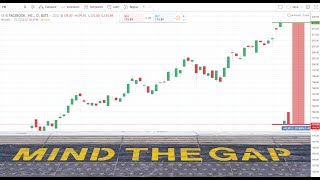
Alberto Costa explains how price gaps at market open can blow past your stop-loss orders. He recommends staying out of new positions for 10 days around earnings, closing shorts before earnings, and checking a stock's historical gap size before you trade it.
Chapters
Hi everyone. Welcome to this new video. The topic today is gaps. And the reason why I'm doing this video is, well, you can see here from the chart what recently happened to Facebook. Before earnings, Facebook was trading at around 216, $217. What happened after that? Earnings and market opened the next day at 170. Around 170. So there was a very big drop in price. And what is the problem here? That even if you have a stop loss, it will not protect you in this case. Why? If you remember my video about stop loss, I said that the stop loss is a trigger. It means that when the price is going below the stop loss, then an order to sell if you are long will be transmitted and executed at market price. So let's say that your stop loss was around. Here. Okay, so you think that, okay, if I'm hitting this level, I will sell at 200, let's say 210. So you think that this is your risk, but actually the day after you sell at 175. What does it mean? It means that potentially you can lose much more than what you have expected. And this is a problem because we know that the strategies we should use are based on money management and are based on specific risk that we want to take for trade. And the other thing to notice is that sometimes those gaps are not actually a consequence of bad earnings. Sometimes the earnings may be better than estimate and yet there can be a gap down. Or sometimes you can have earnings that are worse than estimate and then there is a gap up. And just to show you this example, this was a case, for example, Tim, where earnings were the results were not as good as expected, but yet there was a very big gap up. So what shall we do in this case? The first thing is I will distinguish between long and short position. Okay, but in principle, before you enter a trade in the stock market, I suggest you not to enter if the earnings are closed. So we can write this as first condition one, do not enter, Let's say before 10 days. So what I mean here is that if the earnings are in 10 days or less, wait. Okay, but then you may ask, okay, great. What if I am already in and the earnings are approaching? So in this case, so what if you are already in? Now I will distinguish between long and short. So let's write this in red. If short, close your position. Why this? Well, the reason for this is simple. When you are shorting, you don't know how it can go. If you have a long position, the worst that can happen is very Unlikely. But the worst that can happen is that the price is going to zero. So you lose the entire position assuming you are not using margin. But this is another story. But if you are shorting, your risk is actually unlimited because the price can go as up as theoretically can go to infinity. But it means you don't have a threshold, you don't have a price. Like for long position is zero, you don't have any upper bound for the short. So if there is a gap up and you have a short position, you can lose a lot of money. Okay, so if you have a short position, please close before earnings. What if you have a long position? Well, in that case you have a few options. Okay, so if long option number one, again you close. This is conservative. You just don't want to take the risk to have a gap down. But sometimes you may also have a gap up and make more money than what you would have made otherwise. So the conservative option is to do the same you do for short. So you close, you have another option. Another option is to. But this is more advanced hedge. What does it mean? Well, if we go back here, let's say you are here and then you don't want to close your position. You may use for example options. And using options can give you some tools for making money when you have situations like that. So this is called hedging. You are losing from your position in stocks, but you are making money from your position in options. The thing is that options are complex because the price of the option is not just determined by the price of the underlying security, but also on the volatility, time decay and other things. So if you want to use instrument like that, you must really understand how they work. Okay, you have another. Another option is to check, to check at website like Zucks that if you don't remember, I made a video about that. So what do you do with Zucks? Well, if you look at Zucks, you will see that there is this earning expected surprise prediction. So what I do usually is if I am already in and the position is long, I check this and if this guy is positive, I keep the position open. If it's negative, I close it. But again this is just another possibility that you have. If you are afraid that there may be a very huge gap down, just close your position and so you can sleep well and you have no problem. Another thing you can do is to check from the chart if previously the stock react with gaps at earnings. So you see for example Facebook, when you have earnings, often you have gaps right and sometimes they are smaller, sometimes they are bigger. They can go up or down, but it happens that you have gaps. Other stocks, you know, not always. You see here, for example, this time you have earnings. There was no gap here, there was a very big gap up. Here, the price moved up, but no gap during earnings. So. And here, no gap. So it really depends. It's not something you can predict. So the advantage to keep the position open is that if you have a gap up, you can make a lot of money. And, you know, the thing is that sometimes you may make more money, sometimes you may lose money when you have a gap down. And maybe overall these things balance. But again, if you really want to be conservative before earnings, just close your position and. And remember, always close your short positions. Okay, so this is my suggestion for the earnings, for the gaps. Of course, earnings is not the only reason why stocks can have gaps, but at least for earnings, we know when they happen. Okay, here you see Facebook, there was a very big gap down as well, but there was. It was not associated with earnings. So these things can happen. And again, remember that stop loss give you a protection, but not if you have gaps. Because again, I want to repeat it. Stop loss is just a trigger. When the price is below the stop, you will basically execute a market order. That means you sell at whatever it is, the market price, and the market price can be very, very low, much lower than your stop loss, like here with Facebook. Okay, I hope this video was useful, and I hope that now you know better what to do when you have earnings approaching. So thank you for watching and see you next time.










