How to PROFIT from POKER THEORY in TRADING!
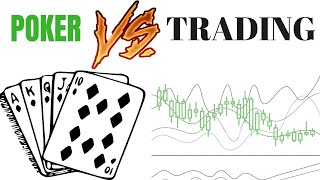
A YouTube video by Alberto Costa explaining how mathematical concepts from professional poker (odds, pot/bet, expectancy) map to trading decisions. The speaker uses a Texas Hold'em cash-game example to show how to compute expectancy (probability-weighted win/loss) and then translates that to trading using R (risk per trade), stop loss and take-profit levels, emphasizing backtesting and a trading journal. The video contrasts gambling (decisions based on feeling) with systematic, expectancy-driven decisions.
Chapters
Hello, everyone. Welcome to this new video. Today I want to discuss a topic that is quite important and often misunderstood and is basically the differences and the similarities between poker and trading. Because many times people tend to think that poker is just gambling, and most of the times it's true, I have to be honest. But for professional players, they know what they are doing. And I want to quickly show you the process they go through when they have to decide if playing or not. And as an example, we are using here, the Texas hold'. Em. That is basically a game where you are given two cards and then first there are three cards on the table and this is called the flop. And then there is a card number four that is called the turn. And then the last one is called the river. And every time you need to decide if you want to bet or you want to fold, you can raise. You have many actions that you can perform. Now, for this example, imagine the situation where you are playing and then we are considering cash game, because cash game is basically you have cash and then you play, and if cash is over, you can add more cash and keep playing. Different from a tournament where when you are out, you are out. So the logic of the tournament is a little different because you need to survive and go to the highest positions. But for cash game, the idea is that if you perform the mathematically correct action as much as possible, you should be profitable. So imagine this situation. We are here and we have two cards. We don't know here what they are. And there are five cards. And our opponent, let's say there is only one left, he goes all in. All in means he put all his money. Then it's up to us if we want to call. So we want to risk our money to see who is winning, or we want to basically say, okay, you know what, I fold my cards. I think it's not a good deal. If you look at poker games and tournament, you see that most of the times the top players are more or less the same. And people like Daniel Negreanu, Dwight Brunson, just to cite a few, they are often in the first positions. When you look at tournaments or other poker events. Now, if they are often winning, it means that it cannot be just luck is not just gambling. So they are doing something that other players are not doing. And what is that? Well, of course, you need to have some skills being able to understand what the opponent is doing. Experience, yes. However, the big part of their success is because they understand the logic and the mathematics behind. Let's go back to our Example, let's say that we are in this situation and let's say that the Pokemon that is basically the money that you can potentially win maybe is $300, right? And now if you want to call, so if you want to bet your money that your cards are better than the opponent, so you win, imagine that you need to put hundred dollars. Okay? So this is basically your risk if you want to take it. Now what does this mean, knowing this situation? Then the poker player is doing this. He's looking at the cards, is kind of assessing more or less the situation, understanding what the opponent may have, and estimate what is called odds. It's basically the probability of losing if you want, versus the probability of winning. So let's say in this case that the odds are 2 to 1. It means that out of three games with the cards he has and the cards he thinks the opponent has, he's going to win one time out of three, okay? Now knowing this information, then he is able to decide if he's worth risking this money or not. And how does it work? You look at what is called expectancy and it's computer basically like that is the probability of winning times the amount that you win if you win, plus the probability of losing times how much you lose when you lose. So in this case, how will it be computed Is like probability of winning is one time out of three, right? How much do you win? Well, you win $300 if you win. Plus what is the probability of losing is two out of three times, right? Times? Well, the loss is the hundred dollar that I have to bet. And because it's a loss, we need to put a negative sign. Now you compute this value and then what you get is hundred minus this is like 66.7, let's say so is 33.$3. Now because this guy is positive, because the expectancy is positive, then it's mathematically correct to risk that. Meaning to say if you keep doing that times and again, you will make money. Because yes, you know, you may be unlucky and your opponent is not having the cards that you think or maybe you know, this kind of situation can be also done when you, when you see three cards or four cards, right? Is this kind of process can be repeated throughout the game. But the main idea is that you want to assess if it's mathematically convenient to risk your money or not. So that's it. That's basically the idea behind the poker, the mathematics of poker and why people seems to win more than others. So it's not Just, oh, I feel lucky, I play the cards. No, they go through something like that is, of course, a little more simplified. They learn some kind of numbers. For example, they say, oh, well, I know that if I have this card versus that card, the odds are already dead. So you don't have to be very, very good in mathematics. It's basically learning a few numbers and then it's just a multiplication. How does this work in trading? Because in trading, you can have the same thing. You can be gambling and just buy and sell according to how you feel, or you can use a process that is basically the same. Now we just need to change words. You know, imagine this situation and you see this stock actually in this case is an etf, but doesn't matter. And you see the price, the price here that is bouncing. So you, you think, okay, my strategy is telling me that I should buy. Okay? So the blue line here is a buy. You want to buy here. And then you put your stop loss here. Okay? So the stop loss below the previous low. Again, I assume that your strategy is telling you can do that. And then you decide to take profit here. Why? Because you see that there is a previous high. Okay, so basically this means I buy here, if the price is going down, I exit here, and if the price is going up, I take profit here. So imagine that you risk, say, hundred dollars for your trade. Okay? Okay, so let's put it. Risk per trade is $100. That is the same as the bet in this case, right? How much do I need to pay if I want to be in this game? And how much is the pot? Well, the pot is basically the profit that you can make. Okay, now how do you compute that? Well, if you watch some of my previous video, remember that I called this guy R. Okay, so this is one R. One unit of risk in this case is equivalent to $100. Let's say that this is 1.2 R, for example. Then it means that the potential profit if I win should be $120. Okay? So the concept of R is just a way to normalize everything. But the concept is if I'm risking this and I'm making that, I know the risk and I know the profit. And this is the same as the pot and the bet. Okay? So if this is the same, then the next thing is, okay, what about the odds? The odds are the probability of winning and losing. And this is something that should come with your strategy. So if you trade enough, your strategy, you will know more or less what is the probability of winning and Losing. So, for example, you say, look, the probability of winning of my strategy is, I don't know, 20% very bad, and the probability of losing will be 80%. Okay, okay, now what does it mean? It means that your odds in this case will be four to one, right? Because four time out of five you lose. So then you can compute the same thing here, right? And then you say, well, what is my expectancy in this case? Well, it will be probability of winning. That is one out of five, right? Because I win one and I lose four times, how much do I win? $120 plus probability of losing. Well, in this case is four out of five times hundred dollars minus 100 because it's a loss. So you can see already that this is negative, right? And because it's negative, this is not a good trade. So you don't take it. Right? Same here, right? If the poker player was facing a situation with the same kind of risk, profit and odds as this trade, he will not take, will not do something like, oh, you know, I feel the cards are good, or I have a feeling. No, it's the same thing you do here when your math is telling that you should not take this trade, but you have the feeling that, oh, you know what? I think this one will go up. That's when you are starting to gamble. And you should not do that because remember, if you want to win in the long term, you need to take decisions that are mathematically correct. That means expectancy should be like, in this case, is negative. So it's not good here, is positive. So it's good, right? And this is also very important because before moving to the last part, where I want to summarize the differences and similarities between them, it's also very important that you understand this concept because what many, let's say, fake gurus will tell you is that, you know what? I have a probability of of winning with my strategy of 90%, right? Maybe they tell you I have a system that, I don't know, let's say my system, the system that they want to sell you. They tell you that the probability of winning is 90%, so you only lose 10% of the time. And you're like, oh, it's a great strategy, right? I make a lot of money with that. No, because what you should look at is expectancy, not just the probability of winning. Because if this strategy, this system, yes, it can win 90%, but when you win, you win hundred dollars, and when you lose, you lose $10,000. Is it profitable? Well, maybe no, because if you compute the expectancy, you will find out that it is negative. In other words, yes, you win a lot of time, a little. And when you lose, you lose a lot. This is something you need to keep in mind. If someone is trying to sell you a system where they only tell you this, you should also ask this, because only then you will be able to understand if it's a profitable system or not. So let's conclude the video with the similarities between the poker and trading. So the first thing is the concept of expectancy. So for poker is the same as for trading. So is the same. You just have different words, right? You have pot and bet. Here we have profit and risk, then we have odds, and then we have probability of winning and losing. But is exactly the same idea. Speaking of how to determine the bet and the pot, that is basically the risk and the profit. So let's call risk and profit value. Okay, so this is not the same because in poker, how much you bet depends on, in a way, on what the opponent is doing, right? It depends on the game. It depends on how big is the pot. So for example, if the opponent is pushing all this money, right, you need to put the same if you want to see the cards and have a chance of winning. So this risk, how much you risk for each game, is not under your control. And the profit is also not under your control. So in poker is not under your control. This is for poker, Right? But in trading, yes, because you can decide how much to risk. You cannot decide the level, like the stop loss level. And the take profit is part of your strategy. But how much you are risking and how much you can make is somehow more under your control, right? Because if you want to risk 1% of your capital for trade, you just buy less shares, right? So in trading is under your control. Partially, I would say. So let's say it's partially under your control. I'm sorry for my writing, but it's not easy to use this. What about the risk, profit probability? So what we call odds, okay. Or win or loss? Well, in poker, I would say is it depends on the experience of the player, of course, how good he is at reading the opponent. Okay, so if you see the cards and you, you have your two cards, if you are good at reading the opponent, you may have a quite good estimate of that. Okay, so this is based on experience, I would say experience and ability also. So this is about poker. In trading, of course, is also based on experience, but it can be also based on backtesting. So when you have performed a lot of operations with your strategy. When you have trade enough, and then you collected information to know more or less what is the winning and losing probability of your strategy that can help you estimate these numbers. Okay, so while the poker player should do some computation, thinking what the opponent may have and doing something like that here I will say is definitely experience, but is also testing. Okay, Testing. I mean, all the trades you did in the past. That's why it's very important to keep a trading journal. So you can check and then you can see how many times you win, how many times you lose. And then you can have a better idea about the probability of winning and losing of your strategy that will help you find out if the expectancy of a trade is positive or not. So that's it. You now know what are the differences and similarities between poker and trading you have seen. I hope you have understood by now that poker can be gambling, but also can be professional. And trading is the same. You can take it as a serious business where you look at expectancy and you keep your trade. You have all your records and every time you have to place a trade, you do something like that. And Excel can really help to automate a lot of these operations. Or you can take it as just a game, but then you cannot complain if you're losing money. In the long term, the choice is yours.










