Teaching ESL in a Biased World: Addressing Bigotry in ESL Discussions
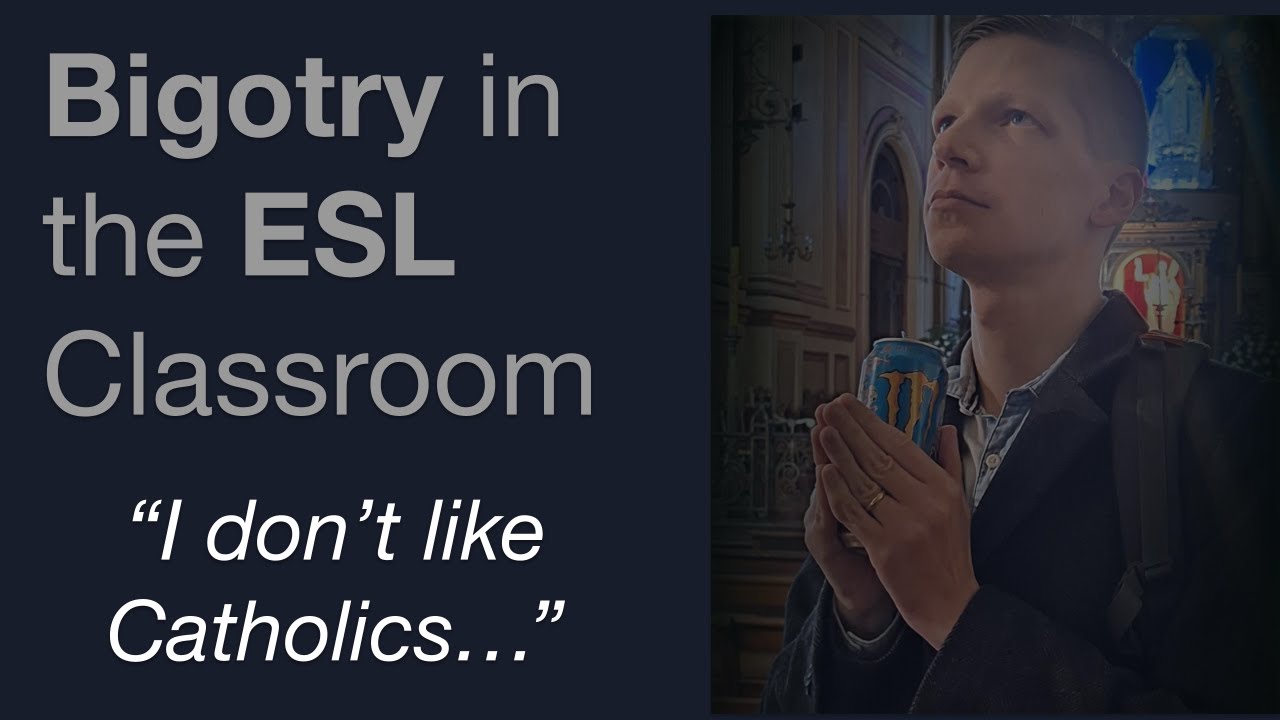
Alexander Popov argues that ESL teachers should engage with student prejudice through questions rather than shutting it down. When a student says "I don't like Catholics," asking why and exploring the roots turns a tense moment into a lesson in critical thinking and empathy instead of alienating the speaker.
Chapters
Hello, I'm Alexander Popov, and in this video series we'll explore some often overlooked challenges that educators face both in the classroom, online, and beyond. Recently I came across a post with a thread of comments that, rather than confronting bigotry in the classroom, seemed to unintentionally or intentionally reinforce it. As educators, our role is not only to engage students but also to encourage open dialogues, ideally in an environment clearly marked as a safe space for diverse opinions. And yet, even relatively broad statements like, I don't like Catholics, are increasingly seen as problematic. Why's that? Let's examine the nuance. Frankly, if I were one of the students, possibly a student who is into Christianity, the teacher threatening this peer with consequences and shutting him down would disturb me much more than the pure statement. With him being silenced, I would not be able to eventually find out whether he dislikes Catholics in general or only those in certain class for certain prior statements. This would be even more troubling. Second, he didn't say I hate Catholics or that they all should perish. He said he doesn't like them. Later, the original poster mentioned that the student tried to defend himself after being accused saying he was just being honest. So instead of encouraging his honesty and turning this into a constructive activity, the teacher simply shut him and his supporters down. That student had supporters, which means the teacher did the worst possible thing. Not only did he discourage the students from participating in a discussion in the target language, but he also alienated the person from others reinforcing his possible dislike of Catholics, as well as dividing the class into 2 antagonised groups. Interestingly, one group supported free speech and discussion, and the other group, without being consulted, was assumed to be opposed to it. Many of these students simply decided not to speak out against the teacher due to the teacher's extreme reaction, especially regarding his threat to report the incident to the assistant principal. From the outside, it appears that the teacher, afraid of any topic that might be considered taboo, decided to abruptly interrupt the discussion, leaving others both curious and offended. Picture this: someone is asked to sign a disclaimer stating that their intention is not to offend the feelings of any particular group. While they may sign it, they would still feel compelled to speak their mind, hoping their words will be in an impersonal manner. A disclaimer or a similar policy to be acknowledged at the start of the class would be entirely fitting, much like the disclaimer presented at the beginning of this video. What should have been done? First, teachers love to ask the why question and often rely heavily on the Socratic method even when it borders on the ridiculous. Yet here, for some reason, the teacher was too intimidated to explore the theme or suddenly considered it irrelevant. But students do not just spontaneously say, I don't like Catholics, in the middle of a class, so the theme they were dealing with must have been relevant and prompted him to express himself this way. Additionally, regarding the jerk comment, it seems no progress has been made in this area either. Second, young students often reflect their parents' values, who may be their primary authorities, not the teacher. Making the student feel that everyone in this class is alienated from a worldview he holds in high esteem renders the following educational process pointless for him and for all those supported this student's right to free speech. That means the teacher might as well just Leave the class right now and never return, since the efficiency of any upcoming educational progress may be compromised. Especially given that this teacher's level of self-confidence was so high that he not only posted this on Reddit, but also asked for reaffirmation, seeking approval from other teachers. It signals deeper issues regarding the teacher's confidence and ability to handle even such innocent situations. So apart from wondering why Catholics, why not ask, for example, what about Protestants? Do you dislike them as well? Which would help reveal what exactly he dislikes or doesn't dislike about them. Moreover, mind you, he didn't say hates, he said dislikes. Why not also to ask him about Orthodox Christians? Does he know in what way that branch of Christianity is different? If he answered that he didn't know, he didn't care, he could be informed that his opinion lacks value because it lacks argumentation, since argumentation Argumentation is required when a statement is made. He could have provided at least several reasons why he dislikes Catholics, and it would have been accepted. But without that, yes, the teacher could have informed the student that his comment lacks grounding and value. That's what I did in class when extreme statements were made, as well as those towards other peers. Without proper argumentation, the student's statement would be discarded immediately. For lacking explanation. Third, this very student may have suffered in the past at the hands of people who were Catholic or who claimed to be ardent Catholics. The student may have received such treatment or gone through such terrible experiences that he can't even speak about them due to the gravity of the childhood trauma. That's when a teacher could have stepped in and said, if If someone who claimed to be Catholic acted in a horrible way towards you or harassed you, rest assured there are many Catholics who would be happy to deal with that person accordingly because he acted against the ethical and moral values of Christianity and possibly any religion in the world. In other words, let the student know that if any Catholic hurt him physically or emotionally, many fellow Catholics would gladly confront their coreligionist, for such actions, that is, kick his ass. In ESL class is about discussion where humour, sincerity and trust are intertwined. How is it that this case, which was a clear opportunity, was not merely overlooked, but instead turned into a moment of intimidation and incomprehension, which certainly didn't help the student to dislike Catholics any less? Why not show inquisitiveness? Why not ask whether his dislike is rooted in historical context, especially with regard to missionaries? For example, even San Roque, a Jesuit priest and missionary, was killed in Paraguay by indigenous people because he came with pressure to abandon traditional beliefs, rituals, and spiritual leaders. San Roque was hacked to death with a tomahawk and then thrown into a burning chapel for Spreading Christianity and establishing missions among the Guarani people. Though he wasn't known for using slave labor himself, many other missionaries either imposed Christianity superficially or were responsible for the deaths of many Aborigines. And we are not even touching on the Crusades, the Inquisition, and so on. There are many things Christians are not proud of, many things they would like to leave in the past, many things they admit were deeply wrong, even Popes themselves and many other high-ranking clergymen have had the courage to acknowledge the Church's mistakes. So if the student knows a lot about the Church wrongdoings, the statement, I don't like Catholics, might have simply been his way of expressing awareness of those wrongdoings and perhaps a wish that things had been different. You may say that those clergymen previously admitted that because they represented the Church. But why do so many laypeople express their opinions about the For example, whether they liked the previous one, the current one, or even the one before that. They went to church every Sunday, but openly criticised the Pope as if he were their local politician. Regarding the past of Catholicism that shaped the modern world, in many cases, as we know from history books, entire peoples and nations were colonised without any regard for their existing traditions and culture. For example, when Don Felipe González landed on Easter Island, in typical colonial Spanish fashion, he marched with 2 priests and a squadron of soldiers to a high point on the island, planted a cross, and claimed the island for his king. He recorded how he taught some locals to recite in Spanish Ave Maria, Long live Charles III, King of Spain, before disappearing over the horizon. And this was one of the least violent cases, which still eventually contributed to the near-complete disappearance of indigenous peoples in many parts of the world. Considering that, historically Catholics are associated by many with murder, imposition of their faith, and the enslavement of people who had nothing to do with Jesus Christ or Christianity, it may very well make sense why someone has questions or even resentment towards Catholicism. Moreover, whenever we read about the Vatican today, we often come across news about pedophilia scandals among priests, anti-abortion agendas, hypocrisy, women's rights violations, and many other positions far from being progressive, especially in the 21st century. There are all the reasons in the world for the students to have questions about Catholicism at the very least. And this is not to mention Catholic institutions where questionable educational practices are still in place even now. So before labeling the student's comment as racist or bigoted, perhaps the teacher should have at least tried to understand the nature of his attitude. So we should not forget to ask why. Inquire into the nature of the remark. This is a great opportunity to teach about the topic of extreme statements or generalizations. For example, like in Aikido, you might actually encourage students to take their statement even further than, I don't like Catholics. Let them go to greater lengths and then teach them how to soften their statements, perhaps using humor, since by then everyone would already understand what the student's attitude is. Imagine the student saying, I'm not sure I quite like Catholics. They tend to be, uh, at times a little bit inconsiderate and slightly prejudiced. Just don't shut students up. Let them speak out. Make sure they give enough reasons and use the target language. Don't be afraid to confront the student. It would be definitely more respectful, even if he is a Muslim who doesn't like Christians, or perhaps even a Buddhist. Ask the other students what stereotypes they know about this confession or religion. You may all come to the conclusion that every confession or religion is surrounded by prejudices, even atheism. Just be more playful, humorous, considerate, and respectful, like a teacher should be. An English teacher is not a security guard, not a judge, and not a prosecutor. Teachers are not prosecutors, they are mediators. For instance, in a small group where a teenage brother in the midst of adolescence calls his sister names, the teacher should avoid responding with this typical, stop! You can't call your sister that! She's your sister! This response would not only be misunderstood, but would also be entirely irrelevant. A teacher is not a parent, and more importantly, they do not have all the details. Perhaps the boy is the family favourite, or the opposite. Regardless, the situation should be viewed as a dynamic between 2 relatives in the class, both of whom are trying to learn together. The teacher, who should recognise how awkward the situation may be, can use various techniques to ease the conflict, addressing it in a tactful manner to both parties. The role of a teacher is not to stifle discourse but to guide it in a manner that fosters understanding, curiosity, and respect. When confronted with difficult statements, such as a student expressing dislike for a particular group, it is crucial to explore the why behind the words. Rather than dismissing or silencing them, educators should sees these moments as opportunities for thoughtful, depersonalised exploration of ideas, transforming them into lessons in critical thinking, empathy, and the art of argumentation. The goal is to view any offensive statement not as a personal affront but as a case for impartial academic inquiry, especially within the structured environment of a classroom. After all, this is not a pub brawl moment where the immediate reaction would be, what did you say about Catholics? Let's step outside and talk, you piece of— A good teacher is not a judge but a mediator, helping students navigate their emotions and opinions in a way that encourages growth, dialogue, and mutual respect. By handling such situations with care, humor, and inquisitiveness, we not only enrich the learning experience but also promote a classroom environment where everyone feels heard and valued.
If you're an English teacher looking for higher rates, free TEFL/TESOL credentials, and recognition for your project, consider enrolling in our 300-hour TEFL/TESOL proficiency course on Udemy. Don't forget to subscribe to our LinkedIn community. We provide LinkedIn recommendations to teachers for their projects and teaching approaches that we believe in, so don't hesitate to connect with us for valuable networking opportunities. If you're an edtech developer with a project to showcase, Grande Mastery offers a free platform to highlight your work through our ESL Treasures Showcase. Additionally, take advantage of our free article submission opportunity and get featured on the Grande Mastery blog with dofollow links for free. All links are below.
More from Alexander

10 Free Opportunities for English Teachers & Educators – Build Your Career in 2026



Can AI Replace English Teachers? How to future-proof your teaching career in the AI era.

Random Proverb Grandomastery Activity: Creative Thinking Meets Language Skills


Random Questions Grandomastery Activity: Spontaneous Speaking with Dynamic Random Question Exercise

Random Word-Formation Grandomastery Activity: Boost Creativity & Language Skills in 10 Minutes

Random Creature Grandomastery Activity: Transform Language Learning into Creative Exploration

Random Symbol Grandomastery Activity: Boost Your Classroom Creativity with This Symbolism Exercise

Random IELTS Cue Card Grandomastery Activity: Creative Exercises to Master IELTS Speaking