Alex Cornell | Choosing Idea Vessels For Your Creations | Awwwards Conference San Francisco

In this Awwwards conference talk, Alex Cornell argues that ideas are fragile and need protective "idea vessels"—formats that transport them from the creator’s mind to a wider audience. He explains that the size and complexity of a vessel must match the substance of the idea, and walks through a series of real‑world examples ranging from tiny tweets to full‑blown promo videos. Throughout the presentation, Cornell interleaves live FaceTime calls with past and future versions of himself, revealing the chaotic process of trying to finish a demo video called “Lookout” while simultaneously delivering the talk. He showcases experiments such as a glyph‑debate at Facebook, a hold‑music song for UberConference, a dramatic Antarctic photograph, and a speculative drone‑service pitch. The talk culminates in reflections on how absurd or overly elaborate vessels can backfire, and he shares two rhetorical tactics—confusion and schadenfreude—to keep audiences engaged. Ultimately, Cornell stresses that the vessel should never eclipse the idea itself and that choosing the right vessel is as critical as the idea’s content.
Chapters
Thank you. All right. So, ideas are weak. They need to be protected. The internet, which briefly was a hospitable place, has become capricious and hostile. If an idea is going to survive in such an inhospitable environment, it needs a form of armored transport, specifically a powerful vessel that can ferry it from your mind to that of a wider audience. Now, there are many different types of idea vessels. Some are small, tweet-like contraptions which are generally hauling simple or fleeting ideas, and some vessels are large, film-like containers which work best for robust statements. and hypotheses. Now, it is very important for a vessel's magnitude to be appropriately chosen, based on the substance and the shape of the idea. Matching an idea with the right vessel is almost as important as the idea itself. Now, all vessels, regardless of size, need to be built. The choice and construction of these vessels is the purpose of the talk today. So actually, I wanted to talk about a video that I had just made, but I wasn't able to finish the video in time.
Oh, shit!
I'm so sorry, I thought I turned this off. Just give me, just give me one second.
Hello?
Come on, what are you doing? This is not what we planned.
Wait, what do you mean?
Did I call at the wrong time?
Yeah. I thought I could have sworn—
No, dude, the plan was I would call you when I got to the end of the talk.
What?
Yes. No, I just read our notes. It said after the intro, past Alex will call future Alex, you, when you're on stage using FaceTime machine. And that's, that's right now, so that's why I called.
Right, but like one week later I changed that. I wrote current Alex will call past Alex you during the finale of the talk.
OK. But if you changed it one week later from when I am now, then it's never going to happen that way, given that I already called you already right now.
Right.
I think I branched us, right? Or me. And you also. Anyway, I'm really sorry. Why was I supposed to call in the first place?
I mean, it was going to be the finale. The idea was to interview you after the Lookout video falls through. It's okay to fail. You've heard that before. That kind of thing was the idea.
Oh, man.
Wait, the Lookout video falls through?
Yeah.
I thought that was like the whole point of the talk, right?
It is.
Yeah, it was. It was supposed to be.
That's right.
Yeah.
Okay. So as far as you know, you never called yourself in the future. The you on stage in your past never called another you in the future.
No, I remember writing that you, me in the past, would call me after we were unable to finish the video in time. That's the whole point.
Man, this, this is pretty weird, I gotta say. This is pretty weird. I mean, if I branched us and my path to you is theoretically different now, right, like I might still be able to pull the video off at least Here, like, for me. And I guess what I mean is, if I'm able to complete it, then you don't need to end with the clichéd failure stuff. Like, you could just call me back, right, uh, when I'm done and show the final video that way. I mean, and the rest of your talk can be the same idea vessels and all that, but for the end, just call me back, right?
That could work. So I'll give the same talk, idea vessels, that kind of thing. I'll lose my ending assuming you're able to I'll check in along the way just to make sure it's going okay.
Yeah, I mean, I, I'm still not super sure what's going on. I think, uh, I think that this FaceTime machine thing is kind of a little screwy maybe, but, uh, yeah, give me a call back and, uh, I will— I'm just gonna go try to finish the video. I'll talk to you soon.
All right, cool, man. I'll talk to you later. I'm sorry about that. I did plan for that to happen. It was supposed to happen at the very end. You see, for this talk, my plan was to create a new project and make the entire thing about the process of that project as it happened. I'll pull some of that stuff up right now. That project was for a video called Lookout, but I never finished the video because it turned out, as you can imagine, to be a lot harder than I thought to make the video and simultaneously document every aspect of it for this talk. I've got a bunch of the prep work on screen now. You can see my notes, loose scripts. I mean, this is basically as far as I got. I had this prep material, but I couldn't do this and write a talk about it at the same time. So I prepared a different talk instead, one about idea vessels, which I guess, I guess I'll still do. I'll just check in with myself, I guess, along the way, just to make sure I know whether or not I can end with the finished video or Or not. And we'll hope that he finishes in time. All right, well, I'll get back to this. So, idea vessels. I think the easiest way to understand this is to walk through some examples of different ideas. I'll put some things up that in their current state are too raw and unsubstantiated to be able to survive on their own. They're interesting ideas, but without the right battle dressing, they're not going to get beyond the minds of the one or two people that are discussing them. So, like, we look down at our phones too much, there at the bottom. It's a good example of an idea that in its current form is ill-equipped to further the public conversation in any way. It may be true, but it's not yet interesting. So we'll take another example: interaction design. I'm an interaction designer, and during my time at Facebook, I would constantly need to present my ideas both in person and asynchronously. The most basic visual way to present a design idea is the static mock, and depending on the complexity of the experience, sometimes this is sufficient. But as you know, interactions are rarely static, so it's usually much better to present a potential design in prototype form. At this point, the idea is technically richly expressed and ready to be evaluated, but it's still a primitive vessel, and it's one that requires me to be present to be properly conveyed. As soon as it makes its way beyond my reach and, say, is shown to a product director over the weekend, the framing context is gone and the idea will die regardless of how good the prototype was. So if we're preparing this idea to travel, we also have to consider Keynote. Keynote is a great way to tell a linear narrative and to frame simple concepts. There is also video, which starts to bolster the idea's ability to emotionally connect with It can look real, which makes it easier for people to imagine it being real, like the thing you see on the screen, even if it's just a prototype. And at the extreme end of the spectrum is the promo video, and this can portray a hypothetical reality which imagines your idea already exists. I used to do this a lot at Facebook, as you can see on the screen, and this one was in fact so realistic that I got a frantic email from the legal team reprimanding me for launching a product without telling them. The idea didn't actually exist, it still doesn't, but the vessel was so substantial that most people assumed that it did. And it's that assumption that results in attention, which often is all we can hope for. And so that was true as well for this next example, which I will show just a little bit of quickly.
With Gopher, drones on demand are the future. Using our mobile app, you can task a drone to provide you a multitude of services. services, either from a list of presets or using voice commands. For example, why settle for mediocre selfies when you can have a drone take HD photos and videos of your adventures? Gopher Drones can go anywhere, so if you're traveling and want to scout a new city ahead of time, it's easy to send a local drone to check the live feed. Our object-based tracking system allows you to explore anything the drone comes in contact with. For example, a restaurant where Gopher can pull up wait times or even link with social networks to see if anyone is there that you know. On select objects, audio monitoring can be assigned, allowing for quick and easy telepresence. Of course, the drones can also be used for safety and—
Okay, let me quickly pause if you don't mind. I'm just going to give myself a ring. I want to make sure he's still on track making that video. Let me just see here.
Yo. Hello.
Sorry.
Hey dude, how's it going back then?
Uh, yes, good. I was just actually starting to write a basic script for the video. Cool, okay.
So look, I realized I never explained what the video is supposed to be about. I thought maybe you could catch everybody up on it if you have a second. I'll pull up what I got also here.
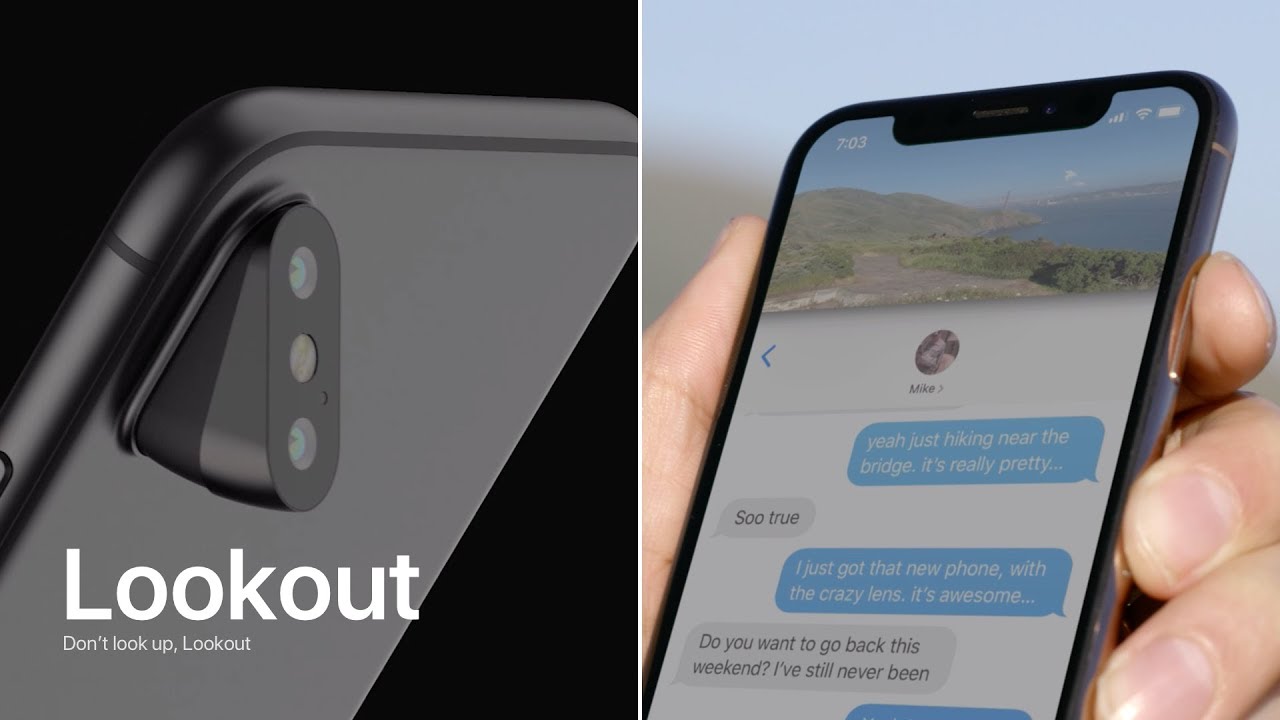
Yeah, totally. So I guess the basic idea that's being transported here is we look down at our phones too much. And, you know, that idea has been beat to death in the news, on Twitter, and magazines. So I think, like, to even be able to participate in that conversation in a meaningful way, we need a unique vessel. So in this case, that's going to be a hypothetical app, a video for a hypothetical app where using new technology, a new lens on the camera can stream whatever's directly in front of you to the top of your phone. So you never need to look up. Cool.
Yeah, I got some of that up now. It's very dystopian.
Yeah, exactly. And I think the key is that you don't wink, right, and make it obviously satire. Yeah, I think I'm writing the script now, and the hope is to basically stay right on the line between the obviously insane and somewhat plausible. Yeah, like I just wrote this line, for example: You hear people say we look down at our phones too much. What if the problem is not that we're all looking down? What if the problem is that we ever have to look up at all? So obviously facetious, right? But said in earnest with the right visuals, hopefully it's not going to seem that crazy. Cool, man.
Sounds like you're still on track. I will call back later, check in.
Sounds good, dude. Yeah, I'll get back to it. I hope the talk's going well.
Talk to you soon.
Okay.
This is good. If he's writing the script now, he'll start shooting soon. This is good. Okay, back to idea vessels. Not everything falls along a visual spectrum. Other mediums can be just as effective. So in 2011, I co-founded a company called UberConference, and our mission was to make the conference call, which is typically a tedious and annoying affair, into a delightful experience. Every aspect of the conference call was reimagined. Including the hold music, which if you've ever been on a conference call, you know usually sounds like you're in an elevator going to the dentist at best. Hold music instead could help us convey this idea of delightful surprise, which is something that we wanted to reinforce again and again throughout our product. So for our hold music, I wrote a song about being on hold, which I'd love to play for you, but I don't have it on this computer. I'm gonna try something. Just give me a second. There's a new feature here that I think could work. I just have to like unplug some stuff here.
Yo!
Hey.
Oh, hey, man.
What's up?
Yeah, I was just setting up the FaceTime machine camera, which I think looks pretty good for a webcam.
What's going on with you?
I have to ask you a favor. I wanted to play the Uber Conference hold music. I don't have the file. I thought maybe if you have a guitar, you could back me up really quick, please.
Yeah.
Yeah, hey, look, I have my guitar right here.
Nice. Yeah, and if you want to sing on stage, I am happy to back you up. Sort of, not really, but I'll do it. Alrighty, let's give it a go. All right, so this is the hold music for Uber Conference.
Well, I've been sitting here all day. I've been sitting in this waiting room. And I've been waiting on my friends. Yes, I'm waiting on this conference call all alone. And I'm on hold. Yes, I'm on hold. I hope it's not all—
Nice, dude. Thank you.
Nice, man. Sounded good.
Hey, I gotta get back to this video.
This thing is not gonna finish itself.
I hope the talk is going well.
I am like 75% of the way there. I'll talk to you soon. Okay, cool.
All right, moving on. Something I've been interested in is how the vessel itself can be as interesting as the idea. And this is a delicate balance, but it was especially important at Facebook, where there was no shortage of ideas being passed around the organization. And I think for anyone that's worked at a big company, you know how hard it can be to be heard. So one method I experimented with was to place my ideas into massive and increasingly absurd vessels that, even without their idea cargo, would be noticeable from a distance. On screen are some examples. So my favorite involved two simple glyphs, and for context, the Facebook app used to use the down chevron as the affordance for the overflow menu. Tapping on it would present an action sheet of options, and this drove me crazy. To me, the down chevron is a directional indicator. It's similar to a back chevron, and it signifies that things are going to move. Something's going to be minimized. Something like this. The proper glyph for more, I felt, was the three. 3-dot, which literally symbolizes the concept of more if you think of the ellipses. So to insert this idea into the organization, I started with a debate, because there are good arguments on both sides. I moderated a discussion between the personified versions of the glyphs, each portrayed by myself live. And to do it live, I used a complex 3-camera setup which allowed me to cut to each angle as though there were actually 3 different people in the room. I mirrored each of the side cameras, which makes it such that when central Alex turns to his left, the Alex on the left looks like he's turning to his right. So the vessel's way more complicated than the idea, but this is technically what allowed it to spread. The idea gains traction, it gets visibility, but in this case, change was slow to come. Tests were run, but the default global experience was still the down chevron. Months later, a new vessel was launched, this time a faux news broadcast, which was also broadcast live, which portrayed the dire, dire circumstances that 3 Dot found himself in.
Welcome tonight to Facebook News Now. We have a late-breaking story this evening. 3 Dot, the very popular interface element, was incapacitated late last evening as the result of some accident. We are not aware at this time of the circumstances that That accident, no foul play is suspected. However, this does come at a very turbulent time for 3-dot, in particular given its relationship with Chevron, another very popular glyph which has maintained a surprising reign over the Facebook interface far longer than many experts suspected. This comes actually not that long after a very contentious debate, a very, in fact, turbulent time again in their history.
So, The reason each of these videos is filmed live is to increase the perceived weight of the message than if it had been pre-recorded, for example. Having them unfold live made it feel much more urgent. It made me seem crazy, but then ultimately it made it impossible for the ideas not to be noticed. So as a happy aside, Facebook today uses the 3-dot globally as a glyph for more, and I would never assume to have had any influence over that decision, but all 5 of us are very pleased that that decision was made. Okay, so before I get any further, I have to check in with myself one more time. Sorry to keep doing that, but he should be shooting by now, so let me just try this.
What's up, man?
Hey dude, how's it going back there?
Yeah, just out here filming. You can see the rig right here. I've been using these funky clay Prototypes. I don't know if you can see that. It looks really janky if you get up close. Yeah, yeah, it's like really weird, but I've been filming far enough away that I hopefully— you won't be able to tell, uh, in the final shots, I hope. Uh, and it's going to be paired with a 3D rendering, which I'm pretty sure you've got the file for those. So if you want to pull that up, um, you could do that now.
Yep, yep, I got it up. Um, did you also end up building the prototype that you mentioned? Yeah, the prototype.
Yeah, so since we're doing all this over-the-shoulder stuff in hand, like with an actual phone, I needed to build an app that was able to do a few things. First, it needed to be able to record video in a location, so like one like this. Then it needed to be able to play back that video at the top of the screen above like 4 or 5 different use cases like email, text, And stocks, and you need to be able to do that on cue. So you need to build a whole system for that.
And actually, I think you've got the file for this too, if you want to pull that up. Yeah, yeah, I got it. Um, and show the prototype.
But yeah, anyway, I, uh, I gotta go. I have a cold. The video is due in like a week. I am pretty sure I'm not gonna be able to finish it. I see what you were talking about.
Yeah. Um, but yeah, I hope things are going well on stage.
I'm gonna let you get back to your talk, man. See ya. All right.
So before I go any further, I want to make it clear that sometimes a complex and absurd vessel is completely unnecessary. As I said, it's about matchmaking, the right vessel and the right idea. I want to show this photograph as an example, just to balance out the Facebook stuff. So this was luck. I happened to be in Antarctica on a day when this particular iceberg decided to flip over and show its fleetingly pure underbelly. I photographed it, and that photograph is the idea. No mix of words or music or media is going to enhance it in any way. And the vessel became the internet itself, which, as you know, can be difficult to navigate in its own right. And in this case, it's about recognizing when it's time to be restrained and let the image speak for itself. So this one ended up spreading very far and wide, and I got a lot of recognition for it. But this was difficult for me. I enjoyed the attention, of course, but I felt no pride in the actual image, given that I had done nothing to create it other than be in the right place at the right time. It's not a particularly good photograph. Literally anyone could have taken it. It was the content that was remarkable. So my plan when I was down there was to shoot a video for a mirrored concept which I had thought of, which I thought would be a project that really resonated with people. It was not at all. Very few people saw this, but when I think back to that trip and the content that was created, this is what I'm most proud of. So I'll show a brief excerpt of that one now too. Okay, so here's where I'm not super sure what's going to happen. I was planning to finish on an example where all of this vessel choosing and that kind of thing can go sideways, backfire. I had tried to shoot the video for Lookout. which I mentioned earlier, but it was too difficult to do while also writing this talk. The final point was going to be, don't ever let vessel construction be more important than the idea itself. I did that, and I have no video to show you, but I guess rather than walk you through how I failed, we can find out together if other me was able to succeed. I hope so. So we'll give him a call, and if he's finished the video, we'll just play it that way in the past.
Hi, Alex.
So let's take a look.
Yo, man. Hey, man. How's it going? I was hoping you would call.
Please tell me you finished.
Yes, I finished.
How is that— how's that possible?
So I think I know where you went wrong. You were trying to write the talk and execute the video at the same time, inextricably linking them. Now, I basically just don't think that's possible. Right, so I focused 100% of my energy on only the video. Knowing that you were already going to give the talk, I figured I would just work on the video. That's it. That's where 100% of my attention has been over the last, like, couple months, I guess.
So doesn't that mean you won't be prepared for your talk, like, at all?
Yeah. Oh yeah. I mean, I'm completely screwed when it comes to that. Yeah.
Okay.
Anyway, the video is ready. If you want to play it, it's good to go. Okay, good.
That's awesome. Why don't you introduce it since you're the only one that's seen it so far?
Yeah, sure. Okay, so this is a promo video for Lookout. It portrays a future where your phone has a new lens that can look and see whatever is directly in front of you and then stream that to an intelligent overlay at the top of your phone, the idea being that you never need to look up. Pretty dark.
Pretty dark. I think it came out pretty good.
Anyway, yeah, let's, let's give it a go. I think if you, um, yeah, if you just hit enter, it'll play. Got it.
This is Lookout, a new camera that looks ahead so you can keep looking down. Finally, you can see what's in front of you without ever having to look up from your phone. Lookout is enabled by a breakthrough camera system which allows the lens to tilt forward and constantly stream your immediate surroundings to an intelligent overlay at the top of your screen. A visionary awareness algorithm is what alerts the Lookout display to activate whenever your attention is split between your phone and your life, so you know you can feel free to keep your eye off the ball. At last, you can drive to work while you read the morning paper, Or go sightseeing while you catch up on email. Basically, you never have to do this anymore. You hear people say that we look down at our phones too much. What if the problem isn't that we're all looking down? What if the problem is that we ever have to look up at all? Don't look up, look out.
Dude, that was awesome.
Nice job.
That was really good.
Yeah, I thought it came out pretty good.
Very good.
Nicely done.
It was kind of crazy though.
I had to shoot everything locally. That's why I'm in all of the shots because, I mean, there was no time to hire a crew. I think we did this in like a weekend. Yeah, pretty intense. Definitely wouldn't do that again. Anyway, I know you're finishing up, so I'll let you get back to the talk.
If I don't see you again, have a nice life, I guess.
And yeah, I guess maybe catch you on the next one.
Shit.
All right, cool, man. All right, I'm glad he was able to finish. After trying to do both, I know that that would not have been possible, at least not well. So, strange vessels for ideas, that's what this talk has been about. And if it wasn't already clear, that's what this talk is. I started speaking a few years ago, and I found myself frustrated with the standard format. I feel like we ask A lot of you, the audience, to sit and listen to us for a very long time. And when our ideas are transferred using ordinary means, it's too easy to tune out and disengage, regardless of how good the ideas are. So I've been experimenting with a few different constructions for a few years, and I have to say, none of them are completely successful, but I have found a few things that I'd like to keep around and I apply elsewhere. Confusion is the first one. Confusion is a powerful way to keep someone engaged. If people don't understand what's going on, they're innately driven to address that confusion and pay attention at least as long as it takes for them to do that. There's also great power in schadenfreude, that feeling of guilty pleasure witnessing someone else's misfortune, like singing on stage. I like to intentionally bring this on myself, not because I want to be embarrassed, but just because I want you to pay attention. So in conclusion, this has been a very complex way of expressing very simple ideas, but that is, after all, the whole point. So if I could leave you with just one final thing, it would be this. Oh my God, I'm sorry. Thank you very much.
More from Alex
Alex Cornell - How to present your designs and get buy-in for your ideas (Dive Club Ep. 58)



Alex Cornell: The Inner Monologue of an Insecure and Distracted Designer at Awwwards Conference L.A