What OpenAI Is Building Next (and What It Means for You)
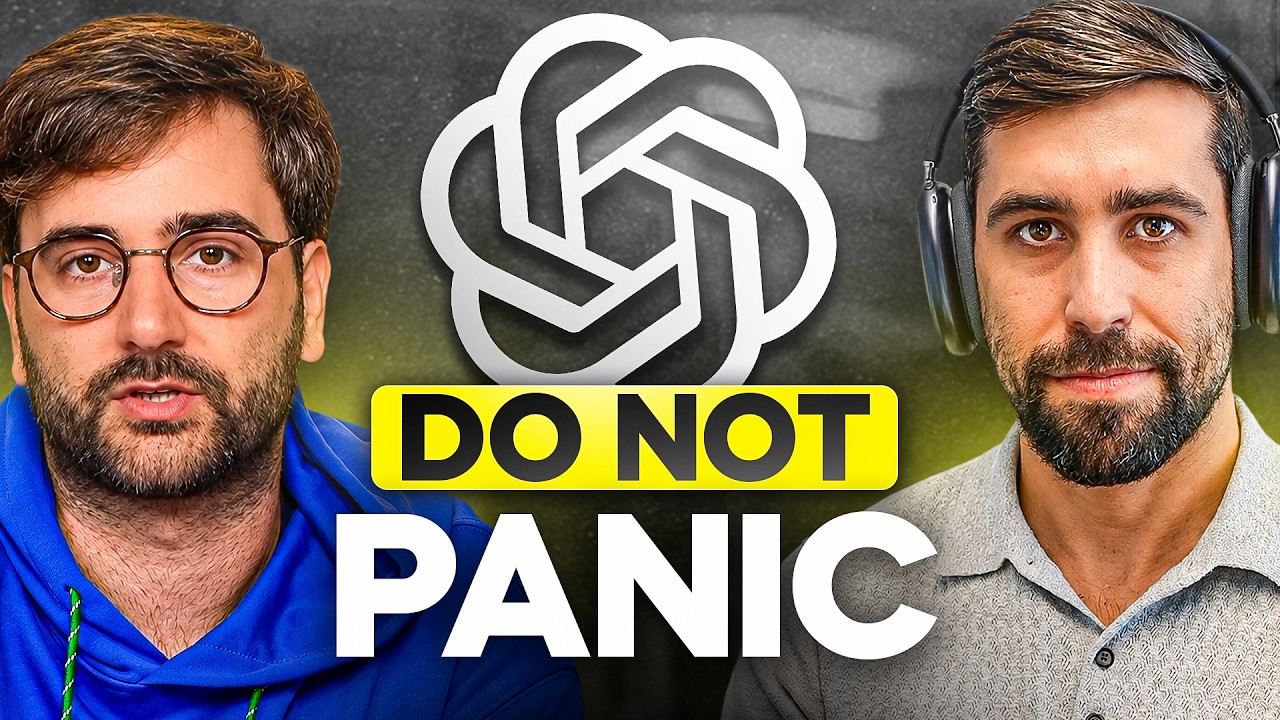
In a conversational interview, Alex Lieberman talks with Thibault from OpenAI about the company’s near‑term roadmap. Thibault explains how OpenAI is turning ChatGPT into an open ecosystem—allowing users to sign in with ChatGPT, share tokens across partner apps, and build plugins that run inside ChatGPT. He highlights the launch of “ultrafast” models that are dramatically cheaper and faster, enabling real‑time interactions and smoother developer workflows. The discussion then moves to DOTS, OpenAI’s long‑running, proactive personal agents that act as virtual coworkers for both consumers and enterprises, promising seamless, context‑aware assistance that reduces digital noise. Thibault shares four optimistic predictions for the next year: widespread adoption of the ChatGPT ecosystem, the ubiquity of ultrafast models, the maturation of DOTS into truly proactive assistants, and breakthrough advances in medicine, science, and mathematics within 6‑12 months. Throughout, he frames these developments as ways to shift the narrative from fear to a human‑centered, empowering view of AI.
Chapters
Almost everything you hear about AI right now is fear. Your kids, your jobs, the future of humanity. So a few days after Dev Day, I sat down with Thibault, and he is optimistic. He shared 4 predictions for the next 12 months, from AI that gives your attention back to medical breakthroughs that are less than a year away. Let's get into it.
I think it's going to start with a bit of a glimpse of what we shared at Dev Day, which flew more under the radar. It's like there are 2 things I think that are important to think through. It's like the first one is we opened up a big chunk of ChatGPT as an ecosystem. We mentioned we're working with 16 partners so that you can sign in with ChatGPT and then use your usage and use your tokens right there in the other products. Also, we're doing the other way around where we're allowing products to build straight inside of ChatGPT with plugin extensions and opening up ChatGPT itself as a platform. We took the first step, but it's going to be even more compelling than that a year from now. You can imagine multiple agents, maybe not all OpenAI agents, collaborating together within ChatGPT as an open platform together with other humans. And I think it's going to become something much more compelling than what ChatGPT is today just because of this ecosystem. Around it. And the other thing that we also showcased, you know, we announced like ultrafast, which I think surprised people because, you know, we're able to democratize it quite a bit. You know, it used to be something that, you know, only a select few could use just because of the capacity. But, you know, we found ways to make it work at scale. And now it's almost, I would say, affordable, right? Like it's, you know, at what you would have paid for Astra. Now you can have like, you know, ultrafast on 6.1 SOL. You know, we announced that, you know, that's coming next week in terms of general availability. And so in a year from now, I think this is going to be much more like, you know, the expectation in terms of default speeds. And then once you have that, you know, you can have things such as, you know, just really real-time interactions and real-time applications almost, which is, you know, like right now we're quite stuck still in conversations. So I'm like very excited for the next step there.
There already has been some version of ecosystem within Codex for a little while in terms of the Connect and the relationships with companies. But as you've described, this kind of takes it to the next level in terms of both, you know, the 16 partners that you're working with, also the ability to sign in from other applications. Like, what deeply human need does opening up this ecosystem satisfy that you think is really powerful? And also, why do you think— why does this point in time make a lot of sense for this to happen?
There are 2 sides of this. So one is it's always been hard to make the economics work If you're just trying to build an AI product out there, you have to shop around and then find ways to then charge the right amount for tokens. Maybe you make it through partnerships of your own or heavily subsidies from VCs, but really there should be a very cheap way to get started. Lowering that barrier to entry is what we're doing with Sign In with ChatGPT, where you can focus on building a great product. And then bringing users in through the distribution that we have so that you can quickly iterate without having to worry about even paying as a startup, as a company, paying for those tokens. And then you benefit from that. And so it solves a problem for all these startups and these companies out there who want to be successful in this next era of AI. It's like we provide the intelligence, you provide the great product. And I think having this open ecosystem is going to be awesome instead of trying to build everything You know, just saying like, oh, ChatGPT will do it all. Like, you know, ChatGPT will not do it all. For users, what it solves is that increasingly, you know, you will use ChatGPT as your personal agent and you will want to take it with you everywhere. And it's not just that, you know, you'll want to consume it through ChatGPT as a client. It will feel increasingly boxed up there, you know, because it knows so much about you. It's so useful. It understands your personal preferences and how to help you. You'll want to bring it everywhere. And so it is also essential for us to open it up such that you can find use in other products, other parts of your life, so that it all connects. And it's not like an artificial boundary where you're like, beyond this boundary, beyond this little app on your phone, you can't make use of it. And so it is useful in both those cases.
Something I think about a lot is as people are using these different surfaces and going back and forth between models, what is almost like the internal mental model that people have for how they prioritize what features of a model or, or the surface matter most? And what it's starting to feel like, and I'd be curious your thoughts on this, is like, is your view that like ultra fast is partially a bet on the fact that speed in this like pecking order of priority will just continue to get more and more important as the frontier gets pushed out? Or is it an expression of a different, better perspective that you all have?
Ultimately, we're producing models that are more capable, ever more capable. And so we're able to solve very complex scientific problems or math problems that we've never been able to solve as humanity before. And that requires a step change in the intelligence. Separately from that, you can scale the axis of how slow or how fast it can go. And it's quite incredible that we're able to even have this access so that we can have both the very frontier on the intelligence and then also make it much faster. And so, well, ultrafast is about 8 times faster. And when you get to play with it, it allows you to stay so much in the flow and you realize how annoying and how quickly you got used to multitasking a lot. As a programmer specifically, you used to be able to just think about a single problem and just really stay in the flow. And then because coding agents were like not fast enough, you had to learn to multitask a ton. You know, it's just, you don't get that feeling of being in the flow anymore. And then now with speeds that are reaching the speeds that we have now, and like, you know, we'll have like further improvements there at some point as well. You know, you're able to stay in the flow again. And it's just, you know, kind of like regaining that feeling from like a year or 2 years ago. And it's like really, really delightful when you're able to achieve that. I think it's not going to be for everyone. It's not going to be for every application. You know, there is also a lot of use to Just really, really slow speeds that are much cheaper. If you just need a result by tomorrow or by next week and it's all fine and it's not critical, of course you shouldn't need to use the absolute fastest speeds.
If we're a year into the future, how do you think directionally people's experience with personal agents will change or look different?
Yeah, on DOTS, this is our vision for what incredibly capable, long-running agents that are proactive and working in the background look like. We got people started with one, but soon we'll be able to create more than one and they will be able to work in team formations. We wanted to learn a little bit of the deployment of a single one per person first before we innovated again. Really, we use DOTS everywhere at OpenAI, so they very much behave like virtual coworkers and they report to people and then they have specific roles. For example, a role might be Like, hey, you know, it's just like, I want you to monitor this particular aspect of performance in a product. And it's just like, it just goes and it just works 24/7 and just takes care of that part of the product. And it's just their responsibility. No human in their right mind, you know, would want to stare at performance dashboards and metrics like, you know, 24/7. You know, you can have a bot do that and, you know, it'll do just fine. What we're also seeing is that, you know, they're very effective, you know, in back office, you know, such as procurement, you know, just doing tasks that were, you know, fairly repetitive, but also require quite a bit of intelligence to do, right? We took all of that. And we packaged them into this product, which we launched at Dev Day so that you can also use it just right on your subscription. Obviously, they're extremely powerful, so you might want to use them in your personal life as well as a super powerful personal assistant. I think where it will change in a year is that it's going to be way more seamless than it is. So for example, you can call your Dot now. It takes about 5 seconds to pick up. Why does it not pick up instantly? That's going to get fixed. It's also going to be, I think, much more seamless across physical space. So you might reach home. It might understand, like, oh, you're just home. This is what's actually important to you in this moment. It's going to get much better at being proactive, but in the right way and not being annoying. This is something we spent quite a bit of time tuning. You will receive this notification. You'll be like, that's exactly right. So delightful that I'm receiving this now. If we do this well, this is something I'm already feeling, it's going to provide a sort of zen to people's lives, where you don't really need to worry that much about, you know, all this, these piles of emails, or all these notifications in these other apps, or you can just stay focused on whatever you want, and then know that everything that is important will bubble up to you. And everything that is not important, or like can be done, you know, automatically is just kind of like handled for you. You realize that it learns quite a bit after a few days of interactions, and then you can explain what matters to you. It understands your goals. And then the only thing that I do in the morning is I just ask like anything urgent. Uh, and then I receive like the 3 or 4 things or sometimes nothing. And I don't need to check my Slack. I don't need to check my email. I don't need to scroll like, you know, for an hour to find like the important things.
The way that you're thinking about the utility that Dots can provide for a user, it's almost like there's this beautiful simplicity. That's created, if done well, that actually quiets a lot of the noise that people have experienced. I don't feel like you hear people talk about it in that way, but I think that's a really profound thing.
I think we're all overwhelmed with technology and, you know, we're so glued to our phones or our laptop and, you know, you're almost kind of compelled to have it around you at all times. Um, and then, you know, you compulsively like check it and, um, I don't think that is good. I would love for us to find ways to change it. And I think AI has the potential to change it. And this is what we're building towards, where you can achieve this peace again and just behave as you would naturally behave as a human and just walk around and maybe you have a thought and you just jot it down and then you just hand it over and you get to be much more connected to other people and the physical space around you rather than being just constantly on your phone and stressed about it.
What I understand as your and OpenAI's perspective around DOTS is like, because there's almost been this, um, this label of, right, personal agents created that like everything kind of sits under from like many players in the space. And I think people have a certain association with what the word personal agents means. And I think people's association historically has always been Like for the consumer, like this is going to be like the consumer's right hand, as if they had like an executive concierge to help them with travel booking, calling restaurants, etc. But as you talk about it, this is as profound of an unlock on the business side, where it's like you go into an enterprise who has hundreds of thousands of employees, and for the first time, they truly have a fully customized proactive agent. Who helps them with the work, with the work they do. It's almost like, you know, how I think about some of the most powerful businesses historically have been those that were kind of reserved for the, for the elite or for the executive, but then offered the same power to the masses. It's like, you know, the CEO of a company who's always had a chief of staff or an executive assistant. What does that look like for 300,000 employees? And what is the impact that has to the business? It sounds like that is as much of the focus of this as it is for people on the consumer side.
A lot of the use cases that people use it for are across getting advice for their relationships, getting advice for their personal health and finance. But it's going to take it a step further where soon it will be able to handle your family finances and payments and taxes for you and make sure that you're on top of all the things that you need to do for your kids' school and find that summer camp and all of that. Stuff. And I think this is going to be profoundly transformational for people and create so much more joy as well in their lives as you sort of like regain that time. And also, you know, obviously, you're going to use that, you know, to even create small businesses and take care of that small business. And, you know, like, maybe you're looking for like a physical storefront, you know, it finds the perfect location, it's able to create like a whole advertisement campaign, it's, you know, helps you in like creating the brand and the tone, and then you know, figuring out, you know, how to, like, you know, if you're selling some items, like, you know, how to stock them, where to get them from. And like, you know, you don't have to think about all of that. That's just like done completely for you. And you can just focus on, you know, like the actual outcome that you want to achieve and, you know, running a healthy business. And that's like for small businesses. And then in large companies, it's going to completely transform things again, where, you know, most of the back office and most of the, um, you know, repetitive, uh, work that still requires some, some amount of intelligence is just going to happen automatically. And, you know, and then it can elevate the company as well.
Last question for you. Any other big predictions for the remainder of the year, or maybe unpopular points of view that you have right now as the space continues to unfold?
Well, big predictions is I think we're going to continue to be surprised by the incredible advances across medicine, science, mathematics. A lot of what was unsolved by humanity for decades suddenly is within reach. Definitely, if not within the next 6 months, you know, within the next year. And I think this is going to, you know, be doing so much good for humanity.
So as it relates to breakthroughs in medicine and in science, not just how that will be so profound from like a just pure science perspective and the impact on people's lives who are impacted by whatever the medically related thing is, but I also think about this a lot from like the reputation And narrative around AI and how important that is, because I think with every technology, there's a ton of fear. I actually think is one of the best opportunities to help the narrative around the technology.
Everything that we do at OpenAI is created like in support and in the pursuit of, you know, making humans more successful. And that requires, you know, just really thinking about it from first principles. And I believe this is why we have You know, made incredible advances in like image generation and multimodality, incredible advances in voice, you know, because you want this technology to interface with humans in, you know, in the most natural way possible. Like, you know, if you have AI that doesn't quite understand when you're talking to it that, you know, you're a little bit frustrated or that you're happy, you know, if we don't have that technology, then I think it's not really going to be able to just really connect. to humans, and it's not going to be something that has humans at the very center of it. And this is maybe something that I believe very strongly will allow us to deliver technology that is very powerful, but also profoundly useful. At the end of the day, you're just going to have something that you talk to in a very natural way. You interact with through physical space as well, through notes, through you forwarded an email or a text or It's— the interface is not going to matter. It's just going to be helpful and attentive to like your needs and, you know, help you take care of yourself and help you achieve more. And I think if we fulfill that promise together with incredible scientific and medical advances, then, you know, we'll be in like such a great spot.
Thibault, thank you so much for joining the conversation. It was such a pleasure to have you. And we'll look forward to having you on again in the future. And in the meantime, best of luck as you guys continue pushing the frontier.
More from Alex






SF startup Eve just raised $103 million led by Spark Capital with backing from a16z and Lightspeed.
Today in AI - Sora 2 released, AI recruiter raises, and Microsoft launches Excel agent