ChatGPT for SEO: Opportunities, Threats, Tips & Future in SEO and Search
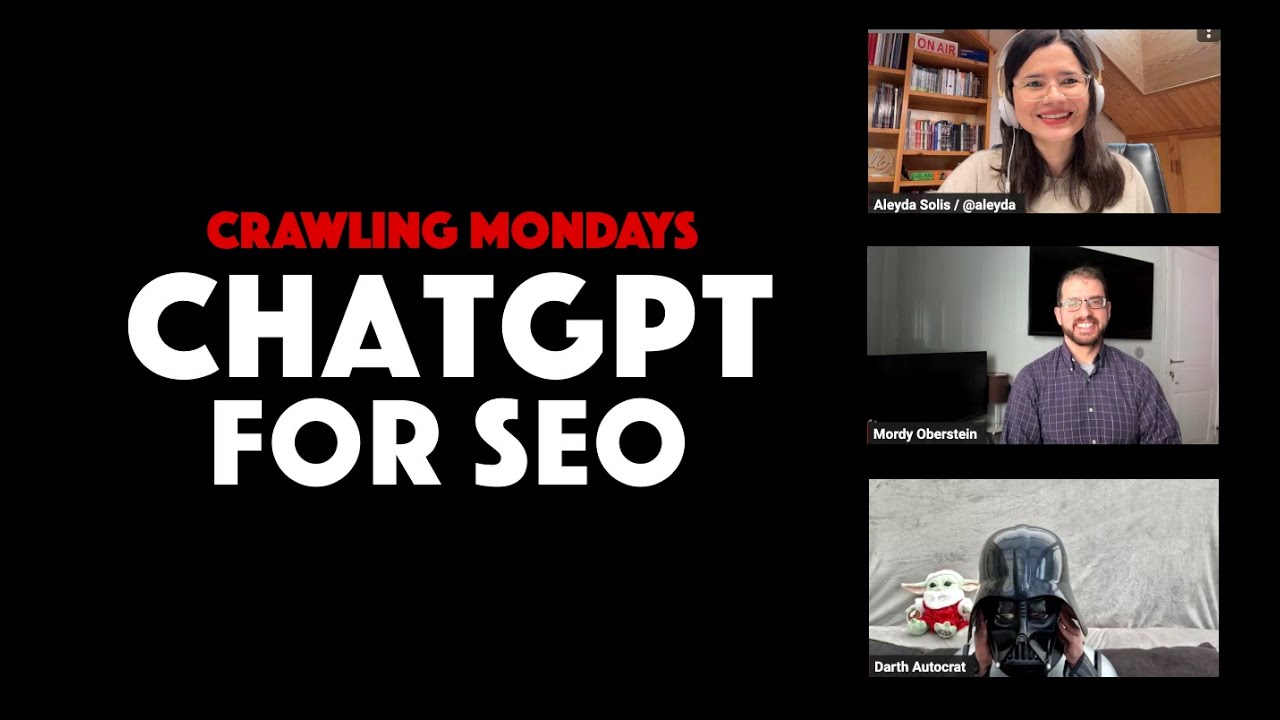
Aleyda Solis, Mordy Oberstein, and Darth Autocrat discuss ChatGPT's impact on SEO. Google allows AI content if it meets E-E-A-T standards, but Bankrate and CNET published AI articles with errors. Safe uses include generating outlines, FAQs, and alt-text, though human review is essential.
Chapters
Welcome to a new edition of Crawling Mondays. Today's edition is really special because we are going to cover and talk about a very, very hot trending topic, ChatGPT for SEO.
Is it good?
Is it bad? What we can expect out of it? How to make the most out of it? How to avoid the biggest threats and challenges? And to talk about this topic, I have asked a couple of SEOs that I highly, highly, highly respect, that I know that have an opinion or two about the topic too. Mordy Oberstein, who's the head of SEO branding at Wix. Hello, Mordy. How are you?
Hey, Aleyda. How are you?
Really good. Thank you for coming today. And then we also have Darth Autocrat for the first time at an online event, webinar, show, however you want to call it. Darth Autocrat is a very well-known digital marketer who's always contributing over Twitter.
Hello, Darth.
How are you?
Fine. And thank you ever so much for having me.
Oh, thank you very much for coming. Before starting our conversations, I want to thank our today's sponsor. ContentKing is the real-time SEO alerting tool, crawling tool that you can easily configure to identify whenever something goes wrong on your site. So yeah, you don't suffer from any SEO horror story. So go and take a look at the link here below and start using it now with some special deal that they have just for you. So thank you very much, Content King. And now we are ready to start with today's topic. So ChatGPT, it is the chatbot built on top of OpenAI GPT-3.5. That interacts with users in a conversational way. And since it was released, it became a boom. It really sort of changed the way many of us did simple research and many started to replace it for tasks for which they usually used before tools like Stack Overflow, for example. In fact, they banned the answers generated by ChatGPT. A lot has been said, like Google issuing a code red internally because they could see how this could suppose a new paradigm for people to look for information. There are also, in fact, like a couple of search engines that started to integrate the chatbot-like features like you.com and also perplexity.ai via Bing Search too. A lot of SEOs also started the conversation about how is this going to change our work, how we can leverage it, if Google is against it or not. So to start, I want to ask Mordy and Dar, what do you think? What is your take in general? ChatGPT for SEO, good or bad? What's your stance? Knowing also, and this is important to clarify, that already Google mentioned that yes, They don't care that the content of websites is created via AI as long as quality is high, is unique, expertise, authoritativeness, trustworthiness, experience. This additional experience criteria that they're asking or they have added, something that particularly, I don't know if any AI will be able to provide, but yes, it's important to also like clarify this. When starting this conversation?
Personally, it's not good for SEO at the present. It's predictive text. It's not much better than what you use on your phone when you're sending a text message. It's set sequences. This results in content that is legible, comprehensible. It makes sense. It tends to follow grammatical and syntactical rules. It does not mean what it actually produces is correct, valid, accurate, It's even dangerous at times. It's, it's useful for certain things, short, shallow, common bits of information, it can handle anything detailed. Unless it was trained on a large quantity of text around that topic or subject, it's not going to be particularly usable.
I think on that point, you know, sometimes you look at, you look at what the results you get back, like, that's amazing. And you're looking at it as a novelty, like, wow, it can do that. But that's a different way of looking at content than if you're an actual user looking to have an answer, got a question answered. Yeah, it's really cool. It's really amazing. It makes sense. It's pretty well structured. But as somebody coming to like, you know, get an answer because you're trying to figure out a health question or finance question, is that really the level of expertise that you want? Which goes back to your point, Aleyda. I know Google's kind of said in the past they've been very anti-AI content and now they've kind of like loosened up the reins a little bit.
Yeah.
Personally, I'm saying it's pure speculation. I think they're not sure what the heck to do at this point. They know that AI writers are not going anywhere. They're going to be part of the ecosystem in some way, shape, or form, so they can't rule them out. So they'll say things like, yeah, no, AI writing is fine as long as it meets all these stuff, you know, thresholds, which of course it can't. It can't actually meet an expertise threshold. So I kind of feel like they've been saying it's okay on the one hand, but if you look at the rest of their guidelines or the rest of the things that they're talking about, it's a little bit contradictory because I don't think they've figured it out yet.
A couple of points that I thought of when you were talking. So on one hand, regarding the accuracy, the more and more we start using it and play with it, we identified that at a very high level might be good, but then if we go at a, with much more granular in-depth topics, the result is not as good. It was Mark Roth the other day mentioning how he generated a short plan tags with it and the values were not the correct ones. We can argue that this might depend a little bit on how specific or well-specified the prompt is, but yes, I mean, it's risky. Then on the other hand, we have cases that have arisen in the last few days. Bankrate content was shared that they were publishing content generated by AI that was supposed to be validated by editors, by human editors. And still some of this financial-related content or information had issues, had errors that were caught after this was disclosed. And people went and took a closer look at the quality and the accuracy of this information. So it is important to align a little bit the expectations of how high quality and accurate this information might be, also with the limitations of this information, because we know that the content that it provides is not aware of anything after 2021. So yes, it's not real time. It's not fresh information necessarily, but beyond that also, like what we can expect to leave it on, let's say on autopilot at all, or without proper validation or addition to make it really insightful, unique, relevant at the end of the day. I saw a comment of someone over Twitter saying that They expected to see that this type of content as it is right now, it could replace the mediocre content that is already anyway generated by content farms, whatever that unfortunately exists out there. But we cannot expect that it will replace proper, authoritative, real expert written information about a specific subject matter. Understanding all of this, what do you think are the best and more reasonable use cases to leverage ChatGPT for SEO?
I've used it to play around with it to see like, you know, what kind of entities are related to this topic. Party planners. What are some entities related to party planners? And it came up with a bunch of subtopics for me. Or if I wanted to see like related questions, I was searching for buying a house in New York. So the related questions that it gave back to me were way better than what I saw on the actual SERP itself. So there's some really interesting things there. I think if you wanted to, you know, push it to the limits, I think things like writing a heading, if you gave it a piece of text that you wrote, and then you said write a heading for this, for this paragraph, you probably get something decent back, you might have to change a word or two. I already know, you know, tools like Semrush have integrated GPT-3 into their AI writing tools. If you're stuck, and I think Microsoft plans on doing the same thing within Word. If you're stuck, you want to be— get something rewritten because you have writer's block, that sort of thing. I think the max That you'll ever be able to use something like this for is where you have a topic that's already been done a million times over. So, I don't know, the case I've been using all week long has been around snow tires. Like, what are snow tires? Or when do I need to change my tires to be snow tires? There's nothing as a human being at this point that I'm going to write that hasn't been done a million times over. So yeah, let ChatGPT scrape the web and regurgitate the same thing and spin it out. As long as I'm reviewing it to make sure that it's not like pulling any nonsense, then, then fine. I would imagine that sort of thing could in theory be like the, the outer limits of what you can do with an AI, an AI writer.
I think the easiest way to view it is you've got a 10-year-old, maybe a 12-year-old, and you've sat them down with a bunch of books, got them to read the books, and then ask them to write out a description, explain something to you based on what they've read, because that's all ChatGPT is doing. It's consumed content that's been tagged. It's not just the words, it's the topics, the subjects, the domain. It's limited to what it's learned, and it can only produce what it's seen. Whether it gets it right, whether it remembers correctly and associates stuff, the more you ask it to do, the less likely it is to produce something valid. So as Maudie said, it's basically stuck with doing paraphrasing, rewriting, resaying, and short bits— titles, headings, maybe link text, possibly anything up to a description. I wouldn't trust it to do more than a paragraph or so at a time. I made a little tweet with a scorecard on it listing things like you can go for breadth, But you can't do depth because it scores higher. And once you go over a certain score, your risk of having inaccuracies and producing something nonsensical goes up drastically. And yet people want to use it for big pieces of content. They want to do long form about topics they don't even understand, which is where the real risk is.
I can definitely see the point about how handy it can be to rephrase something. For example, or to summarize something, that can be too, but from content that you have already produced. So the input needs to be really good, insightful, unique, accurate. But another completely matter will be to generate something from scratch of information that is out there that it might contain bias, inaccuracies, also might end up being duplicate or semi-duplicate of other content that it has already produced. So we need to be Very careful about that too.
This kind of brings up, you know, the point where Darth mentioned that you could do a paragraph at a time. If you look what Bankrate did or what CNET did, it looks like they did a whole blog post, you know, 5,000 words, but all they basically did was string together an FAQ. They asked it a question, made a paragraph, then asked it another question, made a paragraph, and it didn't do that well. But I think we look at those things like, wow, it did 5,000 words. It could write long-form content. It can't. It barely was able to handle the FAQ that Bankrate gave it well. It certainly didn't handle CNET right. That's how they got in all this trouble. And we're looking— I think it's a big problem for the state of the health of the web because people are looking at it like, wow, because it solves a real pain point. The barrier to entry for content is really high. To write good content takes a long time and you have to be good at it, which is not always easy. So people who are stuck like, I don't have the time, I don't have the money, I don't have the expertise to write the content, I'll just use an AI writer, they'll spin it up. And I think we're looking at a point where the— I don't remember a time like this in the web where I was worried what's going to happen next. You want people to be able to write content, but you don't want it to be so easy they can just spin up whatever they want. And now they can. So now what?
So this is what I call the content economy. And it's something that Google basically fostered onto us. Because of the way that their algorithms work, they have to consume content, they have to use that content to score stuff. And it's not just per page, it's per section and collection of pages. They seem to assign terms to a site, a domain. The problem is, is the quality of content across the entire internet is definitely questionable. There are billions of pages that are fluff, inaccurate, useless, out of date, paraphrased. There's so many copies and nears Similar pieces, and this is what ChatGPT was trained on.
So summarizing something that you provide already or provide you ideas, or even I have seen people generating structured data for content. It is okay as long as you go and double check and validate it with the Rich Results tool or the Structured Data Schema tool and verify that validates well and is correct for the purpose that you actually want it. So again, it's good to use it, let's say, as an input, as a base for something. And I actually like how many of the content optimization tools like Frase, for example, have integrated these AI features because they can definitely help copywriters to generate, for example, some initial outlines for content to generate, to spark their ideas, right? But not to replace them. There are quite a few tools to identify content that is generated via AI, but many of them, I think it was Christoph Kemper, did a test and many of them didn't accurately identify ChatGPT-generated content. It was Vincent Tarassi who last week released a new tool, Draft and Goal, that I can see that it does a better work at identifying these different fingerprints. Left by AI models. But yes, there were some people also trying to work around it, say if you change the wording a little bit, make the phrases a little bit longer, things like that, it will already pass. So I would like to ask you regarding tools that you would like to recommend, resources out there to benefit those use cases that you think are valuable for us.
So I think, you know, I know Glenn Gabe has a whole list of tools that you can use to check. The accuracy, whether it's an AI writer or not. I've had the reverse problem where I messed around with them. I don't remember which one it was. There's a few of them I've been using where I've written content and it thinks that it's AI-written content. And it's usually for content that's very— it's like a podcast description. Like, I was making fun of Aaron Sparks because he does our podcast and he does the descriptions for it. And I was throwing him into the testing tools. It was coming back as AI content. I'm like, Aaron, you're a bot. But it's because when you have that kind of, that kind of very formal sentence structure, sometimes these tools aren't so accurate. They think that the formality of the sentence structure mimics an AI writer, which again is very formal kind of sentence structure, not a very firsthand kind of sentence structure, language structure. And they're not exactly accurate. So I would say be very, very careful with them. I'm not sure how accurate they really are.
It's pattern recognition. That's how the large language models are built. They look at set sequences of words that occur. They look at which word occurs in front of, which word occurs behind, or 2 in front of and 2 behind. And they annotate it, mark it all up, and log it. To identify that, the detectors take the same approach. The problem is, is language is built on rules. We're all taught you have to put certain words in certain positions. You put an adjective in front of a noun. or several places behind it to describe it. If you follow those exact patterns when you write, you're gonna get flagged. You can't help it. When you hit prose, you can break the rules more often. You can have a different style. But for formal writing and the stuff that this sort of tool was trained on and the detectors look for, it's common patterns. If you use tools like Grammarly to improve your writing, you're going to hit a wall because they're following set rules and the detectors are going to flag it. It's only when you come up with a subject that is rare, hardly seen, includes words that aren't that common, that the detectors are likely to fail and you can break them. Just different synonyms and Use rarer words, change the syntactic order, switch tense, split a sentence from an ordinate to an ordinate and subordinate. Anything to break the pattern that the detector is looking for based on what the actual writer would generate, and you pass. They're very, very fragile.
That's what I think, by the way, Google's doing with when they're looking for, say, in the product review updates, they're looking for firsthand experience. The syntax and the sentence structure is completely different than if you didn't have the actual experience and you're writing a more formal piece. I think they're reversing that.
Yeah.
Just to ensure also that it's mentioned, there has been a wealth of resources that have been created lately. There is this Chrome extension called AIPRM for SEO, which literally is preloaded with SEO prompts.
Yep.
That can be used for a lot of very common use cases for SEO. Also, Andrew Schottland had a list of some cool SEO uses for ChatGPT too. I created this article with 20 ways to leverage ChatGPT. And then of course I created this section in learningseo.io, automate SEO tasks section, where you have all of these resources and more in case you want to take a look at that enrichment. Develop those tools that can be quite handy for scenarios where the outcome will be more useful and positive. So for example, alt tag generators for images, or also he created, I think, a script for someone who couldn't write as well, write his answers in a very formal, professional paraphrasing what the person has already said in very simple terms, allowing this person to be able to close deals and to have a much better interaction with their clients. That is fantastic. So I want now to ask you regarding the future of ChatGPT for not only SEO, but from a search standpoint. We all saw, we all read that article regarding Google releasing this red code internally. And even there was another one last week. Published by the NY Times saying that they have called Larry Page and Sergey Brin to come over to really ask them for their input a little bit and to put the conversation on what they can do. We are aware that Google has the capacity to do this too, but of course they are in a position where it is much risky for them to release this with all of the limitations, the biases, et cetera, that something like this can have, but they have already announced that they expect now to release quite a few AI-related tools integrated within their products since they now have been put in the position to be left behind in this AI race, right? What is your take on this? Do you think that this chatbot-type conversational functionalities is something that can be easily integrated in search and can be beneficial again? Suppose a changing of the paradigm in the way that we tend to use search engines at the moment?
Google have already been doing it. We know since when, 2012, we're coming better than that. Google have been working over words and looking at synonyms and that, and with more recent advancements, they can handle paraphrasing. They lump different queries together, because the actual sense, the meaning, is the same whether you ask it in a positive or a negative, whether you omit words or not. It can identify, which is what chat basically does. It's an interface. It's not a tool in and of itself. It's got a large lot of data that is not tied to anything specific like searches. It doesn't retrieve documents. It uses them to build itself. So technically, it's not going to replace search, but it can act as middleware between. So where we can open up our mobile and say, hey Siri, or ask Google and get a search result, it's going to improve how that works because it can understand far more variants. than what we've currently got.
I agree. I think, you know, I know you've integrated it the way that you almost have like a featured snippet based on AI. I don't know if that's the future of chat or AI chat in search. I feel like that's very heavy on the resources where if you could just scrape a piece of content, pull out a snippet from it and show it on the SERP itself, like that's a much more cost-efficient way to do this. It's the same time, it's the same net effect. I know it's cool to have an AI do the same thing, but if you're asking a question like, how many home runs did Babe Ruth hit? 714. Google's showing you the answer right there. I don't see the chat being a feature for that. What I do see is, again, it's the interface, it's the dynamic. If I ask Google's chat feature, hey, what are 3 places nearby where I can eat some pizza? And it brings up 3 places. And then I say, hey, do me a favor. Tell me the one place where they have a gluten-free menu, and then it brings up that listing. That it— the, the dynamic back and forth of either exploring out or refining topical matter, I think that's a really interesting way that Google can leverage AI and chat. The featured snippet direct result kind of thing, I feel, is already there. By the way, if they do something like that, rank tracking as you know it is dead, because how are you going to track those links?
It's the whole citing thing is something that some of us have been worried about for years. As soon as they started with featured snippets is attribution. If they're using content that way, it's technically going against how we will permit them to crawl, which is going to be a minefield. You know, technically, we've already seen it with some of the images, the text-to-image stuff like DALL-E. Where it's— you can emulate someone's style, and some of the images that have been used have apparently been used without permission. Same applies for text. If search engines or a new service appears that's feeding off content that other people have produced, it's gonna go to court fast.
Definitely not necessarily for this very factual type of searches for which we already get a position zero anyway, but there might be others which this type of conversational interface can be quite handy. And also by adding the sources where they have gotten the information as citations at the end, because it's true, like it's already Google had its chatbot features through the, through their app, through their mobile app, the way that it worked For me as a user too, it was like, it felt like not the best, like suboptimal, right? Because they ended up just giving me the first answer of search results anyway. Many times it was not useful at all. So they didn't generate necessarily an additional layer of format that could be more helpful for me, like with the 3 top results that they will have given in search results, but blended together for a more comprehensive easy summarized answer that could be helpful for me, and then adding the 3 links later on for me to take action if I wanted. So this type of thing, it made me think, right? That might not necessarily change the way it works completely, but it might add this additional interface to facilitate interaction with the user. To start wrapping up, I wanted to ask you regarding a last tip or recommendation about ChatGPT for SEO in particular. What would you say, something that we haven't mentioned yet that you think It might be useful.
I think it would be prudent to pay attention to the competitive landscape and seeing what's happening out there because you can find much more long-term opportunities. I think initially it's going to take Google a long time, relatively long time to figure this out. I think, I think you still see content like you saw the CNET ranking pretty well. They're going to have to figure it out because the, the influx of just watered-down content is going to be— it's going to ruin the ecosystem otherwise. They're going to have to figure a way out. And if you can look at what's happening in the competitive landscape by seeing what your competitors are doing, how they're integrating AI, and how that might be a win now, but take into account that what's going to happen long-term and don't be tempted to follow suit, then you could be positioned for a long-term win. And at a minimum, you'll set your brand up to be differentiated in the fact that your brand offers real value through its content, where the other brand might be ranking higher than you at the moment. But their brand, from a branding point of view, offers the typical watered-down content that we're going to end up seeing. If you think it's bad now, it's going to be infinitely worse as everybody starts using this thing.
Not wrong. It's going to be an absolute break in the dam, and there is going to be a deluge of poor content. It's nothing new. The internet's filled with it, but it takes people time to produce even that garbage. Now the same people can produce 10, 20, 30 pieces a day without breaking sweat, rather than 1, 2, 3, you know, maybe 4 short pieces of fluff. They can do tons, and it's just going to reduce the internet to, well, a puddle of depth. You know, the volume of quality content is going to be comparatively And Google's going to have to find ways to identify it before the users do. At the moment, they're relying on implicit feedback. They're relying on links. They're relying on signals that we tell them, yeah, this was good, that was bad. They're going to have to start predicting it. They've got no choice. They've already made efforts to reduce what's in their index in the past 5 years. We've seen it. They've stopped taking duplicates. They seem to have reduced the threshold for similarities. They don't take stuff from sites that have got a history of poor content and satisfaction issues. It's getting harder. And now the masses are going to be producing God knows how much garbage. Google can't cope. They don't have the storage. They don't want to spend the money on the resources.
What is important here is to think about from a strategy standpoint, in an era of automated content, the one that is human wins, like what can be your differentiated offer, like unique value, right? If there are lots of mediocre content that is generated thanks to this particular new tool that we all have access to. That can commoditize this type of content, what extra can you give to be top in class, to be the best answer to a particular question? That is something that I am always asking my clients to identify, to establish, because at the end of the day, this is what Google wants to show, the best answer. And the ones that can win on that, the best will be. You may find many of these features to improve productivity. to accelerate capacity, but not to replace if you really want to be top-notch, best in class too. It's a fine balance that you will need to tackle to leverage the opportunity, make the most out of it, but then also without risking or threatening your quality while also doing it in a way that will allow you to be always best in class too. So thank you. Thank you very much, Mordy and Dark, for your time.
Thank you.
I really, really appreciate it. I couldn't have been happier to have you both here contributing on this super hot topic that I know that everybody will love to know your thoughts on. And if you like this topic and if you liked Mordy and Dart contributions today, follow them over Twitter, LinkedIn, Mastodon, everywhere nowadays. Now we are, because as you can see, They are quite experienced and insightful. Also, if you like the episode, remember to like the video and subscribe to the channel too. And if you have any question too, you can leave it on the comments and I'll make sure to follow up and tag Mordy or Dard in case you have any question for them. Thank you very much for watching again, Crawling Mondays, and until the next episode. Thank you very much, Dard and Mordy.
Bye.
Bye.
Bye. Bye.
More from Aleyda



How to Communicate and Sell AI Search Optimization (GEO, AEO, LLMO) to Decision Makers



AI Search Optimization (GEO, AEO): What is it, Common Errors & How to Optimize AI for Success



OpenAI has introduced shopping research in ChatGPT - #SEOFOMO TL;DR December 1st, 2025

OpenAI announces Instant Checkout and the Agentic Commerce Protocol - #SEOFOMO TL;DR Oct 6, 2025

Google's August 2025 Spam Update Finished Rolling Out - #SEOFOMO TL;DR September 29, 2025