Content Strategy for SEO: What Is It, Top Errors and Tips for Success
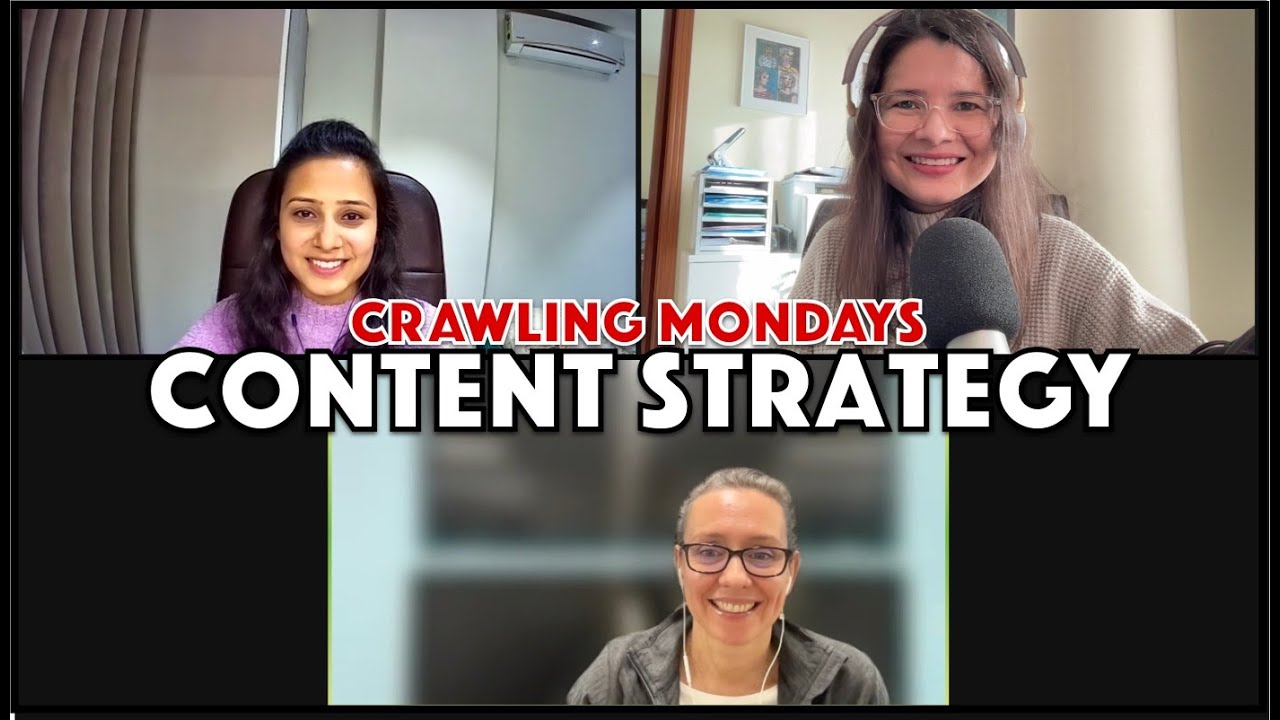
Aleyda Solis, Himani Kankaria, and Shelley Walsh define content strategy as a blueprint connecting audience insights, business goals, and SEO outcomes. Common mistakes include treating keywords as strategy, skipping audience personas, and ignoring user intent. Success requires mapping the full customer journey, using tools like Semrush and Google Sheets, and continuously measuring results against SEO goals.
Chapters
Welcome to a new edition of Crawling Mondays. In today's edition, we are going to talk about content strategy, especially within SEO processes, right? What it is, what it's not, what you should expect, what are the building blocks, what are the main issues, challenges, how you can make sure to make the most out of it for your SEO success. And to talk about it, I have invited a couple of people who specialize in this area. On one hand, I have Himani Kankaria. She's the founder of Missive Digital. Hello, Himani. How are you?
Hey, Aleyda.
Thank you. Thank you so much for having me.
On the other hand, I have Shelley Walsh. Shelley, she's a content SEO consultant. Hello, Shelley.
Hi, Aleyda. It's very nice to see you again.
So nice to see you too. And before starting the conversation, I have to thank Content King, who's today's sponsor of this episode of Crawling Mondays. Content King, in case you don't know it yet, Is an SEO alerting tool that will be monitoring your pages' status, configuration, and alert you whenever something goes wrong. It's pretty flexible and you can configure it as you wish in order to be on top of things before a misconfiguration can cause any harm. So take a look, Content King, and thank you very much again for sponsoring today's episode. That is going to be awesome. And to start a little bit the conversation now. Himani, Shelley, I know that because you are focused on content, right? This is a term that you see so many times used like synonyms, but it's not. Content strategy, content marketing, copywriting. So I want to start with the basics. What is a content strategy and what is not?
So I would like to begin with first that what content strategy is not. Content strategy is Not just a list of topics or keywords. And even content strategy is not exactly the content marketing strategy. Content marketing strategy is the overall thing that talks about the process that we would be taking care of, right? For content promotions and distribution. But what content strategy is exactly, a blueprint that has everything about creating the content, delivering, managing, and all of those stuff. So content strategy, it's a blueprint.
For me, I think obviously content strategy can be quite wide depending on historically what content strategy used to be. But if you look at content strategy in an SEO context, it's about connecting content and utilizing content in connection with a predefined goal or outcome that your identified audience is going to respond to. And I think there's some key points in there, which is particularly that you've got an identified audience. And they're also connecting to goals and outcomes that are specific related to SEO. I mean, obviously, you know, a goal can be anything, but if we're looking in an SEO context, then I actually quite like to connect content to a goal that has some value, such as particularly, you know, conversion, et cetera. But also, you know, your content strategy encompasses segmenting your content into brand and non-brand and also mapping to different stages of the customer journey or the buying funnel. It can also be just using content for brand awareness, but for me predominantly in SEO, it's about gaining visibility in SERPs or across online. So also considering, you know, different channels where your audience might be. For some people, you know, that can be YouTube, can be an integral part, or Instagram. What content strategy is not, and I'm quite— I say this with a smile on my face, is content strategy is not a content calendar. And I think a lot of people seem to think that if you're just producing X amount of blogs, you know, I'm knocking out 5 to 10 blogs a week, that's a content strategy. But if you don't have an objective or you don't have a defined audience, then that's just generalized content production. It's not strategy.
I love that you made this comparison. In SEO, right, we can easily extrapolate this when we talk about SEO tactics versus SEO strategy. It's the same when we talk about content production in general and then actual content strategies, producing that content to achieve a specific meaningful goal that aligns all the work. And this goal or content goal in that particular context should be something in an SEO process that will support the SEO goals too.
It's also what's a really important part of content strategy is what happens when people get on the page. So, you know, you can drive your traffic to the page, which isn't really that complicated to do if you just isolate a specific keyword and then optimize for that. But what's really important is what does your traffic do then? Where does it go? What do you want them to do? How do you actually achieve that goal? So it's making sure that you're, you know, integrating CTAs, having the right user experience. And I think that gets overlooked quite a lot in content strategy.
It reminds me a little bit of the conversation that we had a few weeks ago when we covered topic clusters. And we were talking about that it's not only to attract the user, but to help the user to convert. And then also to give post-purchase support or to increase the loyalty and to make sure that the user is Well served afterwards and is happy with it and can make the most out of the product or service.
I think what people would deem as non-relevant pages on a site can actually be quite critical, particularly to the customer journey. So like you say, information pages, you know, particularly FAQs, you know, they are such an important part to support customer purchases, answering the right question at the right point on the right page.
Now that we have seen what is and what is not content strategy, what are the main mistakes that you see people do in general?
I would say some of the biggest mistakes apart from people just producing a content calendar and not really having consideration for what their content is doing for them is not knowing their audience, being too wide and too broad. But more than anything, I see brands doing this a lot, they're writing for themselves and not the audience. So not actually focusing on what the audience wants and particularly the pain points of the audience and solving problems for the audience. That's what your content should not just be talking about, this is our brand and this is why we're doing and this is why we're so great. Your content should actually be there to provide solutions and information. As we touched on before, not having goals, KPIs, just churning out content volume without considering, is this performing? Is this actually doing the job that I want it to do? And also creating isolated pieces of content that might just get a spike of traffic and then, or say links, but then very quickly have no value. So they're not Connected to a longer consideration or strategy, but also not connecting your content to your SEO as well, which is obviously what we said just before. I really see that a lot, and now I think they're so intrinsically linked that it's you know essential moving forward. You can't have SEO without content and content without SEO for me personally.
Even I have seen as that you know sometimes when a person is searching for a content, they might have different kind of intent, right? For reading the content, they might have different kind of expectations. Say for example, there was one blog that we wrote. They had 2 different kinds of audiences. One that could be market leaders, business owners of the market leaders. And then there would be people who might be looking at the articles just for the sake of inspiration to buy from. So there could be different kinds of audiences and their expectation to read content is also different, but the keywords could be same. So, you know, that mismatch is always there when it comes to, you know, preparing the strategy that the purpose is not defined, that what this content is going to actually have. So in that point also, I sometimes feel that There is this missing point of content brief. So they don't even create the content brief that would have the brand guidelines that, you know, even they won't have what they exactly want to promote in a content, whether they want to promote a blog, whether they want to promote a product or service, they are even not sure what they want to promote. So that is also a gap we see.
Amazing. And potentially like the best way to avoid these issues of not identifying well who are your audience and that also the different type of audience can have when researching about this exact same product, just because their context is different and their needs and pains are different, is something I can definitely see very, very meaningful to take into consideration. Even if a few people dislike the persona concept, I can also see how it can be, if it is well done, can be helpful to develop not only from a purely content, but also user experience perspective that can really better match with their needs and with their goals. So to avoid these issues, what would you say are the building blocks? And I understand that processes can vary a lot, but those main fundamental steps that you believe should be when developing a content strategy, yes or yes?
I would say that first of all, one needs to define the ICPs, you know, ideal customer profiles or buyer persona, whatever they say, right? So at least there has to be a list of buyer personas ready so that what happens is whenever you document your strategy, you can link back to them. When there are team discussions, one can revisit to it and they can understand, okay, why this content is being created. What is the purpose of creating it? What are we going to get it? What the audience is going to get it, right? All of these things can be well understood. So that could be one thing that, you know, defining ICP is. Then there is also one thing that intent, right? Our intent, the brand's intent, and the audience intent as well. Another thing I would say is very much important is the what part of the content, that what it is going to have. If it is infographics, what all data it would have. If it is a blog, what all things it should include. And the type of content also needs to be added in the strategy portion. To achieving these particular goals, we would need to create these types of contents. And then you, you can define the topics according to the format that we want to create. And obviously there are some marketing messaging that needs to be aligned as well. Like I said, that we miss out on adding what we want to promote in a type of content or a content, right? So that, and obviously the KPIs. Some really good points.
Thanks, Himani. In addition to this, for myself, if I'm looking at a content strategy, I would always start with first is knowing what you want to achieve and, you know, really defining that, having a really clear definition of that. I think also what's quite interesting as well that with different niches, the model can be completely different. Like say for example, a large publishing site, for example, SEJ, it's very much about page views. So that's a completely different strategy of how you're going to drive the traffic and potentially what kind of keywords and the whole process you'll be going for. Then, for example, one of my other main clients, it's a lead generation site. And it's a very high-ticket item lead generation, which again would be very different if you were looking at a SaaS, which has got a small cost price, for example, or a one-off purchase compared to subscription models. So all these things kind of really need to be really important to define as to how you would approach your strategy. And then also, is your strategy predominantly about providing information? Or do you want to encompass user-generated content and actually involve the audience in what you're producing? And then I think also critically, resources and budgets. Often these aren't talked about, but unless you have a sufficient budget and resource, then you're not going to be able to achieve your goals. You know, I've worked for clients before where they're expecting you to produce magic without the budget, and it just, it's unrealistic. It can't be done. So that is quite a critical part that people perhaps wouldn't consider. Again, know your audience, but also finding where the opportunities are. This is a really critical part of any content strategy, you know, and this is your job as a creative content strategist to find those opportunities. You know, I do a lot of keyword research. I love keyword research. I love the psychology of it and, you know, how it reflects on sociologically, how it reflects on society. I find it a fascinating insight and I find some amazing keywords as I do my research. And then also looking at those keywords, the balance, you know, having that good balance of brand awareness content, your top of the funnel stuff, and then balanced with your, your real conversion, your money pages, your bottom of the funnel stuff. Auditing the site content, that's a critical part of the strategy, seeing what people already have. So what can be reused? What can be repurposed? What can be consolidated to strengthen it? What needs to be removed to improve the site? And I'm a big fan of topic clusters as well, particularly getting a really strong content directory, site architecture on a site. That's not an exhaustive list, obviously, that's just some key parts of how I would approach.
Thank you very much because I think that because many of us in SEO think of it as keyword research, of course we are going to start with keyword research, but I also see many, many times how for an ecommerce website, for example, they do the keyword research and they start identifying all of these queries that are being searched through the journey, just at the start of the journey, when we are in the discovery phase about what are these products, what are these products for, why should I be buying these products in the first place? And then this type of very, let's say, informational sort of topics are completely dismissed because, oh, they are not commercial enough. We want to really focus on commercial-focused transactional terms that will bring the money because we are an e-commerce website at the end. It's because of this myopic vision that you're only focused on money-making queries, right? It's also about blending the terms through the whole journey, which is necessary.
But also I think what's really important in the strategy is, you know, a lot of people, I do see a lot of brands where they're producing content without any consideration for a targeted keyword. So they're missing out on organic search visibility, which is going to bring in, and this is what will bring in your consistent long-term traffic. So you need to be structuring into your strategy plenty of keywords that are going to be delivering relevant traffic, but then also combining that with some other content which is perhaps more creative, which will be directly converting in your user journey. So having that balance, so you're actually getting that brand awareness, getting the traffic to the page, and then filtering them out into other types of content through the site for an experience.
One way that we can avoid having this issue of overlooking completely certain type of queries that should be targeted by a level of the website or a section of the website to do a very good keyword mapping, topic mapping, content mapping also called, to make sure that the different type of areas and sections are connected with the queries that we're working on. A lot of people, I'm afraid, tend now to think about, oh, content optimization AI and one click away and you will have all of this content generated for you from scratch. However, we need to be realistic and that is Something that we cannot put on autoplay for sure. However, many tools nowadays allow us to, let's say, to support the work of copywriters and content strategies and content marketers in general and SEO too. So for example, Surfer, Frase, Neuraltext, there are many tools out there. What are your favorites? What are the keyword tools, content tools, like keyword tools, Semrush, Ahrefs, etc.? They are the most typical, well-known ones, but I don't know if you have any favorites that you always tend to use. Again and again to facilitate your work?
So I've got 3 main tools that I use more than anything else. Sheets, Search, and Semrush. So Google Sheets, I just could not live without Google Sheets and I just use that so extensively. It might not be the kind of tool that you're looking for, but for me, I think people rely too much on tools to try and make up for lack of knowledge and experience. And actually content marketing is only prescriptive to a certain point. And then you get to that point where you've really got to know your product or your audience and your niche. And you've got to be able to make decisions and choices yourself and about what to include or not. So I actually tend to rely on my own judgment when I'm doing these things. So Sheets, Google Search, absolutely. It's, you know, it's Sheets and Search. But if I'm doing keyword research, I've tried all the keyword research tools there are. And for me, I think the keyword data out of Semrush is probably the best. I sometimes use Ahrefs, but I do prefer Semrush. I also have a really good look on the, in the SERPs to the People Also Ask box. You know, sometimes use Answer the Public. Out of all these tools, you know, I still just come back to those 3: Sheets, Search, Semrush for me. And I do use others around that, but they're the core and I couldn't live without those really.
Same for me. I cannot imagine my strategizing part without Google Sheets. I definitely love Answer the Public. Public. I also look at Semrush as well, BuzzSumo. There are other platforms like Quora, even people also ask a section on the Google search. That is something that I look up to for content topics. For keyword research, no other tool except for Semrush, because we all know that the accuracy is quite high over there. And I also look into 2 other tools. One is any conversion optimization tool, Lucky Orange or Hotjar, whatever is available, because we want to understand what people are actually doing on the content, whether they are finding value on the content or not. So that is very much important. So we have this conversion optimization tool and there is this project management tool as well. So we have to assign the tasks for writers, for internal graphic designers or all of those people. So we have this project management tool like Wrike or Asana. We use it.
I have also seen more content tools that are releasing features that will support beyond the content optimization per se, right? So Frase, I know that they have integrated a feature to generate the briefs. To facilitate the generation by integrating and also suggesting potential terms and topics and areas to cover, not only from keywords from Google, but also from Reddit, from Quora, that will allow, you know, to realize which are the pains, the actual questions about particular products. So it's great to see that there are more tools like supporting the whole journey more than just adding terms within the copy. And then also something creative and nice that you mentioned before was taking a look, paying attention to the behavior of the user by using tools like Hotjar to see and realize how people are using. I will say even to ask the support department, and if there is not support department, also leverage tools like Hotjar to add feedback or questions from different areas of the content or pages of the website to understand what are the pains, what are the questions, what is the feedback of the user from there. I have seen them to be very useful when generating FAQs, especially for certain pages that are sometimes very niche. So it's very difficult to get any meaningful terms from the typical keyword tools. So the best is to go and rely on the know-how of the business from support and also leveraging these tools.
I've just realized one thing that we haven't covered. This is something that I use Google Sheets extensively for, which is actually the reporting and the analysis on the content. If you produce something, then you have to track it and review it. And I create, I've spent a lot of time investing in my Excel skills recently and build quite a lot of dashboards. And that's a really integral part of what I do because it gives me feedback on what's working, what isn't. And actually you can glean a lot of information from user behavior, from the data.
Amazing. Thank you very much both for sharing so much. It has been, I think, quite an insightful episode and I believe that many SEOs can take definitely something from today's conversation in order to improve and expand and take their content strategy to their next level. So if you have liked this episode, remember to subscribe to the channel, to like the video, and of course follow Himani, follow Shelley. You have their details here. And thank you very much for joining again Crawling Mondays. Thank you very much, Shelley and Himani.
Thank you. Have a good day.
More from Aleyda



How to Communicate and Sell AI Search Optimization (GEO, AEO, LLMO) to Decision Makers



AI Search Optimization (GEO, AEO): What is it, Common Errors & How to Optimize AI for Success



OpenAI has introduced shopping research in ChatGPT - #SEOFOMO TL;DR December 1st, 2025

OpenAI announces Instant Checkout and the Agentic Commerce Protocol - #SEOFOMO TL;DR Oct 6, 2025

Google's August 2025 Spam Update Finished Rolling Out - #SEOFOMO TL;DR September 29, 2025