Conversion Optimization for SEOs - Challenges, Do's and Dont's and Tools
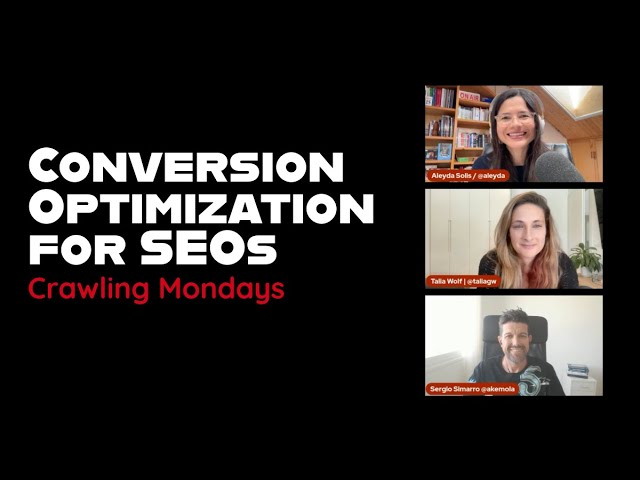
Aleyda Solis talks with Talia Wolf and Sergio Cimarro about how SEOs can improve conversion rates without breaking things. They cover common mistakes like blindly copying competitors and misconfigured A/B tests, then walk through practical steps: research, messaging audits, heuristic analysis. Tools mentioned include Hotjar, GA4, Crazy Egg, and Optimizely.
Chapters
Hello there. Welcome to a new edition of Crawling Mondays. In today's edition, we are going to go beyond SEO. We are going to talk about conversion optimization, which I have to say is something that we should be very mindful about. And we should be always looking to improve whether it is under our own responsibilities or not, because at the end of the day, the ultimate goal of an SEO process is to increase sales, conversions, revenue. And to talk about this particular topic, I have invited a couple of people who can teach us a lot. On one hand, I have Talia Wolf, founder of GetUplift. Hello, Talia. How are you? Thanks for joining.
Hi. Thank you for having me.
On the, on the other hand, we have Sergio Cimarro from Magnificro. Hello, Sergio. How are you?
Hi. Nice to be with you both here today.
Before starting our today's conversation, I want to thank our today's episode sponsor, ContentKing. ContentKing is the real-time SEO crawling/alerting tool that will let you know if something goes to hell on your website before being too late, right? If your canonical tags have been misconfigured in the latest release, if your title tags have been changed, if your internal links are broken, ContentKing is the tool that you need to use to alert you in real time and avoid Like biggest issues on your SEO process. You can take a look at the link here below. And now to start the actual conversation. I was talking before a little bit, both Talia and Sergio, and I have heard how shockingly some people don't think that SEO has any relationship with conversion optimization when our actual work is to get more traffic. But if we want to get more relevant traffic. is not for the sake of the traffic itself, it's for the sake of increasing sales conversions. So conversion rate optimization and SEO, how they two align together and in which scenarios have you found that shockingly they don't, right? Very keen to hear your thoughts here.
I think the biggest thing is that, and I was telling you this, that I got this feedback at one of the conferences I was speaking that they didn't understand the connection between CRO and SEO. And I am not an SEO specialist in any way, but a lot of the work that we do for companies is for their organic traffic. For example, for B2B companies, for SaaS companies, we do a lot of comparison pages. And within comparison pages, you're essentially positioning yourself against additional, like different competitors, and you're trying to stand out, but you're not just putting out that content there for for it to be there and say, well, Slack versus whatever. You're trying to actually convert them and say, hey, you should choose our product versus another product. So we do a lot of work on organic. And I think the important thing here is that ultimately you can create beautiful pages with all the keywords and all the SEO, you know, minded strategies and tactics. But if you're not also using CRO tactics, and if you're not also thinking about conversion, that page isn't going to matter. So great. It's fantastic. But even getting engagement on the page is even more important. And I think SEO and CRO go hand in hand always. I mean, I don't think there's a lot of instances where CRO or SEO contradict. I think a lot of people like to look for the contradictions, but I think when you work closely, they work together.
I think the more SEO has become a little bit more sophisticated And more mindful about UX, that has become the norm, isn't it?
I wanted to say that I totally agree with what Talia said, but even we need to think about that only not SEO should align with CRO. All digital markets should be aligned because we need to understand that we are paid by the same companies and we are working on the same digital assets. So that's what we should change.
I think that is actually super valuable and even positive for us in SEO to work along with UX specialists and conversion optimizers also involved in the projects in order to make a better case for many of our own recommendations too. So for example, I can think of a couple of scenarios I have found where it has been core to prove the value. For example, when I was trying to recommend an e-commerce website to include more information in their listings, in their categories, in their PLPs. Because these were just product listings that they were listing like 10 products per page, no descriptions, no information, just a heading that was also very broad. And then I came up and said, hey, you cannot rank with this page like this because literally if you disable the JavaScript of the page, you can see that there's no text. It's pretty much just the links to the internal products. Google cannot understand what this page is about. Users very likely cannot understand what this page is about. Out, you need to include your descriptions for every product, then FAQs in the listings to clarify doubts that users or potential customers might have at this stage of the customer journey, clarifying the core questions that, you know, people tend to ask when buying these products. So this content is very well aligned with the intent of the user. And they were like, no, no, a few years ago had included Uh, bigger text, bigger descriptions. At the end, we had to put them in the bottom because they hurt the conversions. It's like, can you please show me those texts and those descriptions? So at the end, ultimately, I go to go to the Wayback Machine because of course they didn't have a copy of anything. And, and when I went to take a look at the Wayback Machine of what they used to have, of course it was detrimental for conversions because these were very generic, crappy text, not aligned with the intent of the user, not in a way that it actually supported the user through the journey. So, I mean, there are good ways and bad ways to do stuff.
I recently, we were working on an e-commerce website and we had this exact debate. This is why I've been smiling the whole time because they were like, no, people don't read. That was basically the only thing you haven't said. And all the examples are like, no, people don't read. We tried this before. It doesn't work. And like, basically you're coming onto a category page and it's, it all says the same. Like you have the name of the product, but everything else is exactly the same. How are people going to make any decision. And we ran an A/B test, an experiment on all the category pages, and we changed all the copy for like the main header and actually gave like a description that described, you know, the intent of the customer and what they're looking for and the results that they're going to get. And conversions were through the roof, not because we're some amazing snowflake, but just because we understood what the customers were looking for and we were able to deliver that on the page. And it's incredible to me how the, the disconnect between what people think is needed and what's, you know, the right rules and what gurus are telling them and what like best practices tell you. People don't read all that stuff versus a holistic experience where it's not SEO, just what Sergio was saying, not just SEO, not just PPC, not just CRO, but everything together works as one system.
Can you please share the top mistakes that you see, or you tend to see that in SEO processes that people end up doing, not necessarily SEOs, but potentially because of the lack of communication that sometimes happens, showing why also it's important to communicate well. So for example, I remember many months ago I was involved in this process where they were testing a new design for the website and they actually hadn't told me. And then I realized that there were A couple of versions of the category pages getting indexed at the same time, et cetera. And when I realized why you didn't tell me, I could have you like the configurations to avoid this from happening completely. I have also many years ago seen the other way around, like the homepage getting noindex because of some misconfiguration, because they were doing some A/B testing. And rather than noindexing the new version that they wanted to test, they ended up noindexing the current one. So that is why I believe that it's So important to have a good alignment too, just to even avoid this very basic mistakes, right? I don't know if there's anything else that you have seen, especially generated by an SEO recommendation, right? That you would like to highlight to avoid.
For me, I think one of the biggest things that lead people to us is we did a redesign. It was going to be amazing and it tanked our conversions. And now we don't know what to do. And I say, hey. Did you do any research? Did you speak to an SEO specialist? Did you like what's happening with your traffic? What happened to it? What were these decisions based on? And whenever you ask them what were the decisions based on, and this is a mistake, like a common mistake that happens in SEO and CRO, it's, well, our competitors are doing it.
Yeah.
Or it looks really good. I read on some blog post that someone increased their conversions by 300% when they did this one hack.
Yeah.
And it's never based on actual research, right? So that's like, that's my biggest mistake that I see is that within SEO and CRO, the mistakes that people make is they follow best practices blindly, or they're copying their competitors for some godforsaken reason. And they're like, they must know what they're doing. We'll just copy them. And it's always, it's the same with redesigns, it drives me nuts.
Yeah, talking about that, for example, sometimes I think, because I conduct many experiments, that they fail. So when my clients say, no, I checked this functionality, this feature, from any client, I'm thinking, in case our competitors are checking our website and they get into the experiment and see the experiment that failed, in case they implement it, they are going to lose money because I'm watching that conversions are under 10% or 15%. So I say, okay, that's— maybe I should conduct many experiments like this and try to communicate in any way so competitors adapt it.
Leading Brands can go work on that.
Maybe you can run a campaign there to push like whenever the competitors actually search for something that you know that they will search, They see that version. So they think that you're doing that and they end up copying. No, but you know what, realistically, it is indeed one of my biggest pet peeves in SEO. And then I ask the clients, like, are you really comparing yourself as a startup with the biggest leader in the sector who is able to get away with this because it's the leader at the end of the day, not thanks to it? I mean, it is despite all that particular configuration that they are able to win, not because of it. So it. Also, it has a lot to do with each website audience context, right? Unfortunately, we see all of these dark patterns, right? Pop-ups, interstitials that cover all of the pages of publications. And supposedly they are implemented for the sake of conversion. As a user myself, right? And I don't know if we can say that I am not the standard user, right? That I have a little bit of more sophistication than that. It annoys me a lot and I try to advise clients. Also, it has to do more and more about page experience that we know that Google now takes into account. How do you handle that? Yeah.
I can't believe we're still having this conversation. I got on stage at 2016 and had a whole talk just about this. And it was the connection between, you know, the interstitials and how Google's penalizing people now. And, but there's like, still this disconnect between if I show this big huge thing on my screen, everyone will convert. And it again goes back to that place where we're not considering the intent. If someone's on Google and they're searching for something, your whole job, the only job is to answer that question. They don't, they're not coming to your website to sign up, most of them. So you have to answer that question, help them solve a problem for them, and then actually convert them. And I just see this mistake happening all the time. It's not just with popups. And I can even go back to the example I gave at the beginning of these comparison pages. So when we did an extreme amount of research to write these comparison pages for our client, and they were very long pages, right? Like, you know, maybe 3,000-word pages with comparison. And the PPC team was sending traffic and organic traffic was going to that, to this page. And with PPC, they had all these ads that were like this versus this. You must choose. You must choose. And like a CTA and buy now, whatever. Sign up now because it's SaaS. And the conversions tanked on the comparison page for the PPC. But for organic, they were coming and we increased their conversions, their free trials by 54% because people were coming to the website and they don't want to sign up for a trial. what they wanna do is read and they're going for the comparison table and they're reading every single thing and there's testimonials and there's social proof and suddenly everything aligns and the CTA was at the bottom, but we increased signups by 54% because of the alignment with intent. We could have put a popup there, but it decreased conversions. So it just, it just shows you that there's like a disconnect between what customers are coming from and what sometimes CROs or PPC managers think that needs to be there for CRO, when in fact you can increase conversions if you work together and you go and you kind of reverse engineer what people are really looking for. So it's, yeah, it's mind-blowing.
Aleyda, let me give you a headline for this episode. CRO dark patterns are responsible for SEO people, and I'm going to tell you why. Why? Yes.
What the heck? No way.
No, no, no, no, no. Yes.
Keep it, keep it. Yes. And I found many projects, it's aligned what exactly Talia was saying, projects with a huge amount of traffic coming from the blog. The SEO team has developed a strategy to increase traffic but not thinking on sales, just more and more traffic. I totally agree that if you create accurate content that ranks well, it can, thanks to the internal linking, benefit the ecommerce main pages, the products, and all this, but it's a huge amount of traffic. I have clients about 60-70% of traffic just from the blog that doesn't convert. So we need to understand that most part of the traffic, they do not convert and they will not convert because they are not searching for your product. They just need information. Any further iterations, maybe they can recognize your brand and buy.
But the goal is different for that content for sure. It's at a different stage of the journey.
Yeah. I'm sometimes under pressure on my projects. Because they say, okay, we need to grow. We are not at the goals that maybe they wanted to reach. And they say, what can we do with all this amount of traffic that doesn't convert? What can you do at that time?
Sign them up to the newsletter.
You need to know the patterns, but you need to use some tactics in order to try to get registers.
Oh, poor you, you get pushed to project dark patterns. But that's not our goal.
It doesn't work because that traffic The traffic doesn't want to buy, the traffic wants to read.
Yeah, but that is not the fault of the SEO or even of the users at that point. It's about the expectations of the decision makers. And I have that issue too as an SEO too.
I think one thing that's important to remember, and you said this before, Aleyda, is that when people come to the blog and I started this and Sarah, you said the same, ultimately these are people who are in a different stage of awareness. When people go to a blog, they're usually in the research part and they're in this stage, they're not even convinced most times that they need a tool or a product in order to solve their problems. So a lot of the times they're reading blog posts in order to understand what works for me. Can I do it myself? Do I need to hire a product? Do I need to hire someone to do this for me? Do I need a software? And I think, and what I've seen work very well is the understanding that the only conversion, the true conversion that you can really get from a blog, depending on the articles and depending on, you know, how sophisticated your customers are, is really subscribing them to newsletters and subscribing them to your email list so that then you can write a real onboarding sequence that's nurturing those leads and eventually moving them from research to product aware that like, okay, now I'm aware of your product. Now I'm going to go and compare you to some other competitors. But in the meantime, you're nurturing them to most aware and bam, you're converting them. Trying to convert people on a blog to start a free trial or to purchase a product. Yes, that might work. But oftentimes it doesn't work because of where people are in the stage of awareness. And I think, as you were saying, Sergio, people are driving so much masses of traffic there. And then 2 years later, they're like, but it's not converting. Of course it's not converting.
To continue with the conversation, which are the actual steps that you will recommend, especially SEOs who would like to start testing out minimum viable ones that you will highly, highly recommend for those starting? facilitate their lives? And then on the other hand, which are the tools that you think nowadays can also highly facilitate experimentation?
If you're an SEOer and you're just getting started with CRO, I think there's a couple of things that matter most. So with CRO, the most important element is always research. And you really want to know who you're speaking to. You really want to understand the pain that you're trying to solve, how people are feeling right now and how they want to feel after finding a solution. And for me, that is the first step because once to answer, who am I speaking to? What are they looking for? How do they want to feel? That really answers a lot for you because the first step after that is auditing yourself. And I'm not talking about technical SEO or looking at how many keywords you have, auditing yourself in terms of messaging, reviewing everything on the page to ask yourself, am I actually answering that? Am I actually solving people's problems? Am I really doing a service for our customers? And in addition to that, am I doing that with the right visuals and with the right setup? So then the next step, if we've got step number 1 is research and step number 2 is an audit in terms of messaging, the 3rd step that I would take is doing a heuristic analysis. And that is essentially looking at the way the page is built in terms of UX and UI. You don't have to be a designer to understand this. It's just very technical steps that you need to take in order to look and say, can people actually use this website or can they not? Can they find what they're looking for? How many clicks are hiding behind this action they're trying to achieve? So those are probably the first 3 steps that I would take. But if you have to start anywhere, it's always gonna be research because I really feel that with the, the amount of SEO work that I've seen being done, it's so focused on generating traffic and not enough focus focused on the customer journey and who they're serving. And I think once you know who your ideal customer profile is, the pains, the challenges that they're facing, the problems, why they're coming to the website and how they want to feel and the solution they're looking for, it makes the SEO work even better because then you're actually going to be able to stand out in that crowded market in front of that big giant that can allow itself to make, you know, those SEO mistakes. So that's just like around steps of what I would take in terms of tools. You know, we're an agency, so we tend to work with the tech stack that our clients have because trying to migrate teams from one tool to another has never been easy. So I'm going to say that I'm not going to talk about A/B testing tools because I think that an A/B testing tool, we all know Optimizely, Experiment Engine, VWO, we all know those. For us, the tools that we love using are tools like Typeform, Hotjar, SurveyMonkey, tools that help us do research. So going back to the initial step, and these are tools that you can, some you can actually use for free, and I highly recommend them because they help you better understand your audience. And I think when people think about CRO, the immediate thing they think about is A/B testing, but there's so much more to CRO than just A/B testing. So just leaving out those tools, I highly recommend looking into Typeform. It's probably one of my favorite tools out there. And so is Hotjar for surveys and research.
Totally agree because I also consider that research is what you need to start from SEO. We are talking about search intent and this is completely aligned about what user is going to find in the text, in the product when he lands on the page. So we need to understand that we are offering what people are searching. An extra key step. For the CRO project, prioritisation. Because it's not a long-term project, they need to understand that the project is working in any way. It's something that you can say, okay, we need some extra months, but the sooner you try to show them how you can increase sales, the more resources you are going to receive. So for me, a key point is trying to prioritise, to know which experiments should work. And even if they are not really profitable, at least they show an increase in sales. So that's how they think. They say, okay, we are on the right way. But I have found some projects that after 3, 4, 5 experiments, that you are just trying to learn the business and working on trying to understand what your user needs. That's not a bad result. This is some kind of knowledge. So you need to prioritize in the right way in order to not to fail too much at the beginning.
I can definitely see that research time for many business owners that are not aware might seem like a waste of time. Like when in SEO, we start with the audit.
If you're running an experiment that's like, let's say changing a call to action button, or if you're changing a headline or you're reducing a form field, I think that's isolated and it's easy to know, you know, why things happened and what didn't work. But in many cases, when we're launching experiments, they're strategic experiments, and then you're changing a bunch of things. You're restructuring a page, you're redesigning a page, you're writing new messaging completely. And it's a little hard to know what led to what and how and why. So, I mean, usually it's a lot easier. I agree. But I think in some cases you prioritize a strategic change that serves the intent of the customer over immediate conversions, knowing that in time it will align and slowly grow because you are directing yourself to specific ICPs, ideal customer profiles. I think for one of our clients, for example, we knew when we started A/B testing that the overall signup rates are gonna go down, but their ideal customer profile signups are gonna go up. And I think that's also a mindset. So sometimes it's hard to know when you're looking at data what actually matters and what doesn't and what led to what.
Yeah.
Usually with SEO is about the alignment of signals. Too. So yeah, sometimes you cannot isolate, but it's like if they're all well aligned, they will push results forward. Sergio, the tools that you will consider that are super useful in your case.
Yes. GA4 for understanding the data. Also adding to Hotjar, I would also add Crazy Egg. I work with Crazy Egg. And also now we have for people starting Microsoft Clarity.
Okay. To start wrapping up. I want to ask you for a last tip, something that we haven't mentioned that you think that is important.
We have to consider talking about SEO and CRO that both try to create better user experiences and that better user experiences leads to new sales. So as an SEO specialist, you should try to understand the CRO process methodology by reading, by learning, by subscribing to any newsletter, by making a course. So my recommendation as an SEO, if you're an SEO, would be try to learn about CRO because you are going to use many of the resources that we are working right now.
Yeah, I'm going to echo Sergio. I think that, you know, as a CRO, it's not— I feel like when you're doing PPC, you got a certain amount of things that you need to do and you know exactly what you're doing and you can improve on on them. But when it comes to CRO, you're doing a wide thing. So you have to know psychology, you have to understand UX, you have to understand UI, you have to understand design, you have to understand SEO, you have to understand PPC, you have to understand so many different components. But that's what makes a CRO person really good at understanding customer journeys and understanding how to serve them better. So I think just like you said, Sergio, that it's, it's, if you're into SEO right now and that's what you're doing, I would definitely think about how I can improve not only in just CRO in terms of A/B testing and experimentation, but learning more about psychology, learning more about copywriting, learning more about UX and UI and understanding the full picture because that's the way that you stand out and that's how you become the one that lasts, because if you're just doing technical SEO, if you're just doing a very specific niche, but you don't understand the full picture, it's really hard for companies to keep hiring you if you don't understand the business goals and how businesses work and what they're looking for.
So be more holistic on our understanding and what we know and we can do and the influence in the project to achieve these goals. It's usually really good advice in general, right? So thank you very much for your time, Talia and Sergio. I really appreciate it. I hope that this has generated food for thought on SEOs and thinking the best ways to align with conversion optimization efforts within the companies, projects, organizations that they are involved with, and also looking to learn more about this particular topic to show a better impact, bigger impact, and potentially to partner also with conversion optimizers a little bit. More to, and if that's the case, here you have Talia and Sergio for sure. So thank you very much. And if you liked this episode, remember to like it, leave your comment. If you have any questions, I will tag Sergio and Talia so they can follow up with it. And of course, subscribe to the channel to avoid missing any other episode. So thank you. Thank you very much. Have an amazing day.
More from Aleyda



How to Communicate and Sell AI Search Optimization (GEO, AEO, LLMO) to Decision Makers



AI Search Optimization (GEO, AEO): What is it, Common Errors & How to Optimize AI for Success



OpenAI has introduced shopping research in ChatGPT - #SEOFOMO TL;DR December 1st, 2025

OpenAI announces Instant Checkout and the Agentic Commerce Protocol - #SEOFOMO TL;DR Oct 6, 2025

Google's August 2025 Spam Update Finished Rolling Out - #SEOFOMO TL;DR September 29, 2025