Google AI Mode Announcement Analysis - The Hottest in SEO News with SEOFOMO TL;DR
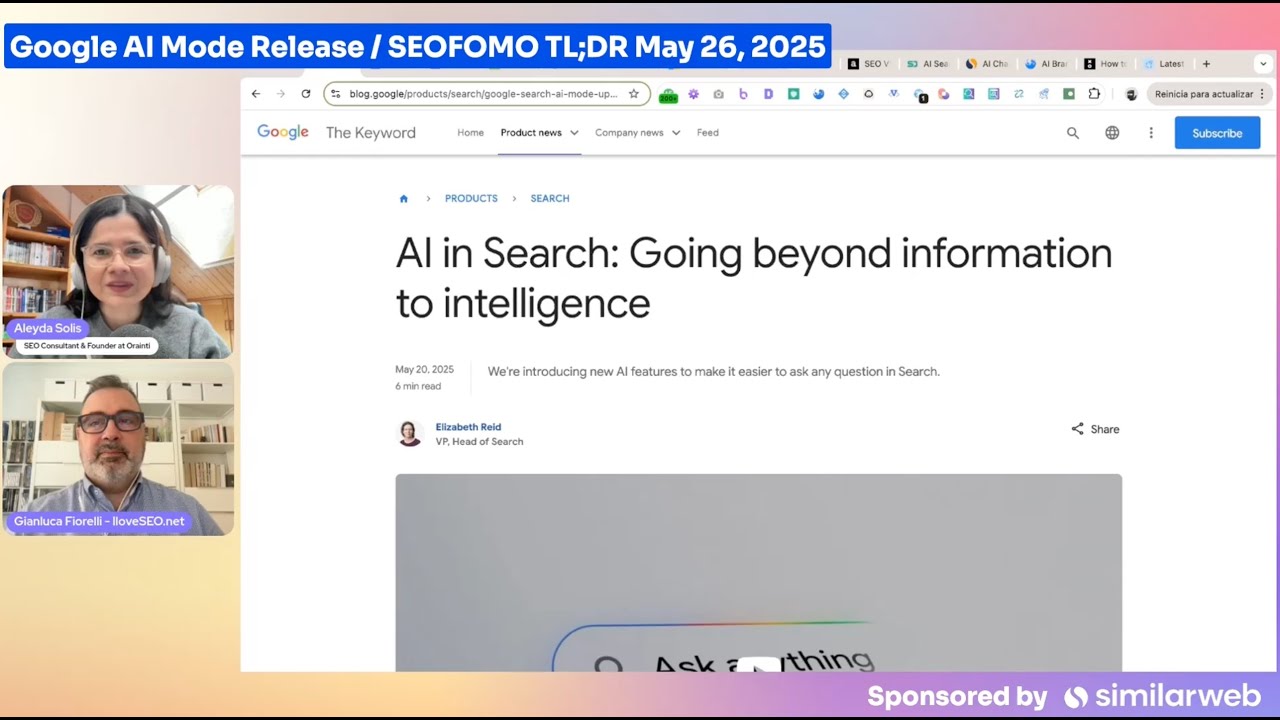
Aleyda Solis and Gianluca Fiorelli break down Google's new AI Mode, an LLM interface launching in the US that sits beneath AI Overviews. A no-referrer bug currently hides AI Mode traffic in analytics, though Google confirmed it will fix this and add Search Console reporting. Publishers should expect click drops as users stay in the AI experience and adopt semantic modeling for "topic ownership" to compete.
Chapters
This edition of the SEO FOMO to Lunch in Read is going to be dedicated to the AI mode Google released earlier this week at their Google I/O event, officially launching AI mode for search in the US. But additionally, they announced the evolution that will come with AI mode, with the additional features and personalizations that AI mode will bring in the future that they will start testing too. And to go through all of the announcements, resources, guides, and commentary that have happened in the latest days related to the AI mode. I have invited today my good friend Gianluca Fiorelli, who's also an SEO consultant.
Hi, Aleyda. Hi, everybody.
Before starting to go through the latest news, I want to thank Similarweb, who are today's episode sponsor. Now let's go through the announcement. In May 20th, we saw Google releasing in public AI mode in search. AI mode had been already tested in labs. I had already covered a few early observations about the new Google AI mode, going through how it is really an evolution of AI overviews that is pretty much here a bridge for Google. So whenever there is an AI overview showcased to the user at the top of the SERPs, there will be now a button at the bottom allowing the user to dig more about the topic that he's researching and taken to a new screen that is pretty much LLM-first, very similar to what we have seen so far with Gemini or ChatGPT. So Google has now released this live to everybody in the US. So Gianluca, I know that there were a lot of reactions going on in the community, even some headlines about how this is the SEO AI apocalypse, but realistically, considering that at least right now AI mode will be pretty much endorsed or showcased or refer to those who actually get an AI overview in the first place to continue their search journey or their discovery journey, we can expect the users that end up getting impacted are a subset of those. That end up getting the AI overviews, which are at the moment, as we know, prominently shown for majorly informational queries, a lot of branded queries, navigational queries, factual-related queries, rather than commercially money-making queries, which, by the way, we know that Google is also announcing major upcoming features related to AI, but not necessarily here yet. So what we can expect as an impact right now is this.
I think we should note in our Google Analytics especially, and with extension also on Google Search Console in order to see if there is a further decrease in clicks because people clicking on the CTA in AI overview to go explore deeper with the AI mode. Because sincerely, if we think to the tab, AI mode, there is the behavior of people to go default. We see it with news. All the other filters, people usually don't click on them.
That is a really good point. Thank you for bringing that up. There is another way, in fact, indeed, that you can go to the AI mode, which is through the tab here at the top, as we can see on the screen, that it is shown to the left of the old tab where we are. But indeed, we already see how those users that go to the image tab or the video tabs are a minority and pretty much trivial in comparison. And thank you very much for bringing up the topic about measuring the impact. The first to highlight this was Tom Critchlow, then validated by Patrick Stocks. And I also double-checked that the sidebar links showcased in AI mode, which actually links to the site where the information is coming from. are adding a no-referrer. This no-referrer will won't send the referrer information and it won't allow us to track it accurately in any analytics systems that we use and will be added as a direct traffic in our analytics. An update to the no-referrer issue from the AI mode links. John Mueller has now clarified that this is indeed a bug and since There's a long weekend coming up. They haven't yet fixed it, but a fix is coming. So we can expect this no-referrer to be removed and to be able to properly track and attribute this traffic in your analytics platform. He also clarified that it's not yet live in the Search Console, but it's upcoming. However, he also followed up saying, for the sake of clarity, the reporting that is planned to be added in the Search Console is like the one that already exists. For AIO, meaning that it won't be separate or break out and no API change will be involved. So what I recommend you to do in the meantime to start measuring the impact of AI mode in the US right now is to add an annotation to the release date in your analytics platform, May 20th. Start comparing your before and after in organic search traffic, look for negative shift, and compare also the before and after of the direct traffic where it is right now. Being attributed to and look for any increasing shift there. Also, since John Mueller already clarified that they will start taking into account AI mode traffic in the Google Search Console, but without splitting it in a similar way that they do with AI overviews, I will highly recommend you to start configuring your analytics platform to start tracking AI overviews along with other SERP features that will likely also allow you to track AI mode when they no refer. Is fixed. Go and take a look to Dana's guide where she doesn't only describe step by step, but also has filmed a video here. I will highly, highly recommend in any case to keep close attention to the changes that they are doing because one of the things that it was clear from Barry coverage and the coverage from a few SEOs who were in attendance at the Google I/O event and the announcements that they made over their livestream was that they are testing a lot of this. Right, Gianluca, we were chatting about this. It seems that whatever we see right now, we need to take it with a grain of salt. I think it says a lot that they have only launched also in the US. And my feeling is that a little bit of what has happened with AI Overviews so far, depending on the, let's say, experience and results that they see from users, they will showcase this more. In particular, also depending on the performance, very likely they see on the ads that they also announced the day later with the Google Marketing Live event, for which they actually published this very comprehensive and detailed document here that I am featuring on screen, where they pretty much go through how advertisers can showcase their ad at a much more granular basis and have all the control in AI overview and AI mode. As you can see here. So I expect that if for some reason we cannot get direct data from the Google Search Console, at least if we work with clients that have paid campaigns in Google, we can get this information through paid campaigns. It was very noticeable, let's say obvious, how Google waited until having a very refined ads offering to integrate in AI overviews and AI mode to start releasing it in public. Because at the end of the day, this is the business model they make money out of ads. And it will depend also on the performance they see on this and the impact they see on this, that they will start shifting more to show it more prominently and into more markets, right?
Yes, totally. I think that this is also the big difference between AI mode, AI overview, so Google and its competitors. Their competitors still haven't found a way to monetize their answer. Another thing that was said said at Google I/O is that substantially in this moment, it's similar to a sort of alpha test. So it's pushed live in the US, probably in a few months in other English-speaking countries to retrieve tons of data in order to then eventually make it something better. And one thing that they said was that each time we are going to test features on AI mode, we'll push them on AI Overview. So this is an important thing to remember that AI Mode and AI Overview are substantially the same and are going to be even more the same thing.
Something also interesting is that along with the announcements of AI Mode, Google also released this new documentation, new guidance of top ways to ensure your content performs well in Google AI experiences on search. And honestly, it doesn't necessarily disclose Something completely new. Focus on unique, valuable content for people. Provide a great page experience. Ensure we can access your content. Crawlability, indexability. Manage visibility with preview controls in case you don't want to showcase certain information there. Make sure structured data matches the visible content. Go beyond text for multimodal success. Video, photos. Understand the full value of your visits. And I think that this bit here Is what is actually more meaningful in this document, in this guidance, because pretty much warn us that we shouldn't assess the value that we get from Google, in this case, from AI search related presence through visits, right? Because they expect that the visits are more engaged, but if you read through lines, This also means that there will be not as many visits as we have had so far in traditional search results. So we knew that for a lot different type of sites, like transactional oriented sites, e-commerce, marketplaces, SaaS businesses, and so on, uh, this was true. Traffic was only just another metric, but But realistically, for a certain type of businesses, in particular publications, that for them, they make money out of impressions, out of the adverts that they showcase in their website, this might be not necessarily that easy to do, will directly harm, let's say, traditional business model. I want to warn users that this is pretty much the first implication that we will see, that we have already started to see with AI overviews. Like if the intent of the user was very informational, very factual, and they are satisfied with the explanation of the AI overview, they won't engage as much, they won't click as much, right? However, now with AI mode, we potentially will see this much more at an exponential level because the interface will be conversational that will incentivize the user to continue their journey there rather than going to the website, right? So what will be important here And I believe this connects with what I had already shared in previous guides and presentations too, is that the real difference will be in user behavior. In traditional search, we had this typically short keyword-based, very transactional and commercially focused queries. And now with AI mode and LLMs in general, we see That the queries are different, the intent is different, it's multi-turn and conversational. So realistically, eventually at some point, maybe not necessarily at the beginning, what will be important here will be to understand the difference in search behavior in order to diversify our content strategy and start targeting more and more in different ways. Those queries that we see that are important, that are actually relevant for which it actually fulfills a need and is worthy to target. to connect through LLMs, which might differ to the ones that we target in traditional search.
Totally. The differences are there, even if there are many things that are still the same, but there are differences. And it's more really to say it in one phrase, you must own the topic.
Actually, Microsoft also showcased their own next level strategies for marketers for AI-powered search. We can see that in their case, I love how it was actually a little bit more actionable. Enhancing search quality and user experience, planning for AI search, perform a comprehensive content audit, create an AI-focused content calendar, target high-intent queries, focus on content that addresses user needs at all stages of the customer journey. So realistically, this doesn't change as much what we should be doing in any case so far. I actually cover it before in this guide showcasing what changes with AI mode and with LLMs. Gianluca, you actually also share a couple of guides, very comprehensive about this. One is a guide to semantics and how to be visible for both in search and LLMs, showcasing the importance of pretty much owning a topic, right? Like from defining the ontology of the domain of the website, defining the entities.
Exactly.
developing the whole cluster for the area of expertise, providing very actionable examples.
I think that it's different in the mindset. If we think in terms of semantics and so optimizing for AI search can give us more power in some sense, because before you were optimizing, for instance, an architecture was something that Sometimes we were coming after. Now we are key in this sense because the first things we should do is if we want to own a topic in all the customer journey, in all the potential journeys, the first thing that we must organize is an architecture. And from there going down, down, down up to the single content level. So this is the biggest shift. for me. And then it's a shift also in terms of finally considering that people, as you were saying, the search behavior has changed. We must always think in what's next, what's next, what is the next potential things that our audience, our target can ask.
That is why it is so important to have that information from LLMs, right? So it's not only Google, by the way, to have ChatGPT and other LLMs to provide a report. Like the ones that we have in Google Search Console to understand which are the queries, which are the topics, and the type of visibility that our websites get there. By the way, and I don't only mention them here because they are our today's sponsor, but also because it's pretty much the only platform that I have seen so far giving this information. Similarweb has this AI chatbot traffic report here in which they don't only disclose the AI chatbot traffic over time for any website and the pages that they are referring visits to, but they actually showcase the top prompts of each of the pages, right? And you can definitely see how the behavior of these prompts are very, very different than the ones that these pages will tend to get from traditional search results. So this is something to also take into account. So if you want to learn more about how to optimize for LLMs, and AI mode, take a look at these resources, these guides to semantics and how to be visible both in search and LLMs by Gianluca. And this other resource, Gianluca, that you have created, I think is also interesting because you provide actionable ways for certain types of publications that rely on ads to, let's say, evolve over time and how it will be possible for them to migrate the type of strategy that they're following right now for traditional search. for AI mode in order to make it ROI positive too, at the end of the day, mentioning how there should be other ways ideally for them to monetize the user rather than purely impressions and traffic, because that is something that obviously, unfortunately, is going to decrease. And this is something that I was actually discussing with a client yesterday, the announcement. In their case, they are highly transactional. They are marketplace. Many of the queries for which they are showcased right now in AI overviews have minimal value for them through their customer journey. And the ones that where they are showcased that are actually valuable for them are the ones that are brand-oriented, right? Like those where the users are comparing them versus their competitors just before the transaction and for which the user will in any case go to any website and finish the conversion. Rather than staying in any AI overview or any AI mode because their need is not satisfied in there. But that is a certain type of player here. There are other players like publications where their content, their information is their core value, their core product that will need to diversify on how they make their revenue, potentially more unfortunately paywall content too. And you mentioned here additional ways for them to get visibility and get that traffic coming, right? Newsletter, podcast and YouTube, communities, merchandising and digital goods. I'd love to hear more about this.
Publisher, especially, I'm not talking of big news website. I'm talking of a publisher that were also hit by HCU, for instance, that kind of publisher. And AI overview and AI mode in their case for informational queries, it's becoming an awareness surface. It's not becoming a surface where they can obtain traffic. Traffic is going to be minimal from there. And we notice that, we know from the many screenshots that people are sharing. It's an awareness as it is an Instagram timeline, as the Facebook timeline where news are shared. It's the same thing. We as a publication are always present there. We are going to be considered by the user as a source that matters and consider if people is interacting. And that's why I was saying we should try, if we are this kind of publication, to do everything we can in order to retain this user, offering them possibility via newsletter, creating community, engaging them, but also offering them content which is stronger and bigger and that can retain them than just the classic answer that an AI overview can offer. So it's a way, a sort of loop that can retro-aliment itself. You are creating your community, a community recognizes you on AI overview, click on you, return, et cetera, et cetera, et cetera. I think that is surely complicated, surely to be tested, but if you don't do this, and maybe this is a Kind of strategy that should have been done before with the same start and growing of a zero-click SERP phenomenon. This can be a possible alternative.
It's also important to note that this is just the next step, right? This is definitely just the beginning of what AI mode will end up being, and we can expect in a few months, right? Google also announced deep search in AI mode. To help you with further, much more in-depth research, live capabilities in search for real-time help, agentic capabilities to do the work for you. And in particular, they announced how the first integrations will be to buy tickets or do restaurants reservations. And all of these features will be initially in test to validate until it is finally released. But Google, I believe that Is already showcasing how this is just the start, how they are definitely just setting the base with first the release of AI mode to make it much more powerful. Another thing that they also disclosed was how they will start also embedding and personalizing more the experience of AI mode to make it more aligned to transactional and shopping experiences that are going to be powered by all of the product listings that they already have in the shopping graph, which makes complete sense because the UI, the AI Overviews UI so far has been so suboptimal for it. And that is one of the reasons why probably they haven't been showcasing product-related information in AI Overviews and AI Overviews had been prominently focused on pretty much informational queries, right? But it's also upcoming. Again, this is not going to be launched right now, but it will start to get tested. The same with personal context. Google will start personalizing the suggestions based on past searches. And this is again something that is true that in traditional search results, if we are logged in, our results are also personalized, but this takes personalization the next level, also with information that can be obtained by connecting with other Google apps, like for example Gmail.
I believe also related to shopping and also to the publisher, for instance, we were talking before, personalization brings us to one thing that really, really must stand in our work. We must work on these other 2 metrics, memorability and attention, because if we are creating content which is memorable and able to catch the attention of our audience, then we are going to be used in the personalized search. And so this is how we can, also a small publisher, also a small e-commerce, etc., etc., etc., can become visible.
Thank you for bringing memorability and attention because this has actually to do with brand, brand visibility and recognition. I actually presented about this topic and you can get the deck here, and I will be expanding and refining this much more, also taking more into account what we see in AI search. But yes, it's only going to become much more important also thanks to these additional features that will be integrated in AI mode. Again, all of these were only announced, are not going to be released right now, are going to start to get tested. So yes, we can see already a little bit of the mid-future out there is fundamental for us to get prepared. I highly recommend you to go through all of these resources, all of these guides, Gianluca's guides here that are also very actionable. All of these insights about what are the differences, what are the gaps and commonalities of optimizing for traditional search versus LLMs, putting more efforts into your brand, better understanding the crawling behavior, the prompts behavior. Of AI chatbot traffic and hopefully getting a little bit more insights from Google. And if not, to use even third-party platforms like SimilarWeb, for example, that provides these additional insights that are unfortunately not yet available for Google. I want to finish our today's episode sharing also how, if you want to keep updated pretty much in real time on all the latest AI search-related news and releases, to go and take a look at the SEO FOMO News, where these are pretty much submitted, upvoted, and commented by the community. You can also install the Chrome extension that is completely free to get alerted whenever something new is submitted. And I want to thank Gianluca today for your contribution, your commentary.
You're welcome.
Provide additional context, additional insights. I really appreciate it. Hopefully this will provide more in-depth view of what has been going on this week with AI mode. It's important to put things in context. This is the base of the next step for sure. And as you can see, we have already resources and we have the know-how and we have experience to succeed in this new reality if we do things well, which I expect that we do if we focus on the broader strategies rather than the specific tactics and one-trick pony type of actions that could have worked so far, but will not in the future. Thank you very much. And remember to subscribe to SEO FOMO. to keep updated too, if you haven't yet. Until the next edition, bye-bye.
Bye-bye.
More from Aleyda



How to Communicate and Sell AI Search Optimization (GEO, AEO, LLMO) to Decision Makers



AI Search Optimization (GEO, AEO): What is it, Common Errors & How to Optimize AI for Success



OpenAI has introduced shopping research in ChatGPT - #SEOFOMO TL;DR December 1st, 2025

OpenAI announces Instant Checkout and the Agentic Commerce Protocol - #SEOFOMO TL;DR Oct 6, 2025

Google's August 2025 Spam Update Finished Rolling Out - #SEOFOMO TL;DR September 29, 2025