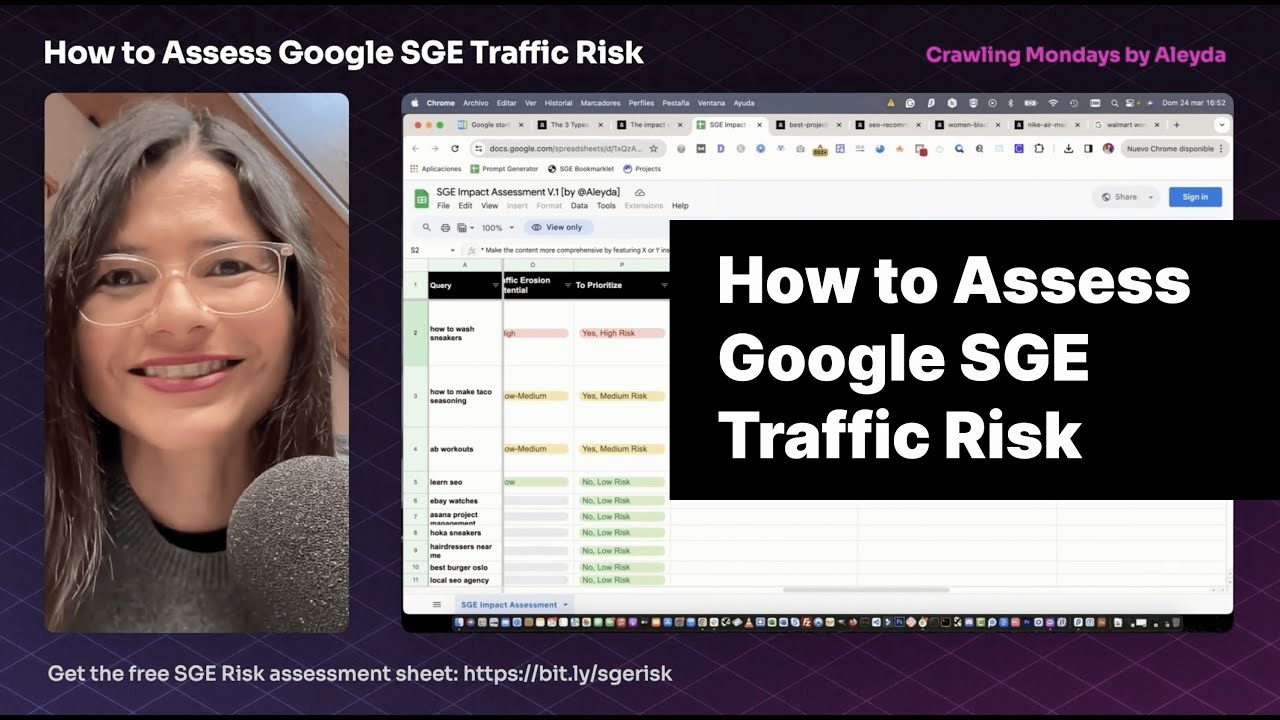
In this instructional video, Aleyda Solis explains the upcoming rollout of Google’s Search Generative Experience (SGE) snapshots to the main search interface and why site owners must evaluate the potential traffic impact. She classifies SGE snapshots into three risk categories—duplicative (low risk), summarizing/complementary (low‑medium risk), and accelerator (medium‑high risk)—and provides concrete query examples for each type, illustrating how they can either mirror existing results, supplement them, or replace them and drive clicks away from traditional rankings. The video highlights how these effects vary by query intent (informational, product, navigational) and by the site’s role (brand, retailer, middleman). To help practitioners assess risk, Solis introduces a downloadable Google Sheet that tracks key metrics (search volume, CTR, visits, position, SERP features, above‑the‑fold visibility, snapshot presence, and fulfillment type) for top queries across the customer journey. By populating the sheet, users can identify queries at risk of traffic loss and plan actions to maintain visibility. The video concludes with a sponsor acknowledgment and a call to like and subscribe.
Chapters
A couple of days ago, Google announced that they are going to start testing SGE snapshots in the main Google Search interface. Until now, they had been only showing them to those who had opted into the Search Labs. The reason is that they want to gather feedback from a wider population, so it's even more important than ever that you start getting prepared for a potential launch. There have been many tests and analysis showing how the quality and experience of the SGE snapshots so far are far from ideal across so many different types of queries through the customer journey, but it is obvious that they want to get it right before a potential launch. There have been also many studies assessing the potential impact to many different sorts of queries, showing how the snapshots are shown much more prominently to those more informational types of queries and in certain sectors, and how Google is not showing it by default or at all for certain topics like your money or your life. However, the best way to assess the potential traffic risk for your own websites is to go ahead and validate. In my own case, I have also performed assessments to many topics, identifying different levels of risk based on the type of snapshot and the relationship with the current organic search results. I have found and classified the snapshots in 3 types: those that have a duplicative sort of experience showing a lower risk that will provide a very similar experience or information than the one that is already provided by the top-ranked pages. So for example, best project management tools, here we can see how the SG Snapshot is pretty much generating a list that is a duplication of the sort features shown at the top. Of the traditional search results. And in the case of these features, these are actually clickable, unlike the ones that are provided by the SGE snapshots. Something similar can be found across so many different types of queries. So for example, the local-like, you will see the SGE snapshot generates a map-like type of functionality that is very, very similar than the one already provided by the Mac Pack search results. I believe that for many of these duplicative types of experiences, Google will reassess the need of including them or launch them. Likely eliminate. Then we have the low-medium risk snapshots, which are the summarizing complementary ones. So for example, for queries like SEO recommendations prioritization templates, for which you actually need to take a step further, you won't be fulfilled by the information provided by the snapshot. It will be a nice summarizing and complementary type of information that you will be getting from here, but it's not the one that will completely satisfy your need. For this to happen, you actually need to go and take a look at the resources, at the information, at the products or services linked by the traditional search results below. An example of this can be seen here when you search for a template. It's great that Google explains what is a template here and can give you a good overview of what it is about, but it won't fulfill your need and you will actually need to click on the links here already shown in the snapshot carousel or directly in the ones in the organic search results. We know how most of those links highlighted here in the snapshots are taken from the already ranked pages here below. So this shows the importance to continue optimizing your already relevant pages for it and how the user will likely need to continue going to them in order to fulfill their need. Then we have those snapshots with the medium, higher type of risk. These are the snapshots that I call accelerator, those that actually take the user to a step further in the search journey. They will be better fulfilled by the information of the SGE and clicking on their links directly. So for example, when you search for women black jeans, we can see how the SGE snapshot here recreates pretty much a PLP, a category page, a facet page type of experience, listing type of experience. Showing directly a list of products that match with the characteristics that I look for. And whenever I click on this products here, Google will provide directly a product knowledge panel with the information, allowing me to go directly to the product pages that offer them across a variety of websites, as we can see here. Of course, this pretty much recreates the behavior that any of these top-ranked category pages will provide me instead. And this will likely affect the click behavior on these already top-ranked category pages. Something similar happens with very specific and even branded product-related queries. So for example, Nike Air Max for women. This type of queries are being ranked right now in the traditional search results by the categories from Nike directly, of course, and then all the very authoritative retailers. However, with the SGE, this sort of category-like experience or facet-like experience again is provided directly by the SGE snapshot, where I can click on any of the products shown and I will be provided the product knowledge panel where I am able to click on any of the retailers showcasing these products. Now, this is the thing. Nike is one of these retailers, but not the only one. They are also provided by other distributors of Nike. This is great when you are the brand, when you provide the products, right? But not necessarily when you are the middleman. So something similar happens when I search for something navigational, like Walmart women's sneakers. It's obvious that in this case, I really want to go to this page. See how Google by default doesn't provide a snapshot for this query. However, when I generate it, I can see this same sort of products that I am searching, but not only necessarily from Walmart, which was the website that I was looking to get here, but also from competitors from Walmart, like Amazon here and other players too. So in this case, I can definitely see how in this particular scenario, Walmart will be losing the traffic versus their competitors and likely the user experience one also. Be the best because the user was actually looking for women's sneakers in Walmart. So as you can see, the impact of SGE can vary a lot depending on the query type, how it connects and complements the already existing results in Google, and the stage of the customer journey where the user is. And of course, it will be very, very different from site to site. So in order to help you to assess this, I have created this SGE impact assessment Google Sheet where you can add your top queries through the customer search journey. You should be able here to add the search volume that you're seeing right now, the current click-through rate, monthly visits, current positions, SERP features, the inclusion in these SERP features, the visibility above the fold, the ramp pages, and if the SGE snapshot is provided by default or on demand or not at all, the type of SGE and how the user need is fulfilled by the SGE. This will allow you to assess the traffic risk In order to establish steps to start getting featured or take additional actions based on the identified potential threats that this could generate to the traffic that you're already getting from these pages. I hope this helps with your assessment before Google releases the SGE and that you are better prepared when this happens. I want to thank ContentKing, who has been the sponsor of this video. And if you like this video, remember to like it and subscribe to the Crawling Mondays YouTube channel. Until the next one.