How to Successfully Pitch and Speak at SEO & Digital Marketing Events
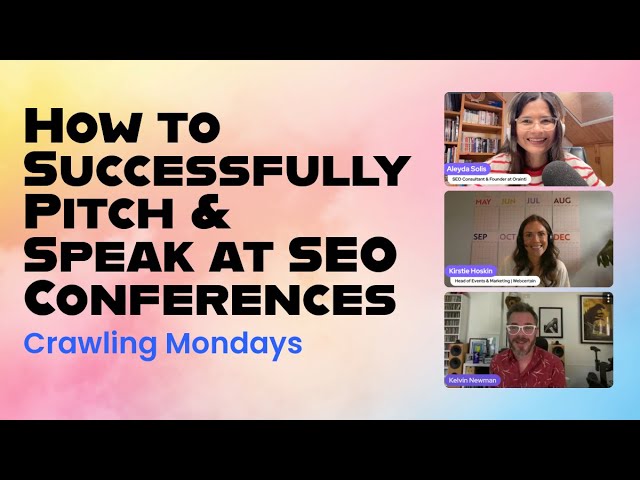
Kirsty Holtzkin and Kelvin Newman, who run major SEO conferences, explain what makes a pitch stand out: be specific, show real experience including failures, and align with the event's actual audience. Rejected pitches aren't personal. They look for originality, actionable value, and clarity.
Chapters
How to successfully pitch and speak at SEO and digital marketing conferences. If you want to be a successful speaker, this is the Curling Mondays that you need to watch. Today I have with me 2 of those organizers who are able to run very successful and massive events across the world, who are going to share their insights, their tips, their advice. For newcomers and also experienced speakers in order to make the most out of their journey and experience at SEO conferences. On one hand, I have Kirsty Holtzkin, Head of Events and Marketing at Webcertain. Hello, Kirsty. How are you?
Hi, Aleyda. I'm great. And I'm so happy to be here. Thanks so much for having me.
Thank you very much for coming. On the other hand, I have Kelvin Newman, who's the organizer Founder, director of 2 of the best known conferences in our sector, Brighton SEO and HeroConf. Hello, Kelvin. How are you?
Yeah, good.
Good. So yeah, also very happy to be here as well. So yeah, I'm happy to share my experience and hopefully, yeah, give some people some helpful advice.
I'm very looking forward to learn myself as well. What are the top mistakes that you see people making continuously when they pitch At your events?
I think the first thing for people to realize is that, you know, we turn away really good pitches. So like, I think sometimes people think because we've said no to them, it's because their idea is bad or we didn't like it. And that's very much not the case. In fact, there's hundreds of, you know, applications that we've got that I would like to program, but there's only a very finite number of slots that we've got. And, you know, like it's a kind of quite tricky challenge to balance what we're speaking, and there's many moving parts in it. So the first thing is like, if you were rejected, it didn't mean there was anything wrong with your talk. In a lot of cases, it just could be, you know, we had lots of similar topics, we've had you speak recently, you spoke at other events. Just on that particular moment in time, the way in which someone framed their pitch just appealed to me, um, in a quite different way. So first of all, I would say, you know, you might have had a really good pitch, you might have had a really good idea. But then there's also, I suppose it's sometimes it's around either not being unique enough. So it might be really interesting, but it might be quite similar to other ones we pitched. And, you know, we accepted someone 6 weeks ago who pitched a very similar sort of topic, or the titles are sort of too vague. So they might be kind of quite a big topic. And our format is we have lots of tracks running concurrently, um, so we want them to be narrow so there's different things for different people at different times. And they're quite short, they're 20 minutes. So Sometimes people almost kind of go, I'm going to do a talk about, you know, link building or digital PR and be very general. And it's kind of like, well, I'd much rather something very, very, very specific if possible.
Yeah, I think we experience a lot of the same thing. I think for me, one of the top mistakes I guess we see is just lack of awareness either about the event focus or about the audience. I mean, for example, for us, you know, international is in our name, the International Search Summit, the International Social Summit, it's it's very clear on the pitch form that we're looking for a specific type of talk and topic. And I would still say that over half the pitches that we receive have absolutely no international angle. So it's just having that awareness about, you know, what the event is and what it's looking for. You know, we leave our agenda from the previous year online until we launch the new one. So, you know, it'd be very easy to go and look at the sort of talks that we've previously accepted, kind of really get like a vibe for them in the same way that, you know, Calvin's very rightly said, we get so many that's like how to do international SEO, or it's not a fresh perspective. And my other sort of mistake, I guess, that I see is the self-promotional, whether it's for yourself or for a brand. I don't know about you, Calvin, but to me, those pitches just, even though people try and mask that they're just basically there to sell something, it just comes through so, so strongly. And that's always a bit of a turnoff for me. So kind of like to take it from a. Value first and then sort of branding comes later. So if you're adding value, then by proxy, you'll get that recognition. But coming in with that is, for me, it's a no-no anyway.
2 important things that you just highlighted that I want to even double down on. The first, don't take it personal because I have seen, and I have also mentored a few people and given even tips. Once you start to speak at conferences, don't take it personal. It's not against you. As a speaker, as a person, right? But it's more about the specific topic that you pitch, the angle that you took, and the perception of the value that this particular topic and session might potentially have with that particular audience, because that same topic might be completely fine if you go to a much more generic industry event. Like for example, if you go to an education trade show, like how to do SEO for education companies or how to do international SEO or how to start international SEO in the education sector might be completely fine for that audience that is not specialized necessarily. But if you go to events that are about international SEO and everything will be international SEO, you need to go much more granular. And what you mentioned, Kirstie, also is the balance of how you focus in on a topic for which there is a particular interest at the moment. And I imagine, and again, I can also as a speaker myself, I can see how tricky it can be because I imagine that a lot of pitches nowadays regarding AI. AI search this, AI search that. And I can imagine that this is also something that you want to cover, of course, but it's not the only thing. There's so much more happening. So it might be worthy for a lot of us in SEO to think about, okay, if I don't have necessarily unique insights because of my own research or my own experience on doing this at this point, what else is tangential or interesting regarding what the changes that are going through in the SERPs or how to bring results right now, given the current context of things.
It's funny you mentioned this as that we are currently about, we're just about finalizing the agenda now. And we have had so many pitches for this November. We're actually having to up from 3 tracks to 4 because it is about what's, you know, what's hot, what people want to know about, and AI is clearly a hot topic. So instead of impacting all of the other tracks and that sort of taking over, we're gonna add that in as a standalone. And that's not an easy decision. It's been a 3-track event for years, but we do have to diversify and move with the times. And it's massively exciting, but it was kind of that thing of the real Tetris of how do we feature it enough so that it feels that it's included, but it doesn't impact everything else. And I've said this I think for the entire time that I've sort of been organizing at ISS, we try and give feedback. I know it's difficult. We can't always give everybody personalized feedback, but if you are turned down from something, reach out to the organizers. My inbox is always open, or reach out to other speakers, seasoned speakers, and say, I pitched this, they didn't go for it, and actually ask for that kind of feedback rather than just taking it to heart and then throwing your toys out the pram and not pitching again. There is very valid reasons and it is a real juggle to get it right and to get people in. So please don't take it personally.
Yeah. I mean, I had a situation recently. I caught up with someone who I hadn't seen for a few years and they were a bit like, so why don't you like— like they didn't say it quite in these words. They're like, so what have I done to piss you off? You know, you've not given me a speaking slot in 5 years. And I'm like, they had done nothing, right? First of all, there was not like a kind of like a process where I'd gone just for whatever reason. they'd pitched a few less times. They were doing like— it just didn't really— like, their talks weren't really necessarily landing with me. And that is me as an editorial person choosing what I like, right? I, I'm making a guess. And, you know, like, I hope over time I've got a good sense of what people are interested in, but it's not perfect, right? So again, there's that kind of degree of like, just because I've chosen doesn't mean it's, you know, it doesn't mean it's a bad idea. It just meant it didn't appeal to me at the moment of time when I was doing that kind of appraisal. We've got there as well. And yeah, and as I say, lots of times I struggle when people come to me like, let's see, It's fair enough to say, to come and ask for feedback. I struggle often when people come in.
Well, I mean, yeah. And it's like, yeah, it's different. It's different scale, isn't it?
If I know, 100%, I agree with the scale and sometimes it's tricky and you only have so many hours in the day, right. To be able to follow up with these questions. But what I do feel that it will be useful from a speaker standpoint here will be that I can imagine that manually answering every single pitch that you say no to. That is not feasible, but, but some people manage it.
I don't know how some people do.
Maybe you have an assistant or AI, I don't know, of sorts. And that can go very quickly. I can imagine at this point still, but, but my, my recommendation will be to have at least as a template sort of message saying, sorry, but your talk didn't make the cut for the next edition. So they are aware that they are not chosen.
Yeah.
And then have a little bit of a message. It's like, it's not because of you, but the criteria. And here it ties very well with the next question I wanted to ask you about, but it doesn't align with the criteria that we had prioritized for the next edition, which is topical alignment with the audience of the interest or being the first to pitch this idea or the angle that you took. So one of the things that I like to do whenever I pitch at an event is to go and take a look at What was covered in the previous one already. And of course, my understanding of what is going on in the industry. And for me, it might be quite easy because of the SEO FOMO newsletter. And I see everything what is happening and going on. And I tied that very quickly with what I do in my day-to-day because I am in the trenches, but I can see how that might not necessarily be as natural for everybody. Right. So yeah, at least having a little bit of a templated message, like going through the criteria so that people understand a little bit more, but that doesn't mean that they cannot already pitch. for the next one and potentially add even the link for the next one and have the ball rolling like that in a very natural way. I would love to hear your specific tips for people aligned with the criteria you do use when going through the topics and when you see all of the pitches.
I think for us, the criteria we've already talked about, we have a very specific focus, so it kind of has to tick that box initially, but we are really looking at the like speaker potential, whether the title and the aim of the talk is clear. Is it relevant? And as we've said, you know, is it original? Does it have a fresh take? Is it, does it stand out against lots of things on the same topic? Does it add actionable value? You can clearly see when we're looking at pitches, confidence, clarity, and passion that comes through in a pitch. And they're the sort of criteria that we really focus on, and it might seem like one of the sort of odd questions that we ask on the pitch form, but it's why would you like to speak at the event? Because that gives me personally, and Gemma a lot of the time, a really clear indication of that person's obviously goals around doing it. But they're what we sort of look for. And when I'm talking about speaker potential, I'm not talking about experience, clearly. We have always and always will champion sort of first-time speakers. And it's not how long someone's been saying something, it's, you know, what they've got to say and what they're bringing to the table. So it's about sort of the potential of what they're bringing to the event and ultimately the value that they'll bring to the attendees. That's always our focus. And that is the sort of core criteria is, will our attendees like this? Will they take something away from it? Or will they give it a zero on the feedback form? But that's the kind of criteria that we work with.
Yeah. I mean, I don't know. There's a mega complicated process for me. It's like, do I like the sound of it? But yeah, no, it's so there's clearly there's particular things that like I and we as a team collectively like in our talks and we don't always get it absolutely perfect. The process we kind of go through is we look at the titles first, then who pitched them second, and they kind of almost do a sift in that kind of process. And it's like, do I like the title and description? Yeah, then I'll look at who's done the talk and do it kind of that way around, which certainly is part of the equation there. And we, I particularly like those that are kind of framed in a specific way. So I like how to do a thing in, you know, how to do X in Y. It's a pretty good formulation.
Actionability.
Yeah. And that, yeah. And that's kind of, again, it's a good thing for speakers to be framing their talk in that way even before they start, because I think that's sort of useful in that sense. That they're kind of going, okay, what's the lesson that I'm trying to teach them? But it is a real juggling process. So we do it in SIF. So like one thing that like probably for my, you know, me being bad in terms of some of the things Leda was just talking about is we never decline a talk, which I know annoys a lot of people. So we don't ever say no, you haven't got a speaking slot. And that's for a couple of reasons. One, because like it feels a really aggressive thing. You know, like, I don't like the confrontation of that, you know, and that's selfish on my part, whereas like kind of going, I don't want to send 500 people.
That's very British of you.
Yeah, yeah, it is. But, but also quite practically, it's kind of our agenda is an evolving thing. So like, we're what, 10 weeks out from our San Diego event yet? It's mostly there, but there will be slots that move around, people that need to, can't go, that could, people who we thought were going to be involved who weren't going to be involved, people who want to change their talk title, people who we thought could do one day, but they've had a flight booked, they've had a, you know, an emergency. And if we've declined all those talks and then have to go back to them, it's tricky. So we like to kind of go, well, we like to have our options open.
Oh, that's so interesting. I think we work in a completely opposite way.
And I mean, and that's some of it's down to the culture of how we as an organisation operate and the business model that we operate and all that kind of stuff as well, and the sheer volume of like slots that we're dealing with. So we've got 5 tracks with 15 speakers per day. So yeah, it's like 100 and 150 speakers that we're dealing with. So yeah, there's a degree there, but like in terms of the things that I'm looking for, it's like, yeah, I like it to be framed in an actionable way. I like it to be niche because like I say, because we've got concurrent tracks running. And yeah, I, I like a combination of like really new stuff, but I also like stuff that like feels a bit more timeless. And that does also again sort of feed into our programming schedule as well, is that yes, we're confirming things last minute, and that again allows us to fill in those bits that are newer. But a lot of our program is like San Diego, which is in September, we were probably 50% programmed by January. And like, yeah, we'll change the titles if we need to, but kind of trying to find things that are going to be Relevant, whereas I think some other events, maybe less of R2 actually, but some of the other ones that were particularly around before, but also now that'd be like single track, they would do quite a different approach. And like Lindsay used to run Search Love Words of Us, and they would often choose the speaker and they know they're gonna do a really good job and then they can refine the topic nearer the time, or they have a rough sense of the area that they're talking about. So yeah, often it's kind of, we'll get like in the process when I then start to put the pinboard together or the Post-it notes or It's actually a Google Sheet. Well, am I pretending it's paper? But where I'm putting the the talks together, often a a talk might well be selected because we've chosen two already. We both like those, and your one was a really good complement to that to be the third speaker in that. And there might be ten other pitches which are like individually better in inverted commas than than those, or a better qualified speaker. But we chose that one because it select it. Fit well with the other topics that we've got programmed. We don't go in with a, here's the agenda we're gonna fill. We kind of go, I'll invite like my first wave of speakers and then work out what topics have emerged. And that works well in terms of how I like to work, but it does sometimes create problems. Like, you know, like last time around we didn't have very many digital PR sessions and we got a bit of like negative feedback on that. And it wasn't, do you not like digital PR anymore, Calvin? It's like, no, just The way that it shook out was this was it, and I hadn't realized we weren't really covering that. So we then try and revert back next time around to cover it off. But I like the way the agenda emerges rather than doing that. And some of that's practical stuff as well. So when we're choosing who's on which stage, we do the vote. So we will program it, group it into sessions, and then say to the audience, which are you most interested in? And then that chooses who's on what stage. 'Cause some of our stages are quite a bit bigger than others. So again, that sort of helps us get a sense each time around of what topics people were most interested in. And that is sometimes surprising. It does surprise me quite regularly.
I think that you both in different ways brought something that for me, I imagine that is particularly important for you to ensure quality and that the conference performs well. So it is a successful experience for everybody, the audience, the speakers, sponsors, and it's Ensuring that there's qualification, the trust behind that, and how to showcase and communicate that to be picked as a speaker, because you want to deliver. And what you don't want is to feature someone who, rather than sharing a topic in an insightful manner, they will go and just self-promote, for example, or to explain something in a misguided or negative way that you don't want to necessarily endorse. Or someone who might really do good, but it's their first time speaking. And unfortunately they still don't have the abilities and the skills to communicate as well. And I know that both of you do also a lot of efforts with the community to provide opportunities to first-time speakers, but I can definitely see how there is a balance on that that you need to take. And there are risks as well, but there are also ways to mitigate that risk. So for example, I have had just in the last couple of months, event organizers asking me, hey, Do you know this person who has spoken at these other conferences where you have been? Have you seen them speak? How, how do they speak? Because they need to ensure that they are going to deliver at their event. And that is completely understandable as well. And in my case, what I tend to do also is to say, because coincidentally, even myself, I try to apply this whenever I organize my meetups. I want to invite people that I know that will have an amazing conversation, an insightful conversation, will have something to say, right? So I try to balance people who I know and have seen speaking in the past and newcomers as well that I have seen that even if they haven't spoken in the past, they have actively shared amazing stuff with articles, with guides, in webinars, in other formats, right? Not necessarily even speaking, but in other formats. And the tip that I gave to these conferences organizers when they have asked me is like, go and take a look at this video, this webinar that this person has done or this podcast interview, so you can see how this person communicates and what they have to say about this particular topic. I'm pretty sure that you have plenty of tips for newcomers, especially how they can make sure that even if they don't have a lot of experience speaking at events, they are picked up to speak.
Diversity and inclusivity is really important. Trying to balance that is really hard. And I'd be lying if I said that there's not comfort and safety in You know, I see a pitch from you come through and I think she knows what she's doing. She knows where she's going. She'll be there on time. Quite low maintenance, but incredible on stage. And that, you know, it's kind of like the dream scenario. The key point is that it is a really, really hard balance. And what I will say is that we're really trying to include underrepresented races and ethnicities, women, make things as accessible as we can be. And what I would say to like first-time speakers who are looking to sort of try and get into it is First and foremost, like network and learn, like go to conferences first, watch webinars, you will learn a lot from observing seasoned speakers, you know, even just watching something like this, that's us giving you those tips, sort of see above, you know, go niche, sort of be actionable. And if you are nervous, start small and build your confidence, you know, there's fantastic Keynote Speaking Club, and, you know, you could Record yourself and sort of see how you feel or try and get, you know, go to a local that's a smaller meetup, those sorts of things. But it is, we've said, sort of be clear, make sure you add value, have like a niche, have a fresh perspective and a unique point of view. Don't be afraid to talk about things that don't work or that didn't work. It's not all about I'm the best and I'm the most amazing. Talk about what you've actually done is a good start. And we're open to hearing things that didn't work as much as things that did.
I think I sometimes have to remember, cuz I probably over-index against that. And like a lot of the people who do a lot of events, I sometimes kind of go, oh, well they speak at lots of events. They, you know, that's tricky. The reality is that like a lot of the people attending Brighton SEO have never been to an SEO event before, let alone lots to kind of go, this speaker is, oh, you know, mega frequent. And then equally it's that kind of, well, you don't know who's gonna be good until they do it as well. It's a challenge, but I think that the people who wanna do it, it's kind of about. asking yourself, well, if I do want to put myself forward to speak at an event, it is an undertaking. And we're incredibly fortunate and appreciative of anyone who puts themselves forward to speak and puts the work in to do it. But kind of know that if you're pitching to do it, you're kind of going, that you want to take it seriously because that it isn't easy, but hopefully it's enjoyable.
I would love to hear your thoughts regarding the things that tend to be usually overlooked or are that people don't even know about. Running events in general that you would like to raise awareness of, because it might help to understand certain things that people tend to complain about. So for example, a couple of things when you have no shows, like 2 or 3 editions ago that I organized one of the SEO FOMO meetups. And again, they have nothing to do with your events in terms of scales. But yes, what happened that there was a big storm like the day before at the location that we were doing it. And then a couple of people had to cancel and I was, the first thing that I thought is like, I'm sorry, and I completely understand because it's a storm, very bad storm. What you can do, you cannot arrive or go to the location, right? And the first thing that I thought is like, thank goodness that these are panels, that they are not single sessions that I will start to look for backups at that point or realize at that point, oh, I should have had backups using Haze, right? And I can definitely see how proper conferences, professional conferences that are run like people like you, they do have backups using Haze or they have some sort of action plan in case of things like this happen, right?
You're making me worried about storms now.
Oops. Oops. Oops. Sorry. Sorry. And also the cost. We understand that a lot of people, again, complain about, oh, but it's so expensive to go at events, but they have no idea the cost behind everything from location to drinks, food, and the whole financials around running an event. So if you want to raise awareness of this or anything that you think that tends to be misunderstood because they don't know the background and the context of it, we'd love to hear about it.
I think probably, as you were saying, it's the sheer number of moving parts that I think is kind of hard to sometimes get your head around. So it might well be like, you know, an individual speaker. We try and do as much quality control as we possibly can. And like the, you know, we have mentors, we have feedback processes, But occasionally things do kind of sometimes not quite meet up to what we'd expect. And it's very easy to go, well, why didn't you spot that? It's like, because there's 150 people that I'm having this conversation with, and that's a lot of emails, that's a lot of PowerPoints, that's a lot of opportunities to do that there as well. And yeah, it's just the kind of like the challenges between, I don't think as many people realize quite how, like, well, a lot of events that you think are very successful aren't and don't make any money. You know, like it would be the first thing that I would say. And then even those that are, like, the line between a huge successful event and a not very successful event is, you know, quite significant. So we're lucky because we do sponsorship, but like, it's not like the events that are mainly ticket, you know, all ticket revenue. Like, I, I couldn't do that because like how late that revenue comes in, right? So most ticketed events across all kinds of different industries probably do like 50% of their revenue in the last 6 weeks or last month, right? And if you bear in mind, uh, a profitable event, which like a lot of events aren't, they probably only like 50% gross margin. So like 50% is like what the event costs before any staff. So it might well be that you're not even going to make any money. You don't know. You're not broken even. You don't know if you're going to make money or not until 4 weeks before the show. And then you don't know afterwards quite how much it's going to be until like— and you don't know what your final costs are going to be and all that kind of thing. So yeah, it's a It's, it can be quite stressful. And I mean, touch wood, we, you know, I have a great team and we're, we're on top of it and we do good shows that are successful, but it doesn't mean it's not like, it's high stakes. It's a very high, and that's what makes it compelling, right? As a person organizing them, events are stressful but rewarding, right? And that's kind of the, the, the risk that's in it. But I sometimes don't think that necessarily that's always appreciated, but that's like a first, you know, me moaning about, oh, how hard my job is. But it's like, I don't think people always realize like quite how many bits there are to a show, and they might see an individual bit that doesn't quite meet their expectation or wasn't as good as they wanted and wonder why that happened. And it's because there's just so many things going on that it's quite easy sometimes for those things to not quite get, get picked up.
It is incredibly challenging. Like, for the large part of what we do, there's 2 of us. So obviously not on the day, we have wonderful team like from, from the agency coming to help out, but everything that goes into this event. We run the sponsorship, the strategy, all of the marketing, the speaker liaison, the travel. All of those things are sort of sitting with us. All of the proofing, like the proofing, the sort of design checking. It's very, very sort of challenging. And particularly, you know, we never know, like a ticketed event, we have to sign contracts for a big venue with a lot of cost and There's always that, as we're talking about agendas, there's always that fear that people go, oh, actually don't fancy it this year. And then all of a sudden you stop growing, you stop getting bigger, and then you're in a, you know, in a very sort of stressful position. And we always joke that our ticket platform can email you kind of like once a day with like a sort of roundup of who's booked tickets. But we've just left ours so that every time a ticket comes in, we're like, so it's kind of that excitement factor. And it's still 5 years on, it's still the same feeling and I absolutely love it. But I think Talking about what people sort of don't know about events, and this again goes into like the moving parts conversation, is that great content doesn't always bring great footfall to your session. And I think a lot of people kind of take maybe that for granted, that they think that they've been given a slot and therefore they're going to have this room full of people. But what I want to do is take sort of responsibility for that because When you are running parallel sessions with speakers with busy lives, we've talked a lot about the programming. It's very easy to put— you don't know what's going to perform well on the day, and you kind of know your audience, but, you know, we've had it before where we thought, you know, a paid session would sort of attract about, say, 50-odd people. 200 people wanted to see that, and you've got people sat on the floor, and you're like, You know, you can't, because there's parallel tracks and people are allowed to move. There's kind of that to consider as well. And we are so appreciative of sort of people coming and putting their time in to do it.
Any last tips or thoughts for especially those who want to start doing it or who have attended many times and have never found, let's say, the courage to speak? Any additional insights that you haven't shared that you think are important? Before finishing our today's episode?
Yeah, put yourself out there, you know, because if you, if you've never pitched, you should. Like, that's the first thing. If you want to speak and you haven't pitched because you've been nervous about it, do it, because there's a chance that that might fit precisely what we're looking for. Um, if you've pitched before, not got in, do some more. Like, I'm not going to hold that against you. And if I actually— arguably, there's a great likelihood that, like, you're putting the title that fits perfectly with 3 other talks. So it's that kind of just be available and be active and the universal reward that often, I think.
I think stay humble and curious. Like, I find personally that some of the best speakers are often the best learners, like the people that are constantly sort of striving to learn more and help others, you know, learn more. So, I mean, this industry is the best industry that I've ever worked in, and that's because people are so open and so keen to learn. So I would say keep being generous with that. Share ideas, uplift other people. And like I said, when we will just keep thriving if we're not competing. And I think finally, for me, like events, it's not just about the talks. It's about the sort of overall experience. So be that person who stays, mingles, and speakers, like if you can, like contribute beyond your slots, speak to the attendees, offer them that additional value, because That's the sort of thing that kind of creates community. And likewise, if you're there, make the most of those opportunities. Do sort of ask. Nobody loves a dead Q&A. Like, try and ask questions, approach people, network, and really, like, just try and make the most out of the whole experience.
I try to stay for the networking or to be before the day, during the evening before, where there is the networking. And I know that you put a really good networking, Kirsty, and Kelvin, A lot of the reasons why people still engage so much at Brighton is because of the whole many different types of networking meetups, events, get-togethers that happen during Brighton as well. So thank you very much for bringing that up. That is a huge part of it. So not only speak, but also engage later on with, with the community. And this is where a lot of the learning happens, a lot of the sharing happens too. And something that I would like to highlight that I believe that is particularly important to you, especially if you're starting. Start little by little. For example, if I were starting right now, rather than pitch to Brighton, that might be the biggest event in the sector right now at scale of it, it's huge. I will start pitching at smaller meetups or smaller conferences to build my confidence. And because of me, not because they are not going to choose me necessarily, right? But just to build my confidence, to validate that I enjoy the experience. Start pruning and refining my skills. I know that I don't speak right now in the same way that I spoke at my first international event in SMX London back in 2012, for sure. So it's a process. You always evolve, you always learn, you always refine your speaking skills, let's say. I also have to thank many initiatives that exist in our sector right now that support new speakers. So there's definitely that. And my very big tip, especially if you cannot come up with an easy topic to speak about, especially because of, oh, but so many people might be pitching right now about AI search and how does it— think about what you do in the day-to-day, what you see your clients asking from you, what you see are the biggest challenges in our industry and share your perspective and your takes. Very specific, your own experience. I think that it's very hard to beat that combined and aligned with things that are actual problems in the industry.
So.
Hopefully this helps as well. And I really, really want to thank your openness, the flexibility to give opportunity to new people and continue. I know, I understand that how it can be complex from time to time to run this event. And I have huge respect to what you do, Kirsty Calvin. I really appreciate it. And if you liked today's episode, remember to like it, to subscribe to the channel. If you have any questions, any doubts, leave them here below in the video. I will Make sure to share them also with Kirstie and Kelvin and hopefully follow up with them. And remember to subscribe to SEO FOMO in case you don't want to miss out about the next events, SEO events. There is a section about them in the newsletter. Remember to pitch to WebCertains events, International Search Summits, International Social Summits, and many more events that Kirstie is starting to organize as well. And of course. Write On SEO and HeroConf organized by Kelvin as well. Thank you very much. And until the next edition, thank you, Kirstie. Thank you, Kelvin. Bye-bye.
More from Aleyda



How to Communicate and Sell AI Search Optimization (GEO, AEO, LLMO) to Decision Makers



AI Search Optimization (GEO, AEO): What is it, Common Errors & How to Optimize AI for Success



OpenAI has introduced shopping research in ChatGPT - #SEOFOMO TL;DR December 1st, 2025

OpenAI announces Instant Checkout and the Agentic Commerce Protocol - #SEOFOMO TL;DR Oct 6, 2025

Google's August 2025 Spam Update Finished Rolling Out - #SEOFOMO TL;DR September 29, 2025