Most Common International SEO Issues & How to Fix Them
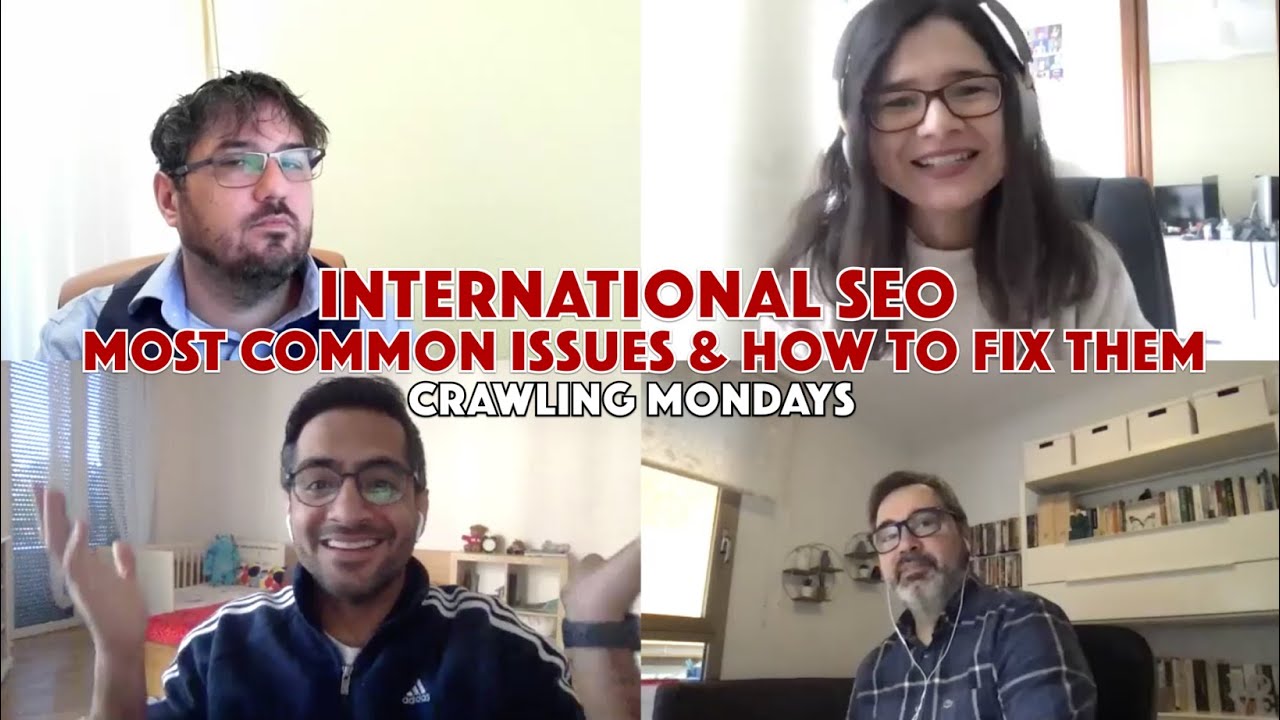
In this Crawling Mondays panel, Aleyda Solis hosts three seasoned international SEO practitioners—Gianluca Fiorelli, Nidhin Manchanda, and David Eveno—to dissect the most frequent pitfalls that companies encounter when expanding globally and to share practical solutions. The conversation covers strategic missteps such as targeting too many markets without proper planning, neglecting tracking and experimentation, and lazy localization. Technical blunders are examined, including improper hreflang implementation (wrong ISO codes, URL encoding, canonicalization), illegal gating, and mishandling of redirects. The panel debates the pros and cons of different site structures (ccTLDs, subdomains, subdirectories) and stresses the importance of link consolidation. They discuss resource‑aware localization tactics, from prioritizing high‑value markets and pages to leveraging machine‑translation tools (DeepL, Bing) combined with human review. Regional nuances, user‑experience considerations (local currency, payment gateways, idiomatic language), and the ultimate goal of converting traffic into customers are highlighted. Throughout, the experts provide actionable recommendations, tooling tips (hreflang checker, Screaming Frog, custom extraction, XML sitemaps), and a mindset of prioritization and validation before scaling international SEO efforts.
Chapters
Welcome to a new and very special edition of Crawling Mondays. Today I have 3 other very highly experienced SEOs with me because I want to make this edition special about the most common international SEO challenges. So of course I had to invite other international SEOs with tons of experience to come and join me today in order to highlight and go through the most common and top challenges across many different types of scenarios and industries. We have here Gianluca Fiorelli. He has his own SEO consultancy too. He's originally from Italy but based in Spain. Nidhin Manchanda.
That's the first time you've pronounced it like that, so I'll take that.
Manchanda. Okay, much more exotic. He's originally from India but he lives in Germany. He used to work in Trivago as an in-house SEO and now he works at Omio. And then we have David Eveno. from Australia originally. After living in London for a bit, he's now back in the Netherlands and he's the head of SEO at The Known. In general, I think he's seen many, many stuff regarding international SEO. If I ask you what is the top one mistake that you see again and again as international SEOs, which would you say that is the top one?
Oh, if I can start?
Please.
The most common one is clients with a website that is trying to target too many countries at the same time without having really planned how to target them. And then they don't know how to do it, if it was worth doing it, if they have the resources, if they have the budget to maintain all these versions. So this is usually the most common issue.
Yeah, absolutely. So for me, I think it's SEO tracking because a lot of people just hear what others are doing and what is working for them and then blindly just copy that. So for me, the biggest mistake I guess is not experimenting, not tracking things. So if you don't track it, you won't know whether it's working for your brand or not because something that is working for another product, another industry might not work for you. SEO is so dynamic. So start tracking things and then see what works for you. And then if it works for you, you can think about expansion. And if it doesn't work for you, you can think about improving it and then testing it again. But yeah.
So I think the biggest one is laziness. So the failure to localize stuff. So, you know, oh, we're operating in a Spanish-speaking market. Portuguese is close enough. Italian, it's kind of the same. Dutch, German, it's a Germanic language. So I think that's one thing which I regularly see. Where a platform launches in one market and I hate to say it, but typically a lot of US companies are prone to this. They will launch into the UK, Australia and use basic things such as American spelling. So, you're trying to optimize for particular keywords, you have no chance. And also from consumers' trust point of view, if I'm going to a site and it has Zs instead of Ss, immediately something's not right. And a lot of these things are very small, But yeah, I definitely think the failure to take time to localize something. And again, they're spending sometimes millions, tens of millions on marketing and they won't spend $1,000 to get some proper copy written for the homepage.
You know what? I think that realistically many of these mistakes are tied to— one may think that has to do a lot with what Gianluca mentioned at the start when many of the companies start doing international SEO and reaching international markets. They do it without really analyzing, validating, sometimes just by copying what the bigger player in the market is doing without thinking, how should I say my internationalization? Is it worth it for me to target countries or to target languages? Should I enable my international versions with ccTLDs or subdirectories? Do I have enough content and technical resources and support and ongoing marketing resources and copywriting resources to be able to maintain all of these international versions? Because when Someone comes and says, I don't have resources. I know that I should be enabling original content for each one of all these versions, but I don't have resources for that. That tells me that you didn't do your work well at the beginning, validating it. If you didn't have the capacity or the resources to maintain those versions, why do you even enable them in the first place? Regarding technical-related issues, which are the top ones that you see and how do you usually tend to fix them?
Well, the gating, so the redirection stuff is— it was more common maybe because I work a lot with the European and European Community-based websites. And so you know, maybe not everybody listening to us know, but by law since I think one year or a couple of years, it is forbidden to gate users into one website. Let's say that I started to see a better situation these days for European websites. But yes, gating for all the other websites, imprisoning people into one version, targeted version, which can be linguistic or geo-targeted version, is still common. What I usually do is really explaining things to the clients. It's relatively easy to make them understand But this is wrong, both in usability, in SEO, crawlability. And so this is a solution that I was able to manage.
I think hreflang is something which is really easy to mess up. And I've seen a lot of companies, even big brands, messing up with that completely. So I've seen a couple of big brands using, for example, wrong ISO codes altogether for language and location. So for UK, companies often use UK, but that's not right. I mean, for that it's GB. That's really common. I mean, I've seen like a lot of companies using different language codes, different location codes, and then like it's really easy to mess up. So that's one big thing. And then I think I would also categorize this particular topic in technical, which is user experience. So basically mapping your demand with right supply. Adidas, for example, is a very good example. They in UK have a category called football shoes. And when they launched in the US, they had soccer shoes because there football is a different game altogether. So if you're creating a page for football shoes and targeting that demand, then it's incorrect. Then people would rather be looking for something else and then you are serving something else, which is not good for user experience. So connecting your demand with the supply that you have is really important. It's really important for user experience. And if you can't make a user happy, then of course, I mean, it's not good.
How do you solve these issues?
Here at Ownmio, for example, we have a recommendation engine. So this basically eats a lot of data from different places. Google Keyword Planner, for example, internal data and so on. So we consider all this data and then make decisions based on that. But in general, I mean, if you want to solve this problem, for example, this particular case where we have football shoes or soccer shoes, we are not sure what people are looking for. when they are based in the US, then probably a very quick thing can be running a paid campaign and then see how it works. Because there you can just put some money and then get immediate results, which is not possible in case of SEO. And that is what I would recommend here.
To identify the demand in particular countries, you mean?
Yeah, exactly.
Okay. And for hreflang annotations?
Oh yeah. For that, I'm a big fan of your toolkit. So you also have a hreflang checker, so XML creator as well. So I would recommend just checking it there because there you can get codes for all the languages and all the countries. That's really easy. And otherwise you can just go to wiki and then get all the language and country codes there and then keep this map in your local system or in your infrastructure so that you're not missing it at any cost anytime.
I mean, for hreflang, it's, you know, the validators, you know, there's You know, various tools like Screaming Frog, Deep Crawl, you can do the custom extraction. So I think it's— you also get the situation sometimes that page or category or product doesn't exist. Or it can be the case that, you know, in the UK you might have 1 or 2 variations of the, you know, the Adidas football boot. And again, we might call it football boot instead of football shoe. But in the US you might have 15 different varieties. So you also have to deal with when you have one SKU in one market and 15 in another. These things can get very confusing. Also, if you're working with different CMSs, I might refer to it as off-white, you might refer to it as white, you might refer to it as cream. So yes, I think in a lot of situations manual mapping is sometimes needed or you just make a decision certain pages don't have hreflang.
I think that that is the key. In fact, what I tend to do when I have a client with millions of URLs and there's a really highly dynamic type of generation of them and sometimes they are not found in the same way across many of these markets. Prioritise. Don't bother starting with those. We need to come back to the issue that hreflang annotations actually want to solve. They are not the ones suffering from these issues of not being shown in the relevant markets, but the top pages, the top category pages, the top location pages, the top listing, the top subcategories, the top facets that exist across all of these markets and sometimes are the names are very similar or in a similar or in the same language that end up competing against each other, cannibalising each other, shown in an inconsistent way. So for me, in a lot of cases, it's simplify it, at least at the beginning, especially if there are not that many technical type of resources and let's start building mapping and implementing measured language in the top areas of the website. Then let's look in analytics, ranking tools, which are those particular pages that have actual geolocation inconsistent issues, and then implement hreflang annotations in those. And if there is no support from a resources perspective, then it's maybe better to generate hreflang annotations in XML sitemaps too.
The hreflang generator tool from Bill Han, the hreflang builder, is amazing for enterprise type of Another thing, sorry, on the hreflang thing, which I see happening a lot, is they mess up the URL encoding. So I worked with a very large job site and they actually found out they didn't actually use UTF-8 encoding on any of their multilingual URLs. So they were actually creating a whole bunch of sort of duplicate content and junk into the Google index because they hadn't correctly encoded the URLs. Although they'd set up the hreflang tags, They weren't actually working because Google's looked at it and said, hmm, this is not the same thing as what I'm seeing when I crawl the site. So I think that's another thing. If you are dealing with a global site, hreflang tag is tip number 1. But then actually look at the URL encoding because you may find that you've kind of only gone halfway.
Where is it problematic? It's problematic when you have canonicalized URLs and you are using the hreflang. Let's create this kind of rule so in order that when a page is going noindex, the hreflang annotation is eliminated. When the URL is canonicalized, then you have 2 options. If you are able to make that the hreflang is always the canonical, or you have a second option. Quit the hreflang embed. Canonicalized page. Because so you are going to solve, I think, at least 60% of the mistake messages about hreflang. So concentrate on always the 200s, okay URLs and indexable.
Let's go to another very big topic that I am consistently asked and Probably you are too, regarding international web structures, whether subdirectories, subdomains, or ccTLDs.
I think a lot of the times mistakes are made. I mean, even I know my own projects, I've launched some local ccTLDs, so .com.au websites, and they start getting some traffic from overseas markets. But then you relaunch the version on a global TLD and your traffic spikes. So I think if you look at big global brands, they typically run on a TLD. So, you know, Booking.com, Pinterest, although Pinterest now uses subdomains strangely. I think it's very much the big players who have a centralized strategy and want to dominate the space. They don't run multiple I guess country-level domains. So I think it's very much the best practice strategy is to go with the top-level domain and use the folder structure for the countries. If you really, really have to do it, potentially subdomains. But the issue is you'll find is you can't often secure a lot of those domains. So all of a sudden in some markets, you know, you know, you're in Spain, you might be the Facebook. And in Mexico, you know, you might be facebook.mx or facebook.com.mx. So I think that's the other thing that's also very confusing for consumers. The same thing when it comes to your link building budgets or content marketing or when it comes to, I guess, branding and marketing. So if I have to customize my marketing for every single market I'm running in, that's very expensive versus if you're booking.com, That's all you go with. We're booking.com. That's a very simple message and it's very cost-effective to scale that globally. Whereas, oh, in this market we're booking.es, in this market we're booking.mx, in this market we're booking.com.au, .co.nz. It's very, very expensive also to buy all those domains globally and manage them. In some markets you have to set up a business unit to register a domain. So, yeah, register domains if you can and make sure they redirect to the correct folder. but definitely run on a global site. Also, I've seen from my own data in my previous role at Shipstead, the click-through rates were vastly higher on a single domain strategy versus a subdomain strategy.
Yeah, absolutely. I totally agree with this because even click-through rate is good because of one brand. So Booking.com is a perfect example. I often speak about that. And even if you ask my grandmom that, hey, what's the best hotel booking website? She'll say Booking.com because that's one brand. that she has to remember, nothing else. And in our case also, Omeo, we have a very hybrid structure. So we have subdomains in some cases because it's really, really difficult to maintain and it's really expensive as well. So our plan was to go to ccTLD initially when we migrated. And for Germany, for example, which was one of the biggest markets, we could not get omeo.de. And sadly, then we went for de.omeo.com. Now imagine a person who is responsible for this market only. How would this person communicate with his friends saying, hey, have you checked de.omio.com? That sounds so unnatural. So from branding perspective, from the CTR and all the signals put together, it's really difficult maintaining different web structures than just one domain and using subdirectories there.
It's much better to have the consistency. And one question, so do you still have the subdomains? Or have you already migrated to the subdirectories?
No, we still have subdomains because when I joined Omeo, the plan was already there and we were halfway there with implementation. So we could not change much. But yeah, if I can change it, if I can make a big change again, I think that would be the first change. Getting organic backlinks. So acquiring high-quality links. That's another important thing because right now for us, it's like 28 different domains. So we need to basically prepare 28 different strategies for getting organic backlinks so that our domain is kind of trustful. But if you have only one domain, this domain gets all the value.
Consolidation. Link consolidation for sure. Happy that you mentioned that. For sure. The problem is about copying other website structures. A lot of people go to Google. A lot of people go to many huge companies that have CCTLDs. Without thinking that these companies have millions or billions and they have all the links in the world spontaneously, that they don't need to worry about link building. And that these are also very legacy type of website structures. Not one that have been necessarily created thinking about what is the optimal type of international setting necessarily. And unfortunately a lot of people start by looking at the big players and saying, oh, ccTLDs, they are the ideal type of international web structure to geolocalise. And indeed, from a geolocation standpoint, they might be already by default geolocalised to the particular country. But the cons for the normal company with not all the money in the world to building marketing, creating or supporting dozens of domains independently might not be necessarily the most cost-effective one to geolocate at the beginning, right? Also, I have to say something important. If you want to go to with subdomains or subdirectories, it's critical to geolocate every single one of them to their actual relevant country through the Search Console. Register individually and geolocate to the relevant country.
I can see only one reason for, let's say, a new business or a business that is entering in a market to eventually not Choosing the subfolder strategy, legal reason.
In a lot, a lot of the scenarios, realistically, going with subdirectories will potentially be the most cost-effective way to do it. In some, it's like, for example, in the past I have worked with a forex company many years ago, and realistically, even if they wanted to go with subdirectories, they couldn't do it so because of legal restrictions indeed. And they had to in their particular case to restrict, for example, US users to enter completely to their European targeted domains because of legal reasons again. So of course it's important. There are a lot of different edge cases here and that is why it's also critical to go to an SEO consultant validating each particular scenario. But unlike many people think too, In many occasions, going directly with a GTLD with subdirectories and geolocating them will be the most straightforward solution, especially at the beginning. What is the best way that you have found to localize the metadata, the content as much as possible in the most cost-effective way? Realistically, the typical excuse and the typical challenge too is like, I don't have enough resources. How do you deal with that? How do you handle that?
It's a question of prioritizing stuff. Sincerely, it's not a question of doing or not doing or doing it using machine learning translation stuff being better. Sincerely, I still find quite buggy. The idea is really, really prioritizing stuff. So what is— okay, you are a Spanish company. What is your second most important market to work with? Is it, let's say, Italy? Okay, let's start with Italy. What are the most important pages you need to really focus on for the Italian market? Let's say homepage, category page, product page, these specific product pages, etc., etc. So doing so, you can surely plan a long, long-lasting localization because it's not going to be done in one month doing so. But doing so, you are able to start localizing the most important things before.
If you're planning to enter in a new market, then of course keyword research to understand demand is a mandatory step. So you cannot bypass that. So once you have that, just try to note down all the intents people are looking for and then just create a list of that. And then based on those intents for different categories, you can think about creating different templates and just rely on these templates to begin with. And once you have more resources, you can think about building a nice structure. For example, we are working on a product here internally at Omeo. So this is basically about not just one template. So we are thinking about using different templates and different keywords that we can use in meta tags. And for each keyword or keyword set of keywords, we are checking search volume, estimated search volume. And once we have search volume for a set of keywords for any given category or landing page, then we can decide on the fly what exactly we want to use. So we use like different keywords and then check median of that to understand the demand for that page in general. But when we're creating meta tags, then we pick the highest search volume keyword and then create meta tags dynamically. But that's a cost expensive— that's an expensive solution. And I think simpler way would be just noting down all the intents and then creating templates and relying on them. And for that, as Gianluca mentioned about this machine learning-based solutions, so I think you can totally rely on that. So that would be cheaper than hiring an agency who writes this content for you. Just, you know, do your research, create these templates using these machines, and then share these templates with these agencies who can verify the content for you. And if they have to make some changes, they can do that. And that solution would be much cheaper than relying on them to generate this content for you.
So your approach is hybrid. Go with machine-based automatic type of generation first, then on a for reviewing purposes, go to human validators, human people, native people who can revise if what you have generated in the first place is correct. What is the technology that you use?
Yeah, well, there are some ultra-smart technologies, for example DeepL. So there is a translator called DeepL which is apparently much better than Google Translate for most of the European languages. Well, there are some exceptions like French, for example, but for many other languages it works So awesome. I mean, even if you're editing, you do not need to make much changes, like 90% accuracy, which is totally acceptable, right, for the first phase. And then you share this content with agencies and they can make minor changes and you're fine with that.
The thing is, we've done this a couple of different ways in the past. So we, in the past, were doing app reviews. So we had 150 reviews and we narrowed it down to there was basically 12 templates we needed. We hired a an agency to do the translations and then basically replied to the various comments based on the particular template. So we hired a native language speaker. Some of the feedback we got from the people was, you know, Google Translate crap. So even if you do it right, you know, people still perceive it to be Google Translate. The other thing I think I look at it, if we're ever doing translation, ideally base language is English because the translation tools have more data to process. But if you are honest about your writing, your quality, it's not amazing in the first place. When people say, well, Google Translate doesn't do a great job, honestly, a lot of the content a lot of us are typically producing is not amazing. The grammar is not perfect because as native English speakers, and I'm probably going to offend a whole lot of people, we're not great on grammar. People who learn English as a second language actually often know grammar better than we do. So I think we need to be realistic about the content we're translating is not amazing in the first place. Typically, the things which I try to advise markets is translate key things at the breakpoints. So again, working with a global jobs company, they found in one of their markets the interaction rate for English speakers was, I think, 10 to 20 times lower than the native language speakers, and that particular market has a very high level of English. So again, use your Google Analytics data to understand where the breaking points are. Also be aware if you've got a JavaScript-heavy website, the Google Translate will often break things as well. So look for translation of key breakpoints such as login, checkout, terms and conditions. So make sure they're translated properly. Because a lot of the times, we can be very much on our high horse that Google Translate is not good enough. You'll find your users who can't speak the language are using Google Translate anyway. So I think it's about making it easy for visitors. You can very much sit on that high horse that we would never lower ourselves to Google Translate. Your customers are using Google Translate. You can see it in your analytics data. Look to help your consumers and sort of get off the high horse that Google Translate or DeepL is not as good as it could be. I think Bing is slightly better in some languages. I actually love Bing Translate. So look at your data, identify which markets or which languages are struggling to perform actions on your website that make you money. Make sure key items such as privacy policies and legal terms and conditions and checkout login pages are translated properly. And then ideally help your consumers. If they're having to cut and paste your content into Google Translate or they can pick a competitor that has a badly translated website, if they're relying on Google Translate, just do the hard work for them.
Indeed. I have to say that it's about what Gianluca mentioned at the beginning, prioritizing on one hand and then being a little bit smart about how we can get there faster at the beginning with the minimal effort. And when we reach a certain point, we can be really picky about it and we can be as optimal and to make the most out of really the opportunity. Because unfortunately, sometimes the translators won't necessarily select the actual term that is actually popular to search for those particular products or services, which you expect that this is something that a native marketer, not necessarily a translator, a native marketer will be able to pick up or understand. Using also search volume and integrating more data sources into the decision-making and validation process. I think that is important. Just to wrap up today's episode, which is the top tip that you think that we haven't covered yet that you would like to share with the audience when saying goodbye?
Regional nuances. Pushchair, baby chair, stroller. So I think that's a big thing, how you're approaching regional nuances if you're in a massive market. That's a big consideration.
Important in Spanish too. So many ways to say car, so many ways to say apartments, for example.
Indeed.
I would more generalize this same concept. It's basically about serving the right user experience. So localization, for example, and then supporting your local currencies as well. And then if you're supporting Spanish local language and local idioms, phrases, everything, but if you're not supporting, let's say, the payment gateway they prefer, then you're again, the entire funnel is broken. So I would think about optimizing the entire user experience so that you're not just getting traffic, but you're also converting that. And then you are getting these users once forever. So I would focus on that along with focusing on SEO elements. But yeah, user experience is definitely the number one thing so that you are not just getting traffic but you're getting high-quality traffic which is converting.
Which is at the end of the day an actual goal for SEO, right? You just don't want traffic, you want actual customers at the end of the day.
One of the effects I see in this sense is websites that are using globally all the same imaginary. And when it's not correct, I mean, one thing means something visually to India and one thing, the same thing means something else in Italy. So also pay attention to these details. No, it's not just written content.
That is great advice. Thank you very much, Gianluca. And thank you, everybody. Thank you very much for your very limited time. Really appreciate it. And looking forward to have you soon again in another episode of Rolling Mondays. Bye-bye.
Bye, Aleyda.
More from Aleyda



How to Communicate and Sell AI Search Optimization (GEO, AEO, LLMO) to Decision Makers



AI Search Optimization (GEO, AEO): What is it, Common Errors & How to Optimize AI for Success



OpenAI has introduced shopping research in ChatGPT - #SEOFOMO TL;DR December 1st, 2025

OpenAI announces Instant Checkout and the Agentic Commerce Protocol - #SEOFOMO TL;DR Oct 6, 2025

Google's August 2025 Spam Update Finished Rolling Out - #SEOFOMO TL;DR September 29, 2025