SEO Agency Growth: How to Grow Your SEO Agency in a Sustainable Way
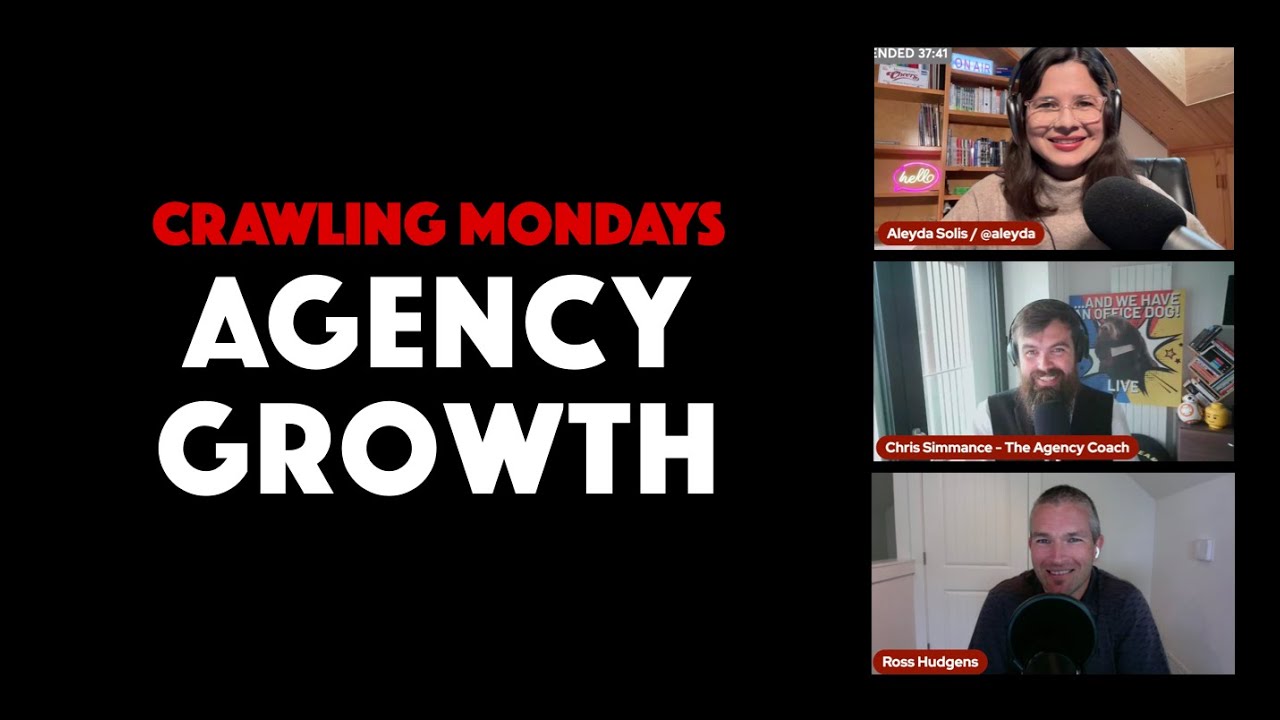
In this Crawlie Mondays episode, Aleyda Solis hosts SEO experts Ross Hodgins (CEO of Siege Media) and agency coach Chris Simmons to discuss the biggest challenges and practical solutions for scaling SEO agencies and consultancies. They explore hiring and retention difficulties amplified by the Great Resignation and pandemic‑driven freelance shifts, the importance of clear positioning and saying no to unsuitable clients, and how role design can hinder or unlock growth. The conversation highlights the need for documented processes, remote‑first workflows, dedicated learning and development, and strong agency values and culture. They warn against competing on price or over‑delivering in proposals, emphasizing value‑based positioning. Practical building blocks include process documentation, learning programs, controlled client intake, and aligning purpose, vision, and values. The panel also shares resources such as the Two Bobs podcast, David C. Baker’s "Pricing Creativity," and "The Art of Critical Thinking" as essential reading for agency leaders. Throughout, the tone is conversational and experience‑driven, offering actionable advice for both boutique consultants and larger agencies seeking sustainable growth.
Chapters
Welcome to a new edition of Crawlie Mondays. In this edition, we are going to cover one of the biggest challenges that any agency face, or even any consultancy or freelance who would like to grow as an agency and expand their services. Agency growth, or how to grow effectively as an agency or as a consultant or as a provider in general. This tends to be a challenge in the digital world because at the end of the day, as many other agencies' business, we rely on people. And what comes first? Do you hire first and then look for clients or the clients come first and then you hire people? Type of chicken and egg scenario, but don't worry. We have 2 people who have tons of experience on it. On one hand, I have Ross Hodgins, who's the CEO and founder of Switch Media. Siege Media is an SEO-focused content marketing agency that has grown a lot in the last 10 years. It's mind-blowing. Hello, Ross. How many people are in Siege again?
Uh, around 120.
120. Amazing. In the last 10 years, he's going to tell us everything later on in the episode. And then on the other hand, I have Chris Simmons. He's the agency coach. Chris has seen it all, right? Like successful agencies who have grown a lot. Then on the other hand, unfortunately, the struggles that many agencies face. But before we start the conversation, I would like to thank our today's sponsor, that is ContentKing. ContentKing is the real-time SEO auditing and monitoring platform. It's that tool that you can configure when you start with a new SEO project and will let you know whenever someone messes up with the canonical tag. Or the meta robots, or they change the title text or meta description without telling you. Unfortunately, it does happen. So go and take a look at Content King. Okay. So I have to start by making a confession here. I have been doing already SEO for a long while, and I have stayed as a small boutique SEO consultant by design. Because when I was an employee, as an agency employee, oh my God, I think that I faced pretty much every struggle that an agency team member could. Like way too many clients at the same time, projects that were sold without actually validating with the SEO specialist. A lot, a lot of struggles. So when I started my own consultancy, I say, okay, no, no, no, no. I dislike the management life and managing. Teams and people and business as a whole is not something that I actually am attracted to, but I prefer to stay small because I really enjoy doing SEO and I want to keep doing SEO, right? And that is okay. But I also reckon that there are so many more people who think differently and have different tastes, preferences, and many of them really, really want to grow, right? Really want to become entrepreneurs and scale. So the first question, what do you think are the biggest challenges that agencies face when looking to scale? And what is the best way that you have found based on experience to address these challenges?
I thought about this a little while, a little while ago actually. And there's, there's kind of 2 perspectives on it that I can see. So there's the right now perspective, the current kind of biggest challenge that I'm hearing about a lot. But there's also this sort of big, big picture. Big picture challenge that agencies face, and the the right now picture I think is that hiring and hiring the right people is a big problem. It's a big challenge that agencies face have always faced in terms of you know getting the right people in, but now seems more evident than ever because larger agencies are inflating job titles and therefore the salaries, which then means the smaller agencies, the boutique smaller agencies, the ones that do great jobs can't necessarily compete. They then hire, you know, maybe less capable people and try to train them up. There's a cash flow drain and it's quite costly and time ineffective. But then on the bigger picture perspective, like looking sort of more broadly across the whole sort of agency timeline, not having a proper plan of where they're going is often the biggest challenge because it's kind of like sailing rudderless. There's always a course correction that needs to be made because They haven't realized that that's where they're headed to. And again, that costs lots of money and cash flow is the lifeblood of an agency. And if you keep kind of making mistakes just because you're not really planned and not sure where you're going, often then you end up not being able to scale when the opportunity comes across you.
That is a really good insight. And probably like what you mentioned before about the roles and salaries and positions, I believe that potentially both have seen this a little bit lately, has to do with the boom And the change that we have all gone through with the pandemic and a lot of people changing jobs. And then on the other hand, the need to start working remotely too, because people have changed their preferences, the priorities. These are things that have definitely influenced beyond the usual, right? And many agencies having to hire fast and provide potentially more incentives for people to join.
During the pandemic, the, um, one of the key things, mostly in Europe, I don't know about what it was like in the States and Ross, you can probably elaborate on but quite a lot of people who worked in agencies were quite good at what they did, went and started freelancing for themselves because they had an awful lot more time on their hands working from home and not commuting, things like that. And they kind of got a taste for it, which then means that when agencies are looking to rehire when their cash flow allows after the pandemic, they're kind of having to rehire freelancers at day rates, which is quite a lot more expensive than the model tends to allow for.
Yeah, yeah, hiring is, is tough right now for sure. Team retention was It has been tough with the— I forget the term everyone's using— the great resignation. Yes. Yeah. So it is tough. It's understandable. I think I have seen a little bit of that, Chris. We mostly hire writers. So there is an aspect of that where it is easier to get a little freelance work if you want that. And maybe that does lead you to eventually go full-time. And a few of our team did do that. So it is kind of more common and something you're fighting against. For sure. So like on the agency side, I do think retention is one of the biggest issues people face to that side of things. And something we fought against historically is like trying to make sure we have those processes in place. Like one thing we specifically faced that maybe doesn't go into everyone's situation, but we hired a role called a content marketing specialist that was research, writing, and outreach. And no one really wanted to do outreach. And that role tended to churn for us. It didn't scale very well. That was, we had great retention everywhere else in our agency, but that role churned and that kind of caused us, prevented us from being able to grow. And we're going to be publishing a post soon. We're actually phasing out of our, a lot of our outreach and focusing more on just content creation. And we believe that will, that's been one of our scalable unlocks is that role. And like designing, thinking we need this very special thing that's just us might prevent you from growing as the agency. I don't know how common. that kind of unique role design is at companies, but I have a feeling that will be a big thing. 2 other quick things that I see a lot is poor positioning. People trying to do everything, take on any kind of work they want, saying yes to every single client. Being willing to say no will help you grow. And then a lot of people focus on new business.
It's ironic.
Yeah, focusing on new business. I think a lot happens like, how do I find these different channels without realizing Your issue is kind of service quality, and that service quality—if you focus on that—the new business takes care of itself a lot of times. So it's kind of like cart before the horse kind of thing.
I 100% agree with positioning because one of the things that I was actually going to mention was that the biggest issue that I saw back in the day when I was an employee at an agency was that indeed, in order to be able to keep up with the churn of clients, was this need of always be selling, selling, selling. But then many times they tried to. Sell things that didn't even make sense at that point, right? And just because they had this pressure, right? Thankfully, because I am a big SEO consultant, I don't have that pressure. But then also I usually tend to have to be referring clients a lot to many other SEOs who tend to do the same thing or very similar things that I do because of my positioning, because I am not a link builder. I am not an SEO who does content marketing. I am not like, no, I am International SEO, strategic SEO, technical SEO, and I can help you to do very specific things. And since I have established myself in those certain areas, I will tend to get clients on those. And then on the other hand, the clients that come my way, they end up being happy and they refer me whenever they have the chance of a friend or a colleague, or whenever they move to a new company because they have had a good experience. So I understand that from an agency standpoint. Minimizing churn with great service, with like specializing well and ensuring that they have a framework in order to deliver and good established process and experience and the insights that are actually needed from their team to be able to deliver what was established helps a lot, of course. But I also understand that is something that unfortunately sometimes is not enough by itself because there's this need to grow, scale, et cetera. You can also do it. By positioning yourself, as you mentioned well, Ross, in a specific area, right? And this is another point. Avoid losing your time on trying to, let's say, like to handle all of these potential clients that don't make sense for you. You don't want your salespeople or pre-sales support people to waste their time going through all of these potential leads that don't make sense also. So from a project validation or client validation perspective, perspective, I do think that is something as important as knowing how to establish yourself, sell yourself well, explaining what you do in simple terms, and establishing a framework to eliminate this insecurity that there is when hiring for SEO processes, right? Because of the complexity and how technical it can be.
An additional thing in the sales process, it builds trust when you say you can't do something. Like it's ironically one of the best things to hear. Just that we don't do that. It's actually part of our pitch deck to say we don't do paid social, we don't do PPC, we let the experts do that. And that's why we think we're the expert on this thing. And that can be very powerful. And some people take the opposite position and it could do the absolute opposite of what you think it's doing.
I think a good, say, 10, 12 years ago, running an agency was a lot different and the mindset is still the same, sadly, in that 10, 12 years ago, an agency was sort of stack clients high, sell things cheap and do everything because everything was an awful lot simpler now. So 12 years ago, SEO, realist, you know, there was still the individual segments to SEO, but realistically one person would do content, technical strategy, all of those things for one client. And that isn't possible anymore. But lots of agencies are still working on this assumption that, Okay, well I can just get a social media person in. There's like 8 different things to do in social media that I can just think of the top of my head. You can't run a model where someone is an expert in all of those things. But by saying yes, you churn the client relatively quickly, which costs money 'cause you've had to market to them. You potentially churn the member of staff, which is even more expensive because you have potentially recruiter fees and all the losses of that. And that just eats away at the soul of an agency leader. It's really tough.
Yeah. So you also mentioned something that is very important, how difficult it was hiring, how difficult it was also to retain people. And unfortunately, I think that there's this feeling in our industry that yes, you go to agencies when you're starting to learn because there's no better place to see many projects at the same time and get all of this natural training across many different scenarios, but You shouldn't expect much in terms of the pay, the conditions, the possibility of growing and actually developing yourself as a specialist. And that, I reckon, that is also the cause of the churn that we see many times in agencies and people jumping and going to look for greener pastures in-house whenever they have the chance, or even as independent consultants. So how do you see this? Is it something that You also perceive yourself as a top challenge, how you believe that companies could target it or could solve it in a scalable way too.
Yeah, I don't know that it's truly solvable necessarily, but you definitely can fight against it. Like we, we try to pay well and continue to do that. Of course, one of the, like a lot of agencies have tight margins. So that's one of the things you're battling with for sure. But one thing we do is we have active learning and development processes. So we have someone in charge of onboarding that actually takes people through training cohorts. Every 2 months and we have like dedicated training through that to hopefully get them up to speed and have a good experience. And we also have ongoing weekly trainings for the entire team in different departments. You can support people through career development budget. I think that helps, but I think you can also embrace that to a degree too, is you, you help people learn. And there might be a point, especially at our size, where that year 1 to 3 for agencies, very often you might be able to grow really aggressively in your title, but for bigger agencies it gets a little harder. But if you do give that experience for people and a lot of different client accounts and they then change jobs to HubSpot or Asana or something like that, that's not something to be depressed about. I think I get a little more depressed when they go join another agency or something that, that maybe that, but I, I think embracing letting them grow and make jumps in their career, if it's done the right way and it's a, it's a positive exit is just part of the agency game as well.
I totally echo both those points. I think one of the, one of the things that you kind of just have to accept is that certain roles will not last forever. You might even change the roles in the agency as the agency evolves itself. As you were just saying, Ross, you're changing some of the roles that exist now, but there's the agency, things move quick. And if you want to learn quick and learn a lot, then you, you, you start at an agency. Um, you don't always have aspirations to go to, to work in-house somewhere. You don't necessarily know that that's an opportunity. Because quite a lot of the time you start working in an agency at graduate level or things like that. So you don't really know what you want and you just kind of know a bit about the internet and you have a play. There's certainly the case that quite a lot of the specialist roles, once you get to— I think quite a lot of agencies are becoming sort of specialist businesses in that a lot of the exec-level doing of things is either able to be automated or anything that is heavy lifting is something that can be done at scale in many cases now. It's quite a lot of the time that you want to focus on the thinking development of your people, because that's where you'll keep them. Because the more people think, the critical thinking aspects, that keeps people excited. They get out of bed in the morning because they've got some, a really tough, meaty challenge to get into, and they'll stay longer. And you can, you know, extract more from your staff and they can extract more from you. And it's a fair process.
I love that you're already sharing tips and steps to how to solve it, right? Which is going to be actually my next question. We have focused on the challenges, but what would you say are the building blocks to establish a good base or those principles that you think that should be there for consistent, healthy, scalable growth in agencies?
Yeah. Uh, we sort of talked through some of this, but We didn't do this until kind of late in the game. Also going 100% remote made us kind of go this direction, but building process documents I think is super critical. We learned, uh, I think it was GitLab that we heard that from, or was it GitHub? One of those two are huge remote companies and they have this whole remote database, which if you Google one of those two, you'll find it. And we learned a lot of just like they document everything in this wiki. Process docs are very easy to change as compared to like videos, even though we do a lot of those videos, but like setting that standard. So every time you, you do something, you write it down will just make life better and scale up with your agency. Having people in charge of learning and development, I think is helpful as well. It's not possible day one, but I was doing that actually very early still in a little different fashion. So I think most agency owners should be. really hands-on if they want to be doing that, those things aggressive, uh, well. And then not saying yes to every client, I think, is critical. We kind of touched on that, but if you're saying yes to every single client, onboarding people aggressively, I think that's just setting yourself up for disaster. We like very commonly would pause new clients, I think partially due to that role design I talked about earlier. But if you're saying yes to everybody regardless, you're going to stress your team out. They're going to churn off of that. The client performance will be bad. That could blow up. And I see like, generally when I see an agency that's like rocket ship growth, most of the time I'm like, that's probably gonna blow up. And so far in 10 years watching that, most of the time it does in some form of at least some negative repercussions from it. So if you're rocket shipping, this doesn't scale well. And if you can do it well, props to you. I haven't been able to do it that way, but.
Yeah.
It's been my experience.
Yeah, I think you're spot on with all those things, Ross. I think the rocket ship is often what people aspire to. They try and get this kind of escape velocity either because they think that that's cool. Headcount is the measure of success for many people. But my answer to this, Aleyda, I'm afraid, is potentially relatively boring. And the boring bits are the things that keep agencies alive. And realistically, if you focus on a purpose and values that an entire business can be bound by. So purpose being the reason everyone gets out of bed in the morning and the values are the kind of shared things that people agree to as ways of behaving and ways of acting in and out of the agency. You can then look at kind of a vision of where we wanna be and that's then your, I wanna be here in X amount of time. And the boring piece, well, I find it absolutely riveting and I really bloody love doing it, but the boring piece is going, well, if we need to be here in this many years, We need to do this in this many years all the way to get to year 1 right now. And that tells you that, you know, you need to do this amount of marketing for the agency with this low level of churn, with this profit margin to keep these people with the learning development and the bonus structures to keep people happy and provide the services to the clients. And often that then is followed up by lots of layers of management and accountability stuff. So systems and processes. boring, but it's not like the fun stuff you see on LinkedIn and Twitter where these agencies are going, you know, junkyard golf and all sorts of cool stuff like that. That happens like once a year. Everyone does the boring stuff all day long. And half the time, if you've done it really, really well, the people who work at an agency just feel like it's normal. They go to another agency to work and they go like, so what are the values of the agency? You haven't got any.
What is the culture? For many, also having a good culture, but a real one, right? The one that will provide also a lot of the meaning and what differentiates the company from others. That is definitely not having a ping pong table in case you have an office, or definitely not having office dogs, right? So 100%.
Yeah.
But I think that because that is something that we see big companies, I believe, like, I don't know, Google, Facebook, like those companies that are supposed to have cool cultures that everybody wants to work for. That have scaled massively, have great brands, have smaller companies try to replicate, but they sort of replicate the byproduct, but not the actual value that will make it a great place to work and a good company in general that at the end of the day, everybody wants to work for and everybody wants to hire at the same time too, that will grow accordingly.
I mean, to use a deliverables analogy that I think everyone in the audience that you have will understand is you're— all of the tools and resources that you share, Aleyda, are fantastic. The Google Sheets things, they're excellent. But if I wanted to build my own and I just took yours and changed the logo, it wouldn't work for the purposes that I have. And if I then sold that as part of what is me and my business and my deliverables, There's always gonna be that underlying, I don't know how this all works, but I'm following the boxes as the boxes get filled in. And whilst you can use a template as a template, if you really want it to be your own, you kind of have to understand why it's a thing. You need to understand why you have the values that you have, why you have this shared focus and vision that you all have. Otherwise, that's when conflict in an agency stops being good. And starts being kind of open Slack warfare.
Yeah, I like the values theme. Like we didn't do that early years, but went to a conference, I think it was called like Founder Conf, or it was for agency owners in the US and they kind of made that a highlight for me to set some values. And I think it has been helpful for giving people shared understanding of how we should work in order to help clients. And to your point, Aleyda, I think the Focus on non-salary compensation is something we've tried to avoid. Like agencies are tight generally with margins, so you should put every ounce of that bean into compensation, in my opinion. Uh, and it, to your point, like the other stuff is just smoke and mirrors. And I think people catch up to that, especially in remote work. It's just so obvious, more obvious to do that, I think, because thankfully we don't have pin ping pong tables, but that's, that's just—
You send a ping pong table to every home of the stuff that you have.
Yeah. We play virtually on the internet, maybe video game ping pong.
You mentioned a few of the principles, the fundamentals, and then also like the type of stuff that people end up doing instead, rather than the hard work that at the end, many of these require trying to close clients and to grow, right. And to be able to deliver something or show the value to clients. A few agencies also end up getting into this process of trying to even overdeliver at the beginning, even in pitches, send audits directly. In requests for proposals, already send actual definitions of campaigns more than just simple ideas. And I do believe that at the end of the day, this also ends up hurting because it undervalues the work of many agencies. And I have also heard and seen this type of back and forth between agencies saying, but what do you do if there is this big company requesting proposal from many agencies? And if one of them do all of this right away just to win the client because they are in this crazy need to close a new big deal, what will the others do? Many of them feel pushed to do the same. So all of this ends up generating this sort of like, what you will end up paying the client to hire you at the end of the day, right? So, well, maybe that is a little bit extreme, but— You see what I mean? What do you think about this? How you can overcome this sort of challenge? Because if you end up competing by price in an aggressive way like this, like providing your value even for free, like how you can establish yourself or what are the tips that you will provide to avoid this type of struggles?
I think, I think if you compete on price, you immediately are not competing on price, but you're capitulating. You're, you're agreeing at that point that you're not worth it. If you send too much in advance, you're proving that you're not worth it because you've already shown all of the stuff that you can do. That sets expectations which can't be met ongoing. And that means that the client that you've spent all this money on to acquire and given a discount on to win and shown all this stuff upfront, they won't get those expectations met in month 3, 4, 5. And by month 6, they'll churn out and then you have to do it all over again. And a bit like Ross said, you've gotta kind of Say no. And I think, 'cause you've got a specialist agency, Ross, I think you know in a sense that saying, knowing exactly who your client is and who that potential prospect can be happen less because those sorts of people that have all of this send all of your stuff in advance and this agency is offering lower, can you do lower than that? You don't often get that if you're speaking to the right people because you've positioned yourself As the experts in a space?
Yeah, for sure. And I mean, we, you still occasionally get people negotiating on a price and things like that, but I think it's a fair conversation. One thing we try to, we don't completely just send a proposal without adding some kind of advice or strategy to it. We try to minimize it for sure. So I'd say like 2 to 3 hours maybe would generally be how much time we'd spend. And then we have another deck that I think the longer you do this stuff, The faster you can build proposals that feel custom, even though they actually aren't as much. Like we have e-commerce client, fintech client, we can very quickly pull content examples, like different strategies that very high level would make sense. Of course, we checkbox those and then add that custom on top of that and within 3 hours. And generally that feels worthwhile most times without going overboard and like Giving free advice, as you say. And it, that is a balancing act. I have heard that recommendation. Some people send one-pagers and I'm sure if that's approached correctly, some ways that's even more powerful for the sale. Like, I'm in so much, if you can just be aggressive, like I'm sure Aleyda, you can do that of, I just don't have time to do this. If you wanna work with me, here's the one-pager. People are gonna say yes to you. But if you do that, yeah, it's, I'm sure it has to be navigated correctly. Depending on the person, but if you can do it, super powerful. I have no doubt.
Amazing. So to start wrapping up, I wanted to ask you if you have tips that you think that we haven't mentioned yet, any resource, any book, any tool that you would like to highlight that you think that could be useful for any agency owner or anybody who would like to start an agency and also wants to see what they can look up to in a few years. Towards growth, to start doing it well, right from, from the beginning.
I'm looking forward to digging into Chris's podcast. It sounds like he has a great agency podcast as well. He's probably heard of the Two Bobs podcast for agencies. I think that's pretty solid. David C. Baker is one of the guys on that podcast who's very strong. Also the co-host, I don't, I forget his name off the top of my head, but he has a book called Pricing Creativity. It's, I think, a great read for agency owners. I found some immediate tips. They talk about that one-page proposal on there. It's like $300. They price creatively or creativity very well, but it's worth it.
From a book's point of view, like apart from all of these books, which I pretend to have read, there's one book which I think if understood correctly and if every single agency member of staff across the planet read, I think it would change the way agencies worked within a week, just in general. It's called The Art of Critical Thinking. Critical thinking is a concept you can surmise really, really quickly into a paragraph, but this book is, they've, well, they've obviously made some money out of it, so they wanted to over-explain it somewhat. But if you read something like that, it does change how you think about solving problems. And then that helps from a leadership point of view, but also delivery perspective. And I think in terms of getting help, I think there's always your peers, there's other agency leaders, there's people in the industry. I mean, as long as no one's arguing on it, Twitter's great if someone needs to be reached out to and ask for some support. And then naturally there's coaches and mentors, but then that obviously has a price to it. So I would always say read a few books around how to build a business because an agency is just a business and understanding how businesses work allows you to deliver better for your clients and then ask for help when you know that you can take advice.
Perfect. Excellent. Those are actually great tips. And also my own tip from my own, let's say, experiences, you don't necessarily need to grow in volume if that is not something that you actually enjoy, right? Because I believe like when you start consulting or you are freelancing a little bit or even establishing a small consultancy that you feel pushed that the only way to grow is like a 10, 20, 50, or 100, 200 people agency. And that might be the path for you. It has challenges as with everything, of course, but if you enjoy them and grow in the process in different ways, that is magnificent. But if Let's say if you don't have that entrepreneurial or the desire to grow in that way, that also many other ways to develop yourself professionally also as a consultant. And for that, we have had also a couple of editions of Crawling Mondays that you can take a look at about independent or freelancers you're consulting to. So this is the beauty of this, right? There are so many different ways to do things. So thank you. Thank you very much, Ross and Chris, for your tips, for your insights. They are quite valuable. Follow Chris, follow Russ. You see how insightful they are. They're very active in social media. Also, if you need to hire a little bit of help with it, if you have the budget too, Chris can definitely help with it, as you can see. Indeed. Very looking forward to also see you in the next Rolling Mondays. If you have enjoyed this edition, please Like the video, subscribe to the channel, and if you have any questions or any doubts, you can definitely leave them here below. I will tag Ross and Chris so they can follow up to clarify any doubts that you may have. Thank you very much, and again, thank you for watching Crawling Mondays. Take care.
Bye.
More from Aleyda



How to Communicate and Sell AI Search Optimization (GEO, AEO, LLMO) to Decision Makers



AI Search Optimization (GEO, AEO): What is it, Common Errors & How to Optimize AI for Success



OpenAI has introduced shopping research in ChatGPT - #SEOFOMO TL;DR December 1st, 2025

OpenAI announces Instant Checkout and the Agentic Commerce Protocol - #SEOFOMO TL;DR Oct 6, 2025

Google's August 2025 Spam Update Finished Rolling Out - #SEOFOMO TL;DR September 29, 2025