SEO Clients Management, Communication & Coordination
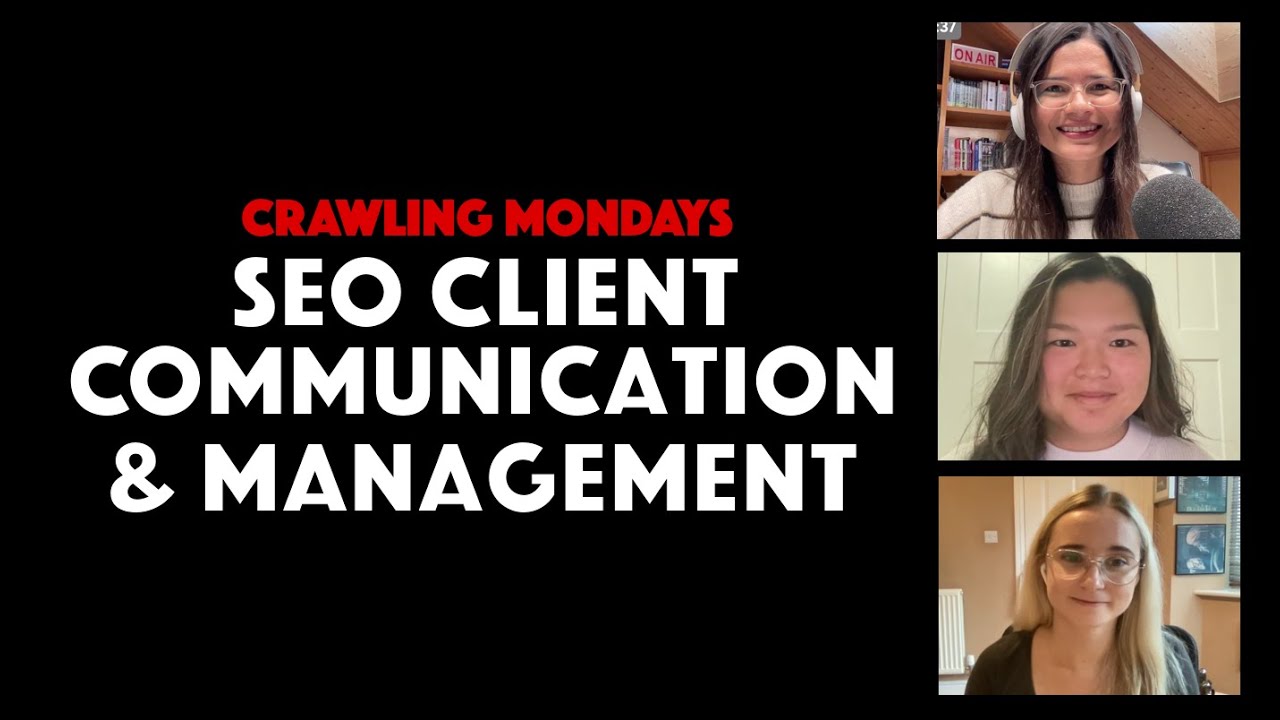
Tessa Vox and Sophie Brandon discuss managing SEO clients without burning out. Set expectations early, stop saying yes to everything, and match your reporting rhythm to the client's needs. Document decisions and tell them what's working and what isn't.
Chapters
Welcome to a new edition of Crawling Mondays. In today's edition, I have the pleasure to talk about one of those topics that we all certainly need to do in one way or another, whether in-house or especially if we work at agencies, right? Managing, dealing, handling SEO clients. How do we communicate with them? How do we coordinate with them effectively in order to manage SEO success? for our processes. And to talk about this, I have invited today a couple of SEOs who have a lot of experience managing SEO clients. On one hand, I have Tessa Vox. Tessa is the Senior SEO Director of Operations at Local SEO Guide. On the other hand, I have Sophie Brandon, who's the Client Services Director at Absolute Digital Media. Before starting the conversation today, I want to thank To our sponsor, ContentKing. ContentKing is the real-time SEO crawler that will alert you whenever something goes wrong on your website or your client's website. So if you don't know ContentKing, you can go to the link below. And now we are actually ready to start our today's conversation. I have to say that in my case, when I started in SEO, I was in the agency side, but I was in this agency where Like every SEO, we used to handle, I don't know, like 30 clients or something like that at a time. So it was quite a bit of a challenge, right? And not only to do our work, but also to deal with that. So I wanted to ask you, what are those preventable mistakes, those issues you think that most SEO consultants or agencies tend to make again and again, especially when starting to handle clients? For example, one thing that happens not only when you are at the agency side, but also in-house is by default saying yes to whatever the client requests or asks you to do, rather than positioning yourself as an expert, the specialist who knows better and is able to advise the client when it makes sense or not to go ahead with their request. I imagine that you have many other thoughts that you would like to share with Polymonde's audience today.
Completely agree. Saying yes, yes, yes to absolutely everything. everything, even if it's out of scope. I've seen this a lot with account managers and kind of spoken to a number of different agencies, and it's an easy trap to fall into because a lot of people are too scared to say no to their clients. They're like, okay, they want this to be done, they're paying us, like, we need to just do whatever it is. But as you said, we're the experts in that. We need to be leading that direction. And I think a lot of that is around not setting realistic expectations as well about exactly What the budget is, what kind of scope that brings, and the reasons why we're doing a lot of things. And that can be from the initial sales process, so how that's been brought on into the agency, and that can even be from the initial conversation that you have when you're kind of discussing the strategy, discussing the website and things. Alongside that as well, I think maybe not knowing what they want to achieve with the campaign and just kind of going ahead, and that really feeds back into the saying yes, yes, yes, because They're not sure what their end goal is and not knowing what that end goal is, is going to basically stop you from driving that strategy and driving the reporting and linking anything back. You're just going to keep doing whatever it is you think you need to do to get some form of result. And that's where you're going to end up tripping up really.
You mentioned something regarding that a lot of this necessity to say yes is because the client starts asking for stuff. that is out of, even if it is out of scope of the project, but it's because of, there has been a lack in the sales process before, in the validation of the right fit or understanding of the scope of what the client needs and what they should expect in the first place. And because there hasn't been potentially even an SEO specialist involved, they have been only a salesperson who have promised this and there or whatever, just to close the deal and the client and the project. And then later on, the SEO manager or specialist in charge have this pressure to have to fulfill all these requests or demands of the clients just because this hasn't been communicated well at the beginning or validated well at the beginning. So this is very, very important that communication and the establishment of expectations should start right when the SEO process is being sold.
I think, yeah, the overarching theme here is communication, like early and fast communication, setting expectations, validating what has been said in the sales process. And really, I think the one that like a lot of people miss is not like overpromising what you're going to be doing. Just keep it simple. And that way you can always surprise people, but you never disappoint. And I think that's like a big one that's easy, easy to do, but if you miss it, it makes like a big difference.
That is important. Just being reliable, reliability in whatever you do is already the base for a successful project. The problem is like when there is not like, let's say an agreement established, well-aligned agreement by all sides of what you are supposed to deliver, do, achieve, et cetera. So the communication bit is definitely critical. On the other hand, something also important is establishing also the resources that will be needed. And setting the expectations that you will need to communicate to with all the areas. It should be clear that there should be like ongoing communication, 2-side communication with the development team, with the copywriting team, with the PR team, all the teams involved within the execution in order to achieve success. And not only communication, but also coordination to be able to manage together the activities. So as a next question, I wanted to ask you, which would you say are the building blocks for an effective SEO management slash coordination slash communication with clients?
I think from my side of things, like we've touched on communication quite a lot already, but I think particularly if you're in more of a kind of a senior SEO position, we deal with SEO every single day. It's not always clear for a lot of businesses, particularly if they're small business owners in particular, what that divide between what SEO is and what development is and kind of how that is all differentiated, like where those lines are. So really making that clear and really understanding what that scope is, is all a part of that communication. Because if you're not speaking to them, you're not understanding that level of knowledge and how much grasp they have of what you're doing, like everything's going to fall down straight away. Because if they don't understand, they're going to disengage very quickly. And it's really It's much harder to win over a disengaged client than what it is one who really understands what you're doing. So for example, if you're sending over like a monthly report, but you're not explaining that and it has absolutely no context and it is just a load of data that means nothing to them, to the stakeholder, to the client, then you're going to end up in a bit of a hole because you could be doing the most amazing work. But if that's not clear and they're not actually seeing what they're getting out of it, or that's not linking back into those main KPIs that they've set, or maybe they haven't communicated with you, but you could be reporting on keyword positions, brand visibility, you could be reporting on traffic to the site, but they might only be interested in ROI and what that's actually making for them. So really, really good in-depth reporting, but also that communication piece and understanding what it is those initial objectives are that you're trying to achieve will help you to build a much stronger relationship in the future and stop things from falling down.
I totally agree. Just the ability to tell a story. With what you're doing and to follow, kind of follow up with the client's goals. And hopefully maybe you're doing extra on top of that. But the ability, yes, to report and communicate those things in a way that they can understand them in a way that matters to them and the people in their business that it matters to is huge. And also just the ability to kind of like wrangle clients. We were talking about how they get a little bit off topic and how there's a lot of like out-of-scope activity that kind of Gets brought up a lot and tries to get like pushed on consultants and agencies and just the ability to be able to wrangle that in and manage it, the ability to say no and how to like say no both like politely and also to like drive it back to like the original strategy and alignment is huge. And I feel like the most successful clients have the ability to do that and do it well.
Yeah. And just to add to that as well, kind of honesty and transparency, because not everything in SEO is going to work first time. And I think a lot of SEOs and agencies really shy away from this and they're Again, almost too scared to turn around to the client and be like, okay, we tried this, but it didn't work. Like they just tend to show everything that's in green. So businesses are not stupid. Like they know that not everything we try is going to work first time. Like everyone has a bad day. Like if everything's perfect, then they probably think you're actually skewing the numbers. You're skewing something. It's actually going to probably cause a bit of distrust there instead. So it's important to showcase like what hasn't worked and we've actually learned from that and then how we've adapted that with the strategy. And again, it all just ties back into that reporting and that communication.
I love this because you mentioned, I think, 2 things that are fundamental. Storytelling on one hand. I truly believe that the capacity to engage, to connect with what each audience and stakeholders understand and is looking to achieve with the SEO process is critical. And for that, the KPIs and the goals that you are going to report on with director of marketing will be completely different than the CEO or the director of operations that is also supporting you in the implementation or the director of content that is also giving you a share of their efforts to achieve certain type of SEO activity. So it is so critical in order to better engage, communicate the success, and also show the value of your work for their areas of what they care about that we are able to craft Not only the SEO reporting even, but also when we recommend things. Whenever someone asks me like about tips about good SEO recommendations rather than, okay, comprehensive audits, which is great, but how you communicate that in a way that is actually meaningful for the business and for the person who's receiving this recommendation. So they see the necessity to implement it. Then the second bit of it is when we communicate at an ongoing basis through reporting. I still see today a lot of pretty much generating automatic reports with SEO tools, right? Which, I mean, it's great that we can leverage all of these SEO tools in order to graph and to monitor at an ongoing basis the evolution of our work. But one thing is what we monitor through a dashboard, and a completely different thing is what we report on based on what actually matters to each stakeholder that we're communicating to. The frequency, the metrics, the type of goals that each one of them want to achieve or what they care about should be completely different, right? And for that, a little bit of personalization is needed and storytelling is needed. Regarding honesty too, I think that that is fundamental. And again, I think it ties back about good initial communication of what to expect and setting expectations, because if a lot of us still today are afraid to say that something hasn't been successful, it's because we haven't necessarily established realistic expectation of what is SEO and how does it work, right? Like how we can sometimes establish hypotheses. Sometimes it works, sometimes it doesn't. It's normal and it's natural because it's not us who have direct control of what happens in the SERPs, but a lot of other factors. So sometimes it works, sometimes it won't. And what is important is that what you mentioned, Sophie, indeed, what are the learnings and what we are going to do next based on the results, right? Like it's important to have like an alternative to have some conclusions based on what has worked and what hasn't. I also believe that many of us obsess a lot on establishing certain pace of our communication or coordination. So for example, weekly calls, biweekly reporting. Sometimes I have seen like companies doing biweekly reports, like really, like, I mean, you implement stuff once every month, you have monthly launches. Do you really expect to see biweekly changes. Like it doesn't even make sense. Right. So I have seen a mismatch based on your experiences, too much or too little, right? Like what is, what is that sweet spot that you have found with clients or the criteria to establish it depending on the process?
It really depends on the client. Some clients are a little bit needier than others. And some clients are kind of not forget about you, but they're like, you're definitely in their background. So I think it like the typical SEO answer, but it depends. I think, you know, at LSG we try to keep like weekly communication with a client, whether they've asked for it or not. Just like even just a general, like the notion of like, hey, we haven't really forgot about you. This is what we're working on. This is what we're doing. This is what we've done kind of thing. Just a quick, just a quick email to let them know that we're thinking of them and, you know, we have them, they're top of our mind. But also I think it also depends like what else you have the client integrated. Like do you have them integrated into your PM system so they can really see step by step? Do you send out like an automated something? Yeah. What is your normal like meeting cadence? It depends on all those other things too, because like you mentioned, you don't wanna overdo it, but also you don't wanna leave clients like following up with you like, hey, like ting, ting, ting, are you in there? What, you know, what are you doing with our money? So it really just depends on the client and feeling them out.
Yeah, I completely agree with that. I mean, as you mentioned, Aleyda, like I know of clients and of situations where they're asking for weekly reporting. They're like, bring a new set of slides for every single weekly report we have. And then we must also have a monthly checkover and then a quarterly checkover and then everything like this. And it's like, So clearly you don't understand SEO. So let's take it back to that education piece. And like, so this is actually what you should be seeing, the expectations you need to put in place. But I do think like really regular check-ins with clients is important. So as you said, Tess, like making sure that they're not following up with us and that we're being really proactive. So for us at Absolute, we recently introduced Slack to do that with our clients. So originally it was all via email. I was doing a few feedback calls and things like that. And they, were kind of finding that maybe our responsiveness wasn't as good as what they would expect. So we were like, okay, cool, what would be a solution for this? Let's try like an instant messaging kind of platform. And Slack's really worked well for that because you can, rather than just keeping the whole conversation just about kind of like SEO or any of the other marketing channels, you can just drop a quick message on a Monday to be like, hey, so-and-so, like, how was your weekend? You can actually try and build up a bit more of a personal relationship like that. Now, There are some hit and miss things when we're talking about kind of instant messaging apps for client use, because we need to obviously make sure that it's not being abused by clients, that their expectations are like, they're not putting too much pressure on our account management teams and they're not expecting out-of-hours responses. So it's important to put those kind of boundaries in place and those expectations in place. But it's really helped us just to build better client relationships overall and just manage those expectations a lot better. But in terms of those reporting, I think a monthly report is absolutely fine because you're doing A certain amount of work every month. You're normally working to monthly retainers in most cases in agencies. Or if it's things like digital PR, that could be quarterly. But just having really regular updates of, hey, this is kind of the thing, this is what we're working on, or these are some trends we found, or this is like one of the latest Google algorithm updates and this is the information we have about it. And just keeping clients as up to date as possible about what's going on.
I totally agree that it depends a little bit on the type and nature of project and also like the, the Capacity of the client to implement stuff that needs to be communicated and validated with them, and also what we have agreed at the beginning with them. It is important to have this share understanding of like okay we are going to do weekly calls if there's something to be coordinated, to be launched, whatever. What I tend to do also with certain clients if I see that the cadence of of the work is not the one that we initially expected and and they're a little bit slower, I try to be proactive and say hey have you done anything this week or have like Have you done any progress on this as we had already expected? If so, let's definitely have a catch-up as we had planned in a couple of days. Otherwise, let's follow up next week when you have already done this. Can you please let me know? It's used to show that on one hand, we're on top of the things, but on the other, that there's flexibility going on. And sometimes it doesn't make sense to do that call that we had initially arranged just to say like, oh, we have, you haven't. They haven't been able to do anything. You're not able to validate anything. Like there's no point for the call, right? So I think that a little bit of common sense there and flexibility and good communication is important on one hand. Then you also mentioned, I believe, something that is fundamental here regarding this, let's say, way that we use the tools. You mentioned Slack and I have this love-hate relationship with Slack and I love Slack because of The ability to communicate synchronously when it's actually needed, when something goes really bad, when something needs instant action or a quick clarification that is trivial and it's just for quick alignment, because it will take longer to go to the project management system and wait. But then on the other hand, I can definitely see how many, many, many times both instant messaging and email even is misused. To discuss stuff that should have been put in the project management system in order to be seen not only by you, but to be easily referred and validated by a bigger team of people and to be well documented that needed some, a little bit of more in-depth analysis potentially, and can be followed up in an asynchronous way. Right. So I established this distinction and tried to also at the beginning of the process to set the expectation well of what is doable or reasonable to discuss over Slack indeed for those projects in which I have it and in which others it doesn't. And we are going to discuss in an asynchronous way, many times even me recording my screen and explaining stuff. So whenever the client comes back online, like a few hours later, they see it and it's good. So even for complex stuff, it can be done like that. Otherwise I'm afraid that The excess of that instant messages can make us go a little bit crazier and not being able to effectively do our work, right? Because we're always getting those instant messages all the time, right? Like I have even heard about horror stories, especially of SEOs, thankfully not me, and I will never do this, but of SEOs handling things with WhatsApp messages. It's like, what are you telling me? Imagine receiving chats. Through WhatsApp, I've seen it from business owners asking through WhatsApp at 8 PM, like, no. And expecting an instant response, because that is the thing. Whenever we send something through instant messaging, the expectation is that you reply right away because of the nature of the medium, right? So there's a fine balance there. It's important to establish what can be expected, what is not reasonable to expect, what Should be discussed through each medium? What are the type of criteria that you use to set this with clients?
Yeah, I think like you said, we've had the WhatsApp thing. We've had clients message us over WhatsApp for some unknown reason and somehow managed to find people's mobile numbers that were not even passed over, or they've accidentally called, say they're out and about or something, they've called the client via their mobile, the mobile phone's been picked up, just awful things like that. So yeah, it's Pretty crazy. But in terms of those boundaries that we're setting, like, we are very clear to our clients, like, these are our working hours. If you're sending messages within this hour, you typically get, say, a 24-hour response because that's what we'd normally do with our emails anyway. We do like our account managers to kind of just go in even just to acknowledge it as well, just like a little thumbs up. Like, they don't even have to go back to it at that time or anything like that, but just making sure that, like, clients aren't being forgotten about. But it's just making sure that, like, Clients aren't expecting out-of-hours responses. They're not expecting things always instantly. And just making that very clear from the minute it's set up as well, to just be like, this is what we're using it for. We send out a Slack guide now as well. That's something new that we're putting together to be really outlining these expectations for our clients. So it is 100% clear for them and 100% clear for us as well how we're using it, why we're using it, and kind of how they can expect that communication from our teams. So yeah, just really making that very clear is super important because you will get clients, especially small business owners where this is a large portion of their marketing budget or it's all of their marketing budget. And again, they don't really understand SEO, but they kind of know that they should be doing it because someone down the pub told them that that's what they should be doing. So they want to be constantly monitoring it. But just making it super clear, and that's where your reporting can be really helpful and it can move a lot of that communication away from instant messaging, constant kind of calls, weekly calls. We've had clients even phone up like 3 or 4 times a day every single day and take up loads of account management time because they Didn't know what to expect. So just making that really, really clear from the off is just super important.
Communication is all about expectations. The expectations that you like set with the client and then also the expectations you follow up with. Like if you tell the client, you know, you can expect to hear response from us within 24 hours, then you should, you should really do that. Like not like 3 minutes after they send an email, but maybe like wait, because if you, you know, set the expectation that like within 24 hours, but you're constantly like replying to them almost instantaneously or quickly, then they're going to expect that. And then the second it doesn't happen, like we, the agency side, are like, yeah, we said 24 hours, but they're like, you know, the unwritten expectation is 1 hour because that's what you always do. So yeah, it's really what you follow up with and how you set expectations up front.
Now that we're talking about different formats and mediums and messaging systems, I know You said that you love ClickUp and I would love to hear a lot more about it. Which are your favorite tools? Which are those tools that you use and you love? I would love to hear how you use them too in order to effectively communicate and coordinate stuff with clients.
Sure. I can go first. Yes, I am a ClickUp enthusiast, if you will. I do love ClickUp. We use it internally for project management, but also we're going to start bringing our clients into like certain, they'll have certain views or, you know, capabilities within there. Not to like change anything on our side, but just to be able to communicate to them so they can like see what we have going on. The questions that come up in our comments, they'll have the ability to comment back, things like that. I think it just takes a lot of the guessing game out for them and a little bit more of like communication without like having to overly communicate to them. So that's really nice. But internally, yes, we use it for everything for project management. We also keep client data in there. We have what we call like client information center so we can keep all of the resources, project notes. Meeting notes, sales notes, all the things in there. We also use Slack internally. We haven't invited our, our clients to it yet, but that's a really interesting thought and I haven't really thought about it until now when Sophie mentioned it. But we also use Notion for documentation and other like client type things. We don't really allow our clients to come into it. It's more of an internal tool, but from a client management perspective, I guess that those are the things that we really use.
I love a project management tool myself as well. So we, we use Wrike internally. We might maybe, maybe move into something else, but Wrike's what we've used for the last 14 years. And it's essentially Asana. If you know Asana, it's very similar to that. But what I really like to use with clients more so, because Wrike can get a little bit confusing because it's, it's quite a lot because it's lots of different subtasks and things like that. If you don't know how to use it, it takes quite a bit of time to learn. I love Trello to use with clients because you can pretty much just set up a bunch of different cards, particularly with developers as well. To say, this is everything that's outstanding. You can put as much information in there. If there's any questions, you've got kind of like comment streams on there and it's all kind of in one place. You could just move that ticket into a different stream depending on the stage it's in. So if it's in progress, if it's in QA, if it's been completed, if it's waiting for sign-off from anyone, it can all just go into like a different queue. And it's very easy for us to track. It's very easy for them to track. And we'll typically have like an absolute queue and then the client queue and manage it like that, which is really, really helpful. In terms of like other ways that we collaborate with our clients in terms of tools. So I use Semrush quite a lot. You can add clients into their own individual projects. And that's really helpful for clients who have kind of like marketing managers who already know quite a bit about SEO or may have used it in the past before as well. And it's just a very easy way to visualize a lot of the data that we may use to report on. So that's obviously really helpful. It's not just a bunch of numbers. It's like a nice visual chart, keyword gap analysis, things like that. It's all very, very visual. And then just using things like kind of Google Sheets, Google Documents, and things like that, because it makes things a lot more collaborative rather than having 50 versions of a Word doc sent around. You can get the people that you actually want collaborating on that. And that's again, internally and externally. So we'll put together whether it's a report or a QBR document or really anything like that. We can put all of that together rather than having all of these different versions. Or if you need the client to collaborate on something, say it's a marketing manager putting together a document for the board of directors, then we can help them with that as well. We can fill in our data, they can fill in theirs, and we can help it to tell that story. And we can really collaborate with our clients in that sense.
I do a mix of, on one hand, Basecamp pretty much because it's the easiest. And in my case, it's like whatever the clients feel is more complex for them to deal with, or yet another system in which they need to register and manage and deal with. So a lot of my clients will tend to say yes to Basecamp because it's so straightforward and easy to document pretty much communication. And to easily refer to the communication. And then for file sharing, yes, Google Docs, Google Sheets, Google Slides that we can link from there quite easily. But yes, the main challenge, and this is why many, many clients will end up asking for the Slack channel, right? Because they are already using Slack very likely internally for their own purposes. Then for bigger companies, what I tend to get requested a lot is to, we will give you access directly to our Jira. Or to our Microsoft Azure. But yes, I get access directly to the ticketing system that they tend to use with the development team to follow up because of how easy it is for them to get their team involved and to eliminate that, let's say, extra challenge that the developer, the copywriter, whoever is involved will say is like, oh no, yet an extra system for me to deal with. To start wrapping up a little bit our conversation. I wanted to ask you about that one tip, client communication, coordination, management tip, something that you haven't shared yet today that you think that will be valuable for the audience to know.
So I've touched on it quite a lot already, so it's not kind of new at different times, but properly reporting on the work that you're doing can really make or break the relationship. Aleyda, you said it right at the start, but it's not sexy. It's not a sexy part of SEO. It's admin heavy a lot of the time, and it's sometimes quite time-consuming as well to personalize it and to do it properly. It's not fun. You're not deep diving into the technical depths of a website. You're not doing anything cool or quirky with machine learning or anything like that, or writing some amazing copy. But it is really vital, and it's something that a lot of SEOs forget. And it's that really a report is the most tangible thing that a client will receive. And particularly if you're directly working on the backend of a website that you're not giving recommendations and you're not having to send content for approval and you're just pretty much taking complete ownership of the campaign, the report is all they're getting from you really. So it should really clearly showcase what you're doing, why you're doing it, the impact it's had, and the outcome of that as well, and how all of that links back to those initial KPIs and the KPIs that are most important to the person that's receiving that report, not to you as an SEO. So like I said earlier, you could be doing an amazing job on the site, but if the report isn't showcasing this properly, then you could easily be at risk of having your SEO budget pulled completely because the person who's receiving it might just might not get it. So just making it super clear and personalized to the person that you're— who's receiving that report.
I think the overwhelming theme here is just communication in general. I think One of the biggest things in client management in agency life is really just figuring out communication, how to effectively communicate. Like you can communicate, but there's also effective communication. So really like setting expectations up front, like having the communication that whatever is being said during the meeting, but also like validating and playing back information within your conversation to be able to validate to the client that you understand them and that they understand you that way. Expectations are almost always aligned and you're on the same page and everybody knows what to expect.
At the end of the day, we talk about, about our skills as SEOs of being like highly technical, but at the end of the day, it's like half of the work is getting your clients to implement stuff. And for that, you also need to be a good communicator to be able to showcase or to make them understand the why, the importance, right? And 2 things, like one of them, I think that has been highly implied, but I think it's fundamental, it's critical to document everything. And that is a challenge whenever, like when we handle different project management systems, sometimes the instant text message or the email many times, or whenever we have calls that are not yet followed up with a summary or a recap of the call, that is another risk, right? Like if you are not documenting something that is meaningful, important, that has been agreed. that has been planned or whatever that you have communicated that is meaningful for the process in the decision-making, it has an impact potentially in the goal, whatever, it is fundamental that you leave a document in whatever project management system you're using to communicate with the client, right? Because after a few months or at the end of the month or whenever you're reporting and somebody asks, oh, like, what, but why you are reporting on this or why this has changed or whatever, like, Oh, because we had already agreed on this date, this time, this call, and you can see it here documented.
Exactly.
Because otherwise, even if you have actually talked about it, if it is not written, it goes with the wind, right? And nobody knows. The person who was there also, potentially people change roles, and what you had agreed with the previous manager, with the previous person that you will handle in the project, might go away from the company, et cetera. So all of that, what is really meaningful is important that is left documented. And then another very, very important thing that many times we spoke about this over the reporting, but I believe that is truly critical in whatever we ask or communicate with the clients, like even in the SEO recommendations, whatever, like we always should communicate the why, why is this important to achieve X or Y goal that is actually like meaningful for the person that we are talking with. Showcase examples of competitors who are able to already do this and are achieving success with it, or all the areas of the own business or the own website that is already doing this and is already seeing success or the expected results that we are looking to achieve. At the end of the day, that is what will allow us to achieve the execution that we expect and the goals that we look forward to. So thank you. Thank you both. Very much, Tessa and Sophie. Your insights have been super valuable. I really appreciate them. And as you see, both of them, Tessa and Sophie, are experts in the field. So if you have any questions, if you have any doubts, please leave them here. I will ensure to tag them so they can follow up and please share them through social media where they are very active. And thank you very much again for joining. If you like The video. Remember to like the video. If you're not yet subscribed, you better subscribe so you don't miss any more videos, of course. And very looking forward to see you in the next Crawly Mondays. Bye-bye. Bye.
More from Aleyda



How to Communicate and Sell AI Search Optimization (GEO, AEO, LLMO) to Decision Makers



AI Search Optimization (GEO, AEO): What is it, Common Errors & How to Optimize AI for Success



OpenAI has introduced shopping research in ChatGPT - #SEOFOMO TL;DR December 1st, 2025

OpenAI announces Instant Checkout and the Agentic Commerce Protocol - #SEOFOMO TL;DR Oct 6, 2025

Google's August 2025 Spam Update Finished Rolling Out - #SEOFOMO TL;DR September 29, 2025