SEO For Startups - Tips, Do's & Dont's to Optimize & Grow Startups Organic Search Results
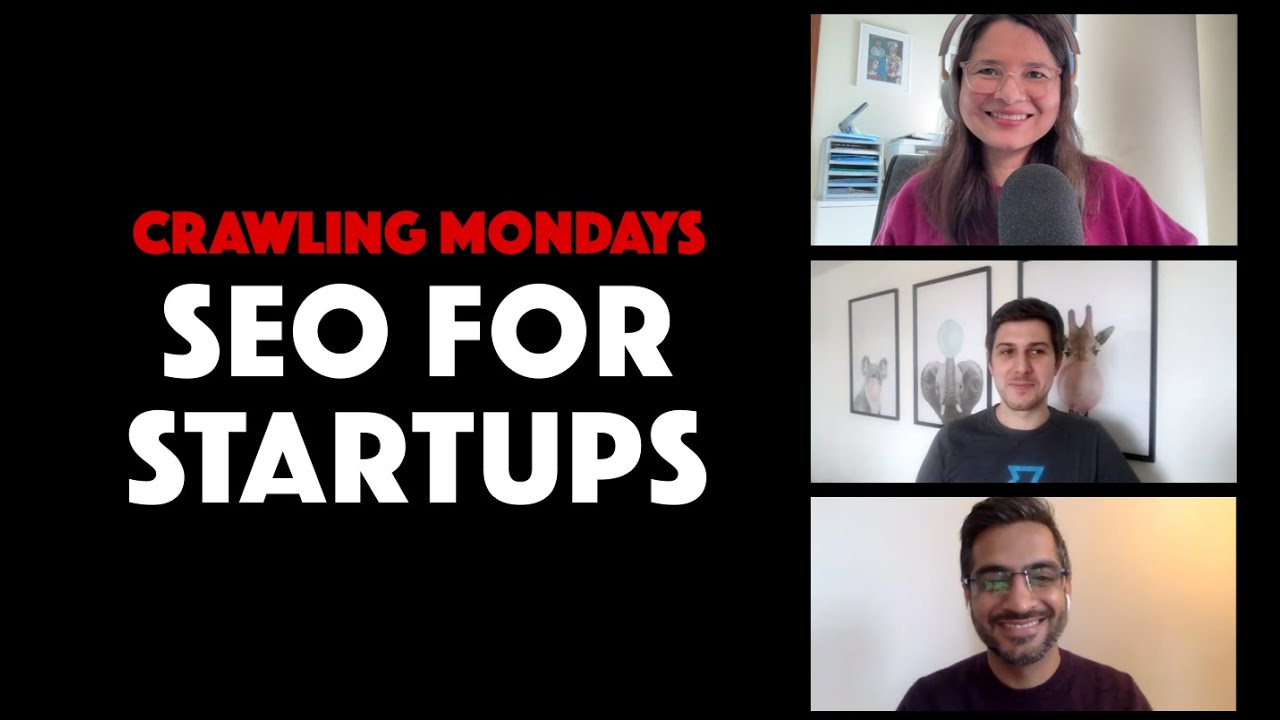
Nitin Manchanda and Fabrizio Ballarini explain how startup SEO differs from enterprise work: new domains have no authority, budgets are tight, and you can't outspend competitors. They recommend aligning SEO with product launches, building targeted landing pages, and using free tools like Google Search Console instead of spreading thin across every tactic.
Chapters
Welcome to a new edition of Crawling Mondays. In today's edition, we are going to talk about a very popular topic that somehow sometimes is not covered as it should be actually, SEO for startups. There are quite a few guides out there about SEO for startups, but whenever I read them, in most cases unfortunately, they tend to cover the typical things that we all need to care about in general for SEO, but knows those particular aspects or configurations or areas that are much more important for startups because of their nature, right? And to speak about that today with me, I have invited Nitin Manchanda. He's the founder of Botpresso, but in the past, he has worked with many startups. Hello, Nitin. How are you?
Hi, Aleyda. Thank you so much for having me.
No, no, thank you for coming. And on the other hand, I have Fabrizio Ballarini, He's the head of organic growth, but also slash SEO at Wise, previously known as TransferWise. Hello, Fabrizio. How are you?
Hello. Hi. Thanks for having me.
Before starting the conversation, I want to take the opportunity to thank Crawling Monday sponsor Content King, real-time SEO auditing monitoring platform. I don't know if any of you, Fabrizio and Nitin, use Content King, but if you don't, you definitely should.
We are a customer.
Yeah. Oh, really? Amazing. That's great to hear. So if you are not, Then you can totally take the opportunity to start right now with the additional time of testing that they can give you if you go and take a look at the link here below. Now we're ready to start with our conversation, SEO for startups. So I want to start with the most basic question about this topic. What is the actual difference to do SEO for startups than for any other type of company, for an enterprise-level company? or even a small company that is a small business, but not necessarily a startup. The first thing that comes to my mind, because I have also had quite a few startup type of clients, is that at that stage, many times they don't have an in-house SEO, they don't have any digital marketing team properly. So it's all about foundation, a good foundation, working well with multidisciplinary teams, designers, developers, but ingraining and establishing, let's say, the blueprint for SEO within the company. I would love to hear from you what you have found that is that characteristic that differentiates doing SEO for startups than other companies.
As you mentioned, and as you correctly pointed out earlier, there are plenty guides out there that will have as a title SEO for startup, and then they mention a bunch of things that anyone would do in any company. And the problem with those guides is that If you are a startup founder and you are not an SEO, they absolutely don't make any sense. And that's probably the first challenge is, as you pointed out, is setting up the team and setting up the foundation or even just like a very top-line vision of what is it that we have to achieve. And I think that the hardest part is probably for a founder. You know, if a founder is an SEO, like you're starting with a little bit of an advantage, but still you are by yourself, right? If you're not an SEO, it's probably this learning phase in understanding even how to buy SEO or how to buy consultants like you, how to work with agencies, how to self-start with your own team. That's definitely the hardest part, at least from what I've seen speaking to founders. And then the second point, this is just recent. I have a friend who moved to a startup and the first question that they asked me is that like, we don't have a domain and that is also a problem, right? We haven't launched the domain yet and I guess it You know, it's probably acknowledging the fact that most of the people don't even have a domain, most of the people haven't picked a brand, and most of the people, if they have a domain, it's a brand new domain that doesn't perform nowhere near as any other company. Even a small business that has been out on the web for a while has got a little bit of an advantage compared to you starting tomorrow with a fresh domain. I think these are the— at least by speaking to people, the 2 Most painful area to begin with.
Especially when talking about setting a foundation, a blueprint, starting from scratch. It's important to establish why SEO in the first place and how SEO will be integrated within the product, the overall marketing efforts of the company too. And here it comes also something very, very important, I believe, at this stage too, that is a little bit of evangelization with the product team, also with the development team too.
By definition, a startup solves a problem which is not solved yet. And that means in some cases you won't even see the demand, right? Understanding the market and what your product offers. That's a very, very core part when it comes to SEO, but in some cases you won't see that. And if you talk about Slack, that's a fantastic example. So they invented this workspace communication problem. They solve this problem, right? And then we talk about Zapier. They also solve the problem of workflow automation. When you talk about startup versus a normal company, a company, a business, which is already established. If the business is already established, there would be some demand. People already are educated to some extent about the product and services. But in case of startups, that's something which is new. So you need to have this growth mindset and it is not just SEO. The market research is a different story altogether when it comes to startup in some cases.
And also the understanding of the product, right? What is the actual benefit and advantage and how to position the product in the first place? I can also see that in many circumstances, the challenge of the startup, even if they are disruptors, the challenge to compete with very well-established websites, properties in the market that are the old school versions of what they now do. So for example, in your case, Fabrizio, with Wise, like many banks or old school transfer companies that had very authoritative and very well-established domains, how do you do to compete with them and be able to grab some market share? that can help it grow consistently. So I can definitely see that as a challenge too. What are the most common mistakes that you see people doing? There are certain use cases and scenarios that might be different, but which are those, let's say, major don'ts in these cases?
If at the beginning we would've tried to play by the books and trying banks that have been out there for hundreds of years, or companies that have been on the web providing services about currency exchange since maybe 20 years, would it be at least One of them I know would be the equivalent of trying to outlink Wikipedia, which is kind of a bit impossible. So it's exactly having the right understanding of the product as well as SEO, which is hard, you know, for a new company to avoid playing everything by the textbook. One thing that we didn't do because of that, decided, okay, we're never going to outlink these people. Let's not focus on links. Let's just try to build the best possible set of pages out there relentlessly for a while, right? Before we worry about links. And then at any point in time, I guess we have to decide, whether this opinion can change. But at least the early days, as opposed to building one page and one link, we decided to build many pages and very good pages. And I guess like the challenge in this area, if you are a startup founder or if you're an early stage team, is to get the confidence that someone more experienced in SEO has got in making this call. And this part probably comes earlier, you mentioned about learning from the community. I've been linking your learning SEO.io, I think, website a lot recently to people in startups, but they need to learn a little bit and they need to learn also to get feedback. We have an amazing community and they can get a lot of feedback from people. As Nitin said, is really to test something or get feedback whether something a bit more extreme could be as opposed to, you know, doing a little bit of technical SEO, a little bit of on-page SEO, a little bit of link building. And then, you know, like 2 quarters' time, not achieving much result or otherwise not betting big enough for some reason, because maybe people are not even searching for your startup in some situation. So I think that's the hardest part. And it's very tempting even when you read the job description for people to join as the first SEO member in a startup or in a marketing team. There is very textbook job description, but probably they don't need all of those things. The risk is doing them because you don't have time. as a new company. And if you do all these things and you're probably going to do them in an average way, I think is a bit of a mistake as opposed to picking one fight really well, like getting really hardcore in one particular area, which then, you know, with time you're going to expand all of them. But to begin with, I feel is a better bet to outrank a giant because some of these people are really, when you look at them at the beginning, you're like, it's never going to happen.
This is even why When you do SEO for startups, you really need to have this very strategical mindset. When you are doing SEO for enterprise-level companies, you have all of the resources in the world, but a lot of bureaucracy to even like implement redirects. You need to wait for months, right? On the flip side, when you work with a startup, it's the other way around. You have much more flexibility. Implementing stuff sometimes will require you just to send a message over Slack or opening a little ticket over Jira in a much more straightforward manner than in a big company. But yes, you cannot do this again and again and again. Otherwise they will get sick of you because there are a lot of constraints resource-wise. So you really need to be very mindful and think very well what you will do with the resources constraints that tend to exist at that point of the journey, what you actually should do with the little resources that you have and to maximize the impact of what you do, I can totally see how that is very important. Also, all types of companies have pros and cons, right? So the pros of a big company, of a big enterprise company, is that they have all of the resources in the world. The con is the bureaucracy. But if a huge big company don't have such a big bureaucracy and is able to implement fast as a startup, It's all a win, right? I can only see success there. On the other way around, if a startup, unfortunately, have resource constraints that is usual in startups, even if they are well-funded, it's usual. And then on the other hand, there is no flexibility that should be the main characteristic at being, having an agile approach for a startup. And you have all the cons, all the bureaucracy that you already see in bigger companies and then constraints of resources. No way to win, run away. Right.
I completely agree with all the points which, you know, you and Fabrizio shared. And I have seen this a lot myself as well. And I think one more thing which I see as a common mistake that startups do is not considering SEOs from day zero. And that's really important because SEOs can help you with initial demand-based validations and also choosing the right domain. Also, you know, with the tech stack so that you're not crying after 6 months that, hey, we did everything. But not getting any SEO results because search engine bots cannot even access the content you have on the website, right? So just to avoid these horror stories is if SEOs are involved from day zero, that's fantastic. And then also if SEOs are involved from day zero, they can also start this internal education flow basically internally so that people know what SEO is and what to expect from SEO. Because that is also a big pain point when the company is established and you bring in someone who has different mindset altogether. That creates a lot of friction in most of the cases. So if someone is hired on day 0 itself, from day 0, this person can tell you, okay, what SEO is and how you should think about SEO. And then I think another common mistake that I've seen happening a lot with startups is comparing SEO with paid marketing. They do this often, right? They say, okay, well, we have been investing in SEO for 6 months and then we have— we're investing in paid marketing as well. And this is how the unit economic looks. You can't even compare them. And SEO, you're building long-term assets. You're building assets for your sustainable growth for long-term, right? We should understand this clearly. And on the other side, if you talk about paid marketing, you are spending money and getting some traffic. The day you stop spending that money, the traffic stops there itself, right? Of course, I mean, you have some brand awareness, so that's there. But yeah, the traffic stops. Whatever traffic you are getting, it stops completely. On the other side, like SEO, Yeah, even if you stop working on something, you have built those assets in the past, they will keep bringing traffic for you. So I think that's really important for startups to understand the difference between SEO and paid marketing.
And now that we have gone through a few of the don'ts or the mistakes that you see, what are those steps that you follow to avoid these issues every time that you start working with a startup that you think are fundamental to avoid misunderstanding, minimizing challenges?
This is really connected to what we just mentioned and what you mentioned about expectations. I always try to have— because like I agree with Nitin that he says, okay, you should start from day zero, but often startups are not even in a position to decide whether they should do it or not, or whether they should do it as opposed to do something else within marketing, because they're pretty much throwing spaghetti at the wall hoping that something will stick and drive growth. So I think like what I always end up— and I spend time with early-stage companies these days just to advise as a friend. I often advise to some extent to get even paid consultants like you, Aleyda, and then like unopinionated people in there. Because obviously if you hire a full-time SEO, this person will tell you that you need to do SEO. If you are an agency, this person will tell you that you need to do SEO. But it's really important to get the expectation mindset right to avoid not getting burned with like commitment, even like simple forecasts, right? Or like finger-in-the-air assumption, oh, we're gonna do this amount of work and this is roughly by when. you could get it back without, you know, we all know that we're never going to be able to forecast this to the day, but at least we can give expectation. Okay. If we do this set of changes or these type of changes are better than other. And then like when it comes to the implementation, then like people can figure out whether they want to hire in-house. At some point we decided to build like a full in-house team. Some companies decide to outsource, but at least this first stage of assessing the situation and having the first 5 things that I would do. list vetted by someone to the point that with some of these startups, I even helped them to hire their first SEO just because the founder couldn't judge the first person. I think these are the steps that like they're far from any action, but they are critical to avoid that the day you go into action, you're gonna like buy resources that you don't need or buy resources that are slow or maybe as Nitin said, okay, we produce content and actually cannot release pages. Right, and there are always these challenges, and I guess getting this first process of feedback loop with someone experienced that you trust is probably critical unless you are the SEO, but most of the startup founders aren't.
So understanding the product is the most important thing. You speak with your consumer, like what they like about your product or services and what they don't like. Talk to them, discuss with them what they would want to see. What is missing right now? And look at market, look at competition if there is any, right? And once you know that, only then you can work on your product and services. And that's the most important part, because if you can't make your user happy, you cannot grow organically or, you know, anyway. So, and product roadmap understanding is another part where you're getting feedback from people and then putting it in there and understanding, you know, what the company is doing in next 3 months, 6 months, 12 months. That's also important because Your SEO strategy is not for next 2 months. It's for next 12 months to begin with, or let's say next 24 months. You are thinking about what you're building. You're thinking about how you can grow your organic traffic. So understanding of product roadmap plays a massive role in this initial stage as well. And then also understanding the biggest. So let's say you are not joining a startup on day 0, but on day 1 or day 2. So you also need to understand what are the biggest SEO wins so far. Or what are the biggest failures? Once you know that, and also the open questions, right? Once you know that, you can plan your strategy accordingly. So these are, I think, really critical things. And you should also think about building processes. You're not fixing things only for today. You're building processes so that when the startup grows and becomes a giant organization, you're able to scale those processes. If you're not able to think in that direction, and by the way, automation is not only for enterprise SEO, it's for startups as well. You should think in that direction. So whenever you're building something, think about how you would scale it. If you're not working on one landing page or 100 landing pages, maybe you're working on 1 million landing pages. So you should think about that. You should think about prioritization framework, because right now you probably only have 5 topics in your list. So prioritization is really easy. You, you know, sitting in a room, you can just raise hand and count those raised hands and you can do the prioritization. But when you have 20 items or 50 items in your list, prioritization will also become difficult. So think about processes and think about more and more brainstorming. Think about experimentation from day one, because something that works for another brand might not work for you and vice versa. So you should have this framework, this mindset from day one. So only then you can grow a company from 0 to 1 and 200,000 and yeah, to million as well.
I love how you mentioned the understanding of the functionality of the tool and how the tool wants to position itself to identify opportunities, to leverage those, to create your moats. And to scale. So you don't need to do it by hand, one by one. So for example, going back to the case of Zapier, right? Every connection between tools is a landing page for them. And to avoid thin, non-useful landing pages that won't really satisfy user expectations, they feature actual different recipes to do with these connections. In the case of Wise, for example, I have seen that part of your strategy has been to create landing pages with conversions across different types of currencies, right? And the combinations of sending money per countries. So I can definitely see as a user, that will be very handy. Also the IBAN numbers of banks internationally, right? Like what is the IBAN? So I can see how you have identified which are those, let's say, needs, questions across the customer funnel, across the whole journey of the user. Those are more informational than others are more transactional-driven and creating content structures that can be scaled with the information that you already have and that will satisfy a need of the user at that stage of the journey. That for me is fantastic.
Even the fact that you understand the product roadmap. If we, regardless of this specific example, if we would have stayed only in UK as a company and only with the money transfer product, would have been way less fun as SEOs that expand into multiple product offerings for business, for consumer, international SEO as well, because you have different challenges with countries. So in all these areas, I think it's really important to understand where the company is going, both when you join that company. Some companies will promise you that they will launch a lot of things and then it will not happen. Sometimes we even build pages for things that are not even live because we know that they are coming in the product roadmap. So like startups are about launching things that you don't have initially. You go out with a proposition solving a very big problem for customers, but you probably don't do it really well. And then with time, you launch a feature that will achieve that. As SEO team, we decided at some point to anticipate this because otherwise we always had the product manager coming to knock our door and say, oh, today we launched, why are we not ranking? And then I'm like, yes, but no one has built the page yet, right? And so we run with a little bit going fast forward on the schedule of the product roadmap to the point that We already build pages 6 to 9, 12 months ahead of when the product will launch because Google doesn't necessarily know whether we can really do this service or not. They know that we have a page and then the day that the product team is ready, we have a good sync between them now to go live on the page. But it's really important that it kind of saves you 6 months. I think time is a really— scalability and time and automation is really important because in a phase where you have to like grow your presence on the web as fast as possible, starting from the homepage only, most of the companies just have one page and I think how you tackle these and how you set up the team to scale pages as fast as possible is important because otherwise you could— when we joined, we had a lot of links because the company was 4 years old. We had a ton of PR, but we only had one page. And no matter how many links, it was one page. And if you can scale the pages, then you also have more footprint internationally, more footprint across, as you say, topics that are relevant to our customers.
What are in general, the tools and resources that you have found that have been more useful for you in your SEO journeys with startups?
So Google Search Console is an amazing tool, right? So you— and it's free. So you definitely should not miss on that. And then Google Analytics also gives you a lot of good insights about, you know, how the users are coming on website, how they're behaving and everything related to that. So that's another fantastic tool. And for reporting and everything, I think Google Data Studio is another free tool that you should definitely look at. There are a lot of amazing templates. Available on the web and you can just use them and start your amazing reporting on SEO from day one itself. And then I love Semrush, their research tools, the whole toolkit they have about research is amazing. And that's like really inexpensive as well. So I highly recommend using Semrush. And I also use their position tracking on mobile app as well. They have mobile app and you can track your position there. And then I've been using Oncrawl now for quite some time. I completely love that tool, but that's a, that can be a bit expensive if your website is large in size. So Screaming Frog is another option that you can use, which is dirt cheap, like $150 for a whole year license. That's fantastic. And then I think using a tool for content production or translation, something like Jarvis, Neuraltext, or Surfer SEO, or for translation, you can use DeepL. So I would not say use these tools blindly for content production and translation. But they can definitely help your content team accelerate more, way more efficiently. Yeah. And then on top of that, I would also talk about Content King. So the sponsor of this show as well. So that's fantastic tool for monitoring your website because you'd want to avoid horror stories while you're building SEO assets in the initial phase. And then I think apart from that, also use Google Suite. So that's fantastic. Google Sheets, Docs, really, it makes it really easy for, you know, shared documents within your team. And Trello is also a free tool and fantastic. So they have like free version as well. Very easy to manage your tasks and projects. And then Slack for communication is another tool that I use. And then on top of that, I think one thing you should bookmark for sure, if you haven't already, that's learningseo.io. So whenever you're working on SEO, there are a lot of questions you have, a lot of topics you want to know more about. So it's a fantastic website where we have all the resources available there right in front of you. You don't have to go anywhere else.
Especially at the start, Google Search Console, that is a must. It's crazy to see many websites that don't yet have it at all. Also Bing Webmaster Tools that can provide you, let's say, another view of the puzzle also to validate. And they have also quite a few handy features that you can use as SEO tools directly too. Even an SEO crawler integrated within the tool. Also, I have seen how many websites that are already a little bit biggish, they don't leverage the opportunity to create independently each subdirectories or even language versions or country versions that they might already have at some point to have more in-depth information.
Especially these days that people can leverage more API as well of Search Console. If you have properties, you can do a little bit more tricks with that. We had a very complicated relationship with tools. When I joined, the person before me that just literally set up SEO a few months bought every single tool out there. So I had to fire them all because I didn't have time to look at them. And then we just religiously looked at Search Console. Google Console plus our own analytics conversion data for a good while, plus simple stuff like Screaming Frog and stuff that you need to have. A couple of tools for our content team to do keyword research, SEMrush, Ahrefs type of tool for like expansion of keywords. And then like, I guess we went in phases. There have been periods where we were buying API, ranking API and stuff like that and build our own tools. There have been phases when we said, okay, too much development time, we buy them from companies. I think depending on which stage you are, You then change a bit your mind on where you're going with the tools. But definitely, I think, especially in the early days where you don't have time to look at everything, I'd rather have less than more.
Thank you very much for your time, Fabrizio and Nitin. I really appreciate your inputs. It was an amazing conversation. And as you have seen, they are quite knowledgeable. They love to share. So please follow Nitin and Fabrizio over Twitter. They are active there. And if you have any questions, any doubts, please leave them below. I will tag them so they can follow up and If you like this episode too, remember to like the episode and subscribe to the channel for more episodes like this. Thank you very much for your time in Crawly Mondays today, and see you in the next one. Bye-bye.
Bye.
More from Aleyda



How to Communicate and Sell AI Search Optimization (GEO, AEO, LLMO) to Decision Makers



AI Search Optimization (GEO, AEO): What is it, Common Errors & How to Optimize AI for Success



OpenAI has introduced shopping research in ChatGPT - #SEOFOMO TL;DR December 1st, 2025

OpenAI announces Instant Checkout and the Agentic Commerce Protocol - #SEOFOMO TL;DR Oct 6, 2025

Google's August 2025 Spam Update Finished Rolling Out - #SEOFOMO TL;DR September 29, 2025