Structured Data and Entity Search Optimization
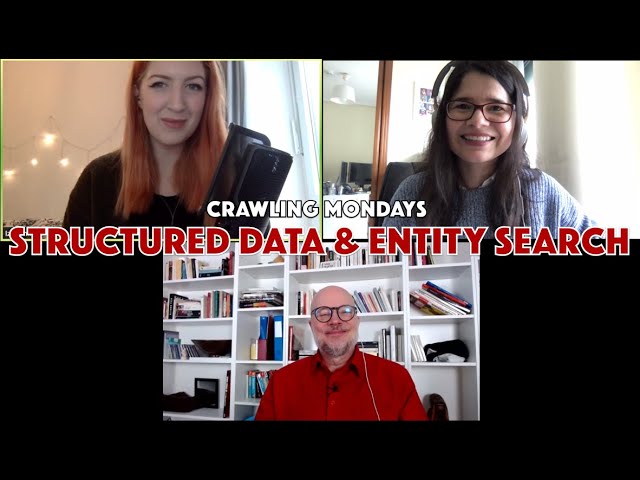
Issa Smit and Jason Barnard explain why Google now ranks entities instead of just documents, making structured data essential. Start with an About Us page and schema markup, test before rolling out site-wide, and use tools like Yoast and Google's Rich Results Validator to track what shows in knowledge panels and featured snippets.
Chapters
Welcome to a new edition, a very special edition of Crawling Mondays. Today with me I have the wonderful Issa Smit, Technical SEO Analyst at Bright. And then I also have Jason Barnard, also known as the Brand SERP Guy. If you hadn't yet wondered what today's episode is about, it's about structured data and entity search optimisation. This is the thing. I think that we know, all of us, why it is important. As usual in SEO, we have limited resources. So why right now do you think structured data and entity search is so critical, is so important?
Yeah, I think it's really hard to ignore the importance of this topic just by looking for the rankings that we have for our clients, not just on the specific products that we surface but also for the brand. Like I know that's something that Jason specializes in and It's amazing what he does there. But just by taking a look on our search engine result pages, on our rankings, not just on the positions in our rank tracking tool, and not just in Google Search Console, but to see the amazing and rich results that Google is displaying there. So we have entity features like knowledge graphs, knowledge panels. We have rich results. We have featured snippets. So much is going on there because Google is moving so far away from documents towards entities. So if we're not optimizing for— we're not applying structured data in the correct formats in the correct way, if we're not enriching our entities, making them more stronger and more connected, then we're really missing out from being displayed in these features. So missing out on a lot of clicks and a lot of relevant traffic to our website and a lot of brand presence as well. Like, that's something that we can't ignore as SEOs or as marketing practitioners.
I love that because indeed we have moved away from just thinking about rankings and positions to visibility in SERPs. That sometimes it's not even like just anymore the bridge to the website but even the destination sometimes to find information. So the more value we can get from there, the best it is.
The fundamentally important thing is your brand is an entity. Your website is an entity. Your website isn't the be-all and end-all. Your brand is the be-all and end-all. Your brand owns the website rather than the other way around. And if you can get Google to understand who you are and what you do— and that's my favorite phrase in the entire universe— is get Google to understand who you are and what you do. And thirdly, the most credible solution for its users. But that's a different question. That's much more to do with EAT. But if it can understand who you are, it can start to think about what you do. So the first thing you want to do is to make sure you've got your schema markup on your site, because your site is the first port of information that Google will go to to get information about you. So if you can identify who you are and what you do on your site clearly in your content, Google will figure it out. If you then add schema markup to confirm what it's already understood, it will become more confident in that understanding. And then if you can corroborate it on third-party sites, preferably with schema markup once again, that confidence will build and build and build until bingo, you get an alignment.
Alignment of signals and maximizing the alignment. So this actually ties really well to my next question. What will be the fundamental steps? that you think websites should do all the time? Like every single time there is a new website and you're looking to start an SEO process or optimisation, maximising the value of your brand visibility, entity visibility and optimisation efforts, what are the fundamental steps to take?
Well, I mean, I'll continue with kind of that. That actually leads nicely into what I was thinking about saying and hadn't managed to get around to it was start with your About Us page. Describe who you are and what you do on your About Us page. Put your schema markup on because that's the basis, as Izzy was saying earlier on, of everything that's going to follow. Google will present your brand in its SERPs to its users in the way you want it to, as long as you provide the information that allows and helps it to do that. It's got no reason to present you in any other way. So you have to take control of your own brand and your own the way you want to be presented by Google, hand that over to Google and allow it then to present you in its SERPs. And just to finish that point is when it does show you in the SERPs, don't ever forget that it's recommending you to its users. They're not your users. Your audience is a subset of their users and it's recommending you. You're asking it to recommend you, and to recommend you it has to understand who you are, what you do, and that you're the most credible Perfect.
So the structured data in the About Us page. Anything else, Izzy?
Yeah, just to touch upon that. So when we're feeding all of this data to Google, sometimes people like some SEOs might say, okay, let's not feed the beast. Let's not give all that data to Google. They're just going to steal our brand entity and so on. So it can be a very controversial topic. But I think this is so important to do in order to take control of the data that we have because we don't want to risk Google or other third-party data sources showing our information. We need to make sure that it's credible, that it's reliable. Again, just to stress this really is like taking control over what we have. So yeah, About Us page, that's really important. And of course, just seeing like which search engine result page features that you can be prominently listed in, in order to drive more traffic. And this comes with a lot of testing. Because just because a featured snippet, for example, exists— let's say, let's take FAQ page as an example, which basically anyone can use. They can mark up, they can create frequently asked questions on their page, they can provide answer content on their page and then provide the markup so that we have the really cool accordion result. And just because we can have it doesn't mean that we should apply it and roll it out across all of our pages. Yeah. So I think in the first instance, while you're getting a good feel about rich results and what schema markup to apply there in order to get those, we really need to do controlled testing. So let's say you want to take a controlled set of pages that have a similar topic, maybe from the same category, and just take half of them, apply that schema markup, and then test results, test impact on not just your click-through rate, but how that traffic coming to your website is engaging with your content. content, is the presence of the rich results, so that increased amount of data on the SERP, does that reduce any sort of concern or, how to say, ambiguity about your content? And then does it therefore reduce bounce rates or reduce exits from your page? Does it increase conversions as well because they trust you more by seeing something like a rating star or aggregate review result there? So don't just roll it out across your website. Really test it.
Especially because it depends a little bit at the end of the day on your own development capacity and the platform. It can be very straightforward. It can be a choice in a dropdown to select which is the type of structured data that you want to apply and select where and specify the naming conventions, the patterns, etc. Or it can be something that indeed it will consume or might consume a lot of resources. So I love the balanced approach of test it first, verify, validate. And also it's not just because you can or you see that your competitors are doing it. What incentivises a lot of people to do it, and especially when clients come and ask it, ah, I see that my competitors are being shown in this way, but realistically, do you have content that will end up profiting from that? And your website, bottom line, will end up profiting from that. So I think that your approach of testing, validating with a set of pages is excellent just to make sure that it really makes sense and the actual value that you get from it besides the click-through rate is positive but much more beyond that within the bottom line. Then also, I think that there's a point on people rethinking a little bit more of how they do rank tracking and monitoring or their presence in the SERPs. There has been a little bit of conversations about this lately. How still many of us, we include already like how many SERP features are being included in this type of results. Takes me to the next question, right? What are those tools, resources that you have found particularly useful to go through this process, to implement this step?
Well, I mean, I personally, I've used Yoast shamefully to do my FAQ, but it works really well.
To implement this FAQ?
Yeah, yeah, I mean, I did it for a client and they've got a hockey stick going on with their FAQ because they worked on it incredibly well. It was very good quality questions and answers. We researched it, we— and what we've managed to do is 2 things, one of which is bringing new clients with questions around the product when people are researching, and also answering questions about the product once they've bought it. So we've actually managed to own both of those ends, which is top of funnel and Below the funnel, as it were. And that was a really, really big success. And I really like Yoast for that because of the way Jono Alderson has built it. It's all these blocks within blocks within blocks, and I love that. So I would recommend very highly Yoast if you want to get started.
Are you sure that you're saying that not because Jono will otherwise kill you if you don't mention Yoast? I'm kidding, I'm kidding. We love you, Jono. in those websites that use WordPress. It's so straightforward indeed.
Yeah, sure. Another one for WordPress, and this is Wordlift, and this is kind of the Italian guy Andrea Volpini, who's an absolute genius with this stuff. But Wordlift, what they do is they build your knowledge graph, and he's got this thing of saying, build your knowledge graph. Think of your site and your content as a knowledge graph that you're feeding to the machines. And I love that approach.
So I really love Mobile Moxie by Cindy Crum, her SERP Radar. Because all of these specific entity features are definitely going to vary across device, across location. So her tool there, where you can enter in a specific keyword and a location, we really get a much better feel of how our entity information and our structured data is being displayed across many different platforms, devices, different locations as well. Because that's so important to remember, you know, you're not just targeting and creating content for the country that you're within, or that specific domain language that you've specified. So there's many different facets that you might be unaware of. So it's really important to check that out. Something that I also really like to do is, I don't know if you've heard of VisualPing. It's something that you can set up on a page and it will email you when something has changed. So I do that on Google's documentation for structured data so I can be fully aware of when they change things around or when they add new structured data types for specific rich results. So that's like, I was aware of the FAQ rich result before they even announced it, which was really funny. And it's good because they change their documentation. They change their restrictions and rules about these rich result types quite often. So it's really good to have that and just to be aware of what to change so that you don't lose your performing rich results as well.
Jason, you have your own tool too?
Yeah, it's the brand SERP tracking tool. Basically you put your brand in, I do invite people to do it, I mean, it's free. I've got 75,000 brands that I'm tracking across the world. I've got, I think, 7,000 from Spain, quite a few, 7,000 or 8,000 in Germany, and I wanna get as many as possible because the more data I get, the more I understand and the more I can tell everybody about the stuff I've learned. And so I've got a collection of 75,000 brands and 12 million brand SERPs that I just go through the data all the time to try and figure out What it is we're looking at, what triggers. I mean, I figured out what triggers Twitter boxes, what triggers podcast boxes, what triggers video boxes, image boxes, and knowledge panels. Go along to callicube.pro.
Have you seen this tool by Cole Handy put together? He built like pretty much the MIST interface to check and validate the existence of any algorithm out there.
I've actually got exactly the same tool on my site too. Yes.
Oh, okay. So please mention about like Oh my god, Jason, you need to self-promote a little bit more here.
I'm totally— I'm kind of against link building in its sort of classic approach. I've always hated it and I've never really wanted to do it. But what I do love is this relationship building. I think that's so important and so powerful to find related sources where you should be relevantly listed on. Increasing that relatedness. So for example, for your brand, you should always search for the topic that you provide, the services and so on, with best. Because usually, you know, Google is displaying these big entity carousels at the top of the SERP. So when I'm looking for best video editing software, there is a list of companies that have been known as being recognized as the specific entity as being connected there. And usually Google is also pulling these from list articles, from comparison articles, from trusted sources. So these are the kind of mentions and links that you should be going out there and getting.
You know what I love seeing? I love seeing the image search results. When you see all of the different types, connected types of images related to you.
Well, it's the ontologies at the top and it shows you how it's categorizing you. And that is brilliant. Bill Slawski was talking to me about that. And if you look, if you search for your own name, your brand name, and you see what ontology it pulls up, you can see if your image strategy is any good or not and the content around the images obviously.
You mentioned many tools. A tool that is obvious but of course it needs to be mentioned is the Rich Results Validator from Google and then on the other hand a very important tool is the Schema App from Marta van Berkel. If you, I will say, are doing this at an enterprise level, platforms that you have created for yourself and you cannot use Yoast or any other extensions, I'm sure that Marta's tool will be potentially the most straightforward way to implement structured data on your site. And just to finish today's episode, I want to ask you, what is the one tip, topic, thing that we haven't mentioned today that you cannot finish the video without mentioning it? Potentially something that goes very overlooked, please.
Well, I'm gonna say something about brand SERPs because that's my favorite thing in the entire world. What I quickly discovered was that if you look at a brand SERP, you read the first 2 or 3 pages, you look at what rich elements you've got, which SERP features you've got, what kind of text is appearing. I've analyzed using Google's NLP what comes up when you analyze all the text that appears on the SERP, what entities there are, what categories it puts you in. But more than that, if you look at all of that, you can immediately get an overview of your brand's digital ecosystem and an overview of how good or bad your digital strategy is. For example, if you don't have video boxes on your brand SERP, you've got a not very good video strategy. If you don't have images, your image strategy isn't up to much. If you don't have Twitter boxes, your Twitter strategy is not up to much, and so on and so forth. If you don't have a knowledge panel, your entity strategy isn't up to much. So look at your brand SERP and figure out what your digital ecosystem looks like and where your strategy is going right and where it's going wrong?
I think something that we really need to do more often is better understanding of the searcher intents and how Google is aiming to satisfy those specific types of intents. And then taking inspiration from that, depending on what content and features they show, and using it to leverage or to improve our strategies with structured data, with content creation, with formatting, and so on. So Cluster your keywords based on intent, such as navigational. So your branded terms or people looking for direct services that you provide. But also informational, like research intent queries are more likely to yield featured snippets. But also, you know, take into consideration these hybrid intents. So it could be transactional research. So cluster your keywords this way, really categorize them as best as you can. Do some research, spend the time to see how Google is aiming satisfy that content and how you can do one better. And by using the features that they're giving to you and then providing the content, providing the structured markup, the structured data, whatever you can in order to be there, to be ranking prominently and proudly, and in order to get those visitors to your website and then keep satisfying them as best as you can with your amazing product and your services.
This is wonderful. Can I just quickly mention a tool? Because exactly what you just said, I'm working with Authoritas, who are actually the tool that gets the brand SERPs for me. They've got an API for pulling the SERPs in and it's absolutely beautiful. It's really powerful. And they've just introduced intent analysis using rich, the rich elements, the SERP features to figure out what the intent is. And it's incredibly accurate. I've been beta testing it for them.
Nice.
And for brand SERPs, they've got it 90 to 95% right.
You know what? Now you're making me think. When a lot of people ask me and tell me like, oh, Aleyda, like you have the knowledge panel, et cetera. Amazing, whatever. But I have to say something. I have to thank my parents who named me Aleyda and not Maria or something far more common because, and I have this issue with remoters and this is funny. I think this is paradoxically Like the other way around when we try to name things in SEO like remoters, right? A lot of people mention remoters not because of my website but because it is the way that they call remote-based people, right? And then I can see how for many brands and websites that are called with generic terms, it's much harder to send aligned signals and much more clear signals for Google telling It is me, my brand. So another point too, maybe you should call your child in the future something a little bit more exotic. Maybe your next website and brand should be something more unique.
Yes.
Just don't take it to Elon Musk standards.
Oh, Elon Musk baby. It's true. Oh my God. No, no. It still needs to be something that people can spell. Like it's not even a name.
It's a Wi-Fi password.
Yeah, it is.
Well, sorry, I think that last point that you made about ambiguity, Aleyda, is brilliant. I mean, I see it all the time with my brand SERPs. The big problem with ambiguity, both for personal brand SERPs and for brand brand SERPs, and then by extension Google's understanding, getting that knowledge panel, getting Google to understand who you are and what you do. The more ambiguous your name, the more difficult it is to disambiguate.
If you are in the process of selecting a name, That new website or company indeed. So thank you very much, Izzy. Thank you very much, Jason. I think that we have plenty of advice and tips, tools.
My pleasure.
And hopefully this will be helpful for you to prioritise your efforts in structured data. And of course, if you want to know more about these topics, you can follow Izzy, you can follow Jason. Of course, if you liked the video, like the video now. Don't forget about it. Subscribe to the channel. Leave your questions. I will make sure that Izzy and Jason answer any questions or doubt that you may have, of course. And stay tuned for the next Crawling Mondays. Thank you very much. Bye-bye.
Bye.
Thank you very much. Bye-bye.
More from Aleyda



How to Communicate and Sell AI Search Optimization (GEO, AEO, LLMO) to Decision Makers



AI Search Optimization (GEO, AEO): What is it, Common Errors & How to Optimize AI for Success



OpenAI has introduced shopping research in ChatGPT - #SEOFOMO TL;DR December 1st, 2025

OpenAI announces Instant Checkout and the Agentic Commerce Protocol - #SEOFOMO TL;DR Oct 6, 2025

Google's August 2025 Spam Update Finished Rolling Out - #SEOFOMO TL;DR September 29, 2025