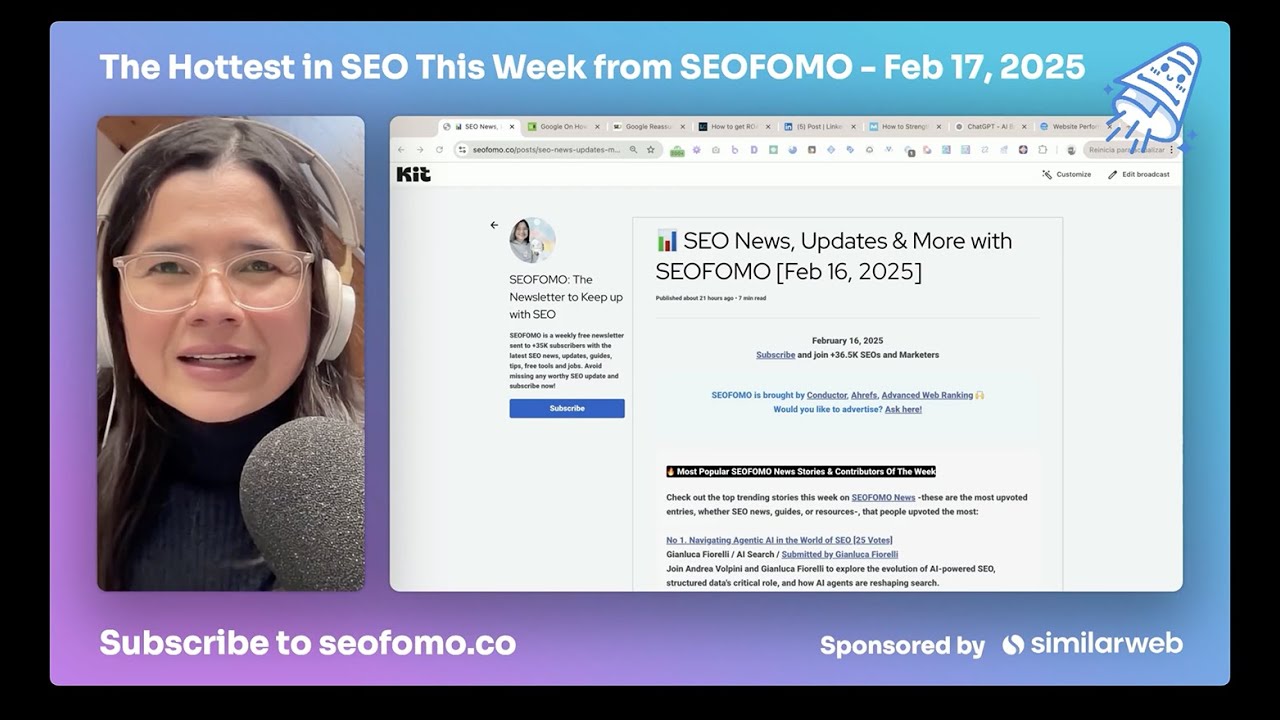
Aleyda Solis covers this week's SEO news: Google's handling of JavaScript and tabbed content, anchor URL behavior in Search Console, GA4 methods for measuring e-commerce ROAS, and why product pages aren't indexing. Includes a ChatGPT app for brand visibility.
Chapters
Let's go through the top hottest SEO news from the latest edition of SEO FOMO. Pretty much your to-learn-ding read from the last SEO FOMO. This new edition is brought to you once again by Similarweb, our today's sponsors. Thank you very much for your sponsorship. Let's go through the top SEO news. The most popular one has been this coverage from Barry Schwartz from an answer of John Mueller about how to tell if Google sees tab navigation. It was an answer to Remy Sharp over Blue Sky when he asked if there's any real-world research showing that Google and other SEO crawlers can navigate JavaScript-based tab systems. And John answered, the challenge to search engines comes when you require a click event in order to load the information. But if the information in the tab navigation or content is, is shown in the DOM when the page loads, it should be indexable. Then he added something that I found to be really, really interesting, that there's a disagreement in the SEO community about how well it will rank even if it is indexable, right? And he mentions how he thinks that the bigger issue is that's easy to confuse users, like making a really long page. Theoretically, the text on the bottom could be found in search because it's indexable. But if a user explicitly wants information like that, they might choose to bounce instead of digging for it because it's very difficult to find. So he highlights the importance about making the really important information that you want to be ranked for also easy to find for users, which at the end of the day, it's totally reasonable and aligned with good user experience. The next most clicked article was another coverage from a clarification by Google's John Mueller, this time by Roger Monte about reassurance that the anchor URLs in the Google Search Console are okay. In fact, I found interesting how John mentioned he is not necessarily a fan to show both canonical URLs and URLs with anchors in them. They are sometimes shown in the Search Console in their performance report, but there's that and we shouldn't be worried about them being independently indexed because they are not indexable. The 3rd most popular article was this very insightful piece by Luke Korty about how to get ROAS for e-commerce SEO using Google Analytics. He explains why last-click attribution is dead and wonders why in SEO in particular we don't use other types of attributions that they do in paid search. For example, he goes through a way of how to actually obtain this information in GA4 from the lazy, very straightforward approach to see how organic search contributed to conversions to another more personalized, but at the end of the day, also more meaningful one that you might want to configure. I think it is about time that we change the the narrative about how we can track and how we should measure and report and communicate the value of our work in SEO. And it shouldn't necessarily be only the last session because of course we know how sophisticated the user search journey can be. Another very popular resource was my post from LinkedIn that it really surprised me how popular it got and shows how many e-commerce suffer from this particular issue, the crawl not indexed product detail pages shown in the Google Search Console indexing reports. I go through different ways to troubleshoot them, to identify what's going on with them. So I explain how we should check if the content is actually correctly rendered. Maybe you're overrelying on client-side rendered JavaScript and it's just too slow to load to get completely indexed. Check if all the unique meaningful content of the PDP is also indexable. Way too many times, just a couple of reviews and a short version of the description are. The rest might be lazy loaded or dependent on a click event and the content is not actually rendered on the initial page load. And if the PDP incoming internal links are pointing consistently to the canonical meant to be indexed URLs through the navigation, for example, rather than pointing to different URLs variations, all of these configurations might be harming the capacity for Google to understand that these are actually meant to be indexed and worthy to be indexed URLs. Last but not least, a ChatGPT brand and product visibility. GPT app I created to help you to identify your brand visibility and opportunities in ChatGPT answers for your top brand-related queries as well as your most popular product-related ones. Go and take a look in case you haven't yet. I want to finish today's edition by thanking again to Similarweb that has been our today's sponsor once again. As you can see, it's a comprehensive digital marketing platform that you can use to identify, assess, validate not only your own but your competitors' performance performance and the behavior of your audience too that goes beyond just organic. If you want to keep up with the latest news through the week, you just don't want to wait until the next edition, go and take a look at the SEO FOMO News. It will allow you to keep up with the latest in SEO pretty much in real time. Thanks again and subscribe to SEO FOMO to avoid missing out. Until the next time.