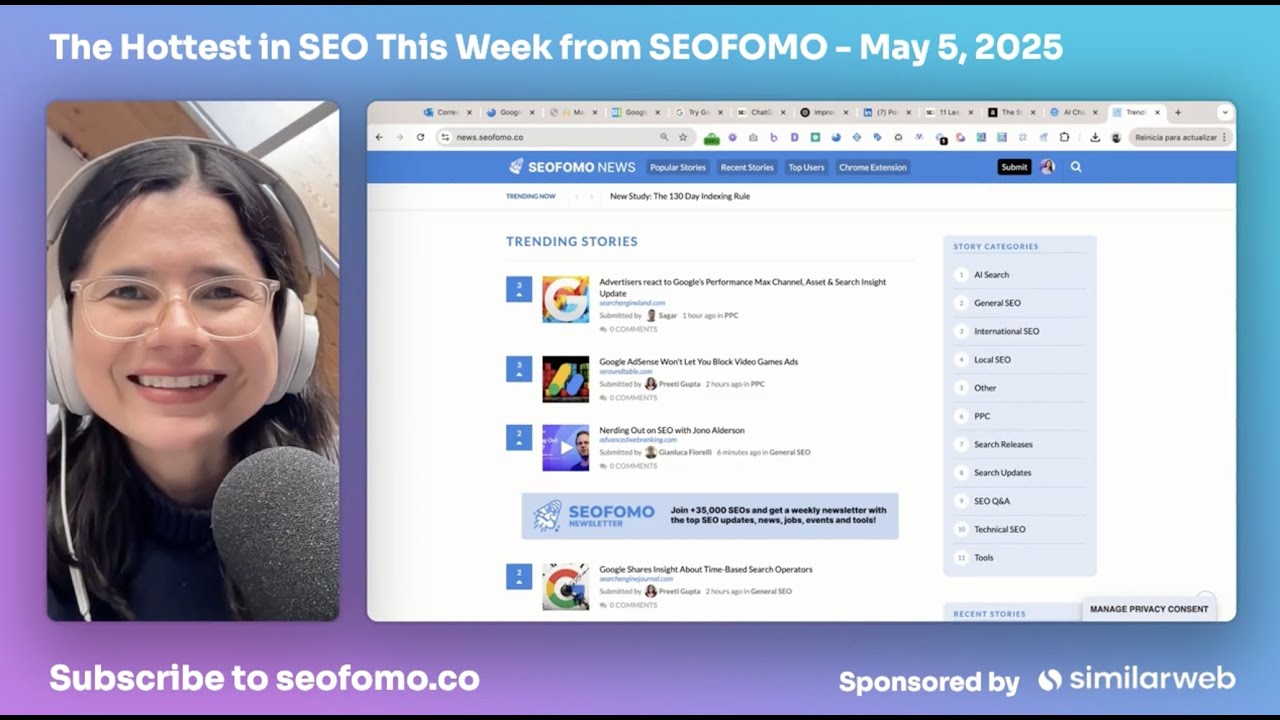
Aleyda Solis covers Google's AI Mode rollout, OpenAI's new shopping experience, and lessons from auditing 500+ sites. She also presents her State of eCommerce SEO in 2025 findings for professionals tracking AI-driven traffic shifts.
Chapters
Let's go through the hottest news in SEO with today's SEO FOMO Too Long, Didn't Read. Today's edition is sponsored by Similarweb. Thank you very much for your sponsorship. The most popular story of the week is the coverage from Barry Schwartz going through how Google AI Mode will start to get tested outside of Labs, drop the waitlist, and add a product and place cards and history panel that it was shown here in the official announcement will look like a business/product panel. Knowledge graph type of panel, as you can see in the screen here, that will facilitate users to see more information about any business that they are looking for. It's interesting to see how Google is accelerating the release of AI mode by testing it with random users in the US, supposedly because they have gotten really good results so far in the already existing test. It will be great to see in the upcoming weeks how this starts to impact our actual website's results. We will need to keep an eye open. The next top story is the coverage of Search Engine Journal's Matt Giess-Southern about the OpenAI announcement of ChatGPT new shopping experience. This new shopping experience, as we can see, allows you to get much more detailed, specific, useful results in a carousel-like type of format. And when you click on any of the products that are showcased, you will get again a product panel type experience where you can click on the actual results. This is obviously a release that established them as a direct competitor with Google for those product-oriented queries for which they hadn't been given necessarily until now the best possible experience. OpenAI actually shared documentation about how they are showcasing these products in the results, how the results are selected, what are the criteria from structured data from third-party providers, model responses generated by ChatGPT before it considers any new search results, and OpenAI safety standards. Also how they get and provide product descriptions, labels, reviews, and ratings. It's interesting to see how reviews and ratings are not verified by OpenAI, and pretty much they are performing as a bridge offering information from third-party providers. In particular, it took my attention how they highlighted how they don't re-rank merchants based on factors such as price, shipping, or return policies, but they expect this to evolve as they continue to improve the shopping experience. So if you want to understand better how the product results are showcased in ChatGPT, this is a great resource for you to take a look at. It will be also certainly interesting how this might accelerate Google's integrations of AI Overviews and AI Mode with the Shopping Graph to take the product packs type of results to the next level. Very exciting. And in this particular case, ecommerce websites might need to start paying more attention to ChatGPT traffic. The next most popular story is this comprehensive guide of Olga's article in Search Engine Journal going through 11 lessons learned from auditing over 500 websites, going through how technical SEO is the foundation for success, how JavaScript SEO can easily go wrong, how crawl budget matters, but only if your website is really big, that Core Web Vitals tend to be overrated, so we should stop obsessing about them, and more. Go and take a look at this comprehensive resource. To ensure that you're not missing something very important when auditing websites, analyzing them, and prioritizing what actually matters. Last but not least is my State of eCommerce SEO in 2025, going through how to win in today's product SERPs based on the presentation that I did last week at SEO Week. I go through the main points with the resources and insights of how have organic search results and SERP features inclusion changed in product SERPs in the last year, how are these organic search results and SERP features inclusion are actually impacting How are these organic search results and search features inclusion actually impacting click behavior across different verticals, for which I identify very clear patterns like generic retailers and publications losing clicks and specialized brands and retailers gaining them? And what should we do about all of this to keep winning, providing specific advice to go through. So don't miss out and take a look at the resource as well as the presentation embedded at the end. I want to thank again Similarweb, that is today's sponsor, Similarweb. Is a platform that allows you to obtain not only SERPs-related details regarding rankings, SERP feature shifts, click behavior, but also now going beyond that and showing you AI chatbot traffic information, the evolution over time of ChatGPT, Perplexity, Claude, etc., traffic with additional insights of how it is behaving. So go and take a look in case you haven't checked it yet. And if you want to keep up with the latest news in SEO without having to wait until next week, remember to go and take a look at the SEO FOMO news aggregator featuring the latest news pretty much in real time. Subscribe to the SEO FOMO newsletter and looking forward to see you in the next edition of the SEO FOMO Tool on Daily Read. Bye-bye.