The Top SEO Myths and How to Dispel them
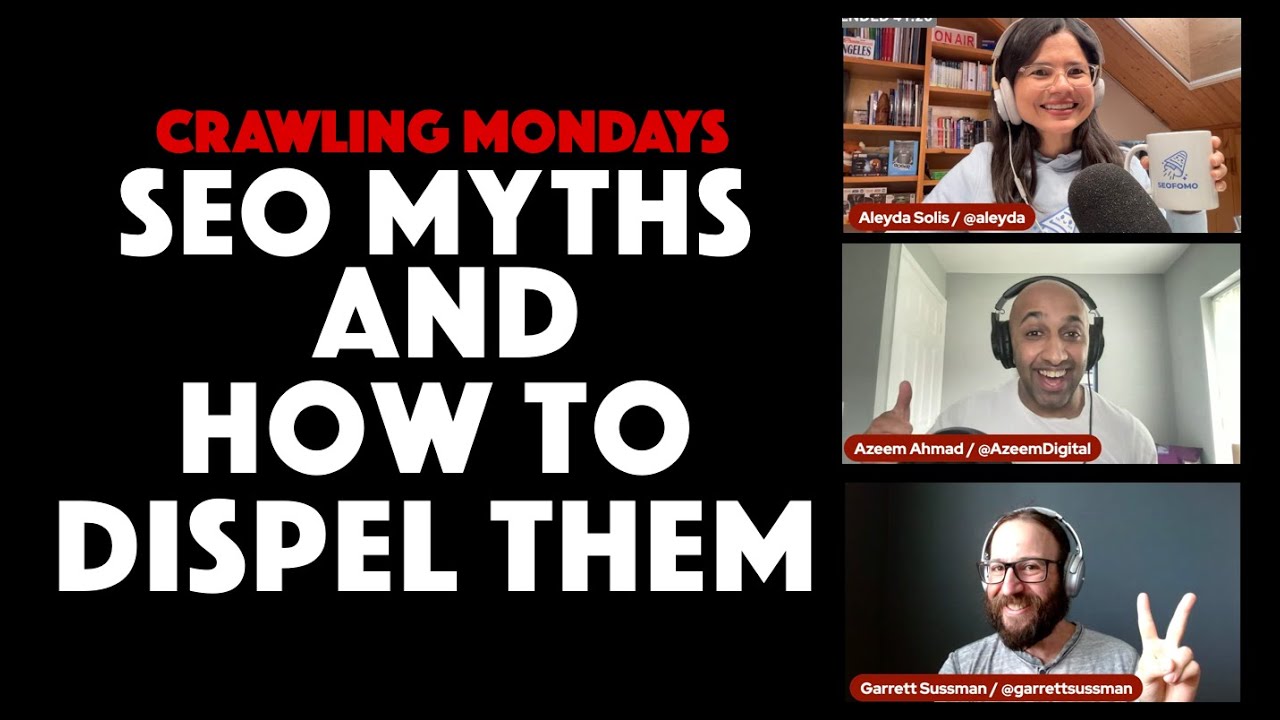
In this Crawling Mondays episode, host Aleyda Solis brings together SEO experts Azim Ahmed and Garrett Tuzman to dissect persistent SEO myths and discuss how to dispel them with data, context, and critical thinking. The conversation begins with a sponsor plug for ContentKing, then moves through a series of widely‑circulated misconceptions: that duplicate content automatically incurs a penalty, that a brand‑new domain must age before ranking, that AI‑generated content is inherently penalized, that longer content always ranks better, and that page‑experience signals are no longer important. The panel also tackles the relevance of E‑A T and authorship, the controversy around AMP, and the misuse of blanket statements in SEO advice. Throughout, the experts stress the importance of using official Google documentation, trusted industry resources (Barry Schwartz, Learning SEO, Moz), and real‑world case studies to back recommendations. They advocate a data‑driven approach, framing recommendations as evidence‑based and hypotheses as testable ideas, while emphasizing risk‑reward assessment, stakeholder communication, and rigorous testing before implementation. The episode concludes with practical tips on critical thinking, testing, and leveraging networks to validate advice, reinforcing that SEO success hinges on context‑aware, evidence‑backed strategies rather than myth‑driven shortcuts.
Chapters
Welcome to a new edition of Crawling Mondays. In today's edition, we are going to go through the most common SEO myths and how they are still a thing and how to dispel them. I believe that unfortunately, even if we have reached already a certain point of maturity in SEO, we're still coming across the same type of SEO myths over and over again. To address this painful situation, I have invited a couple of other SEOs and digital marketers who have a lot of experience also communicating, interacting, speaking with clients and stakeholders to address this particular issue. On one hand, I have Azim Ahmed, Digital Marketing Lead at Asaboy. Hello, Azim, how are you?
I am wonderful. Thank you very much for having me. I'm looking forward to this immensely.
Thank you. Thank you very much for the opportunity and the willingness to participate today. On the other hand, I have Garrett Tuzman. He's the Managing Generation Manager at iPullRank. Hello. Hello, Garrett.
Hey, Aleyda. Thank you so much for having me.
What a—
how cool is this? I'm so excited to dive in.
Before starting our today's conversation, I want to thank our today's sponsor. That is ContentKing. ContentKing is that SEO tool that will let you know when something goes wrong, that you will be able to configure to get those real-time alerts. In case your robots.txt ends up blocking or unblocking certain areas of your website, or if someone changes the canonical tags and starts canonicalizing everything to your homepage for some reason. So for any type of misconfiguration, you will be able to have an alert with them. So go and take a look at Content King because it will eliminate a lot of painful situations in your SEO day to day. You can find the link here below. And now we are ready to start our today's conversation. So SEO myths, it's funny because I believe that when I started doing SEO back in 2007 or so, right? Like a lot of what we consider SEO myths now were at least partially true back in the day. And potentially that is the reason why they exist in any case. So for example, that longer content ranks better, which is not true anymore due to the layers of sophistication and understanding that Google has. But still today, you can see so many articles talking about having a minimum of words, of keywords versus content ratio and things like that. What is the worst SEO myth, the one that you dislike the most? And why do you think that they are still a thing?
For myself, one of the biggest ones, old school ones, is this idea of penalizing duplicate content. And one thing I think about is everything when it comes to myths is about context. I mean, that's why there's this big joke in SEO about it depends, where it's like, no matter anytime you make blanket statements, there's a risk because what might apply to one website in one industry doesn't necessarily apply to another. So the whole idea with this, I penalizing, or penalties in general, for like duplicate content is more of the context of is it helpful for the user? Is there a differentiation enough between the text on the page? And typically that's not actually going to be a penalty. Will you see an influence in ranking? Absolutely. But this idea of if you have duplicate content you automatically get a penalty, I feel like that's a myth.
This is the problem wording. Matters. It's not only about the context, but also how you use the term penalization, right? It's different having a penalization rather than having an understanding on intent, for example. So you can have a different type of content addressing similar queries or even the same query in different ways to fulfill different types of intents across the customer journey. And if that's the case, Then it's okay. On the other hand, if you have the exact same content published across 10 different URLs, all indexable, then it's not that you will have a penalty, but you likely will run into other types of issues on consistently ranking with the page that you actually want to many, many times and will carry other types of issues, right? So it's the balance, I believe, and the complexity of the situation.
I had I suspected that Garrett might talk about duplicate content, so I came prepared with a secondary answer. But before I go on to that, the point that you made there about misinformation and good information, a lot of that good information comes from you specifically. So on recording, I want to say thank you very much for doing what you do. I, and I'm sure many other people, appreciate what you do.
Thank you.
The thing that I am seeing lots of in my experience recently Which I don't know the context of, but for me personally, it's frustrating. It comes down to the myth that a brand new website or a brand new domain will take a long time to rank for anything. The age of the domain has to be a factor for ranking. And I was like, this is something that we as an industry got rid of a while ago, right? But I have been hearing this more and more recently. I mean, I've seen people colleagues, people in other departments, people that I've spoken to at events who sort of allude to this fact that they're struggling to find success with their website. And they might suspect it's down to the age, which I'm not so sure is correct.
Any other myths that you dislike in general?
Oh man. The most recent one that's really been getting under my skin is that if you produce content that uses generative AI, That it can't rank, that you're gonna be penalized for that. And it really speaks to some of the miscommunication that— not miscommunication that Google does, but Google does change their documentation frequently. So like at one point in their spam policies, they did say things along the lines of, you know, generative AI content when it's not helpful to the user is you know, considered spam. Whereas with the proliferation over the last, you know, few months and, and people learning that, yeah, you can't publish necessarily raw content because it's not going to be quality, that's a reason it might not rank. I mean, there's this whole correlation factor. So this is one that's really annoying me because Danny Sullivan's even come out and said, yeah, you— something can be produced by AI as long as it's helpful and useful to the user audience.
But it's reasonable, right? If you think about it, the problem is when you think like, why do you try to take word by word and overthink it and try to apply it in a way that is not reasonable rather than thinking it's like, is this natural? Is this useful for the user? Which at the end of the day is what Google wants, wants to provide a really good user experience because otherwise the users will end up searching somewhere else. So that is the primary criteria. And it makes sort of sense in the past when Google mentioned that they didn't like automated content simply because the level of sophistication of this content and quality of this content like a year ago was nowhere near as the one that can be produced right now just because of the evolutions of LLMs in the last few months happened really, really fast. So what was applicable and relevant a year ago might not necessarily be at this point. And that doesn't mean that it was wrong a year ago, but it can be certainly wrong now. What we need to think about, I believe, especially in this type of scenarios, is like, okay, has the scenario, has the context changed? And has the context changed in a way that actually now it makes sense to change this tactic or this approach? Because now the effect that it has towards users and ultimately the business overall It's actually good instead of bad, right? So this is what I believe happens with not only content automation, but automation and the leverage of AI, LLMs, whatever you want to call it in SEO.
The concept of thought leadership knowledge is almost alien. So when you have that conversation, you start to, you push these types of pieces out. Great. The— you get— it's like running a race and you get right to the end and you trip yourself up when it comes to discussing authors and authorship. We don't need to have an author on there, we don't need to put an author's page or authored by the company. And I'm thinking, we've done 99% of the hard work, right? We're so close. And I think everything— well, we've like went with this helpful content update and the stuff that we've seen come out recently, the point about Expertise. I could talk about this all day.
I love that you touched the topic of expertise and authorship, because I think that is highly, highly related with E-A-T, which until not so long ago, there was this huge debates over SEO Twitter about, is it a ranking factor or no? And my stance was always like, why should I care? I know it's positive. To integrate it into my content because at the end of the day, I want my content to be reliable and highly fulfilling and easy to engage and trust by users. So I don't even care if it is actually a ranking factor or not, but I know that Google rates content taking this as a criteria on one hand. And on the other, I know that is good ultimately for my customers, for my clients, for my users. So why does it matter if X or Y is a ranking factor? Just do it. It reminds me actually how the other day Google mentioned that they were going to stop showing page experience from the Google Search Console as a report. And just that made certain SEOs to start saying that it didn't matter anymore. And it showed that it never had any weight or It had minimum weight in any case. And I was like, look, I think that any reasonable SEO has never— and I think that Google has actually made good, well-weighted guidelines regarding them. I remember that when they released it, they say, okay, it's not only that we are going to dismiss content relevance all of a sudden just to rank the best performing from a speed standpoint page. No, it's about giving weight and of course content relevance and popularity and authority will be always there. But then if you have a million pages being relevant and being highly authoritative and really highly engaging, like which is the one that you are going to rank better? The one that loads faster, that is non-intrusive, that gives the best overall experience? Yes, that one. So I mean, again, common sense. Unfortunately, in life in general, SEO, I believe, is not necessarily unfortunately that different. We like simplistic approaches. And I will completely understand if a lot of this type of debates and hot takes came from newer SEOs that were still learning how it is, but from old school SEOs that I guess that they also like to spark debate over Twitter because of engagement, visibility, whatever. So just a warning, let's be aware that that's unfortunately the case from time to time, and we shouldn't fall into that trap. So having said that, I want to ask you, what are the steps that you take to address these concerns whenever a client stakeholder, especially at the beginning of the process when you're still establishing trust and a set of knowledge and evangelization. How do you address this type of myths? Any type of steps that you would like to share with the audience?
I'll give you a comedy answer and then I'll give you the proper answer. So the comedy answer is to just get a very cheap plugin, any sort of cheap plugin, SEO plugin to the website. Make sure everything, every box is ticked, every light is green and you're good. Screenshot that. You're fine for another 6 months. That is my comedy answer. Please don't do that. The serious answer is everything, certainly from the way that I work, everything has to be data backed. So I will always, always include recommendations with a set of data behind them. For example, a traffic forecast is a forecast. Great. But I will show you my methodology, the way that I work, the way I've arrived at those numbers. I will even account for seasonality, peaks and drops. The overall point is every single thing has to be data data-backed. And if it's not data-backed and that data isn't accessible, I will then put that forward as a theory or a hypothesis. And I will say, right, okay, these are my recommendations and these are my hypotheses, and we can look at these hypotheses as potential tests, but do not take my hypotheses as facts. If I say to you hypothesis X, that does not mean I will deliver X for you. Recommendations are what will deliver. Hypotheses are what will test on the way to get there. Long story short, everything must have data behind it.
I agree with Azeem, and I will also caveat that with addressing it in a lot of the data that's put out there, the correlation component of it, as opposed to everything, as we're saying, has context. And so I would couch all of the education in experience. I think there's a lot of value for, you know, when you're, you know, Aleyda, and You know, like when you're in an agency and you've worked with a ton of clients, you've seen a bunch of different situations and you've seen potential results based on those situations. Because ultimately we have these ideas of best practices, but we live in an industry that's all about science, testing, experimentation, and your comfort with risk. So it's really kind of talking through these flowcharts, talking about the risks, the priorities, and couching it in the education of what's come before and your own personal experience. So I think that it's really just setting the context, explaining the context specifically for whatever you're doing with that stakeholder or with that client. I mean, you need to do your own research as well, and we all have great networks. So a lot of times, you know, leveraging the networks of someone who might have had a specific experience with the problem you're trying to solve and talking through it with them So that when you do give your recommendations, it's backed in something personal and not just a correlation study that may or may not actually be relevant to the client.
I think that here it's where I have found that it's super valuable to have this. And probably you have seen this too. Like we have a much more open and transparent and fluid communication with the Google Search team than 5 years ago or even before. And now we see them being even more present in SEO events or search marketing events online and even in person clarifying doubts. I love also the role that Barry Schwartz plays here because I don't know how many times, and this is something that I usually do to also easily dispel SEO myths that have been like long clarified by Google by going through his archives. Because he has quoted whether John or Gary or Martin so, so, so many times clarifying doubts over Twitter or over online events or in-person events and have been later documented by him. So he has built this large archive that I go back and again, again, looking for this particular topic and the clarifications regarding how hreflang works. If ccTLDs versus subdirectories for internationalization, this type of doubts that many times they have addressed and around which there are still certain type of myths. So whenever I have a client say, you know, I read 10 years ago that this worked like this, I go back and say, hey, have you seen this quote from a Googler from a year ago or 6 months ago clarifying this? Particular configuration has long gone not being taken into consideration or has changed the way, or it's more blended than this, or it depends on the context. It's not always X or Y in every single scenario. And from there, it gives me a good ground to start the conversation. The same with the documentation. I know that it has been Lizzie and Gary Illyes who have been doing amazing work with Google documentation, and now it's much more specific. much more detailed and up to date, right? And also Martin has done amazing work regarding JavaScript optimization too. Whenever I see now a myth coming my way, I go and look for them, send them because they come from official sources. And from there we can start working on a better ground of, okay, you can see that this is not necessarily the case. Let's now talk about how it actually works in your context. And then what I tend to do too, is that we know that a lot of clients love to refer to their competitors whenever they want something that in many, many times is not necessarily the best in their context. But what I tend to do is to do the same because they love to compare themselves with other players in their industry, especially if they're winning or above them, for those particular configurations that are actually reasonable. And I explain why they're reasonable and how they are winning with it and how they are leveraging and they are not yet, right? So, it's like a little bit the inverse I'm with you.
I think, I mean, Google Search Docs have been incredible what they've done over the last few years, especially with specific documentation and use cases. I will also say, going back to what we're saying about how Google does change constantly, that we need to be cognizant and critically thinking about what John and Martin and Gary all say, because at the time they always have the best intentions. I don't think they ever lie to anyone. That said, I think there are sometimes things can change. And so we need to be prepared to also point that out. I was watching Martin actually has had a wonderful series on the YouTube channel around mythbusting SEOs. And he was talking about this like 2 years ago, talking about AMP. And they were giving all this advice around AMP. And then in the last few months, we've seen a big controversy around the motives around AMP and whether or not they're, you know, Google was trying to actually prevent other advertisers from getting onto articles, which it's, it's a reason that people do sometimes question some of their, their recommendations and documentations. And then on the other side with John, he is sometimes talking about specific context as well. So I think with anything, we just gotta avoid the blanket statements, but use it to support our theories. The other 2 resources I use is You're Learning SEO is a huge resource that I put towards clients or stakeholders specifically because You've established that trust. I mean, we talk so much about EAT and that trustworthiness that you take all this time to curate articles, being in the industries for so long that you know that an article on learning SEO is dependable, is reliable, is trustworthy. And then the other one is for the longest time, Moz, I think, has always put out incredible resources and documentation.
So when they put out something, I find that to be a valuable Garrett stole my answer because I was, I was going to recommend Learn SEO, but yeah, that is an incredible resource. And I think Mark Williams Cook's got a great course that he often sees lots of talked about on LinkedIn about picking up SEO. And I only ever see good things about that. I've not taken it personally, but everybody that I've recommended it to has taken it. It's only got good things to say about it. And then the other thing that I would recommend While is it's still fresh in my head, you both mentioned about the Googlers and the team, the team from Google. And I think I agree with you both wholeheartedly. But the only thing that I would add to that is unfortunately there are people in the industry who will bend and twist their words to their will, and then it is effectively disinformation. So the short version is to challenge what's being said if it's not from an official or like trusted source. And I see at events, and I'm sure even more so in your case, Aleyda, as well, and I'm sure, Gary, when you start going to events more, you will notice this. For example, if someone from Google is at an event and they're just having a chat in passing with someone, often they will get asked a very specific question about their website, very technical, very whatever, and then they'll get an answer and they'll jump straight onto Twitter, Mastodon, LinkedIn. I've just spoken to John Mueller from Google. I've just spoken to this person. This is what he said. And immediately it gets picked up And it just rolls massively. And I just think, well, you've, you've got to be careful because if you've got a piece of advice that's specific to you, it might not help everybody else in the industry. So because it helps one, it will not help all. And I think if there was a better way for the next generation of SEOs to develop like critical thinking skills, and it was out there in the industry, I think so. It would be incredible. I don't think we'll ever get rid of disinformation stuff in the industry, but more good resources like the ones that we've all mentioned, critical thinking, which is, I would argue is a skill we all need anyway, whatever level of SEO that you're at. And the very last thing that I'll say, it doesn't matter who you're talking to in your business, agency, client, whatever. If they are there for 5 days or 5 years, often that person who's been there for 5 days might have a way of thinking or doing something that is completely new and fresh and totally different to the way that you've done things, but will get you the same or better results. And I think there's a common misconception or a myth in the industry that you have to be around for a certain number of years to, to do well. And I think we need— that's one thing that hopefully we can shatter in this episode, that the length of time you've been in the industry doesn't indicate how much of quality or how qualitative your thoughts will be.
I love that you actually go a little bit faster where I wanted to go, because I wanted to ask you for a last tip, right? And I believe that the advice that you have given is amazing. It's super useful. Critical thinking in particular. I believe that whatever the scenario in life is important and to not take blanket statements, especially generic ones, and try to apply them independently of the context.
I mean, tied to that whole critical thinking advice, which I think is fantastic. is what you kind of touched on is this idea of risk and reward and confidence level in what you're going to experiment or recommend in that, you know, if you're able to take off a small chunk of website and test a specific idea and see the impact and there's low risk but potentially high reward, that's one type of way to approach these types of myths. Whereas if you're talking about something like site architecture where you're going to upend an entire site, you better be pretty confident that you're doing the right thing and you can't take the risk. So I think with any of these myths, I think you take it all with a grain of salt. I think your experience over time and your context matters, but ultimately think about the potential consequences, both positive and negative, of any sort of tactic or strategy you're going to implement and go from there.
And if in doubt, test. I believe that in SEO, Testing is everything rather than believing blindly in whatever, even if it sounds reasonable to you. Have your own website to test, to validate yourself before, especially if it is one of those scenarios, Garrett, where there's a lot in risk. It is always worthy to validate before launching anything. So thank you. Thank you very much, both for your participation, for your ideas, for your contributions. I really, really appreciate it. If you like this episode, like the episode, subscribe to the channel so you don't miss any other. Crawling Mondays. And thank you both very much, Garrett and Azim. Start following them because as you can see, they are super knowledgeable and are sharing all the time and subscribe to their podcast too. Take care. Bye.
More from Aleyda



How to Communicate and Sell AI Search Optimization (GEO, AEO, LLMO) to Decision Makers



AI Search Optimization (GEO, AEO): What is it, Common Errors & How to Optimize AI for Success



OpenAI has introduced shopping research in ChatGPT - #SEOFOMO TL;DR December 1st, 2025

OpenAI announces Instant Checkout and the Agentic Commerce Protocol - #SEOFOMO TL;DR Oct 6, 2025

Google's August 2025 Spam Update Finished Rolling Out - #SEOFOMO TL;DR September 29, 2025