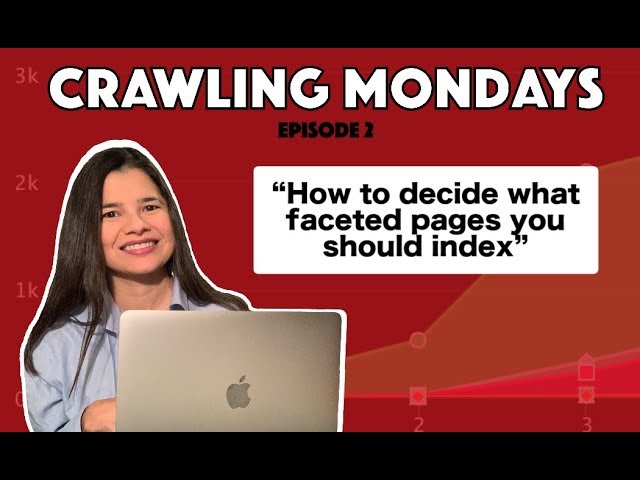
In this episode, Aleyda Solis explains how to decide whether to index e‑commerce faceted or filter pages or to canonicalize them to their parent categories. She frames the decision around product‑market fit, supply and demand, and the presence of sufficient search volume for specific filter queries. Sorting pages that merely reorder the same products are generally not indexed and are canonicalized. For color or attribute filters, she recommends using keyword tools (e.g., SEMrush Keyword Magic) to assess demand; if a filter term (e.g., “black leather backpacks”) has enough search volume, a dedicated landing page should be created and self‑canonicalized. She illustrates this with Amazon’s dedicated black leather backpack page versus Macy’s approach of canonicalizing to the generic category, showing the impact on rankings. She also stresses a minimum product count (3‑5 items) on a facet page to avoid thin‑content and duplication issues. Finally, she outlines the options when indexing isn’t viable: canonicalize, noindex, or block crawling, and hints at future deeper discussions.
Chapters
Hey, Aleyda, is it really worthy for us to start indexing this set of pages, usually filter pages, or should we just canonicalize them towards their parent categories? This is one of the most common questions that I will get, and I'm pretty sure that you too, after going through the first stages of the SEO process. And today I would like to share with you which are the main criteria that I take into consideration to answer this question in the best possible way, in a way that is completely targeted and personalized based on the specific characteristics and scenarios of my clients, because you definitely want to make the most out of each specific situation. You really want to be able to fulfill a demand if it actually exists, right? Let's take a look at— The criteria that we should take into consideration, and this, I believe that as with everything with our business, it should be about product-market fit and supply and demand, right? Like, I know that many of us would like to have some sort of rule of thumbs, and there are definitely, like, for example, Sorting pages. Sorting pages like this, sorting filters like these ones here, they don't change the products themselves. So the supply doesn't change, right? It's the same. It's only the organization that changes. So the content itself doesn't change. What we are offering to our users doesn't change, right? So realistically, there is a very limited option with this sort of sorting. So there are this very easy-to-follow rule of thumb of not indexing these pages. And if we go to any e-commerce website, like here for example, uh, price too high to low here, and we will see that, uh, these particular pages here, they are not self-canonicalizing. As you can see here, the canonical tag is going to the women's backpack category page instead of this filter page here, uh, that is only sorting the same products in, in a different way. And this is very straightforward and it's reasonable to, uh, not index these pages and canonicalize back to the parent categories because the, the offering doesn't change, right? However, there are other specific situations, like for example, with leather backpacks that we can already consider is a second-level category, not necessarily the main category of our website. Of course, it will depend if we are only offering backpacks or we are offering any type of retail type of products, right? However, in any case, backpacks is usually a category and leather backpacks will be already a subcategory. And in many, many, many situations and scenarios I have seen like for websites, ecommerce websites to say, oh, all the color filter pages, they should be noindex, canonicalizing to their parent categories to avoid content duplication and cannibalization issues. And in many situations and scenarios, it is okay-ish to do this because we definitely don't want to run into content duplication and cannibalization issues. And then the other alternative instead of canonicalizing to the parent category is to differentiate that content, but is that realistic? It is worthy to sort of generate and develop specific descriptions for each one of these color pages? Well, my answer will be it depends. On what will it depend? On this. So for example, if we check with any keyword tool, I love the SEMrush Keyword Magic Tool because they will show me already segmented the most important patterns here in a very easy to understand way to identify if there are enough set of permutations with a specific term. Like for example here for leather backpacks, after women, the top term is black, right? And there are so many search potential here, potential traffic from this whether black leather backpacks, black leather backpack purse, black leather backpack women's, men's, black leather bags. So many permutations with black leather backpacks. So of course, like, if we canonicalize the black color page in the leather backpacks category to the parent category, we will be leaving out the opportunity to specifically address this, this query, and it will be a pity, right? We will definitely avoid any type of content duplication issues and cannibalization issues between color pages, but then we will be leaving this out. We won't be addressing and leveraging the opportunity to specifically address these queries, right? Um, so it's important to validate, it's important to check and to see that if there is enough search volume potential to bring enough traffic towards these particular filter pages, then it is very worthy that we specifically optimize these pages to become relevant towards these queries, to become unique, to become different, to make them worthy to be ranked in the best possible positions by Google, right? And if we take a look at which the SERPs, the specific search result page for these queries here, black leather backpacks in this particular case, we can see how in the first position we have Amazon, surprise, surprise. They have a specific landing page and if we take a look at the specific page that Amazon has addressing this particular query, we can see that it's not the typical ecommerce type of listing where the color will be just a filter in this very common type of ecommerce listing page. No, it is a specific landing page that we can see that they are specifically targeting this this particular term. And if we see, of course, this page is self-canonicalizing here. We can see how, of course, the title is specific and including the leather, black leather backpack term here too in the meta description, the heading too, the main heading, etc., right? So of course they are addressing that specific opportunity. Uh, and of course this might not be worth it to do with every single color out there, but with the most important ones, the most popular ones It is. And then let's take a look on the 4th position. We have Macy's on the other hand, and we can see how Macy's is ranking, but not with the black page, right? They are ranking with the generic leather backpack listing page. So we can see here, leather backpack here, this page is focusing on its own specific term, nothing about black here that I can see. Color leather backpack, yes, but not specific black, right? Why? Because they do have a specific color page, but of course we need to go to that particular page. We need to select it here. Let's see. And yes, in this particular case, we see that the URL has changed. And if we go and take a look at the title tag and everything, and let's check out the canonical tag too. So for example, of course here the title is of course specifically addressing the The black specific term is being included. Description, shop for a leather backpack, neutral leather backpack color. Oh, in this case they don't change the meta description. Let's take a look at the canonical tag. So if we take a look at the canonical tag, it's canonicalizing again to the parent leather parent category that we saw before. It's not including the /color-normal-black ID one here. No, no. So it's not self-canonicalizing. This is the reason why Macy's is not specifically ranking with its particular black page, right? Because it's not, it's not indexable. It's canonicalizing back to the, to the, to the little backpack ones. And you are going to tell me that it's like, okay, so Macy's is getting away with it, right? Like, they are not necessarily indexing their particularly relevant, specific black page to target that query and it is okay enough to be ranked in the 4th, what? 1, 2, 3, 4th position so that should be okay. Well, it is Macy's again. This is what happens with big brands, right? That they are able to get away with it because they're already, leather backpack page is already worthy enough and relevant enough to rank with that too. Etc., etc. There are many, uh, reasons and, and, and regarding relevance and popularity, what an authority of this type of pages, right? However, imagine what could happen if they were addressing, specifically addressing by indexing their specific blog page. They might not necessarily be in the 4th position but in the 3rd, in the 2nd. We don't know the reason for it. I have no idea what's going on with Macy's It's very easy and we shouldn't necessarily say, oh, they are doing this wrong because they don't know. They certainly might know about it, but this is what happens with huge websites, right? They have so many constraints with the platform, so many priorities that need to be addressed and not necessarily that much flexibility. They do have resources, but not necessarily flexibility, right? However, if they have the opportunity to start specifically indexing for these very popular colors. Not necessarily for all of them again because it's not worthy to specifically optimize every single color page because some of them won't necessarily have as much potential, have as much of a high search volume. So it won't be worthy, but for black, definitely. So on one hand, we don't want to leave out these potentially profitable and relevant queries that will bring tons of value On the other hand though, it's equally important that we make sure that these facet pages feature enough products, enough content in order to fulfill those queries, not only to provide the best possible experience to our users and customers, but also in order to avoid any type of thin content and content duplication issue, which is something that we definitely don't like. So this is another requirement, another criteria to take into consideration. These pages need to feature enough products. If these pages, for example, have less than 3 products or 5 products, those that we consider the minimum to fulfill our customers' requirements, then it might be not worth it to index them and we should leave them canonicalized to their parent categories, for example. So if we take this couple of criteria into consideration again, product-market fit, supply and demand, and the connection between these 2, we are not going to be able to also target and profit and make the most out of this potential really profitable queries on one hand, but also to avoid content duplication, thin content issues, and making sure that our web structure is correctly targeted to fulfill our customers' behaviors and demand towards our products and services. I hope that you have liked today's episode, and of course there's so much more regarding this topic. For example, if we decide to index the facet pages at some point, if it is not working because the queries are— the search volume of the queries is not big enough, or because maybe we don't have a good amount of products, a good volume of products to feature in these pages, what is really the best way to Should we canonicalize to the parent categories? Should we instead noindex these pages? Or should also avoid at the same time completely crawling from the website? There's so much more here, but that will be for a future episode. And thank you very much again for watching this. Don't forget to subscribe in case you haven't yet done it so, and please follow Crawling Mondays on Twitter too. Thanks, Aleyda. To keep updated of any new videos and also provide a few ideas for future episodes too, if you want to. Thank you very much and until next Monday. Bye!