CNBC TechCheck+ chats with Neo CEO Ali Partovi about OpenAI partnership — 3/24/23
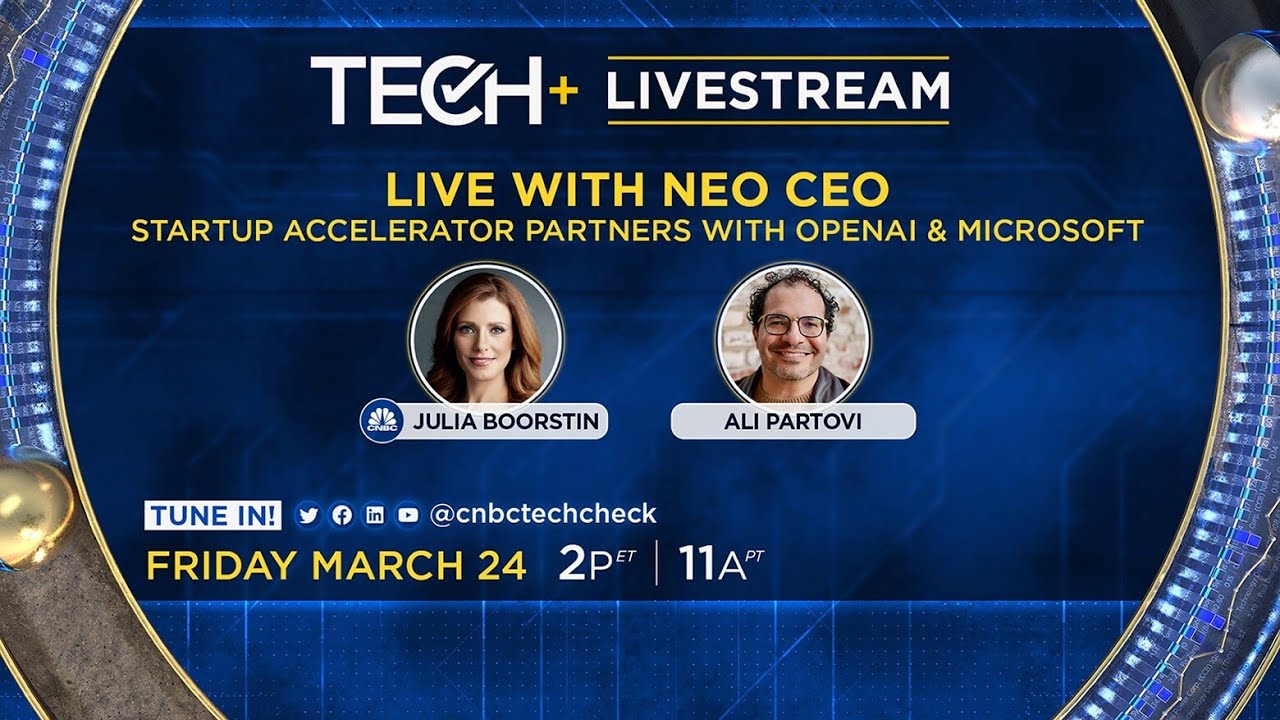
Ali Partovi, CEO of Neo, discusses the accelerator program Neo built with Microsoft and OpenAI. The three-month program includes a month in Oregon, funding, mentorship, and compute credits for founders building on AI platforms. Partovi calls 2023 a turning point comparable to the iPhone, arguing AI will reshape every industry.
Chapters
Hi everyone, I'm Julia Borstin, CNBC's senior media and tech reporter, and welcome to Tech Check Plus. I'm very excited today to get a chance to interview Ali Partovi. He's the CEO of NEO, and today NEO, which is, um, an investment fund but also a startup accelerator and incubator, is announcing a new focus on artificial intelligence in partnership with Microsoft and also OpenAI. Thanks so much for joining us today.
Thank you so much, Julia. It's great to be here.
So let's talk about the news. You're creating this accelerator program specifically focused on AI. What is it? And talk to us a little bit about how you're going to be working with Microsoft and OpenAI.
Yeah, you know, Julia, so many of us were blown away in November with the release of ChatGPT and For those who are focusing on innovation and building new startups, it was a wake-up call that this was going to be a direction for so much new innovation. And we, as we were thinking about our startup accelerator, immediately realized we wanted to have a track to give extra support for entrepreneurs building new things with AI. And so we've created an AI startup accelerator to specifically welcome new startup founders building things on AI. We've done this with support from OpenAI and Microsoft to provide software, technology access, compute credits, mentorship, and other benefits to give these new startup founders an extra boost.
You put this together relatively quickly considering how recently all of this ChatGPT and OpenAI stuff exploded onto the scene. What does this actually mean? What is the program going to look like? When's it going to start? How can people apply and what interactions might they be getting, these entrepreneurs be getting from the likes of OpenAI and Microsoft?
Applications are open right now and for the next 2 weeks. Actually, March 31st is the deadline, so less than 2 weeks, about 1 week left. We have already been getting a massive influx of interest. And the— so the— we're receiving applications right now. We'll be interviewing and evaluating startup pitches and, you know, making selections. We offer funding, mentorship. Our program includes a month-long retreat in Oregon where we give each startup team their own house. We provide breakfast, lunch, and dinner. We basically take care of everything in life so that the startup founders can just focus on their work. And we have the mentors from OpenAI and Microsoft will be flying to Oregon, staying overnight, you know, not for the whole 4 weeks, but making visits to help people and, you know, get to know people personally, along with, you know, dozens of other mentors from across the tech industry with, you know, with experience, prior founders, experienced operators to provide help and support to anyone who has questions or or just wants support.
Why was it— I'm sorry, go ahead.
I was going to say, in addition to that retreat, that's 1 month out of a whole longer program, 3-month-long program. Everybody in NEO is connected via our online community on Slack. Mentors from OpenAI are already on there helping members of the NEO community who have questions about building on OpenAI.
Why was it so important for you to partner with Microsoft and OpenAI? Obviously, everyone's mind has been blown by ChatGPT. And there's been a great fascination there, but there are a lot of other players in the space. Does this inherently align the entrepreneurs you're working with with the OpenAI model, or were you at all tempted to do something that maybe wasn't tied to one particular company? What was the advantage and the intention with this strategy?
So first, let me put the scale of what's happening this year into context. I think we're gonna look back and remember 2023 as the year when life changed because of artificial intelligence. And as an analogy, think about how much your life is different today than it was before the iPhone. You know, how many times a day you depend on the phone in your pocket to get you a car, to get you a meal, to contact somebody. And the world changed Because of the invention of the iPhone. But the analogy goes further. For the first year and a half, the iPhone had no apps. It had no App Store. So all of those things that you use today weren't even there for the first year and a half. That's what AI today is like as well. OpenAI, ChatGPT, these things are just the tip of the iceberg. The true transformation in our lives are going to be the innovative things that other people build with these tools. And so the reason we are so excited about this is to embrace that and to cultivate that and to encourage that. And, you know, and I truly think we're going to look back and see this moment as a shift in, in the trajectory of humanity because of all the possibilities that this technology opens.
Wow, that's a very dramatic statement, but I have to say, I think I agree in terms of this being a big Turning point. What's so interesting is it sounds like you're really encouraging entrepreneurs who are not trying to compete with an OpenAI ChatGPT, but rather build tools that are maybe layered on top of them. Talk to me a little bit about what types of companies you see the most opportunity in as an investor, as well as someone who's running this incubator program.
So you're right that there's definitely some like that, although I would say we're not in any way limiting people's creativity. So we, we're anticipating a little bit where we think people's creativity will be, and we've also already seen so many people building, uh, with OpenAI and Microsoft. So we're kind of trying to go where the hockey puck is going. But, you know, I would not presume to, you know, to— for me to kind of tell people what they should build, or for my imagination or my creativity, you know, uh, my ability to predict these things pales compared to the collective imagination of of all the brilliant, innovative young people who are building things. Well, but again, to, to make an analogy, sorry, is think about when the iPhone came out. You know, nobody came out and said, oh, this will enable you to push a button and get a driver to show up at your door and pick you up, right? But in fact, it did enable those things, and that was not possible before everyone had a phone that also had GPS. And do you see what I'm saying? Like, the building blocks were there But to actually have a service like Uber where you can be anywhere in the world, push a button, and somebody shows up with a car to drive you, that is transformative. And it required not just the platform, but the innovations built on top of the platform.
And I'm curious, I'm curious though, as you look at sort of this as a turning point, the fact that you're aligning your incubator with OpenAI and ChatGPT, there are other models, right? There's Google and Bard, there's Jasper. And do you think that this— and does this bet indicate, or this partnership indicate, that you're really betting that OpenAI is going to be the definitive sort of model in this world? Or do you think there will be a real rivalry between some of these tech giants?
Excellent question. I guess my answer is yes and yes. I think we are making a bet, but I'll— and I think there will be a rivalry. Like I said before, we're not going to exclude other options. If somebody says, hey, we are excited to build an incredible startup and we are building it on a different AI platform, terrific, we would fund that. Or there might be many companies using the best of both. We're not going to try to limit somebody's options. Frankly, I don't think that Microsoft and OpenAI are trying to approach it that way either. But we're just trying to provide the best support in this direction. In terms of comparing these with each other, what I would say is that OpenAI and their partnership with Microsoft and Azure, that's what has captivated the imagination of all of us. ChatGPT has overnight become a sensation and so We're trying to build around the thing that is the center of attention, and we're trying to provide that support there. By the way, as an aside, Julia, I believe Sam Altman of OpenAI is going to be the Time Person of the Year. I'm the first person I know of to predict that, but the level of innovation that that company is pushing forward is staggering. And so what we're trying to do is align our program and our founders to get the best access to the people making that innovation.
I just lost audio. Ali, can you hear me?
I hear you. Did you hear what I said?
Okay, you're very quiet. I don't know what's going on here. Let's try this again. Sorry, this is the beauty of live anything. Can you say something?
Hi, do you hear me?
Yes, I got it now. So sorry about that. So I just lost you at the very end there. But so to your enthusiasm about saying, Sam Altman and OpenAI. I have 2 questions about the AI startup space right now. The first is about AI valuations. You run a fund, you invest in startups. Have you invested in many AI-related startups to date? And are you concerned that valuations are at a bubble right now? I mean, notably, AI valuations have been very high despite the fact that there's been an overall pullback in the market tied to the public markets, among other things.
You're correct about that. They are high. You know, we have made investments already in AI startups. We've been investing in AI startups for years, uh, and some of those investments I'm really happy about, uh, right now, and we'll continue to make AI investments. I guess I'll step back and say, for the past decade, there have been many things that people predicted, oh, this is the next disruptive platform shift. As I'm cognizant that, you know, 10 years ago people were saying self-driving cars or metaverse or VR, AR. I think there is somewhat of a zeal amongst Silicon Valley to hope that today's thing is the next big thing, uh, Web3, crypto. My, my philosophy and my fund has generally not jumped into that. So, you know, we focus on investing in amazing people and not a specific sector generally. This is the first time really ever that we've picked a sector, so to speak, to elevate. So this is the first time we believe that there's truly a real disruptive platform change. So while we have made investments in each of the other things I mentioned, you know, it was because brilliant people that we really admired were building things and we wanted to, you know, support them and bet on them. With AI, I would be happy to go all in saying that this is you know, perhaps the greatest disruption in our lifetimes. And, um, and so from that standpoint, are valuations high? Yes, they are higher, but I think we might also be looking back, you know, uh, in the future saying they were low. You know, the, um, the level of productivity increase and, um, you know, change for humanity that these technologies offer is incredible. It's almost unfathomable. And I would generally say innovation is probably the best path out of the macroeconomic difficulties that we face in this country and in the world.
Well, it sounds like your commitment to this as an industry or as a sort of, you know, world-defining industry innovation is a testament to the fact that it's not just limited just to the tech industry, but this idea that AI is going to have an impact on every different part of the economy?
I very much believe it will. And, you know, if I— the economy is in— is, you know, it's facing some difficulties right now, and it's a little bit of a catch-22. You know, if you change this, this goes down, or it's hard to know what's gonna be a solution for the economy. But I would say one of the few, you know, kind of entirely positive solutions is technological advancement. Technological advancement and productivity increases that come with that. And I think productivity is just gonna skyrocket over the next few years because of computers enabling all of us to be— just to have superpowers compared to what we were before.
So in light of all of this and all this enthusiasm about the positive impact of AI, there are 2 questions I want to follow up with. One is about the potential impact. You mentioned the positive impact on the economy, but the potential impact on jobs. When do you think we'll start to really see a dramatic impact from AI on job losses? And then the second one is on all this fear about the negative impact of AI in sort of the robots taking over. And I'm saying that with a little bit of a smile, but that this is something that people have raised concerns about. And there was certainly some buzz about The AI chatbot interacting with journalists in ways that felt weird and inappropriate. But how do you think about those 2 sets of concerns? There's sort of the practical impact on jobs and the sort of more amorphous robots taking over the world.
Yeah. Well, Julia, I'll start by saying the good thing is that almost everyone involved with AI technology is aware of, is conscious of, and is talking about these issues proactively. which is quite different from almost any of the other technological disruptions that you can think of. To the question of how AI may cause harm to humanity, I would say AI has already wreaked some havoc on humanity, and not recently. I would say influencing elections in ways that we might not fully comprehend, but algorithms like Facebook or Twitter you know, decide what people see and might influence how people vote or cause divisions. These are things that happened 7 years ago, and, and we're still feeling the repercussions. Um, so I think it is a very serious thing to be vigilant about. I think the good news is that the people at the forefront of this technology are being vigilant. They're talking about it proactively and overtly. That doesn't mean there will be no problems. I'm, I'm sure there will be some issues. I'm much more optimistic about it though, because people are in that conversation. And I'll say from our perspective, as you know from our past conversations, we care a lot about diversity and investing in founders from underrepresented backgrounds, whether it's female founders or Black, Latino, and other underrepresented minorities. It's important to have all voices in that conversation about how this technology is used because it'll affect all of humanity. So I'm not gonna say that everything's gonna be perfect, but at least I'm optimistic that the conversation is happening and is proactive rather than after the damage is done.
And reactive, yeah. And what you're referring to, and I think it's important to be explicit about this, is there's a lot of concern that AI will be racist or sexist or biased in one way or another because it is trained in many occasions on the internet. And the internet's been around for 30 years and is certainly not unbiased in any way. So—
Or just unintended consequences, not thinking about what about this person's perspective or so on. Yeah.
But before we're out of time, I think it's important to sort of explain what NEO is and how it's different. I mean, you said that this is the first time NEO has ever focused on a particular industry, and this time being AI, though I would say it's going to impact all industries. But explain sort of your approach to this idea of investing in people at the very earliest stages. You mentioned your focus on diversity, but why don't you lay it all out there?
Sure. NEO, we identify first and foremost as a mentorship community. And what drives us each day, you know, waking up and working is to help other people maximize their potential. And in a lot of cases, that's about helping young people who might have self-doubt feel the support to aim higher, to, you know, to take a little bit more risk, to do something a little bit more ambitious with their lives. And we do this with different programs starting as early as college. So we try to identify the most promising computer science students in North America at the college age. They apply to become Neo Scholars and we rigorously vet them. Include them in our community, give them mentorship and support, and connect them with each other, as well as encourage them towards working at a startup, whether that's a startup we've invested in or, or just the best startups we can find. We try to encourage young people towards more entrepreneurial paths. And then the other program is the NEO Accelerator, which is, we believe, going to be the preeminent launchpad for the next generation of tech startups. And we started Neo Accelerator a year ago, but this announcement, you know, this year is really, you know, elevating its profile and, you know, and lifting its presence. And Neo Accelerator is intended to support somebody a little bit later in their career, maybe 3 or 4 years out of college, you know, who's maybe worked at another tech company for a few years and is now ready to start their own.
Well, that's a perfect note to end on. Great to hear about your perspective on the massive opportunity in artificial intelligence and all the surrounding companies that will emerge because of it, and to hear about NIO's partnership with Microsoft and OpenAI and its first-ever industry-focused, or I should say sector-focused accelerator. Thank you so much for joining me today to talk about this, NIO CEO Ali Partovi.
Thank you, Julia. It's an honor.
More from Ali


Microsoft Chairman and CEO Satya Nadella on Empathy and Lessons He Learned the Hard Way

Uber CEO Dara Khosrowshahi on Leaving Iran, Hitting Rock Bottom, and a Costly Mistake at Expedia