South Summit 2016 - Ali Partovi - Learning the code is not just for coders
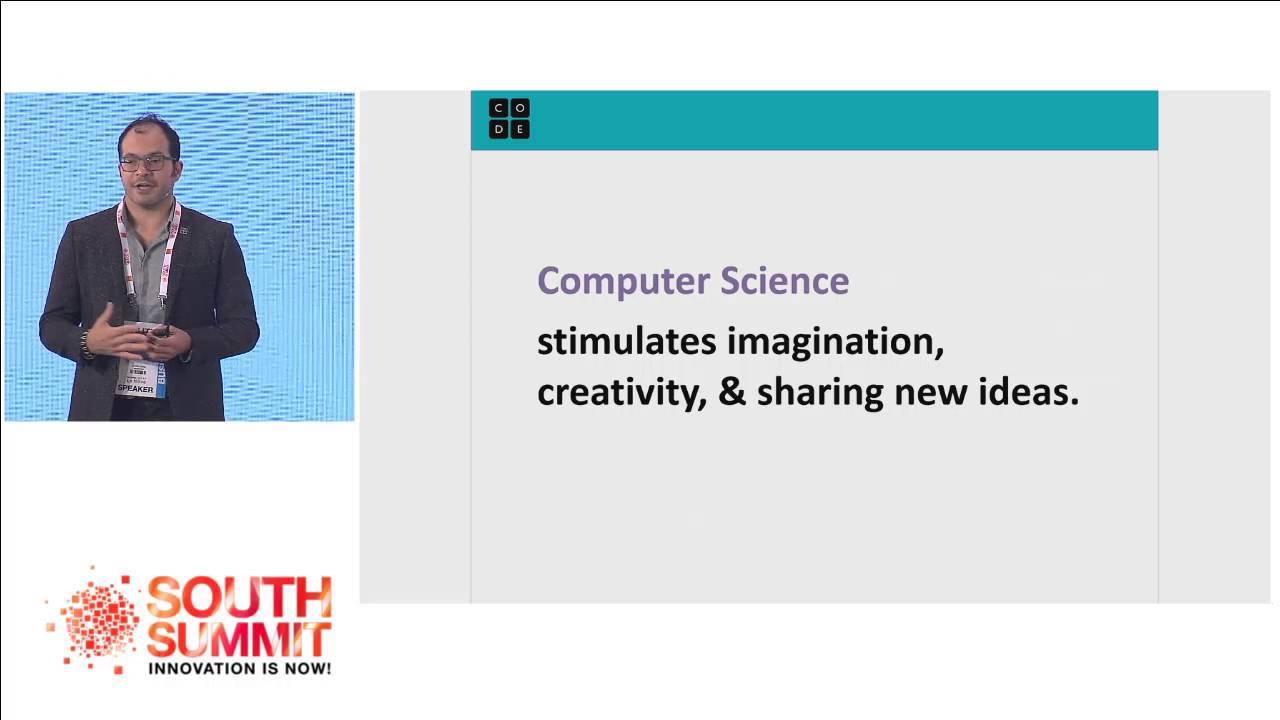
In this South Summit 2016 keynote, Ali Partovi, co‑founder of Code.org, argues that computer science (CS) should be a core liberal art taught in every public school. He opens with a Steve Jobs video asserting that programming teaches thinking, then shares his own childhood in Iran, where a gifted computer sparked a lifelong love of coding. Partovi recounts founding Code.org with his twin brother, the rapid growth of the Hour of Code (over 100 million participants), adoption of CS curricula in 7 countries, 20 US states, and hundreds of thousands of classrooms. He tackles common objections—whether schools should prioritize math/reading, concerns about screen time, and the notion that only future coders need CS—by reframing CS as foundational thinking akin to math and literacy. He illustrates how elementary CS teaches concepts like functions through familiar songs, making abstract ideas tangible. Partovi cites Stanford data showing that nearly half of its majors require CS and that 90 % of students take CS courses, underscoring its relevance across disciplines. He likens CS education to mandatory biology, arguing that children today depend on computers as much as on their bodies, so they deserve to understand how they work. Finally, he notes that CS can be taught without screens, using pen‑and‑paper programming, and emphasizes the broader societal benefits of universal CS literacy.
Chapters
Right now, it's my pleasure to introduce to you somebody that's really close to my heart, a good friend that has been a supporter of the South Summit since we started at the very beginning. One of Silicon Valley's top angel investors. I'll never forget what he said to us here in Madrid 4 years ago. He said, if you're gonna fail, Fail fast. And that's probably the best advice you can give a startup entrepreneur. Ladies and gentlemen, Ali Partovi is not only a great angel investor, but he's got a big heart too. He's got 2 nonprofits, one that deals with food for children in public schools, and the other one that he's going to talk about today is very pertinent to the idea of innovation and disruption. He wants to teach the children of the world To code, computer code. Ladies and gentlemen, Ali Partovi.
Thank you, Paris. Hola. Three and a half years ago, my twin brother Hadi and I launched Code.org. To promote computer science in public schools. I'm going to go back further in time, though. 20 years ago, Steve Jobs voiced a provocative idea that is still relevant today, and which is the inspiration for my talk. I'm going to show a quick video of Steve Jobs saying that he believes that computer science is a liberal art. Let's see if the video works.
I think everybody in this country should learn how to program a computer, should learn a computer language, because it teaches you how to think. And so I view computer science as a liberal art. It should be something that everybody learns, you know, takes a year in their life, one of the courses they take is, you know, learning how to program.
Computer science is a liberal art. Computer science is a liberal art, he said. So my story begins farther back, when my twin brother Hadi and I were kids. We grew up in Iran, and when we were 7 years old, there was a revolution and then a war. Our life was basically defined by fear. We were afraid literally all the time, day and night. And yet I would still say we were amongst the luckiest kids in the world, because when we were 9 years old in 1981, our father gave us a magic gift, a computer. And it didn't have any games on it. He told us that if we wanted to have any games, we would learn how to— we would need to learn how to program it ourselves. And so our father introduced us to computer programming, and we fell in love. We became great at computer programming. By the time we were 15 years old, our family had moved to the United States, and my brother and I had computer programming jobs throughout high school. We paid our own way through college. By the time I was 25 years old, I had started my own company and successfully sold it to Microsoft. Today, back in Iran, almost every public high school teaches computer science. Yet throughout most of the rest of the world, most children in school still don't have access to this magic gift, whether in the United States or other parts of the world. And so there's a huge opportunity and also a huge challenge to update the curriculum of the world's public schools to include computer science. And this has been an amazing movement. In the past 3 years, there's been enormous progress. 7 countries have adopted computer science as part of their national curriculum. In the United States, 20 states have passed laws to embrace computer science in their education policy. More than 120 public school districts have partnered with Code.org, and several hundred thousand classrooms are now teaching our curriculum. We launched a thing called the Hour of Code, and more than 100 million kids worldwide have done the Hour of Code. And so this has been enormous progress, yet we still have a very, very long way to go. Now, this much change in such a short period of time has also raised some questions and some critics. A lot of people actually ask— How do you think Do we really need kids to learn how to code in school? And they raise some legitimate questions. So first of all, shouldn't schools focus on more fundamental things like teaching children math and reading and writing? Secondly, screen time— kids already have way too much screen time in their lives. Do we really want them to have screen time in school as well? And then perhaps most importantly, why does everyone need to know how to code? After all, for medicine we have doctors. If you need your car repaired, you go to a mechanic. Can't we leave coding to the coders? Well, I'm going to address these questions starting with one simple vocabulary change. Instead of talking about learning to code, let's talk about computer science. Computer science is a legitimate and rigorous academic field, and it's foundational, and it should be taught in every school. And it's about much more than simply learning how to code. Schools teach kids reading and writing. Writing is not just for kids who are going to grow up to become writers. Math isn't only for mathematicians. These topics are foundational to all other pursuits, and that's why every public school teaches them. Likewise, computer science is foundational. Computer science is not just for coders. It's for everybody, and every public school should offer it as part of the curriculum. Let's take a little bit of a deeper look at it. Math is a subject that I love. The reason we teach math in schools is not for kids to learn how to do algebra or do proofs for the rest of their lives. It's because it teaches kids how to think, how to solve problems. And this is what makes math fun. Computer science is also about logic and problem-solving, and it's even more fun than math is. In fact, this year a survey of high school students asked them which class they liked the most, and after the arts, the class that students like the most is computer science, more than any other subject in school. And this is because computer science takes challenging, advanced concepts from math, but presents them in a much more tangible and fun way. And so this not only makes it more fun, it also makes advanced concepts easier for kids to grasp at a younger age. I'll give you an example of this. Abstraction, for example. Abstraction is about things like functions and variables. That's introduced in 7th or 8th grade algebra. Well, the same concepts are introduced Earlier, in 4th or 5th grade computer science. Wait a second, you might be asking, what's 5th grade computer science? We didn't have that when I was in school. And you're right. In fact, computer science has not existed in elementary school until fairly recently. Code.org has created an elementary school curriculum for computer science that starts at 5 or 6 years old and goes all the way through school. and we give it away for free. And several hundred thousand classrooms now around the world are teaching it regularly. And so I'll give you an example of a task in 5th-grade computer science for how to introduce functions to kids. It involves— imagine programming a computer to generate the lyrics for a song. So my example is an American song, which is Old MacDonald. This might not be familiar to people here in Spain, but it's a repetitive song that goes on and the words change in each verse. It's like, es como una cantajuego, como chuchúa. Anyway, it's a very long repetitive song. Actually, it's an infinite song. It can go on really forever. Children know the song because it's a pattern that repeats. They don't have to memorize an infinite number of lyrics. They just need to memorize the pattern, and they know that a few words change each time. And similarly, if you're teaching a computer how to generate the lyrics for this song, you don't need to provide all of the— an infinite number of lyrics. You only need to provide the lyrics for one verse, and there's 2 parts of it that are different each time. There's an animal name and an animal sound. And you define that as a function with 2 parameters. And then each time you want to generate a verse, you invoke that function with a different animal name and sound. And so you can generate a very long song without having to repeat the lyrics every time, simply by invoking that function. So this is an idea that is very easy for children to grasp because they already have learned songs in the same way, in their head. It's not a new concept. It's simply putting a structured mechanism around that concept, and then they can use that same mechanism, that same tool, to break down other large problems. And this is a very foundational part of computer science, which is it gives children the ability to tackle larger problems and break them down into smaller parts by seeing— by finding patterns. So talking a little bit more about— moving on from math, looking at English or literature. We don't teach English or literature in schools just for kids to become writers when they grow up. It's because once you learn to read and write, you can learn new ideas, and you can also create your own ideas and share them with other people. Well, just like English isn't simply about learning how to spell, it's not simply about learning grammar, Computer science isn't just about learning how to code. Learning how to code is just the beginning. It's once you know the language, then you can use your imagination. Then you can use it to solve problems and to be creative. And learning how to read and write really prepares students for university and for life. It's indispensable for higher education. Today, I would say the same is true for computer science. Computer science prepares students for university and for life. A child who's going to university growing up today, it's really indispensable for them to know computer science. If you look at Stanford University— this has not showed up correctly— there's 65 undergraduate majors at Stanford University. Almost half of them I don't know if you can see the colors. Almost half of the majors at Stanford University today accept computer science courses as counting towards their graduation requirements. And that includes majors like archaeology and political science and human biology. No matter what kind of science you might study, computer science is relevant. In fact, the Nobel Prize winners just announced yesterday or the day before were computer scientists. A few years earlier, the Nobel Prize in Chemistry was won by computer scientists. The leading research in birds, in ornithology, is being done by computer scientists. Now, in addition to these 65 majors, Stanford actually has just recently created 14 new majors, all of which are computer science plus a humanities course. For example, computer science plus history. Computer science plus literature. And this is because they recognize that even for people who are studying the humanities, computer science is important to them. And today at Stanford University, 90% of students take computer science regardless of what their major is. And the university describes the computer science program with the following sentence. It says, computer science prepares students for careers in government, law, the corporate sector, and graduate study. That means whether you want to become a politician, a lawyer, a businessperson, or a professor, computer science is for you. And so this is my point: computer science is foundational. It's like a liberal art. Now, even if computer science wasn't foundational, there's another reason why every public school should teach it. Consider, why do public schools teach biology? For a few students, biology in high school might lead to a career as a doctor, but for everybody else, it provides a basic understanding of the world around them. Imagine a school— would you send your kids to a school where they didn't teach photosynthesis, or where your children would graduate without knowing how the human digestive system works? You wouldn't call that an education. Even if your child is not going to become a doctor, there are certain things you expect them to learn if they're graduating from a school. It's just an expected part of education to know how their digestive system works. Well, kids today are surrounded by and dependent upon computers. In fact, I would say that the kids going to school today use their smartphone more frequently than they use their own digestive system. And they deserve an education that teaches them how both work. So every child deserves to understand how the computer in their pocket works. It's something that they're dependent upon. It's something that they use all the time. And it should be an expected part of education, just like you understand how photosynthesis works or other things around the world, to understand how computers work.
Thank you.
Now, one of the concerns that a lot of people have, especially parents have, about computer science is screen time, which, you know, kids are spending way too much time in front of screens. I'm concerned about screen time too. I have kids, and I worry about them having too much screen time. But the good news, actually, is that computer science does not require necessarily screen time. I studied computer science at Harvard, and not a single classroom had a computer in it. Computer science can be taught with pen and paper. In fact, you can write a computer program just with pen and paper. If you think of it this way, a computer program is like a recipe.
Awesome.
You could create a recipe using just your imagination in your head and then write it down without having a kitchen to test it. Of course, it's more fun if you have a kitchen, then you can test it to see if it works and if it tastes but you can still do it using only your imagination. And the same is true with a computer program. Remember that example I showed with the song? That's an example of an activity that children do in the classroom with pen and paper. They don't use a computer for that. They can do that singing and writing on pen and paper and learning functions without a computer. Actually, do you know the history of computer science? The first computer was invented in 1943. It was as big as a room. The first computer program was written by Ada Lovelace in 1843, a full 100 years before the invention of the computer. 100 years. Ada Lovelace did not have a problem with screen time. Screens didn't even exist when she was inventing computer programming. She only used her brain, her imagination. Computer science is not screen time. Computer science is brain time. Now, screen time can be bad when it's used for passively consuming. When kids are watching TV or playing games, that's bad for their brain. But it's actually great for their brain when they're using the screen actively for problem-solving and creativity. Those stimulate brain development. To limit that would be like depriving a child of time with her paintbrushes. Why would you want to limit a child's creativity? Just like art, children love computer science. They love computer programming because it empowers them, empowers them to use their imagination to create whatever they want. You know, I think back to when I was a child, Growing up in Iran, you know, life was really difficult for me. I was constantly afraid of our house being bombed by the Iraqi bomber planes. I was afraid of the government. I was afraid for my parents. And for me, I fell in love with computer programming because it was an escape. It was a way to create my own world, a world that made sense, a world that actually followed the rules, and a world where I could make anything I wanted. And and a world where anything that went wrong could be fixed. It's no wonder that I fell in love with it. And it's no wonder that teachers who are learning to teach computer programming are falling in love with it. Code.org actually has trained more than 40,000 teachers in the last 2 years, 40,000 teachers to teach computer science. And they tell us that they love it because they see their kids' eyes light up when they are exposed to this amazing experience. And across the world and across the United States, from inner cities in Brooklyn to Chicago to Oakland, children are falling in love with computer programming, not just because it's a valuable skill, not just because it's a vocational skill, but because it's an escape for them. It's a chance for them to create their own world. It's a chance for them to use their imagination. It's a chance for them to have hope. It's a chance for them to be creative, and it's a form of learning that makes school more relevant and more real than many of the other things they're learning in school today. Now, The unfortunate thing is that today in America, only 1 in 4 schools offer computer science. It's even less actually here in Spain. It's less than 1 out of 10 schools offer computer science. And this is fundamentally unfair. This magical gift should not be a privilege only for the lucky few. Really, I believe every child in the world deserves access to computer science. It's a basic foundational field, not just because it will give them a better understanding of the world around them and a better— and a foundation for life, but also because it will teach them how to think. It will teach them how to imagine and how to create. So thank you very much. Coming up this December will be the 4th annual Hour of Code. If any of you has connections to a school anywhere in Spain or in Europe, please encourage them to participate. We hope to reach more than 100 million kids this year with the Hour of Code. Thank you very much.
More from Ali


Microsoft Chairman and CEO Satya Nadella on Empathy and Lessons He Learned the Hard Way

Uber CEO Dara Khosrowshahi on Leaving Iran, Hitting Rock Bottom, and a Costly Mistake at Expedia