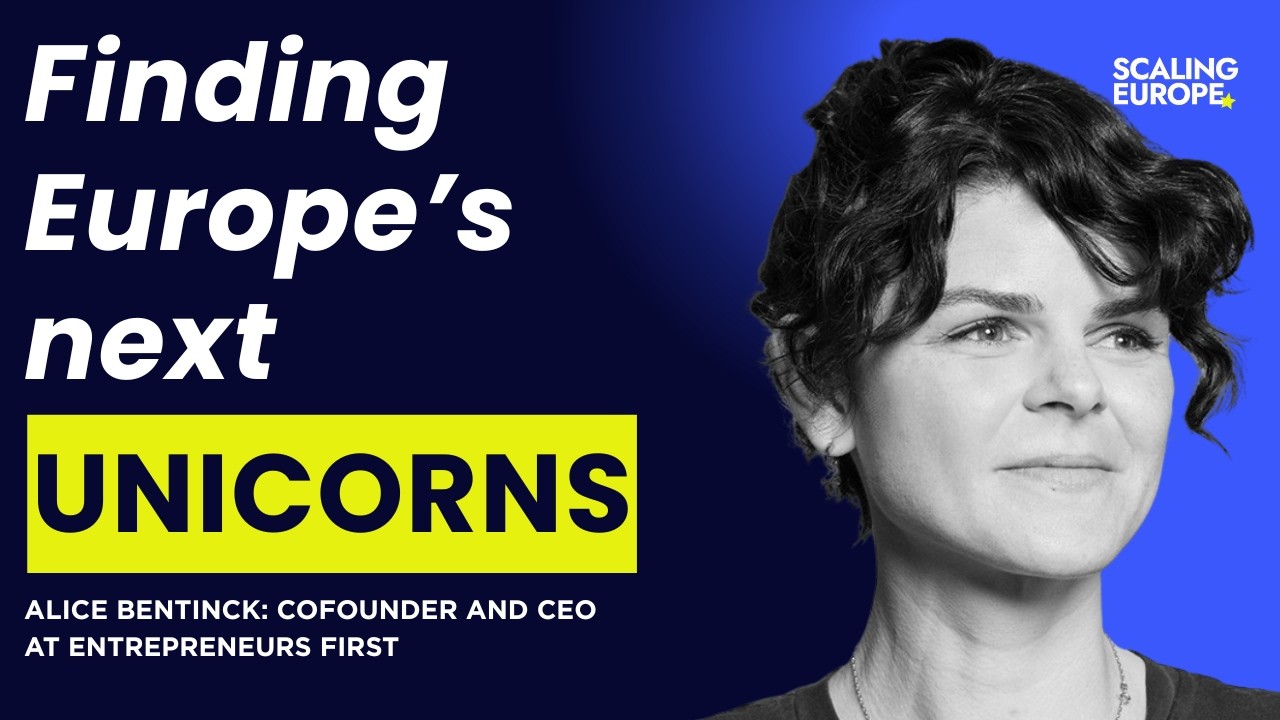
Alice Bentinck and Matt Clifford | How To Be A Founder

Alice Bentinck and Matt Clifford, co-founders of Entrepreneur First, explain how they match strangers into co-founding teams and build companies from scratch. They debunk the myth that you need a perfect idea or Silicon Valley connections, and describe the "idea maze": testing both your concept and your co-founder chemistry at the same time.
Chapters
Hi everyone, welcome to Grey Matter, the podcast from Greylock where we share stories from company builders and business leaders. I'm Reid Hoffman, a general partner at Greylock. My guests today are Alice Bentinck and Matt Clifford, who are the co-founders and co-CEOs of Entrepreneur First. The Talent Investor, as they are known, was created with a mission to connect founders no matter where they are in the world and recruits and backs them at the very earliest stages. They've been going strong since 2011, and Greylock is proud to have been partnered with them since 2017. While the world, and especially tech hubs like Silicon Valley, are awash with incubators and accelerators, Entrepreneur First has built something very different. By focusing on connecting individuals rather than defined teams, they've gained a unique perspective into what makes good ideas and how the right co-founder dynamics can bring it into reality. Now, everyone has the opportunity to learn more about their strategy and insights through their new book, How to Be a Founder, which was just published last week. It's a great resource for any entrepreneurs. And the co-founder topic is extremely important because we have generally found that, you know, while there's amazing solo founders, many successful startups are done by 2 or 3 co-founders. And that right chemistry, that right way of putting them together is extremely important for success. So we're very fortunate to have Alice and Matt to discuss it with us. Alice, Matt, thank you so much for joining me today.
Thanks for having us.
Great to be here.
And of course, you know, thank you for writing this book. You can never have too many resources as entrepreneurs, we all know, and this one is a very valuable one. Before we get into the specifics, can you give a brief overview for those who may not know how Entrepreneur First operates?
Sure. So I suppose the starting point for EF is the idea that the world's missing out on some of its best founders. Why is it missing out? Well, largely for 2 big reasons. One, Entrepreneur First tends to operate in countries where starting a company is not yet the obvious thing for smart, ambitious people to do. And so, a big part of what we do is really normalize the idea that this is probably the highest impact path for an ambitious person. But the second part of what we do, and you sort of already hinted at this, is we think the other big barrier that stops great companies being built is It's not obvious in a lot of the world who you would start a company with. You know, I kind of feel one of the many benefits of Silicon Valley is if approximately everyone is thinking about startups, then your chance of like knowing someone who would be a good co-founder for you is pretty high. In a lot of the world, that's not true. And so what EF does is twice a year in 6 cities around the world, we curate really high-quality cohorts of around 50 people. And the value proposition is come and join one of these cohorts. And we've designed a methodology, like culture and a system for helping people find a co-founder within that community and taking them right through from pre-company to having a seed-funded company 6 months later.
So over the last 10 years, we've built about 500 businesses, many of which are still in the very early stages. But the portfolio is now worth about $10 billion. And I suppose what we've seen is actually there are some real similarities between building a company at the earliest stages in Europe and Asia and all these kind of nascent ecosystems outside of Silicon Valley. And what we wanted to do with the book was distill many of the frameworks and learnings that we use day to day at Entrepreneur First and give entrepreneurs all over the world access to that, partly to increase their chance of success, but largely just to encourage them to get going. One of our favorite phrases is, most people won't. Lots of people want to be a founder. Lots of people are trapped in the status quo. And even though they have this aspiration, they just never get around to it. I hope what the book does is both help them understand the why behind getting started, but also the how, and give some practical steps on finding a co-founder, developing an idea. And there's, I think, a lot of startup advice starts from the point where you have those 2 things. What How to Be a Founder tries to do is start from the point where you suddenly think, huh, actually, can I do this? And if I do, how do I get started?
You know, one of the things that, you know, we've all been in dialogue with the various commentators around the book, and I think the book has been very well received, has been this question of, well, that's all great and good about how to have really strong dynamics that work for starting a great company with co-founders, but how do you find a co-founder? And obviously this is one of the things that Entrepreneur First, you know, has been years in helping. Describe a little bit of the process by which you have people come and join your cohorts, you know, what the kind of classes look like, why this is an optimized path for finding a co-founder.
Yeah, I think one way to answer this question is to think about what would you look for in a co-founder, even if you knew everyone in the world. And I think you would screen for— you want to start a company with someone really smart. You want to start a company with someone very skilled that's going to bring something obviously useful to the table. You want someone who's very determined and resilient. Hopefully, you want someone very ambitious because hopefully, you're setting out to do something big. And you want to start with someone who's super committed, at least as committed as you are to, like, go the distance. Now, the hard thing is you don't know everyone in the world. And even, you know, among the people you do, once you filter by those things, you're usually left with a very small group. Now, because EF has been around for a very long time and because we spend millions of dollars a year searching the world for great aspiring entrepreneurs, what we can provide inorganically, if you like, is the network that you wish you had when you were starting that process of screening. So, you know, we would probably in a typical year get around 20,000 applications from people that want to start companies. And we're whittling that down to a few hundred across our sites. And so we're doing all that screening that we think you should do as a baseline. So you know that when you join a cohort and you meet everyone from the first day, you know they've been through a highly competitive, really selective process. You know that they're not kind of tourists who are kind of intrigued by entrepreneurship. They've given up something to be there. Not most of them are not gonna be the right co-founder for you. But we believe strongly that if you join a cohort of, you know, 50, 60, 70 people who've been through that process, probably the chances are that one of them really could be. And so we, you know, we take that very seriously. We're very lucky that EF is so competitive to get into today, but it means that for the people that get in, we really think that they're starting with pretty good odds.
The selection of who we have in there is super, super important. One of the most valuable parts of what we've learned building Entrepreneur First is the methodology to actually build strong co-founding teams. You know, I think when we first started, the idea that strangers who'd never met before could commit to each other to co-founding a company for possibly decades seemed totally, totally insane. And when we analyze and break down what has made the co-founding teams built through EF so successful, a large part of it is the initial founding moment. And we go into this in a lot of depth in the book. You know, how can you set yourselves up for success in terms of having open and transparent conversations about what roles you're going to have, how you're going to split equity, about your expectations about what you're trying to build, but also importantly, how to give each other feedback. And I think the bit that often is missed out on is how to develop an idea together. And actually, one of our big beliefs at EF is that the co-founding and ideation process need to be done simultaneously rather than sequentially. I think often the, the way it's sort of thought of is I come up with an idea, And then I go find someone to help build my idea. Now, that does work and can happen, but actually the most valuable and powerful ideas that we see built through EF is the coming together of 2, as Matt says, smart, committed, ambitious individuals where they say, hey, what could we build together if I combine my background, my skill set, my edge with yours? What could we create? And actually, that's where you get really exciting, unique, and differentiated ideas.
And we won't go into too much depth in this because I know it's part of the secret sauce, the trade secrets. This is one of the things that made me such an enthusiastic investor and partner from our very first meeting, is how much study you've done on who to recruit, who to let in, how to partner people, how to get the teams to gel well. I mean, this is a repetitive, you know, kind of intense work that you guys do in order to facilitate this, which I think is really awesome. Great for entrepreneurship, great for the societies and industries and creation, and obviously great for the founding teams.
Maybe one thing we can say on that, Reid, though, that's worth emphasizing, just because you, you reminded me, is it's very difficult if you're in Silicon Valley, I think, to imagine just how underrated technical talent can sometimes be in the rest of the world. So I remember when Alice and I started EF, we were like, we went to speak to lots of people, as you know you do, and the number of people who were like apparently quite credible were saying things to us like, yeah, I guess you're going to want to get a bunch of MBAs and like get them to like put the tech people in a back room and It's like, whoa, whoa, whoa, no, absolutely not. This is not how EF works. And I think one thing that we've— I'd like to think we've done well at EF is really focus on finding great technical talent and really saying, like, you know, today, if you can build, the world is your oyster. You're not a backroom person. You're right at the heart of things. And so I think one of the things that's made EF special is actually being a really great place for technical talent to come together and sort of realise that It's almost the other way around today. If you're a builder, you can be a business person, um, rather than the other way around.
Yeah. One of the things that I'll explain, because it has some funny irony in this conversation, every time I give a talk to a business school, I say 2 negative factors that need to be explained away in order for me to invest. One is an MBA. The other one's a background in management consulting. And so both of you have some, like, brief management consulting.
That's true.
It explains why that it's explained away, not disqualifying. It's no, no, no, no, I went and saw this, I developed some interesting intellectual frameworks, and I realized that building was really important, so I went to go do that immediately, right? And that's actually a good trait. I've actually, you know, Jeremy Stoppelman went to Harvard, kind of HBS, and then dropped out because he's like, oh, this isn't helpful, I'm just gonna go start Yelp. And part of what you guys do is say, well, who are the people who have the grit, the drive, who are builders, obviously the in-depth technical talent, that's all part of what ends up in these cohorts for EF. Now, the different angle I was going to go in the direction of was that, you know, obviously a lot of the Silicon Valley people say, well, this is all kind of like, you know, we live awash in this because like everyone kind of moves here from around the world in order to do this stuff. But it's actually, in fact, I think one of the important things that Entrepreneur First does and also what you're doing with the book, also why, you know, kind of I do Blitzscaling and, you know, Gray Matter and Masters of Scale is to is entrepreneurship talent is everywhere. And with just maybe a nudge, can build amazing things. And so say a little bit about some of the experiences and lessons that are particularly applied, you know, kind of in Europe and in the rest of the world.
I think one thing that people often misunderstand about this is, if you're in Silicon Valley and you've never thought about starting a company, the idea that you would need to have someone come up to you and say, hey, have you ever thought about starting a company? you're probably inviting adverse selection, by which I mean, the people in Silicon Valley who have never thought about starting a company probably are not going to be great founders, because of the water they're swimming in. It's in the water. I think the thing that people— the analytical mistake people make when they look at other places around the world with that lens is they forget it's not in the water. So actually, there are many people who are every bit as entrepreneurial, whatever that means, as their Silicon Valley counterparts, but are swimming in in water where the obvious thing to do is go be a banker, go work for government, go be a whatever. And so I think one of the reasons that EF has ended up being quite a powerful engine for entrepreneurship is that far from being adverse selection to go and knock on doors that are not familiar with entrepreneurship, what you're actually doing is often creating an aha moment where the former management consultant, the former banker, the former lawyer, whatever, says, suddenly it all fits together. I spent my life just trying to make my boss look good. There's got to be another way. And so, I think a big part of what EF does and what we're trying to do in the book is transfer something of what's in the water in Silicon Valley to everywhere, such that when ambitious people think about their option set, they're not limited by the default career paths of the past. They're actually saying, I can do this. And actually, the more I think about doing it, the more it feels like it's actually a fit for me. So we don't believe that it's like some gene that like, if you've got it, you'll figure it out. We think entrepreneurship is really largely culturally determined. And great people, you know, once they imbibe the culture, can become great entrepreneurs.
The misunderstanding that I see constantly is around, it feels like the opportunity cost of becoming a founder is, I miss that promotion, I miss miss that pay rise. I will have this terrible mark on my CV that I, you know, tried a company and it failed. But if you've got a billion-dollar company inside you, that's the opportunity cost that you didn't try, that you never explored that avenue. And I feel that that's more of the Silicon Valley mindset of like, wow, I should find out whether I can do this. Whereas often in Europe and Asia, what we see is much more of the mindset of what if I fail rather than hang on a minute, what happens if I succeed? And I think when you flip that around, that's when it suddenly becomes so inspirational to that group of people who, who want to try but feel held back by those cultural norms.
So this is a great opportunity to bridge to another topic, which I think you guys are really excellent on, which is, you know, the importance of entrepreneurship. And so, you know, it's been under just under 2 years since you were last on Grey Matter. You know, we discussed Entrepreneur First against the backdrop of the pandemic, you know, kind of an asteroid that hit everything in the world. And while there were some obvious challenges to running businesses, Part of, I think, what makes you guys great entrepreneurs and obviously brings about the kind of network is to say, well, actually, in fact, these challenges present opportunities, right? There's things that entrepreneurs can do. And so I think it's one of the great things in the book, you know, How to Be a Founder. We always need entrepreneurship. Say a little bit about kind of entrepreneurship, its role in societies, its role in industries. It's part of the mission from the book to Entrepreneur First is.
Yeah.
and how people broadly should think about the mission of entrepreneurship?
I think our core belief is that entrepreneurship is an extraordinarily versatile vehicle for changing the world. I mean, I think one of the things we most love about our, uh, you know, our jobs at EF is we not only get to work with extraordinary people to start their journey, but what the impact they want to have in the world varies so wildly. Like, some people want to, you know, bring about closer human connection through, you know, social networks. Other people are trying to remove carbon from the atmosphere through genetically modifying algae. And like, it's all entrepreneurship. And so I think like one of the really great things about living in 2022 is the fact that there is now a global startup ecosystem of co-founders, advisors, investors, etc. means that, you know, there is a toolkit that is actually quite common across a huge range of different kinds of ambitions. And so, you know, whenever I want to feel like pessimistic about the future, which is never, but, you know, I open a newspaper. But when I want to feel optimistic about the future, I look at what the entrepreneurs in our portfolio and beyond are doing to solve huge problems. And those problems are so, you know, kind of wildly different. And yet the common themes around like being willing to envision a better future, and then like, you know, to use your phrase, like build the airplane on the way down. It's hard to look at people doing that and not feel optimistic about the world.
We might've spoken about this when we were on the podcast last time, but we were surprised during COVID to see applications increase to Entrepreneur First, as in that was not what we were expecting. But when you look at entrepreneurial individuals, they see opportunity and change. And they see opportunity both from a mercenary point of view, but also from a missionary point of view. And we talk about this a little bit in the book, this idea that actually the best founders are this combination of both missionary and mercenary. You know, it's not enough just to be attached to a cause. You know, we're not building charities here. And it's not enough just to be motivated by the financial side of things. You actually need to be one of those individuals who's looking at the intersection of the two, who says, yes, here is a change. And with COVID for example, a very negative change, and where actually the opportunity was how do I support people? How do I create products that allow and enable remote work, that enable rapid testing, whatever it may be? But I'm building that not because I want to build a charity, but because I want to build something that is highly scalable and globally impactful. And that's the, that's the mercenary side of things. You know, a business without a business model often doesn't last that long. Well, there's a lot of VC money around, but ultimately there should be some sort of business model.
Indeed. There's a lot of different definitions of entrepreneurship and they all have strengths and weaknesses. One of the ones that I always find myself a bit entertained by and appreciate is entrepreneurs make plans well beyond their current resources. You know, entrepreneurs can never have too many resources. And so, you know, there's now, you know, obviously there's a bunch of podcasts, bunch of books. You know, I contribute to this melee as well. How did you go about deciding which were the most important things to add in terms of contributions?
The target audience that we're really speaking to here are the people that we've been working with for the last 10 years. And these are individuals who are at that point in their career, whether it be academic, whether it be in the corporate or startup world, where they're going, I'm pretty sure this is what I should be doing. I'm pretty sure that I want to get started. But everything that's out there starts from the point where you have a company, i.e., you have a team and you have an idea. So how do I get to that stage? And we actually talk a lot about the myths that need to be busted around, I need to have the perfect idea, I need to have a big enough network, I need to be in Silicon Valley. Because we know that there are so many barriers holding people back. And these are largely often status quo or kind of mental barriers rather than actual barriers that need to be solved. So I suppose the— if you're sat listening to this podcast thinking, yeah, one day I'll be a founder, one day, you are the person who should be buying this book, because we hope that by the time you've read the book, finished the book, you think, actually, not one day, I should be starting today. And one of the things we talk about a lot in the book is If you look at the EF process, if you look at what we do with our founders, we push them really hard to move very, very quickly. So within 6 months, you can basically see whether it's going to work. Am I going to be a founder? Do I enjoy being a founder? Can I find a team? Can I find an idea? Giving up 6 months to have a sabbatical to experiment with being a founder should be possible for most people who are, you know, on high-ambition career paths. So I hope that if you read the book and you're thinking, what if, maybe, you go into work the next day having read it, and you ask your boss for that 6-month sabbatical to just go out and try and see whether you have what it takes and see whether it's the right path for you. But I think the book has a nice balance of both, hopefully, the sort of inspirational side of things, or helping you understand whether it's the right path for you, but also the practical side of things, as in a bunch of frameworks just to help you get going.
I think the other thing I would say is that We want more people to start companies, but we also want the people that start companies to be more ambitious. And Alice already used that word. It's a really important word at EF, because you look at, say, the UK, which is the place we know best. You can probably tell from our accents where we live. And one thing you see is people are starting companies. The rate of entrepreneurship as measured by companies started has never been higher. But you look at the data, and about 1% of them become what we would call high-growth companies. Now, I actually don't think that's because, you know, people wouldn't want them to be high-growth companies. I think it's just sometimes a sort of social permissioning thing. It's like, well, can I be the person that actually, you know, is one of the 1% that does it? And so, quite a lot of the book is about encouraging people to lean into their ambitions and not worry too much about, you know, like how that might be perceived. I think one of the things that we find quite odd, and we encounter it all the time, and it might be a European thing, but we've definitely seen it in Asia as well, is people almost believe there is a trade-off between how hard a business will be to build and how ambitious it is. They're like, oh, well, if I just lower my ambitions, I'll make it easy. Well, certainly that is not our experience at all. I know people who started cafes that they never intended to scale, and they work 80 hours a week, and it's incredibly stressful. And like, those things are also true of people building high-ambition businesses. But at the end of it, they have something that, you know, hopefully puts a dent in the universe. And to go back to your point, Reid, about like having plans outside your current resources, I think one thing that people forget, certainly in Europe, about ambition is ambition attracts resources. If you're going to try and build something big, how are you going to get the resources that are in line with your plans? Well, certainly not by aiming low. You know, like, if you want a Greylock or a Reid Hoffman to invest in what you're doing, which, you know, hopefully brings your plans and resources more into alignment, you're going to have to signal huge ambition. And so one of the messages of the book is don't pretend or don't, like, lower your ambitions in order to make life easier. In fact, counterintuitively, the opposite might be true.
Yeah, I cannot agree more strongly with both points. you know, Alice and Matt, you just made. And part of that is, it is exactly my experience too, which is, look, it might be 10% harder to try to start the platform or the huge business, but it's not 1,000% harder. But the outcomes are millions of times different, right? So, you know, go for the ambitious thing. And actually, that's a little bit of like, for example, that collection of of highly ambitious, you know, people that also kind of explode the general, like, well, it's missionary or mercenary. No, no, actually, in fact, it's clear-headed and both, like deeply missionary, but also deeply we're creating a business, right? We're creating something that will survive and thrive and scale because it has a really powerful economic model. And so I can't agree more strongly. And I think some of it's cultural issues and some of it's the kind of the permissioning of what society allows you to say. And I think it's actually super important to have that message out there. As you know, I am a huge fan of all of the work you guys do, was delighted and honored to write the foreword to the book. This concept around founder edge, because people might initially take this to be, well, no, until you're like totally like, you know, have like 1,000x founder edge, don't be a founder. It's like, no, no, no. Be a founder, have ambition, but always be attentive and be refining and developing that founder edge. So describe a little bit about what you mean.
So maybe it's worth telling the story of how we came up with edge. So back, oh, probably it's now 2014 or something like that, we found that we had lots of people coming to join EF who all wanted to solve the same problem. And actually, back then, it was dating. They all wanted to solve the problem of online dating and how do you make this more effective. But you had individuals wanting to solve this problem who were machine learning engineers, who were very senior lawyers, who were fresh out of university but had interned at a construction company, who had a variety of backgrounds, a variety of different knowledge, skills, behaviors they were completely disregarding because there was this sort of cool zeitgeisty thing that they wanted to jump on. And I think often that is a challenge that we see with individuals who are coming into, into founding where they say, ah, I know that Web3 is hot, so I'm going to build a Web3 company, or I know that climate is hot, so I'm going to build a climate company. Actually, the idea of EDGE is so simple. It's basically just saying, what have you done in the past? What skills have you built up? What markets or industries have you built knowledge of that you could actually leverage in your pursuit of becoming a founder? Now, why, why do that? Well, Well, Matt and I have probably sat on the investment committees now of 2,000+ companies that have been through EF. Whatever idea you have, I have seen it in Bangalore, Singapore, Paris, Toronto. Ideas are cheap, and they are so, so similar. So actually, what really matters is the team's ability to execute on that idea. And so instead of going after something that's trendy, and instead saying, well, actually, what am I good at? What is the problem that I have an advantage in solving? That's where you should start. Now, one of the things that we talk about in the book in some depth is that it's not, as you say, Reid, about being the absolute expert in a space. It's about having sufficient exposure to a space or sufficient experience. We've got a company called Cleo that is a finance management platform for Gen Z. Now, the founder of that company, he'd done, I think it was about a year, a year and a half work experience at London's fastest growing fintech startup at the time. Now, does that mean that he was the absolute expert in fintech companies? No, but he had sufficient experience of the world of fintech that he had identified a problem. And then when you combine that with his youth, he was reasonably fresh out of university, actually that intersection of his edges of understanding the Gen Z market and understanding the fintech world was where he could come up with a really unique differentiated insight that became the foundation for his idea. So edge is really a starting point. It's a way of saying, how can I constrain how I think about ideas? But it's also a way of talking to other individuals who could become a co-founder to help them understand, this is what I'm good at, this is what I've done in the past, and how can our edges combine to create something really unique?
You know, it's funny, I realize, Reid, we have a big affinity on this because Reid, you were on my podcast a few weeks ago talking about your book, Startup of You. And one of the things you say in that is almost like beware of passion as a guide. And we say the same to entrepreneurs. You might be passionate about sports or music or whatever. And guess what? So are literally a billion other people. And that's probably not the right starting point for building a business. Someone who's been very kind to us over the years is Daniel Ek, the founder of Spotify. And, you know, like, I'm sure Daniel would say that he's like passionate about music, but I also am sure that if you talked to him about building Spotify, he'd say not a ton of listening to music was the kind of key to that. Like, if you want to spend your life negotiating with record labels, then start a music company. And so I think one thing that we often say to people is like, you know, like obviously you need to work on something that will drive you for, you know, many years. Like entrepreneurship is not a get-rich-quick scheme. But beware of thinking that means that you need to focus on like a hobby or a passion. Like actually what should sustain you probably is the intellectual curiosity to keep pulling at a thread that, you know, gets more rich and complex as you go. And, you know, we always say like all these frameworks are not meant to be like start by numbers. That's impossible. You can't provide a step-by-step plan, but they are meant to nudge people kind of towards more fruitful hunting ground and away maybe from some of the more barren spaces that are easy for people to pick over.
Yeah, it's exactly right. I mean, one of the things I think is deeply underappreciated about entrepreneurship is that the edge against competition is the really key thing. Like, so to some degree people say, well, Elon is magic. Yes, he's magic. But to some degree when you say, well, the car companies have not been doing that, they like actually, you know, GM created electric vehicles and then buried it versus there's something that, that's kind of an example of burying the future. the American rocket companies had outsourced all the rocket manufacturing and hadn't updated for decades to the Russians. It's like against very bad competition when innovation has already been created, that's actually one of the places where there is fruit. What in the kind of, you know, the idea space do you try to help the kind of entrepreneurs kind of figuring out What is good? And, and the, you know, as we were just discussing, it's not, well, but everyone knows that a dating app would be a really good thing, and, and boy, everybody, you know, like, it's like, no, no, going where everyone else is going, unless you have a really unique edge, is a terrible idea. It's figuring out where you have some edge on this. And so what, what's your, what's your process with the teams and ideas at EF?
The first thing that we do is we try and demystify or just clarify what is an idea? As in, you know, LinkedIn is an idea, but hey, that's an exited company that serves billions of people around the world. EF is an idea, it's 10 years old. Google is an idea. Whatever you thought of in the shower this morning is an idea. So how can we break down the kind of constituent parts of an idea? So the way that we think about that ideation process is to say, look, understand your edge, understand what you're good at, and then use that to come up with a belief about the world and think about that belief as something that will be enduring throughout the life of your company. Now with EF, as Matt was saying, And our belief that has actually remained true for the last 10 years is that the world is missing out on some of its best potential founders. Now, our hunch about how to solve that problem changes probably every 2 years. And when we look at the first way that we tried to solve that problem, it is very, very different and wrong compared to what we're doing today. But really breaking down an idea into, okay, well, you need to know what you're good at. That's your edge. You need to have a belief about the future you want to create. And then you need to have a very flexible hunch that will probably change pretty frequently. And one of the ideas that we talk about, or one of the concepts we talk about in the book, is the idea maze. And I think this is where, you know, your edge is a starting point, but actually through having— being a deeply curious founder, you can build and develop and hone that edge. And the idea maze is this concept of actually most ideas have been done in some way in the past. Your job as a founder is to understand and interrogate what happened to those ideas. Now, you know, a large part of being a founder is coming up with things that are totally new, but a large part is actually borrowing and seeing what's existed in the past and using that to leapfrog your learning. So the founders that I love meeting the most are the ones where they started off with maybe a nugget of an edge, like just the beginning of an understanding about an industrial problem, but then they've gone so deep on their customer, they've really got curious to understand the customer's problem, how it plays out, and how their solution might be able to fit into that. But, you know, they're curious about the customer. They're not obsessed and attached to the solution that they're creating. So edge is your starting point, but actually there's a lot of things that you can do as a founder to really hone and develop and build that edge so you can be a truly world-class founder. And Reid, I think you call it, you know, infinite learners. And this is what we see, you know, these individuals who are so deeply curious that they're infinitely learning about the customer and about the problem. And, you know, 10 years in from joining EF, I think one of the things that sustains me and gives me resilience as a founder is that I still find our customer wildly fascinating. And, you know, sit me down with our customer for a couple of hours and I will happily chat away and be deeply curious. So, you know, you need to care enough about the customer that you're dealing with that 10 years in, you still, still want to do that.
100%. So one of the other things that's part of the entrepreneurship process, and, you know, Eric Ries does this, you know, well with The Lean Startup, there's a bunch of other things. Which is to try to figure out how to figure out early, is this idea working? Is this working? Because this is one of the things that frequently people outside of the entrepreneurship realm don't understand. When you say fail fast, they're like, no, of course failure isn't the goal. But you want to get to the— if there is going to be failure, you want to get to it as soon as possible to pivot and correct for success. So what are some of the things that you do to kind of help seek the things that might fail? So that you adjust as quickly as possible? And what runs into the kind of the EF process that helps with that?
Maybe this is where it's useful to like go back to the idea Alice touched on earlier of, you know, at EF, because everyone is meeting their co-founder, you know, in that community, when you're coming up with an idea, you are in parallel testing a co-founder relationship. And so a lot of the time, the whole idea of starting a company with a stranger seems crazy to people. But it's actually doing for teams what you just described for ideas. Like, actually, there's a ton of co-founder breakups of teams that have known each other for years. But often, they don't push themselves to find out whether that's going to happen because they're friends and it's awkward or whatever. At EF, it's kind of the opposite. Like, as people test their ideas, they're also testing out the team. And, you know, one of the ways we make that easy for people is we say, if it's not going to work out, you want to find that out really quickly. You don't want to find it out as you're signing your seed round documents or whatever. So a big part of our framework, and we do this in the book, and we do this like in the Entrepreneur First program, is to say the only way to really test a co-founder relationship is to really work together. Like, it's not some sort of analytical thing where you can go through a checklist and be like, yeah, I can be pretty certain this person ticks the boxes, they are my co-founder. And so what we encourage people to do at EF is to actually go out and talk to customers together to really try and validate the hunch, as Alice described it a few moments ago, that it's real. Like, the hunch isn't real if no one wants it. Like, you know, you have to have a value proposition ultimately that is good enough for someone to want to pay for one way or another. And so, a lot of the big chunk of the idea section of the book and a big chunk of the time on the program is spent in using frameworks actually like Eric Ries's that you described. We're big fans of that idea. We're also big fans of, I think it's Chris Dixon's idea of the idea maze, the idea that Like every idea has been tried before. So like, what have you learned from the people that did it and didn't build a big company? But, you know, at the core, you know, I feel like the meta framework there is saying your time is valuable. You do not want to waste it by kidding yourself that something is working when it's not. And, you know, one of the things I think sometimes entrepreneurs struggle with is we're in sales mode a lot of the time. We're selling to people we want to hire. We're selling to people we want to raise money from. We're selling to customers. The one person you should never sell to is yourself. You know, like if there isn't actually demand for it, yeah, you could probably kid yourself a little longer. You may even kid your investors and your employees, but if the demand isn't real and like enduring for what you're doing, you're wasting your time. Your time is valuable. So like move on. Now, as you say, there's like lots of frameworks that you can use to test that, but that core idea of radical self-honesty, is really at the heart of how we encourage people to think about idea validation.
I suppose the bit that I just think about radical self-honesty and how that feeds through into the founder-co-founder relationships. I think one of the challenges of being in an ecosystem where there isn't a plentiful supply of potential co-founders is that you see individuals kid themselves that they've got the perfect co-founder, they've got the right co-founder for them, whereas actually it's just often the most convenient or only available co-founder for them. Having the wrong co-founder is one of the most expensive things that you can do. It will often mean that the company doesn't work out, or the company might work out, but you might actually end up having to pay off that co-founder, or it gets very complicated very quickly. If you can be radically honest with yourself about whether the relationship is working, identify the productivity of the team, and we, in the book, go through, you know, how can you actually do that, that is one of the key ways that you can set up your startup for success in the long term. So get that co-founder relationship right.
And that really is the foundation for everything else you Yeah, and one of the things that I think is great about what you guys are doing with the book and, and with Entrepreneur First is, you know, on one hand entrepreneurship is not for everybody, but it's for many more people than who would initially think that if they just took that initial step and that jump. Now part of it, as per the earlier stuff we said in our discussion today, you have to have a bias to action. So if you're thinking, well, entrepreneurship someday, 5 years, 10 years down the If you're really gonna be doing that, you're probably not the right person for founding something, because you have to have a bias to like, why not go get into it today? Why not next month? Why not the month after? If it's something that's there. Now, part of the question is, is people have to kind of get through the non-important obstacles, right? The things like, you know, that's an illusion. You know, that's a little bit like, so you don't have the resources right now. Your plans have to be ambitious, have to outstrip your current resources. You know, what are some of the kind of the myths that mentally block people?
One thing we really believe in, and it's kind of obvious, but I think it's maybe underrated still, is the value of role models. Again, like, you know, why is Silicon Valley such a successful corner of the world for starting companies? It's probably because you see people do it all the time. And sometimes it's the, you know, your friends that have built their companies in Silicon Valley, and sometimes they say quite rude things like, I saw this guy build a billion-dollar company, I didn't think he was that smart. So in that case, I'm going to do it. And that's maybe the more negative side. But I do think one challenge that we have globally is that for a big chunk of the population globally, they don't see people like them building companies. And there's all sorts of moral and ethical reasons why diversity is important. And we're big proponents of that. And we built that into EF from the beginning. There's also a purely economic one, which is a huge chunk of the great founders that the world is missing out on are people who are underrepresented in, uh, rather from groups that are underrepresented in the great founders of today. And so they don't see people like them, you know, going down that path. And so I think one thing that we have noticed that I think is like another really optimistic take on the world is that, you know, we operate in 6 countries around the world. And although there's always more to do, I'd like to think our, you know, our cohorts are pretty diverse. And yet it's always striking to me how much more they have in common with each other across that global community of EF alum than they have in common with other people like them in their home countries. There is way more in common with, like, a Singapore EF alumni and a Toronto EF alum than there is between the typical Singaporean and that person, or the typical Canadian and that person. And, you know, why do I say that's a very optimistic take? Because actually, I think the things that entrepreneurs have in common are evenly distributed around the world. And so there's a lot more to do to like create the role models that I think make entrepreneurship mainstream in some of these places. But I think one thing we have learned from, from building EF, and, you know, we talk about in the book, is actually whoever you are, even if you feel that there's something in your background that means that people like me don't build companies, actually the relevant ways in which you are like you, people like that do build companies. And we're very excited about that. As you say, we think there's probably somewhere between 10 and 1,000 times as many people that could and should be entrepreneurs as are today. That's certainly not everyone, but it's a big number.
One of the other myths, and Reid, you feel like the perfect person to talk to about this, is often we hear people say, when I have the right network, then I'll become a founder. But I think that undervalues the fact that you can build a network, and intentional network creation isn't that hard. Now, it takes time, it takes effort, it needs to be intentional. But often we say, hear founders say, well, you know, I can't find a co-founder because I don't have anyone in my network. I can't find investors. How will I raise money because I don't have anyone in my network? One of the things we try to dispel, one of the myths we try to dispel in the book is that actually your network is everyone you know, friends, family, friends of friends. Okay, maybe you wouldn't classify them as being in your business network, but actually these are all people who can help you, who you can help, and who have maybe an interest in what you're doing. And it goes back to this idea as well of, you know, if you took 6 months to think about building a startup full-time, imagine if you put 30 days, you know, just 1/6 of that time into building the network that could be helpful for you, whether it's customers, co-founders, or investors. And how many people could you meet? What kind of connections could you make? And actually, we, we have a very long, um, chapter, uh, long but pithy chapter on—
I was gonna say, it's not that long.
Raising, uh, raising money from investors. And I think one of the things that if you're not in the industry may seem harder to understand is that investors want to meet great founders. If you are a great founder, investors actually have a bunch of processes to find you. They want to have coffee with you. Basically, an investor's job is to go and have coffee with lots and lots of bright and interesting people who are building cool things. So often we see this kind of network barrier really holding people back, whereas actually, if you are intentional about it, if you see founding a startup a process and one that you can ace, if you like, then actually the network myth, the network barrier shouldn't be something that holds you back.
100%. And obviously, building networks is one of the things, as you gestured at, something I put a certain amount of time and energy into, both globally for the world and personally. One of the key things that derails a lot of entrepreneurs, would-be entrepreneurs, etc., is failure. You know, obviously, it's a natural fear. No one No one likes to fail. People get particularly concerned about like failing publicly. That's one of the things about going and starting, like, I'm going to start a company and then it didn't work. The network is already one thing that, you know, kind of, Alice, you're just mentioning about is really key. How do you get founders to think about failure in a way that increases their chances of success, increases their chances of running the slalom course or the minefield smartly and potentially boldly and successfully?
I hope that the message that comes from the book is not to undermine or disregard that failure happens— like, failure does happen. I suppose what we're trying to get across is how can we help you understand the common causes of failure and the points where failure is actually a choice? And it's totally fine to choose to stop. And sometimes there are very good reasons, well-informed reasons to stop. But I suppose what we're trying to do is help individuals understand, okay, here are some of the common causes of failure, whether it be having the wrong co-founder, choosing the wrong idea, and how to avoid those. But also understanding that, and, you know, Matt has talked about this in length before, willpower is a resource. And if you think about willpower as a resource, you can think about feeding and exercising that muscle and identify where are the areas where you can build resilience to help you succeed in the long term. One of the, I suppose, slightly counterintuitive things that we've seen, just having worked with thousands of entrepreneurs over the last 10 years, is that there is a definite distinction between the individuals that plan to succeed versus the individuals that plan to avoid failing. If you're planning to avoid failing, a large part of your mental capacity is sketching out potential failure paths and then working out how to avoid them. Now, the minute you start sketching out those paths, actually, your brain and activity goes down that path. The individuals that succeed often have what we call very high personal exceptionalism. They sort of can't even fathom why they would fail because their brain is constantly planning and investing in what success looks like. Now, maybe it's visualization, but I think actually what it is, is they are planning that next step. They're planning beyond the resources that they have. And individuals, other individuals see that ambition. And so it attracts venture capital, It attracts talent, it attracts co-founders. So often it's the most cautious individuals who are desperately trying not to fail that actually end up going down that path, slightly counterintuitively.
It's worth emphasizing the sort of power of ecosystems and communities as a— maybe antidote's a bit strong, but like a real like mitigant to failure in that, you know, it's funny, we were recording an interview with a journalist earlier about the book and completely from nonstop non-venture land. He asked this question, which was really interesting to me because it was so obvious to me that the answer was no, but it really wasn't obvious to him. I guess for most listeners, it'll be familiar, but let me say it anyway, just in case. He said, isn't one of the big fears of failure that investors really don't want you to lose their money? I was like, no. I don't know any good venture capitalist in the world whose biggest fear is losing money on their investment in you. Their biggest fear is is that they miss the thing that gets really, really, really big. And so I think it's obviously, like, you know, for a founder, you're not diversified in the way that a VC is, except that you are part of an ecosystem and part of a community. And, you know, just as no VC is gonna, like, ruin your career because your, uh, company failed— in fact, they're incentivized to help you find the next thing, you know, whether that's being an employee or being a founder again. And, you know, like, one of the things that I find truly magical about EF is seeing what happens to people that take part in one of our programmes and don't build a company, and realising that for many of those people, it's this catalytic event in their life and career. So many EFers work at EF companies. So many of them have become investors who invest in EF companies. So many of them are now advisors to EF companies. There's even 3 EF marriages, although I always like to say we've spent about $300 million of investors' money so far. And so, at $100 million per marriage, it's maybe the world's worst dating app. But there is a ton of benefit to embedding yourself in an ecosystem. It doesn't mean that your specific company won't fail, but it does mean that your career failing is very unlikely as a result of anything that goes wrong with your startup.
100%. So there's obviously a bunch of different principles and rules in entrepreneurship, but, you know, it's always good to be considering which ones are right for you. What are the rules that you guys crystallize for ambitious founders?
We have a chapter in the book called 3.5 Rules for Founders and for Ambitious Founders. It's slightly tongue-in-cheek, especially the half, but, you know, again, like As you say, no rule is actually on a tablet of stone, but drawing on a lot of the ideas we've already discussed, we really believe that one important rule is to think about scale from the beginning. We call that scale matters. I think if you buy everything the 3 of us have talked about, about ambition in the last 30 minutes, it's kind of an obvious one, but do something that could scale. If it can't scale, or if it's going to be incredibly painful to scale, maybe don't go down that path. Second, and relatedly, we do think it's quite hard to become ambitious later. You have to bake it in from the beginning. It's like so much of your culture, the people you attract to work with, the investors you attract are going to shape the trajectory of the company. And so again, if you're in a culture where ambition is something that you have to hide or you don't talk about in public, this can be non-intuitive, but we really recommend And again, I really like that framing of have plans that are bigger than your resources. The third of our 3 and a half, we've touched on. Alice did it beautifully, so I won't labor the point, but this idea of being a missionary and a mercenary, have a real intrinsic motivation, but follow the money. The money is a pretty powerful signal. The half, which maybe I will dwell on just a little bit more, again, may be obvious to listeners of Grey Matter, but something we struggle with a bit in some markets is it cannot be overstated how software is the most beautiful business model in the history of the world. Software broadly understood, whether you're delivering a service over the internet or kind of selling enterprise software or whatever. But the ability to put time and effort into building something once that can be delivered many times at close to zero marginal cost is just a beautiful thing. And one of the things we're quite evangelical about is not that everyone should build a software company. That's why it's only half a rule. But we say in the book, all things equal, strongly consider building a software company. There are many ways in which you'll make life easier for yourself if you possibly can to go down that path. Like just the reach of software today, the scope, the fact that cost has been driven down and down and down in, you know, kind of distributed, getting started in particular, the economics. We're big evangelists that people should build software companies.
So last question for today's discussion, although obviously, as you see the broad range of all these things, we could We could easily do this conversation for another couple of hours given the importance and depth on all this stuff. And natural enough for me to be asking, given, you know, Masters of Scale, Blitzscaling, talk a little bit about how you prep your founders for scaling. Obviously, there's find the right founders, get the right idea, get on base, raise money, do product-market fit, all of those things, but also You know, one of the paradoxes in entrepreneurship is you can't think, well, only now versus future, or only missionary, not mercenary, only long-term, not short-term. You have to be putting all of these things together and doing it in a kind of blended way. So just talk a little bit about your questions and toolset and concepts and so forth to enable founders to be ready for the scale ambition journey.
We go into this in the book in more depth, and I know we don't have a huge amount of time, but I think one of the important things to flag, particularly as talent investors, is As a founding team, one of the most important parts is scaling yourself as founders. So as individuals, as the CEO, as the CTO, whatever role you're taking in the company, how can you make the leap from managing 6 people to managing 12, 60, 600? And, you know, we've got some founders where within 18 months they're managing a couple of hundred people, having never managed anyone in their lives before. Now, it used to be that often VCs would come in and, you know, kick out the founding team and bring in, you know, the execs that knew what they're doing, the MBAs. That's now very much out of fashion. And that is largely a very good thing. But it does mean that founders need to think intentionally about how they scale and upskill themselves. And in the book, we talk a little bit about how to use coaches and mentors and advisors and investors to help you go through that process. But I think for many of the best founders that we work with, actually, that's the joy of being a founder, is that, you know, you're going to go on a learning curve, you really can't access anywhere else in any other career. I've definitely had, as a founder, opportunities that my kind of peers in the same age category as me probably didn't get for another 5, 10 years. And probably I was wildly underqualified to do what I was doing, but I got to do it because I was the founder. So I think this idea of how can you intentionally scale yourself, and we talk about that a little bit in the book, is one of the most important concepts as people go through that founding journey.
Yeah. And just maybe just one thing to add on that, or rather amplify. I mean, scale is so counterintuitive. Like, things happen to companies as they scale that are really non-obvious. And you can save yourself a ton of time and pain if you get people around the table who've done it before. Now, that doesn't mean that you need to have done it before as the founder. But one of the things we talk about in the book is like how to pick an investor. And I think one way to pick an investor is find someone who ideally has done it before, maybe in an analogous space. Maybe it's obviously not going to be the same, exactly the same, but obviously it's one of the reasons that it's been really great to work with you, Reid, over the last 5 years is you've seen it. You've seen it yourself. You've seen it in many other companies. I think what we've learned when we first met you, EF was basically in one site in London and we were doing, I think, about 100 founders a year were coming through the program. And today it's like 10 times that. And it's very different. And it's been painful in some ways and wonderful in other ways. But having people around you who can say, don't worry, that bit's normal. And maybe that bit's not normal. Let's try and work on that. It's the way to basically get the leg up, if you like, on not being someone who's done it before. So we talk a lot about in the book about investor selection. I think a lot of people, if you've never raised money before, the first time someone offers, it's like, oh wow, this is so great.
I better just take it.
And actually, one of the things we say in the book, and we say all the time at Entrepreneur First, is just take a little bit of time. Like, you can't fire your investors, so pick a partner you want to be in business with for a long time.
And by the way, I think that partnership perspective and advice is exactly right. It resonates back to the whole co-founder in-depth expertise, what the book's about, what Entrepreneurship First is about. Also, you know, part of the thing about me choosing founders is I choose founders that Along this path I will learn from. And I think as this discussion has shown, there's a bunch of things that, that you guys learn from your 80-hour weeks, 100-hour weeks, where your plans may outstrip current qualifications, but that's how you get the qualifications and you make it happen. So, you know, there's a ton that's great in the book. There's a ton that's great in Entrepreneur First. So Alice, Matt, thank you for writing How to Be a Founder, which anyone can buy now. whatever your preferred book source is. And thank you for joining us on Grey Matter.
Thanks so much for having us.
That concludes this episode of Grey Matter. Please subscribe to us on SoundCloud, Spotify, or wherever you get your podcasts. You can also find episodes and other content on the Greylock website, greylock.com/blog, and you can follow us on Twitter @GreylockVC. I'm Heather Mack, and thanks for listening.