An interview with Alice Bentinck: CoFounder and CEO at Entrepreneurs First
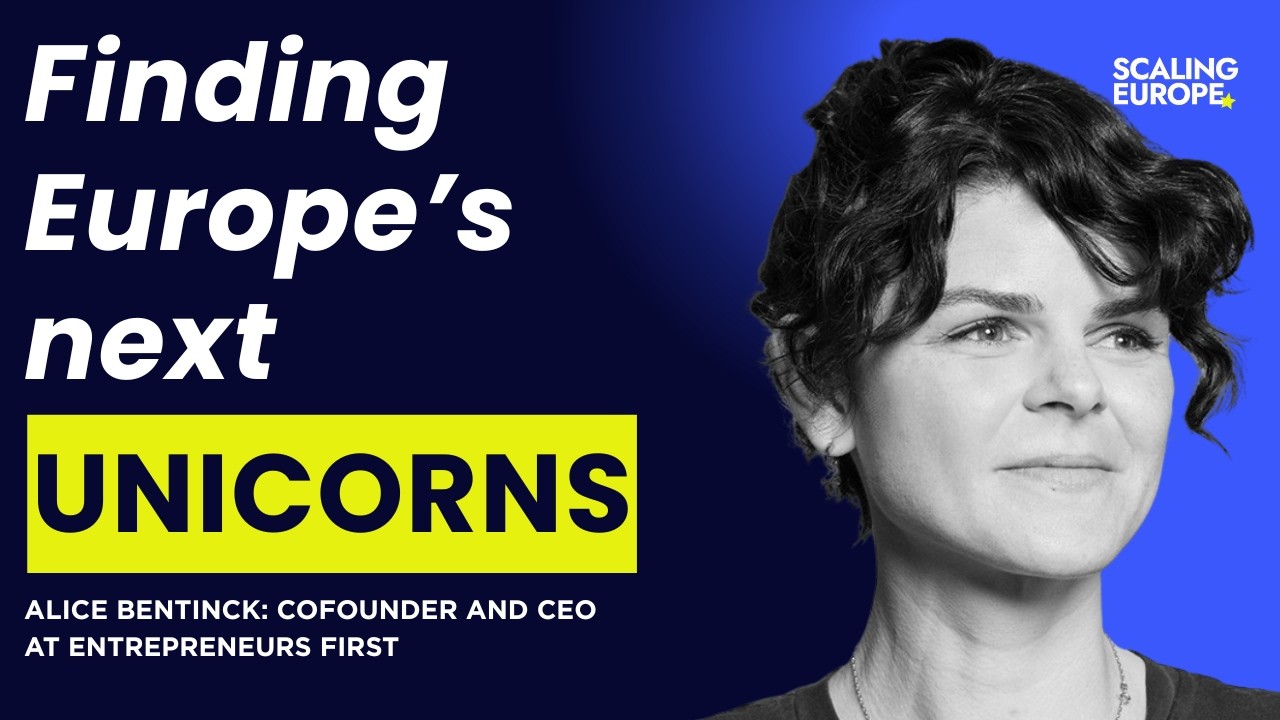
Alice Bentinck, CEO of Entrepreneurs First, discusses the program's 15-year evolution from scrappy nonprofit to $12 million Series A. A 2015 demo day produced a unicorn and $70 million exit, turning the tide. She explains why EF moved founders to San Francisco, where valuations doubled and fundraising cycles shrank to two weeks.
Questions this video answers
No.
The people.
The time difference with Europe.
My family.
Ensure Europe attracts the world’s best talent, especially through its world‑class universities, and provides pathways from education to opportunity.
Chapters
Hello and welcome to the Scaling Europe Show. I'm Seb Johnson. Thank you so much for joining me. If you like what you see, please like, comment, subscribe. The more engagement, the more visibility, the better guests I can get, and the better coverage I can provide of the European tech ecosystem. I would also like to say a huge thank you to my sponsors, Checkout.com, one of Europe's leading fintechs, and it is where the world checks out, and SurrealDB, the multimodal database for AI agents, which has partnered with thousands of the leading organizations, including the likes of NVIDIA and Samsung. So if you like both of those, check them out. out the links below. Thank you very much. Hello, and welcome back to the Scaling Europe Show. I'm Seb Johnson. I'm here with Alice, the co-founder and CEO of Entrepreneurs First, which needs no introduction. How are you doing, Alice?
I'm very good, thank you. Thank you so much for hosting me today.
It is my absolute pleasure. Look, I want to go straight into it. You know, anybody watching my channel, anybody who interacts with my content will 100% know who you are and know the journey of Entrepreneurs First. You've been a A pivotal player in kind of growing, especially I think the UK ecosystem, but also, you know, you've had a huge global footprint at some point, and you've been operating in lots of countries. I want to go straight into what has been the most amazing point of the journey. And I think you've been doing this for almost 15 years. I think the early days were, I think, were a bit like you were sort of doing it not quite full-time, it was a bit scrappier. But it seems like it's between 10 or 15 years that you've been doing this like full, full-time. you know, going at it. So, what has been the best point in the journey? Maybe it was a portfolio company doing amazingly, but maybe it was the moment where you realized, okay, we've really got something here. But I would just love to know the highlight of the journey so far.
So, you're right, so it's been 10 years since we started investing. We did our first investments in 2015, um, and the 3 years before that, we were actually structured as a not-for-profit, um, and as you say, it was sort of slightly, slightly more random start, um, Best moment. I think one of those sort of magical pinch-yourself moments is when we were raising our Series A, because EF is this unusual, you know, we invest but actually structure as a company. We went and pitched Reid Hoffman at the LinkedIn office in the Bay Area in the US. And I remember a sort of magical moment was looking at the clock at the point where he said, cool, how much money do you want? I'm in. And it was 17 minutes past 5. And it was one of those magical moments where it's like, wow, in 17 minutes, we've— it was one of those sort of pinch yourself moments where, honestly, I think he'd done a huge amount of due diligence on us beforehand and had a huge number of references on us. But that felt like one of those sort of magical founder moments. I suppose more honestly, the day-to-day thing that I really love is that because our product is so hands-on, and we work with these founders for such a long time. One of my favorite moments is whenever I meet an alumni, the most common thing that they will say to me is, EF changed my life, and I just want to say, you know, thank you. And I feel very lucky as a founder to be working on a product that has such an enormous impact on our customers and the people who go through our products and through the process. So, yeah, the Reid Hoffman moment was definitely the Pinch Me one, but I think my favorite moments are, you know, meeting alumni and seeing what an impact EF has had on their lives.
And did you have an amount in mind that you wanted to ask Reid for, or were you a bit thrown off?
We did. We knew how much we wanted to raise. I think we were raising $12 million at that point for our Series A. This is back in 2017. And then Reid has been the most amazing friend to EF and has been on our board for the last almost 8 years. We feel very lucky to have worked so closely with him.
Yeah. And on the operational day-to-day stuff, and, you know, I've interviewed a bunch of EF founders, both people who've been through it recently, But then also people like Barney at Clio, and he was talking about it on the Bulletin podcast recently. And yeah, like the reviews are absolutely glowing, which, yeah, it must be an amazing feeling knowing that the founders that have come through do really love it and are so positive about the experience. And what about on the other side? What's been the hardest moment or the lowest point where maybe you felt like this is all falling to pieces, this isn't gonna work, what am I doing?
Oh, how long do we have? I think there's, you know, I say this to our founders, there are 2 kinds of dread when you're a founder. And I think the stage that I'm at now is, you know, EF works and now the risk is like, I miss how big it can be or, you know, we miss its potential. The thing in the early days that was really, really hard and that I see a lot of founders struggle with is Matt, my co-founder, Matt Clifford, And we didn't know if we were wasting our time for about the first 4 years. And we'd left McKinsey, we were hyper-ambitious, all our friends were going on to go and do these really cool, interesting things. And we were running this slightly random not-for-profit. We didn't have a business model. We didn't know how it was ever going to make money. We weren't deploying capital at that point. And this sort of existential dread that you're working insanely hard, but you've got no idea if it's on the right thing. And the thing that kept us going, because again, like what we were doing back then was so crazy. It was very much challenging the status quo, investing in individuals before they have an idea. Like literally just, you know, now it seems obvious, like pre-seed investing is a thing, but back then it was very much against the status quo, which was, you know, uh, investing in companies that had something. Um, and For our 3rd Demo Day, which was in 2015, our 3rd Demo Day beforehand, Matt and I were like, look, if this doesn't work out, we've got to can it. Like, if this Demo Day doesn't go well, if the companies don't do well, we're canning it. And actually, from that Demo Day, we got our first unicorn, we got our first $70 million exit. And so, you know, the rest is history. But yeah, we were pretty close to canning it. We actually spent, in the early months of EF, we really, you know, the idea of EF seemed cool, but we were also building a dating app on the side because we thought there might be an alternative. Yeah.
Um, that's— yeah, that's super interesting. It's like one of the things I love about talking to, to founders, especially in tech, is that it is such a long game. You do just have to— you know, the most interesting founders with the best stories who've built the most interesting things spent so much time with no reward and no traction, or like, you know, everything going against them. And then there was that moment. Uh, so that definitely sounds like that moment to you. Um, and how do you see yourself? Do you see yourself more as a, a founder in typical sense of like a tech founder, or do you see yourself more as an investor?
I really am at the intersection of the two. So, you know, EF runs like a company. We have 100 employees that work across 4 locations, and we've always run as if we are a company delivering a product, but obviously with a business model that is an investing business model. I think to be a good investor, you need to be really interested in the process of identifying and understanding outliers, whether that be outlier companies or in our case, outlier talent. So, it really is a hybrid of the two, which I think is kind of what makes it fun as well. We have the challenges and excitement of building this incredible team where we have You know, one of the things I'm most proud of is the team that we've managed to build around this and how long our senior leadership team has been with us. You know, we were adding this up the other day in our, you know, our partner team, we have 60+ years of experience at EF between us. So yeah, we have the company structure, which makes it really unique. But one of the reasons we do that and why we think it's good for our customer is that it means that we can be very nimble in how we adapt our product, how we adapt our strategy, rather than being tied into any particular LPA that means that we're committed to working a certain way for the duration of that. So yeah, we've switched between investing off our balance sheet and investing out of funds. We're currently investing off our balance sheet. Patrick and John Collison did a, alongside a bunch of other unicorn investors, unicorn founders, did a $150 million round into EF in 2021 on the balance sheet, and we're investing out of that at the moment. So, yeah, we are a weird mix between the two, but I think for what we're doing, which is, you know, we're building a product, we have a set of customers that we want to wow, we feel that this structure is optimal.
And before you became the CEO, you were the CPO, right? The Chief Product Officer at Entrepreneurs First. Do you have a personal preference? Do you prefer building the product, building the team, or do you prefer, I don't know, the investing, the finding the founders, the classic sort of like talent sourcing?
I mean, I love both. I feel very lucky that I really love what I do and feel very lucky that I get to spend all of my time either building the EF team or helping our founders build their companies. So, I enjoy both, you know, the switch from being the CPO or in some ways like the other founder, so doing lots and lots of different things, you know, running the company, managing lots of people, and building the worked out, you know, moving to the CEO role, I am spending more time with our investors and spending more time thinking about the financial strategy of the company. But, you know, Matt and I have always worked very closely. I think we've been very lucky to have such a fantastic co-founder relationship for the last 13 years. And we still do work very closely together and are very good friends. I was actually at Matt's amazing 40th birthday this weekend. So, I think, you know, we've worked very closely together. We still do. Uh, but I've definitely enjoyed the sort of new challenge of really getting to grips with, um, how our investors, which is a mixture of high net worth and institutional LPs, think about what we do. Um, and, uh, yeah, you know, as a founder, the joy of being a founder is that you are on a constant learning curve and that you are constantly on the edge of what you know how to do. Um, and that's one of the reasons why it's such an incredible job. And why it's hard and can be tiring at times. But I think if you're the sort of person that really wants to push yourself to the edge of what you can do and the edge of what you can be, this is why there's no other role that can compare.
Yeah, no, I bet. I mean, you seem to be doing an amazing job and it's been such an amazing organization for, I think, you know, the ecosystem. Talking briefly about yours and Matt's co-founder relationship, why do you think that's been, you know, what do you think it is that has made it so strong and has enabled you to kind of keep working together for such a long period of time? You know, there's often, you know, you often see it even in the most successful companies, even when the founders kind of move away or do different things, often the relationship could deteriorate for a number of reasons or can break down.
Like, what do you think has enabled you two to stay If you think about EF's product and what we can do that no one else really has been able to replicate at the scale that we do it, EF is about building co-founding teams from scratch. And I suppose it would be ironic if we hadn't been able to maintain our relationship. But I suppose we as a company have come up with a bunch of norms and processes to help people have functioning co-founder relationships. And I would say there is, you know, Matt and I use that for our own co-founder relationship as well.
But that's exactly what I was going to ask. Yeah, because I was like, you know, has yours and Matt's relationship kind of defined how you build co-founder relationships at EF, or has EF sort of helped you manage your own co-founder relationship with Matt?
I think a bit of both. I think a bit of both. I mean, the bit that, you know, we always push our founders on when they're trying to select their co-founder is, does this person make you feel more productive? Are you more productive when you're in this relationship? And it's amazing how often somebody will say, I really like them, but that's not true. And I still want to stay with them. I'm like, no, no, no, that's a terrible idea. And Matt and I are a really, really insanely productive team, and he makes me feel more productive. And I think we are lucky. We have a huge amount of respect for each other. We have some skills that overlap, and I think that's helpful. You don't necessarily want a co-founder that has a completely different way of working, skillset, opinion about the world. Like, you need to have a very strong overlap, but we also have enough differences in our preferences and skillsets that there's kind of enough for each of us to do the work that most excites us. And, you know, throughout the time, you know, the journey of EF, we have had reasonably distinct roles, and Matt has been the most incredible fundraiser for all of the various vehicles that we've had. And I spent a lot of time building the product and running the operations of the company. And I think that's given us the space to be able to do our thing. But we also spend so much time together, as in we talk to each other relentlessly. And I think this is one of the things that you can't skip as co-founders. Relationships atrophy really, really fast. And the only way you fix it is by spending more time together. We've also had amazing coaches, and I'm always a big fan of spending more money on a coach than you think you can afford. You kind of get what you pay for. And we've had some very expensive and very, very good coaches. And we both speak to them individually and then we speak to them together. And it's just one of those hygiene things that means that you stay on the same page and stay— often with our coaching sessions, we would turn up and be like, I don't think we've got anything to talk about. All's fine. And then within about 10 minutes, you're like, oh yes, this is what we should be talking about. And that's what a great and very experienced coach can do for you.
And is that part of the role that you and the team play for your co-founders? I mean, the Cohort co-founders, do you end up playing that role of sort of like mentors and coaches to the teams?
Yeah. I mean, the way that we think about it is when you are an early-stage founder and when particularly at that stage where you are trying to work out who to co-found with, you need a mirror. You need somebody who can reflect back what they are seeing. Now, if you've never really gone through the co-founding process before, you don't necessarily know what good looks like. And so, that mirror needs to help you understand where you are in the stack rank of possibilities and outcomes. So, yeah, this is a key part of what we do at EF is like, yes, it's about giving you a pool of carefully screened, carefully curated co-founders. But as importantly, it's having somebody guiding you through that journey saying, look, Seb, I know you really want to make Alice, but what I'm seeing is that actually you're less productive than you were with, you know, Thanks. And let's talk about why that is. And let's work out if this is actually the right co-founder relationship for you. So, yeah, it's definitely, you know, it's definitely a large part of what we do.
And that move, you know, from Matt stepping down and you going into the CEO position, how did you find that on a personal level? You know, you mentioned that you had quite distinct roles and quite distinct areas of responsibilities. I assume that was quite a big jump to then sort of, sort of looks like you're almost doing both. How did you find that kind of transition?
I mean, it was more of a change than I expected, if I'm totally honest, because we have worked so closely together and talk relentlessly and discuss everything and every decision. I thought it would be less of a change, but actually, it is a change in responsibility, and it's a change in the kind of things that I'm spending my time on. But I've really enjoyed it and I like taking on new challenges. I like learning new things and this has pushed me to do things that I haven't done in the past. So yeah, it's been— so it's now been 2 years and yeah, it's really fun. I think we're both very happy with the changes that we've made to our roles. In that period of time, I've also moved to the US and I now live in San Francisco. So, there's been lots of different changes, but, you know, I've been doing this for a long time, and I think having the opportunity to do actually a much more radical change in role than I'd expected has been really reinvigorating.
Amazing. And look, let's talk about the US then. You're now based there. You know, EF has now changed, I guess, its model, and now it's all about sourcing founders from London forever, but getting them to San Francisco. Can you talk a bit about the rationale for why EF made that switch?
Yeah, so there's 2 parts to this. One is— oh, sorry, you froze, but maybe that's okay. Sorry, had you finished or did I just cut in?
No, no, that was it. Don't worry.
Okay. So, there's 2 reasons why we've made this shift. For the last couple of years, we have been trying to work out how to engage our founders with the US. We have this incredible investor base that is largely US institutions and US high net worths. It's not that we didn't try to raise from institutions in Europe, it's just that we had a lot more success in the US. And have been very lucky to work with Alex Bangash at Transpose Platform, who's a sort of big and early believer in alternative models of venture. And so, I actually spent 3 years spending 3 months a year in San Francisco trying to work out, you know, how do we get American capital to invest in more European companies? You know, do we do this through roadshows? Like, what's the right way to make this work? And I would highly recommend it. It's like being able to dip into the ecosystem, but for enough of a period of time, you actually begin to tease out the differences between the ecosystems. I would highly recommend it. Also doing it between February and sort of, you know, April is a really great time to be, well, in the UK. And so, part of it was we were actively thinking about how do we make the most of our connections in the US, make the most of the ecosystem here. And then the big shift that we were seeing was a change in what our customers wanted. And in the last 18 months, suddenly we were beginning to hear, my number one priority is to try and get to the Bay Area as quickly as possible. Can you help me to get to San Francisco? And as a company that has a product with customers, our job is to make sure that we're delivering a product that delights our customer. And I think it's partly that there's been a shift in the demographics around founders, as in we're now working with younger and younger demographic. 25 used to be seen as like a youngish age to be a founder. Now it's sort of 17. And so really, it was the combination of those 2 things. How do we how do we make the most of this incredible network that we have in the US? And then seeing our customers actually change how they think about what they want from their founding journey. And, you know, the fact that OpenAI and Anthropic are headquartered in San Francisco has brought so much energy back into the city and really, really brought, you know, it's now the center of this AI revolution that we're, this current wave of AI that we're in. You know, the energy is palpable and it's really beginning to attract more and more Particularly young European talent, um, to, to come over here.
And are you seeing results already? I mean, I know it's fairly early in terms of like a full venture cycle or whatever, but are you seeing, uh, tangible differences in maybe the amount of money raised, revenue generated from those companies that you've brought straight over to San Francisco versus the ones in, in prior kind of cohorts that, that hadn't made the move?
Yeah, happy to, happy to share some numbers on this. So, um, If you look at the average valuation pre-us being in SF versus post, so now basically all our companies kick off their fundraisers in San Francisco. Although I will say like some of our amazing European VC friends have done a great job at coming out to Demo Day and still being part of that fundraise process. But if you look at pre being in SF versus post being in SF, valuations have doubled. We're taking the same people, we're doing the same things, valuations have doubled. If you look at the speed to close a round, we expect pretty much all of the fundraising to be done in 2 weeks post-Demo Day. And Demo Day is a hard starting point. Like, you don't start raising before that. Previously in Europe, that would've been more like 6 weeks, although things are beginning to get faster. So we knew that there would be a shift in— we expected that there would be a shift in the amount raised, the speed to raise, the caps that they were getting. I think the bit that has surprised us most, and I think is definitely undervalued, is what happens when you work with US customers. So, looking at the speed that our founders can get to pretty significant contracts with American customers is unlike anything I've ever seen before. And so, if you look at the top companies by Demo Day, and these companies are max 6 months old, and this is from like a standing start, pre-team, pre-idea, they had nothing, and then 6 months later. But some of them are only sort of 4 or 5 months old. World. And they're getting to somewhere between $100K and $500K of ARR. And that's largely all coming from American customers. And American customers behave in a different way compared to their European counterparts. I think that was probably one of the things that I'd underestimated. One of our incredible investors, Charlie Songhurst, who's one of the world's best angels and backed Matt and I when we basically had absolutely nothing, He said to me, which I think is so right and definitely isn't talked about enough, he said to me, everyone thinks that the founders set the culture of a company, and they do to some extent. But what you don't realize is that the customers set the culture of a company. Because how fast your customers move, how quickly they respond, that is the pace that your company will move at. And so, by having American customers from day one, it forces you to adopt this pace and productivity, which when we look at this particular wave of AI companies that we are in at the pace and productivity has never been more important. So, um, so yeah, it's definitely been one of the things that has surprised us is, yes, we've seen amazing fundraising outcomes, um, but actually it's the speed of revenue generation that's been so, uh, so incredible.
That's so interesting. Now, I hear a lot from founders about procurement generally, but, you know, Europe versus US, when the companies are based in Europe but selling to European companies versus, you know, maybe they're still headquartered in Europe, but they've got, you know, their go-to-market in the US. Procurement is the thing that they talk about and how risk-averse European companies are, but I've never heard that point about it having such an interesting impact on the companies itself. But given these results and given doubled valuations, the insane speed of revenue growth, do you regret not doing it sooner?
I mean, if you look at when else we could have done it, I think COVID would've got in the way. If you look at the story arc of EF, we went really big into Asia. Like, we took a massive bet on Asia and in 2016 expanded to Singapore and then expanded to Hong Kong and to India. And we've now actually consolidated and we only have India left. So, we took a big bet on Asia and at the time it felt like the right bet to make. I think we now realize, like, the right way to run EF is to actually scale a small number of hubs and scale the number of people going through each hub, rather than trying to do enormous geographic coverage, which honestly operationally is just very, very hard to manage.
Yeah.
The really hard thing is making sure that every site has the right taste. If you think about normal VC, you have a small number of partners who are making decisions about who to invest in. And we have that at our investment committee, but actually the first selection decision, the first investment decision is which people are you going to take onto the program? And We now have a very deep apprenticeship culture in each of our sites. We have very experienced investors teaching the next generation. And so, that's one of the reasons why we've shifted to a much more consolidated model. So yeah, could we have moved to the US earlier? Probably, yes. But I think the timing right now is pretty great. San Francisco as a city is really so, um, on fire is the wrong word. Like, it's, it's so buzzing right now, um, and increasingly so, sort of quarter on quarter. Um, so I think that the timing has been pretty good. Uh, yeah, maybe, maybe we should have come earlier.
No, interesting. Um, I also want to talk about the, the reaction to the move to the US. I think, yeah, I actually put a poll in one of my newsletters when, you know, when it was like hot topic at the moment, and it was bang on 50/50. I said, do you think Entrepreneurs First have made the right move, you know, prioritizing getting founders to the Bay Area? And half said yes, half said no. What was your interpretation? What was— what did you feel like the reaction was from the wider, or maybe the specifically European ecosystem? How did that respond to the move?
I don't think the ecosystem love us to move. And I can see why, you know, we're taking a bunch of high-quality companies that previously were raising and staying in Europe and now are not. But ultimately, my customer is not the ecosystem. They're a really important part of what we do. But the most important thing for me, you know, I'm the founder of a company. My job is to make this company as successful as possible, both for me, but also for my many shareholders. And I think EF will be more successful and will produce bigger companies by being able to give our founders access to the US from early on. You know, our applications this year are double compared to last year. You know, EF has never been more attractive, and that's largely because we have an offer that really, really appeals to our target customer. You know, I love our product, and I've spent so much of my career thinking about it, and I have to do what is right for our customer and what they want rather than what's right for the ecosystem. And, you know, I think EF has done an amazing job and I'm very proud of what we've contributed to the European ecosystem. And I understand that the move is not necessarily going to be popular and we have had a bunch of pushback, but I think ultimately any founder needs to listen to their customers and what their customers want. And if anything, we are seeing increased, rapidly increasing demand to try and get to the US. I think the piece that is worth I'm noodling on is how can we build a bridge that goes in both directions? So, rather than seeing this as a brain drain and a cutting of ties with Europe, how can we say, look, there is one of the world's best talent ecosystems in Europe. The talent in Europe is absolutely world-class, some of the world's best universities. We all know how great the talent is in Europe. And we know that the ecosystem in the Bay Area is the world's best ecosystem. And on whatever metric you look at, it just is the world's best ecosystem. How can we connect these together? How can we build a bridge? And honestly, since I've been in San Francisco, I'm seeing more and more European VCs come out. Lots of them, when they come out, they come say hi, come to the EF office. And more and more of them, I see the narrative is shifting where they're saying, look, actually we need to take both ecosystems seriously and connect between the two and help our companies access US investors and help our companies access US customers, um, rather than seeing this as pure competition. Um, you know, if you are a founder in the UK and you're ambitious, you're building a global company from day one, and there's lots of different ways to do that. And, you know, you said, you mentioned Barney from, from Clio. You know, he's an amazing founder who has largely, I think, 100% customer base in America, but the whole company is based in the UK. And, you know, he's making $250 million a year, is profitable. Um, so there are lots of different ways to do this, but when we think about the connection between, between the 2 ecosystems, that's when we can actually really, really begin to push Europe forward and accelerate the growth of both the founders, European founders, Um, but also, uh, you know, European talent, um, and seeing Europe as a great place to, to build out, uh, talent hubs. So there's lots of different ways to think about the model rather than just thinking it— think of it purely from a nationalistic, um, and protectionist, uh, perspective.
And I think you touched on it earlier, but, you know, the way that, uh, the speed at which VCs are now moving in Europe, it seems to be because, you know, that bridge is, is kind of clearer than ever, and more, more American VCs are now trying to kind of get very early into European deals is sort of forcing our VCs to move quicker and move faster and adapt that speed, which I think is kind of to your point. It does work both ways, and we kind of rebuild the good habits from learning from our American peers. But I think it was really interesting, the move, and I think you kind of touched on it, that, um, you know, nobody would criticize a European founder for going out to San Francisco, you know, like an early-stage founder trying to build their business. You know, no one ever criticizes or pushbacks against them for doing the best thing. But I think it's because it's such an amazing role that you and Matt have played in building the ecosystem, people forget that you are a business, not an ecosystem player. You know, you're not a not-for-profit. It's been a long time since you've been a not-for-profit. Um, so I think it's really interesting. And how did you find that on a personal level? You know, because it really, it clearly sounds like the absolute right thing to do for the business, and you have played such a pivotal role in building up the European ecosystem. How did it feel then to have, you know, some of the ecosystem then kind of push back at what you felt was the right thing for your business?
I mean, you know, it's not nice, but ultimately, you know, being a founder is not about people pleasing. Being a founder is often the opposite of people pleasing. And ultimately, it's going back to the principle of what does our customer want? And, There is nothing more satisfying than delighting your customer and speaking to somebody who's thinking about founding and you tell them what EF now does and how we can help them get to the US and give them exposure to the ecosystem here. And their eyes just light up and they are super excited. And it's the easiest sell for us, honestly. So, you know, when we first started EF, the ecosystem thought we were wasting our time and we did not get a positive response. So, this is not like we've been the darlings of the ecosystem for 10 years and no, until we had the Magic Pony exit, which was largely almost 5 years after we started EF, I think we were seen as a bit of a joke. So, I'm fine with being unpopular. The most important thing is pleasing our customers and I believe we can build EF into one of the largest and most successful companies that's ever been built from Europe. And I think it'd be crazy not to leap on that opportunity.
Amazing. No, it looks like you're doing an amazing job. But yeah, it's just such an interesting perspective. Yeah, it feels that there's such a big pro-European movement at the moment. And yeah, it just looked from the outside like a really challenging position to be in, you know, trying to balance this reputation you have as an amazing ecosystem with actually just being the CEO of a great business that you're trying to take to the next level. I also want to touch on your experience being in London and in hubs all around the world, London, Paris, Singapore, India, and then also now in San Francisco. What are some of the key differences? What do you think are the key things that hubs like London need to do to try and match either the speed or the intensity, the productivity? What can we learn from San Francisco?
The crazy thing about San Francisco is that it is a single industry town where almost the geography of it makes it special, as in it's a tiny, tiny city, right? And you probably don't really go into the Tenderloin. So the spaces where people are hanging out are reasonably small and I bump into people on a daily basis. And the reason why that is helpful is that you end up exchanging information really, really quickly. And so, what are the things that make it so intense here, that make it so productive? And it's largely that the connectivity is so high. Everyone you bump into, if I go to a kid's birth— I've got 2 small kids. And if you go to a kid's birthday party, it's probably actually a networking event, as in you will largely be meeting a bunch of people who are in or around the industry. And so, the kind of density of the networks here is really, really interesting, unlike anything I've ever experienced. I do miss the days in London when Google Campus and Sarah Drinkwater and the team there did such an incredible job to create a sort of single hub that really, really pulled people together. And in some ways, San Francisco is a much, much larger version of that. And so there's something about how do you create density? How do you create these spontaneous interactions? But I think the bit that is much harder to replicate is the cultural pieces. It's things like in London, I had lots of friends who weren't in tech and spent a lot of time hanging out with people who weren't in tech, which is great. Here, You really do only hang out with people in tech. And one of the interesting kind of consequences of that is, if you are an ambitious and competitive person, it's very easy to stack rank yourself versus other people. And I think there is something that then means that you are constantly getting a view of, okay, well, what does the best in the world look like? And actually, how far away am I from that? And so, I think it makes outliers, sort of outlandish success, much more legible and observable. And I think there's something really, really interesting about that that's quite hard to replicate. But I think that my one push would be that I think ecosystem density really matters and proximity matters. And so tech clusters, I suppose I believe even more in kind of small You know, really trying to gather people together in a small, distinct place that enables people to aggressively network and build those relationships that drive decisions around funding or hiring or getting access to customers.
Yeah, it makes sense. And yeah, London is terrible for that at the moment. We desperately need one place, like, you know, a startup city for, you know, people in King's Cross or in Shoreditch. Yeah, they're all over the place. I think it's something that Stockholm is doing really well because Stockholm is small and it's got such dense, dense, like, high, like, incredible talent density in Stockholm. And that— and you're seeing that flywheel turn. Um, but yeah, we definitely desperately need that in London. Um, I want to talk about the portfolio generally, you know, like you took— we've talked about Clio. I think Tractable is your first unicorn. Uh, Polly AI, I think, is another one. They seem to be doing really well. These are all companies founded I think probably like 20, I think Tractor was probably even earlier, but Clear was like 2016, probably 2017. Yeah, 2015, 2016, 2017. Way, way before the AI wave, you know, way, way before kind of the ChatGPT moment. These are all AI companies. I think there's something really interesting that Entrepreneurs First has had such success with AI companies that are not this sort of like new AI wave. But are still doing incredibly well. And why do you think your model specifically attracted the type of founders who were building the types of technology that were really ahead of their time?
Well, and I think that's the right point, is that it's actually not just AI. I think we were very early investors in AI, you know, Tractable. We almost had to explain what deep learning was at that Demo Day in 2015 because it was still so new. But if you look at some of our other big companies like Aztec or Jensen, these are companies that were built 2018 and 2021, and these are Web3 companies. Or if you look at OCA Bio, which is a Khosla-backed biotech startup that has got a billion-dollar contract with Boehringer Ingelheim. Again, it wasn't that we had a particular thesis on biotech, it all goes back to our model is to find the very most ambitious, most talented individuals and then say, cool, what are you interested in right now? We see seed VCs are a lag metric for us rather than a lead metric about the future or a lead indicator of the future. And I think you can basically never go wrong by asking ambitious, smart builders, okay, well, what's going to be the next big thing? And sometimes we get it wrong, as in, We put a lot of money into quantum computing, probably too early, and augmented reality. But ultimately, by backing early technologies, I think you end up being on the cusp of some really, really interesting businesses, but also really interesting people, as in finding people who have contrarian views about not just a particular business opportunity, but a contrarian view about a certain technology. So yeah, I think we've done very well to be early in some of the most kind of exciting spaces.
And are you seeing that in your portfolio today? Or like, you know, everyone seems to be building in AI. Are you seeing people who are going against the grain, who are building at technologies where you are sort of like, not like there isn't much excitement or hype about them? Or is it still very much like everybody's focused on AI?
I think we are at an interesting inflection point at the moment because this sort of feels like when we were first starting EF in the early 2010s, you had VCs that were only investing in apps and mobile VCs, VCs that were specialists in mobile was a thing. And I think we're now tipping over on that point where every company is an AI company. So, I think it becomes less about the technology and more about What are the interesting technologies that are intersecting with AI? And so, we have a bunch of interesting companies coming through that we'll be doing Demo Day in January. So, I probably can't give you any spoilers there. But yeah, I don't know if I would want to make a bet right now on what the next big technological shift is going to be. But I would say we will experiment. And if anyone who's listening to this who is interested in founding a company and believes that they have a view on what that next shift will be, we would love to speak.
Amazing. Well, look, I want to finish up with some quickfire questions, just 4 or 5, short, snappy.
Ready?
Right. Are we in a bubble? Yes, no, don't care, doesn't impact my job at all.
No.
No. The best part that you, the bit that you enjoy the most about being in San Francisco?
The people.
What is the absolute worst part about being in San Francisco?
The time difference with Europe.
And what is the one thing that you really miss about Europe?
My family.
Yeah. And then finally, if you could implement one policy change across either the UK or the whole of Europe magically that you think would kind of take the tech ecosystem forward, what would it be?
Ultimately, we are in a talent war, and so just making sure that the UK and Europe is doing whatever it takes to get the world's best talent, particularly through our universities. I think when you look at what is one of the great assets that Europe has, it's our universities. They're absolutely world-class, and just making sure that we are attracting the very best in the world and giving them access to not only our education, but then the opportunities that come from that. We mustn't lose sight of that.
Amazing. All right, so double down on talent and make sure we can attract the world's best. Well, look, Alice, thank you so much for joining me. I've absolutely loved chatting. It's been really interesting hearing about, you know, your journey and Entrepreneurs First.
Thank you so much for having me. I've really enjoyed it.
Amazing.


