#71: Matt Reustle, CEO of Colossus — Lessons from a first-time CEO, how to analyze a career pivot...
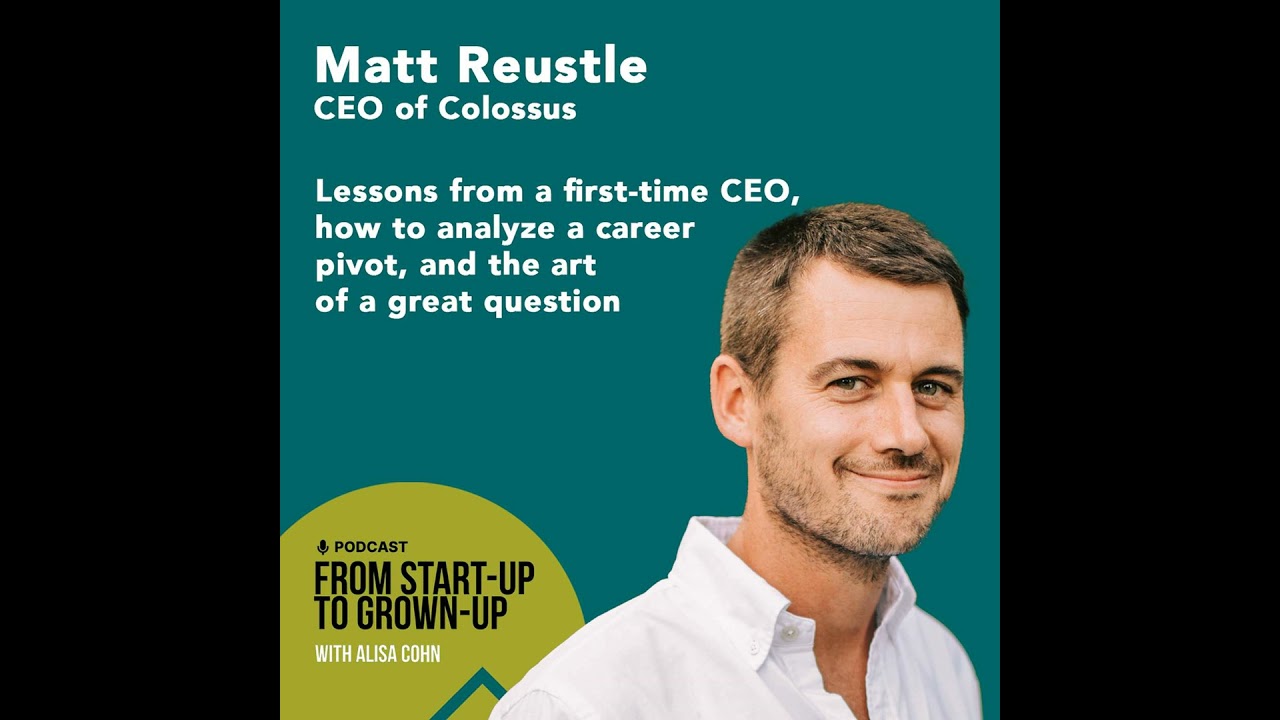
Matt Russell left Goldman Sachs and Raven Capital to build Colossus Network, a podcast platform for institutional investors and founders. He explains how he de-risked the career pivot, what it takes to be a first-time CEO, and why he refuses to buy downloads to grow podcasts.
Chapters
Welcome back. This is From Startup to Grownup. My name is Alisa Cohn, and today I'm thrilled to welcome Matt Russell to the podcast. Matt left his high-flying finance career at Raven Capital and Goldman Sachs to become the CEO of Colossus. Colossus is a boutique content platform built for institutional investors, founders, and executives. The family of podcasts receives over 1.4 million downloads per month, including the very well-known Invest Like the Best with Patrick O'Shaughnessy. Matt and I had a fantastic conversation. We started out talking about how and why he made such a career pivot. We talked about how he handled being a first-time CEO and the most important practices he implemented as he leaned into running the business and managing people. We also talked about the specific practices he uses as a leader, which you'll find very valuable, including how to manage people whose job you've never done before. In addition to being the CEO of Colossus, Matt is also the host of Business Breakdowns podcast. So of course we geeked out about podcasting, the business itself, how to grow your audience, and the art of a great question. This is such a rich discussion, and I love how enthusiastic and analytical Matt is. You're gonna learn a lot and you're gonna love this episode. So please enjoy this great conversation with Matt Russell, CEO of Colossus Network. Matt, welcome to the show. I'm so excited to have you today.
It is great to be here. I'm equally excited. Uh, thank you for having me.
That's so great. Well, you know, Matt, we met at the Founders Only meetup and we had such a great conversation and I loved your background. Then we'll get into, you know, I will have introduced you before this and we'll get into the whole thing, but you started life as a finance guy and then you left it to come and build the, uh, to build the Colossus Podcast Network. So like, why did you do that? You left Goldman Sachs and another, and another like prestigious firm to come be a podcast builder, Tell us about that.
Not the natural career progression. No. Yeah, that I think I was expecting to follow and that most would expect me to follow. But to start, I love audio and podcasts when they really hit the mainstream and I would say mid-2010s and AirPods and an iPhone, it just opened up this entire new world of learning for me with white space in my day that could be filled with me learning about finance-oriented topics, history topics, sports and entertainment. It was just something that immediately clicked for me just in terms of the engagement and how much of a user I was. And that helps, you know, it just at least opened my mind up to possibilities in terms of the industry itself. And I started to get this sense that the impact that audio was having on me went beyond what I got from other forms of media. And I think the Founders event, which you mentioned, is a great example you have these parasocial relationships with people on the other end that you're listening to, that you feel like you're in the room, and it's completely different than what you get from somebody's writing or even from video, I think, to be honest. There's something about audio that was really clicking, and I still don't think that's exactly been figured out, but I think there's something that's really there that clicked with me. And you pair that with an industry that was growing substantially from a financial perspective, again, the finance background, it's incredibly inexpensive to create podcasts. They're hard to scale, like many businesses, but the fixed overhead is extremely low. And that to me was an attractive financial opportunity as well, you know, offsetting some of the risks associated with other businesses. So, you know, putting all of that together, it was not something that I necessarily expected to do, planned to do, but there were a lot of things together that lined up right with the team, that I would be joining, the people that I would be joining, and those collective things where it wasn't that I was running away from finance. If I hadn't left, I think I would still be in the same position at Raven Capital that I was in before. But this was a calling that I had that I wanted to run towards.
Yeah. Oh, that makes so much sense. I mean, we could go into depth and I think, I hope we will later about the parasocial relationship and kind of the beauty of podcasting and how really intense it is. And just to give everyone a little background, this sort of the Founders Only conference that we met at, it was created by, it was convened by David Senra, the founder of The Founders Podcast. And I think all of us felt a lot of rabid, you know, obsession for that podcast, which is why we decided to all come together in this like crazy conference. And in some ways that was the only thing we had in common, this sort of love for Founders Podcast. So I can totally relate to that also. The idea that you can fill the white space with learning on so many different topics. It is very— it's a wonderful medium and it's a very exciting medium and the sky's the limit in terms of what's possible. But what specifically happened for you? So you were at Raven Capital. You must have met Patrick O'Shaughnessy at some point, or how did that all come together for you? And was it a hard decision to make once you, you know, all the pieces fell together?
Yes. So Patrick, Patrick, in the summer of 2020, announced that he was launching a media business around his original podcast, Invest Like the Best. And that was one of my favorite podcasts. I love the way that Patrick thought. I love the guests that he was bringing on. Many of these were not investors. They were restaurateurs or people that ran businesses in far corners of the world, Africa, you know, having their own safaris. And the stories that were coming out were so much different than you were getting from anywhere else. And there was a certain attractiveness to Patrick being able to be somewhat familiar with his brain just from listening to him ask questions over the years, uh, and then, you know, what he was building in public around the business. It just was something that I was aware of, I saw happening. And fast forward 6 months later, they announced that they were expanding the team looking for someone to really, uh, take the content arm, you know, hands-on. And that was something where my previous background— I, while at Goldman Sachs, wrote investment research. That is a form of content. I often say it's a substitute for sleeping medicine for some, but you get a sense of what many of the people in the investment industry and the business industry care about in terms of consuming and and some of the things that work, some of the things that don't work, some of the common mistakes. So I felt like, okay, here is something that they're building. Here's a skill set that I potentially have and can help out. And now I'm going to get into something where it's building from the ground up. And that was in the back of my head. You know, if I go through this life, am I going to regret whatever it might be? And one of the things I would regret not doing is trying to build something from the ground up. So that was, that was something that was pulling me. Now, that was just, okay, I'm going to reach out and see if there's a possibility here. And then going through the conversations, it came down to a great group of people that I would be connecting with, be working with. And that to me was very, very intriguing. Again, that's the, I want to run towards this rather than I'm running away from something. And what was beneficial about this was, leaving the finance industry, there are the Um, the pedigree and the prestigiousness of it, but there's also the financial compensation, which is a tricky thing. And figuring that out with a team that was willing to work with me and come up with a solution, I think this is the benefit of smaller companies where you can get creative. You can come up with metrics that say, okay, we can't put you there now, but if you grow it to this and you hit these milestones, the company is then winning. And you can win alongside of us. And that was what got me comfortable. Um, and it was still a leap of faith and, uh, a risk that I was aware of, but I thought there were a lot of things about, you know, the, the situation and everything around it, which felt like I was de-risking it to whatever extent possible.
Yeah. De-risking in terms of, there was like a sense of, yes, you will be able to get you to a certain comp level that's gonna make you happier, if once you could demonstrate you can grow the business and also an understanding of the colleagues and the tradeoffs you were making in terms of the colleagues around you. Would you say that?
Yes. And the third thing I would add is what our content covers. Again, we have Invest Like the Best, Business Breakdowns, Founders, Making Markets, Art of Investing, shows around investing. So we're spending most of our time talking to investors. So I'm still in this ecosystem. I cannot claim to be an investor anymore, a professional investor. But I'm still in that world and spending most of my time with those people. So if everything failed and we decided this project wasn't going to work out, I was still going to be around the people that, that I think I would ultimately want to be spending the rest of my career working with, whether those were inside the organization or outside of the organization. So that was like a third lever alongside of that. And again, it's the, you know, I truly believe that most of the market is efficient in order to generate more reward. You usually have to go further out on the risk spectrum. But there are ways to de-risk whatever situation you're in.
Yeah, I love that. And also, I mean, just to say, like, when I coach my clients about on any topic, it's really about, you know, skills and knowledge, right? You wanna be building skills and knowledge and you wanna be building your network. So I think that's what's set— what also you're talking about is that you saw the opportunity to continue building your network probably much broader than you would've in your existing, you know, Raven Capital, which you wouldn't be able to do.
100%. I think, The thing that I've consistently underestimated in my career is when you move into new roles, oftentimes in whether it's different asset classes on the investment side or moving from an investor to an operator, you would open your world up to an entirely new set of people and A-players in those specific industries or sectors or whatever it might be. And you just expose yourself to so much more and you bring along with you the lessons that you've taken away from those other places. Uh, but you enter a new world and get to learn and, and that, that curve is just exponential in the early days. And, uh, it's, I would never say it's, it's pure fun because it's, it's excruciating and it's, you're getting up to speed and it's often painful, but it's so rewarding when you always look back on those periods of time. So you have to always remember that.
Yeah, I think that's so true. And also I, I really love that you said like you knew that you wanted to build something from the ground up and there would always be like an itch inside of you. And I'm just curious, What conversations did you have with your wife about, you know, this career pivot? It was a significant career pivot and you kind of need to get the family on board. What kinds of conversations did you have with your wife about it?
Well, the, it was funny because the weekend that this all came to be, she was away on a trip with her friends. So I was at home with the dog. This is before we had kids. And she was, yeah, at this point, um, when, when I was making the move, she was 7 months pregnant. And I actually, my, my my first day leaving Raven and the 2 weeks in between starting were when my son was born. So quite the time to be doing this. Wow. And that played a little bit of a role in terms of if I'm going to do this, I don't think it's gonna be after this happens. And she was incredibly supportive as she always has been. She asked me questions about what this ultimately meant, whether there would be changes into our lifestyle, what that was going to mean in terms of, you know, work and time and all of that. And, you know, I did the best that I could to reassure her about my decision. And what it comes down to is she said, you know, I trust your decision on this. I think I can feel the energy that's coming out of your voice from it. And I believe in you. And that's all that I can ask for in terms of, you know, support. So she has always been somebody who has helped me out a lot. And she herself is a very accomplished person in her industry. And that has just been an incredible relationship for both of us. You know, we started in New York in the summer of 2008, you know, her in advertising, me in finance. Quite the time to start our careers and, yeah, and then just be on a journey together, which has been really rewarding in a lot of different ways.
Yeah, I think that's so important. You know, something that we've learned from Founders Podcast, from David Seder's great podcast, is the importance of having a supportive spouse. You know, in terms of your career success and certainly in terms of founder success. And, you know, in some ways you were really founding, refounding your own little division there of Colossus Media and you became the CEO and you were a first-time CEO. Is that correct?
That's correct. Yes.
So you moved from, yeah, from finance and you were probably, you know, working inside of a large institution in a certain kind of way. Now suddenly here you are, you're the CEO. How did you prepare yourself and What was your mandate and what was the step-by-step process you went through to think about that?
At the time, there was a lot of organizational change. Uh, the CEO that I joined to work with went back to his previous company, got a great opportunity to become the CEO of his previous company, which he is today. And there were several other entities that were kind of combining, but what we realized was Colossus needed its own isolated attention. And I like to think that it was a trust factor that played into taking on that responsibility for me. Being able to be trustworthy with the various responsibilities that come into running a business, many of which I underappreciated being on the investment side, telling people how they should run their businesses without any appreciation for what it actually takes. So the first thing was, it was trust that got me there, maintaining that trust. Ensuring what we had, which was a great foundation, was not going to be sacrificed for what we wanted. And I think building on that first, just remembering the foundation, remembering what the bar was, was the most important thing to me. And then it was taking a lot of the experience that I had from other managerial roles historically. And I didn't overthink it, I would say. I do think there's a lot of things that CEOs, particularly public company CEOs, need to think about a lot in terms of the communication elements and communicating to the team, communicating to investors, communicating to the board, communicating to customers. I think that's one of the most important things is keeping that communication line open. For me, I felt like it was probably more of the managing all of these different things, trying to do that effectively. And it was lead by example, maintain that trust, and build what we can, you know, go out to build and live up to the potential. And being a hard grader on yourself is always the best way to get the most out of yourself. So that continues to this day.
Yeah. Yeah. I hear that. When you say it's so fascinating, I totally get like you're telling people how to run a company and then boom, suddenly you're running a company. What are some, what are the things that surprised you? What were some of the, you know, like hard, like aha moments that kind of stuck you in the face, especially at first? And then also, as you've kind of gone on this journey?
I think it's, it's best to think at the highest of level and frameworks and can we create, you know, the buzzwords, can we create a flywheel where this is feeding this, which feeds that, and then that all the way ties back to this. And these are great higher-level concepts. Actually creating them, putting them into execution is incredibly difficult. The amount of friction in organizations on a day-to-day basis is unlimited and it's, it's Unlimited to the extent that you allow it to be unlimited. The only way that you can limit it is by enforcing some type of constraints in terms of what you're gonna focus on. Is this project on video going to be something that we focus on? Because if we want it to live up to our bar, we need to put full focus on it. And I underappreciated just how many smaller tasks there are. And you can outsource a lot of these, but you know, registration for state taxes. And filing taxes based on, you know, states and where the advertiser is, dealing with benefits and health benefits, you know, the things that are completely ugly, really don't get you any type of reward, need to be done, need to be done right. Those things can really pull on you until you find the systems that you can tackle those. So getting those systems in place, and I got the great opportunity to work with some great operators Damian Bryschi was the original CEO. Josh Joseph was somebody who worked with him here. And they put systems in place. And I realized, okay, these are, you know, systems and how you build them and how you just clean up everything that you're doing in a way that that then frees you up to create something higher level, um, that, that can be a sexy framework that you can share externally about, you know, how the engine works, uh, and, and how it's all beautiful and, and buzzy. Um, But the reality is inside, it's usually chaos, you know?
Yes.
Organized chaos, but chaos.
Yes, totally. I talked to a founder once and he had moved from a large company and it was like, literally, what do you do on the first day? Like, suddenly you're the founder and literally, like, it's like, literally, do you have an office? And like, to your point about like figuring out where you file the taxes and how all that stuff kind of works together, it's just a lot. It's kind of humbling in some ways.
100%. It makes you appreciate founders and the businesses that they build. And you often hear about these excruciating experiences and they'll give you some details here or there, but there's just an unlimited amount of those small stories, those small details, business insurance or insurance about something over here, or you have a change in the number of employees and dealing with the plans. And at the end of the day, you can outsource these things, but somebody has to make the decision. Somebody has to sign off. And feeling comfortable either delegating that at some point with somebody that you trust or having to wear it on yourself. There's just an unlimited amount of those things. And going from Goldman at the start of my career where everything was taken care of, the systems were in place, there was all types of organizational coaching, development, different things. Raven, smaller firm, less of that. People didn't pick up the phone as easily because it didn't have Goldman attached to it. So you just go through these, oh, okay, now I see the other side of it. And You know, you appreciate those things a lot more after the fact. I don't think there's necessarily a way to appreciate it in the moment, but, but it's certainly been a learning lesson and something I've come to realize over time.
Yeah, for sure. When you say organizational friction, unlimited organizational friction, what do you mean by that?
I think if, if you have a lot of different activities going on at once, you need to prioritize. You need to make sure that everybody understands the prioritization. If you have a lot of touchpoints, we both of us deal in the people business. So scheduling things, uh, with the various counterparties that are involved, you have principals, you have agents, uh, dealing with all of those different people, then recording, getting out the edits, like these little things can be friction points. And if you have one person in the, the chain and fall flat, that can just break down the entire system. So it's just How do we remove that possibility as much as possible? And how do we make sure that everybody's aware of the priorities, what they should be working on, making rules in a way that allow people to make decisions without having to go up in authority? You know, what is going to be our stance on whether we allow this to be said or not said? Okay, let's create some type of framework so that once we make the decision, if we coach somebody else on doing this in the future, they know, okay, here is the general rule which we follow, and that's gonna clear things up in the future. The challenge is the first time you go through all these things, you have to treat it with the proper, you know, touch and care. But the important thing is that once you've made a decision like that or come to a conclusion, that you set up a system where not everyone has to be involved again in the future.
Right, totally. And then also communicate all the systems and policies and procedures, which don't sound sexy, but actually really help a business when there's more than one person. Yeah. How many, did you hire, sorry, did you inherit a team? How big is your team now? And did you inherit a team?
Yes, a team was inherited. Some of those were hires that I made while there, but the team, depending on how you wanna measure it, is 4 full-time. It's about 12 when you include our very closely related contractors or partners that we work extremely closely with. On either a day-to-day basis or at least a weekly basis. And then if you extend beyond that, in terms of a lot of the people that are helping out in our system, it's closer to 20 to 25. I know it's, it's very— it's— I would, I would put 4 as the true number in terms of the team that's building everything. But I think nowadays we're getting into this, well, can one person with AI build a billion-dollar company? And I don't think it really matters because you're going to need other people to be dependent on for whether it's marketing or whether it's this or that. So you might have one person on the org chart, um, but you're gonna have a lot of, uh, other people and relationships that need to be treated with care and with respect and with thoughtfulness, um, that are different from traditional employees, but to me feel very, very similar just in terms of how you deal with a team that's ultimately trying to build something together.
Yeah, I think that's a very interesting point and also an important— it's an interesting like management challenge, right? So you obviously had managerial experience when you you came in, but like, what was it like to sort of be the boss and be the CEO and, and be the person who was setting the rules? And then how did you think about managing both your full-time team and then of course this sort of, you know, ecosystem of contractors?
One of the best things that happened to me in my career was going from Goldman where I had a team and a lot of autonomy. So I ultimately reported up into one person, but they were so senior that they did not really need much from me. You know, it was communication, but it was me updating them, not too much coming down from them. Going to Raven, where it was more hierarchical, and while I had people under me, they weren't my team, and I had a lot of people that I reported into ultimately. And what I realized after that was when you're a manager, it's— you're not getting the full picture from your employee base. They are not going to tell you everything that they think. They're going to laugh at all of your jokes. They're generally going to agree, or when they disagree, they can be harsh about some things, but they're not going to give you the full transparency. And I think that was a really helpful just reset for me prior to coming here, just being aware. I think it's very easy and it's no one's fault. I think it's human nature when somebody is either paying your bills or the decision maker, you pick your battles. We have a lot of, you know, internal— there's not much groupthink. We do go back and forth, but just being aware of that was helpful. And I just came in and thought to myself, you know, who can I help develop? How can I help develop them? How am I going to handle everything else? And then having someone like Patrick O'Shaughnessy, who essentially acts as the board member, um, who is going to make a lot of the major decisions— it would be like a big board if there's major decisions He's going to make a lot of them. Somebody that I could rely on for a lot of things, who's ultimately going to give me freedom on the majority of everything else. But having that sounding board was, was helpful as well coming into it. So I have a specific style, you know, in terms of managerial style, which I take in. I don't necessarily know that it's the best, but it's what I'm most comfortable with. It's what's been helpful for me on the other side of, you know, a manager-employee relationship. And that's what I tried to bring and just get better and more thoughtful about it over time.
Yeah. How do you describe your management style?
I would say I, I tend to be thoughtful about the place that someone is in, where they are good, and making sure that they're getting work that they can do in that particular area because it's going to energize them and it's going to make the rest of their work better. When they're making mistakes, there are acceptable mistakes and unacceptable mistakes. Acceptable mistakes are, you know, we had this thesis, it was a well-thought-out thesis. We implemented something, it didn't work. The audience wasn't there, or we overestimated the international market size and there really wasn't a monetization opportunity. That's okay. Unacceptable mistakes, attention to detail, uh, response language. Um, and rather than just saying things are good or bad, if, if I'm going to say something is bad, I'm coming with a solution that's going to make it better. Why is it bad? Or why is it good? And the same thing goes for the good feedback. I think the worst thing that can happen is this was good or this was bad because it just lacks any type of depth to it. And it's not necessarily making people better. If they know why something was good, they can do more of it. They know why something is bad, they can improve it. And that's always been so helpful for me. Something that I learned from my father, you know, if you're going to present a problem, bring the solution or at least, you know, some options for a solution. And I think that's, somewhat, you know, like well-publicized advice, but I think it, it, it's amazing in terms of how valuable that can be.
Yeah, it sounds like your style is kind of very specific and deliberate. Like you, it sounds like also you're probably clear about your expectations.
I think so. And I think that I would say in certain areas I can be clear about expectations. In other areas it's a lot more difficult for me. You know, we have an engineer on our team, Joe, I have a much harder time managing Joe without engineer experience. I like to be able to work in a person's field. That way I can understand what they're doing. I have zero experience in the engineering field, and that's always been something that I think about a lot is how much am I helping you out? This is difficult and I'm aware of that. I can do projects and I could do flow, but it's a much tougher evaluation type. So those are things that I think about a lot as well as, you know, areas for improvement. You don't want to just focus on the people that, you know, you know what they're doing, uh, you have a tendency to, um, be able to add more value or help coach. Um, you want to be able to do it more holistically, or at least find other people that can, that can assist you with that.
Yeah, for sure. I know that's very challenging to like manage somebody who you've never done their job. I mean, have you found any best practices for that that you can give advice to founders?
I wish I had. Um, it is something looking for best practices from you all. Yes. Yeah. If you've got 'em, send 'em my way. And even then, you know, it's that nuance. I think it's probably something, I don't know that it's the most efficient or effective thing, but there is nothing better than sitting in a seat doing the actual work. You know, I've edited these podcasts in Descript, worked with our editors, basically done, you know, pretty much every other role here and gotten some experience for it. And even in the beginning of my career, I started out on the trading floor in a sales seat before going to research. That at least helped me when we were coordinating with our sales desk to know what their mindset was. And there's some obvious disconnects that you would not appreciate unless you've been in that seat before. And I wish there was a way to accelerate that where you didn't have to go through the actual career experience. But I think, you know, it's gotten very, very out of vogue. But you look back in the '90s where you had the GE, Exxon-type management positions where you would move from being the GM of North Africa and then you would go to Alaska and you would go from midstream to upstream and refineries. And it was this training that really puts you in a good spot to understand the whole entire business. So I wouldn't be shocked. I think maybe that's a little bit dated, but I think there's some real value there. And if there's ways that you can pick some of that up, I think it has merits just in terms of being able to connect with everybody on your team and make them feel, um, make them feel like they're understood in terms of what they're doing.
Yeah, it makes complete sense. Also, like the apprenticeship model and sort of having sat in that seat and knowing what that's like, I think that's really— it's a good line of sight. Now, as the CEO of Colossus, just to also clarify, there's a whole bunch of podcasts on Colossus Network. How many podcasts do you have approximately?
We essentially have 5 that are running, full-time weekly podcasts. We have several others that run off-cycle special series, um, you know, individual episodes, um, but, but 5 weekly shows.
Okay. And presumably you'll be building that, you know, as life goes on.
It's, it's a fair question. I think that was a thesis that we had for a while. We are not in an ad shows and that is the ticket to success. I think if I were to frame it in terms of you know, platforms, I would be much more attracted to the HBO style of this is very curated. Um, HBO has a brand, and when they roll out The Sopranos and The Wire and Sex and the City, uh, the next show you're probably going to give 2 episodes a chance because it's their touch, it's their taste, and you have an appreciation for that, which is different than what you see with some of the other streamers. I am much more attracted to that boutique-like approach where taste is high, and that's where there's brand value. Because I think there's a big question, what, you know, what is the value of Colossus versus Founders, which is a hugely valuable property? David, you know, will accrue the majority of that value. Invest Like the Best, very similar business breakdowns. How do these all fit together? And I think that's the way that they ultimately fit together, is by, by making it mean something, where the Colossus stamp is, is some stamp of approval.
Well, it's really interesting the way you think about that. That's a very interesting strategic take. I mean, I hadn't really thought about that. And obviously you, just like any network, are trying to build a brand about what you're gonna find on this network, kind of the style, the taste, the maybe the subject matter, but also just kind of the overall imprimatur.
That's correct. Yes. So I think you won't see us doing, you know, an entertainment show or something around sports. We try to be thoughtful about our audience, our core investor audience, our core operator founder audience. And what we're ultimately trying to do is, is build this world like it is worldbuilding where there's an ecosystem that the most interesting people in the world will be a part of in some way, shape, or form. That might be listening to the content, reading the content. It might be being featured on the content as a guest, as a host. Uh, it could be via some type of funding mechanism. Patrick has a venture fund, which we, we work closer and closer with over the years. And just in terms of figuring out, you know, solutions when we have great people that we feature, and if there is an opportunity that makes sense, we never force it. But if there is, those can create great opportunities as well. So I think the more that we feed our audience that content, the more that it attracts. And that's where you get into what I mentioned before in terms of, you know, the buzzy words. There can be a real flywheel there where that all works together in this really, really interesting way. And you're creating this really interesting world for people to operate in, live in, and feel this stamp of approval that when they're consuming that, um, or being featured on it, they're getting the highest taste, highest class, uh, content in that world.
Yeah. Also, that's good for everybody. There's a vibe of like, we all win together. Mm-hmm.
Yes.
Yes. That's really good.
That's a major thing that Patrick has been really talking about since well before I joined. You know, learn, build, share, repeat, you know, is one of his mantras. Learning in public, a lot of these things. It's amazing when you put stuff out into the world, so much comes back. And I think that's something that I've really appreciated since being here is when you can create something great, the opportunities follow on the back of that. Um, and everybody can win together.
Yeah, very true. Now in your role, we're gonna get into your role as a podcaster in a few minutes, but just specifically as like your role as CEO of, of the network and really now being steeped in podcasts, what have you learned about the art of growing podcasts? I'm listening with both my ears right now.
Yes. It depends on what game you wanna play. If you wanna play the game of downloads, I can get you downloads. There's money to spend that can just buy you downloads. I don't think that's the game that most people want to play. It is for some, you know, there are huge networks that will just go out and do that. Um, if you want to build an audience, I think that's a little bit different. And I think there are natural growth strategies, which certainly help. And that can be obvious things. If you want to get podcast listeners, what's the best way to do that? Find other podcast listeners. Where can you find them? On other podcast shows. So going onto another podcast show as a guest can help you attract listeners as a podcast host, um, fishing where there are fish. Um, I think that those are the most commonly referenced things, going on other shows, advertising on other shows. And I think those are strategies for growing. It's not stuff that we do really aggressively where we tend to focus most of our time is quality of content, making sure that's reaching the right people and understanding each time you have a new guest, that guest is likely, if they really appreciate the episode, to share that with their network. And what you hope is that you can convert some percentage of their network to become part of your network. So it's every new guest is this hub and they have a bunch of spokes and maybe some of those spokes now connect to your hub that you're creating. Uh, and that's a goal. And, you know, to get into more of the weeds of that, what does that mean? What you ultimately want to get to is a point where people are showing up to listen to you as a host. That takes time. They are not going to know your personality. They are not just going to show up and listen to 5 episodes for no reason. They might show up for a great guest. You've had some great guests on your show. They might listen. They might say, you know what, I really love the way she asks the questions. I love her perspective, or I love that she's talking about— oh, she's talking about these coaching dynamics. So those are things that over time, there's no way to really speed up the parasocial relationship, but you can help at least increase your likelihood by having good guests and covering relevant topics. So one of the best examples is anytime we cover a luxury brand on Business Breakdowns, there's a huge audience. And one of the most interesting things that happened was we covered a well-known watch brand, Patek Philippe. And after that episode, I got outreach from someone who just found that podcast from that specific episode and then wanted to do something with us. Um, so I think that, that was like a good example where usually I just assume that it's luxury lovers and outside of the business world, and it's good just for, you know, overall audience size. And maybe we convert some people. That was a very direct example of somebody coming into the network from that specific episode, appreciated things, and now we're creating stuff together. Um, so I know that doesn't answer your question as, as detailed as you'd like with a magic solution. Um, but I think it, it's a very difficult industry in terms of discoverability. Um, and what you want to do is, is build a real audience rather than, you know, what's out there sometimes, which is, um, more manipulated or, um, hacked audience growth, uh, that, yeah, I think can catch a lot of the headlines but not necessarily be true in reality.
Yeah, I think that's very wise. I mean, You know, anything that's like really substantial and sustainable does take time. And to your point, it takes time to like get to know and build that parasocial relationship and kind of get to know this person. I had Sal DiStefano on my podcast. He's the founder, one of the co-founders of Mind Pump Podcast, Mind Pump Media. And I love those guys. First of all, it's a weightlifting podcast. Hi, I'm obsessed with that podcast. And so it was such a thrill to interview him. What he told me was that they started in immediately, uh, uh, podcasting 5 days a week. So they do 5 episodes a week, which is a lot of podcasting, people. It's a lot of time. And they said— he said they wanted to get good at their craft, and they knew that they needed to have hours and hours and hours of reps in order to do that. And I think the result is they have a lot of content. So you have a ton on their library to pull from to kind of accelerate that process. So one thing that I've discovered also is by putting yourself out there more often is actually very helpful.
Yeah, it's two parts, right? There's the reps which increase the quality of the content. And for many of our shows, we will do a lot of reps before we publish anything. Business Breakdowns was months and months and episodes and episodes, some of which were good, some of which were awful. And even today we won't run a lot of episodes, but it's— it was a let's make this good so that when we launch, it's great. I think there are other styles. I do think cadence helps. It certainly helps with the algorithm, with charts, with weekly downloads, but it also gives people a place where if they start to like you, then they can really dive in and they can really connect with you. And I've had that where, you know, I still listen to Bill Simmons on Monday mornings after all of these years. It's like my coffee on a Monday. And there's various reasons why, but That, that has just become my habit. Um, and you wanna create something where it's a habit for people and then, you know, the sky's the limit from there.
Yeah, totally. Now, how I, I'm so curious about this. How do you tell a guest that we are not running the episode with your podcast? It, P.S. it wasn't good enough.
Yeah. Well, oftentimes it can be our fault as hosts. Uh, I will go through this a lot where You know, to give good examples, if we're covering a certain business in a complicated industry, I will feel the need to really dive in on that industry. And I can butcher an episode by just getting way out of whack, ruining the flow. And in those cases, I try to wear as much of the blame as possible. There are other times where the guest level of detail is not quite there and they haven't come with the numbers necessary to do it, or there's just not enough detail that we feel is there. We will often give guests an opportunity to rerecord. I would say 95% of our guests, it is not that they can't produce a good episode. It is that for one reason or another, it just didn't come out well. And then there's the 5% where it didn't come out well and you have to, you know, mention that you can still wear some of the blame in terms of taking responsibility for preparation and, and not preparing them enough for it. Um, but you ultimately share that and you're going to make some people upset, uh, for sure. But I think it just comes down to the quality bar that you need to ensure that you meet. Um, yeah, it's, uh, what's very interesting is I talked to a lot of other podcasters, probably the most common thing that comes up, um, from when we first started mentioning that we do not run a decent amount of episodes, um, inbox just was flooded with that. And, um, yeah, it's difficult.
It's difficult. It's uncomfortable.
Yeah.
Um, I know that Harry Stebbings of 20VC, um, on Twitter will regularly say, we don't run 30% of the episodes or whatever he says. And I think, oh, there's always these questions like, how do you tell them that? But, but Matt, it sounds like you are willing to spend the time to redo the episode if you think that it can be a good episode and it just didn't kind of get there?
100%. Uh, we do want to respect that they put in the time, and if we think that they can get there, then we will give them an opportunity. And not everybody will take us up on that. Some will say, you know what, no, you didn't think that was good enough? That was the best I had. Um, but I think trying to treat guests with the most respect as possible is incredibly important. We want our guests to have incredibly positive experiences with all this. That really helps in terms of growth. If a guest has a good experience, they're going to mention it to other people. They're going to mention it to other potential guests for you. So you do want to ensure that you're treating them in some ways as if— as you would treat customers well. And I do think that's important.
Yeah, I definitely see it that way. So we've been talking about this a little bit, you know, I say generally, but actually you are the host of Business Breakdowns. You're not always the host, but you're often the host. Is that right? Of Business Breakdowns?
That's correct. Yeah.
So on the Klossus Network.
Mm-hmm. Yep.
Yeah.
And, um, do some of the other shows as well, uh, where I will jump in and have done many episodes. Business Breakdowns was a show that almost started out— we, we like to call it like a SportsCenter-like show where you knew what you were gonna get. It might be a different host in the seat each time, uh, but there was this You show up for the business and we still try to keep that in place now. Where we started to run into challenges was there weren't people that had this as their priority number one, to host the episodes and then make sure that they were coming out on a weekly basis. Um, so that is, is where I've ultimately stepped up and filled more of the episodes over time and made it more, um, you know, taken on more responsibility with it and host the majority of the episodes today. But it's just been a show that over the years has been— there's been a lot of learning, there's been a lot of success, but there's been a lot of, okay, let's pivot. How do we think about evolving this? And over that time, being able to be in the host seat, but also in the editing seat, in the guidance seat, and a variety of different things has been really, really interesting.
I can imagine. I mean, also, that's a great show and also you are so great in it. And I really understand how your finance experience just shines through in that discuss— in those discussions that you have. You do such a good job. I mean, I haven't gone back to listen to your first episode, but I can only imagine like, don't— how have you, how have you evolved as a podcaster? How did you learn to be a podcaster?
Well, listening to a lot of podcasts is a great way to start. Um, and you do change, you do shift from listening to the active listening to how someone is interviewing to, oh, That was really interesting back and forth. What was the spark that created that? But the biggest thing is I get to work with Patrick day in and day out, and I often laugh to myself because I can be very critical after episodes. There's a running joke where I will send it to our editing team and say, I think it was like, okay, I did a shitty job with the questions. And they will say, that's usually a good sign. And, you know, I'm putting myself up against him, who I think is just absolutely incredible at it. So I think there's a few things that ultimately go into it. It's reps. There's no replacement for reps. You just get comfortable. There's pattern recognition. You're at ease. It becomes more conversational and less interview-ish, which I think helps. Then there's listening back and realizing what words you overuse. I probably say curious about 100 million times in an episode. So that, that's one where you know, you pick up on your tics and then listening to other podcasts more actively to hear whether it's the phrasing or the framing or the adjustment and the pivoting and the segueing that they're using. And can I pull some of that out, which is actually fun. Some ways this can ruin your experience with something where it goes from being something that you enjoy into work and it deteriorates. I have yet to get to that point where it has become a negative. Um, and I do feel like there's been just a sharp improvement over time, uh, from all of that stuff working together. And you can definitely hear it in the, in the early episodes for sure.
Yeah, I totally hear that. You know, when I'm listening to other podcasts, I will actually write down a question that they've just asked. I'm like, oh, I should be using more of that question. And I personally regularly take on like a little mini goal, like I'm trying I'm kind of failing in this discussion, but okay. I'm trying to use the technique of just moving on to the next question and not commenting on what the person just said, which I heard was a good move. And I heard the founder of Stripe do that with Charlie Munger in a podcast. I was like, oh, that's actually really good sometimes, right? What about you? What are some of the things that you might be working on at a micro level as a podcaster?
I think the first Opening to a conversation to me is always really important. I think this is where Patrick really differentiates himself, is he is usually asking something that's like an immediate hook and it can often be out of left field. It might be, you know, you wrote about this concept in a 2016 blog post and I want to hear you discuss it a little bit more. And you're immediately like, whoa, I was expecting to get his background and where he came from and all of this. Instead, it's like hit the ground running 80 miles an hour and it's not going to stop. So that's something that I always think about is the beginning and the end of a conversation. Um, I think the segueing is something that I go back and forth with because segueing is one of the easiest things that you can edit. So I will often tell if I'm talking to other hosts, we can cut all that stuff out and then it can just be your question. And oftentimes that, you know, is fairly easy. Uh, so a lot of those podcasters you might be listening to, maybe it was edits, you know, that one was on our network. I won't confirm or deny whether we edited out any segueing, but, uh, I don't think we did. John was absolutely incredible in that interview. Um, it shocked me.
He really was.
Yeah. The back and forth was, was, it was incredible. Um, and then the, the other thing is, um, I, I just, when I listen back to certain things, I realize, oh, I could have dove deeper here. Um, so trying to, to make sure that I'm actively listening, I have the outline with me, but, but I wanna make sure that I dive into it and then It's, it's the words for me. I have certain words that I go back to. I have certain ways of asking questions that drive me crazy. Um, and, uh, those are things that I, I try to work on. Is there, is there anything else besides segues that, that you think about a lot?
Um, I definitely think about how I want to structure openings because I do, when I interview founders, I do like to start with what was the founding idea.
Sure.
But I appreciate so much Patrick's, to your point, he will come not even out of left field, left field, but also just something fresh and unexpected. And I do, I do love that. Also, I'm really trying to work on, I, whenever I talk to anybody, including you, I feel like, oh, so much to cover. Fascinating. And then I want to cover the whole thing. So I recognize it in editing. One could edit out, but then I'm like, oh, I don't want to edit that. That was so good. So I think I sort of boil the ocean and don't, focus enough on, on really the, the depth of where I want to get to.
That's, I, I, it's common for us as well. And it's common feedback. Uh, you know, even with the Invest Like the Best from earlier this week with Mark Lazary, I was thinking to myself, ah, I wish Patrick just doubled down in that one area of owning the sports team and what social dynamics are doing to it. Does it impact rights? Um, so, and we share all of this feedback. It's, Sometimes our little content editing Slack is just like an intense boiler room of back and forth in terms of what can make it better. But there's no better environment than that where you get all these people, you know, commenting and opining. And at the end of the day, yeah, you're always going to want to have ones you could do over, but it's hard to fix it all. Yeah.
Yeah. And the point about self-critical, like you're saying, I could totally relate to that. In fact, what I do is I listen— first of all, I think like, oh no, much of that went well.. And then I listen back, I'm like, hey, that was pretty good. So that was helpful. But then also you sort of hear what you could have said or should have said. But I think the good news is that literally no one else is in your brain, so they don't know you could have said that. So you have to sort of give yourself a lot of grace and forgiveness. Otherwise you can't.
I've given other podcasters grace and forgiveness as well, because if I have picked up on them mispronouncing something, there was a long time that I was mispronouncing NVIDIA and saying NVIDIA, um, and plenty of people let me know about that one. Um, but, uh, whether it's that or misunderstanding something that they said, so the question you ask is, is kind of way off. Um, it's given me much more grace to, uh, to other podcasters for when they, they mess something up like that.
Yeah. So you've now reached a milestone pretty recently of 150 business breakdowns, you know, you and the conglomerate sort of. But like, what takeaways do you have? You know, you've learned a lot about businesses. What kind of takeaways do you have of, of the business breakdowns that you do, that you've done?
I mean, uh, one of the most fun things about this entire experience is that much of what we're doing is studying great entrepreneurs and great businesses. And at the same time, we're trying to build a business. So, you know, we're doing all of this and putting it out there to the world in many ways to educate and help people do that. But what better case study than ourselves in terms of what we can do with this all? So yes, I, I often think about what are the lessons, you know, that are coming out from these companies, and you start to get pattern recognition. You know, I did this really interesting episode on a, uh, high-performing conglomerate, um, where they make these really complicated manufactured parts for technology, NASA missions, fusion energy, airplane cockpits, all of these really obscure things, and they're tiny little components, um, in these interesting end markets that are mission critical. Tiny component in an end market that is really, really important. Tiny component probably has a lot of pricing power because it makes up a small percentage of the overall piece of equipment. Um, therefore, if it's 10% of the overall, you know, piece of equipment, you increase pricing by 10%, that's a 1% increase in price. It's not that much to them. And if they need your part and your part is the most reliable, then you have pricing power. That's just like a very recent example, but we see that time and time again in some of these episodes. And then there's various things in terms of the different strategies for companies to build. So there's loads that I pick up on from that. And then there's just the higher-level experience as well of the more that you do, the more that you're connected to new investors. Each new episode brings you an opportunity again to connect into new nodes. And it's just amazing the compounding that happens from that. Where it might be an episode that I did 2 years ago that somebody listens to, they reach out, it's a new connection, opportunities pop up. Uh, and I think we severely underestimate still to this day how the internet has just created this living database of all this work that has this value. And it's, it's like unlimited duration. That value might pop up in 20 years from now and you never know. Um, and that continues to amaze me. So it's the combination of the 2 things. There's the experience of, of hosting the shows, working with the people and getting just higher and higher profile people. Still, the early people, many of them were high profile, bringing them back in and, and making it feel like a community. Uh, and then learning from the businesses themselves, which is always fun.
Yeah, totally. Do you have any insights, um, about what it takes to be a successful founder from your study of, from your own experiences and your study of founders and business breakdowns?
I think founders specifically, I think there's one trait that you just can't underestimate, and it's grit. And I know that's commonly said, but I think it is 100% true. If you're the CEO of a large organization that's already established, I think it's more of a mosaic. I think grit certainly is still very high on the list, but I think that there is no trade-off for a willingness to grind. And what you're ultimately doing is you're betting on yourself being an outlier. There is no statistical proof that you are going to succeed. You should be a failure every time. You basically have to be several standard deviations away from the mean in order to succeed. That means that there has to be some luck involved. How do you increase your surface area of luck? It's grit and grind. It is responding to things as late at night as possible on the weekends. And it's an unfortunate reality. I would love to say that it is more work smart. I think that comes into play once you've established something. I think there's a lot of thoughtfulness around end markets that you're tapping into and making sure that you're part of a good market. But I would not put anything besides grit number one. I do think for the established CEOs, I think that then it changes quite a bit. I think what ends up happening a lot with early successful teams is winning will just overshadow any of your sins. And we see this everywhere. I think it's not necessarily a bad thing if you win. I, I think there's just, you know, you could put away the leadership principles. Um, it's a net benefit for everyone, even if they're, you know, lowest on the totem pole, they're not getting paid enough. We see it in sports. The worst contracts that are handed out to sports are from teams paying the role players on championship teams to become, you know, part of their team. And it's consistent, it always happens. Um, so I, I do think like that can ultimately create bad habits or bad assumptions in terms of, oh, well, this was working when we were winning. Now we're not winning and we need to adjust. So I do think it transitions over time.
I think that's a really, really good point. I mean, of course, winning solves so many problems. One of my clients that I work with, he told me about a board meeting they just had and he said, well, we had a great quarter. So actually it was a really helpful, it was a great board meeting. Of course, Of course, it's such— I hate to say it's such short-term thinking, but yes, it's very short-term thinking. But I'm just curious, have you learned anything about— and you may not have because I know that your business breakdowns are really about the business and not necessarily about the leaders, but I'm just curious if you've learned about leadership skills that are necessary as someone moves from an entrepreneur into a CEO. I think that's so essential because to your point about a grit and grind, that is You're absolutely right. This is not gonna happen without your energy. But then over time you become a choreographer of a team. Your role is different. I'm just curious if you have any insights about that.
I think as, as you, uh, grow and expand where the biggest skill that comes into play is the communication skill. And I think that when it's a small team, it's much more obvious what everyone is working on and you can be a mediocre communicator but have that focus, that, that vision, that grit. And, um, the message is still coming across. Once you add each additional person, it is a web. And as communication lines become more and more blurred. So I do think that's one of the key things in terms of being able to tell the story, being able to ensure that everybody is on the same page. We talked about frictions. Those are the things that kill businesses is frictions and bloat and unnecessary tasks. Um, and it's harder and harder if you're not consistently communicating those things. So I think that is probably the biggest tool that needs to be added as something is maturing over time. And we see it. And one of the interesting things that I see is when you have companies where there are several legacy CEOs or there's changes in management teams, but the culture is maintained. And the culture being the key word there, which is kind of a fluffy word sometimes. And what does it really mean? It's often there are operating principles that we have put in place. We communicate those, those leave room for flexibility and pivoting. But we know this is how, you know, we operate. These are the targets that we have. These are the metrics that whether it's volume, whether it's sales, whether it's margins with each individual business leader and you're communicating that down, making sure that everybody is aligned, you know, on that specific team. Those are the things where I almost think those are more interesting to study because, you know, there's the key man risk concept, but is the value coming to the enterprise or is the value coming to the person and, you know, just kind of shifting up to the enterprise? So I think those are equally as interesting to study.
Yeah, those are very interesting. I love that you bring up culture, especially— it's very fluffy, but you're— and you're a numbers guy, but like, how— I would love to double-click on that because I either would love to know if you have an example of a business from Business Breakdowns or others that you really felt like, you know, was important here, the culture, and here's why, like a story about that, or for yourself at Colossus or inside of the organization, how that notion of culture and operating principles plays out specifically.
I think we recently had an episode with Mitch Rales, who was co-founder of Danaher, um, on our Art of Investing podcast and Danaher, If you pull up a stock chart, has been one of the most impressive stocks over time. Anyone in the investing industry knows it as this cult name. And Mitch goes through the various chapters. They're at Danaher 4.0, and what they realized at various points in this— they were originally the CEOs, and then they got to a point where they needed somebody with true operating chops to manage the specific business. They had ideas, in mind in terms of how they were going to do it with the manufacturing process. It's hard assets. It is not software that just, you know, has very low fixed cost. These were very complicated. You're running plants, doing all types of dynamic things, um, and bringing that person in, being able to have them run it from, uh, what is now Stanley Black Decker, uh, and then facing two more of those points where the business eventually shifted to medical devices. The existing CEO, what was told through Mitch, did not believe that he necessarily was the best person to run that business. He did not want to risk the overall Danaher company. So he stepped down in what Mitch thinks was probably earlier than he might have otherwise thought he would have, but he elected to do that personally because he had so much pride in Danaher. So I think that's a good example, and you can get really in the weeds and in terms of Danner's operating principles, something that a lot of people try to mimic. The reality is you could talk about the operating principles, implementing them and the execution is the real work. But just a perfect example of seeing that these transitions and a company where a management team feels the pride. And when you own equity in that business, you're the CEO, you might not be getting as much equity in the future, but you still hold a major stake that your wealth is tied to. And you have a lot of pride in the company. So I think that's always interesting to me is when you see these transitions and the culture can stay the same, or, you know, there's almost like a self-sacrifice in order to maintain it.
Yeah, that's beautiful. It's a great example. Matt, all leaders have ups and downs. Can you share about some personal experiences that you've had, like one of the highest highs that you've had and maybe one of the severe lows that you've had in your career?
I think the— I'll start with the lowest lows. And most of that was around my time in equity research at Goldman, which is a really, really challenging seat. You're essentially forced to have a public opinion on 20 individual companies that are sent out to the masses daily. And a great investor maybe gets 55%, right? So that's saying automatically, if I was great, I would— it's going to have 9 companies that I was wrong on with all of my views published for everyone to see. And on the other side of that are some of the most critical thinkers in the world, in the hedge fund analysts and the long-only funds and everyone involved in the investment industry, where I love these people, very kind, but when you have a daily scoreboard for what you're doing, it makes you somewhat cynical, somewhat angry. It is more hate the— hate— don't hate the player, hate the game situation. So you get absolutely crushed and ridiculed, and people are not afraid to email you, email your department, email the masses, call you on the phone and tell you that those with honor and respect will at least do that. But it forces you immediately to say, okay, going back to there's acceptable mistakes and unacceptable mistakes, um, you know, what's my thesis? If we're just having an argument over facts, I'm comfortable with that. As long as I have the facts in place, I can come to a different conclusion than you. Um, but there were several times throughout that where I was just blatantly wrong on a stock, and everyone knows about it. Your department knows about it. Your Investors know about it. My wife certainly knew about it. And just being able to pick yourself up because those periods of time can go on for extended amounts of time. And there's living with it personally. There's a whole nother aspect when it's just done in public and you're seeing a lot of this. And that just totally shaped me just in terms of my dealing with stress and mistakes and failure and challenges. It put an entirely new set of skin on me and scar tissue. And Goldman was great about coaching you about those things. They know what's going to happen. So I commend them for a lot of the coaching and different things that they had set up there. Again, one of those things you can't really appreciate until you realize you don't have it anymore. But I would point to that as being just like one of the biggest lessons from failure, just failure experiences.
Yeah, it makes complete sense. Like, it's like a slump in sports.
Yes.
It's like a hitting slump or something. And everyone's watching you and then commenting on it on the radio or whatnot. How do— what, what specific tools have you learned either just from your own understanding or from Goldman's coaching or whatnot that has helped you overcome those little— not little, I mean, the sort of issues of failing in public in that way?
I think that I remember once being brought basically as the sacrificial lamb with a trader. A trader had lost a significant amount of money in a certain trade. And I was the research analyst on that name. And, you know, he was, he was basically blaming it on me and taking that view. But going into that office and the, you know, head of trading essentially said, I had zero words that were said in that, that, that meeting because the person, you know, who was the head of trading did not want to talk to me. He wanted to talk to the trader about the situation. And He basically said, listen, last year you were awesome and you weren't the most amazing person in the world last year. And this year you've been terrible and you're not the worst trader in the world. You're a very good trader. You're much more like last year than you are this year. So, you know, let's figure out this one situation. Let's figure out how to get it right, whether we need to just say like, let's get it, get rid of it or something else. And how is that going to impact you mentally? Because there is the I still believe in this, so we should buy more. But if mentally that's going to really ruin you, it might not be worth that type of impact. So treating it with nuance. And I think that's the reality of the world is like there are going to be roller coasters and it's something that I can only appreciate over time, you know, keeping journals and just knowing, oh yeah, you're going to have slumps and you're going to have, you know, moments of euphoria. And the reality is it's the line is somewhere in between and it doesn't make it necessarily better in that moment, but just in the back of your head, I think, you know, and then the other thing is, and this is somewhat cliché, it's just taking care of yourself. So working out was something that I wasn't doing nearly enough of then and going for runs. But the chemicals are real, you know, like it totally changes your mindset. And I think all you have to do is, is go run, you know, for a certain amount of days consistently, track what your mood is like at the end of the day. And don't do it. And I, I am almost certain that, that you will come out showing you, uh, that that can help improve it. Because the worst thing that can happen is it spirals and impacts you, you know, your mental health and, and all types of things, which is very common, uh, in the investment industry in terms of alcohol and other type of substances which just wear on you. Uh, and that's the last thing you want to happen.
Yeah, that makes complete sense. Of course, I'm a big fan of working out and think everyone should do it. And it is true, it really helps you sort of put the world in perspective, and it also just gives you a, you know, a perspective on yourself in a way.
Well, it's funny, we were at the conference, David's conference, and I think you saw me, uh, on that last day, and I was just kind of beaten down, um, and tired for a variety of reasons, had a lot of stuff going on. But my friend Steven, who was also there, sent me a message because he was feeling a little worn, and one of the things he said was, you know, I was on a little bit of a funk, just kind of dragging, and I I should have just stepped out, gotten a quick workout in. It would've been so much better. And I'm like, you know what? That was probably my answer too. Like, that probably is what I should have done. And it's just another reminder to do it. And yeah, it's pretty, pretty interesting how consistent that is the case.
Yes. Now you just mentioned kind of a little bit to the side about journaling. Do you have a journaling practice?
Practice is probably not the right term. I wish I was more consistent with it. But yes, I journal. I try to journal as much as I can, build whatever habit I can. And most of the reason why— and I keep various types of journals. I keep a vacation journal where when I'm on vacation, it's amazing how I can kind of see the world with more clarity, have a much higher level view, appreciate things in a very different way. That is a separate journal from my day-to-day journal, which is a little bit more like logging of different things. My views on things, you know, why I made certain decisions. That way I can go back and look at the framing of it, how I felt in the moment. And yeah, just keep other journals for like family things for my kids and stuff as well. And I'm trying to be better about it. I wish I could say that I had this like really good regimen, but doing the best I can at this point. Yeah.
It's a work in progress. So we're going to talk about one of your career highs. What is one of the highest highs of your career?
It's funny, highs always feel like in retrospect, they feel like highs. And I think I would almost frame it more as the best experiences that I've had where maybe in the moment I wouldn't exactly have called them a high, but 2015, 2016, I was in an energy credit seat, high-yield energy. And I had transitioned into this role. And this was a good example of you want to put yourself at the right place at the right time. And a lot of that takes luck. But if you're there, then there's the opportunity. And I'm a big believer, like, there are just certain moments in your career where you're going to have to really step up and execute. Sometimes you won't know that you're in one of those moments, but oftentimes you do. And anytime you think you're going to have a really important meeting or you're in the midst of something that's really high profile, it is worth all of the extra energy and exertion and everything that goes into that. And in that period of time, I was still fairly new, but all of the eyes shifted towards that industry. And most investors did not have experience looking at covenants and credit packages. So there was a ton of attention and we were a team of 2 at the time. So I had a senior boss who was excellent. He gave me an unlimited amount of rope, threw me into the fire, extremely great. Just in terms of, you know, if you're going to make a mistake, you'll make a mistake, but I want you to, you know, experience that. I'm not going to hold you back. What came through that was, I look back and at the beginning of it, I was this person at the firm in this chain of command. By the end of it, I was going to meetings with some of the most high-profile people at the bank covering that sector with the specific niche of credit and offering views on that. But what I appreciated was those people at Goldman, those extremely senior-level partners, heads of divisions, they treated me like a counterpart from there on forward. It was not this, you're stuck in this spot. It was, okay, you executed on that and, um, you know, I saw what you can do and this was great. And I'm, you know, and then more opportunity came and then more responsibility came and then new, um, new roles and whatnot. So, um, I look back at something like that where it's exactly like they say it is. You're gonna have this, you know, potential place where there's a wave and you can ride it, but It comes down to, you know, you can't make sure that you're going to be in that spot. That takes some luck. But if you are, make sure that you seize it. Totally.
That's great advice. And it sounds like also you just kind of— everything was kind of clicking for you at that point.
I will— in the moment, I don't think I kept journals at that time. It was a lot of extremely, extremely late nights. I would call them mornings. A lot of work that just felt never-ending. Keeping my head above water. We were— I was getting married then, so that was a whole nother screw in there. So I think it didn't feel like that at the time. It's only when you kind of get out of it that, you know, you're running on adrenaline, you're trying to do as much as possible, you don't feel like you're keeping up, but you kind of look back at that whole body of work and then you say, okay, wow, that was— so it was, I think, like many great stories, I think this is often the case, and David Senra talks about this a lot, you know, You get the legends after the fact. But for those that write about their experiences in the moment, I think there's often a lot more friction— using that word again— and nuance to how things played out. And, you know, that's the reality. I could tell the rosy story, but the reality would be much more complicated.
Yeah. Truth. Truth. Just a few more questions. Have you ever experienced imposter syndrome? Or severe self-doubt?
So imposter syndrome, early in the investing days, certainly. I think many people when they start out, they think to themselves, I will never be able to, uh, you know, communicate like that, see businesses like that. Um, and that has mostly— I would say imposter syndrome is not something I generally feel. I generally feel comfortable in any room that I'm in and feel like I can participate now. People around me might not feel like they're getting the same value, but I can look around and feel very comfortable about being in pretty much any room. Maybe if I'm in an AI engineer room, then I'm going to feel very much an imposter. But when it comes to business and investing, I at least feel like I can be a very useful and additive portion of the conversation. Self-doubt, certainly. That is constant. That is just a matter of can you harness that in the right direction? The worst thing that happens is you let the voice in your head take over and self-doubt, you know, stop you from doing a lot of things. So that's something that persists and it's just a matter of keeping that under control and differentiating between, you know, is this reasonable to have doubt about or is this unreasonable? And, you know, I, I won't say that I'm the most vulnerable person, um, but if there are people that you find that you can be vulnerable with, then be vulnerable with them, and, and they can often reassure you.
Yes, very good advice. Such an important thing to have community around you that can kind of show you your greatness when you forget it yourself.
Yeah, I think that's— in this day and age, it's becoming more and more important because with Slack communication, digital communication, there is a lack of that follow-on. There's a lack of the body, um, language that comes with any message. And if you have self-doubt, the voice in your head will completely crush whatever message and, and spin it in the wrong way. And that's why those, those, um, other voices are going to really, really be useful. So I would just only echo what you just said there.
Matt, what do you wish you had known earlier on your journey?
I think the value of putting things out in the world, um, I think one thing that I often think about is, oh, my work will do the talking for me. But if you're really pushing or creating new things, I mean, creator world, I get, is, is very common now, but creating things is value-add. If they're great, there will be things that come your way. The opportunities that come on the back of great creation, whether it's content, whether it's products, whether it's something else, there is no way that I could overestimate the value of doing that. Something that Patrick mentioned to me early on was actually a shift for him as well early on in his career when somebody essentially said the same thing. And you just— it opens up your eyes. So Um, and I still, you know, beat myself up for— there are more things that I could be doing in that realm, uh, that I think would be valuable. Um, and if I think of what's the highest value thing that I could spend my time on, it's, it's oftentimes it's creating another thing that's great for others.
I love that. Something that we should all remember. I constantly push myself about that too. It's so true.
It's not easy, but yeah, it's not easy.
It's time-consuming. And not easy, but very rewarding for so many different reasons, as you just said. Last question, what advice do you have for founders as they embark on their journeys to grow into leaders?
I think it's a little bit cliché, but I think it always requires saying over and over, the value of putting yourself in someone else's shoes goes beyond just value to that person. When you put yourself in somebody else's shoes and think, okay, from their perspective, How does this seem? You can then use that as saying, you know, you sit down in a meeting with them one-on-one and say, this is probably what you're thinking. They might correct you and say, that's not what I'm thinking. And this is why. Now you understand why you have some type of communication issue that's going on. The other thing that can happen is they'll say, yes, that's what I'm thinking. And then you can explain what you're thinking from your perspective. And you've automatically created this type of rapport with them. That they feel like they're being seen. And I think that is so consistently missed. It is oftentimes when I'm dealing with some type of internal issue or friction, I think to myself, all right, let me just put myself in this person's shoes. What is the situation that they're in? What are they tasked with? What are the circumstances? How am I fitting into that? And am I meeting what I'm supposed to be, you know, like, am I living up to what I'm supposed to be doing or am I not? And why is that the case? Have I not communicated something here? Have I not done something here? Or, you know, this is like a tough spot for them to be in and they're in a rock and a hard place. And I think that is so useful. It is a little bit mentally time-consuming, but oftentimes it leads to solutions to conflicts or resolutions that might be someone leaving or someone doing something else. But the, the rapport is still there. And I don't think anything ever— like, relationships can break up in a poor way, but if they're done properly, the recovery can oftentimes be quick. And I think that's like always important to me, is at least you understand the circumstances as to why I came to this decision, or you explain them to me. Then I could still be upset, particularly in the moment, but after the fact, it might, you know, there might be a quick recovery.
Matt, such a rich discussion. I really have to say thank you. This is such a good conversation and I just so appreciate it. And I know everyone's gonna get a lot out of it. So thanks for joining me today.
Thank you for having me. It was just as enjoyable from my side. Enjoy listening to all of your conversations. So thank you.
Thanks for listening to From Startup to Grownup. If you like what you heard, give it a review on Apple Podcasts so other people can find it. And if you know of a founder or someone else who is meant to be on this podcast, drop me a line through my website, alisacohn.com.
More from Alisa

128: Ken Davenport Produces Broadway Hits. Here's the Startup Playbook Behind Them


The Library of Minds Podcast | Top Startup Coach: The New Hiring Rule for the AI Era | Alisa Cohn


124: Alex Lieberman Built Morning Brew to $75M. But That Was Just the Start [ENCORE]

123: GiaNina Paolantonio Has Millions of Followers. Here’s the Business Behind Them

122: The Kettle & Fire Founder Is Fixing How America Pays for Health | Justin Mares, Co-Founder a...

121: Founder Mode on Bitcoin: Double the Volatility, Double the Stakes | Will Reeves, Co-Founder ...

120: Miro's Founder on Reinventing a 100-Million-User Company | Andrey Khusid, Founder of Miro

119: Eric Ries, Author of The Lean Startup, The Corporate Governance Crisis No One Wants to Admit

118: Josh Reeves, Co-Founder and CEO of Gusto, The 3-Part Alignment Framework Every Founder Needs...