#73: David Savage, Group Technology Evangelist at Nash Squared and host of TechTalks podcast — Ho...
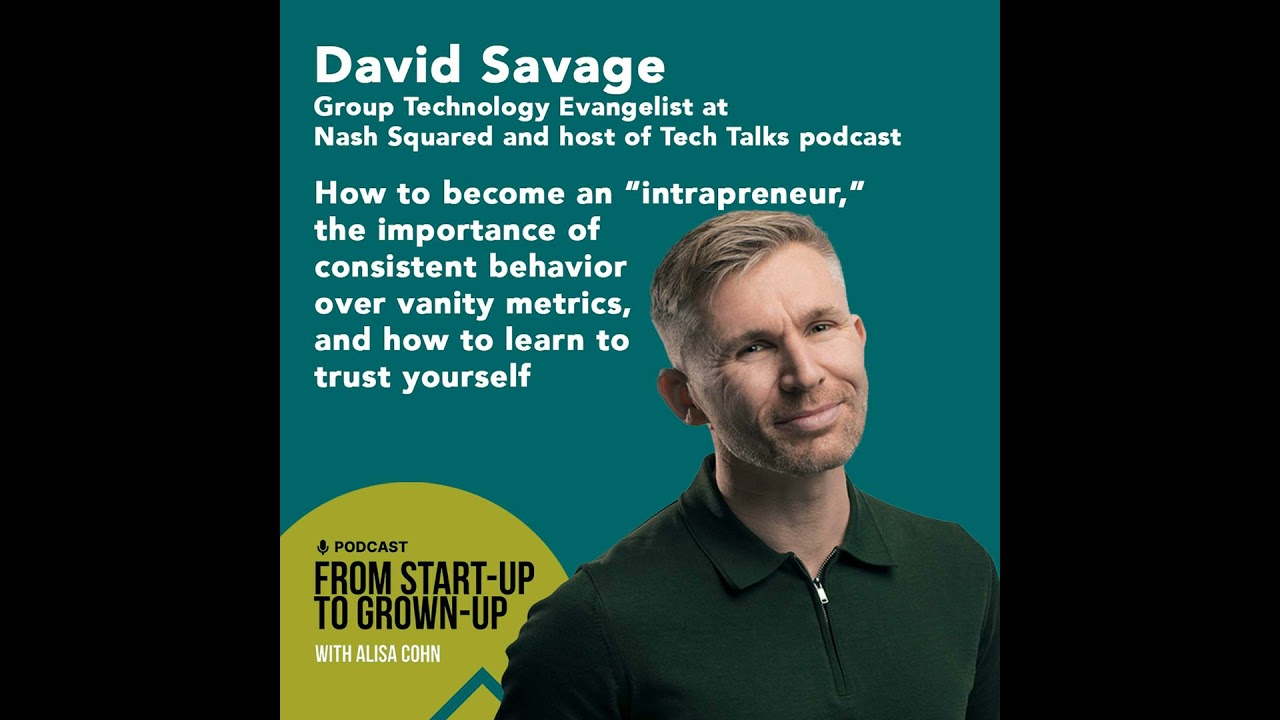
David Savage built a top-10 UK business podcast as an internal project at his recruiting firm, starting with phone-recorded interviews on a shoestring budget. He shares how intrapreneurs find niches within existing companies, experiment through failure, and grow through incremental steps rather than waiting for perfect conditions.
Chapters
Welcome back. This is From Startup to Grownup. My name is Alisa Cohn, and today I'm thrilled to welcome David Savage to the podcast. I wanted to talk to David because he's an entrepreneur inside of his company. So he's an intrapreneur. And I thought a lot of you'd be inspired by his story. David started off as a recruiter for Nash Squared, a recruiting firm based in London. He started thinking creatively about how to get more meetings with the right kind of people and decided to create a podcast. His podcast, Tech Talks, is now in its 9th year and is one of the top business podcasts in the UK. David is now the group technology evangelist for Nash Squared. You gotta love that title. And we talked about the other creative and interesting things he's doing as a part of that, including making documentaries. David and I also talked about where his creative ideas come from, and he shares advice for you if you want to be an intrapreneur in your company. So please enjoy this great conversation with David Savage. David, welcome to the show. I'm so excited to have you.
Thank you for inviting me.
I'm thrilled that you accepted my invitation and to give people a little background, we met through the Web Summit family of conferences and you were kind enough to have me on your podcast. And as we were chatting, I realized you're a very interesting person and I need to have you on my podcast. And I wanna talk about, I think you have a lot to say for entrepreneur, to entrepreneurs and also to non-entrepreneurs. And I wanna start with this notion of kind of intrapreneurship, because I really see you as somebody who has done something along the lines of intrapreneurship. So if you reflect on that term, how does that sound to you?
Yeah, look, it's something I suppose I, I do associate myself with. Somewhat, I think perhaps overflattering that I got used as a case study in a book about entrepreneurship, but on a chapter about entrepreneurship by one of our mutual friends, Sonny Barlow, a few years ago. And it was very much along the lines of the fact that I, I started in a recruitment business. I started there 17 years ago, I was a hands-on recruiter. And then 9 years or so ago, I had this notion that running a podcast would be really good fun. And from there, my job kind of broke out and evolved into something entirely different. Quite unstructured, quite organic, but it was that thing of finding some added value for that business that made sense. And as you did that, them going, okay, keep going, keep going, keep going. And you kind of pushing the barriers a little bit and them going, yeah, this works. And I suppose intrapreneurship is that thing of finding a niche within a business, offering them some value that kind of fits within their business model, but doing something that wasn't there initially kind of greenfield.
Yeah, that's beautifully said. That's a, like a textbook perfect definition of entre— of entrepreneurship. And then I, I think it'd be helpful for you to be more specific in like tracing your journey. So you wake up one day and you're like, I wanna do a podcast, but that's not really how it happened probably. And then how did you talk people? I think that's a starting point. Like you had this idea, how'd the idea come? And then how did you talk people into it, into letting them try out your podcast? Because Just to clarify, David has a podcast inside of Nash Squared, inside of the recruiting agency, and you've become an evangelist. We'll talk more about what that means, but how did you kind of initially make the case that this would be valuable?
Okay. So I suppose there's two parts. Um, let's start with initially making the case. I suppose it didn't make the case. It was more a case of, um, don't ask for, don't ask for permission, ask for forgiveness. In that I felt it would add value to the relationships that I was growing anyway. So the whole point about being a recruiter, obviously, is you want to get in front of hiring managers and you want to spend time with them and you want to find out what their problems are. And there's a couple of things that you've got up your sleeve, and they're all kind of fairly familiar to anyone who's worked in that sphere or for sales for that matter. And you've maybe got a survey, you've maybe got a publication, a white paper, say, and you go, let's meet for a coffee and talk through that. But there aren't too many instances of that in any given year without it getting very repetitive. And there's only so many times that you can ask someone to meet over a coffee and discuss their problems before it's like, well, you know, what are you going to sell to me? So for me, it was that thing of, well, what could we offer that's valuable back? And that realization that obviously people are being brought together for events or for white papers because they're interested in knowing what's going on amongst their peer community.. And if you've got a content channel, you can, you can get the peer community to talk to each other. So yeah, it wasn't a podcast. It wasn't that I thought, let's run a podcast. It was, let's run a content channel that offers some value and speaks to that community. And at the time, that would have been YouTube, because podcasting was not a vogue thing. But I didn't have the skills. I didn't have the money. I didn't have the know-how. And I certainly didn't have the time. So podcasting was a, to my boss, hey, look, this isn't really going to get in the way. I just, It's kind of an extension of what we do anyway. I'm gonna ask existing clients if they'll mind sharing what their challenges are so that we can publish it and play it back to their peer community. So if their heads are down in the trenches for the very reasons that they like coming to events, their heads are down in the trenches, but they're looking for a little bit of validation externally that what they're doing is the right thing. We can give that to them. So The reason for the podcast was because it was a vehicle that made sense resource-wise. And the way that I convinced people to share their stories initially was by going to my existing client network and saying, hey, look, do you mind sharing your story? Because I know that you like coming to our events because you like hearing from what other people say on stage and what their challenges are, and that's beneficial. So it was just taking that event thing off stage and putting it somewhere where it was accessible to everybody. And that just happened to be a podcast, which then obviously was quite lucky that 2 or 3 years later it then became very vogue.
I love that so much. So it's like, you know, sort of the sense of how do I, like, you were genuinely looking for a solution to the problem, which is how do I, you know, continue to basically build relationships and continue to invite people into a speaking space. I know from my podcast, I've really figured out that like, it's just wonderful to be able to invite people on. Like, people wanna come on your podcast who don't necessarily wanna have coffee with you, but as far as you're concerned, it's like, well, it's the same thing.
Yeah, absolutely. Right. I mean, coffee in a sales role is an opportunity to sit down with someone and get to know them. And podcasting is exactly the same. It's an opportunity to sit down and get to know them. So, right. I felt that it was a vehicle for that. And the other thing is obviously that you can revisit on a podcast. There's a very clear narrative of let's have a recap, let's go back, let's see how that story's evolved, which fits very organically, which doesn't necessarily fit if you don't have that narrative arc and you're just meeting them for a coffee. So in lots of ways, it just made sense as a way of kind of building relationships. But also at the same time, I think this is really important, something that you felt would give some value back to the people the people that were taking part and the people that might tune in.
Right. And how, so then it just grew. It sounds like, first of all, I wanted you to tell the story again about your first podcast. Didn't you like have your phone on a thing like that in the middle of the table between the two of you?
That wasn't the first. So, so the first podcast, yeah, but it was literally my phone on, in the middle of a table in a meeting room.
Recording.
Recording. Yeah, exactly. And then you realize that you work in a corporate office and this is obviously very much pre-pandemic. It was like 2015. Yeah. So it was a busy office, 240 people in the middle of London. We had about 10 meeting rooms and the meeting rooms were in the lobby of the office. We had one building of the Salesforce Tower in the City of London. So very, very busy. And you'd get people walking past in work shoes or high heels, because everyone was still quite in kind of formal attire at the time. So it was kind of these hard floors outside the meeting rooms and everything, everything would echo. There was glass everywhere. There were these footsteps going past and the phone on the table would just pick it all up. It was, it was terrible. So one hack around that was, hang on, if we wanna dampen the sound, why don't we just stick the phone on a wedge of paper towels? Because then you don't hear all those noises so much. So yeah, it was very, very, very rough. And very much a case of, I don't really know what we're doing here, but we're just gonna record a conversation, stick it out there. You know, no production value, no music, no real intro, no co-host to provide kind of a narrative arc from episode to episode, but in essence, interviews with people in the industry and what they were up to.
Yeah, very scrappy. I love, I love that. And one thing when we were on a panel together talking about podcasting, one of your like pieces of advice to everybody was just start, right? Which I think has really worked for you.
Hmm. Yeah, I did a podcast series a few years ago for Blue Microphones who were big in the gaming space and they wanted to get into podcasting. And at the time their PR company was a company called Wildfire PR and they got in touch and said, look, you've got a, you've got a B2B podcast to say essentially, and we've done a few things together. Would you create a kind of an in-house podcast that just talks about Blue, you know, very much influenced the marketing. You're in this space, create something new, get it out there, talk about the fact that you're using Blue microphones. Still using Blue microphones to this day. They gave me a bunch of free mics and they said, we'll give the guests free mics. So it was great because I'd spent, I don't know, by that point, 3, 4 years maybe podcasting and speaking to people in tech. But then this gave me kind of carte blanche to talk to people in all sorts of different fields under the guise of podcasting. So I went and I interviewed people who I knew and podcasts that I'd listened to, some running, some sports and whatever else, and some in industry. And one was 11FS's Fintech Insiders, which at the time, along with Secret Leaders, was one of the top 2 business podcasts in the UK. David Breer, who is CEO of, or at the time, I've got to be honest, I'm not sure if he still is. I think he still is, but at the time, certainly was CEO of 11FS. Said, you know, we were a small fintech consultancy. Podcasting for us was our entire marketing strategy because we didn't have the marketing strategy to compete with the bigger boys in the market. But it also meant that we just had to go for it. And his advice was the first 10 of anything that you do will be shit and it doesn't matter. And it's like, oh yeah, of course. Like, of course it will be because How else do you know? And you just have to kind of accept that and not worry. And I think too many people don't start because they think it's got to be pristine and polished, and that just stops them doing anything ever. Because of course, you will never ever start pristine and polished.
Yes, 100%. And you know, to me, that brings us to the topic I also wanted to talk to you about, which is about taking risks, right? So I, you know, we've only known each other a little bit at these conferences, we've seen each other, but like, You are someone who just seems like you don't care, like put it out there, we'll see how it goes. So two pieces about that.
Mm-hmm.
I have experienced that you're willing to try stuff, just try, try, try, try, try, try, try. And the second is that if it works or doesn't work, you don't have a lot of investment in that. So can you talk about maybe how you've thought about risk-taking either in your career, in the products you put out, you know, sort of what does that bring up for you?
I suppose in my career, risk-taking. Look, I was a recruiter. I was a pretty good recruiter. When you're a recruiter, you sit on a contract book of runners and that's your paycheck. And it's almost like golden handcuffs. And when I switched into a content role, my wife was aghast because it was basically a colossal pay cut into doing something quite untested that wasn't really sure that the business— because there came that kind of the that point of like, okay, if you want to do this, then you kind of got to stop doing what you've been doing for the last so ever many years that's been making you money and making you successful within the business. Where's your priorities? And there's no guarantee that it's going to translate to the results that they're looking for. And it took a good few years to get back to where I was in terms of earning potential. And earning power. But I always said to my wife and to family, it's like, yeah, but don't want to be a recruiter when I'm 40. Because I kind of feel that it's a brilliant job. It's a brilliant skill set. But it's very much a month on month on month, same thing. And you're only ever as good as your last month type mentality, kind of very much salespeople again, will, will, will, I'm sure, kind of know and relate to that. Whereas this, I felt I could build something. I felt that I could potentially walk away at some point in the future and go, there's some kind of lasting legacy that someone would pick up. And for me, that felt like a risk worth taking. And I felt that it would actually broaden my career prospects in the long term and increase my earning potential, because I thought it would be valuable in a way that just being a salesperson or recruiter wouldn't be. So that was, I suppose, a risk in that sense. And then on the content—
Oh, David, David, before you go on, just to ask you that question, at the moment, you were talking about that with your wife, you have to sort of make a choice, it sounds like. Take us back to that moment. Like what was going through your mind at that moment?
That it would work. That it, it would be successful. You weren't worried?
No.
I mean, we took a big pay cut. We just got married as well. So I'd saved quite a lot of money to get married in quite a short period of time. And then had to move into a new flat because we were renting in London and the rent went up because of what the market was at the time and then took a colossal pay cut. It was quite tough for a little while. She was like, well, then I can imagine. But no, I always felt that this in the long term would open more doors and more opportunities and that that mattered more and that I would be more fulfilled and happy. And I do genuinely think that if you're doing something you care about, you will most likely be more successful.
Right.
So no, I was never worried. I felt, and I felt like actually the entrepreneurship thing's really important that I was doing it in an environment where there was a lot of buy-in and trust from people. I'd already been there a while. And so if it was going to be slower to get off the ground, or if results were going to take a little bit of time to transpire, that there would be that trust and room to make it a success rather than trying to go in somewhere new and start from scratch where you are having to win people over, prove. That would have been so much harder.
Yeah, that makes sense. Now, I'm sorry, I cut you off. You were reflecting more on risk and sort of what happened after that.
Yeah, well, there's plenty of stuff that we tried and just hasn't really kind of gone anywhere. Yeah, it's fine. I mean, so the podcast has been pretty successful. It's got a good audience. I don't do video podcasts, generally speaking. They've always been audio only. And obviously video is a massive part of the market. And if you're not producing video, you're missing out. So during the pandemic, when it was impossible to do events and to get in front of stuff, I kind of said to the business, well, let's, let's try and do video interviews and we'll call it In Conversation With. And I kind of had seen David, is it David Letterman? My next one, David. Yeah. David Letterman, my next guest is. Oh yeah. Netflix.
Yeah.
It was very simple, very stripped back. It's just him on a stage talking to a celebrity. And I thought, well, we could do that. Like we could do something like that. And so I got in touch with some guys that I'd met a few years ago called Sound and Colour, um, who we'd been put in a room at a conference together. They'd been the, the, um, video guys. And I was, I was interviewing CIOs for the day and we just kind of got chatting. And so I got back in touch with them and I said, hey, would you want to help me kind of put this together? Cause I kind of had it in my head that if we were going to do video, It couldn't just be Zoom and, you know, Riverside and platforms like this are great, but anyone can do it. I wanted it to be a little bit elevated. So if we're gonna get good guests, I wanted them to feel that we were putting a bit of money behind it and a bit of production value behind it to attract them. So, yeah, with the first one we had, um, Dr. Crystal Johnson, who's the deputy director for the, uh, NASA Goddard Space Flight Center. We had the CIO of, um, Williams F1 who did their recording Did their recording in the museum surrounded by championship-winning Formula 1 cars because we were willing to show that we were taking it seriously and trying to do something a bit different. They were really good bits of content, but they were too similar to the podcast. Like people would constantly say, is this the podcast? It's like, no, no, no, this is In Conversation. This is different. It's like, this doesn't quite work. It kind of misses and it kind of falls because people aren't sure which is which. Even though I've called it something different, even though one's video, one's audio, and to me a podcast is audio, other people don't get that. And so in a lot of regards, it was really, really successful in that it opened doors to new relationships, which is handy for the business. It didn't really kind of make waves in any way. Didn't chart, didn't, you know, it was just, they were on YouTube and they were on the website and they did quite well when you put it out on LinkedIn, but not any more so than another post.
Yeah.
But what it did do was provide a real learning ground and develop the relationship with Sound and Colour. And fast forward a few years until about a year and a half ago, I said, all right, let's make documentaries. This thing doesn't really work because they're too similar. But no one's out there making films, or at least if there are, there are very few people out there making full-blown documentary films. You've either got Zoom or you've got Netflix and the BBC, but there's no one in the middle. And where you've got kind of online talks and you've got events and then kind of TEDx sits in the middle of like a stage for people of pretty cool prestige, but you know, it's kind of, it's kind of that middle ground. There's nothing for film that kind of does that. Let's see if we can kind of start to occupy that and make, make feature documentaries. And all of that learning from In Conversation With, all of that relationship building with Sound and Color, all of that really helps cement that and pull that together. And that has been successful in as much as the last film that we've made, which is all about robotics and AI, AWS screened it, NASA screening it at Columbia University this September. Web Summit are talking about screening part of it in November. There's suddenly kind of, it's not got great, great numbers, but there's buzz that people think, hang on a minute, this, this is worth showing. I went for dinner a few months ago. The last one about the lack of funding for female-led business was picked up by the Sifted community and shared around their kind of newsletter. Like, so all of the stuff that we did in the interim gets you to that point. And I suppose this is a very long-winded way of saying that if you don't just try with content, if you don't, if you're not prepared for it to miss the mark slightly, you'll miss out on all of the learnings that you get along the way with it too.
I love that. So the idea is you've gotta try because maybe this won't work, but it opens up doors to other things and certainly it prepares your mind.
'Cause that's pretty— Sparks ideas.
Sparks ideas. But I'm just so curious, David, because that's a pretty big leap. You're like, People are doing podcasts. People are doing YouTube. I know, I know, I know. And I gotta just tell you, I am not personally— now I am because you just gave me this idea, but I'm not equipped to be thinking, I know I'll do documentaries. You know, where did they— didn't you, do you have a background in documentaries before you did that? I mean, that's, that's so, I guess I'm just so curious. That idea came out of nowhere.
Um, did the idea come out? I'd been talking, no, it did come outta nowhere. I mean, I suppose I'd been talking about it for a little while with a few friends who were like, look, one of the things that we know about you is generally you have an idea and you just kind of go, sod it, let's do it. You're like, you've been talking about this for about 6 months to a year now, just kind of get on and do it. And I'm like, oh, okay, yeah, fine. No, I mean, I've no background at all in television. I'd never presented anything like that, but in my head I was like, how hard can it be?
And how hard was it? How hard was it?
I mean, it is hard.
Yeah, it must be hard.
I mean, so, so my point, I suppose, being that I've got this really good relationship with Sound and Colour, who are this amazing TV production company in Manchester. But when I met them, they had literally just formed 7, 8 years ago when we got thrown into that room together at an event. And then we've done lots of stuff in the intervening years where they're kind of like corporate gigs to them, are their bread and butter whilst they're trying to build up their repertoire. And Chris and Rick, the co-founders, had always said to me, oh, we'd love to do documentaries. And I'd sat there whilst I'm interviewing CIOs and we'd be sat in a room all day, right? And you'd have one after another brought in. So you'd have like 10 minutes between and you go for lunch and whatever else. And we'd be kind of chatting and you go, you know, I'd kind of like to do stuff like, love to do more fun stuff like this. Cause if you make podcasts, whole idea of making creative stuff is kind of fizzing away all the time. So they wanted to make podcast, uh, documentaries. I wanted to try and make something like that. It was just a, well, why don't we try and do it together? And they had a great background in that they've done kind of, they've filmed adverts and they filmed social media content for football clubs, soccer, big soccer clubs like Chelsea and Liverpool. They'd worked with musicians. So they had a visual style that was really cool and was a bit different to corporate anyway, but were willing to experiment and try. And we just said, well, look, what, what is the least amount of money that we could do this for and actually get it off the ground? And so I came at it with a, let's start with a personal story. The first one was kind of 14 minutes long. It wasn't really a documentary, but it was almost like a proof of concept. Can we even do this? And it was, let's, let's go and talk to a few people about a chronic illness that I've got. It was, um, it's something called primary sclerosing cholangitis. And I wanted to do a short film about how tech was helping improve patient outcomes in healthcare. So I had, I lent into people that I'd interviewed on the podcast, people that I'd interviewed, or, you know, had kind of an understanding of through my health stuff and brought that together. So in some regards, it was easy because you just again lent back into relationships that you previously had. And then it was just about the confidence of getting up in front of camera and working out what worked for me. And that's been an ongoing process. We've made 3 of these films. First one, 40 minutes, then the last 2 have been half an hour long, bit bigger, bit meatier. Second one, we tried autocue. God awful. Do not like autocue.
What is that? Autocue?
Where you've got a screen in front of the camera with the words on it. Ah, teleprompter.
We say teleprompter here.
Yeah, hate it. It was fine. I just looked really stilted. I didn't, I didn't feel comfortable. And it's this funny thing that like, you kind of learn your own kind of what works for you. Like, um, Chris and Rick are always saying that actually walking and delivering lines to camera is really difficult for most people, but I actually find it, that's how I feel most naturally relaxed. So it's been one of those things of, sod it, let's just start making them. And it's, it's not like they're going to get a release at a cinema. So who cares? We're going to put them up on YouTube. We're going to share clips on LinkedIn. Like, people are just going to be impressed that we're even trying. And they're not going to, like, you know, the first 10 are going to be shit. It's that attitude again. Like, let's just get out there and start making them and then work out what works and what doesn't work. And we're in the process of planning the fourth one now. And you now have a much better idea of how it puts together and what Chris needs and what I need to do. And how to kind of tweak and improve bit by bit.
Right. That's how you learn. I love it. So if you can sort of sum up to some extent, like you have lessons learned or advice you want to give to people about, let's say, first of all, I'm going to start with intrapreneurship, right? If you want to become an intrapreneur inside of your company, what advice do you have for people?
I think you need to know your company and your business. You need to know the people in it. And you need to have their trust and they need to trust you. You need to understand what that business ultimately is all about and trying to do. Because no idea is, you know, if you're trying to think of something that is new, it needs to complement what they're trying to do. There's no point trying to reinvent the wheel. I think if you kind of go in somewhere like a bull in a china shop and tell them that they're doing it all wrong, that's not going to float. So it's kind of what, what, what, what essentially fits into this model but flips it slightly. And podcasting in a weird way was all about meeting generation. And it was how do we flip it being from me reaching out to people and me booking meetings with people to people wanting to book meetings with me, which is how it now is because years later I get kind of 20, 25, 30 PR approaches a week for guests to be on the show. That's meeting generation. If you want to boil it back down to what it really is in a sales environment, that is, that is meeting generation. So it complements the existing business. So I think intrapreneurship is all about understanding the business that you're in, what it's about, and the people that are in it and having their, having their respect and understanding.
I love that. Also, to your point, not just sort of going in and declaring what you're going to do. I mean, there's also partnership that I feel like you really formed with the folks at your company.
Yeah, yeah, absolutely. I mean, I would not have achieved anything without a lot of people lending time and support and sponsorship along the way.
Yeah, I love it. Now let's move to sort of risk-taking either in your career or the things you wanna do. What specific advice do you have for people who know they need to take more risks, but for whatever reason are uncomfortable or shy to take more risks?
But it sounds really glib to be like, you know, you've just got to go for it.
I see.
Because that doesn't really help anyone. It's a very easy thing to say when you've kind of been there and done it, I suppose. But not everyone is wired that way. I suppose it's that thing of what's the worst that can truly happen? Like, I used to hate public speaking. Like, at university, I was terrified of public speaking. I stood up at the end of my first year to run for captaincy of not the first team, but the second team of the cricket club at university. Like you're talking about 10 people in a room that like no one else cares about. No, no one gives a shit about this particular election other than the 10 people in that room. And I struggled to tell them what my name was. Like I was terrified of public speaking, but no one in there wanted me to fail. Everyone in there was my friend and supportive. Even though it was horrible getting up and standing in front of them and speaking, it was a positive experience. And I ended up getting voted in as captain of the cricket club. And then I got a promotion.
Congratulations.
Thank you.
Early leadership win.
Well, no, but it snowballs, right? I suppose this is the point. Like you take that first little step of how bad can it be? And it snowballs. Cause then from there, a year later, I got talked into running for student office. So I don't know whether you have athletic unions in colleges in the US, I think athletic unions or something similar, like the collegiate sports.
Sure. Yeah.
Yeah. So I ended up becoming the university's president of collegiate sport effectively, which was, which was a campus-wide election where several thousand people voted and that was election hustings. And that was going out and canvassing and campaigning for votes up against a bunch of other people involved in university sport. And there's no way that I would've been able to do that without getting over that initial fear of standing up in front of 10 people and talking and kind of going, well, look, what is realistically the worst that's gonna happen? You're not gonna be the second team captain of the cricket club. You'll be fine, you'll survive. But you never know what that might lead to. So I, I suppose it's that thing of you've got to get it into your head that really the worst thing is, is not that bad.
I love that. I think when people are, are just like, 'cause everyone's just nervous, nervous and like, you know, it's un— it's unclear and kind of abstract. And the notion of really pinning it down and really recognizing what's the worst that could happen is such a powerful tool for any kind of risk taking. For certainly for public speaking, which everyone is afraid of. And certainly any kind of risk-taking because it forces you to get just really rational about what you are kind of worried about. And I just think that that's a very powerful tool that extends into a lot of different contexts in life.
Yeah. Yeah.
I'd agree with you. So David, I wanted to talk now about what you've learned in your— have you really done 608 shows or something like that?
It's more, we officially say 608, it's more, it's more, it's more like 750. 50 to 800.
Oh my God. So all the shows. So you've talked to— yeah, God, you've talked to a lot of people. You've talked to a lot of, of startup people, tech people. I guess I would love you to reflect on, if you think about entrepreneurs that you've talked to, what does it take, do you think, having talked to so many people, what does it take to be a successful entrepreneur? What are the personal skills? What are the qualities? How do you know if someone's going to be successful? What have you learned about someone being a successful entrepreneur?
If I think about the people that I've met who are really successful, and it's hard because you interview a lot of startups who've gone on to have big valuations and they're all slightly different personalities and each company reflects the different personality of that individual. But I'm not swerving. I'm not going to kind of like sidestep it. There's two things. They are incredibly driven, quite clearly. Like, hustle culture is not particularly healthy, but at the same time, you have to sacrifice a lot if you're starting up an idea. I think this whole thing of kind of glorifying hustle is counterproductive, but it does not get away from the fact that if you are building a business from the ground up, it is probably going to be fairly all-consuming. And then you have to be really passionate about whatever it is, because it's going to be, without doubt, every single entrepreneur that's been successful I've spoken to has spoken about how hard it is. So if you don't have that passion for it, you're never going to sustain it. And I think the vast majority of people have fixed problems that they see, that they care about, that they think that is an injustice or that is something that needs attention desperately. And I think without that, you fail. I think if you want to be a founder and entrepreneur because you want to be a founder entrepreneur, you won't get anywhere. But if you are almost an accidental founder or entrepreneur because you see something that you want to fix and you are willing to work at fixing that particular thing. If there's a business angle to it, well, you might just be successful with a bit of luck.
Yeah, I think that's very well said. I mean, the truth is, like, I've heard it said, you need to fall in love with the problem. And so in some ways you're called, you have to be called into being an entrepreneur because it's actually, to your first point, it's a very unhealthy environment. It's just very, it's very challenging. You have to work really hard. It's very stressful. It's like an extreme work environment. And you know what you said about the first point about driven and hustle culture. Hustle culture is maybe not healthy. Maybe that's probably true. And also it's not clear to me that, in fact, I would say the opposite. Entrepreneurs are not optimizing for health. That's the thing. Entrepreneurs are a certain kind of person, is my observation. I'd love to get your take on this. And they are, you know, they, they, they're driven to the point of, you know, burnout or like hustle, as you say. And they have a certain temperament, which is not the same as people who are craving balance. If you are craving balance, the life of an entrepreneur is not for you. I think that's my observation. Like hustle culture may not be that healthy, but you cannot be an entrepreneur without actually expecting to put the time in.
I think one of the things, one of the friction points when, when any company is scaling is when people come into the business and it's not their idea. And you've got a founder who's like, this is, this is the most important thing in the world. Why are you not sleeping under your desks? And it's like, that's not going to work because that's not how they see the world or your business. They can be incredibly passionate about it. They can buy into your idea. They can want to work really hard, but ultimately it's still not their idea. And you do see a lot of founders who struggle at that inflection point of understanding what their role is and what other people's role is and when to step back and let other people perhaps, you know, how the culture evolves is really important within those businesses.
Yeah, I think that's very, it's a very insightful point. I mean, you think about the founder and the founding team who have this kind of passion and this sort of, you know, primal energy for the business. And you bring people in later on and they're looking for like a retirement plan and career laddering and, you know, days off and, and right, that kind of stuff and the company picnic. And the founder very often is not like attuned to that. Would you say that's true?
Yeah, I, I think definitely as it scales, there is that thing. I think, I think Maybe, I don't know, I don't know where that point is. I think it's probably different with every business. I think, you know, you can build a team to a certain size where it's kind of, you know, that siege mentality, us against the world thing. But at some point you outgrow that. That then does become a difficult point, I think, for some founders.
Yeah, for sure. Now I want to talk about your building your own personal brand. So you, I think your title is, I love this, Group Technology Evangelist.
It's terrible, isn't it? I came up with that as well, which is even worse.
It's so made up. I love it. It's so good. And so, you know, I think there's a way in which you can kind of invent that and, and have it be a lot of different things. And there's certainly, obviously it's contingent on you creating content and being a podcaster and now be a documentarian and all that stuff. But it also requires you to also build your personal brand. So how have you thought about building your personal brand? What's worked? What hasn't worked? What's been your journey about building your personal brand?
So, um, what's worked? What hasn't worked? First of all, the title. When I stepped into this role, kind of went out onto the market, did a bit of research. It's like, well, if you're Apple, if you're any of the big tech companies, they have a chief technology evangelist and obviously they are talking about the tech of that business and they're going out there and when there's big kind of news stories, they're the person that gets out in front of the media and is their person. And I was like, well, we're a tech company, we should have a role that kind of fits that, right? We were at the time thinking about expanding in the US more, and it was like, well, it kind of plays into the US market. Yeah, okay, that kind of fits. And there are variations of it. Brian Kudzminski at CES is, I can't remember his exact title, like strategic themes or something along those lines, director. Thematic director, perhaps, I think. This guy called Rob McCargo, who I know at PwC, he's technology impact leader. So there's variations of a theme, but it's kind of a similar job that does exist across the industry. And I think it's that person who the business can rely upon to be out there as an advocate for the business, speaking on stages, speaking to people, putting them— putting that brand in areas where maybe traditionally it wouldn't be as well received. How do you build a personal brand though? Well, for me, it was— I think we talked about this on stage a little bit in Lisbon, but it was kind of like leaning into stuff that kind of made sense. I am, by training, I suppose, a recruiter. I have interviewed thousands, tens of thousands of people. Over the course of my career for jobs, and then latterly for podcasts. The one thing that I know that I'm really comfortable at is moderating and sharing conversations. So when it came to building a personal brand, what can I be good at? I can be a really good moderator. I can go on stage and I can fulfill that. And guess what? If you've got really big technology conferences, what do they need desperately? They need moderators that they don't have to think about. You are not the headline act. You are definitely the support act or the, and introducing on the film credits, but they're the person that they just don't want to have any hassle from that they know are gonna be there. They know will just do a job so that the speakers have a good experience. And I think if you get that in your head and you go, right, How am I going to build my profile in the industry? I'm going to be the best low-key moderator I can be in terms of I can be the person that if they are in the shit, they will pick up the phone to and go, we've got this panel, can you just run it for us? Because they know that you can just get on stage and run with it and they can just go, it's sorted. And if you're that person, then you will build a profile because they will see your value and they will use you again and again. And I'm kind of talking about the web summits and, you know, those conferences. When we were at Collision, in the end, I didn't go on stage, but they had— I was interviewing for an episode of the podcast Rebecca Parsons from ThoughtWorks. And one of the web summit team comes up just as we're finishing up and says, David, main stage. We've got a guy going on main stage in a minute. He's supposed to be interviewed by someone from the FT, but the traffic's terrible. Can you go on stage and interview him? In 10 minutes. Now, she turned up, I was mic'd up by then, and I had a quick chat, and I was ready to go on stage. But she turned up and I was like, look, you've prepared, this is your gig, no biggie, you go on. Great. But if you're the person that they come to, with 10 minutes to go, to go on center stage with someone, I think he just raised $100 million. So it wasn't a small fish. If they trust you to do that, then you're going to build a profile in the industry. So I think there's actually this thing about understanding what your role is and understanding how you add value. And for me, I know that I'm really adept at getting on stage and just taking anything that gets thrown at me and solving headaches.
Yeah, David, that's a great answer. And specifically this, when I talk about personal brand and this is normal for people, people kind of have this like, ugh, because they think we're talking about how many followers do you have on Instagram? And also how are you promoting yourself? And what you talked about just now, and I want everyone to really sort of take this in. Is you talked about the notion of your reputation to the people that matter and how you build that. And you build that with behavior and consistency and consistent behavior over time gives you a certain quote unquote brand with a certain constituency and has nothing to do with Instagram. They don't, they didn't ask you how many Instagram followers do you have? Okay. Can you get on stage? They've experienced you over and over again. And I just wanna really highlight that your initial instinct when I asked you a personal brand was around how are you showing up in the world that, that's meaningful to you?
Yeah, 100%. I think everything else will follow because of that. Like, I don't have a great Instagram following. I've got, I've got a fairly hefty LinkedIn following, but they don't care about that. What they care about is if they're, I mean, Christ, were you, were you at Collision not this year, but the year before you were, weren't you?
Yeah.
When they had, they had a nightmare because they had about 400 flights canceled from New York and their programs were all over the place the first day and they were parachuting people in left, right, and center to plug gaps. And you want to be the person they call in that instance.
Yeah. Yeah. I was a gap plugger also, cause I was one of the few who made it from New York by driving all night. And, um, yeah, I did. I know you don't ask. They, um, they did put me on center stage to interview somebody because somebody else couldn't make it. And I also had the experience of like, oh, I'm, I'm known as reliable, right? And, and in a world where, you know, there's a lot of fly-by-night things, being known as reliable is like a very high compliment in my opinion.
Yeah.
But you were talking about LinkedIn because, so I appreciate what you just said and it's so important to like think about consistent behavior over time. And also there's the notion of scaling that through different socials, different platforms, and people have different ones. And you and I both are, let's say, more focused on LinkedIn. How do you think about posting LinkedIn content and what advice do you have for people who now also wanna think about, let's say, quote unquote, building their brand on one of the platforms and why that's important?
I think, I mean, it's important because it's reach., and you get discovered that way. Right. So that's a very kind of succinct and easy way to think about it from that regard. Certainly LinkedIn, because of the business community, is incredibly important. I think for LinkedIn, it's— I almost view it's like almost like being in the club. Like there's a lot of the London tech scene. Is big, but at the same time, it's kind of small. Like, there's some very clear players that, that are well known, well respected, and plugged into each other. And they do go to a lot of the same events and pop up at the same things. And you want to be part of that crew. Because they have reach, they have influence.. And they're the kind of people that are in the rooms that can drop names, that can suggest, that can curry you favor if you're not there. And so when I do stuff on LinkedIn, it's with that thought of what's the audience? Who can I, who can I share that with? Tag in posts. Whose content should I be amplifying? What causes do I care about? You know, for me, a big part of that social branding on LinkedIn and personal branding has been around women in tech. I've always, with the podcast, wanted to emphasize that as a straight white male, I'm in a privileged position, and actually therefore I have a voice that can be useful as an ally. And so using those platforms to reemphasize that, is incredibly important. So it's an element of, of really kind of understanding your, your community and the power of that and how that helps you and how you can help them and that kind of symbiotic relationship. So for me, it has to do with that. I don't really worry about number of likes or whatever else, like you post it. So it can be, it can be so random. It's so hard to predict. And I don't spend enough time looking at the algorithm, to be perfectly honest. Um, but I think if you're consistent and I think if you're saying stuff that matters to you and is important, then that's probably enough.
Right. And also building relationships with the people who maybe you don't know that well, but by amplifying their content, you're also kind of show— showcasing yourself as like, you know, somebody who's raising their hand and wants to build a relationship.
Yeah. Yeah, absolutely.
That's great. No, we're using something else.
No, no, no. I mean, I know people who've done an amazing job building brands on, on, online. But I think, I think, to be perfectly blunt, I've realized this is a slightly different skill set. Like, I know this guy called Lawrence, who is on TikTok, and he got stuck in Bali, terrible place to get stuck, during lockdown.
Poor guy.
And he's, I know, he's now got like 2.4 million followers on TikTok. And he's got 60 million likes or something ridiculous. And it was all because he realized that he was this tall white English bloke in Indonesia and he could go around trying street food. And that was quite novel. This white, like, what's this English guy going? And all these kind of like street curries would be like, ah, Lawrence Benson, come try our food. And he'd be like trying food on video. But his skill set was as a brilliant, brilliant video editor and content creator. And he got social. And I think that's different. Like, I, I don't get social. I don't, I'm not a brilliant content video creator fundamentally. And I think I'd need to have someone else if I wanted to kind of do something like you talk to Lawrence and it's all about looking at trends constantly. And that's not where my head's at. So I do think like there's, there's slightly different skill sets that you have to understand that, that are intrinsically different for those platforms.
Yeah. And what your goals are.
Mm-hmm.
Because you know, your goals maybe, maybe are not to be the biggest like creator on TikTok, right? Your goal is to sort of amplify the things that you wanna amplify on LinkedIn.
Yeah, exactly.
Yeah. Yeah. So speaking of trends, I wanted to ask you, you did a few shows recently about a couple of interesting topics, and one was about nonlinear careers. And so I guess I'm just curious, what did you learn on the topic of nonlinear careers and, and what should people know about what counts and how you stay relevant in nonlinear careers?
I mean, to me, long nonlinear careers is, it's just how you work in, in the modern world.
It's just a, a career.
The notion of, you know, here's a career ladder, up you go, it's kind of gone. Yeah. Yeah. I mean, what did I learn? It's all that thing around kind of understanding what your value is to a business and understanding what you personally are strong at and maybe what you're not so strong at, you know, and how you kind of utilize your skill sets to be helpful and useful. At the right times in the right places. And I think it's less about the title and the requirements and more about what you're bringing to the party. I remember a few years ago, we all talked about contractors would very much work in tribes and that kind of idea. And it's that kind of thing. It's just that kind of, I think, kind of extrapolated and expanded upon that. Through various phases of your career, you might not be a contractor, but you will kind of work in tribes and work with groups of people. And they might be internal to you, they might be external to you, but there'll be a kind of a crowd, a community that you're involved in that you'll kind of bounce ideas off each other. And maybe after a while, someone will slide away a little bit, or you'll kind of gravitate to slightly different people, and that's fine. But that's nonlinear. That's you just kind of having this slightly kind of meandering kind of progression, but understanding where you're bringing value and how people see you adding value to their work life.
Yeah, totally. You know, I said for a long time, so having been an executive coach for 25 years and so specifically self-employed, a solopreneur for 25 years, I said all the time, and I still say, people should always have the experience of being self-employed. Like even 2 years of being self-employed Teaches you so much about sales, about adding value, about relationships, about all the things it takes. And I feel like what you are saying is to have a nonlinear career, i.e., a career, you've gotta just think about what do you bring to the table? How do you add value? And how are you kind of putting that together into a career tapestry all the time?
Yeah. Yeah, totally. Yeah.
I think it's, I think it's just so important for people to kind of be conscious about all that. Um, David, how have you changed personally as you've grown as an entrepreneur, as a professional? Grown and matured?
Hopefully I'm a bit more mature. Um, I can, I can be prone to being quite silly. Um, how have I grown? I mean, I'm a lot more confident. By which I mean, I worry less about things going wrong. I think there's that thing that you kind of get to the point where you go, you know, there's a very good chance that a lot of these things, that a lot of these ideas won't land. And that is okay. I think there's an element of this stuff that we're talking about, about you have to take those first steps that over time you do become quite kind of good at just being like, It's okay. It's fine. It doesn't work. And I think there's an element of you get to a point in your career as well where when stuff goes wrong, you see it as an opportunity. So I think maybe that's resilience. You know, people talk about resilience. I think it's possibly that, that you, but not in a really kind of tough, fightery way. I think you've got to stay upbeat. You've got to stay positive. You've got to go, all right, even if there's a setback, there's probably an opportunity in there. You just got to kind of stay calm and work out what you do next and how you pick yourself up and how you move forward and what you bring to the table. So maybe slightly more pragmatic, I guess. And there's a part of me that's a little bit more bolshy about asking for stuff these days. Hopefully in a kind way, but like saying to people, no, no, I'm good at that. 'Like, that thing I know I can do. Give me a go because I won't let you down.' And again, that's probably kind of all those built-up experiences where you kind of get to the point where you can trust yourself to be a little bit more forward-thinking and front-footed on that stuff.
Yeah, I think that's very powerful. And, you know, to your point about confidence and resilient, I think there's an expression like, 'How do you get good judgment? It comes from experience.' Well, how does experience come from? Bad judgment, right? So it's like, Just the experience of having ups and downs in your career journey. If you think about some of the ups and downs you've had in your career journey, is there like a sort of a moment of truth or any kind of like difficult point that you overcame and what you learned from it?
Um, difficult, difficult point. A few years ago, I got completely the wrong end of the stick from someone that I trust. Very much in my business. We were talking kind of mixed messages to each other during the pandemic. And I basically thought that he was saying, well, I don't really see where your job goes within our business. And I kind of went, oh, maybe I don't really see where it goes. So I ended up interviewing elsewhere and got a job offer. And I resigned.
Wow.
And then the CEO went, no, that's not at all what we meant. I was like, oh, but I got told this. And I assumed that that meant No? Okay, fine. So, look, it didn't do my career any damage. In fact, if anything, it propelled it forward because they then went, all right, well, look, we want you to stay and we would like you to kind of tell us what you would like to do to stay. And they were true to their word and they bent over backwards to kind of put those things in place. And I'm forever grateful for that. But it was a moment of, oh, I have completely misread the situation. And that could be quite embarrassing. And I think that there's the thing there that actually corporates can be sometimes a bit messy and a bit political. And actually, instead of sitting in your own little kind of bubble and trying to kind of second-guess what everyone else is doing, sometimes it's worthwhile just going, look, what's going on? What do you want? What do you think? Am I— is this thing that I'm thinking what you're suggesting? Where can I add value? What would you like me to do? And communicating, not being kind of scared and sitting there in your own little kind of world thinking this is what's happening. It's just probably worth kind of talking to people. So, I mean, ultimately that turned out well, but it was a bit awkward. And that was because I just kind of read between the lines and not actually communicated properly.
Clarity. I'm always saying that to my clients. Clarity, clarity, clarity. It just solves so many problems. Um, David, just a few more questions. Have you ever experienced imposter syndrome or severe self-doubt that has been really challenging for you?
Severe self-doubt? No, I think I'm very lucky. I'm very fortunate actually that from that respect. I'm pretty well adjusted. Funnily enough, I play cricket, right? So outside of work, I play cricket. I've played cricket, which is this English sport. It's a bit like baseball. It's like baseball, but more exciting. I like baseball. I say that with fondness for baseball.
We think it's like baseball, but more boring.
No, no, no. It's just far more exciting. Anyway, and I am 39 and I've been playing since I was 8. And going into matches, I will still kind of stand there going, oh, I really need to perform to prove that I'm good. And so my team value me. And in that setting, it's really weird, like that creeps in. But in a professional setting, I'm glad to say that I've never really had that. Imposter syndrome, sure, to a degree, when you're kind of getting up on stage with people who are seriously successful, which I have been fortunate to do. Then you kind of go, I don't really understand how I've got myself here. But if you are there, it's because someone believes that you should be there. I remember years ago, one of my first ever promotions at work, I got asked to lead a team. And there was someone in that team who'd been in the business for longer than I had. And I called up my parents, I was like, I don't know how I'm going to manage this person. Like, they've been here longer than I have, I shouldn't be managing them. And my mum and dad said, yeah, I know, but the business would not be putting you in that position unless they believed that you were the right person to be in that position. And because they have put you there, you have that responsibility, you have that authority to lead and to be that person. They've given that to you. And I think that's the thing that like you can have imposter syndrome and you can sort of sit there and go, I don't really know how I've I'm not here, but someone clearly believes that I should be here. Get on with it.
Good advice. Good advice for everybody, actually. That's great. What do you wish you had known earlier on your journey, David?
I mean, hindsight's a really tough thing. I mean, I wish that I would've started doing content sooner and I wish I would've shortcutted a lot of the ideas and that it is kind of quite easy to do a lot of this stuff actually. There's less barriers than you think, but that's really hard because I wouldn't be good at half of the things that I'm good at without the experiences. You know, the whole point about this conversation hopefully is that it's okay to make mistakes and to take your time and to— that trusting yourself is something that you have to learn and it doesn't come innately or inherently. Obviously, if you could shortcut any of that, then you would want to, but I don't think that's realistic. It's really hard to think of something that you can kind of tangibly say, this would help people. I've got an 18-year-old goddaughter who is horrendously shy. And she's interested in medicine and life sciences. And because of the people that I've interviewed, I said to her, "I can put you in touch with this person, this person, this person. Have some conversations. Just chat to them and see what it is that they would suggest that you do if you want to have a career as someone who is going to be on the forefront of fighting off the next pandemic." I can give you their phone number. No, no, couldn't possibly do that. Well, why not? No, no, too shy. Couldn't talk to him.
Okay.
Do you want to send an email? I can give you their email address. No, no, no. What if I send you an email and then you can send it on to them? Well, sure, but that's not necessarily going to help you. I can get the information. I suppose it will help you. Sure. I think if I look back and I go, what do I wish? It's It's the ability to explain to people in that situation, and I still really struggle now about why they should take a step out of their comfort zone. And that's really hard sometimes to do. I think if you can get it, like throughout my career, I've tried to say to people, take that leap, take that step. Don't shrink back into your comfort zone. It's not the step to do. If I could learn how to do something quicker, it would be to learn how to help other people take those steps quicker. And I still can't do it with my goddaughter. So God knows.
Well, maybe it's a journey for her too. But that is, I think, such great advice for everybody, for sure. And my last question, David, is what advice do you have for founders as they embark on their journeys to grow into leaders?
Surround yourself with, with good people. People like yourself who can kind of coach on the leadership front, good chairman, people who've been there and done it. I think if you talk to founders who've gone on to become successful leaders, they have surrounded themselves with a very good network, with a good chairperson, with investors that they trust, with a co-founder that they can bounce ideas off, from with family who are very supportive. I think more than anything, we sometimes think of the founder journey as something that's kind of like this intensely individual experience, and it's really not. It is this tapestry of people that are a support network around you. And I think that that bit is sometimes not spoken about quite as much as it could be.
Beautiful. David, thank you so much for joining me today. We covered so many great topics and I know people are going to get a lot from it. So thanks for joining me.
Thank you very much for your time.
Thanks for listening to From Startup to Grownup. If you like what you heard, give it a review on Apple Podcasts so other people can find it. And if you know of a founder or someone else who is meant to be on this podcast, drop me a line through my website, alisacohn.com.
More from Alisa

128: Ken Davenport Produces Broadway Hits. Here's the Startup Playbook Behind Them


The Library of Minds Podcast | Top Startup Coach: The New Hiring Rule for the AI Era | Alisa Cohn


124: Alex Lieberman Built Morning Brew to $75M. But That Was Just the Start [ENCORE]

123: GiaNina Paolantonio Has Millions of Followers. Here’s the Business Behind Them

122: The Kettle & Fire Founder Is Fixing How America Pays for Health | Justin Mares, Co-Founder a...

121: Founder Mode on Bitcoin: Double the Volatility, Double the Stakes | Will Reeves, Co-Founder ...

120: Miro's Founder on Reinventing a 100-Million-User Company | Andrey Khusid, Founder of Miro

119: Eric Ries, Author of The Lean Startup, The Corporate Governance Crisis No One Wants to Admit

118: Josh Reeves, Co-Founder and CEO of Gusto, The 3-Part Alignment Framework Every Founder Needs...