#76: Susan McPherson, Founder and CEO of McPherson Strategies — Investing in dormant ties, networ...
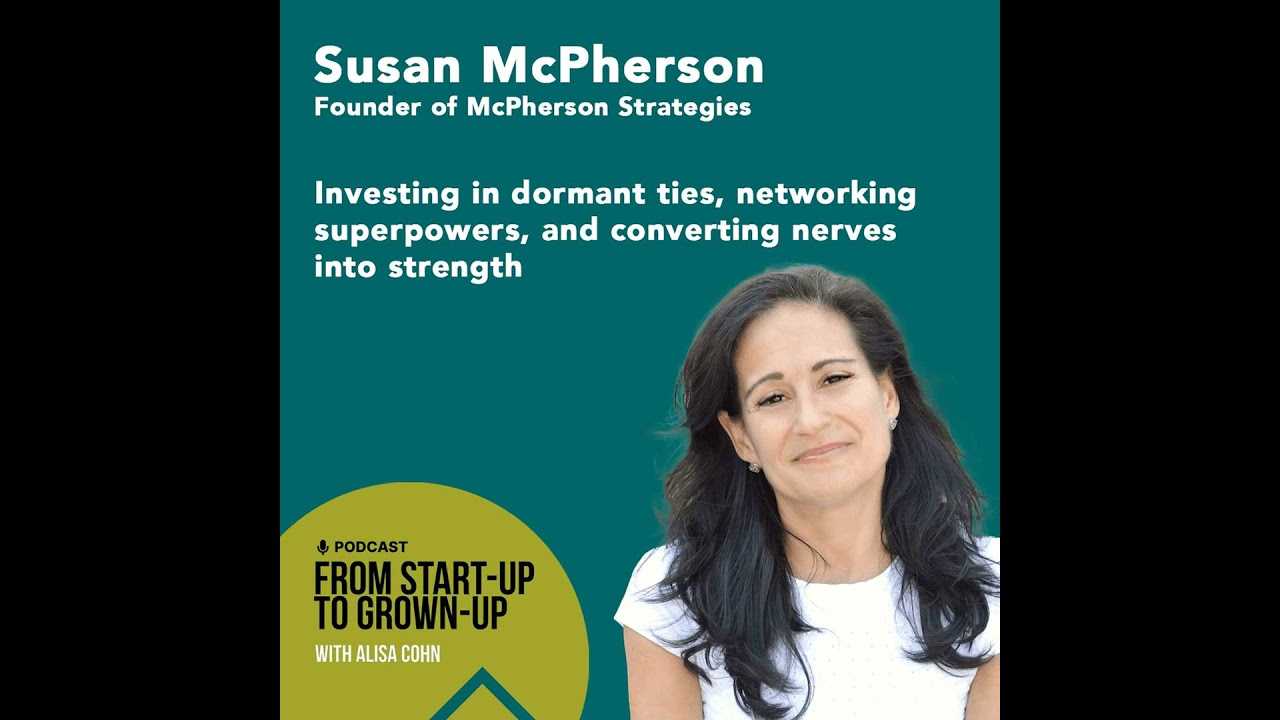
In this episode of From Startup to Grownup, host Alisa Cohn interviews Susan McPherson, founder and CEO of McPherson Strategies and author of The Lost Art of Connecting. Susan shares a step‑by‑step philosophy for building and sustaining professional relationships. She emphasizes making conversations about the other person, doing thorough research, and listening more than speaking. She describes daily outreach habits (3‑5 “touches” to dormant contacts via any channel), the long‑term “10‑touches” rule, and the Gather‑Ask‑Do framework for uncovering personal super‑powers and offering value. Susan offers concrete tactics for large conferences (pre‑research, setting a goal of meeting a few people, sharing three personal facts, and using table questions), hosting events (JOMO‑driven invitation loops, curated follow‑ups, and 24‑hour reply‑all threads), and leveraging social platforms (early CSR Chat on Twitter). She reflects on her own entrepreneurial journey—starting her PR firm at 48, hiring contractors, building a community, and confronting imposter syndrome—illustrating how intentional networking fuels inbound business. The conversation also covers the importance of reviving loose ties, using loose ties to access new networks, and practical follow‑up methods (personalized emails, post‑event notes, newsletters). Throughout, Susan’s tone is candid, encouraging, and action‑oriented, offering listeners a toolbox for turning networking from a chore into a strategic, long‑term asset.
Chapters
Welcome back. This is From Startup to Grownup. My name is Alisa Cohn, and today I'm thrilled to have Susan McPherson on the podcast. Susan is the founder of McPherson Strategies, a boutique PR agency focused on the intersection of communications and social impact. She's also the author of The Lost Art of Connecting, and today we talk all about connecting. Susan is an incredible connector. She knows everyone. And she's built an amazing business simply by being a great connector. So listen up because Susan and I discuss the details, the how-tos, the practicalities of how to connect, how to host, how to make the most out of large conferences and networking events, what to do if you feel uncomfortable, and a ton of other super practical tips to help you get better at connecting with others, which in turn makes your life so much better. You're gonna love this action-packed episode. So please enjoy my great conversation with Susan McPherson. Susan, welcome to the show. I'm so excited to have you.
I am actually absolutely thrilled to be here, Alisa. Thank you.
Well, you're so welcome. I'm so excited that we finally got this scheduled because, you know, I think everybody needs to learn the skills that you have to offer for sure. And just to say that, you know, Susan McPherson knows everybody all the time in all cases. And anytime I say something like, Susan, do you, can you help me with this? She's like, yes. And she calls somebody who she's known 20 years and makes that happen. So I wanna say thank you for that, for using your forces for good. And I guess I just wanna start by asking, you know, you are a super connector, and if you had to describe how to build business relationships elevator pitch style, how would you answer that?
I would start with making it about the other person, the other organization, and not about you. Because sad to say, People want to hear about themselves more than they want to hear about you. So start with them rather than you. That is first and foremost.
I love that. That's great advice. What's the tactical suggestions? Like, what are 3 tactical suggestions that go along with that?
Well, again, and you're talking about a business relationship, a business relationship. Okay. Well, one, make it about them. Two, do your research. And three, once you put it out there, stop talking and listen more than you speak.
Brilliant. I think that is so good. When you said, are you talking about a business relationship or— what was the or you were going to offer me?
Um, I would say personal relationship, but increasingly I, I think the world, ever since the pandemic and even probably before, those two are intertwined anyways. So I just wasn't sure if you meant an, an organization or a person, right?
Yes, yes.
See what I'm saying? So I— that was one of Totally.
Well, I think that organizations are made up of people. And so I always think about building a relationship with an organization as really building a relationship with a set of people inside of that organization. Do you agree?
Absolutely. Yes. In fact, I often quote Tim Cook, who years ago stated that people, uh, I'm sorry, companies are made up of values, um, because they're made up of people who have values and it ladders up.
Yes. 100%. Now in your book, The Lost Art of Connecting, which everybody should go out and get right this second.
Please do.
You talk about the excuses excuses that people use not to reach out, and these excuses are many. What are they and what advice do you have for people to motivate them to reach out?
Sure, sure. Well, number one, most people are afraid of being ghosted and lack of confidence. And I'm of the school, if you don't try or you snooze, you lose. And if you are so disgruntled that you are fearful to reach out, you are missing out on tremendous opportunities. So to me, take the upper hand, be the better person, for lack of better terms, and reach out. Yes, the worst that can happen is two. One, they come back to you and they're not interested, but then you know. Or two, you never hear from them again, but you tried.
Yeah, so do you like, like, do you suggest people just sort of cold call people, or do you suggest that you're saying they'd stay in touch, you know, by just sort of reaching out on a regular basis? Like, spin out that, spin out that advice for us.
And I'm talking about reactivating kind of dormant contacts that you perhaps lost touch with. And even though the pandemic is a couple of years behind us, let's use it. Let's abuse it just like it did to us and reach out to people and say, you know what, during the pandemic I lost touch and I would like to reach out. I don't have this master spreadsheet. Part of what I do every day is what some people think is crazy, but in the morning while I'm having my coffee or kind of when I'm walking my pup, I will do— reach out to 3 to 5 people every single day in whatever mode is the easiest at the time. Email, WhatsApp, text, um, Signal, Telegram, you name it. Although Telegram's on the, on the way out. Um, LinkedIn, DM on a, on a, on Instagram or, or Twitter and say either one of 3 things: thinking of you, how are you, or hey, don't forget I'm here. Kind of thing. And by doing that over time, you are being the one that is reaching out. You are being— you're putting positive juju in the world. Now, when some people hear 3 to 5, they're like, oh, so try one a day.
Love that. How do you decide? You said you don't have a master spreadsheet. I get that. I'm the same way. I'm just very intuitive. Like, someone pops into my mind, you know, just sort of reach out. See, but what, what else do you do to structure who that 3 to 5 are? And again, always, what advice do you have for founders and leaders and ambitious professionals just about how they can think about managing a network, which can feel overwhelming to some people.
Sure, exactly. Well, and there's two things. One, for me, it is just, it's a mantra for me every morning. It's not like, there is no, like, I'm gonna do this so it gets me, right? And I look at connecting over the long haul. I don't think I'm gonna make this connection and this is gonna happen. In fact, if your listeners read my book, this is a, kind of over 5, 10, 15, 20 years. This isn't like I meet you tonight and all of a sudden I'm going to be texting you, right? Like, that is, that is not the case. And my— what I say to founders, what I say to, to, you know, those who are running businesses, is what you do now, you will be the recipient of the benefits in 10 years. Totally. In my 20s, in my 30s, in my 40s, I did diligently built a network, and I founded my company at age 48. Over the last 11 years, 90% of our business has been inbound. That is because of those meetings I took, those relationships I built. Once we had LinkedIn and Twitter and, you know, the various other social platforms, instead of putting content out about myself, I would showcase other people, and that has come back to help. So, you know, again, for founders, make it about the others and not yourself. You know, we have all sorts of tools at our disposal now, you know, with all the social platforms, but also email, Substack. There's ways to be kind of in people's faces without being in people's faces, right?
Yeah. Yeah. 100%. You know, I, I really agree with you. I think it's so important to recognize that today is when you're sowing the seeds for 10 years from now. And you have to just really, you can't expect it to be 10 minutes from now. I, I know for me, when I go to conferences especially, Um, you know, people say, well, was that conference worth it? And people sort of assessed, well, did I get any business out of it? I'm like, ask me in 5 years. Like, I really have no idea if that conference is worth it because it really depends on what happens with the seeds that I got sown in that during that time.
Yes. Another piece of advice for founders and business leaders is lead with how you can be helpful, right? And that goes back to when you go to conferences, instead of thinking ahead as you walk into those rooms, and this can be virtual or in-person, think about what what you bring to the table, not what you are going to walk out the door, get back on the plane, and head home with. And I assure you, when that becomes a muscle, when that becomes a habit, the help returns.
Yes, that is for sure. But some people do have imposter syndrome and think, well, what do I have to offer? Especially when they, you know, like, I go to a lot of like high, you know, high status events like Davos and like TED, and there are plenty of very high status people there, and it can be intimidating. I, I've personally learned to navigate this, but plenty of people feel intimidated and like they don't have much to offer. How do you suggest people handle that? Because they do want to be generous, they don't know what to give.
Sure. Well, first and foremost, every single one of us, whether we go to Davos or TED or, you know, our backyard, have superpowers and have things to offer. And in my book, the methodology I spell out is something called Gather-Ask-Do. And in the Gather phase is when you connect with yourself and you really do kind of an audit of what your superpowers are. And whether you're just, you know, graduating high school or college or entering the workforce or approaching retirement, you have superpowers. It doesn't mean you have to have a PhD in physical chemistry, um, or that you speak 9 languages. But I think before walking in these rooms, an important kind of, uh, activity to do is really kind of think back and realize that maybe you are a guru at TikTok, right? A lot of people who are Davos are not, but they would like to understand, okay? Maybe you, um, happen to be well-traveled and you know the best restaurants in Davos, right? See, so it's like things like that, like we— to talk us out of that insecurity. I mean, as someone who— my license says I'm 5 foot, but I'm 4 foot 11. And when I walk into rooms, I feel like the tiniest person in the world because I am. So I get sometimes very nervous and have inhibitions. And honestly, no one sees me. So what I do is I reach into my kind of superpowers, and that is of listening and thinking of ways I can connect people. And that's what I do. So, but before I go in those rooms, you can bet I have to do like a 3-minute of, I got this. Here's what I bring to the table. Here's how I can be helpful.
Yeah. That is so honest. I really appreciate that. I think a lot of people think like, oh, it's supposed to be natural. No, it's not supposed to be natural. You know, you have to, and you have to always be working on whatever muscles you're building, including the sort of, I can, I can do this. And we definitely want to talk about. Well, actually, I'm gonna ask you right now about also large events. So like, when you— how do you specifically think about walking into a large networking event? Everyone hates large networking events. Everyone gets upset about them. Everyone wants to tell me how much they hate them. And yet, you know, that's like a lot of the way the world works. Like, I go to events, as I mentioned, just like TED. TED is like the definition of a large networking event. How specifically do you think about preparing for that? Navigating that and following up?
Yeah, well, first and foremost, we are blessed in this day of technology where oftentimes we can find out who's in the room ahead of time. And one of the beauties of TED is the TED Connect network, and you can set up meetings 3 weeks before you even get to the conference. That is not always the case, but it's, you know, at major conferences you can find out. So one, do your research. Two, who can you meet that you can be helpful to? Not who can you meet who can get you a new, you know, a new whatever. And 3, speaking of 3, I like to walk into rooms with the power of the 3 in my head, that I'm going to meet 3 people. I'm going to share 3 things about myself, because if we're not vulnerable, we're not open. Guess what? No one's going to be open back. And learn 3 things. And guess what? After that, you can go hide in the bathroom or go to your hotel room. But, you know, set a goal. Is it 5? Is it 10? Is it 2? But keep it in mind, keep it in perspective. Do what is comfortable for you. If you know after you meet 5 people you're going to fall on your face, then stop. It's not a numbers game.
I love that. And I also think that it's so important to just encourage yourself to take a small step out of your comfort zone, not a massive step out of your comfort zone. But if you keep taking small steps, you can expand your comfort zone. I love your idea of also sharing 3 things. You know, I'm sure you know Christian Bush, who wrote a book about serendipity. Yeah, I know, he's wonderful. He talked to Eric and I about the 5 hooks. So you come into a room and then you say, like, for example, I would say, my name is Alisa, I'm an executive coach, I live in New York City, I'm obsessed with kettlebells, I wrote a book. And maybe I would say I'm also ENTJ, for those of you following along, right, with Myers-Briggs, or something like that. And it gives you a gives them a lot of context to kind of, you know, give their like, oh, I do kettlebells, or like, oh, I'm INFP, or whatever it is. And it gives you something to talk about.
I just led a workshop at Columbia University for graduate students at their orientation, and we broke— we did a breakout room or breakout sessions, and each of them broke into teams of 2. And the goal was, over the next 7 minutes, was to learn enough about the person that they could give that person's Oscar speech. And the reason I come up— I suggest that is when you listen to the Oscars or the Tonys or the Emmys, when they introduce the winner, they don't read the person's resume. They talk about everything from, you know, the fact that they, you know, learned how to ride a bike at age 1 and ate a certain kind of cereal, right? So, and then we had the person introduce the person to the larger room as an Oscar speech. And it was exactly what you just brought up, what Christian suggested, and that is describing the totality of the person, not their job, not their skill. Um, and it was really beautiful and everyone felt that at the end of the session, they really had a sense of who these people really are.
Yeah, that's a great activity. Everybody should go do that. That's— I love that. And the point is to find context, actually back to what you were saying with the pandemic, you want to have context sometimes, like an excuse almost to, you know, find out more about somebody or reach out to people. I think that's great. You know, one thing you also talked about I wanted to follow up with is about reaching back out to your dormant ties. Talk about the strength of loose ties and why that's so critical for people's career and personal success.
Well, everything comes down to connections. When I ask audiences, when you think back at the greatest things that happen in your life, 99% of them happen through a connection, right? I mean, whether it's falling in love or whether it's, you know, a, you know, a new job, whether it's a new home, a new city that you move to. I mean, all the kind of cataclysmic times or, or happenings in your life. So why would we want to just let those things go, right? I mean, there is chatter about, you know, friendship breakups and things, and obviously if you, you know, someone wasn't— didn't treat you respectfully, that you don't want to go back and go down harmful pathways. But if it's just dormant because one of you hasn't reached out and the person was someone who held some sort of special moment in your life, it worth rekindling. I mean, I'm, I'm like the Pandora box queen. Like, I love— I, I'm always curious, like, what's on the other side of the door? I will never leave that door shut. So I'm always curious about— although I have to admit, I didn't go to my 40th high school reunion, um, and that I was kind of wondering. But I did have— there was, there was conflict.
So yeah, anyhow, there was reason.
There was a reason my high school memories weren't that great.
Yeah, I hear you. Yeah, it's funny you say that. Um, I just went to, um, an event the other night. Actually, it was a large networking event, you know, which can be challenging. The other night that Union Square Ventures put on, and I saw so many people that I had not seen pretty much since the pandemic when we stopped kind of meeting for lunch all the time. And it was so delightful. And then I've rekindled all these, just like, text, let's get together for lunch or whatever, just because like you're in the sort of the proximity. I think that's so important from a, from a business perspective reason, like in addition to it being lovely and nice. Can you make the case that's actually valuable for your career?
Yeah, business. I mean, when I launched my company, again, age 48, I sent out an email to about 500 people in my network. You can bet $1,000 that I hadn't seen half of them in eons. Yeah, the business. And again, when I founded this, it was a placeholder until I found my next job. That was 11 years ago. So all those people, whether I had seen them or not, had came back. May not like come and had lunch with me, but referred people to me, right? So you are sitting on a gold mine if you are in business and you are not tapping into people that you've lost touch with.
Totally. Also, the whole point is that since you haven't been in touch for 2 years, 3 years, 10 years, it's sometimes they're not thinking about you. When you reach out, suddenly they're like, oh, I'm thinking about you. Oh, Susan, of course I need help with your, you know, expertise or whatever.
Or my cousin, my cousin Sally needs 'Cause suddenly you're top of mind.
The other important thing I think about dormant ties is that they just know different people than you know. You already know everyone you know. You already know everyone who you— who everyone you know knows. Suddenly someone who's more of a loose tie brings you access into other kinds of networks, new ideas, and I think it's so important to refresh the gene pool.
Oh my God, and how dull is it if we're just tapping into the same people over and over again? I mean, again, you and I both know incredible people. But it's always fun and exciting to tap in. And again, I don't mean to take it away from business because for me, there's not a work Susan and a home Susan. Like, this is it. This is all you get.
Yeah, that's all you get. I love it. Now, Susan, one thing that you suggest, and you know, my dear friend and your dear friend Dori Clark and I do this together, one dear— one thing that you suggest is to hosting rather than waiting to be invited. Yeah, that can be intimidating. So like, what, what kind of a pep talk do you have for people about how they can host so that they're not just waiting to be invited, how they can curate groups?
Well, I'll tell you where that grew from, grew out of, and that was, um, my version of FOMO. My flip on FOMO is JOMO, not the joy of missing out, but the joy of meeting others. And it grew out of a very important business need. I was running a sales territory in Southern California in 1991 and '92. Where the competition to the company I was working for had a dominance over all the businesses, and I couldn't get in to see anyone. I wasn't invited to anything. And it was— this was long before Instagram, this was pre-internet. But I, I knew I needed to create my own thing, so I invited 4 of the people that actually I knew in that business world, and we had a wonderful time. And we decided 2 weeks later to do it again, but each person brought 2 people. Within 6 months, we had over 100 people gathering, and it became to be the event of public relations professionals in Orange County, California. Um, I mean, we're talking a zillion years ago, but when I suggest to host, a lot of people who are shy or introverted get really nervous. And my, my suggestion here is you don't have to do all the inviting. And that's what you and Dory do. You both go into your networks, but it could even grow exponentially if 3 other people you invited, you ask them to invite 3 people, right? So this way you are casting a far wider net. You're meeting people and possibly reconnecting with people that you haven't seen. So that's where that grew out of, just to take the onerous off yourself.
Yeah, doing it with somebody else and tapping into other people's networks, I love that. And then over time, actually inviting people who you don't know, but you've heard of, or, you know, very, very vaguely, because it turns out people love to be invited. Have you found that?
Oh my God, of course. It's such a form of flattery. I mean, because we all, in the end, we want to feel connected. We want to feel, um, dare I say, beloved. We want to feel like we are part of the puzzle.
Yes, for sure. Now, I'm someone who loves questions. I'm big on the table question. I'm big on the— yeah, I know, no one knows that, right? And it's a surprise. I'm big on the table question. I'm big on the deep probing question. I'm big on like, let's not go small talk, let's go real into it.
Yeah.
How do you manage hosting at gatherings? Do you use questions to make sure people open up? And do you— I also think I just want to say one more thing about table questions. When you do a table question for a group of 6 or group of 8, you're having dinner. What it does is, in addition to it—
learn—
you learn more about some other people, it also unifies the table. Having one conversation unifies the table. People feel so close to each other, it's kind of astonishing. How do you— what are some strategies you specifically have to host and have people feel warm and unified?
Sure. Well, part of my goal is that the relationships that are sparked at a dinner or an event like that, you know, an intimate will go on to create something, right? Like the impact will live long past the dinner. So I really try to think about what is going to actually create pollination amongst each other. And although it sounds staid at this point, I often say, you know, what is something you're working on that you can, you know, need help with? And what is something you can offer up? And I have never— when I've used those prompts, no one has ever left the table. It is just— which is not a good thing if you want people to go home.
You're like, "Get out!" But I've done—
that one can be personal or professional. I've done very irreverent ones like, "If you could go anywhere on this planet, where would you go?" or "Where is your next trip?" And then inevitably, someone else at the table has been there and can offer up. It really depends on what the vibe you're trying to create. But generally, my fundamental goal is so that, you know, the party starts at 7, by 10 o'clock when people are leaving, there is a next step for, for at least a majority of them.
Yeah, I love it. I think that's so fantastic. And I think that it's so important, as you say, you know, to have a sort of an air of generosity, and people want to give, and they want to have context to give. And of course, people appreciate, like like, oh, that's so helpful that you can help me with that.
Well, and as the host, it's really wonderful if you can follow up the next day and remind people of what you talked about, what was shared, maybe a few key highlights, um, and, and then let it trickle on to what you can be doing.
Wow, that's really interesting. Tell us more specifically that strategy. You email everybody? Tell us what you do.
Yeah, yeah. I I mean, to give you an example, I mentioned the travel kind of prompt. A few years ago, I hosted a book party for Pavia Rosati. She runs a major travel company, and she and her co-founder published a book. So, we had about 45 people on my roof deck. And when you come to my roof deck for any event, everybody always introduced themselves, even if we have 100 people. And that goes back to, I think, attending, and you can appreciate this, how many parties we have been to, how many events in New York City that you look around the room and you're like, I want to know who's in the room. Yeah, there's no way to know, right?
Right.
So this way, at least, um, you know, you, you then can follow up. But what I do is I often, even in that case, give me one word how you're feeling tonight, or, you know, two words about the coming day. But in this case with Pavia and her new, her new book about travel, is I asked everybody where they always wanted to go. And then I suggested, when we were done introducing, is if you'd been to that place, go connect with that person. And I dutifully took notes. So there were 40 people, we ended up with 20 different places, and I made sure that— and I'm sure I made some mistakes, but I was like, Alisa, you and Dory, both you, one of you has been to Alaska, the other hasn't. You need to connect. So I did that as a follow-up. So I love very specific, action-oriented, um, something that is personal but not too personal, right?
Yeah. Yeah. My friend Nick, uh, Nick Gray, you may know him, the author of, um, The Two Hour Cocktail Party. He's, he's, yeah, he's very fun and he's very into name tags, by the way. But my friend Nick Gray also does a reply all email, 24-hour, 24-hour 24-hour reply-all thread. And what I love about that is he puts everyone an email together. And at the gathering that he's had, he typically will have people share resources, you know, podcasts they're listening to, books, whatever that is. And then he'll say, put it on the reply-all thread. But the reply-all thread is only good for 24 hours so that we are not being bombarded by reply-all for the rest, you know, for the rest of the month. And so everyone puts in the 24-hour rule. It also gives you a sense of like, oh my God, I gotta get it in today, you know.
Yeah, that's such a great— I have to check that out. I mean, yeah, you know, there is, there is a bit of, um, controversy, of course, of emailing everyone, right? So I often will ask my guests, you know, if you don't want to be included, let me know. But I just assume if you're here and you're excited to meet people— I mean, at this point, people know this is what I love to do, um, and of course I'll respect their wishes. Yes, but, but it, to me, it's, it, it's a wonderful way. And I think most people today respect not reply all. I mean, there's always one or two, and everybody just kind of laughs at it. At least people we both know.
Yes, exactly. Now, Susan, tell us about the 10 touches rule. What's the 10 touches rule?
That comes back, and boy, you're going— I mean, the book is a couple years old, so you're testing me, my dear. I know, but that is the fact that back to this, you stay in touch, right? And, and it isn't about telling people everything right up front, but saving some of your, you know, your, your superpowers over time and keeping people interested in you so that when and if, for instance, you have an ask to make in 10 years or 5 years, they will already be vested in your journey.
That's a great idea. But how do you do that tactically? Is that finding ways to sort of like keeping people updated.
Yeah, yeah.
How do you do that?
What are social media, social media, um, emails, texts, just dropping— like, I think of them as breadcrumbs. That's all. I mean, you know, this is ridiculous. I mean, I don't sit there and be like, 10 times, ding, I'm done. You know, it could be 5 times, but it, it, it's really kind of metaphorical on the way, because people often come to me and they'll be like, how do I make an ask? And I'm like, well, if you you have kept people in the loop, they are going to be much more inclined to step up and help you, whether— than if you just come out of nowhere. And this goes back to why it's important to kind of dust off your old connections.
Yes, it's so important. And yeah, I really agree that people then feel uncomfortable, like, oh, I have a lot of— I have needs or whatever. Well, that's right, because you haven't been keeping in touch with folks. I like the idea of the newsletter. A lot of my friends are starting personal newsletters, not just business newsletters, where they're just sort of explaining what's going on in their lives and inviting people to reply to tell them what's going on in their lives. Yeah, yeah, yeah. I really love that.
At the bottom of our McPherson Memo, which is my company's newsletter, it says, "How can we help?" right at the bottom. And we get—
I love that. Yeah, that's really great. Susan, what about your own journey as an entrepreneur? So 11 years ago you started your business and you were like, I'll do this until I find had a full-time job and here you are now.
What—
give us a sense of, you know, sort of what that journey's been like specifically around both I have to build a business and also I'm naturally oriented to build a network and keep in touch, but it can be exhausting to do everything yourself. So what are some, what are some breadcrumbs along the way? Wow.
Um, interestingly enough, uh, you know, years and years in corporate America and it never even was like a pipe dream to be an entrepreneur. I always would tell myself, well, I can't do Excel, so there's no way I can run a company. I mean, that was the ridiculous human or the monkey in my brain. But I actually didn't leave my last job until two organizations said, Susan, if you leave, we'll pay you as a consultant. I was that terrified. I was so terrified of— I had had a paycheck since I was 15.
Yeah.
And here I was 48 and, you know, living in the most expensive city in the United States. And I was kind of like, I can't do this. And the first 6 months, I literally was working with those 2 organizations. And once I put that email out, all of a sudden all this new business came in. So the fear at that point was, uh-oh, I can't do business cultivation and do the work, right? And a woman who I had known for a long time, who was a sustainability consultant, pulled me aside one day, and I still remember this— Jacqueline Ottman is her name— and she said, Susan, Women specifically, and I don't mean to make this gendered, but this was her advice. We have a tendency to hoard, meaning when it's— the times are good, we're saving all that money for a rainy day. And she said, when times are good is when you need to be out networking, you need to be out connecting, you need to be out putting a name for yourself. So you need to hire contractors, which is what I started to do, to actually help with the work. And lo and behold, the first 5 years of the business, I brought on 1, then 2, then 3, then 4. I mean, now we have 15 full-time employees, but it, it was— she gave me the kind of confidence to make that, that first investment because I never would have been able to build it. So often what my advice I give entrepreneurs and new startups is you can't do this alone. It takes a village. Um, I also, you know, was very, um, fortunate that I had take, you know, back in the olden days when Twitter was actually a lovely place to be, I created something on Twitter called CSR Chat, which was a really kind— it came to be a very well-known chat again on the platform that brought people together in corporate responsibility. And from a marketing standpoint, it was, it was a very low cost and high return way to use my superpowers of connecting, but take that connecting to the digital world.
Wow. I love that. And I think it's such an important, um, you know, lesson also for entrepreneurs. So it's both being out there and kind of being known. So you're creating a chat, you know, on Twitter and whatnot, and then also hiring people either as, even as contractors so that you have enough time to do the work. So you have enough time to be out there and network and build your business.
Yeah. And by doing that chat, I started to get invited to speak. I started to get invited to write op-eds, um, again in the particular industry. But Twitter's a very different place today. It's not even Twitter anymore.
I know, I know. Um, was there a moment where you began to realize sort of— I kind of want to say that a lot of founders of small businesses, or, you know, even venture-backed scaled business, when they start, they don't take themselves seriously as a business or as a leader or as an entrepreneur. Was that true for you?
And I still don't.
So tell us about that.
I mean, again, I am deeply insecure, and which makes people laugh because they're like, you're Susan, you're— no way. I'm like, when you walk in the world as 4 foot 11, you tend to have insecurities. Um, I've always been the tiniest person in the room, and I, I, I can't blame any kind of problem on that, but it's, it's something that I've had to kind of carry with me, no pun intended. Um, but I, I, I just think it, it back to the gender thing. I think women, we tend to have doubt our own abilities. I think we question our own abilities. Um, I think, you know, as wonderful it is that I founded a company at 48, I'm almost 60. I don't have the energy that I had when I was in my 30s, right? So these are realistic things, but I'm also smart enough to really make the intentional, like, hire people that are really good, hire people that you want to spend every day with. These are things that have, like, kept me going, kept me inspired. It's the team, it's the people, it's the clients that we work with.
Yeah, for sure. But tell me more about— I mean, so I understand what you're saying about walking in the world as 411. I really understand that, by the way. I think it's just so important for everybody to acknowledge, like, yep, we all have our stuff. We all have our stuff and we don't talk about it. And, you know, doesn't— it's like so important to really see, to be onto your own stuff and to recognize everybody else has their stuff. But kind of given all that, I guess I would ask you, how can you— how have you kind of like acted as if, let's say, taking yourself seriously as a business owner? Because you're a business owner and you've been very successful. Successful. So what have you— what strategies have you put in place where you even don't— where you don't need to think of yourself as a leader or a business owner or an entrepreneur?
Well, every, every other week when payroll goes out, I take myself seriously. And there's nothing I love more than paying. Like, it, it gives me joy, it gives me validation, it, it's a delight. I love sending out spot bonuses too, like, like things like that that are exciting. I love our annual retreat, which again really kind of solidifies that that, that, you know, not only is this work, but it's also irreverent. It's joyful. It's fun. In many cases, it's fascinating. My company does social impact strategy and communications, so there's never a dull moment. And obviously, you know, depending on the day in the political world we're involved. So I think those are, those are moments when I've taken myself seriously. I was in 2021 selected as a Forbes 50 Over 50.. And that, I think, was the first award I've ever won in my life.
Oh, wow. Oh, wow. That's so exciting.
It was really exciting. And it was, quite frankly, like, it was so shocking because, again, I had never, you know, I had like, you know, what is it, ribbons from swim meets and gymnastics when I was in high school and earlier, but that was it. So I think that helped me take myself seriously.
Yeah. It's like brick by brick, right? It's an inside job and it's also an external job.
Totally. Writing a book. You know this, right?
Yeah.
When you, you know, there was something really valid dating. And, um, you know, I'll never forget Ruth Ann Harnish saying to me, no one can ever take that away from you.
Yeah. Yeah, for sure. That's, that's really well said. Totally. Um, you know, Susan, for anybody, any professional and certainly entrepreneur over decades long journey, there are ups and there are downs. Can you think about your own, you know, sort of what was a really bad low and then what was a really awesome high?
Yeah. As an entrepreneur or as a professional?
Yeah, either one, whatever comes to you.
Um, in 1994, I was going to— I was working for a company called PR Newswire, which is a company I was with for 17 years. I was going to make my first presentation to 500 colleagues in Orlando, Florida, flying from Seattle. And my boss, that night before my presentation, told me that everyone hated me at the company. Oh my God, this is 1994, nowhere out of nowhere. I mean, she was, she was not I was not a favorite person at the company, but it was her own insecurities. But of course, at that age, I was 30, and to try to process that the night before I had to get up and give my kind of first speech of my life, it was devastating and traumatic and caused me many, many years of therapy. But you can't get much lower than that. So in some ways, hitting rock bottom. And I think also, um, you know, when I was 21— I mean, this is more personal than professional— my mom was killed in a hotel fire. And but because she went back to work when I was in first grade in 1971, which was very unheard of back then, and I watched as I became a teen, and, you know, before she was— she lost her life, she became an executive of public television. So I got to see this, you know, tremendous person, you know, in shoes that eventually somewhat I could potentially fill. But on the same token, such a great role model, um, and, and, and something, you know, on, on the more positive side. So negative and positive. But I think in the last 11 years, I think— I can't think of it like a specific moment in time. I mean, maybe, you know, when we signed our largest contract, you know, that was kind of like, oh wow, this is deal.
Yeah, I think that, um, that is so validating when you get a big contract or a high, you know, like glitzy kind of client. You're like, oh, I really arrived.
Yeah, yeah, yeah, yeah. I mean, I think the day Nike signed, it was kind of like, oh wow, you know, a company like that that, you know, as a kid you remember.
Totally. Yeah, it's such a storied company. Susan, how do you restore yourself?
Well, I'm heading to Puglia next week. Wow. With 25 friends because I have a huge birthday coming up on Halloween. So that will be a week of restoration. But normally, honestly, normally it's long walks. Um, you know, I was a runner for years, but, um, the knee, the knees, the knee doesn't want me to do that right now. Um, and, and walks with my puppy, um, and gathering friends and hosting events. Honestly, it's my joy.
That's so great. Just a few more questions, Susan. What do you wish you had known earlier on your journey?
That I could do it. I, if I had started, I, I credit knowing a lot more, of course, at 48 than I did at 38, but I think how much more I could have accomplished if I wasn't, you know, so frightened because I didn't know how to use Excel.
Yeah.
I could have potentially, you know, started, started is, you know, 5 years earlier, let's say.
So yeah, yeah, I hear that. And last question, what advice do you have for other founders as they embark on their journeys to grow into leaders?
Don't be afraid. The worst thing that can happen is you, you will fail, and if you fail, you can have a TED Talk, right? Right. It's a badge of honor failing. Uh, it— I mean, there's now podcasts and everything about failing. So what have you got to lose?
I love that. You know, Susan, what I love about that so much, and really what you've talked about, is that you're so honest about your own insecurity, your own internal dialogue, your own internal struggles. And yet you've overcome them and you've gotten out of your comfort zone. And, you know, we're kindred spirits and like pushing yourself and getting out of your comfort zone. And so it's like like, don't be afraid, or maybe be afraid, but like, do it anyway, continue pushing and moving forward.
And never be afraid to ask others for help.
Yeah.
I think the fear is we think people don't wanna help, but you know, to echo what you said earlier in, earlier in the interview, people inevitably want to be helpful. We feel needed, we feel desired, we feel treasured. There's always gonna be the one that's like either too busy or something's going on for them, but for the most part, If you don't ask people for help, they— you're not giving them an opportunity to be helpful.
So true, so wise. Susan, where can people find you and if and, and reach and reach you professionally and personally?
Well, you can come join me in Puglia, um, but, uh, McPherson Strategies is my company, so the website's mcpsstrategies.com, and you can find me on all the socials at Susan McP1. Um, and you can find me in Brooklyn, New York too.
Go to Brooklyn and hunt down Susan McPherson. What a great conversation. Thank you so much. It was such a rich discussion having you today.
You're incredible. Thank you so much.
Thank you. Thanks for listening to From Startup to Grownup. If you like what you heard, give it a review on Apple Podcasts so other people can find it. And if you know of a founder or someone else else who is meant to be on this podcast, drop me a line through my website, alisacohn.com.
More from Alisa

128: Ken Davenport Produces Broadway Hits. Here's the Startup Playbook Behind Them


The Library of Minds Podcast | Top Startup Coach: The New Hiring Rule for the AI Era | Alisa Cohn


124: Alex Lieberman Built Morning Brew to $75M. But That Was Just the Start [ENCORE]

123: GiaNina Paolantonio Has Millions of Followers. Here’s the Business Behind Them

122: The Kettle & Fire Founder Is Fixing How America Pays for Health | Justin Mares, Co-Founder a...

121: Founder Mode on Bitcoin: Double the Volatility, Double the Stakes | Will Reeves, Co-Founder ...

120: Miro's Founder on Reinventing a 100-Million-User Company | Andrey Khusid, Founder of Miro

119: Eric Ries, Author of The Lean Startup, The Corporate Governance Crisis No One Wants to Admit

118: Josh Reeves, Co-Founder and CEO of Gusto, The 3-Part Alignment Framework Every Founder Needs...