#84: Ethan Evans, Executive Mentor and Former Amazon VP — Managerial myths debunked, how to creat...
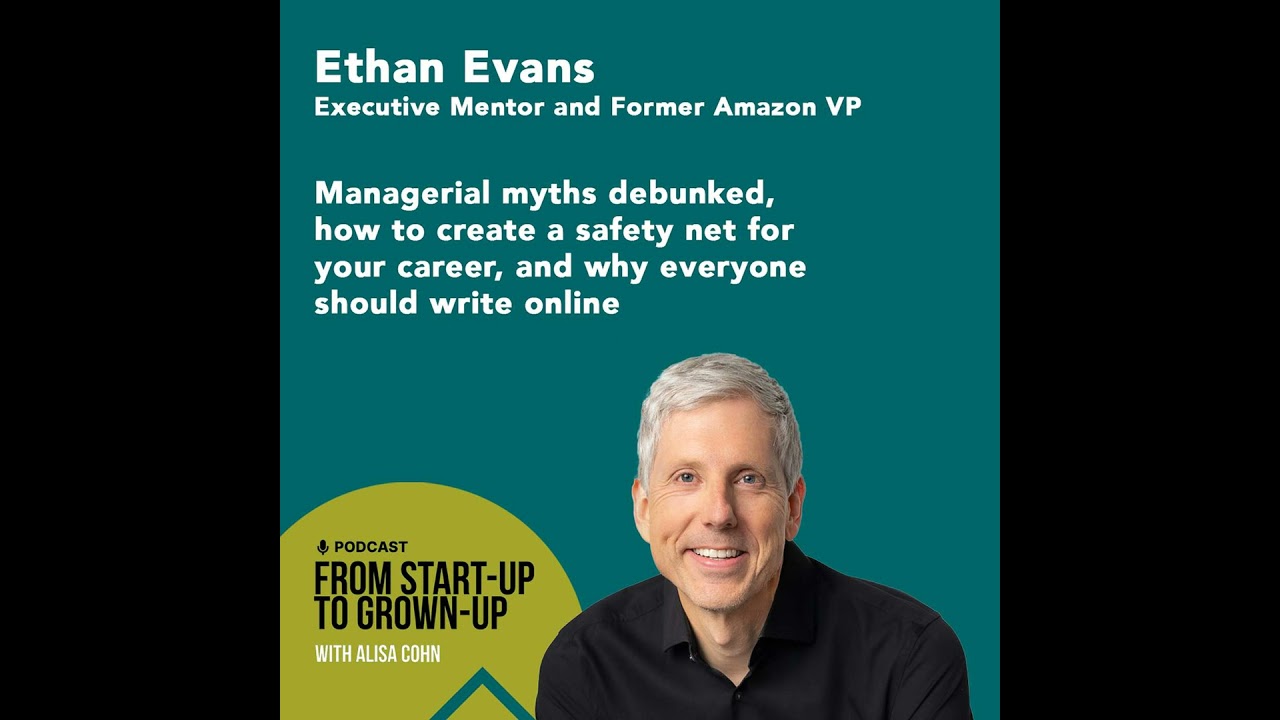
Ethan Evans, former Amazon VP turned executive coach, breaks down the myths keeping people from leadership roles. He shares his five-step Magic Loop framework for gaining visibility and building trust, and explains how he left Amazon to start a coaching practice using Twitch and strategic financial planning.
Chapters
You have to know what you're looking for. Usually it gets down to what are your values? What do you want to be remembered for? What impact do you hope to make on this earth? Because as much as I had a great career at Amazon, one of the things I would say about Amazon is Amazon is not normally in the business of things that create a lot of meaning for people. And what I mean is they're not curing cancer, they're not feeding the homeless, not world peace. So I try and figure out, you know, I try and push people to figure out what's gonna give them that long-term meaning and then how can they start moving their career in that direction.
Welcome back. This is From Startup to Grownup. My name is Alisa Cohn, and today I'm thrilled to welcome Ethan Evans to the podcast. Ethan worked at Amazon for 15 years. He retired as a vice president, and now he's a coach and educator focused on helping leaders grow to true executives. And that's what we talked about, what it takes to be an executive, how you can grow in your career, and the magic loop that Ethan created to help everyone get ahead. We also talked about the executive mindset and what it's like to be in the shoes of your boss. You're gonna learn a ton from this great conversation, so please enjoy my discussion with Ethan Evans. Okay, we're starting the podcast right now. Ethan, you just said, you know, you said you're sometimes outta step with the prevailing culture and also that you know you're doing it right when both sides are mad at you. I have gotta double-click on both of those topics. What do you mean?
Well, one way to look at both sides are mad at you is when I led teams, I thought of it as if no one in the team is ever saying to me they feel under pressure or slightly overworked or pushed too hard, I probably am not pushing quite hard enough. If no one on a large team feels a little squeaky. On the other hand, if everyone does, if you're getting that feedback from 80% of people, you're obviously frying the team. And that's just because life is a bell curve. And so the person who wants to do, or whose life circumstances allows them to put the least time into work, I probably want the total pressure on the team to be a little higher than that person might be completely comfortable with. I'm not trying to abuse them, that's just, that's my barometer. And on the other hand, if half the team is like, Ethan, this is insane, we're working weekends all the time, that's clearly also wrong. So when I say both sides are mad at you, that's what I mean. Now, out of step with the prevailing culture. I don't know which, it depends on whose culture. So what I find is when I write on LinkedIn, which like you, I have a large audience there, um, if I write particularly on feminist or, uh, equality topics that are viewed as DEI, I will get feedback both from what we could classically call the right, which will say, well, you're not— what you're saying undermines meritocracy, and isn't it all a meritocracy? And, you know, shouldn't these people be quiet and work harder? And I will also get feedback, though, from the left on the same post that says, you don't go nearly far enough. You forgot to include and acknowledge this person and that person. And so again, I use these sort of sidelines as barometers. Like if I write a post and no one in what we might call classically liberal is like, you didn't go far enough, then I haven't been bold, or sorry, I've been very bold and maybe too far. On the other hand, if no one on the right says anything, then I haven't been bold enough maybe. And, or, or however you wanna look at it. And so, uh, what I was specifically thinking of when I made that opening statement to you is I have gotten in trouble a couple times and it surprised me. I've made posts trying to talk about equality and giving opportunity and giving a hand up and acknowledging the problems women and minorities sometimes face. And I've gotten quite strong blowback from liberal advocates for the way I've done it or not done enough of it. And, uh, that's fine. Like, I value all feedback, but it had surprised me. Like, mm, what I've learned that's sad is that if I just prefer to minimize my pain, I'd say nothing at all. Because I was actually trying to help and the feedback I got is, well, your help's kind of nice, but it's not really enough, blah, blah, blah. Well, I could do nothing and then you actually wouldn't say anything to me because I wouldn't have brought the topic up. So ironically, like I increased my criticism by trying to help.
Yeah, I think that's powerful. And I think that, you know, for all of us who write online and try to, have a point of view, like, or actually have a point of view, I think we do, you know, open ourselves up to criticism. And at the same time, I think your point is so accurate. It's so well said. Like, if you don't open yourself up to criticism, then you'll never say anything meaningful.
Right.
And, you know, for both of us, it's important to say things that are meaningful. I want to bring us back to where I was really going to start, which I so appreciate this little segue, which is, um, You know, Ethan, you worked at a few startups. You started at Amazon, and if I'm not mistaken, you were involved in the launch of Prime Video, Amazon Video, Prime Gaming, to name just a few of your accomplishments. And then you left after 15 years at Amazon to launch your own business. And now you coach people, you coach, you know, middle managers, leaders to help them become better executives. And I wanna know, you know, broadly speaking, What are some of the key things that get in the way from people, from the way they get in the way of people being able to make it to the executive level?
Yeah, I guess the number one thing that gets in people's way is a sense that all they need to do is work hard and they will be seen and acknowledged. Like, the number one is, I'm told, For example, in some cultures, I won't say to know for sure, but I'm told in like Asian culture, there's an idea that if you just work hard, you should be seen. One of the ways supposedly Japanese white workers strike is rather than walking out, they work harder to shame management into acknowledging their value. So they organize a strike where they're going to work extra and it's a shame thing. Obviously, in our culture, that would feel like, potentially the evil factory boss be like, this is great.
I know, keep doing that.
Yeah, please keep it up. I'll, I'll, I'll, oh, I, I assure you I'm noticing. Um, but, uh, I think one thing is people don't realize that there is— you don't have to be a shameless self-promoter, but you do have to make sure that your accomplishments are getting noticed. And people misunderstand that you not getting noticed isn't necessarily intentional. It's that if I'm the executive, I'm busy. I have my own life, I have my own career, I have my own family, I have 12 people working for me. Do I intend to notice your good work and give you credit? Sure. Am I more likely to notice if you drop me a note? Also sure. So that's one thing. The second thing I think is failing to scale. So people get to a certain level by being experts themselves. They're great at finance, they're great at engineering, and, uh, you know, they're great at art, whatever it is their gift or talent is. And then they're in a leadership position, but they keep doing the work themselves and they struggle to really scale their team and delegate and realize like, well, at a certain level now you're a strategic leader and a team builder. And in fact, if you are doing work yourself, You are probably failing in your mission. You know, there's an argument in some disciplines and at some companies that you should do a little bit of the work yourself to stay current. But a lot of people get more sucked in and they struggle to let go and really stop looking down at the work getting done and start looking up at the strategy. And making sure the right work is on the plate.
So neglecting those kind of topics is, it, it's sort of like that's what stands in the way and those are the obstacles of people kind of rising up and, and really ex— sort of expanding their leadership capacity.
Yeah. It's, you know, I, I, my class is called Stuck at Senior Manager because that's, that's where people seem to get stuck. They get, and I think you can get the senior manager, you know, managing a team of teams, maybe 30, 40, 50 people. By hard work, diligence, and skill. But then it can really slow down if your, you know, all your competitors are good. They're also have risen to that level. They're also working hard. And so your ability to just outwork them or be smarter than them declines because they're also smart and hardworking and from top-tier schools. And so it leads to the question, well, what do you need to do differently? And I think that's often first realize that like, Building relationships and making sure people know and trust you is critical. And that's the, hey, I have to do some PR for myself. I can't just wait to be acknowledged. And then I have to change what I'm doing because if I aspire to lead 100 or 500 people, suddenly the question isn't how do I get the work done? It's what work should these 500 people do? And why is Project A gonna make the company more money or put them in a better position than Project B.
Yeah, I think that's great. And then I guess I wanna then go to the other side of that kind of like relationship where I think you do a great job explaining to people the mindset of a manager, the mindset of a leader. So could you talk a little bit about what is the mindset of a normal everyday leader?
Yeah, well, first I often say the mindset of a normal everyday leader is how to, how are they doing? Right? We all know that most of our self-talk is about ourselves. 70% of our thoughts are about ourselves, not about others. So without criticizing your leader, because we're no different, you are probably thinking, the leader is probably thinking, how do I look? How am I doing on my goals? What is my boss seeing? Oh, right. And then how is Ethan and Alisa? How are they doing? But that comes later. Second, ironically, the first thing they may think about you is, if I work for somebody, they may think, well, how is Ethan's work reflecting on me today? And again, this makes them sound terribly self-centered, but I'm only talking about a normal amount of self-centeredness that we know from psychology everyone has. And so leaders are thinking about that. Now, the second thing they are thinking is, How do I move this whole organization forward? So for example, I always, I often talk about how any leader has a list in their head, and that list is of projects and people that they feel are on track or doing well, and projects and people that they're worried about. And you want to be on the doing well list, not the worry list. And Understanding that every manager I've ever talked to can immediately tell you who on their team they worry about and who on their team they don't, and which project is worrying them right now and which one isn't. I just remind people, your manager's just like this, and where do you fit in that hierarchy? And then the last thing I tell people is your manager always needs help, right? And one way they can think about this is if they're at a management level or a leadership level, even as an individual contributor, a senior engineer, whatever, wouldn't you love it if someone came and offered you a hand? And they're always like, "Yeah, that's so awesome." Well, your boss feels the same way. If you can walk into your manager's office at any level basically and say, "Hey, um, I've kind of got my area under control. If there's anything you don't think I have under control, let me know and I'll work on it. But otherwise, I have a little time where I could help you out. What do you need? You're an immediate hero. Now, there are even more advanced versions of this where you can say, hey, I noticed this thing that needs to be done, so I'm willing to do whatever you need, but otherwise I plan on doing this thing that seems like it needs done. That's great. Then you're not even making them come up with it. If you have a truly deep relationship with your manager, I often hopefully got to the level with my managers where I would just say, "Hey, I saw this needed to be done. I did it. I'm just letting you know it's handled." Well, now you've become like magic to that manager because they're not needing to worry about you or direct you, and you're delivering them little Christmas presents. Every so often of things you've seen and solved without ever involving them.
Yeah.
And that's what opens the doorway upward.
Yeah, I love that. And that leads us into the magic loop, which I love that your, sort of your process and your magic loop. And I'd love you to describe it briefly. And then I would love to probe you on some things that might get in the way of the magic loop.
Absolutely. So yes, you're right. I came up with this theory I called the magic loop. It's got 5 steps, but they're very easy to express. The first one's do your job well. And the reason that matters is no boss wants to try and give you more if they feel you're not doing well at what you're doing. It's the one place where, like, if you go to your boss and say, hey, I wanna help you out with a new project, and they're like, actually what I need is just do your own job first. So get past that. Then what you do though is you do ask how you can help. That's step 2, go help. Step 3 is whatever you're asked for, do it within reason, of course. What I mean is your manager may not give you the most enticing sparkly project right away, but you actually lower yourself in their eyes if you're like, "Hey, how can I help you?" "Oh, I didn't mean that." That's right.
"What's that grunt work you're about to give me?" Right.
Right. You've got to be willing to actually roll your sleeves up and do what they see as needed. And why do you do this? You earn trust and you build a relationship because people help people who help them. So then step 4 is after you've built some trust, you might have to go step through steps 2 and 3 a few times. You go back and you say, hey, I love helping you, but I have this goal. I want to grow. I want to be promoted. I want to, I want to get on this new project. I want to switch what type of job, whatever your goal is. How can I help you that will also help me to this goal? Can we have a partnership where I'll do, I'll keep doing wonderful extra work for you, but you help me get here? And most good managers will do this. Most even average managers. And the reason is it's good for them too. You can count on people to do what helps them. And they, they're smart enough to know that if they don't do anything for you, you'll probably stop helping them. And since they like the help, they want to keep the help coming. So if they can, they will. And step 5 is the easiest of all. It's repeat. Just like in the shower, lather, rinse, repeat. Go through the first 4 as much as you need to in a cycle. And I've definitely had people I coach try this and then come back to me and say, you know what, is there a way to stop the magic loop? Because my manager now is so enthusiastic about my help, like they're drowning me. And like, how do I put up my hand and say, ah, you know, slow it down just a little. So that's the magic loop. What are your questions?
Well, so that's a good question that you just posed. But even before that, I think a lot of people don't really know what their goals are. They don't necessarily know what they want. They want maybe in big picture, they wanna get promoted, sort of, kind of. But how do you help people really hone in on what their goals are? Because managers themselves are like, okay, I'd love to help you. I wanna get promoted. Okay, well how do we do that? You know, it's like it becomes very vague.
Yeah, this is a great point. And you nailed something that I don't spend enough time on, which is how do you figure out your goals? 'Cause I kind of figure people know their goals and you're correct that they don't. You can have career goals in the sense of like money, title, compensation, and that's where people often think first. But I believe you should really start, if you can, with the deeper question of what do I want my life to be about? Maybe not forever. You know, there are phases, but like, what is critical in my life right now? Is it increasing my earning power so I can take care of my family? Is it finding work I enjoy more or that I'm better at? Is it travel or prestige? I took at least one job move within Amazon once so I could travel more in part. I wanted a reason to leave rainy Seattle in the winter. So I took a job that had a team in Southern California, and part of my motive was now I can go to California when I want. Um, yeah, not the deepest motive, but honest.
Yeah. Right. Whatever it takes.
Yeah. Well, so you have to know what you're looking for, and I think how you find that is some introspection. Maybe some people can ask you questions and, but usually it gets down to what are your values? What do you want to be remembered for? What impact do you hope to make on this earth? Because as much as I had a great career at Amazon, one of the things I would say about Amazon is Amazon is not normally in the business of things that create a lot of meaning for people. And what I mean is they're not curing cancer, they're not feeding the homeless, not world peace. Amazon is in the business of either selling things or providing computer services, very reasonable businesses, nothing evil about them, but nothing like top tier, you know, they're gonna build a statue in my hometown. And so I try and figure out, you know, I try and push people to figure out what's gonna give them that long-term meaning and then how, how can they start moving their career in that direction? And it may mean, as it did for me, probably jumping ahead in your story, picking, you know, that you may eventually leave a job because the job can, can't be pushed anymore towards what you've decided is your meaning. And so I had to leave Amazon, not because of anything wrong with Amazon, but because I reached the point where to pursue what was meaningful to me, I had to do it outside of that structure.
Yeah. And I actually think we will talk about that a little bit more, but I, I will just say that, like, I think that people sometimes think I'm supposed to get exactly what I need and want from this manager in this job. And also the responsibility is on them to figure it out for me. But actually the responsibility is on you to figure it out for yourself. And sometimes it's not the right job or the right context or the right manager. And you have to make peace with that too. Yeah.
A phrase, a catchphrase people can take away and remember, 'cause it's funny and easy, is if your career was my responsibility, it would be called my career. And I already have one. So my job as a leader certainly is to some degree to give you opportunity if I'm a good leader and try to support you and give you guidance. But yeah, you, you have to figure it out. And in fact, there's another danger there. What most managers, most of us tend to assume We like our own lives. And so we will tend to assume, oh, you want your career, you must wanna be a manager like me. Let me make you into mini me. So actually, if you want something else where you wanna be, you know, a deeper technical expert, or you want to do something that's not sort of classic leadership track, it's really important that you figure it out because leaders are gonna try and push you down a leadership track most of the time. Because again, going to basic psychology, it's self-validating. If I'm, if I don't think my career choice was a good choice, then I'm gonna start hating myself. And if I do think it was a good choice, then I'm gonna try and tell you what a good choice it is. So you have to be, you know, again, you wanna own your own destiny there.
Yeah. And I think also maybe not be so afraid to make some mistakes because you're gonna self-reflect. You're gonna think you want something. It turns out you don't want that thing. That's okay. You can keep course correcting. But I think the, the sin is sort of just staying stagnant and not trying new things.
For sure. I, I once, uh, worked with a, uh, a leader and a coach who advised people, draw your career map and, you know, you're taught that it should look like a line or a ladder, but draw what it's been and it will look more like a plate of spaghetti. Um, you know, lateral moves and unexpected projects and transitions. And so that's normal and it's okay. Uh, and I often tell people careers are long, you know, even in my case, I retired at, uh, from Amazon just before I turned 51. You know, for me, that was about 30 years from my first sort of post-college job. But a lot of people, their career will be closer to 40 years or even more. You could argue I'm still having a career, but in a different way. The point I'm getting at is those, if you take a 2-year side detour, at the time you might be like, oh my God, 2 years. But actually on a 40-year career, it's 5%. Right. It's, it's not this huge detour that it might feel like upfront.
Yeah. Very wise. Uh, before we leave the magic loop, I wanna address so sort of adjacent to what you talked about. So there's some other pitfalls of the magic loop. Magic loop. It's like, whoa, now I'm getting all my work from my manager, I'm becoming my manager's go-to. P.S., am I going to get promoted? Also, you, you're open to maybe an exploitative boss. But what I'm most concerned about, and I'd love you to address any and all of this, what I'm most concerned about is actually there's a lot of managers who have not been trained as managers, who don't have the inclination, the knack of being managers. So it's not even that they're being, you know, themselves mean or manipulative, but they just don't know actually how to navigate the system and give you what you need. And meanwhile, you're stuck in the magic loop doing more and more work for them.
Yeah. So this is actually part of the reason—
I'm sure that never happens.
What's that?
I'm sure that never happens.
No, never. All managers are great. Um, so one of my frustrations with corporate America and the whole corporate world is it doesn't train its managers. And there's this thought of, oh well, we'll put training effort into them and then they'll leave or they'll want more pay, so let's not bother. But I remind everyone, your manager wasn't educated as a manager. They're a lawyer or an artist or a business person, which is the closest to having some management training, but not very close. Or an engineer or whatever, they don't have this training. And they're having to learn on the job. And bad news, you're their guinea pigs. And so recognizing that, what do you do? Well, you may have to help them. This is what I need you to do. You may also have to go above them with their support. Hey, it seems like you're not exactly sure how the promotion process works. Could you talk to your manager about it? Or could we talk to your manager about it? Or I found this old salt from the company who's told me all about it. Would you mind meeting with them and they'll fill you in? And a lot of people, again, this is, you ask where people get stuck, they get stuck like, oh my God, that is so not my job. First, it's not my job to be telling people what I did. They should notice. And second, it's certainly not my job to tell them how to navigate the promotion system. They should know. And I use the word should twice in there. The point I make is if you wait around for what you should get, you will be waiting a very long time. And a much better strategy is to take control of that yourself.
Yeah, I think it's so, it's so important for everyone to take away the message that actually, to your point earlier, you're in charge of your career. You're the one who cares the most about your career. And even though many things are wrong in corporate America, people can build great careers by taking control. And I think actually it's a very distinctive, you know, sort of competitive advantage when you kind of not get upset about everything that's going on, but instead you keep moving forward one foot in front of the other. Yeah.
And you will look, you will have setbacks. I was laid off twice. Um, I was reorged under bad managers a couple times. Like you, you will absolutely have setbacks that you have to deal with. Even when you have this ownership and proactive management and you're doing all you can, the path up, unless you're just very, very lucky, will not be this straight line.
Yeah. Yeah, for sure. So you, as you, you pointed out, you left Amazon after a 15-year, you know, very successful career. Obviously you could have stayed, but you chose to leave. And I think you had sort of like a mission to help other people. And I guess, you know, I'm just, I'm just curious, How did you kind of devise the idea to leave and start this coaching practice, and what were your first few steps?
Yeah, so, um, I was working at Amazon. I got promoted to vice president. Um, and my first thought was, well, what do I do now? And I looked upward at the senior vice president team, which at that time had like 10 or 12 people, and there were openings on it only like once every other year. And I asked myself, well, like, what would it take to get that opening? And I looked at my 300 roughly peers. There were about 300 vice presidents in the very large Amazon at that time. And I realized two things. Number one, a bunch of them were in line in front of me. And number two, being objective, a bunch of them were actually more gifted. Like, yes, I was very good. I am very good. But several enough were like, oh wow, that person is brilliant. And so I assessed like, well, if I ever make this, it's gonna be 10 or 15 years of grinding. Not my path. So that was step one, was realize the path I was on needed to change. So then I started asking myself, well, where do I want to take it? And I absolutely evolved into coaching. I knew that I liked to invest in the people on my team, and I started doing that and doing more one-on-one and more mentoring and so on. But I was running Amazon businesses that were $100 million, $200 million, $500 million, several hundred people. And that took a lot of time. And so at some point I reached a realization of I can't do anymore in this role. So then I started asking in Amazon, would there be interest in Amazon for me to create a leadership training program? And At least at the time, from the leaders who were there, I can't say it's for all time forever. The answer was no, that, that it just wasn't an appetite for all the reasons I've discussed of why corporations don't invest. So the door in Amazon was closed and I couldn't do more within Amazon. So then I realized like, well, I need to leave. And at that point I took a couple steps. First, I started really counting the pennies in my piggy bank to make sure I felt I could do that financially. And second, I started manipulating my job to allow me to do as much as I possibly could that would set me up for coaching while still meeting Amazon's need. Now, in my case, I was working for an Amazon subsidiary, Twitch TV, which does live streaming. And I realized that I could use Twitch to live stream career advice to the world. And if anyone at Amazon complained, I could validly say, well, I'm just using our product. Like I have to be able to use our product. You know, I'm not a gamer, so it's a gaming product, but I'm, I'm using it in the way I can. And in fact, that did happen. Eventually someone in legal watched one of my streams and they ratted me out. I mean, passed word along to human resources. And I got a call from the vice president of human resources. Now, the fun part of this story is I had planned for this. Like, I'm not dumb. I knew this would happen. And so I had emailed with the CEO of Twitch, my manager, that said, "Hey, I'm gonna use our system so that I learn the system. You know, I wanna be a broadcaster on our platform. Are you supportive of me as one of your executives using our tools on a daily basis and talking to the audience?" So I had an email that said, "Yeah, that would be great." Then HR calls me and they're like, "What the hell are you doing? We hear you're talking without PR approval." I'm like, "Well, I don't know about PR, but I have my CEO's approval." Now, to give a lot of credit to that HR VP, he very quickly spotted what I was actually doing. He's like, "You're setting yourself up for a future consulting practice, aren't you?" I'm like, "Uh." Well, you know, who knows what the future contained, but in a way that I basically, he, I told him yes, but without saying yes in those words. And he's like, all right, I get it. You know, go do your thing. Don't say anything we can't live without. And that's what I did. So having set myself up for a soft transition, when I had enough pennies in the piggy bank, I left, but I had paved the way. So it was this, I'd built an audience, I'd built a following.. It was this very, not completely smooth, but it wasn't a cold start in a new field. I took a following and practiced and experienced with me.
I love everything about that. How did you know that you had enough pennies in your piggy bank?
Oh, this is a difficult question. So what I did is maybe not tough math. I looked at my expenses and, uh, you know, what I was spending and A lot of people will talk about the number. They come up with the number for what they need to retire. Well, having talked to a lot of people making this transition, I came up with my number and then I got cold feet and made the number a little higher because, you know, you never know. And then I got cold feet some more and I made the number a little higher. And at some point I reached a point where I'm like, you know what? I've moved the goalposts like 3 times. I have to stop because I can see I'll just keep doing that. And you can always imagine like, well, what if the dollar goes into a tailspin and it's devalued like the Argentine peso and, you know, we need gold? Like, you can always create some scenario. So I just stopped. And I know I say I just stopped. That process of stopping was really an emotional process.
Yeah. What was that like? What was the inner journey of that?
A lot of worry, a lot of talking to my wife and a lot of planning. Well, talking to my financial planner about the risks and the likelihood, but also planning my recovery strategy. In other words, if I left Amazon, um, you know, Amazon has this saying that things are one-way doors or two-way doors. It's a two-way door. Could I, I was leaving Amazon on good terms. Could I go back to Amazon? Probably. Could I get a job somewhere else? Probably. Could my wife, you know, who had already retired, go back to work? So once I started looking at all the options, ironically, the option I did not have in mind was that my external business would do so well. I was planning mainly on just writing. And teaching for free. But what I discovered was very high demand for specialized services from people who had a lot of free cash with which to pay. And I am a businessman at heart. I give away everything I do. I write online. When I say everything, all the information I have, I'm willing to write and share. There's nothing I hold back. But if you want it all tailored and packaged in a weekend course just for you, organized at your level, then you can pay for that. If you want it free, follow me on LinkedIn and you'll eventually get everything I've ever said or thought, but you might take 3 years. So, you know, it's like a convenience store. You pay a little more to drive a little less, right?
Like, yeah.
Yeah.
I think that's great. Were you gonna say something else?
No, that's the idea.
Just to say, I so appreciate you being honest about worry and about like having to think about, well, I should say like worry and moving the goalposts and watching yourself move the goalposts. I think that people, you know, sometimes will not talk about that and then it just feels like, ta-da, I just left Amazon, ta-da, like everything else, my life is so great. And I think it's so important to normalize for people that actually doesn't work work out that way. And the second thing I'd observe about you is that you have this sort of, in the back of your mind, you have a little bit of, um, not a little bit, but like a plan. So like, I know I'll go on Twitch and I'll get my practice reps in and I'll, you know, build an audience. Or like, okay, if I leave Amazon, I, it doesn't work out, I know I'll go back to Amazon or kind of whatever. Have you always been like that? Yeah.
I, and I'm certainly a planner to the degree of almost being an over-planner. So I always have kind of, Plan A and then B, C, and D at different levels. Honestly, if I knew now what I knew back then, I would have moved faster because I enjoy what I'm doing now very, very much. My wife asks me, so when do you think you'll stop? When will you like actually retire? Because you retired, but then you didn't. And I'm like, I don't know, because like, I can't imagine something I'd rather do. Uh, now I lead a really good life. I travel several months a year. I work very part-time, but I do still work and I have customers I need to serve, but I can't imagine not having them. Like it wouldn't be any fun. So yeah, that's the ideal.
Yeah.
It sounds another lens to think about. For people is what kind of work would you do for free, but that someone will pay you for? And I sometimes joke that I have the perfect job, which is for me, which is people pay me to tell them what to do with their lives. Well, I would, I'm the sort of person who has advice for everyone. So I would do that for free. You want, you want an opinion on how to fix your life? Ethan's the opinion guy, right? And, and I see you smiling. It is, you know, a little full of myself. I admit that. But people will pay me to do it. So this is great because once they pay me, they're actually like interested in listening. So it's even better. They're committed.
Yeah, I, yeah, I could totally relate to that. Actually, when I was 13, I was talking to a friend of mine. She was also 13. We're on a bus and we both were talking about this. What would you do if you didn't have to worry about money? What would you do all day long? And my answer was have intense conversations. So I became a coach and now all I do is have intense conversations all day.
That's, but that's, yeah, that makes perfect sense to me because for me it's very slightly different. I like to solve problems. And so people bring me hard problems with their lives and I'm like, oh, that is a good question. And now I'm interested and it just becomes entertainment for me, but someone gives me money to do it. Like, yay. And same for you. You're getting paid to have intense conversation.
Yeah. It's so great. So you talked about, you know, streaming on Twitch and building your audience. Talk more about how you thought about building your brand.
Yeah, that I'm not as clear on that. I don't have the same story there. I actually got a lot of advice from people who have more of a marketing mindset. So for example, my coaching company is incorporated as the EZ Coach, the letters EZ, because my middle initial is Z. So Ethan Z, and I thought it was cute. People who were sort of more brand focused said, look, when we Google Ethan Evans, your name actually comes up first. You should lean into that. You are a brand, recognize it. And so I changed my website to ethanevans.com as a result because I realized like, oh, I actually am the brand. And so, but I got a lot of help. Like I've just finished working with a branding agency to help me figure that out. And so I guess what I would say there is I don't have a great crisp story to tell you. Rather, when you recognize something's important and you don't know how to do it, get some help. And I, I got first some amateur help and then some professional help.
What insights did you get from the professional help that you got and that you're now going to put into practice?
Great question. I think the insight I worked with visual branding experts. You know, the part of the insight is consistent visuals so that people can learn to recognize what you're doing, particularly on the web. It's easy to have what you do be spread across many platforms. I have a newsletter, I post on LinkedIn, I have classes on a couple platforms, we use Twitter a little bit, blah, blah, blah. If you have a visual symbol that ties those all together, then at least people can recognize it. So, Visual recognition is one piece. I think they helped me refine my tone and, and they pushed a lot on like, what are you really about? What is your core value? And for me, that was practical advice. I try not to tell people pie in the sky things. I try to tell them stuff grounded. You've heard me mention psychology a couple times, normal behavior. I try to ground them in this is how the world really works, not how it quote unquote should work, because I don't think telling people how things should work sets them up for disappointment, not action. So those are a couple things that the branding agency helped pull out, uh, in the process.
Yeah. And at the same time, I mean, you built some sort of a brand, you know, obviously very well. Um, mm-hmm. Because you write quite a bit online and I think you contribute to— you also write on Twitter and whatnot. So I guess I'm curious, did you ever— when you do it, like, what made you start writing online? And, you know, back to sort of what we're talking about at the top of this discussion, like, did you ever feel like, oh, I don't know what I'm doing here, or like, I'm dancing in territory that's going to make me uncomfortable?
Um, well, I certainly have gotten into territory that made me uncomfortable because I try to be pretty transparent And on the uncomfortable, I've addressed topics that are taboo. I've addressed being divorced and what led to my divorce. I've addressed being wealthy and trying to own the word and say, hey, I'm not going to tell you, oh, I'm well-to-do or I'm comfortable. Like, you know, most people, if they looked at me and say, oh, you're wealthy, so own it. Don't hide from like, no, no. And don't play humble pie. But those topics are, can be very uncomfortable because some people will then lash out at you. And so you have to decide if that's okay. As for not knowing, what led me to start writing was that I see people struggling with their careers in ways that I feel are obvious to me and clearly aren't obvious to them. And I wanted to help them out by saying, look, You know, you, you keep stubbing your toe on the door and I can see it, but you apparently can't. Here's what to do differently. And so that's, I started writing and I got into it to help people enjoy their careers more because we know that 70% of people don't like their jobs and are unhappy with their careers. And I feel like you spend most of your time at work. That's a terrible tragedy. Now you, Enjoy your career. You're one of the 30%, which is a big number. But for the 70% that don't, how can I shift that number and help some of them enjoy what they're doing?
I love that. I became an executive coach and not a life coach. Nothing wrong with life coaches, but I became an executive coach because people spend so much of their time at work. And if I wanted to make a difference, which was my mission back in the day and is still my mission to light 10,000 candles and make a difference. I can do that in the work context in such a more powerful way than just like, you know, so the concept of life.
Mm-hmm. It's focused and it is, you know, at least in America and I think in much of the world, it's well known the first question we ask you after, what's your name, is what do you do? And so I think there's an argument that's a sad comment on our culture, but It's a true comment. And so then the question is, how do we shift that? But also in the acknowledgement that it's true, how do we get you to love that? To say, oh, this is what I do.
Yeah. That's great. And I think, you know, you like me, I think see these kind of problems as like interesting puzzles to solve. And if people could just shift their something's wrong to this is an interesting puzzle to solve, which is like called the puzzle of my career. I just feel like they would also be happier. If they had the attitude?
Yeah, um, I mean, almost everything, as long as you still have life and, you know, basic health, almost everything is recoverable. Uh, you know, again, life is long, careers are long, you will have setbacks. It is just a puzzle. You may have to leave a bad boss or a bad company, or you may be unemployed for a while, and that may suck. You know, I've been in the situation of watching my bank account decline earlier in my career and, you know, doing the math like, oh, this many months until we're out of money and then this many months until the credit cards are maxed and then I don't know, and worrying about that. But it's recoverable. It's also very motivational in that case. You work really hard to find a new job.
That's so true. It really drives you. Ethan, have you ever experienced imposter syndrome or severe self-doubt?
Absolutely. You know, I don't come from a super humble origin story in the sense that my parents were both well-educated, but I grew up on a farm in Ohio and never imagined that I would end up in an executive role. And I experienced that most when I was asked to guide and lead people that I really understood nothing about what they did. So maybe the first example is I took over a video game studio. I am an engineer by training and I had several artists and trying to figure out how to steward, manage, and advance the career of an artist when I'm one of those people who struggle to keep a line straight when I'm going down the edge of a ruler. Um, you know, I, that was a big, a big challenge for me, uh, as an example. And then you just feel out of your depth in many other ways. But I guess that one struck me because I, I felt responsible to the point of being a good manager, responsible for their lives. And I didn't— I can't help them produce better art. So what can I do? And how do I, how do I be a good manager for someone where I just cannot do what they do? At all. Can't even, other than appreciate it and say, oh, that's pretty, can't even really appreciate it at a deeper level, or at least couldn't before I learned some more.
So how did you kind of handle that?
Well, part is learning like, well, what does it mean to be an artist and how does an artist develop their career? Also learning what's important to them and then realizing what can I do within the structure of the skills I have of How do you navigate the corporate world and how do you help them navigate the corporate world? Uh, you know, so they're getting paid fairly. I remember Amazon didn't have any artists or game studios at that time, and we were organized within the consumer electronics group. And when it came time for this one artist review, one of the other reviewers in the room was the guy who bought and sold televisions for Amazon. Because that was kind of our group. And so I'm saying, well, this artist should be really highly rated. And he's trying to ask me like a probing question to be skeptical. And he's a great guy and he's thinking and thinking. And finally his best question is, well, is he good? Because he just showed how little context, you know, and so I had to learn how to represent things that Amazon didn't understand into Amazon. Um, and I could go on and on about this. Uh, you know, um, I had a conversation with an Amazon leader about buying items in games, which most people now understand, but 20 years ago, the idea of buying items in games, one of the Amazon leaders, I was explaining in-game commerce and he said, well, how will that ship? His context was like, how does that get into our warehouse and go out in a box? And it was just like a jaw drop, like, whoa, okay, pull my jaw back up, don't be an a-hole, and like lead him through, you know. Um, but that, that led to a lot of imposter syndrome because I was out of my depth because I was not a video game developer and I was leading a game group trying to advocate for game developers in a system that literally didn't understand that virtual items wouldn't go in a box, or that, you know, you have the TV guy evaluating the artist. That's a huge— you're a huge important piece of the puzzle. I think, to be honest, I just put my head down and plowed forward. Uh, you know, I can't— I'd love to say I had a great plan. I just like, well, It is me. I don't know how to do this, but there's no one else. So here we go.
Elbow grease could sometimes be the right answer. That's right. Ethan, I could talk to you forever, but I, I'm gonna just ask you one last question. What do you wish you had known earlier on your journey?
I wish I'd known I would succeed. Um, I wish I had had confidence. I did a lot of worrying. That now from the top of the mountain, I can look back and be like, ah, there were many paths up this mountain and I was going to get here. Maybe not to this exact role or life, but what I try to help people understand is the people listening to you and me are probably in the first world or in the developing world. They speak English, they have internet access, and they're busy listening and investing in their careers. They are going to advance and they're going to do very well economically. It may take a few more years, it may take a few less years, but you're going to get there. Focus on doing the work you love and less on just worry, worry, worry about the next step, the next step. And I, I worried too much. And so I know I can't fully convince someone who hasn't reach the top, that they will, or re— but I wish I'd give them a little bit of hope that I often tell people in my classes, understand you're on the path and you're gonna get there. You're doing all the right things. It's gonna work out. Can I tell you how and when exactly? I wish I could, but I can tell you it will. And that's what I wish I'd known.
So wise. So comforting. Thank you, Ethan. It's such a pleasure to have you. I hope we can have a round two. This was such a great conversation. I really appreciate you joining us.
Ah, my pleasure. I love to do round twos. Uh, you know, so if you have, well, you obviously have more questions, you like intense conversation, so that's right. I'm at your disposal.
That's so kind. Thank you so much. All right. Thanks for listening to From Startup to Grownup. If you like what you heard, give it a review on Apple Podcasts so other people can find it. And if you know of a founder or someone else who is meant to be on this podcast, drop me a line through my website, alisacohn.com.
More from Alisa

128: Ken Davenport Produces Broadway Hits. Here's the Startup Playbook Behind Them


The Library of Minds Podcast | Top Startup Coach: The New Hiring Rule for the AI Era | Alisa Cohn


124: Alex Lieberman Built Morning Brew to $75M. But That Was Just the Start [ENCORE]

123: GiaNina Paolantonio Has Millions of Followers. Here’s the Business Behind Them

122: The Kettle & Fire Founder Is Fixing How America Pays for Health | Justin Mares, Co-Founder a...

121: Founder Mode on Bitcoin: Double the Volatility, Double the Stakes | Will Reeves, Co-Founder ...

120: Miro's Founder on Reinventing a 100-Million-User Company | Andrey Khusid, Founder of Miro

119: Eric Ries, Author of The Lean Startup, The Corporate Governance Crisis No One Wants to Admit

118: Josh Reeves, Co-Founder and CEO of Gusto, The 3-Part Alignment Framework Every Founder Needs...