#88: From Startup to Grown-Up: Eddie Kim, Co-founder and CTO of Gusto - Wearing different “hats” ...
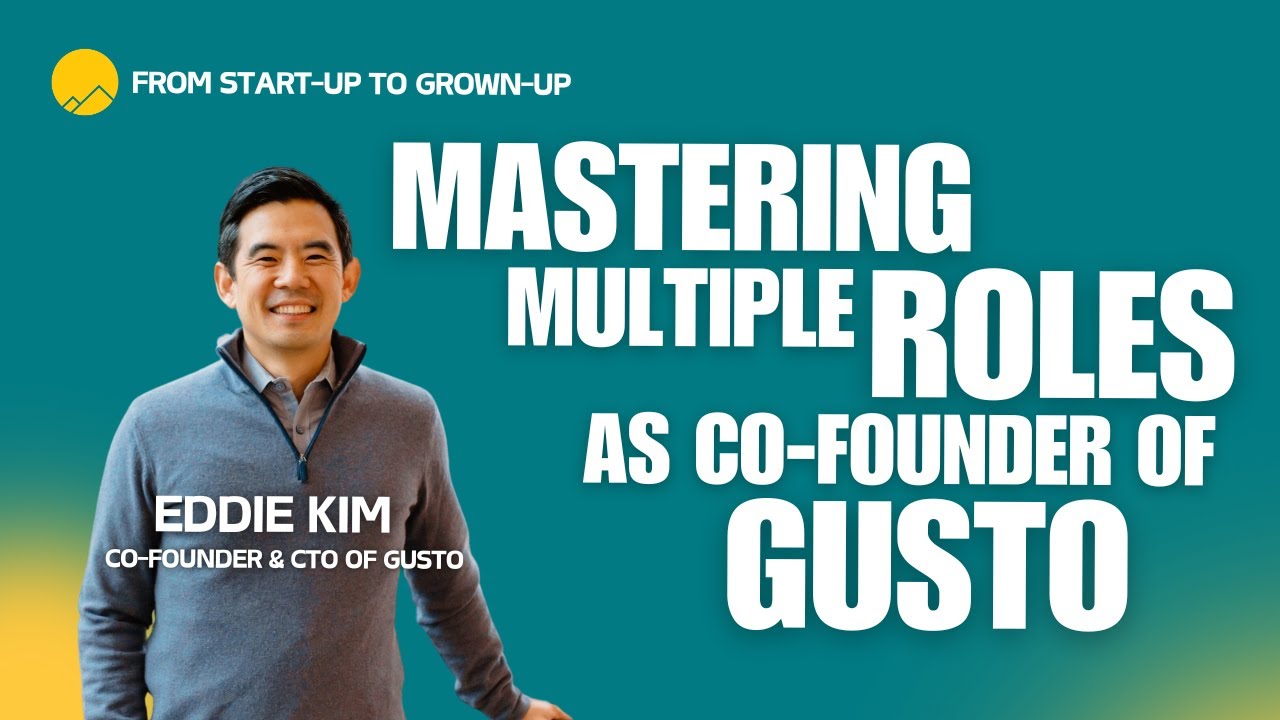
Eddie Kim, co-founder and CTO of Gusto, talks about moving from engineer to people manager, resolving early co-founder tensions through values-based conversations, and building a "debate then commit" culture. He credits Carol Dweck's Mindset for his growth mindset, and describes Gusto's AI assistant Gus, which automates report generation for small-business owners and accountants.
Chapters
if I'm the one that's making the decision is I will actually write up the decision that I've made and I will write up like why I made the decision, the kind of opposing arguments that I've heard against that decision. And then ultimately just saying, you know, making it very clear that these were really considered and they're really great points, but ultimately for X, Y, and Z, this is the decision I'm making. So, I think just instead of just sharing the decision, here's a decision, you know, instead of doing that, like sharing the thought process behind it and like making it very clear that people's viewpoints were heard and understood when making that decision, right? Yeah. Then people, I think, realize that like, okay, this was actually a debate and like Eddie really did think through it and considered it seriously and ultimately made a decision.
Welcome back. This is From Startup to Grownup. My name is Alisa Cohn, and today I'm thrilled to have Eddie Kim on the podcast. Eddie is the co-founder and CTO of Gusto, the online HR benefits and payroll platform valued at almost $10 billion. Eddie and I sat down together at the HumanX AI conference in Vegas, and this was a great follow-up chat to the one I had with Josh Reeves, Eddie's co-founder and the CEO of Gusto, in episode 58. Eddie and I covered a lot of ground, including the role of luck in careers, how the co-founders decided who would be the CEO, and the way Eddie has embraced a growth mindset. We also talked about the specific tactics that Eddie uses to grow as a leader, what his mentors have told him, books that have helped him, and his biggest leadership challenge that he still struggles with today. We also discussed co-founder dynamics and the surprising tool that these co-founders use to stay aligned. I loved this chat with Eddie, and so will you. Please enjoy this great conversation with Eddie Kim, co-founder of Gusto.
Eddie, welcome to the show. We're recording live from HumanX, the AI conference. I'm so excited to, to see you here and to have this conversation.
Thank you so much for having me.
I'm thrilled. We met officially at Web Summit.
That's right. In Portugal.
In Portugal. And I had had Josh, your co-founder and CEO, on my podcast, gosh, in May, April or May of last year. Got it. And so I'm so excited to catch up with what's going on. Gusto and whatnot.
Yeah.
So you're the co-founder and CTO of Gusto, the online HR benefits and payroll platform valued at almost $10 billion. And the story of Gusto, as I understand it, starts with a half marathon. Tell us about the half marathon that started off the story.
Yes.
Gusto.
So I had just shut down my first startup and I was kind of on my own writing a bunch of Android apps. And had a lot of freedom and time to do other things since I didn't have a W-2 salaried 9-to-5 job. And one day my friends were hanging out and I were hanging out and they said, we got to talking about like half a marathon and I was like, ah, that's easy. I could do that without training. And so they bet me that I couldn't run a half marathon. And mind you, I'm not a runner. I didn't run or anything like that.. And so I took them up on this challenge and at the starting line of the half marathon, I ran into Josh before the race actually started. So it was, you know, half marathons start very early in the morning, so, you know, still really early. And it was one of those moments where you see someone that you went to school with. We went to college together, we were the same year, same major. But of course after graduating, like you kind of go your separate ways. We had kept, kept in touch through Facebook and social media, so I kind of like knew generally what, what he was doing, but it was the first time in many years that we like physically ran into each other. So we just said, hey, let's catch up and grab coffee after this race. And I barely made it through this race. I limped the last 3 miles. So although I finished it, I, I would say barely so, and took me about 5 days to recover from like knee pain from, from that. Not a good idea.
Yeah.
To do that.
But not recommended. Do not try this at home.
Not recommended. Yeah. Yeah. But about a week after that, Josh and I met up at a coffee shop, The Creamery, in South of Market of San Francisco, and we just caught up in life. And we found out that, you know, we had many similar life experiences since graduating from college. He had started his first startup, I had started mine, and, you know, we just started reconnecting and rekindling our friendship. And Eventually that was like kind of the chance moment that led us, I think, to starting a company together.
Yeah, for sure. Has it made you reflect on like the role of luck in life and in your, in startup journeys and whatnot?
Absolutely.
Yeah.
I think there's so many things in my life that were a function of just pure luck.
Yeah.
I grew up in a high school that, you know, didn't have a computer science program. I hadn't, not, I was not one of those kids that like, was a computer programmer from the age of 5, but my freshman year dormmate basically said, hey, like, I'm taking this computer science class. Why don't you just take it with me?
Oh wow.
I had no idea, but I just kind of like did it 'cause he was my, he was my roommate at the time and I took this class and I loved it so much. Like it was a thing that like I had never knew existed., but it just like, you know, was one of those things where I actually enjoyed doing the homework and I, I could like sit in front of a computer and program the, the, the prompt to do, do the assignment. And it was actually like really fun to me. And I think that was a chance encounter that like kind of led me down to ultimately majoring in electrical engineering at Stanford. But that was just another coincidence where had I not been in the same dorm as James, then my life might look really different, right? And I might not, may not have discovered my passion for software.
Yeah. Passion for software. And then that also led you to starting a company. It's really, yeah, it's so interesting. I think how all of us, chance encounters, serendipity, have so much to do with our lives as well as of course preparation and hard work.
And both are really important.
Both are really important. Now, when you guys found the 3 co-founders, you and Josh and Tomer, Tomer, and That's how you pronounce his name?
Tomer.
Tomer. And how did you divide responsibilities? How did you decide who was gonna be the CEO? Like, what's an early formation stage like?
So we started out of a house in Palo Alto. That's where Josh and Tomer were. They were actually housemates in this house. And so that's kind of where we started the company. I think one of the things that we did really well in the beginning and still do today is just have very open communication with each other. And not be afraid of having like kind of uncomfortable conversations. And I think a lot of times founders will avoid having this conversation of who is playing what role, right? Because there's ultimately at the end of the day, like most people want to be the CEO and so they just don't want to talk about it and they kind of like sweep it a little bit under the rug. I think one thing that we did really well is as we were getting started, we kind of sat in chairs just kind of like, like this, like facing each other. And we just had the discussion of like, what role should we each have? And we talked about it, talked about our strengths and weaknesses, what we wanted, what we didn't want. And ultimately we decided in that very conversation that Josh would be the CEO. I was, as I said earlier, very passionate about software. I'd stayed closest to it. And so I was going to be the CTO and Tomer was really passionate about product. And so he was gonna be the chief product officer. So it was just one like very vivid conversation. I don't think any of us like really felt 100% comfortable having that conversation, but it was a necessary one to have. And since then it like kind of just gave us a lot of clarity in our roles. And since then we've had so many like direct conversations in any kind of situation that we find ourselves in. And it's our ability to do that, I think that it's led to, in my mind, like a lot of successes of us as a co-founding team, how more than 13 years later, We're still all very active in the company.
Yeah.
Still have a very tight relationship with each other. And even our families now are really close to each other. And so just kind of nurturing that through open communication is really important.
I think that's so powerful and such an important lesson for everybody. When you were in that conversation with the three of you, like having the conversation of who was gonna be the CEO and what were your roles, did you feel like, what, can you give us a little slice of life of what that was actually like? What did people say? What's, what was revealed to you? What surprised you? That was a long time ago, but still that was a very impactful conversation. Is there anything you remember about it that's important?
I think To a certain extent, I probably wanted to be the CEO.
Yeah.
I was the CEO of the first company that I started, and Josh was the CEO of the company that he started. And Tomer also started a company, and I believe he was the CEO of that company. So we were all CEOs before, right? And I think that was it. It was just kind of more of like, what role can I play that is going to serve this company the best? And how do I not let my ego get ahead of what is the right thing to do for the company? The thing I remember is just honestly like a little bit of an internal struggle with that, right? And just, I think having this, yeah, internal dialogue of like, I wanna be the CEO from a, what is ultimately, I think in hindsight, an ego thing versus like, okay, actually I can serve this company best by taking the CTO role. And so that was the kind of feeling I remember in that conversation.
Yeah. Thanks for sharing that. That's so honest. And when you said like, just genuinely, everybody wants us to be the CEO, I think that is sort of true. Not, not everyone wants to be the CEO, but let's assume that like many people do wanna be the CEO, and especially the three of you, you'd all been CEOs. I think it's so important to recognize like, well, why do I wanna be the CEO? There's something about control and ego and like, wanting to be the person. And so just figuring that out and sorting through that must be really, it's important, right?
Yeah, absolutely. And it's not a thing that's just like one and done, like this feeling of ego. I think it's something that comes up over and over again. And especially in, I think in the beg— beginning phases of a company, like, you know, the CEO is oftentimes talking the most with investors and taken to nice dinners because investors want to develop a relationship with the company and invest in the company. And the CTO is kind of the one that's like, in the dark room, like coding and, and building the thing and like kind of doesn't get any glory, right? And so even like those, there were moments even after that conversation where you kind of like have those kinds of feelings of like, it doesn't always feel fair. But then now that I have the benefit of 13 years of experience, I think what I realized is that there are times where it's really difficult to be the CEO and it's not glamorous at all. And you kind of have to look at it over a longer timeframe and realize that everyone contributes and goes through the ups and downs in an even way. But if you kind of look at any one snapshot in time and you focus too much on that, like what's, what is going on in that moment, then I think that's where the ego can kind of come into play too much. And now I think I have enough experience that like, you have to realize that you're on this like very long-term journey. And there's gonna be times where your co-founders, maybe it's health issue or personal issue, that someone's gonna have to pick up more slack. And there'll be times when that's gonna happen to yourself personally and your co-founders will be there to support you as well.
Yeah.
And I think that's a really important thing that I've learned over the past 13 years.
Yeah. Very powerful. I get that. Now, as we talked about earlier, I ran into Lexi Reese, your former COO.
Yes. Lexi's amazing.
You heard her human accent. She is amazing. And she told me that her mantra to you was hands off keyboard. So what was the journey like? Was, first of all, is that true? And what was that journey like for you to get your hands off the keyboard?
Yes. So I remember having conversations with Lexi about this. So, you know, the company is raised a little bit of funding. We raise our Series A, we're starting to hire more engineers to accelerate development of our product. And I'm still very much hands on keyboard, writing code, building features, fixing my bugs. Meanwhile, I have like a growing team of engineers that are reporting to me who at first start out as like kind of your peers. We're working in many ways at a, in a startup, just kind of working side by side, working together. There's no, like, even though I'm technically their manager, there's no concept of like a hierarchical, like I'm your boss type of thing. But as the company grows, like. They do start needing a little bit more structure, right? People wanna start knowing what's their title or like what's the path for career advancement? How do we get mentorship going amongst each other? And like what kind of coaching can they get through one-on-ones with me, right? And the thing is, because I was so hands-on keyboard, 'cause I, I, I'm so passionate about like writing software and like I could just get, it becomes like a time warp for me where I'm the type of person that doesn't eat, that like doesn't sleep just 'cause I'm enjoying myself. I get sucked in so much. And so I really had also another personal struggle about how much do I stay hands-on and like contributing directly versus how much do I focus on building out the organization and being kind of more of a quote unquote people manager. And that's where, you know, a lot of honestly coaching came from Lexi and Josh as well on how I can best serve the company. And even though like kind of being a people manager was something that was a little bit newer to me, right? 'Cause I'm, you know, I was more of like as a, a software developer, it was something that I realized I had to get better at and invest more in my own development, which I did. And ultimately like found a way to get hands off keyboard.
Yeah.
And spend a lot more time enabling others to do their best work hands on, on keyboard.
Right.
Such a, and that was like a big transition that I had to make in how I spent my time at the company.
Such a powerful moment for all leaders to figure that out. When you say you invested, like, I'm curious what specifically you did to invest. Was like that inner work, was that habit change, behavior change? What did you do specifically?
So we were fortunate to have a lot of great angel investors. So part of it was, and great leaders like Lexi, right? And Lexi has a great network. And so a big part of it was just getting introductions to other engineering leaders who were kind enough to spend time with me, to mentor me, to coach me, and just kind of set up one-on-ones. And also on an ad hoc basis, if I had a question about something that they could like help me think through it or even help answer the question that was brewing on.
Yeah.
Another was, you know, I asked a lot of my mentors like, what are some people management books that I should be reading? And so I literally bought, like, if you look at my house, I have like maybe every management book that's ever written. So I can't say I read all of it, but I, I did read— there's some that like really I've read several times that, that have like helped me.
Which were most impactful for you?
I think the most impactful one was a book called Mindset by Carol Dweck.
Yeah.
And it's— she's a psychologist. Mm-hmm. And I think a lot of people have heard this term growth mindset, which means that like your abilities are not fixed, they're not static, that you can exercise and grow them. And really it's a thesis that you can get— be good at anything that you put your mind to, right? You don't have this like innate capacity basically. And I think that book affected me the most and helped me the most. Because if you think about it, like how to manage, how to lead a team, those are all like kind of specific tactics, but you have to— but they are all on top of a foundation of like your— how you perceive yourself and in your own ability to grow, to learn new things and get better at certain things. And so I think that growth mindset is sort of— was foundational to, to everything.
Very powerful. And that's a great book. And I think it's so important for us all to learn. And you're exactly right that like, You can change behavior kind of, sort of, but really what you need to change is your mindset around who you really are to unlock what's possible for you.
Absolutely.
Yeah. Now I read that you had some great mentors, including Jeremy Stoppelman, the CEO of Yelp, and Drew Houston, the founder of Dropbox, and maybe others. What kinds of things did you learn from them?
Oh man, all sorts of things. I mean, I think everything from very tactical things such as I remember specifically setting up like career tracks and levels for individual contributors and engineering managers and like just very tactical advice of like, hey, you need to make sure that your individual contributors have the same like levels as your people managers. You don't want to create an incentive structure that encourages people to just become people managers, that you want to incentivize people to stay as an individual contributor, that the hands-on keyboard folks are just as important. And so very tactical advice on like how to create an organizational structure that creates the right incentives for something like that. And then also, I don't know, just also a lot of like mindset things, like how to handle stressful situations. That are more just kind of talking through problems almost like you might a therapist, right? And so I guess, yeah, both. It's across the board.
Yeah. It's so helpful to have other people who are kind of ahead of you on the path.
Yes.
To be able to give you those tactics and also probably share their experience of how they changed.
Yeah. Yeah, exactly.
I read an interview that you did with Asian Hustle Network. I'd never heard of Asian Hustle Network, but I've read this interview and it made the point that you're one of the few Asian founders of a Unicorn, which I also didn't know, there are only few Asian founders of Unicorn. And you were asked the question about being an Asian leader and you said in the back of your mind you might have thoughts like, people may not respect me as much 'cause I'm an Asian and Asians tend to be perceived as less of a leader than a white person. So I was surprised to hear all that in terms of stereotypes. 'Cause you know, there's so many stereotypes out there.
Yeah.
Can you unpack that a little bit?
Yeah, I, I think it's definitely a, internal struggle that I've dealt with. And I think talking to a lot of my friends who are Asian, like, it's a common theme that Asians tend not to be perceived as a leader of a large organization, that they're kind of more of the, you know, stay quiet, do good work type of—
like, keep your head down.
Yeah, keep your head down. I think part of it is like kind of the Asian culture. I think there is elements of that in many Asian cultures. And so, but then I, I think it's just realizing that going back to growth mindset, that it's nothing about being an Asian person that makes it that way, that it's all sort of this self-imposed constraints. And I think just being able to realize that and move beyond that is another journey that I went on.
Yeah.
And now I think sometimes I'll talk to like, you know, like Asian Hustle Networks to kind of like, yeah, share that message with other Asians who are kind of struggling with the same thing and let them know that like, this may be a self-imposed constraint that you have.
Right. And so that you can share that, your insights with other people to kind of help them get over their own blocks or whatever.
Yeah, exactly.
Yeah. That's great. When I spoke to Josh, we talked a lot about values, and I know that values are important to him and values are important to Gusto. Kind of what's your take about the importance of values at Gusto and how have they played out to you in your hiring, your decision-making?
I mean, I think that values are foundational to a company, right? Values are foundational to any human being, and it's the same for corporations as well. I think they really inform everything that we do from hiring to how we treat people and even product decisions. That we make.
Um, in what way? What's an example?
What's an example? I, I think one thing in our product is we wanna be very transparent with our customers. And so we will try to bias towards giving more information to our customers, but also not overwhelming, overwhelming them. And then at Gusto, we very customer-centric is one, one of the things that we care a lot about. And so we will always like kind of put ourselves in the shoes of our customers and sort of make the product decision on what to do based on that. So that's an example of maybe like on the product side.
Yeah.
But hiring side, like, you know, we even have an interview that we do for every single person that we have since the beginning of the company, and we call it the Values and Motivation Alignment interview, the VMA. And that's an interview that you as an employee have to be specially trained to do. It's a very structured interview. And what we're looking for is, is this person have aligned values with, with the company. And every single person, whether you are a frontline engineer, customer support representative, to a C-level executive, has to do that same interview.
Yeah. And what kinds of questions do you ask and how do you kind of get at the values in that interview?
I think you ask folks to talk about some experience in their life that I think will allow us to kind of sort of dig in a little bit to see if the way that they behaved in that experience is consistent with, with our values.
Yeah.
So one of the things that is in that interview is our value of debate then commit, right? Which is like sometimes decisions don't always go your way, right? And I think we want to create an environment where that is debated very vigorously, but once a decision is made, everyone kind of aligns with it and then moves forward. So, you know, we'll ask in that interview, one of the questions is a time where you had to go along with a decision that you didn't agree with, right? And just, you know, you can learn a lot from how someone tells that story or what story they bring up and how they react to their story. So it's really just through getting people to tell stories, I think that you kind of can get a sense of what their values are, right? It's kind of the same as you might talk to a human. You don't ask them like, hey, what's your values, right? You ask them, you kind of learn about their values based on what they do around you or the stories they tell.
Yeah. Yeah. Values are revealed. Totally. You know, on the topic of debate and then commit, I always am so curious in general with leaders, but certainly with founders, people will sometimes, will bring a lot of their boss baggage to the table, and they'll also say things like, well, it's your company, or it's their company, and they won't always tell you the truth. They won't always debate. How do you create an environment inside of Gusto that helps people really understand that we wanna hear your point of view, we wanna hear your debate, even when I'm the founder sitting in the room?
For me, I, I actually will just explicitly ask them to, and encourage people to share any disagreements, right? So I think the first thing you could do is just really say, hey, I want to hear any differing opinions so that we can debate it and ultimately make a well-informed decision where we've looked at it from multiple angles. I think another thing that you can do is just set a good example. So, You know, when Josh and I are in meetings, like we don't always agree on everything and I will actually like in front of others, like express that disagreement and share my point of view on it. And like, we will have a, like very public debate in front of others about it. And once a decision is made and Josh is my people in power, like once in many cases Josh makes the decision. Then we also show in front of others that like, all right, let's do it, you know?
Right.
And, and I think that kind of then will trickle down to other people. Then we'll, I think we should see other leaders set that example in front of their teams as well.
Yeah. I think that it's so important to show those examples. Do you ever worry that there is, 'cause in some of the companies that I coach, there's the whole mommy and daddy fighting in front of the kids kind of problem. Like, do you ever worry about that in terms of having a debate with Josh?
I don't think so. We really try to run the company as if we are like executives in the company, not like friends or founders. And any like major decision we wanna make in the company, it's done with the executive team and not in like some like kind of secret like founder meeting, right?
Yeah.
And as we've gotten larger and larger and built out a, strong bench of leaders, it's really, really important for that to be because we need those leaders to be bought in and engaged and feel as much ownership as we do. That's the only way it's gonna scale. And so yeah, we really like truly see our roles as executives.
Yeah.
In the company. And I think hopefully that shows to other executives that we're not like mommy and daddy, like fighting.
Yeah. In front of others.
The other, the other thing I'll, I'll, I'll do Sometimes I'll write up, if I'm the one that's making the decision, is I will actually write up the decision that I've made and I will write up like why I made that decision, the kind of opposing arguments that I've heard against that decision. And then ultimately just saying, you know, making it very clear that these were really considered and they're really great points, but ultimately for X, Y, and Z, this is the decision I'm making. So. I think just instead of just sharing the decision, here's a decision, you know, instead of doing that, like sharing the thought process behind it and like making it very clear that people's viewpoints were heard and understood when making that decision, right? Yeah. Then people, I think, realize that like, okay, this was actually a debate and like Eddie really did think through it and considered it seriously and ultimately made a decision.
I think that's so important because actually people don't always necessarily need their idea to be adopted, but they do need to feel heard.
Yeah.
So you figured that out.
Yeah. I mean, that's how I would want to feel as well.
Totally.
Right.
Totally. That's great. How do you, and I mean, I would say sort of you, the founders as a group, I'm sure you've had ups and downs and you talked about your early conversations and the importance of communication. What other tools or techniques or tactics do you have? To maintain your co-founder relationship?
We usually spend one evening a week either at my house or late in the office, or we go, we go somewhere and we just hang out. Most time we, we don't talk about work. We just hang out like as friends too. And I think that's really important for just maintaining our relationship. Very important. And then, you know, even our, we're kind of famous because our parents, have also become close.
I did read about that. How did, how, tell us about that. How'd that all happen?
It may have started by just, you know, one by one, we, over the last 13 years, we all got married. And so it might have started from just, you know, inviting the parents to the wedding and then they meet the other parents and now they hang out without us all the time. They go on vacation together.
Uh, they're their own set of co-founders.
Yeah, that's hilarious. My mom sometimes, my mom, my mom lives in Pasadena and she will come up and visit Josh's mom sometimes and just spend the night with Josh's mom. And sometimes if she doesn't have time, she won't even see me. So she was like, let me know. I was like, hey, I'm going to Josh's to hang out with his mom. If you wanna like come hang out here and join me, like you're, you're more than welcome to. I'm like, okay, thanks mom. I'll just see you later. But I, that to me, that's really special. Like, I think it's like when you see them forming their own relationship and they're able to kind of hang out and get to know each other without you there, I think that's like kind of a sign that they've achieved a certain depth in their relationship and it makes you, it makes you a little happy, right? And that, that also helps with developing your own relationship, right? It's like any kind of, you know, if you get married to, you know, you someone, then your family's like, I was just at my best friend's wedding last weekend and in many ways it's also about the families getting to know each other and getting close to each other. And when your families are close to each other, then like you're closer to your significant other even more.
Very true. And I love that story and I love how you kind of frame it that way. And it is, I think it's like life goals, founder's goals, right? To have all your, did you have your parents like go vacation together?
Yeah. Yeah. It's a, it's a special thing.
That's great.
But it's also, you know, That's, you know, on the personal side, but like, you also have to like know what context you're in. So when we are in work mode, in the Gusto mode, we don't think about any of that stuff. That stuff doesn't matter, right? It's like we are now wearing different hats as leaders in the company and we act that way as well, right? And so, and that's really important too, to not bring like too much of like your personal connections into a professional environment.
Yeah.
That's something that you have to be really diligent about as well.
Yeah. You talked about different hats, and I think that different hats is also another leadership skill. Is this something you think about in the rest of your leadership as well?
Yes. I have to wear many hats and many leaders have to wear many hats. You know, I have my hat as the head of technology at Gusto, but I also have a hat as a board member at Gusto, or a leader in our executive team. And I think it's really important to know what hat you're wearing because you're representing like sort of a, a different role to the company. Sometimes I'm like actually very explicit about that. Like literally we'll say, I'm taking off Eddie's head of technology hat and I'm wearing my board hat right now. And here's what I have to say. Like, just so it's very clear to others, like why I'm responding in this way. I guess that's another thing that I realize is that when you have multiple hats, it's also very important to sometimes be very clear on what hat you are wearing in that moment, sometimes in a very explicit way.
Yeah. So people understand.
People understand.
Yeah.
Yeah, totally.
I think it's so important. You talked earlier about how you, how you learned management skills, and now you're talking about some other skills that you have around compartmentalizing and understanding the need for different hats and and putting on one hat and taking off another hat and also telling everybody about that. There's a lot to it to be a manager. I guess I'm curious, what was the easiest for you to learn and what was the hardest for you to learn in terms of your management skills?
The hardest one for me was really like giving up the hands-on keyboard hat, right? There's some hats you have to take off and never put on again. And I know myself well enough now that if I pick it up a little bit, even for a day, or like we have a hackathon and like I decide to participate in it, then that hat stays on. And then the other hats like don't get worn. And so for me, I don't know why, but like it's almost like a drug kind of thing where like addiction is like, you have to know yourself well enough to like just stay away from it, you know? And like, that was a very hard lesson for me to learn of all things for some reason. I mean, everything else was really just honestly years of experience and making mistakes and learning from them. And I still make mistakes all the time and still learning all the time. And just every time something doesn't go right, seeing that as an opportunity to get better next time. I think that's probably the most important thing, and that's kind of the key to just learning how to wear other hats and getting really good at all these different aspects of being a good leader.
Yes. How, what were some of the lessons you learned around hiring executives, hiring your senior people, especially in your organization, or, you know, being part of the hiring team that hired, you know, your peers around you, executive peers around you?
So, in some ways it's no different from hiring anybody else, especially when it comes to making sure that there's a strong alignment of values and motivation. Again, it's the reason why we have them go through the same interview as every single other person. So there's no difference in that sense. But in other ways, yeah, it's very different. I think executives, I've learned you just have to be very, very patient in finding the right person because the wrong executive hire can be very bad for the company. And then so knowing that like when there isn't a good fit and just having like a direct conversation that, hey, it's not working out, right? So it's—
How do you know it's not a good fit? Like what are some signs for you either earlier or late in the game that they're not scaling or it wasn't the right fit?
There's so many different ways I think it could be not a good fit. It's hard to like kind of, I think every case is a little, you different. Some are, yeah, not able to scale. Some are not good at like inspiring others. I think probably the common theme that I have noticed is, well, I think it's really important to have skip levels and talk to the folks that directly work for this person and get a sense, right? And it's not just that like, oh, do I, do you like this person or not? But really trying to get a sense. I think you can learn a lot from skip levels and, and how the, how someone is performing.
What kinds of questions do you ask skip levels?
I sometimes just don't, you know, with skip levels, I, I really don't try to come in with like too much of an agenda. I try to just learn a little bit more about what they're doing, what they're working on. And I think you could just tell sometimes in conversations, is the team healthy? Are they productive? So, yeah, I really try to come into skip levels without really any agenda and try to listen as much as possible to what that skip level is saying.
Right.
And then you kind of infer based on those conversations on how this particular leader is, is doing.
Yeah. Now, Eddie, any founder over a decades-long journey like yours has had ups and downs. Can you think about like, what was maybe one of your highest highs and one of your lowest lows in this journey of Gusto?
Hiring a really good leader is like one of the biggest highs ever. I never like thought of myself as like someone who could enjoy sales, but like, and not to say like hiring someone is like a sales process, but there is an element of like, once you found the right fit, you need to get that person excited about what you're doing as a company.
Right.
And so there is like a little bit of like salesmanship of like Hey, let's do great things together. And like, here's what we're doing as a company. You can be a part of this, right? And the best people, they have multiple options. Like, they don't have— they don't need you. They don't need to join your company. And sometimes that whole conversation, like, can last weeks and you're getting to know them. And when they say yes to join the company, it is like, in my mind, like, one of the, like, best feelings in the world., and so those are like kind of some, sometimes the, the biggest highs that I can remember. And so yeah, I, I think a lot of the highs and lows in my world right now, like, have to do with finding great people to work with.
I love that. It's so, it's so also interesting that you are the guy that has trouble getting your hands off the keyboard, but nonetheless, you know the value of hiring a really good person.
Yeah.
I mean, it's, I think it's something I've learned over the years, right? Like, it's when you're just starting out and you'd think that like, you know, you could do everything yourself and you are the best person to, to, to do the task, right? But then as you grow, like, you have to realize that it's such a team effort and you have to do it with other people and with other great people.
Yeah, totally. Now we can, we're here at the Human x AI Conference and you are a technology leader. I don't think we can leave this conversation without asking you a little bit about what is Gusto doing with AI these days?
Yes, I'm glad you asked because I'm always excited to talk about it. Yeah, there is so much we're doing with AI. I think it has so much implications to the space that we're in. You know, I'll just share a few examples, but we've built what we call Gus, which is our customer-facing assistant. And Gus right now is helping our customers save so much time get great insights about their business and help their business to be more compliant. On the insights piece, for example, if you think about a business owner, they have all these questions about their employees, how much payroll taxes did they pay last quarter? And to get the answers to these questions, they have to like run lots of reports, generate these CSVs. They then have to like analyze these CSVs. They'll do like pivot tables and formulas and things like that and finally get the answer that they're looking for. With Gus, our customers now just ask the question that they have on their mind and Gus will go generate the report. It'll analyze the report and it'll just give them the answer. And along with the answer, it'll say, hey, this is the report that I used to come up with this answer. You can verify it if you'd like, but this is what I think is the answer, right? And so That's just one small example of like how Gus is helping customers get like good insights about their companies. Also saving them time, 'cause like otherwise that whole process of generating a report, analyzing it, can take hours sometimes depending on the type of question that the business is trying to get answered. But with Gus now, just, you just ask Gus and Gus gives you the answer and also will give you the data to back up that answer.
That's so cool and so useful for your customers.
Yes. Yeah, and we, we see it like actually saving even more time for accountants. So we have a lot of accountants that use Gusto, and accountants are managing many clients on Gusto, right? They have an accountant dashboard. They can, you know, see all of their cust— their, their clients. Maybe they have anywhere from 10 to 1,000 small businesses that they're managing on Gusto. And oftentimes the accountant wants to run this report and answer this question across all of their clients. And so if you talk to an accountant, how they do this is they hire a junior accountant, right? And they say, hey, can you just get this question answered, run this report for every single one of our clients? But now they just ask Gus, hey Gus, can you answer this question for all the clients? And Gus will go in and do it for every single one of the clients and just bring back a big report answering questions. Saves, can save them days or weeks of like work on, on, on their part.
Yeah. And also money, obviously.
Yeah.
And incredible.
Yeah. And for accountants, time is money, right? Yeah. Because like if they can do things in less time, then they're oftentimes actually, believe it or not, like, uh, capacity constrained. Like they wanna take on more customers, but they just are fully loaded in how many clients that they can take on.
Yeah.
But if we can save them time for each client, then they can take on more clients and grow their business.
Love it. So good. Eddie, just a couple more questions. What do you wish you had known earlier on your journey?
Yeah, that's a good question. Known earlier on my journey. I think, I don't know if I, if it's, I wished I knew this earlier, but it's something I've appreciated more is just like how more meaningful over the years our mission to help small businesses has gotten for me personally. And that there's always more to do for them. And of course, I was really passionate about solving problems for small business. My parents were small business owners, but every year you still somehow get more and more passionate about that. And it's something that I've— I didn't really think would happen, but I've come to appreciate much more. The other thing is probably that there's always more to do. I think when we were much smaller, I thought that when we were bigger, that we would have the resources to solve all the problems of small businesses. But what you learn is that there's always more work to do. There's always more problems that you learn to solve. And so things never ever feel like you have done everything you want to do. And I think that's in some ways like a really nice thing because I know now that like I'm gonna be doing this for probably the rest of my life because there's never gonna be like any point in this journey where we're gonna be able to say we've done everything we can for small businesses. And that's kind of a nice thing.
I love it. That's so great. And last question, what advice do you have for other founders as they embark on their journey to grow into leaders?
I think just really having that growth mindset that there's always gonna be ups and downs and successes and failures and taking those failures as learning opportunities. And I think if you just always have that mindset about failure, I think that is really kind of the fuel that helps with the growth of any leader. I think it's fundamental. If you don't have that, I think you limit yourself on your potential as a leader. And if you have that, I think your potential is, is limitless.
Amazing. Eddie, what a great conversation. You're such a reflective person, and also you shared so much practical advice. People are gonna really benefit from this. So really, I appreciate you joining me.
Thank you so much for having me.
Thanks for listening to From Startup to Grownup. If you like what you heard, give it a review on Apple Podcasts so other people can find it. And if If you know of a founder or someone else who is meant to be on this podcast, drop me a line through my website, alisacohn.com.
More from Alisa

128: Ken Davenport Produces Broadway Hits. Here's the Startup Playbook Behind Them


The Library of Minds Podcast | Top Startup Coach: The New Hiring Rule for the AI Era | Alisa Cohn


124: Alex Lieberman Built Morning Brew to $75M. But That Was Just the Start [ENCORE]

123: GiaNina Paolantonio Has Millions of Followers. Here’s the Business Behind Them

122: The Kettle & Fire Founder Is Fixing How America Pays for Health | Justin Mares, Co-Founder a...

121: Founder Mode on Bitcoin: Double the Volatility, Double the Stakes | Will Reeves, Co-Founder ...

120: Miro's Founder on Reinventing a 100-Million-User Company | Andrey Khusid, Founder of Miro

119: Eric Ries, Author of The Lean Startup, The Corporate Governance Crisis No One Wants to Admit

118: Josh Reeves, Co-Founder and CEO of Gusto, The 3-Part Alignment Framework Every Founder Needs...