9 Timeless Leadership Principles at SVN Houston Conference 2018
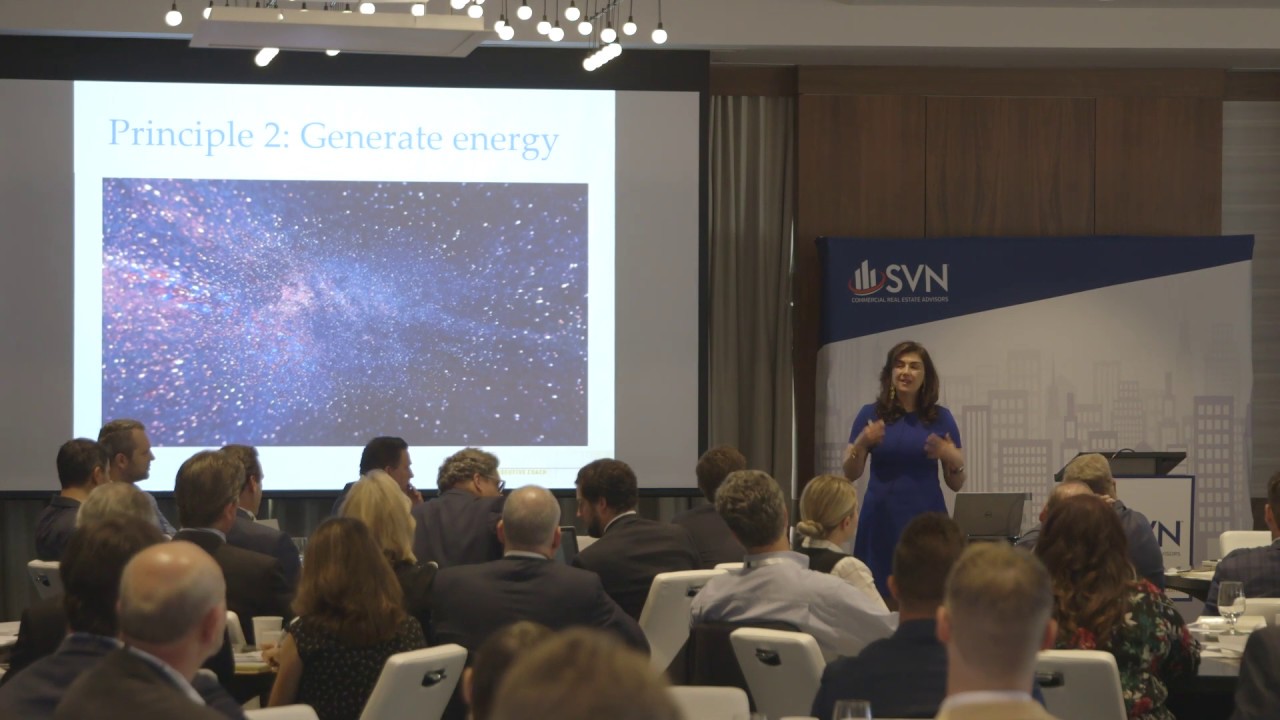
Executive coach Alisa Cohn shares nine leadership principles: Excellence, Energy, Clarity, Feedback, Accountability, Coaching, Time Management, Systems, and the X-Factor. She uses stories from Alan Mulally's Ford turnaround and others, plus practical tools like 360-feedback and daily stand-ups, to show how leaders can improve performance and care for their people.
Chapters
It's fantastic to be here with you guys today. I've heard so many great things about you. And I want to start with an inquiry. I want to start with an inquiry. Think about before you did this, think about the best boss you ever had, the best leader, the best manager, the best boss. Get them, summon them right up in your head right now. Think about their names. Now, what attributes, think about the attributes they brought to make you their, to make them your best boss. Can someone shout out a few attributes? Friendly. Friendly. They listened. They listened. What else? Integrity. Integrity. Owed me money. So they cared about you, that's why. That's great. Think about that. Now, I'm gonna ask you a different question. Think about the worst boss you ever had. Think about somebody who was just really not a great boss. Get them in your head. And now what were the attributes of that boss, of that leader? Schizophrenic. Schizophrenic, inconsistent, self-centered.
Stupid.
Stupid, yep. What, judgmental? I heard critical over here.
Aggressive.
Aggressive. Would anyone say micromanager? Maybe, yeah. So, um, that is just called life, right? We have good bosses and bad bosses, and everybody in this room one way or the other is a leader and a manager of their own life. Their business. And so I just want to say that part of my goal and my intention for today is to help you be on that first list and make sure that you're not on that second list. So thinking about that, I'm going to kind of ask you to take in these principles for today. So just a little bit, little sense of my background. I am an executive coach and a speaker, and I have a confession to make. I am obsessed with the topic of leadership. It really matters to me, and it's mattered to me for a long time. In fact, I've been studying leadership informally and then formally since I was 12 years old. 12 years old. Because my parents put me into this youth group when I was just 12 years old. I was in this youth group, and they said about this youth group that we were peer-led. So I didn't know what that meant because I was just 12 years old. But we were an intellectual youth group and not like a go-to-the-movies youth group. We were like a sit-around-and-have-discussions youth group. And I found myself facilitating sessions for my peers, who were 12-year-olds and 13-year-olds and 14-year-olds, when I was 12 years old. And because we were peer-led and because we were sort of self-organizing, I began to notice that there were some kids that got followed, right? That they were leaders and everybody followed them. And everybody thought they were great. And then there were some kids who weren't great leaders and that didn't get any followers and they had to kind of like constantly be bossing people around and insisting on people and they were not effective leaders. And I really began to observe what makes somebody a great leader even at that age. Why do they naturally build followership behind them and why do some people not get that? And I was kind of a shy kid and I was really interested in being the person that somebody followed. So now fast forward to my first job out of college, and I had this fantastic boss, Beth Shaughnessy. She was this great boss, and she gave me all this feedback. You're doing great. Good idea, good project, well done. She would give me all this great feedback. And then one day she pulled me aside and said, you know, Alisa, you're very analytical. You're doing a good job. And what I'm— what I notice is that you are doing great at problem identifying. That you're great at identifying problems. I'm going to ask you to think about, if you want to take this on, could you be better at solving problems? And I thought, oh, that sounds like a really good idea. And that was the first time I ever got coaching from a boss in a company. And it was a great experience, and I did really well, and then I got promoted. And then I ended up with my worst boss I ever had. And she was micromanaging and controlling and inconsistent. And kind of a yeller, and I, who was really actually a high performer and doing very well at this company, within 4 months I left that company. So I have a newsflash to tell you. Leadership matters. And leadership matters to you guys right here in this room in terms of the way you hold yourselves, and also in terms of the way your people relate to you, and certainly in terms of the results of your business. So, I say that and we're gonna talk today about the timeless leadership principles because I know for sure that you go through ups and downs in your business cycle. All the entrepreneurs that I work with, all the founders, all the CEOs, I work with a family real estate company, I work with actually some large companies as well, all of them go through the same thing that you do, ups and downs in your business cycle. Now, when things are good, these will stand you in good stead and help you continue rallying the troops and then growing as a business. When things are bad, these are gonna help you think about how do you pull people together and raise the standards as much as possible even during the bad times. So they're timeless in that way. Also, they cross industries, right? They are relevant for your business, for all professional services businesses, for manufacturing businesses, because they're about leadership. And the last thing I wanna say is that, um, they are really helping you also to future-proof your business. So Kevin earlier talked about the trends that are going on right now in technology. There's also major trends in the workforce around generational differences. There's also— what's coming for us in the future is all sorts of what we call disruption. And there's also a whole experience of how people want to do business today. So I tell you all that because we all know this already and we all talk about it, but preparing for that is really about preparing yourself for leadership and preparing yourself to be better— better at the end of the year than you were today. And so especially because we're really at the beginning of a quarter, I would really invite you to take one or two of these principles and make this be your challenge and your own goal for the year between now and the end of the year to help you make the most of this experience and help you think about how you can up your game as a leader. We're gonna review a lot of different things, And the most important thing is for you to think about what does this make you realize that you want to do to up your own game in the context of leadership. And then we'll have a workshop after to help you stick that and then talk with the folks around you. Sound good? That sounds great.
Great.
OK, fantastic. Great. This is a picture of Thomas Watson. And he was the CEO of IBM who really brought IBM from a sleepy little computer company into the large behemoth that it is today. And somebody once asked Thomas Watson, how long does it take to be excellent? And he said, it's a second. It's a decision that you make. And I really love that, because it really just goes to show you, and it really helps us infuse ourselves with a sense that it starts with your own mindset, that excellence is a mindset that you can take with you at any moment And you can make that decision any moment in terms of deciding what you want to be and how you want to show up. So I have to tell you this. As the leaders and managers in your offices, everyone is watching you. You set the standard. So when you're having a bad day, they are noticing that you're having a bad day. Now, when you're inconsistent, they're noticing that you're inconsistent. Now, at the same time, when you're really showing up in terms of the way you treat people, the way you treat your employees, the way you talk about customers and clients, the way you treat clients, all those things, the way you manage your time, that sets the standard for the folks around you. So when I think about excellence, I really think about the conversation I had with Eric Schurenberg. He is the CEO of Fast Company and Inc. magazine. If there is an industry that is undergoing disruption today, that is the magazine industry. There is no question about that. But Eric's been able to build that business and get better results than ever before, even in light of that disruption. So I asked him, how does he do it? And he says, I absolutely think about excellence, about how do I show up at work every day and I'm able to inspire and really care for the people in my organization. Because these days, there's no way that my business can survive with the sort of used-to-be top-down management. It has to be that I bring all the people together and get their creative insights, and their innovation and their discretionary effort. And I think a lot about the people who gave me breaks in my life and I want to be able to help steward other people in their careers. So for him, excellence has to do with two things. It has to do with how he shows up and conducts himself as a CEO of those organizations and about stewarding young people in their careers. That's what he's really focused on. So, I guess I would say that when I break down his points, he starts with being intentional. And I would invite all of you to think about that. I want you to think about how do you really begin your day and focus in the middle of your day about being intentional around your excellence? And what does that look like for you? And then purpose. Again, these days, with all the diversification around us and everything is diffuse, the muck and mire of day to day and the busyness of day to day, What you need to focus in on all the time is what is your purpose. So I talked to a few people earlier, and some of the folks here were saying, my purpose is not always in profitability. My purpose has to do with building a culture and a family that we can all appreciate and love. And I think that's beautiful. Some people might say, I've grown up in this business, and I love this business, and my purpose is just like being great and awesome at this business. Some of them would say, It matters to me to leave a legacy. Some people might say, I care about giving my family and, and taking care of my family in a way that is meaningful to them. All of those are fantastic, and really honing in and doing the hard work on reflecting on your purpose is gonna help you center yourself in excellence day to day. And the last thing I wanna say just around the top— on this topic in terms of the inside and the outside, caring for your people is no longer optional, right? Back in the day, maybe it used to be, oh, the command-and-control leadership would work and just like do it and like forcing kind of compliance. These days, and increasingly so, caring for your people is a business imperative and thinking about their why. So you want to think about your why and their why. You know, it's very hard to motivate people, especially across generations in your workplace, So the way it starts is by caring for people, discerning and figuring out what are their aspirations and helping them meet their aspirations, helping them make their own— achieve their own goals and make their own aspirations. So as I sort of share these things, again, we're going to have a workshop after, be thinking about what resonates for you and be thinking about where you think, hey, I'm already doing this, that's great. And I would say that is fantastic. There's a lot of talent in this room and I know that you are already thinking about some of these things. But where are some of the leakages? And where are some of the things where you know that you need to double down on? And be writing those kinds of things down so that you can talk about them at the workshop. So really, again, what I care about is leadership at all aspects. And I was talking earlier with somebody who said, you know, we're always leaders. What I said was, I think we're leaders in our own lives as well. The first person you lead every day is yourself. So a few ideas for you are to know what leadership looks like for you. Know what excellence looks like for you. Because for everybody, it's going to have a different shape and form. And it can be a little confusing. And if you haven't discerned it for yourself, it's worth the time to really put that together for yourself. And picture this. If somebody were coming in and making a reality show movie, like a reality show TV show of your business next week, how would you show up as excellent? How would you make sure— what would that person who plays the role of you, you, what would you be doing, saying, treating other people, dressing like? All those things really matter in terms of your thinking about what it looks like. And the last thing I want to say about this in terms of personal mastery, who's heard of the term personal mastery? Has anyone heard it? Yeah, a few people. So personal mastery to me is a passion of mine. It's about how do you create for yourself the tips and the tools and the things that you do every day to make you a master of yourself. And one very solid tool of personal mastery is the notion of a morning routine. So 85% of Olympic athletes who are, like, you have to say, masters, they have some sort of morning routine. That includes something that specifically primes them for the day. It might be meditation. It might be a gratitude journal. It might be quality time with your family. Do you have a morning routine? You do. Excellent. Very good. It might be quality time with your family, not like rushed freakout time with your family, but really sort of intentional time with people you love. It could be inspirational videos. Certainly, it could be working out. Anything that gets you at your best in the morning, I encourage you to think about what that would look like for you because it really helps you show up every day for game day like dressed, like ready to play. So I give you that, and I would ask you to think about how you can really show up as excellent every day. Now, leaders— the second principle is about energy. And I would say leaders generate energy. And they radiate positivity. So a story I have of that is that I was called into— this woman, her name is Linda, and she was the head of an accounting firm in New York. And she said to me, I'd love you to coach me because I just feel like there's something not quite right between me and the team. And she said, you know, our business is good, but it's not great. And I know it could be better, and I'm just confused. I said, OK, great. So I came into her environment. And I did what's called 360 feedback. Has anyone heard of 360 feedback? Yeah. It's where I talk with folks all around her. And then I also observed her. I observed her with clients. I observed her with her board. I observed her with her people. And it was really interesting. With her clients, Linda was on. She was conviction. She was committed. She was enthusiastic. She was terrific. And with other people, the same thing as well. With her employees, she was pretty subdued. She was reserved, she was subdued, kind of low energy, and she spent a lot of time in her office, doing her thing in her office. Her people only saw her when there was a problem. So you can imagine what this did was it made people feel like, this is not so fun to be here and I'm going to leave as soon as possible. And you can imagine discretionary effort was not a big theme from that office. So as soon as she heard this, she had to really reflect on it, like, what's going on? She said, you know, I feel like when I'm in the office, I feel like I'm sort of at home. I can just relax. I can just sort of be myself. And as an introvert, as an introvert, I recharge my batteries by myself. I can understand that. But if we think about what her role is as a leader, it's to be the leader of that team. So she said, I totally get it. So immediately she changed her attack and her plan. And she did become much more focused on the people in the office, much more present and available. And then she thought, it's not just about my personality, it's about how we orient ourselves today. She instituted daily stand-ups, so people got together every day and planned their day. And then dispersed. She instituted 2-week sprints where everyone was driving towards a certain goal and got to achieve the goal. And she instituted a thing called Friday are for wins, where you could celebrate your successes together as a team. Well, you can imagine office morale went up. And oh, by the way, client satisfaction scores went way up, and so did overall revenue of the business because her people were more engaged because of her ability to generate more energy. By the way, it's not the end of the story. She began to notice that there were people in her office that she herself would work around, that she herself didn't want to talk to because they were toxic or they were sort of difficult. And she just realized this is not sustainable. If I don't want to talk to them, I can only imagine people around me don't want to talk to them. So she didn't like move everybody out like everybody, you're fired, but she began to set an expectation in the office about a certain way of being, a certain way of collaborating, a certain way of just being sort of an up personality. And over time, people changed or they did move out. And they began to hire people with this attitude and this kind of camaraderie and energy. And they began to root out other places which suck away energy from the organization because energy is valuable. Energy is a precious resource. And as a leader, it's critical for you to think about How am I mirroring and sort of showcasing the energy I bring to the table and positivity? Not like a Pollyanna, not like, I think I can, I think I can, right? I'm good enough, I'm smart enough, and gosh darn it, people like me. Not that kind of positivity. The positivity where you know that problems are inevitable, they're part of the game, and you look forward to figuring out how can you help people solve their problems. With no drama, no— not getting pulled into interpersonal conflict and not this sort of constant frustration, but a sense of looking at problems as opportunities to be solved. More on that in a bit. Part of energy is clarity. Leaders— one of the most important things that leaders do, certainly in an office like yours, is to create clarity because clarity creates energy, and lack of clarity is very unmotivating and not energizing for people. So, of course, this is in part about goals, but it's also about some basic communication. Very often, the experience I have with my CEO founders, other entrepreneurs I work with, and really anybody in a leadership position— and you wanna think about this for yourself too— you have a lot of context. Right, you know what's going on, which is fantastic, you should know what's going on. But how often do all of us forget to tell the people around us what's going on? That a new system is gonna be rolled out, that there's a major situation going on with a client, um, that anybody in the office is sort of, something's going on over here and that it needs to get transferred over here. So just thinking about communication and what your process is for communicating So everybody understands what's going on. What I find is that when I talk to leaders and their people, the leaders say, oh, everyone knows what's going on. I talk to the people, and half the time they are confused on a regular basis about what is the big picture and what's sort of some of the coordinating topics in the office. So kind of think about that. Now, at the same time, it is about goals. Let's face it, right? Clarity is definitely— it lives in the family of goals. And so I'll give you an example where this really took root for me, was really clear for me. I coach within this large real estate firm in New York. And specifically, I was coaching the new leader of the leasing division. So the leasing division, for various reasons, had collapsed. And so he was coming in to right the ship. And what he said to me was, within the first couple of weeks, Alisa, the people have no goals. They have no goals. And that's like crazy in your business. I was thinking, what's going on? They have no goals? He said, the group was so demoralized that they stopped doing goals and they stopped doing any kind of weekly meetings. So they didn't have any sense of what to shoot for. And they felt like everything was about blame. And so they would just stop that process. Well, of course, he reinstituted goals. Specifically around goals around process. You may not be able to hit your outcome goals because that's the business that we're in right now, but I want you to think about what are the things you have to do every week that are going to help you get this business on track, and how are we going to together to really work together on sharing best practices and meeting weekly to share what we've done and celebrate success and give each other help that was the key, help to be able to achieve the goals if we cannot achieve them. So it's really about clarifying what does he want you to do every week? What does he— what do they actually want you to do? And I would invite you to think about what are areas where there are some places where people may not be fully understanding what they're supposed to be doing on a weekly or monthly basis and thinking about that in terms of helping them understand and clarify the goals they had— the goals they have. Now, the last thing I want to say about clarity is that people don't think of it this way, but if you think about what needs to happen in the organization overall, what's a great tool for you is to learn to be a master storyteller.
Right?
You don't think of— so stories aren't that important, or I'm not like a— I'm not a Tony Robbins type, I don't have to tell stories. I would invite you to realize that we all recognize the world, we all think about the world in narrative and that stories are a very compelling way for you to explain to them what's the big picture here. Why did I maybe start this business in the first place or why did I want to take over this business in the first place? That is a very useful thing for people to hear and really connect to about what our mission is and our purpose is today. What are we in this for? People are doing, like, their work, and it can be very siloed and very difficult. Think about a great client win that you want to share with people and tell stories about that. And tell stories about your experiences, you know, doing the things that they're doing right now. That helps them have a clarity and understanding of things that you've gone through and also the bigger picture and kind of the— not just like their day-to-day grind. So I invite you to think about, how could I improve my own storytelling skills to create more clarity? So one tool of clarity that is really important that we don't think about as a tool of clarity is feedback. So feedback, feedback, feedback. Everybody talks about wanting to get more feedback. In fact, there is a Gallup poll that just came out that said 87% of people in the workplace wish they got a lot more feedback. Not a little more feedback, a lot more feedback. 87%. Now I want to say this is not 87% of millennials, you know, the millennials. No, 87% of people in the workplace want to get more feedback. So I'm saying to myself, how, you know, how can that be? And I remember that one time I was brought in to do a leadership— sorry, a career development program for a large tech firm. And so I was working within one division of this tech firm. It had about 250 people. So over a 3-week period, I did a lot of sessions of this career development program. I did one session for the individual contributors, for the employees, and one session for the managers. And now with career development, one essential item of career development is feedback. You can imagine, right? How do I know where I'm going and how I'm gonna get there if you don't give me feedback? Makes sense. So I did— I worked with the individual contributors, and they all said, "We don't get any feedback. They don't give us any feedback. I don't get any feedback. We don't get any feedback." Okay, interesting. I went to the managers and did the session with the managers, and they all said, And they said, we're desperate to give them feedback. We're trying to give them feedback. They hate when we give them feedback. So I thought that was very interesting. You can imagine. And I'm thinking, what's going on? And I think what the issue is this. Managers, the people are squeamish about giving feedback. They don't practice very often. So then when they do it, mm, doesn't always go very well. So then there's a natural tendency for the person you're giving feedback to— this is natural, expect this— to get a little bit defensive or a little bit armored or a little bit uncomfortable when you're giving them feedback. So what do managers do? They stop, right? Like, oh, that doesn't look— that didn't go very well. And they don't practice giving feedback. And then I would add that one time a CEO said to me, I just don't feel like I should be telling adults what to do. You could imagine that has a whole bunch of implications for him and his office. However, you want to think about how are you collaborating with people to give them feedback and building your own tools in feedback. Now, there's a lot of feedback myths. So there are so many feedback myths that Forbes asked me to write an article about this one particular— the feedback sandwich. Has anyone heard of the feedback sandwich? Has any— yeah, okay. So that's when you— the feedback sandwich is when You try to butter somebody up, and then you tell them what you actually want to tell them, and then you try to make them feel better. So, like, "Good job ordering lunch for the whole team last week." "Your work has been disorganized and sloppy for 3 months." "Um, nice shirt." Right? So, like, it's not a very great tool, and in particular, it's not a great tool because it's always manipulative. It's always manipulative. It's always disingenuous. And you're training people to wait for the other shoe to drop. Not recommended. Not what you want to do. So why has the feedback sandwich— why do people even talk about it? Why did it become a thing? It became a thing because it actually has two things that you do want to take away that it's trying to do. Number one, it's trying to have you make them feel better. Smooth out the message and be tactful about the message that you're trying to give. And when you give people feedback, it's actually really important to have them hear it, to be able to, um, to be able to have— to be able to be diplomatic in the way that you say it so that they can actually hear it. So being diplomatic and sort of sharing with them that you care about them are the two elements that really make a difference with feedback. So again, it's about being diplomatic, although being clear, and then also signaling to them and giving them "I care about you" message. I'm wasting my breath giving you feedback because I care about you and your career. So those are the things you want to think about when you're giving feedback. I know that this is— actually, a number of people here in this room and folks I spoke to a little bit before this session, They said, we love this culture because it's so collaborative. Some folks said, we came from other firms, and that was not a great place to be. It was like, you know, difficult and in some ways abusive. And we love it here because this is not that kind of a place. There's a culture here of a family and a culture here of closeness and wanting to be together. That's fantastic. And I think that the other side of that is that people haven't learned here to 100% to give feedback to folks to help them do their jobs better. And so sometimes behaviors, I think, slide because we're kind of squeamish about how to tell them. So I want to really invite you to realize that, first of all, you can explain to the feedback receivers, the one you're giving feedback to, that this is a gift for them, and to ask them and challenge them to be masters at receiving feedback, at receiving feedback. And then also practice, practice, practice yourself. Give feedback on a regular basis so that you can get more practiced at it, and also so you're not saving it all up until the end of the year or sort of saving it to the sort of midpoint. And then I would add that when you go first and when you showcase that I myself am open to feedback, I myself am learning and growing. I would like your suggestions to help me be better. You're really setting the example for the team about how to accept feedback for others and then also creating a culture of giving feedback to each other. So I really want to invite you to do that because there's a way, 100%, that you can give feedback which is direct and also diplomatic. And that's what you want to be thinking about. And if you get that, you'll get this kind of success. This was literally an email a client sent me on Friday, on Friday. And he said we had talked about the feedback he was gonna give somebody. He gave her the feedback, and she thanked him 2 times for the constructive conversation. Because back to my original point, 87% of people in your work environments wish they had more feedback in order to be developed. So the second thing that I— just on this topic of helping people do better, is I talked with some folks before this session about accountability. And accountability is a whole issue and a whole sort of difficult topic. So one time I met a woman, and she had written a book. And the book was called "How to Have a Lifelong Love Affair with Your Spouse." That's pretty exciting. So I said, oh, tell— OK, give me the secret. How do you have a lifelong love affair with your spouse? And she said, there's one secret. Marry somebody with whom you can have a lifelong love affair, right? I thought, well, that's great because that's just like business. How do you hold someone accountable? Hire people who are accountable and let them go do their thing, right? So actually, I think that people get upset about accountability because they focus on it on the back end. They focus on the back end. And so they don't think about who am I hiring to make them accountable? And also at the end of some process, they're thinking about how do I hold them accountable when it didn't go well. Well, that's why I think accountability lands for people like criticism and like blame and like this nasty conversation. And also, and I know in your environment, there's definitely some people that you cannot fire, quote unquote, without— whatever that even means, right? You work with a lot of independent contractors. You're reliant on them. To do their work. And so how do you hold someone accountable? And so I would definitely get you to think about setting it up, setting up contexts and processes so they're clear in advance. And think about accountability as ownership. Think about it as ownership in terms of who owns the situation and help them think through in advance what might go wrong, what process they're going to use, and what— what some of the pitfalls along the way are going to be. So just sort of setting up a context for accountability is already very helpful. Definitely hiring people who are super accountable is very helpful. And then I have to say that I live in the real world, so I do know that you're going to ultimately have to have accountability conversations with people. So step 1, and always and forever, emotional self-control for all of us. I know it's an intense environment. I know it can be frustrating if people don't follow through on what they said they were going to do. I know it can be aggravating. So when— how are you getting better and better and better at your own personal mastery of being able to handle, you know, the different slings and arrows and the frustration and having your emotional self-control so that when you talk to somebody, it does not come out like anger? Not to make you a better person, but because anger and frustration directed at somebody never works. So, first of all, having emotional self-control and planning out the discussion to think about, again, how can you be direct and also diplomatic? How can you be calm and also clear? Those are the arenas. And then also what I think people forget to do often, because I'll have a discussion with somebody and I'll say, so did you have the conversation? And they say, yeah, I had the conversation. OK, great. And so what they say, oh, they're felt bad. Yeah, people feel bad, right? Like, oh yeah, I didn't do my thing, I feel bad. Great. What's the next step? What is this person now going to do? And they say, oh, I don't— we forgot. I didn't remember. I didn't get that far in terms of what is the specific next step and who is going to do what by when. So I invite you to think about that on a regular basis because that's going to help you with your accountability conversations. OK, where are we? Coaching the right people. So for everybody, all of you have— what you have in your offices, you have a number of people. And some people take more attention, some people take less attention. I've talked to some people here and they're talking about how do you build up your team and how do you balance your time. Because some people— because I know that your own work is hugely profitable for you. So you've got to think about your own leadership list. Who are your most critical people, and what are the most critical roles? And what are you doing in a planful, intentional way to coach the right people to either be more strong leaders or lead teams in your office? Or to produce more in a way? And what's your coaching plan for them? When you think in advance what your coaching plan is for everybody and kind of where you see them fitting both today and next year and 3 years from now, you'll have a better structure and understanding of how to use your time to coach them better because your time is precious. So speaking of time, who knows what 168 is? Hours in a week. Hours in a week. I guarantee you everybody in this room has exactly 168 hours in the week. Everybody. No one has figured out how to get more time. Not the politicians, not the celebrities, and not even Elon Musk. Okay? 168 hours is all you get. Now, people don't act that way because most calendars that I see look like that. Super cluttered, and I would just say, show me your calendar and I will show you what's important to you. So thinking about how you use your time— and I would invite all of you to do an analysis on your time. And how much time do you spend every day leading and managing versus doing your deep work and your strategic work versus doing your administrative tasks and also your administrative tasks? So I know that everybody here, all of us, are at the mercy of things which are reactive. And you have to also think about how do you block out your time in a way that helps you be the most productive that you can be. So there's two tools on time management. And if you just do these, I promise you, you will completely up your game on time management. The first is prioritize your must-wins every day, every week, every month. By the way, if you don't know what those are, I completely sympathize with you. I sometimes don't either. My clients sometimes don't either. But it's worth it to ask yourself, what are my must-wins? And do the hard work of knowing what drives my business and what's my must-win. And then do action on that in the morning because that's going to help fuel you for the rest of the day. And then you must, must, must, must block your time so that you're doing strategic work and people work and reactive work and administrative work and making sure that you take the— you really schedule all that in your calendar. Otherwise, I promise you this, life is just going to happen to you. And when life happens to you and you don't have a plan, that's when everyone gets off-kilter. And by the way, this is a good tool for you and it's an even better tool for your people. I've never, never met anybody who could not use more intentionality around time management, especially these days of more and more technology and more and more disruptions. So all of this together, it's not just one thing. It's not like, oh, I'm gonna do this one time or this one time. All of this together creates a system. This is Alan Mulally. He was the former Ford CEO, and he was brought in to turn around an ailing company, to to say the least, right? Remember when our car— our car business was kind of down in the dumps. He saved Ford from bankruptcy and he brought the share price of Ford from $1 to $16. Not a bad day's work, right? And I spent a lot of time with Alan because he's part of this sort of group I'm part of. And he would say, it was very simple. I had a system. In his case, it was called the business Plan Review System, and he made sure that all the tools, all the projects that they had going on were color-coded. Green was on track, yellow was off track but with a plan to get on track, and red was ridiculously off track with no plan to get back on track. And so he brought his leadership team every week, every Monday, every Monday for 8 years when he was the CEO called the Ford, the global leadership team, and reviewed where they were on all the key projects. They didn't talk about them there. They just discussed how they were gonna get back on track, and then what Alan said was, "If there was a problem, I'd hear about it in another week because we met every Monday." That was part of his system. By the way, he has a system also. He raised 5 kids. His system at home when he was raising these kids was every Sunday they'd have a family meeting. He'd go around— all the kids would go around the house, pick up their stuff, put it back in their room. Then the whole family would fold laundry together and match socks for 7 people. Then they would look at their schedules for the week and figure out who needs permission slip and who needs a carpool. And then they would agree that anything affecting the whole family, they would talk about it. And then, and only then, after the entire meeting was over, he'd give his kids their allowance. So that's how he was able to get commitment and buy-in to that meeting, right? So I give that to you for free. Feel free to try that at home. Let me know how that goes. So the last, um, oh, I'll talk about this. Being intentional in your rhythm is a key driver of having a system. And again, Getting your people involved in the rhythm, what's going on weekly and daily and what's going on quarterly and annually and how are you calibrating to see if it worked or not. So the last principle is the X factor. Great leaders are distinctive. Great leaders have something above and beyond just their personhood and they're known for something. So we asked them— I'm sure that you noticed that we asked some folks to sort of weigh in on what are the 3 words that you think about when they think about you. And I think some of you got some of that feedback, and some of you may want to go back and get that from your folks too. Because it's not feedback per se, it's specifically how are you showing up for them as a leader? What are the first 3 words that come to mind when they think about you as a leader? So that's interesting. And you might want to think about, What would you want them to say? And how are you distinctive? Because great leaders are distinctive in some way. So, good, good timing. It's about quarter of the hour and I'm gonna take a couple of questions if we have any. And then what I'm gonna invite you to do is to definitely think about what are the arenas specifically that you wanna take forward for yourself and whether they're from this or sort of an outgrowth of this list, what do you specifically want to take forward? And we're going to do a little mini-workshop after this to help you both make your own plan and talk with your peers together. So I will say for the moment, get in touch with me. I'd love to hear success stories. Thank you for your time. And are there any questions? —metrics are so interrupted and everyone else is interrupted. Yes. Metrics, a lot of these fall by the wayside. You can have a blowup week, good or bad. Yeah. So the— what's your name? Doug. Doug Wilson. Doug. Doug was saying the biggest problem is metrics. And that is so true because things go up and down and things change. I would invite you to think about metrics and goals both in terms of outcome, like what you're trying to get, like this— this revenue for this period or this number of deals. And then also process, because the outcomes that you get are a result of the process that you do. And the process that you do day in and day out and day in and day out, if you figure out that it works, it will work all the time. Now, of course, you'll change it now and again. But thinking about metrics from the point of view of process can be very powerful. Good. Other questions?
Yeah. Do you ever coach or teach to the player-coach role? That's what I struggle with. I think we're all a lot of smaller offices here, so I think you have a lot of player coaches. Yeah. This is great if I were a CEO and I feel like I could implement it, but probably 50% of my time or more is spent being a player.
Yes. Yes, it's a struggle. He's talking about the distinction between player coach, and I know a lot of you, if not all of you, have that feeling. I've got to produce and my time is best used producing, and I've got to manage this office 100%. Yes, many of my clients, if not most of my clients, struggle with that too. By the way, startup CEOs are exactly player coaches, always and forever, because they don't have enough team around them, and also because there's things that only they can do. So the answer is not easy, like, here's the answer. The answer is to get clear with yourself about how you're going to handle that and how much time you think is going to work in your business, about the distinction— about the percentage that you're going to spend being a player and percentage you're going to spend being a coach. And then build that into your calendar, and then recognize and be disciplined about using those times. Because even the times that you're being a player, it's not like, oh, on Monday at 9 o'clock, I'm a player and not a coach, so you can't talk to me, right? But at 3 o'clock you can. It's not like that, right? But just recognize that the percentage of your time that you're going to be spending being a player versus being a coach should be baked into your regular calendar. Build up other coaches around you, right? Other sort of other people who might be leaders and can help the junior people and leverage them and also figure out what your strategy is. Earlier I was saying to somebody, they said, I make more money when I produce and less money when I lead. I'm like, okay, maybe you shouldn't have any employees. Like, okay, you tell me. So you've got— and that's not the right answer, right? But you've got to think about what's the right answer for us because there's a utility and a value to your also being a coach at the right time And then figuring out what that time distinction is for you, what that value is, that's where it matters. It's complicated. It doesn't just happen. Yeah, are there more questions? Yeah. So open-door policy. Yeah. Do you advise that you should have an open-door policy or should you close that door and get— Right. And carve out timeframes? Right, it's a good question. Normally it's— oh, so he's asking should I have an open-door policy, people can kind of come in and see me anytime? I think that's what you mean by open-door policy, right? Or should I carve out time frames? So as a coach, I normally say, what do you think, right? But I'm not going to do that to you because actually the answer is clear. You cannot be interrupted all day long. I'm sorry, but you can't be. And so you must have specific times that people can come and see you. And also, you should have specific times where you wander around your office and be available. To them. It's both this notion of office hours and also I'm wandering around and checking in with people and seeing how people are doing. If they have a question, they can ask me. And also I'm doing my work now. Because you will never be able to do deep work and get that work done if you're constantly interrupted. Also, it's helpful to train them to not have you available every minute. Is there somebody else they can go to? Can they solve Can they solve their own problem? Can they put this aside and move on to something else and learn how to sort of do their own time blocking? That's a great thing that they themselves need to learn. And if there's an emergency or the building's on fire, they should probably come and get you. Right? Yeah. OK. Other questions? Or should we go for a break? Let's do a break. And then I'm going to have you come back and be thinking about— be thinking about what is one or two things that I know that I need to improve on. I'm gonna ask you to do a little writing on that and then a group discussion with your table teams and I'll come around and help you and then we're gonna declare victory. I think we'll do a group hug. Maybe. We'll talk about the group hug, okay? And then we'll— we'll go to lunch, okay? Good, thank you.
More from Alisa

128: Ken Davenport Produces Broadway Hits. Here's the Startup Playbook Behind Them


The Library of Minds Podcast | Top Startup Coach: The New Hiring Rule for the AI Era | Alisa Cohn


124: Alex Lieberman Built Morning Brew to $75M. But That Was Just the Start [ENCORE]

123: GiaNina Paolantonio Has Millions of Followers. Here’s the Business Behind Them

122: The Kettle & Fire Founder Is Fixing How America Pays for Health | Justin Mares, Co-Founder a...

121: Founder Mode on Bitcoin: Double the Volatility, Double the Stakes | Will Reeves, Co-Founder ...

120: Miro's Founder on Reinventing a 100-Million-User Company | Andrey Khusid, Founder of Miro

119: Eric Ries, Author of The Lean Startup, The Corporate Governance Crisis No One Wants to Admit

118: Josh Reeves, Co-Founder and CEO of Gusto, The 3-Part Alignment Framework Every Founder Needs...