GRACE under pressure: John Baldoni with Alisa Cohn
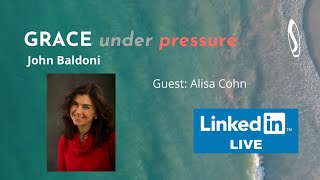
Executive coach Alisa Cohn talks with John Baldoni about leading through COVID-19. She breaks down how founders should balance employee health, customer health, and business survival, and shares concrete tactics: informal chat channels to stay connected, agenda-free check-ins, virtual off-sites with mailed items to people's homes.
Chapters
Foreign.
Welcome to another episode of Grace under Pressure where my prep. My guest today is Alyssa Khan, who I've known for many years now and it's a pleasure to have her. I'll tell you all about her in just a moment. Those of you who know the show know that Grace focus is on the soft stuff, you know, the caring, the connecting, the commitment we sometimes overlook. And grace for me is the generosity we show one another, the respect we give, the compassion we demonstrate. And doing that as a leader. And Alyssa works with lots of leaders, especially in these challenging times requires the ability to act for others and energize everyone. So welcome to the show, Alyssa. It's such a pleasure to have you.
It is so great to be here, John. Thank you for having me.
So I am going to tell folks a little bit about you. Alyssa is an executive coach who works with senior executives and high potential leaders and to help them come to greater grips with themselves and re understand their leadership potential and how they bring people together. Alyssa had a great honor last year. She was the number one folks, number one startup coach in the world. That's according to Thinkers50, which is pretty darn prestigious. So very good. And she was also honored by the Marshall Goldsmith Coaching Awards and she's a top 30 global guru for startups much deserved. Alyssa works for executive teams, not just leaders, and helps them have the, as she says, the right conversations to move to, the right actions to move forward faster and I'd say better. So Alyssa has lectured everywhere, at least when we could lecture at both Harvard and Cornell and the Naval War College. Very cool. And she is a member of Global, excuse me, The Marshall Goldsmith 100 and good thing. So welcome Alyssa. It's a pleasure to have you on the show today.
Thank you, John. My fellow global guru and my fellow Marshall Golds of 100 coach. It's so pleasure, such a pleasure to be here. Thank you. Thank you.
I always start out asking guests about the pressure that folks that they work with are feeling. What's your assessment? What are you, what are folks worried about right now?
Well, I work with a lot of startup founders, so I would say that the founders that I work with and the CEOs and executives I work with are certainly worried about our focused on the health of their employees, the health of their customers and the health of their business, in that order. And a lot of the founders and the leaders I've worked with have really been focusing on how do we make sure the employees are in a good place and with all the back and forth Lockdowns, sort of our structure to work. How do we also make sure that our customers see us as a resource and a value add in this period? And, and then of course, how do we run a sustainable business in the current environment? That's a lot of what we've been working on.
Right. And what's the startup climate like now? Is it, is it formidable or is it accessible? What's your perception?
Well, it's an interesting question. It sort of depends. I had a number of clients who were doing in person kind of activities and that was decimated. Right. There's nothing else to say. Hospitality. My clients in hospitality and in those kinds of service organizations, events organizations obviously had a real problem. Some have been able to move to virtual events. And then I would add that I have a number of clients who do specifically work with remote tooling or remote access in some ways. And they have been great. I mean, they've really been actually accelerating through this. I mean also the notion of communities, if you've been able to turn into an online community and make it work that way, that has also been doing well. Their, their investors have been in most cases very supportive and actually quite helpful. And I've had a number of clients who've been able to go out and get funding in this environment. So there's a lot of pluses or I should say the news is not as bad as you might read. Right on the, on what's going on right now.
That's great. It's heartening to hear that. When I ask you about what startups they're worried about their health of their people first. So when we talk about people issues and with startups and startup leaders, what areas, when you say people issues, what should they be focusing on?
Well, I mean right now, what should they be focusing on right now? You know, at the sort of very difficult end of the clients I've worked with, if they've had to lay off people or cut people's salaries, they want to do that with dignity and to use your word, grace and in a humane way with also being supportive is a massive startup ecosystem where they can help each other or they can help their employees find new jobs. I would also say that obviously moving remote for companies that were not a part of a remote culture, they need to think about how to build culture and cohesion with team members who are now remote, but also team members who have onboarded during this time, they've hired new people. How do they integrate them into the team? Many, many people are balancing challenges at home. Whether it's caring for somebody else at home or caring for children. We all know what's going on with schooling and sort of balancing that time and being clear about structure in their own lives so they can give their all to work but also be able to take care of the needs they need to at home. And then balancing all that with the need to run business. Those are the topics that the my clients have been working with.
Is that all?
Yeah, I know.
Toward that. Do, do you ever have discussions or do your entrepreneurs you work with talk about how do I stay connected with my people? How do I stay connected real way?
Yeah.
What kind of, what advice do you give them or what kind of conversations do you have?
Well, so conversations have been evolving since March. Right. So at first, like a lot of my clients, the executive team were having a daily standup meeting with each other to sort of stay connected. There was a lot of zoom, you know, video check in meetings with their employees to sort of see how people were doing. And then we quickly got overwhelmed with all the video calls. And it was like so many meetings, so much connection. And as things have stabilized, my insights are two insights. One is that you actually want to have a channel which is open for you to have informal check ins with your employees. So for example, one of my clients kind of has a bunch of chats open all the time. And there could just be this quick chat which is more casual and more like the water cooler running into you than like, let's schedule a zoom call. And then the other thing is that to recognize that people need to have the definitely open ended time. So it's not just about what's going on with the business and what's going on with sort of status. It's really letting people have an outlet to say how they're doing. And that sometimes takes a minute or two to warm up. And so really recognize that sometimes you want to have agenda free coffee meetings with your people. And to do that you can send them coffee and you can send them lunch. And getting things in the mail, getting physical objects in the mail has actually been very inspiring for me. People very like, you know, it brings up morale, actually.
Oh, that's wonderful. I haven't heard of anything, any such things such as that I, you know, someone. Something physical.
What a wonderful something physical. We did a virtual off site. One of my clients, I did a virtual off site. And the first thing is we did an entire morning with no PowerPoint. So we made a virtue of the screens, we shared videos, we did workspace collaboration, sort of using some collaboration tools. So we focus on the screens, but not on PowerPoint. And the second thing I wanted to ask them to do to make sure is that they sent people stuff in advance. So like a little wine and cheese the night before to have as your snack the next day. Like, you know, that's how we go to off site. So we can wear jeans and get snacks. Right. So you want to be able to replicate that at home.
That's great. I love that. Well, why don't we go to workshops to get snacks?
That's what we do, right?
I thought that was only me.
It's universal, just something else.
I like the idea that you use the word chat as a, as a kind of substitute water cooler, because there isn't a substitute. But do people, do they indulge in it in a way of fostering ideas? Like, hey, boss, think I was thinking about X. And the boss comes back and said, oh, X. How about adding.
Yeah, just, I don't think, I don't think chat is working for that. I mean, I think it's a very interesting question. Like if you think about chat, chat is the water cooler. How are you doing? I don't know how to do this. What should I do? Let me pull you in and give you a minute or two of feedback. Just a quick feedback bite. We're missing all that. So how do you replicate that? That's separate from what you're talking about is how do we really have creativity and brainstorming. So a number of my clients are finding ways to meet outdoors, you know, in a, in a safe way if they're still in the same location. They're also just finding ways to say we're going to do, we're going to have just a video call, like not all day necessarily, but like pretty much a good portion of the day. We won't necessarily be talking that whole time, but we're going to have it sort of open and available for each other. And if you want to have particular creative meetings, I think that people are also just sort of saying, we're using this time to brainstorm. We're using this time to replicate the in person experience of being together. And sometimes it's about mindset.
Yeah, just thought came up. Have you been physically present with any of your clients since.
Yes.
And how is that, how is that working out and what's your methodology for it?
So, okay, this is an important moment. Okay, thank you for asking. John, if I can share about this. Before the pandemic, I was with one of my Startup founders and we actually happened to. We live in the same neighborhood. So rather than meet in the office, we have to meet for coffee. And we're meeting for coffee and outcome these delicious looking bacon, egg and cheese sandwiches. So we're both like, it's like 10 o' clock in the morning. We both had breakfast. You know what, next time going to come here and get a bacon, egg and cheese. Well, the pandemic hit, okay. I said to him a few months ago, we never got that bacon, egg and cheese sandwich, right? Like what's going to happen? The world's falling apart and we're never going to have the BEC together. Like tragedy. So we met in person a week and a half ago and we sat on a bench to get, you know, actually, actually no, they had tables outside. So for a little while we sat on the bench and then we sat in the table far away from each other and we got the bec, which they delivered to us with gloved hands. And it was like something very special about reunions, right? And rituals. Rituals like this idea that like we had coffee together before the pandemic and we're gonna have that bec and now we're able to complete that and resolve that. It was sort of very lovely. And certainly in New York, where there's a lot of signs of life now in New York, it was like a sign of hope for the future.
That's a wonderful, wonderful story. So I'm thinking in my mind, I don't know, I've met physically once with a client since that time. Yeah, it is good. It is good to actually see somebody nice. Yeah, yeah, yeah.
We've also been have me and my friend whom you also know, Deray Clark. We have had a number. Well, we just started having. We just had one or maybe two outdoor networking dinners because we had constantly been convening people in New York and other places that we went to. We went to actually San Francisco. We convened folks in San Francisco, in the, in Silicon Valley. You know, that's kind of thing that Dory and I do together. And that's why, you know, networking is a passion of mine, as you know. And we had this outdoor dinner with six people. It was just beautiful. And again, it's a sense of like signs of hope and how can we adjust? The name of the game, John, as you know right now is agility and how do we adjust to current circumstances? And it's not about. It's really just about accepting and adjusting to the existing circumstances now.
And I'm glad you Mentioned that because adjusting because we really don't have a choice and so embrace it. And I love the way you wove the concept of. It's a sign of hope. So speaking of signs of hope, you have something very hopeful coming soon. It's called Learn to Love Networking. Tell us about it. Yes.
Oh, thank you. I was very productive with my pandemic period and I did a number of projects and one project I did was I recorded an audio course for Knowable. Knowable is an amazing new startup. They are focused on audio learning. They have a lot of great backers and contributors, including Alexis Ohanian, who obviously is the founder of Reddit and he created a course called Launch a Startup and now a number of creators are creating audio courses. So my course is called Learn to Love Networking and it's about networking and how to learn to love it. And the key point I think is that many people think networking is about what you can take. And I would just say to everybody that networking is about what can you give, what can you contribute, how can you add value, how can you brighten someone's day, how can you connect people? And I hope people will benefit from that thought. In the specific tools and techniques that I teach in Learn to Love Networking.
I love that concept. And it's something of course that we are, we, we seek to practice in MG100, you know, we, what can I, what can I do to help you? Those things. But then we're in this network. So if someone is kind of thinking about, geez, I need some more quote, contacts, I need to network, is there a self inventory or something they can say of hey, what can I give back? Does it work like that? Or what's your perception?
In part, I have a whole chapter on what do you have to offer, a whole lesson on what do you have to offer. People who are junior in their career might think, I don't have anything to offer, I don't have status, I don't have resources. But you junior people in your career, you have the ability to listen, to be positive, to inspire, to encourage. You also have knowledge and insight that they don't have. Maybe technology, maybe an experience of being new to the workforce today which is valuable to other people to understand. Maybe you can help one of their children navigate through college or through an, you know, through a younger experience that they don't have access to. Maybe you are in a place that they are moving to and you can tell them where to go to brunch.
Oh, you know what, thank you for sharing that because that is so simple. And I'm not being dismissive when I say simple, but it's something. The way you captured it as a young person, well, gosh, what do I have to offer? And then the way you delineated it makes it so accessible. I say a twist on that. And we all, you and I both know the work of Adrian Gustick and Elton in their book Gratitude, and I've talked to them about this. And one of the things about gratitude is self gratitude. And I think that a form of self gratitude is just what you said. Inventory those things or consider what you can do. And oh, I can do that. And I have something to offer. It's. Yes, that's a wonderful thing. So how can people find this show?
Oh, well, of course. Right. Thank you for asking. It's going to be up next week. Unknowable. FYI, you can search for learn to love networking. And if you go there now, you can join the, you can join the wait list for the course and be notified next week that it's when it's live.
Perfect. And if we go to your website, which is alyssacon.com will. Yeah, okay, good.
Yes, alyssacon.com. yep.
And you have some even more exciting news which is coming next year and that's From Startup to Grown Up. I love that title. So what is Grown up as a startup?
I know, right. So just to say the notion of From Startup to Grown up is about your growth, anybody's growth and journey as a leader. So this is certainly focused on how do you as a founder turn into a CEO from someone who's building a product, someone who's building a business. It's applicable for anybody who's got a transition from somebody who's doing the work to somebody who's orchestrating the work. And I would say From Startup to Grownup has to do with the notion that, yes, your company grows, your role grows, and as you grow in concert with that, in some ways you're growing, but the role is growing you or the startup is growing you. So they all integrate together and these forces act on you to, for all of us grow up. No matter what age you are, we all have to grow up.
I don't know if I've quite solved that yet, but thank you. I love how you express that because that is the leadership equation or certainly the management equation. We start as, quote, individual contributors and as we rise in our career and certainly building the business, a, you can't do it all, nor should you do it all. And if the business is Going to grow. You need to learn to delegate, which I think is. Is that difficult for entrepreneurs?
Oh, yeah, of course. Entrepreneurials are the ultimate control freaks. It's very difficult. Also, they don't always have the skills to delegate. And then I think what happens for many leaders and certainly for startup founders, is as they grow, they delegate without knowing that the person who delegating to can actually do it and so bad things happen.
Could you define that? What does it mean not to know how to delegate? Does that mean you take on too much? Or what's your. What do you mean by that?
So well, in terms of the skills of delegating or in terms of delegating so well, the skills that. Right. So like regularly, anybody who's delegating will kind of say, do this with no context, no understanding of how it fits into the big picture. No explanation, no sense. I had a client one time who delegated to a very fantastic employee, but a junior employee. Something very complicated about like doing a report and sort of an analysis on the competition. He said, please do analysis on the competition. She did the best she could and she did a fantastic job. But it wasn't what he had in mind because he hadn't told her what he had in mind. He assumed much more sophisticated experience and skills than she actually had. And then he was disappointed at the outcome, but he didn't. Why. He didn't really assess where she was in her learning journey and what she could handle. That happens over and over and over in all companies, but certainly in the startup world.
And I think that you mentioned a key word which in its context, not having the context is, then it's what am I doing?
Yeah, yeah. And also then they'll do it and sort of attack, like, do this with no context. Here you go. Do this. Okay, Here you go. You know, this, like that's like crazy making. Right? Because I'm not like biting off a part of a project and. And also I can't do the best job. So I don't know how this fits in. Like, why are you. Why are you having me do this? I don't understand the bigger picture. People understand the bigger picture. They can do a better job. They can also go above and beyond. Some of my clients will say my people aren't proactive. Okay. But like, are you explaining to them not just what they should do in this task, but how it fits into the bigger picture. So they can then feed into that and then think additionally what else they can do in that context.
Terrific. So this is going to Be exciting. So you're going to be working on that for the next year?
Yes.
And there's something else going on right now and it is our pandemic, of course. So you wrote a one, you are a wonderful writer and you express yourself very clearly and concisely and I love that about you. It makes you gifted in what you do. You wrote an article for Forbes to which you contribute something about. Don't let the pandemic derail your career by that. Because does that mean we should stay where we are or what were you getting at?
Well, really it's about. Think creatively about where we are right now. So, you know, all of us have to embrace what is actually so, right? The conditions that are actually so. And play the present. So play the present means deal with your conditions and take actions from here. So if you want to change if basically, if you were planning to have a traditional career path in, for example, the hotel industry, you know that's not going to happen right now. If you are right out of college or even right at a business school and you think that you're going to get a job in, you know, almost, let's even just say the airline industry, which is suffering right now, you have to step back and think about what can I do instead? So, for example, if you're, you know, right out of school and you had a job, maybe you got laid off, then maybe it's about putting together a portfolio of specific jobs to help experiment with a number of different things. Maybe you're in a job that wasn't quite, you know, like your, like your dream job. Okay, but you're not necessarily going to move right now. So are there skills you can get in those jobs? Can you find an opportunity to manage other people? Can you find an opportunity to train yourself in doing something very different? Maybe data analysis, maybe project management, that's going to help you build your skill set so that coming out of this pandemic, you're going to have more to add.
That's a great idea. You used a word and I haven't quite heard in this context, a portfolio of jobs mean by that? I'm familiar with the concept of portfolio for one's writing or artistic projects or whatever. What do you mean by it?
Well, a portfolio is a selection. It's a curated set of things. So what if you had three or four part time jobs? It would be a curated set of part time jobs or something you're doing for six months at a time. For example, someone's on maternity leave or you Know, parental leave, need someone to fill in an interesting role, or where you could learn a lot for two or three months. Great. You could do that. And then you could gain what there is to gain. Merit, by the way, the skills and the network. Right. That you could gain from that. Maybe you're also doing a volunteer position to build up your financial acumen or something at a nonprofit organization, and then you can take all those skills together and add them to something else. Maybe again, a part time situation or temporary situation. You don't have to find your dream job right now. You have to think about what am I doing in terms of building skills and network so that I have an asset that I am building inside of my portfolio.
That's a terrific idea. That's wonderful. And I like the way you said curate. But look what you need to do, Build it up and find a way to do it. And then find temporary positions that you can fill in. That's great.
Yeah, thanks.
You also wrote another article, which I love the title of Agility in the Time of Fragility. What the heck does that mean?
Look, it's about agility and about adjusting. And I would say to all leaders, your job fundamentally is to adjust your style to the moment. Right now we're in a fragile moment, we're in an uncertain moment, we're in an unusual moment. Right. Emotions are running high, people are acting in ways that you weren't expecting. How are you as a leader taking in the situation and adjusting your style? Agile quickly. And then also agile is really. There's many definitions of the word agile, but one thing about agile is it's used in programming.
Excuse me, we have lost. Oh, you're back.
Yeah. Did you miss my wise words about agile programming?
No. I need you. You are about to define a definition of agility. So what is that, please?
So agility is about quick adjustment, but agility is also found in agile programming. So agile programming is a way of programming where you don't plan the whole thing out all the way to the end. You do small milestone bites. So it's about experimenting and seeing what happens. Experimenting and seeing what happens. Experimenting and seeing what happens and debriefing as you go. They call retrospectives, retros. That they do. And I think that's a very powerful way to think about this time. You can experiment with different routines that you want to build. You can experiment with different styles and approaches in your leadership. You can recognize this person needs something specific from you. Hmm. And then change up what you're doing with that person. And see if it has a better effect. You can change up your planning for. You know, right now everyone's into 2021 planning. That's going to be difficult. So you might want to do a shorter cycle planning. You might want to change up into a lighter weight. I know, exactly. Yeah.
No, that's great. And I like the way you break it down in a way. I just had this thought that we are in a time of ambiguity, uncertainty. That's really the whole world of entrepreneurism.
Anyway, all the time.
So I would say to you, it might be an asset to be an entrepreneur. Am I have thought of it well?
Yeah, I think it's an asset to be an entrepreneur because you're always building up your muscles around experimentation. And also, let me tell you something. In all my companies, all the companies that I'm working with, in the most successful companies I'm working with, who are like totally on a rocket ship, there's a lot that's going wrong. A lot. So learning to adapt to what's going wrong, quickly accept your environment. I think startups are really good at accepting their conditions and experimenting and recognizing that they're not bound to process of things. We've always done in a certain way and to move forward from there. The other thing about startups and founders in particular is founders are. Try, try again. Grit is about founders and it's useful for all of us to take on some grit right now.
That's so powerful. I had a guest on here, Shannon Huffman Paulson, who just wrote a brand new book called the Grit Factor. I highly recommend it. But yeah, we do need that. And I would say I always like working with entrepreneurs because they don't understand the word no.
That is really true.
Yeah. Which is both a positive, but it can be a problem if there's an obstacle. Am I correct?
Yeah. You have to know when to say no. But at the same time, I would err on the side of find a way, try, try again, which is what entrepreneurs bring to the table.
That's right. Pragmatism, which is wonderful. And we're in an era when we need to be. Alyssa, we're coming to the end of our show, but I always like to ask our guests to share a story of grace with us. And you have something you want to share?
Yes, I would love to share a story. So when I was a very young coach and a new coach, I spent a lot of time thinking about my business. Of course. Right. And so one of the things I decided to do was I decided to write a newsletter. So just to say I wrote a monthly newsletter, I just want to say I never got 12 issues out for the year. Okay, so that's a monthly newsletter to me. However, I wrote this newsletter and I used to literally write the newsletter. Took me hours, took me days. And get it ready to go and have my web guy send the newsletter. And I literally would say, I'm going to go hide in my closet. So nervous. I hid in my closet. Every time I sent a newsletter, I would always be sure to get at least one piece of positive feedback from you, John Baldoni. You showed me such grace in those days. I will never forget that. And it was so generous of you. And I say that. Thank you. I've told you this before, but I wanted to let everybody know. Thank you. That's who you are. So encouraging. And I want everyone to know that when you encourage somebody else, it's priceless in terms of what they might be dealing with that you don't know about. And it helps lift them up and helps encourage them to fight another day and then you can be a successful coach. Thank you, John, for doing that.
Wow.
More from Alisa

128: Ken Davenport Produces Broadway Hits. Here's the Startup Playbook Behind Them


The Library of Minds Podcast | Top Startup Coach: The New Hiring Rule for the AI Era | Alisa Cohn


124: Alex Lieberman Built Morning Brew to $75M. But That Was Just the Start [ENCORE]

123: GiaNina Paolantonio Has Millions of Followers. Here’s the Business Behind Them

122: The Kettle & Fire Founder Is Fixing How America Pays for Health | Justin Mares, Co-Founder a...

121: Founder Mode on Bitcoin: Double the Volatility, Double the Stakes | Will Reeves, Co-Founder ...

120: Miro's Founder on Reinventing a 100-Million-User Company | Andrey Khusid, Founder of Miro

119: Eric Ries, Author of The Lean Startup, The Corporate Governance Crisis No One Wants to Admit

118: Josh Reeves, Co-Founder and CEO of Gusto, The 3-Part Alignment Framework Every Founder Needs...