Alison Taylor: The evolving role of the Chief Sustainability Officer
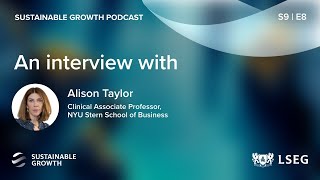
Alison Taylor, a sustainability expert at NYU Stern, argues that Chief Sustainability Officers are typically sidelined into PR and reporting roles without real budget or authority. She and Robert Eccles call for embedding the CSO in the C-suite, linking sustainability to capital allocation and finance, and focusing on 1-3 material issues instead of checking boxes across dozens.
Chapters
Hello and welcome to the LSEG Sustainable Growth Podcast, where we talk to leading experts on topics right at the intersection of sustainability and finance. I'm Jane Goodland, and this week I'm talking to Alison Taylor, who's a clinical associate professor at NYU Stern School of Business. She spent the last 20 years working with multinational companies on risk, anti-corruption, sustainability, human rights, culture, stakeholder engagement, ESG, and ethics. But before we hear from her, let's have a quick reminder to follow us so you don't miss any future episodes. And also don't forget to rate us on Spotify, Apple Podcasts, or any other platform you use. Hi Alison, great to see you. Thanks so much for coming on the show.
Thank you so much, Jane. It's lovely to be here.
So Alison, you describe yourself as a clinical professor at NYU Stern School of Business with lots of other hats and even more opinions. I'm fascinated by that. So tell us more about your career. And what's getting most of your attention at the moment?
Sure thing. So I, right now, um, I am a full-time member of the faculty at Stern. Clinical professor is the same thing as saying professor of practice. So I'm not an academic. I spent some time in mainstream management consulting. I spent time in political risk analysis. I spent 12 years in corporate investigations, so anti-bribery due diligence, broad investigations, money laundering, political risk in what we used to call high-risk emerging markets. Then I had a career in sustainability. I've also worked on questions of organizational culture. I ran and still run a think tank called Ethical Systems. And then I've got a ton of other advisory roles, including with KKR, a Swiss private bank called Pictet, and I do various other sorts of speaking and advisory work. So, um, and you've managed to squeeze in writing a book as well.
I understand.
I did, and I've just written a book called Higher Ground. So I mean, I suppose that is a long-winded way of saying I teach, I write, but I try to keep my hand in the real world and work with real companies grappling with real problems.
Busy, busy lady. Uh, but it sounds fascinating though. I mean, like, all of those things are exactly kind of the sweet spot of what we talk about here on the show, because as you know, we, we really do want to think about the things that intersect finance, business, sustainability. So Looking forward to this indeed. And actually, one of the, one piece of your work which kind of caught our eye was the, the article you wrote with a friend of the show, Professor Robert Eccles. And that was about the evolving role of the Chief Sustainability Officer, which actually then leads on to kind of a bigger exploration of sustainability and business. And the piece argues that these, these positions are undergoing rapid and dynamic transformation. I was wondering, could you talk a bit more about what you mean by that.
Sure. So, I mean, one of the things to say right up front, right, is that this is a weirdly under-discussed topic. Like, the role of sustainability within a company, who it reports to, its budget, its resources, its remit, its role definition, I think have been really lacking. And even though we hear a lot of discussion about how to integrate ESG into companies, you don't tend to read a lot of granular detail about how this is actually getting done. And then when you look at what a lot of Chief Sustainability Officers are actually doing, which I've done because I work directly with them, you very often find that the role is heavily focused on reporting. You find that there is a sort of stealth PR aspect to it. You find that the teams often do not have a lot of budget or resources or power. And then maybe most fascinating of all, there's huge inconsistency over where businesses think it sits and what its remit is. And so to me and Bob, really, this is kind of part of the problem indicating a lack of seriousness or maybe sort of still siloed thinking about this topic. So we make a really strong pitch to getting this role in the C-suite, to professionalizing it, to defining what it's really doing. And most strikingly, I think, arguing that there needs to be a much closer relationship with the senior leadership team and the finance function in particular. Because if a company is taking sustainability seriously, you would expect to see that in mainstream disclosures, which in the US are the 10-K and the proxy statement. And you would expect to see sustainability being factored into capital allocation, governance, and strategic decisions in general. So Bob and I really made this argument that that's what we need. And we explored some examples of leading companies doing this and also really found on that journey that a lot of the companies we think of as poster children in this space are not necessarily doing the best job on this, whereas it is companies really facing what we would describe as existential sustainability challenges, meaning they're not gonna survive unless they adapt. To some of these ESG issues that are really going furthest and fastest with treating this as a true strategic priority. So that was the article. It certainly generated a lot of debate. We've since done a follow-up survey, which I think has shown that still mainstream companies, senior leaders will say this is incredibly important as a topic. But when you actually look under the hood at what they're doing with data and operations and capital, it's a slightly less pretty picture.
And talking of pictures, actually, the article's got a fabulous photo of a lion, I think, walking through Wall Street. Is it? It's very, very cool. You did mention about the fact that you had identified some companies who were taking this seriously because obviously it was very core to their business and the future of their business. So can we pick up on that a bit about the connection between business strategy, investor engagement, and then the kind of the sustainability angle? Because I assume that's one of the stimuluses for companies taking it seriously, right?
Yeah, the article quotes Laura Brooks from Anglo American, really talking about how many detailed questions investors are now asking about this topic. They're expecting to have true experts on the line. They're getting really granular. They're not just picking up on ESG scores and taking a kind of high-level view. They're really, really much more interested and much more informed than they used to be. And so I think traditionally we've seen ESG engagement, sitting with the stewardship team very often. And now I think we're really seeing these next-generation investor conversations evolve where you've sometimes got the CFO, the CEO, and the Chief Sustainability Officer in the room talking to investors together. And I think that's really interesting. We might even think of the CFO as dealing with current performance, being somewhat backward-looking, and the Chief Sustainability Officer's job is then to consider and lay out a long-term strategic vision for the company and the company's future.
So that's, I mean, I think that puts sustainability squarely in this strategy family, doesn't it? Which I suppose we, we've also talked about where sustainability resides in an organization, but presumably strategy is one of the functions that it might end up being in if a company is thinking about it in those terms.
Yeah, and I think, you know, whether it reports into strategy or not, and I think, you know, You could maybe make these arguments in different ways. You would certainly want to see that there is not a lot of air between the core corporate strategy and the sustainability strategy. You'd want to see sustainability considerations factored into core corporate strategy, because if that's not the case, then the sustainability considerations clearly aren't important enough. So we just, I think, need to move on from treating this as a side issue, treating this as really an aspect of stealth communications, and really saying, here are the material issues that we are going to consider. And I suppose that's a different way to think about this as well, that rather than seeing a lot of ticking the box on 40 things and reporting across 70 indicators and working to try and get a better ESG score, what you really want to see is companies focusing on maybe 1 to 3 truly strategic material issues and then reorganizing their business to tackle those material issues. That would be an indicator of seriousness.
Alison Taylor: I think that's a really, really good summary of actually what most businesses need to be doing. You talked about in the article about kind of 4 key changes that you think are required to really get the CSOs into the right space. And I'd like to kind of explore some of those a bit more. So the first is around strategy and allocation, and then it goes on to stakeholder interactions, investor engagement, and then resources. So let's take a look again about kind of the strategy and capital allocation. So leaders in your mind, through your research, what's happening in those companies with respect to strategy and allocation that would make you think, okay, they take this seriously?
Sure. So I think, I mean, again, we can get back to materiality, right? And is the company saying we are going to focus on these strategic priorities, we are going to treat ESG as a strategic challenge, which means we're going to focus and means we might be reporting on some other things, but that is not the same thing as treating them as strategic priorities. We really found that many materiality assessments are really everything is material assessments, and that it's very, very hard for companies to say, here's where we're going to focus, and then here's where we're not going to focus. And then I think by extension, if you do see a company truly focusing on a couple of strategic material priorities, you'd expect those to be factored into capital allocation. You'd expect them to be factored into long-term incentives. You'd expect them to be in kind of mainstream reports and risk analysis and that kind of thing. So let me just go ahead and pick a really controversial example, which is Philip Morris. And a lot of people do not want to hear from Philip Morris on a sustainability angle for very obvious reasons. But one of the things that Philip Morris has done, I think, is to try to address the harms of its core product rather than trying to treat sustainability as, as, as off on the side. And there are very, very clear sustainability incentives for the whole senior leadership team. And the company has, because it will not survive unless it can do something about this, the company has got the Chief Sustainability Officer in the C-suite reporting into the CFO and is focused on the harms of the core product and the business model and not just human rights in the agricultural supply chain or the environmental impact of the product. Both of which are important issues. I'm not saying they're not, but they're not existential issues.
But how many sectors truly have existential sustainability issues that, that would kind of warrant that level of scrutiny at the C-suite now?
I mean, arguably most, if not all of them, right? I mean, I think we can think about fast fashion and whether those business models are sustainable given the pollution, given the labor rights violations and so on. We can think about the future of a lot of food and agricultural products in the face of climate change. We can certainly think about the future or not of oil and gas. We can think about how mining needs to transform. We certainly can't do without mining, but how can the mineral extraction, how can we think about things like green copper, green steel? So how can we think about adjusting the car industry to account for renewable energy? I mean, I'm struggling to think of an organization that does not face these existential challenges over the long term. But I think there's a very varying awareness and very varying adaptation, I think, to these issues when we look at what the company is saying and doing. And so some companies are sort of in denial, trying to manage these ideas by reputational risk mechanisms and that kind of thing. And some are truly trying to plan for the long term.
Yeah, it's interesting, isn't it? Because I think when you look at that question, You get very different answers, don't you, depending on kind of how you come at the topic and where you are on that journey. And I think a high majority of people will be kind of very familiar with the risks associated with our kind of resource companies. But then when you start actually thinking about different sectors and industries and thinking about what, what is the essential risk from a sustainability perspective for that sector, it becomes easier to identify the specific things. So yeah, the other, the other kind of, uh, change that you were advocating for was around stakeholder interactions. Yeah. And I was wondering what you mean by that, because stakeholders got this very sort of like umbrella term these days that it can mean everything, everyone and anyone, right?
Absolutely. So this is sort of my favorite topic because I think this is kind of a remarkable— and I'm going to make a point that I think is sort of obvious, but that is weirdly under-discussed. So you will tend to see in Chief Sustainability Officers' job descriptions that it's the job of the sustainability team to look after stakeholders or do stakeholder engagement or tell the story to stakeholders or, you know, provide information and disclosure for stakeholders. And that's fascinating for a couple of reasons. One, because by implication, if we're saying it is the job of the sustainability team to look after stakeholders, we're saying by implication, it is not the job of anybody else in the business to look after stakeholders. And then that gets even weirder when you think about who stakeholders actually are. So stakeholders in a business are suppliers, customers, employees, and communities. If you are a supplier, you are clearly having far more consequential interactions with the procurement team than with the sustainability team. If you're a customer, you're having far more consequential interactions with the business development team or sales team than you are with the sustainability team. If you're an employee, with your boss and HR and so on. So suggesting that anybody bases their view of the company on, on the glossy reports put out by the sustainability team is really weird. And then I think it is maybe the most powerful indicator I can think of that although all this sustainability language and rhetoric and commitments sound new, what we're actually doing is engaging in business as usual and sort of delegating nice messaging to stakeholders, to a specific team, and not actually thinking what would it take to think about our impact on stakeholders, to think about the externalities of our business, to work on building trust rather than defensively managing reputational risk, and to think about how we consider our impacts on stakeholders throughout the business and not just in one siloed, relatively powerless team. So I think to me, this is kind of a tell that we've moved from shareholder value rhetoric to stakeholder capitalism rhetoric. But we have not really adjusted the underlying systems to account for that huge change in governance that is really needed.
It's fascinating. It's— and so much of what you say there definitely rings true in terms of the statements that, you know, we're all guilty of making in the corporate world from a sustainability perspective. But, but that's really interesting. Let's move on to the other change that you want to see happen is around investor engagement. Do you mean by that just more face time between the sustainability person and the investors, or is it something different?
No, I think there's a— there tends to be conversations between investor relations and the CFO and then mainstream investors, whereas ESG issues are delegated to the stewardship team and the sustainability team. So again, we've got these two sets of siloed conversations and we're not bringing the conversations together into one coherent whole. And so again, if the investor's taking this issue seriously and if the company is taking this issue seriously, you would expect to see the sustainability sustainability team and sustainability thinking front and center in those mainstream investor conversations. And that was something that we heard from many of the companies, leading companies that we spoke to, that that is happening. Because again, if these issues appear to investors to be existential risks to the business, then investors are interested in diving into them and interested in understanding what the company's actually doing. And that is a very different thing from looking at a company's ESG score and thinking this is easy and there's a neat solution. You've just got a score of 70 and that you can make decisions accordingly. So I think this also helps us get on along or move on from this idea that ESG is about picking best-in-class companies or sorting good from bad companies and thinking about this as more of a, much more of a nuanced decision-making tool. So also saying investors need to do the work, investors need to dig in. There's not some easy shortcut to understanding who's doing a good or bad job here. We again have to think of this as a strategic priority and something that presents true strategic dilemmas and trade-offs.
Which obviously works in the context of like an actively managed equity portfolio, for example. But if you look at sort of assets being run off of passive indices, then I suppose the investor toolkit is, is somewhat different.
Yes.
But nevertheless, I think, you know, passive managers can still take a view about kind of what good looks like and what they'd expect to see strategically from the, the companies that are invested in, in, well, they're in the policies, basically. So good. And then the final change area, which I thought was interesting, I'm sure that lots of fellow CSOs around the world listening to this will probably say yes, yes, yes, exactly, is one of resources. Yeah, because resources, I think there's probably never enough of them, is there, in terms of sustainability?
I think that's right. And I think here, you know, it starts to get super complicated, right? Because the question of where to put sustainability and how to embed it into processes and thinking and decision-making is incredibly complicated. I used to work a lot with ethics and compliance teams, and, and they face some of the same challenges. How do we embed culture and ethics into the core of the business? But we know what the compliance team is and what it's for and where it sits. Its job is to think about the regulator. Its job is to reflect regulatory risk. Its job is to be the voice of the regulator inside the company. I don't think we've got the same definition for sustainability. And so we've got this real question of who gets what resources? Are we expecting the sustainability team to own sustainability projects and decision-making? Are we trying to embed them into other departments within the company? Are we treating the sustainability team as a sort of area of expertise that it's doing consulting to other sorts of the business? Is the sustainability team only dealing with certain sorts of material issues? Is it only dealing with reporting? So what budget and resources and what the team does is very, very important. And, and I think different companies will need to make different decisions decisions around that. But what we do need to move on from, I think, is the very common situation where the team reports into marketing or communications, and their job is to spend all year gathering data and writing a nice report, and nothing else ever gets done. And so I think this is genuinely a very, very difficult thing to handle and a difficult challenge for all companies. But we certainly don't get anywhere if we stick to business as usual. And I think one thing here that I would say is that the onus is really on investors to start to dig into this question and actually ask how the company is going to get from A to B in terms of its operations, its data, its processes, its decision-making, its incentives, its authority, its governance structure, etc., etc. I think we need to see a lot more focus on these questions— power, resources, culture, that kind of thing— if we're going to get from where we've been, which is I think picking the low-hanging fruit, to the next stage of this, which is really where things are going to get fancy and difficult.
And I think, you know, the, the reporting frameworks that are coming in now, ISSB and CSID, I think that will help investors to see that type of information because that information is going to be more structured, it's going to be more transparent. But I agree, I think it's really important for investors to be understanding the how this happens rather than just what is happening. And I think all too often the conversation starts at 'Oh, so you've set targets. Are those targets the right targets?' Or, you know, how far, you know, what the progress has been, rather than saying, 'Well, how do you make some decisions? How do you make decisions about what sustainability issues you want to focus on, or, you know, what are the key issues for your industry, etc.' So I couldn't agree more. Let's use that as an opportunity to move on to the relationship between sustainability issues and financial performance, because this is, this is one that comes up time and time again in terms of, but I think that we've sort of covered it in a way, but I'm curious to hear your views about if you're asked, you know, can sustainability or does sustainability affect the financial performance of firms? Imagine you're at the dinner party, you know, it's the age-old question, right?
Absolutely. Well, you know, you like me probably see that there is an enormous amount of debate about this topic. Does ESG drive alpha? Does ESG drive higher returns? This has become, I mean, I live in the US, it's a very, very binary polarized conversation. Two colleagues of mine actually at Stern have recently written op-eds in the FT, one saying ESG is dead and needs to go away, the other one saying sustainability is real and smart and investors know it. So there's this, uh, conversation going on in academia, you know, does ESG drive value or doesn't it? I'm here to just say that the answer is it depends. It depends on the issue, it depends on what the company is doing. It is, I think, a little bit silly to think we can draw some sort of correlation between stock performance balance at that level and try and say ESG is driving it or isn't. And so I think what we really need to do is get far more granular and stop treating ESG issues as this big kind of bucket of generic stuff, which is what companies tend to do, and get much clearer on which ESG issues present the company with risk. So we need better risk management to stop these low-likelihood, high-impact events. Which issues drive innovation or value creation? and then which issues present negative externalities that may not yet have a clear impact on financial returns but could do in future. If we can't tell the difference, um, between those issues and what, um, you know, what the particular, um, ESG issue, uh, what the challenge actually is, is it an opportunity? Is it a risk? Is it an impact? Then we're sure as hell not gonna embed this into processes and decision making. So again, I think this is, um, a plea for a little bit more less simplistic. If you tick the box on these things, we can draw some correlation at the market level. And again, to kind of treat this as a true strategic priority. And I totally agree with you about the rigor of reporting frameworks, but I slightly worry that we are in the process of moving this from a marketing exercise to being a compliance exercise. And so let me, let me kind of end this comment with, with a final plea or a repeated plea to treat these issues as strategic. They're not tick-the-box reporting issues, they're not marketing issues, they're not communications issues. They are strategic imperatives.
Really, really interesting and all very valid points indeed. So let's finish with some common mistakes, and I'm sure that you see many, and I don't want you to name names, but, um, what are the things that companies should avoid doing that you've actually seen happen to get this right?
So the most obvious one is overpromising, ticking the box on 40 things at the expense of focusing on a few things. I see a lot of very vague, nebulous ESG issues that are hard for the average person to understand. I see a lot of yodeling about things that are important at the expense of the really truly existential business issues. So a lot of flagging of things that are very convenient to address. You see this, I mean, one very obvious example would be sustainability leaders in tech tend to focus exclusively on the environment and, and talk exclusively about the environment and climate change. That is fascinating because the truly existential issues facing tech are actually about the social impact of their products— misinformation, mental health, you know, advertising, addiction to the product. And so that is such a tell, right, that the tech industry does not want us to think about those topics and wants us to understand sustainability is just restricted to the environment. And then, you know, you see other signs of lack of seriousness related that we've already discussed. So, you know, lack of power and resources for the team, and really a lot of, a lot of signs that this is being really— this is treated as stealth PR. So lots and lots of common mistakes. But I want to really, you know, double-click on this idea that it is genuinely hard to say, here is where we're not going to focus, here's what we're not going to cover, because of the way that this rhetoric has played out, which is sort of, if any of your stakeholders care about this thing, you need to be doing something about it.
Yeah, I couldn't agree more. It's, you know, it's tough, but I like the idea of less yodeling, more strategic imperative. So if you need to have a memory of something, that's it, you know. It's, uh, less yodeling. I've never yodeled actually in my life before, and I don't intend to start yodeling now. Alison, it's been lovely speaking to you. You are a force of nature. You've got a lot of energy and It's lovely talking to you. Thank you so much indeed for coming on the show.
Thank you. Such a pleasure to talk to you, Jane. Thanks so much.
So that's it for this episode. I hope you enjoyed it. It was quite a journey. If you've got questions, comments, or someone you'd like us to talk to, then do get in touch by email at fmt@elseg.com. That's all from me, but watch out for another episode very soon.
More from Alison

Reconnecting ESG to Ethics: A Conversation on Business and Social Responsibility | Alison Taylor