Business Ethics & Climate Change with Alison Taylor
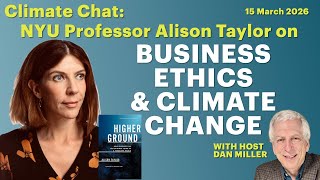
NYU Stern professor Alison Taylor argues that corporate ethics must address climate through three lenses: legal compliance, external impact, and internal culture. She says lobbying and corruption are bigger barriers than voluntary ESG commitments, and that companies should align political spending with climate rhetoric while prioritizing worker dignity alongside environmental goals.
Chapters
And welcome to Climate Chat. I'm your host, Dan Miller, and today our special guest is Alison Taylor, who is a professor in the Stern School at NYU. And I have to throw in where my daughter just graduated, not Stern School. Oh, really? But the theater school. And so Alison is also an author of a book called Higher Ground. And let's see if we can pop that in there. So this book here. And we're going to talk about the book, but also more her work in general on business ethics. and in particular how it relates to climate change. So first of all, Alison, welcome to Climate Chat.
Dan, thank you so much for having me. It's a pleasure to be here.
So I'd like you to start off and just tell us about your background, like what got you into this field and sort of led you to teaching at NYU in business ethics.
Sure. So I'm not a career academic. I joined Stern right before the pandemic, actually. So without going into too much detail on my career, I have a background in political risk and then anti-corruption investigations. So I worked first of all in the Middle East and Africa and then in the Americas looking at fraud, bribery, corruption, political risk, um, you know, the intersection I suppose of business and politics. Um, so when I moved into sustainability, I very much approached questions of climate change and human rights through that lens. Um, and so I suppose what I would say is I've got a multidisciplinary background, uh, where I've explored various aspects of ethics, both the, uh, things that are regulated that companies still may or may not take seriously, and then later in my career I moved into the more kind of voluntary areas including, of course, climate change, but sustainability more broadly. I work for a well-known nonprofit called BSR. I've also got a background in organizational psychology, so I think about questions of culture and leadership and change when we're approaching these topics. So I suppose what I would say is I approach the question of ethics and responsibility through an organizational lens.
OK, and which— what your book Higher Ground, I think, gets into. But can you just tell us a little bit more about the book? What's it about and who is it targeted for?
Yeah, I was asked to write the book by Harvard Business Review Press. They said they were looking for a more up-to-date discussion of business ethics. I think when you say the term business ethics, quite a lot of people just sort of roll their eyes and say, well, they need all the help they can get, or isn't that an oxymoron? Moron. I suppose a perspective I would have is, right, we're having— when we talk about ethics or we talk about responsibility, we're really having 3 separate conversations. And this picks up on what I was just saying about my background. We're having a conversation about the law and compliance and focus on shareholder value and don't break the law, training, policies, procedures, whistleblowing lines, that kind of thing. Then we're having a separate conversation that is really about impact, about externalities, about voluntary commitments, about environmental and social issues. And then we're having a third conversation that's really about leadership and culture and employees and wellbeing. So I rather rashly perhaps tried to bring all these conversations together and answer a question that sounds sort of naive. If you were trying to do the right thing in the 2020s as a corporation, what would that even look like? And my contention is that's actually quite a difficult question to answer, not least because we're so overwhelmed with jargon and frameworks and confusion that it's actually pretty hard to cut through the noise and figure out what even you're supposed to do, assuming you wanted to do the right thing.
Okay, well, along those lines, and this I'm going to guess is one of the most basic questions, but in your book, you argue for a new paradigm of leadership that prioritizes ethical considerations over traditional profit-driven motives. But that seems to conflict with, and when I think about it, with a fiduciary duty to generate profits for shareholders. That's like the main thing you're going to do, and that's going to conflict with climate change goals and things like that. So how can that be resolved, this fundamental requirement, fiduciary responsibility for making money for shareholders versus doing all the other things, the ethical things that you talk about in your book?
Well, I mean, it's possible. I think what you said is quite, forgive me, an American concept of fiduciary duty. It is possible to have broader notions of fiduciary duty, I think even from the perspective of US law. Or what we're talking— what you're obliged to do is act in the best interest of the company, and that might not necessarily be the same thing as the best short-term interest for shareholders. So what you're actually doing, uh, if you observe fiduciary duty, um, is, is thinking about the long-term value, um, of the corporation. Um, and so there's potentially a tension in there. Um, I think it's kind of interesting in the American context still, you know, over 50 years since the famous Milton Friedman article, we still have a tendency to act as if doing the bidding of shareholders is something you can't question. It's kind of like gravity. It's something that we can't possibly argue with. And I think, you know, as the impacts of climate change— and not just climate change, inequality, we can think about a load of other issues— continue to advance, I think these contentions start to become a little absurd.
Okay, well, okay, so given that, and I think you might agree that at least American companies to a large extent seem to be focused on that over maybe climate issues and other things, how do we get them to change? I guess we should have them read your book. That might be a start. But are there other things that people outside the company can do to get companies to consider the broader picture of what's best for the company?
You know, I mean, I think yelling at companies maybe only gets us so far. I think there is a question around focus. I think a really critical question in the context of climate change specifically is around political influence and lobbying, um, and the design of laws. If we're going to go back to Milton Friedman and go back to fiduciary duty, he envisages a very sharp line between business and politics. He's arguing implicitly that businesses should prioritize shareholder needs because the government exists to prioritize the interests of other stakeholders. You know, if you are a lender, you get interest. If you're an employee, you can at least theoretically take your labor elsewhere. So So if we're saying the government exists to protect stakeholders, therefore the corporation should focus on shareholders, what we need is a very sharp line between business and government. And I think we can agree that that line does not exist. So I suppose, you know, as a good anti-corruption person, I've explained this already. I wouldn't say that all of our environmental and social issues would be resolved this way because we've still got an issue of global oversight, but I think we would get a very long way by trying to tackle influence peddling and corruption defined very broadly, including things that are illegal and highly accepted in the American context.
And we can probably start with our government in that particular case, actually. But in your book, you also give practical advice to people and organizations. What are some of that practical advice that either individuals or organizations can use to combat climate change within the business setting? What kind of advice do you have for those folks?
Well, I mean, I think another thing I would sort of say about this whole landscape is that companies, I think, feel quite trapped between a minimalist and a maximalist vision. We've talked about this already. There is a loud chorus of voices who happen to currently be running the government saying climate change is woke, don't think about that stuff, stick to your knitting, focus on shareholder value and don't break the law. They of course do want the corporate money to keep flowing into politics, so that's an only somewhat, uh, grounded and defensible position. But then I think in the sustainability community and among people that care about this stuff, which certainly includes me, you have a tendency to, I think, say that companies need to do more and more and more with no end. They need to tackle all their externalities. They need to do everything all at once. They need to be perfect right away. So I think the first thing we can do is say that companies should focus on the things where they actually have a really strong impact, and they should be much more thoughtful than they've been in the past about the degree to which they have legitimacy and the degree to which they have leverage. So there's plenty you can do to address your climate risk, both from the physical perspective and from the transition, uh, or strategic, um, perspective. Um, but I think we also need to get a little bit clear that not everything is a risk, and there is a limit to what an individual company can do absent regulation, absent reporting requirements, absent policy change, absent, uh, you know, the general population being committed to these topics, which really brings me back to that kind of lobbying and political influence point. But I think what we saw, particularly in the late 2010s, was a bit of a tendency to sort of set a net zero goal in the abstract, even if you had no clear idea how you were going to get there, and kind of cross your fingers and assume something was going to happen about the world. Unfortunately, many companies were setting these goals and making them a big PR statement, and at the same time their government relations teams are lobbying in a completely different direction. So from a really practical perspective, I wouldn't necessarily say that every company out there should target GHG emissions. Certainly plenty of companies I think could do more for climate change, thinking about questions of water or waste or chemicals or packaging or biodiversity. So let's start by defining the climate challenge more broadly than just emissions reduction. And then I think the second thing is thinking about the gap between what you say and what you do, and really aligning your declarations and your voluntary efforts with, let's say, what your policy teams are doing in the background.
So in that response, there was like the part where you're doing things in response to policy requirements or government requirements. So can you give us your perspective on how companies thought about environmental issues, let's say 4 or 5 years ago, let's say under the Biden administration, versus what they're doing now under an administration that's saying, hey, it's not even real, so what are you doing? Have you noticed the difference in how companies are acting and especially in this area of sustainability and, and, um, Climate change because of the change in administration?
I mean, I think there was, um, in the— actually, on— in Trump one, and certainly under Biden, um, a sense, uh, which actually I think is still true, uh, that the world is going in a certain direction on these topics. That might be bumpy, we might not have consistent regulation, but we're broadly understanding that we're in a crisis here and we're trying to shift to, um, using less energy, a shift to renewables, a shift to more regulation. so that seemed to be the direction of travel. And so then you can make all sorts of arguments about anticipating regulation, driving your competitive advantage, understanding where the world is going, meeting the expectations of younger generations. Since then, of course, we've had, um, a pretty dramatic shift back in the opposite direction, uh, from the Trump administration, who would like to claim that climate change isn't real and would like to revive the coal industry. And, you know, I probably don't need to labor point for your listeners, but the rest of the world's still going in the same direction it was going before. So now what you've got is a much more inconsistent picture. Um, but I think that, you know, the point I'd make is that the, you know, the, the Trump administration in America is increasingly a global anomaly. Um, it is a large, powerful, influential global anomaly, but it's still a global anomaly. And then I think the other thing I would say is, you know, take aside the rhetoric and the PR issues at the moment, talk to any CEO running a company, talk to anybody sourcing food, anybody manufacturing. They know climate change is real. They don't think this is woke. This is having actually serious commercial consequences. You just need to look at the insurance industry to know that is the case. So I think we've increasingly got in this country a kind of rhetorical gap opening up between what you have to say to avoid retaliation and the actual internal calculations that your CEO and CFO are making about this topic.
So people who watch Climate Chat know that actually the issues of climate change are accelerating much faster than the general public and the media is aware of, actually. Shows on that all the time. And with the El Niño coming up, it's going to be a very, very warm year over the next year, year and a half. It's going to have big impacts. But I wanted to go into a little more of what you just said about the difference. Let's take the United States versus Europe, for example. My view is that even the ones who are very dedicated to climate and really concerned about it are still woefully underreacting to the real situation, including the governments, even the ones who feel they're leaders. In other words, there's very little actually happening to address the crisis that's before us. Can you give us your perspective on how companies, and let's pick Europe as an example versus the United States, are treating climate climate change within their businesses?
I mean, it depends enormously on the company, right? You know, I mean, and we've referred to this already, a company will have very diverse impacts and very diverse risks on this topic. So what we typically think of when we think of climate change is greenhouse gas emission reductions. I think it is valid, as I've said already, to spend time on water and nature and plastics and all these other kind of components. Um, I think the, um, the norm, um, until recently, and it's some somewhat still the norm, is to set ambitious public goals, um, and voluntary agreements to try to coordinate with other companies in your industry and to try to signal seriousness, um, and set it, you know, and set goals. I think one of the reasons that we're in such a pickle and that things are moving slowly is you need political will here. So I would fundamentally see this as a political and regulatory question. And I think there we've got real issues. You know, I think the sustainability community— I certainly wouldn't blame the sustainability community for where we are today, but there's maybe been insufficient consideration of the voters and the people that might be negative, have their livelihoods negatively affected by climate change regulations. So maybe we haven't spent enough time thinking about oil and gas workers and coal workers and slaughterhouse workers and helping them transition, helping them stay afloat, helping them make a living. So I think there's been a lot of consideration of climate change as a technical problem, a scientific problem, which of course it is, and maybe not enough exploration of what it would really take to get political will around changing these topics.
The government—
Asking specifically about Europe, we all know that, you know, under Biden, what we had was a heavy effort by the government in the US to incentivize investment, incentivize innovation. In Europe, we have something much more compliance-forward and restrictive. So there's also a sort of debate about which approach will drive companies further and faster. You know, right now we've got, we've got now got the American government galloping in the other direction. But I think we need to see that all this regulatory inconsistency doesn't really help a corporation. It just means that they've got to now deal with a lot of uncertainty and a lot of feeling that the topic is being treated very differently in different jurisdictions.
Okay. And in terms of fiduciary responsibility, however you want to define it, you know, having the company function long-term is an important consideration. In your experience working with these companies, talking with them, you kind of got to a little bit with talking about insurance companies. Insurance companies are being impacted right now on climate change. Well, I lost my insurance on my house right here and had to switch to the government-backed insurance because there's forests nearby and trees nearby. And that's happening to everyone in this area. And other things like that are really affecting— in other words, I would say if I were my insurance company, I would have canceled the policy too. But how do you see in your experience talking to these companies how climate impacts either now, like insurance companies, or really looming. The price of food, everything is changing. Um, are, are they taking that seriously and, and, uh, building that into their plans right now?
I don't know of a CEO who isn't taking this seriously. Like, what they're saying, um, you know, uh, front and center, um, is a different issue. But, you know, we've got this kind of challenge, I think, which while there are direct physical measurable financial impacts and risks. There are more strategic issues. If you think about, you know, you're making combustion engine cars, how do you think about how you're going to transition your business model to, you know, to this new world? That's a very different topic from thinking about physical climate risks. And then, you know, unfortunately, there's also a lot of money to be made in these areas. I don't know if you read, there was an article in Bloomberg a few months ago talking about the disaster recovery industry and how big that's getting now. And so I think one of the fallacies here, right, is because something's a problem in the world, it's automatically going to be a cost for business. That is unfortunately not the case, which brings us back to the fiduciary duty question. So I think the imperative for a specific company is to do quite detailed analysis. What is a direct, physical, measurable risk to me now? What is more of a transition or a strategic risk And then is there some opportunity? Is there some way that I could innovate or make money from solving some of these real-world problems? But perhaps the key issue that we're having is that something can be an issue for the world and not necessarily undermine profitability.
Well, speaking of that, I'd love to get your perspective on how executives in oil companies or fossil fuel industries think about business ethics related to environmental issues? Because we all, you know, those of us working on climate, we're always wondering about this. I'm wondering, don't they have children too? What's going on here? And maybe since you, I assume you talk to some of these people and understand the thinking, maybe you could help us understand that better.
Yeah, I mean, I think there's a few things going on. There is a very, I would advise anybody listening that's interested in this topic, there was a very, very interesting interview with Darren Woods at last COP, where he really calls for a carbon price. He really calls for more regulation. He calls for more transparency. So I think there's a few things to say. One is, if we just think about the kind of environmental health and safety kind of oversight and how well governed these companies are, we might not want to hear it, but ExxonMobil and Chevron are actually very well run and very well governed companies. I think we have spent a lot of time and effort in the environmental movement trying to get companies like Exxon and Chevron to move into renewables. I don't know how realistic that is. It is a fundamentally different business model. Oil requires a lot of capital upfront. It requires thinking very long term. It carries very, very heavy risk. And all of that is built into these companies' structures. A lot of renewables, by contrast, run more like utilities. They've got lower profit margins. And just because a company's good at extracting oil out of the ground and moving it around doesn't automatically mean that that same company is going to be good at renewables. So I don't know how far we've got really yelling at these companies. And, you know, something really interesting and very disturbing I think that has happened is because there is so much more pressure on European majors like Total, like BP, like Shell. You see their profitability and their reputations going downhill to the degree we might even see the US majors acquire some of these companies. So I think we still need to take into account the market logic. We still need to take into account the fact that divestment just probably means an investor with lower standards will come in. And I think we need to be realistic about the degree to which these companies are really going to transition their business models. So perhaps a better way forward is to invest more in renewables, to incentivize renewables, to make those businesses that are more suited to transitioning to renewables more viable.
So I want to make a few comments on what you said about Darren Woods' call for a carbon price, since I was involved in this, by the way. And so it is true that the oil companies do call for a carbon price, but the reality is they only want it to be about $50. They've already built that into all their economic models. They're happy with a $50 carbon price and they don't care. But what they don't want is something that's higher than that. So the, so the real people want carbon prices, want it to start at $50 and go up $10 every year to hit $100 and $200. And they are very much against that, by the way. So they, They want a carbon price for certain reasons, but they don't want it to really impact their business very much.
It's hard not to come back to that question of political influence, of denial—we all know Exxon knew—of disclosure, of reputational risk, of the extensive efforts to manipulate the public and the government to avoid change.
Well, no, that was my very next question to you. You're talking about these folks and, you know, that's their business to do oil, but they've gone well beyond that. As you just said, they've vast disinformation campaigns and all of these things. In fact, that was a big thing where when they did find out that this would cause catastrophic, and they used the word catastrophic climate change back in the '60s, I think it was, or '70s. And then, and they were on a path to maybe change her business model over the long term. But then a new CEO came in and said, screw that. So what are your thoughts on that aspect of business ethics? I mean, this is business ethics at the global survival scale. So I don't know if it gets any bigger than that.
Yeah, I mean, the older I get and the more I see what's going on at the moment, I think that the root, if we could just address corruption and influence peddling. I wouldn't say we wouldn't need ESG and we wouldn't need these voluntary frameworks, but I think it would get us a pretty long way.
So, okay, so you characterize that as corruption, that what Exxon did?
I would characterize that as putting your thumb on the scale in the design of regulation and influencing public perception in a way that reduces the kind of democratic accountability and smart, um, oversight that we actually need. Yes, it's legal, but you know, a definite— legal, I was gonna say, it might not get you in jail though, but use of entrusted power for private gain. Lobbying's illegal in many countries. It just happens not to be, uh, illegal here, right?
Yeah, it's— we sort of legalize corruption, I think, is the way I sometimes, sometimes describe it. So, um, all right, so given the dangers of climate change and given that businesses can play a role and your book makes it clear there's lots they can do, what are you, what advice do you have sort of overall, not just individuals, but what we should all be doing as a society? I guess, you know, it's tough when we have Trump there to make this progress, but, you know, climate change is a real and present clear and present danger right now. And companies need to react, as you said, and some of them are going to react by making more money, but we also need them to act collectively to actually reduce the risk that we're facing. And so what are the things, whether in your book or not in your book, just in general from what you've learned over the years, what should we be doing as a society I guess vote in the right kinds of people might be one of them, but what are, what are your thoughts on all of this?
I mean, voting in the right kinds of people, uh, would be a really, really good idea. Um, I think in many cases we need, um, finance to incentivize innovation. Um, there are a lot of problems that we can innovate our way out of, but those need to be properly incentivized. I think we need to— I think we need the general public to be more formed. Um, something we haven't got into yet but I think is very, very significant in the US context. Um, and again, I don't want to start attributing blame here, but it is an interesting fact, I think, that in the US context we've managed to politicize this question. And so if you think about it, um, I mean, the question of whether climate change is real, is that what you mean? Yeah, what to do about it. Um, we've managed to make this a progressive left-wing issue, which makes very little sense when you consider that most Republican voters in America are rural, might see the impacts of things like climate change on things like agriculture more than a Democrat voter in a city. Many Republicans are conservationists, many care deeply about the environment. So it seems a huge error that we have managed to equate doing something about climate change with being progressive. So one thing we could try to do, I think, is to reframe the conversation so that we can think about a broader set of voices and try to innovate more broadly or discuss more broadly what we can do about this as a society. I think it is highly unfortunate that we've managed to make this a polarized topic.
But do you think it was the, um, call it the progressive side that— oh no, I mean, it was— it wasn't just all done on purpose. It's all done on purpose, right? In fact, the whole thing about Republican voters, many people say, is that they're continually voting against their own interests and voting in people that are just going to hurt them, which is exactly what's happening right now. But I think, yeah, and I think that those interests, which by the way include vast funding from the fossil fuel industry to to buy politicians and to get the agenda going the way they want is causing that. And then they need to do something, so they make it a left-right issue.
Yeah, well, I mean, I think everyone sort of made it a left-right issue because we're all very, very polarised. But one of the ways out of the mess we're in might be to try to depolarise the conversation a little bit. And as these impacts, as we know, are becoming more severe, they are accelerating, they're becoming to ignore. Florida, red state, you can no longer get insurance in Florida. So I think a little bit more thought about how we might make this relevant to everybody and less of an exclusively left-wing issue would be helpful, recognizing that there's a very, very long history here. And, you know, it's not necessarily— well, it's not at all fair to say that it is left-wing voices that have got us into this situation.
Although in Florida, if you're in the state government, you're not allowed to use the phrase climate change. Right. Well, we've got— Which made a very, very funny— this is from quite a few years ago, but it was the guy in charge of environmental issues in Florida in front of the somewhat few Democratic members of the state representatives. And they're asking him, well, what's causing this increase in temperature? And he wasn't allowed to say climate change. And they kept trying to get him to say it. And he You just wouldn't say it. So in that case, Florida is really an interesting one where, by the way, the bottom third of Florida will not be on the map sometime next century. That's pretty much for sure already. We know that. And not a word discussed in the state governments. And they're not getting ready.
Well, right. I mean, you know, there was an article in Bloomberg recently that said something like, you know, Trump's in a climate fantasy world. You're stuck in the real one. And I kind of think about that. We can— We can manipulate the rhetoric and try to reduce discussion of this all we like. Climate change doesn't care. It's going to carry on doing what it's going to do. And so you can avoid reality and end up with no house, or you can do something about this.
Yeah, actually, the phrase I like is, you may not be interested in climate change, but climate change is interested in you. That's exactly— so yeah. Well, so really, in a sense, our discussion on business ethics is expanding into really the political realm, which is the thing that regulates it, right?
I would argue that business ethics is fundamentally a political question. There's a lot of people in ESG would say, let's just take the politics out of this. This is about performance. I think that pretty much any difficult ethical challenge is also a political challenge. So I do not avoid those topics. Personally. Okay.
And you kind of answered this question. I have this down, but you kind of answered this partially, but maybe you can take another go at it. As climate impacts increase over the coming decade and decades, how do you think companies are going to respond?
I think they will respond. I mean, I think if it's financially material, they will have to respond because they also have to take into account their fiduciary duty and their returns. I think we also, you know, I spend a lot of time in the classroom. I think we also see a very clear generational shift towards caring about this. I'm always quite impressed by how informed my students are about questions of climate change. So some reason, I think, to think that when generational shifts finally occur in politics, we've had a president that is born in 1946, There was a post about this recently in 1997, 2007, 2017, 2027, the president will be born in 1946. So something that I think would definitely help is a generational shift in our politics.
Okay. Although there's young folks who are just as clueless about climate as older folks. Just look at— I mean, we can look at our government. There's, you know, they're not all old, but Yeah, it's a little scary at times. I want to ask you a question, by the way, that's not directly about climate, although I could probably tie it in if I wanted to. But it is so front and center in business ethics right now. And that is the question of anthropic— Yes. —having business ethics that say you can't use our AI. The government had a contract For those who don't know, I'll just make it very quick. The US government had a contract with Anthropic, which is the Claude AI, and it's used in military for planning and targeting and things like that. But they had written in the contract that you cannot use our AI for mass surveillance of Americans or for autonomous weapons that don't have a human commitment to fight, to commit the weapon. And Pete Hegseth didn't like that, said, you know, you got to change that. And they said, no, we're not going to change that. It's in the contract and you can't use it under those conditions. So they canceled the contract with them and the next day went with OpenAI, which is ChatGPT. And supposedly their policy is you can't use it for that, but it wasn't the same as a contractual obligation. And then on top of that, the government said now Anthropic, you're going to be listed as a supply chain threat. No other US company ever has been designated as such, and obviously it's not true, but they're using that to get back at them. This is, you know, I don't know, this is going to make a great class for your business ethics course, I'm sure. But what's your perspective on—
I've been trying to add my article to the chat, but not managing to do that. Okay. Well, if you tell me what it— okay. I think, you know, I think Anthropic is making quite a smart long-term bet on being the more seen as the more ethical AI firm, clearly running enormous political risk. You've just referenced the supply chain designation, is a big enough and valuable enough company, and I think has a strong enough legal case to run that risk. Cannot describe how many people have said to me in the last week, well, they're the good guys. I mean, we can see how the Claude downloads versus the GPT. Um, so, you know, they're making a smart bet on being the most ethical of the players. And I think we can all probably agree that Silicon Valley is not a high point of ethics right now. That all said, um, I think there is a danger of oversimplifying this debate. I think there are a lot of issues where Anthropic, it doesn't actually look that much better, um, than other firms. And if we're going to get back to climate change, if we're thinking about the environmental impact of AI, I don't think Anthropic's necessarily got a better story than anyone else. So it's a good example of how we like quite a binary good versus evil narrative. And there's something there, like I wouldn't, I wouldn't deny that. I think Anthropic has more savvy leadership and is making a very interesting bet over the long term that I wish more American corporations would do. But let's not kid ourselves. There are a lot, lot, lot of issues with AI— ethical, societal, psychological, environmental— that are not being covered at all in this debate. So I wouldn't take it as that reassuring. Right. And if those who are interested— It's more reassuring than nothing, but it's not that reassuring.
So for those who are interested in this topic some more, you can go back from a couple of years ago to our climate chat. Program with Will Wright on that, and the title was, "Which will kill you first, AI or climate change?" And so we had a little debate on that on Climate Chat. So you can go check that out. Yeah. So that's a very, it's a good answer, but I see in that answer actually something interesting for climate, and that is how can we identify those simple binary stories that might elevate the discussion of climate, breakthrough the noise, because there really is very little media attention now to climate change. And as we're covering on this program, which gets, you know, nothing compared to cat videos or something like that, for, you know, two huge things happening that are mind-blowing. One is the climate change, which was getting warmer all the time as has just in the last few years taken a turn upwards. It's accelerating much faster. Essentially, the rate of warming has doubled because we cleaned up ship emissions and things like that, and then some other factors. And then the other one is that we now know that the AMOC may collapse, which is this ocean circulation, which would destroy Northern Europe and entire Northern Hemisphere in terms of growing food, It's the mother of all tipping points. And, you know, you can hear crickets when you talk about these things. So now, but with what you were saying about the anthropic, I can see, I always felt that the AMOC was maybe that binary story, like, oh, that collapsed, you know, and very soon it could get attention. But it still, climate doesn't get the attention that things like AI, like that military story got. So there's more to learn from that, I think.
Yeah, I'm not sure how good human beings are about these big systemic challenges. I think part of it is not so much that people don't care, but it feels so big and overwhelming. It's very easy, I think, to kind of end up feeling like you're powerless and there's nothing you can do. Another reflection I have is I was in— last January, I was in LA during during the wildfires. I was about 30 miles away from them. Uh, the air was absolutely terrible. I mean, I guess you live in California. Um, uh, but we all at this event I was at also kind of went around about our business, and we sat in our conference rooms, and we went out to dinner, and actually LAX was working really well. And so I think one of the issues, right, is that climate change impacts tend to be quite localized. So for sure, as the scenario you just described come to pass, the people in Northern Europe will be well aware of that. But the rest of the world, if it's not directly destroying your house or your livelihood, it seems quite easy to put the blinders on and kind of hope maybe it won't happen to me. So I think there's an— Optimism bias.
We just did a whole show on that recently, actually.
Yeah, denial and powerlessness. Um, and I think we're not maybe giving— I would say the same thing about corruption, actually, for that matter. I think we need to give people more a sense of agency, um, and more a sense that they can address something, which requires getting a lot more into kind of human behavior and social psychology, um, and political influence. So when I think about promising avenues, um, that seems a really good one.
Okay, well, good. All right. And any other— we're going to move to some other questions here from others in a moment, but just taking a step back, sort of the main advice in your book as it relates to sort of environmental and climate, what, you know, and also what will people learn from reading your book on this subject? Maybe sort of two.
I mean, there are a few messages. I mean, one is, you know, I advise companies to think about how their business directly impacts human beings. I advise companies to treat human beings with dignity and respect, and I advise companies to focus. So stop ticking the box on 40 things, stop treating ethics as PR, focus on a few strategic issues where you can actually move the needle and get something done on 2 to 3 things rather than reporting and ticking the box on 40 things. So I also speak a lot about aligning your words and your actions, including over political spending. And I speak a lot about, you know, opening dialogue and, you know, getting employees, getting other stakeholders involved in these debates rather than treating leadership as a sort of top-down effort of barking orders from the top.
Hmm, okay. So by the way, there's a link to Alison's both NYU page and her personal webpage in the video description. And if you go to her personal webpage, you can find the link to the book to buy the book right there. Also, since we always forget to do this, I also want to ask you to like and subscribe to Climate Chat so that this program and the many others that we do can reach more people because that's That's an important thing, especially if you're concerned about climate. So like and subscribe, please. So we're going to bring in Stacy. We have a question or two for you. And then we're going to get to some questions from our audience members here. So Stacy, welcome. Let's shift to this so we can see your cats in the background. So see, we are trying to make a cat video to increase viewership here as well. We love cats.
So we get to be a cat video. We're going to start classifying it any day now. Amazing. Thank you for being here, Alison. I was a business major long ago, so it's really nice to hear your talk and be reminded of how much I dislike Milton Friedman. So, and Dan, you reminded me that we probably need to make our AI or climate world-ending conversation an annual event because things are changing pretty quickly. That's true. Um, okay, Alison Taylor Taylor, the United States has the world's largest economy. You know this, about a quarter of the global output, even though we're only 4% of the population. We're also the world's largest cumulative emitter of greenhouse gases, second only to China annually. This now, um, we don't have the most people, but we are the biggest and the baddest. So how do you square your thoughts thoughts on separation of politics and business with Citizens United?
Well, I mean, I just wrote another article recently about corruption in America and the manifestation it has. Clearly Citizens United was a key tipping point. I think one, you know, as you can hear, I'm not originally American, though I am an American citizen for everybody. I think Maybe, um, there is, uh, uh, an optimism and a sense of exceptionalism about this country that is what makes it wonderful, but maybe makes it challenging, uh, to tackle some of these underlying issues. As we know, American culture is pretty fundamentally freedom-loving and libertarian. So I think one of the problems we're having is that We tend to associate in this country corruption with a lot of bureaucracy, a lot of government control, a lot of process, and maybe are not seeing the particular way it manifests in the American context. So I think there is some awareness of this. I mean, I find it very interesting that my students, for example, and I teach a sustainability class in a business school, my students turn up in the first session, including including the undergrads, very well aware of business putting its thumb on the scale on political influence. So there's broad awareness. I just think we need a bit more action and we need a bit more focus on this particular topic. And I think the way we think about and frame topics of bribery are very, very still influenced by bureaucracy in developing countries and the former Soviet Union. We're maybe not seeing the particular American manifestation of these problems. Gotcha.
And then the other thing you mentioned along the lines of fiduciary responsibility and our distortion of it. The US CEO to worker pay gap is vast, with CEOs in the S&P 500 companies earning roughly 285 to 290 times more than their median employees. Average CEO pay has soared to over $18 million annually while worker wages have lagged, representing a dramatic increase from a 20-to-1 ratio in the '60s. Sustainability is asked to consider everything. We need to also consider the needs of workers. How about business does that? Why do we have to clean up everything? I could not agree more.
I mean, I think we're in violent agreement here. This is unsustainable. I don't know if you know the work of the historian Peter Turchin. He's been predicting societal breakdown in the US right about now, uh, for many, many years, because that wealth gap is unsustainable. Historically, whether we're looking at the French Revolution or the end of the Roman Empire, this thing does tend to cause society to fall apart. We are pretty close to that. Um, it is unconscionable. Um, I also would want to draw, um, uh, people's attention if people aren't aware of it. There is a, um, it was a survey from Capital in December 2024, where Americans were asked what they wanted American companies to do. If you look at the results of that survey, you would see that things like climate change and minimizing pollution are actually at the bottom of the list. What's at the top of the list is paying a fair living wage, being— behaving ethically at the leadership level, and supporting worker well-being. So I would not read this as thinking that the American public doesn't care about environmental issues. I think it is somewhat of a consequence of corruption, but also somewhat of a failure of the sustainability narrative that we've managed to convince some people that business was setting net zero goals and kind of imposing all these restrictions and telling you you can't eat a burger and still not paying a living wage. So maybe again, if we put human dignity and respect at the center of our efforts, we would find it easier to tackle our environmental challenges.
It's almost like it mirrors the government today, like they're throwing up so many other things that we can't focus on what is the real problem. And so business, by screwing over workers, they have done this, a similar smokescreen for seems like eons, my entire life essentially.
Indeed. Yeah, I share your frustration. I don't think it's going to be sustainable in the long term, but I fear we're in for a very, very messy time in the immediate future.
We'll watch the musical play out live, you know, Les Mis 2026.
Okay, we're gonna take a question from one of our other co-moderators, Eli. So Eli, welcome.
Hi, thanks, Dan. Um, so, um, you're probably familiar with a paper from 2022, Luke Kemp et al., um, Climate Endgame, which related the states geographically which are most susceptible to damage from climate disruption and the, the Fragile States Index. And this is, you know, a situation that we can easily anticipate where, where there are stressors and that just breaks down the, the good functioning of government, um, and what you get instead is an increase in corruption and degradation of services and everything else. You know, this is a wicked problem. Um, I'm wondering if you, you have any thoughts about how that might interact with adaptation and, and, uh, uh, regions are literally just trying to survive, um, and, uh, the, you know, how that interacts with even attempting to be ethical and acting beyond immediate survival.
Well, I mean, I, I fear, I'm afraid, like, you've answered your own question, which is that, you know, the more dire and the more, um, catastrophe-ridden, um, the situation gets, the less appetite there will be to tackle the, the big systemic issues that we really need to tackle. Um, but, you know, we, we also could say that the catastrophe, um, and crisis will drive change in the long term. Humans are adaptable and resilient. There's more going on, uh, than we might imagine. Renewables are still growing despite the government's best efforts to stop that happening. So, have to also assume that adaptation will happen because it will have to happen. But again, I think the problem is the degree of human suffering and environmental catastrophe we're going to have to deal with in the meantime. I think the long-term trajectory is unavoidable because physical reality still exists. This, even if you spend your entire day locked in discourse with an AI. Physical reality still exists. The world is getting hotter and wetter and there are more and more catastrophes. So adaptation will happen, but we're certainly doing our best to make this as difficult as possible. So, okay.
So Stacey, did you find any decent ones?
Yeah, I had 2 or 3 here. So one First is just an observation that from our YouTube listeners, from our YouTube comments. Yeah, that— well, actually, before I do that, let me remind people, please like and subscribe. Please follow us and Alison. It helps out to keep getting this message out there in all the algorithm rhythms, in all the places. We so appreciate you being here and taking the time to watch. It means a lot. If you, um, can push us further so that more people hear it. Um, and also a very happy birthday to Dan. Happy birthday, Dan. And also to Going South, our Greenlander in the, in the audience there. Happy birthday. Okay. Um, so the observation is from Nowhere with Iran, and it's just simply that the storm forecasters and chasers and hurricane track people never say the words climate change. They all describe the increasing catastrophic weather as weird or strange. And I agree with that as well. The Going South had a question about catabolic collapse.
Catastrophic, I think it's supposed to be. What's it? Catastrophic, I think.
Okay, I didn't know if it was a fertilizer term. It's, um, could it start with Strait of Hormuz and the lack of fertilizer for farmers?
Yeah, it could start in all sorts of ways. I mean, that seems tied to the Iran conflict. There's a, there's a water story about the Iran conflict. People say that Syria civil war, I guess 10, 15 years ago, was really a crop failure. We can certainly think about the extremely divisive and contentious question of immigration over our southern border from being fundamentally an environmental crisis So, um, we struggle as humans to, uh, think systemically and focus on root causes rather than obvious manifestations. Um, we are, for example, spending— we spend a lot more time reacting to Trump's latest outrage or latest, you know, racist tweet or whatever it might be, rather than looking more fundamentally, um, at the underlying issues regarding For example, my favorite topic, as everybody knows right now, corruption. So we need to get to the point and we need to see the connections between these issues more clearly, for sure.
So actually, Alison, you are summarizing our thesis here on Climate Chat very well. We've done a lot of shows, in fact, recently because we make the statement that we know as much climate science as we need to know. We're going to learn more. But we know all we need to act immediately, urgently, dramatically. And we also have all the solutions we need to start acting right away. We have— so those two things are given, and yet we're doing nothing essentially on net. We're doing a few things here and then doing bad things there. And we attribute it to exactly what you said, where there's really the human psychology, no long-term thinking, and a lot of other optimism bias. And we've Actually, we're covering that more and more. And actually, actually, it's one of the reasons we want to do here on the show, because, you know, we can have another climate scientist tell us how screwed we are, but in order to do something about it, we have to understand the social and psychological situation that we're in. Yes, it's great. And you're— unfortunately, you're not making it any easier.
And a number of our, our viewers have confirmed, including going south, that catabolic collapse is an actual term. Oh, okay. It's a slow-starting but grinding collapse towards full systemic collapse. So today we learned.
And, and the, the catabolic part is, is the system eating itself, right?
Um, and, you know, I think to go back to where we started, which is questions of business ethics, I would draw a, you know, there's an analogous comment here, which is that ESG, um, it's not called that anymore because it's become politically unacceptable, but the focus is reporting and disclosure and arguing about whether we need to require Scope 3 emissions disclosure or not. And everyone kind of argues endlessly about what should and shouldn't be disclosed, and it kind of is the same point. Like, you don't need to measure your Scope 3 emissions down to the 0.1 decimal point to know where the bulk of impacts and the bulk of your externalities are and to start acting on that.
And so again, I'm even addressing 1 and 2.
I mean, right, um, but what we do is argue endlessly about reporting frameworks and never get to the stage that we're going to actually do anything. So, um, but that said, you know, I mean, I think there is more going on than we might think. I think if you're a B2B business, if you're directly influencing influenced by these things. There is more going on in this area than we might think or might want to believe. So much as I take all these comments and questions are very, very well taken, we have to be careful we're not just fueling this, this, this notion that this is an unavoidable thing that we can't do anything about. And I think one thing we might do is help people to feel a little bit more empowered, that they can have impact, that they can change these things. We just need to focus on the right things.
One last one. Nevitz Forever said, listen to any business-focused radio station. Climate change, pollution, poverty, you name it, gets a token mention here and there. It's all Wall Street ROI and what have you done for me lately. And I'll tack on, other than electing New York City Mayor Mondani to president, how can we change that focus?
I don't think he wasn't born in this country. I don't think he's going to be president, but—
Oh, he wasn't? Oh, shoot, man.
I think, you know, I think, um, I think it's really tough, but we've got to, um, we've got to start with democratic change. We've got to start by making this a policy position. Um, we've got to understand that companies work in this incentive system where, yes, Yes, um, you know, we, we are— they are being incentivized to try to cash out, um, and cash out their 401(k)s before the proverbial hits the fan. Um, so maybe we need to work on democracy and the social contract in this country. I think Mamdani personally is doing a very, very good job on that, and you can see that there is a hunger for that. You can see that there is a hunger for that, a hunger for voice. You see the same thing in, you know, different topic, right? But you see the same thing in Minneapolis right now. You see community engagement, you see a desire to support your neighbors, to feel part of a wider social fabric, to do something and feel empowered. So maybe we would achieve the most we could possibly achieve on climate change by focusing on those kind of levers versus a sort of— and I'm again not saying it's wrong— but a sort of science-based doom-mongering and focus more on collective action and change.
So actually, so I'm going to maybe leave you with the last question because But yes, we're screwed up here in this country. We have a lot of work to do. But now let's take Europe, which is, you know, when you look at it, hey, we have all these climate policies, we're doing all this stuff. But in reality, I mean, let's take Norway, who's at 98% EV sales for new cars, carbon capture programs. They have everything, yet they got all their money from fossil fuels in the North Sea, and they're still doing that. They haven't shut that down. Even though they're trying to be the, quote, greenest. So given that, let's look at Europe, who, you know, theoretically is doing a lot but not even close to enough. What recommendations do you have for that area?
I think it's fine to take oil revenue and invest in renewables. Like, I mean, you know, even if we wanted to, we can't switch off the oil industry right now. We'd all be sitting in the dark and cold. So again, I think we've got to get get real about what this is really going to look like, um, and try to drive improvement with a sense of empowerment and democratic participation rather than yelling at people that aren't going to listen no matter how much you yell at them.
Oh, and I, I just, I remembered one thing that you mentioned before about the oil companies being, you know, not likely targets to change to renewables. I'm very focused on transportation and how people move. And now it's like, yes, this is why hydrogen was promoted because it built upon the infrastructure and the skills that they already have rather than just focusing on what is so much more efficient, effective in every way, electric transportation.
Although it's really a terrible substitute compared to EVs, but that's okay. And it's also 95% fossil fuel derived. It was—
it's for the— it's for the oil industry. Yeah.
No, the oil— that's why they are pursuing it. Yeah. That's true. So Alison, thank you so much for, for being on the show and for writing your book. And let's pop that up here again. It's called Higher Ground. And again, links are in the description, both to her NYU page. Just wanna learn a little more of the, the research she's doing and what she's teaching, as well as her personal webpage. Which does have a link to the book, which got a number of awards already. I saw there on your—
Yeah, it's 2 years old. I would say to anybody listening, I'm very active on LinkedIn. I'm very active on Substack, post all the time, get involved in a lot of debates. Would welcome everybody to join me there, as well as keeping a close eye on this show.
And by the way, and the link to follow you on LinkedIn is actually in the description. Description as well, so people can do that. And that'd be a great way to learn more about what she's up to. And thank you so, so much for this discussion. It really, uh, you know, helps clarify a lot of things. And this is an area where you kind of do wonder if you're not in— and I've been in boardrooms, but usually for startups, not, not the bigger companies, uh, but you do really wonder what's happening there when they're talking about these issues. And you've given us—
willful blindness, denial, and we've got too many too many old people running companies and too many old people in government. Sorry, I'm pretty old myself, but you know, I just got older today. So I think that would help, right? Yeah, very good.
Hey, thank you so much. We really appreciate it. And everyone, thanks for joining us again on Climate Chat, and we will see you next week. Take care, everyone. Bye-bye. Bye.
More from Alison

Reconnecting ESG to Ethics: A Conversation on Business and Social Responsibility | Alison Taylor