Jason Criddle, Investor, Entrepreneur, & Best-Selling Author | Biz To Biz Podcast
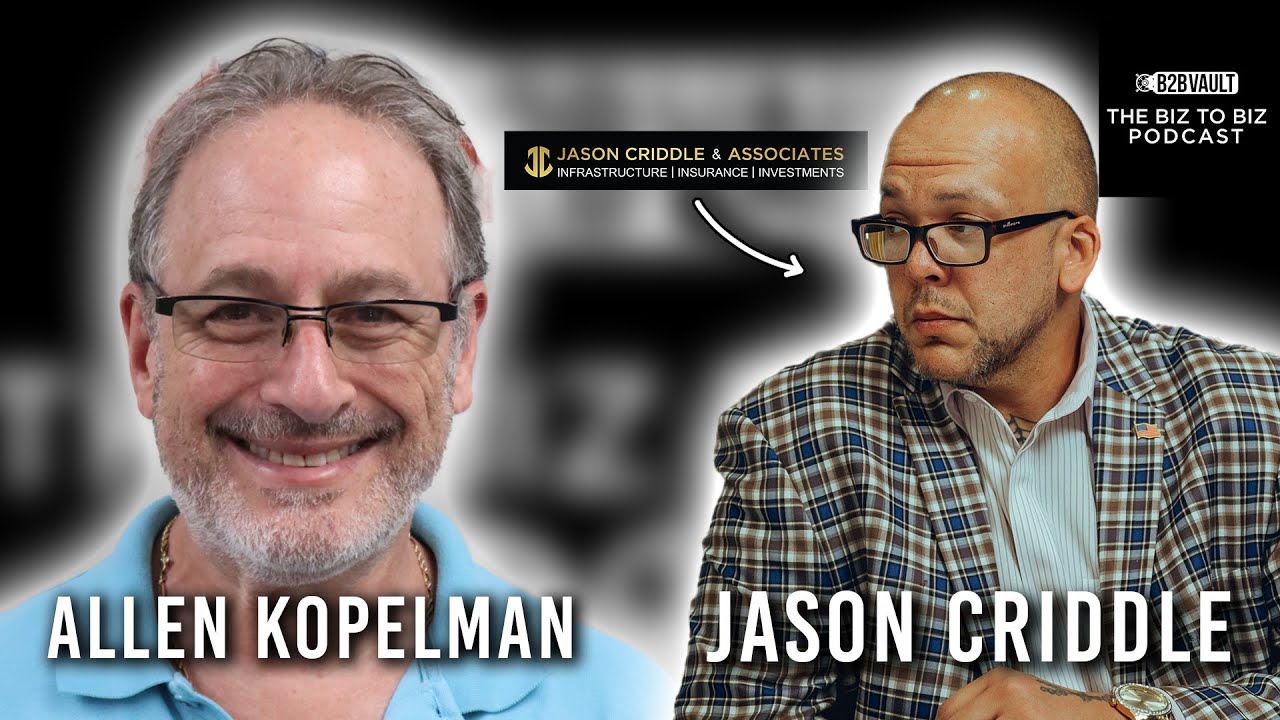
In this episode of the Biz to Biz Podcast, host Allen Kopelman interviews entrepreneur, investor, and author Jason Criddle. The conversation covers how Criddle’s company, Smarter Commerce, pivoted during COVID to serve the surge in side‑hustle demand, the importance of automation and AI tools (especially for SEO, video editing, and contract analysis), and the role of mentorship and networking in scaling a business. They discuss the shortcomings of traditional higher‑education pathways, advocating for trade skills and early hands‑on experience, and explore the societal implications of increasing automation and robotics. Criddle shares personal anecdotes about his early lawn‑mowing business, the influence of books like The 4‑Hour Workweek and Think Big and Kick Ass, and his philosophy that changing one’s vocabulary shapes outcomes. The episode concludes with three pieces of advice for aspiring entrepreneurs: validate the idea with a paying customer, build processes that eventually remove the founder from day‑to‑day operations, and hire the right people to protect and scale the business.
Chapters
Welcome to the Biz to Biz Podcast, your number one source for all business news. Hello everybody, welcome to today's episode of B2B Vault, the Biz to Biz Podcast, where we don't like to wear ties. You can still make a sale without wearing a tie, you can do business without making it wearing a tie. I see all these guys, Mark Cuban and, uh, Gary Vee and Hermosi, they're all out there, so we're not wearing ties either. So today's guest is Jason Criddle, and he's an investor. He helps— he's built brands. He's an entrepreneur. And we're going to talk today. We're going to chop it up. We're going to talk about business, AI, the education system in the US. We're going to chop it up, what's going on. And, you know, let's go. Welcome to the program, man.
Not only am I not wearing a tie, I am wearing my favorite shirt. And I mean, like, I have a hoodie on over it. Like, if you could see this thing, oh my gosh. It has holes and rips. There's more holes than there is fabric, but it was a really meaningful 5K. It was a walk for Alzheimer's that I did, I don't know, probably 6 or 7 years ago, and I have not stopped wearing this shirt. I will wear this shirt while I'm recording with you. I will wear this shirt to a business meeting. It doesn't matter because it has some character. I think that the Yeah, I, there's definitely a place for a tie. I've been wearing a suit and tie like on and off for the last 8 years, but I think that a lot of people put on a suit thinking that it's, it thinking that it makes them look successful. And I've gotten to the point to where I, I believe that wearing a tie makes you look like you're chained down to something.
I think it also like. It's kind of like a mask, right? Like you're wearing a mask. And, you know, I was listening to Robert Herjavec on Shark Tank and he talked about the first time he met Mark Cuban and he said he learned a lesson. He goes, the most dangerous guy in the room is the guy wearing a t-shirt.
Right? Right.
He goes, because you just don't know, like, what, what does this person have or not have? Because they're just dressed so low-key, you know? Yeah.
Yeah, I had a lady who worked for, you know, and I even had many years of that where I was the guy in the room with the t-shirt and the shorts. But I had a lady that worked for, I can't remember the name of it, it's one of those suit companies, J. Hilburn. And she was chasing me around for a couple of years before COVID and like during COVID And she was trying to get me to buy one of these $2,500 suits. And I thought it was really fascinating because about a year after COVID happened, they filed bankruptcy and we increased like 3,000%, you know? And so the follow-up was actually kind of funny because she was just like, "Hey, I just wanted to touch base." We're basically having a sale, you know? We're having a sale and I really want to get you in a suit. And I'm like, ah, you know, we had a substantial increase in growth during COVID and I was sitting at home in my underwear most of the time. So I don't think I need a suit yet, you know? Okay.
No, it's kind of— I've had those companies like approach me, these different companies that like dress executives, and I'm like, yeah, like, unless you have some like casual wear, I'm not really interested.
They do. And it's like $400 a shirt, you know? Yeah, that's crazy.
$400 t-shirts, right? Right. Made with who knows what. Cashmere.
Yeah. Yeah. Something I'm going to sweat in all day. And it's, you know, so what are you going to do, man? Well, what do you got going on in your part of the world, brother? Where are you?
We're in Fort Lauderdale, Florida. You know, Nationwide Payment Systems. That's a company I started in 2001. And, you know, we also saw a big growth period during COVID And mostly we see these growth periods when people are— I don't want to say use a bad word, but people are being lazy or they're feeling down about like what's going on. And I always remember like one of my favorite shows before it was take— you know, it's not on the air anymore, obviously, is The Apprentice. Not everybody's a Donald Trump fan, but people were big fans of his show. And I remember it was 2008, 2009. I was watching his show And he said, listen, when the economy is in a state of flux, he goes, this is the time to make bold moves, do things that people that are outside the box, right, and take chances. And as long as you measure that where you're not like dumping in a ton of money, right, then, you know, those are chances that you need to take. And when people are sitting around and complaining, you need to go, you know, you need to go to work. And right. And it's true. Like during COVID there was a lot of people in my business and they were not working. They were just sitting at home and not aggressively trying to help people. But we went and we started, you know, I got on LinkedIn and I went through people that had contacted us previously and didn't do business with us. And I called them up, hey, do you need our solution now? Do you need our solution? Because we have a solution where you can mail out invoices, and then someone goes to a website and pays by credit card or check, ACH. And tons of businesses needed that, and we picked up millions of dollars in processing volume from doing that. So you can't just sit around and go, oh, the government's doing this and the government's doing that, and the economy's in the crapper and eggs are $20, or whatever it is. You gotta figure it out. You know, and you gotta make it work.
Yeah, we had spent a substantial amount of time and money for the, you know, 3 or 4 years before COVID working on our affiliate apps. And we were just a few months away from launching a new iteration whenever, like, everything that was gonna start closing down and all that stuff was announced, you know? And then everybody started losing jobs. So I immediately stopped. I mean, just put a stop everything that we were doing with our affiliate marketing software simply because it had a monthly fee attached to it and we were not going to get rid of that monthly fee.
Right.
So we started focusing on building out the internals of Smarter Commerce because at the time Smarter Commerce was just processing transactions inside our own software. So then we started working heavily on building a front end for it and providing invoicing and providing the ability for people to hook up their own websites and apps and all this stuff. So yeah, I mean, like, we made a huge shift as well and it went from focusing on, focusing on making money with a commodity, so to speak, and then like building out a necessity because all those people who got laid off from their jobs, what are they going to do? They're going to be at home. They're going to start selling stuff, they're going to start businesses, you know, they're going to start garage selling, hustling, whatever it is that they have to do. And so we even took like the professional side of Smarter Commerce and we started marketing it as like a hustle management software, you know, and people picked up on it just using those little, you know, keywords and everything that people were looking for, you know, and then at the same time the side hustle thing super—
was super big during that time period, you know, developing a side hustle.
Right, right. We went from— with Smarter Marketing, we went from our, our slogan was "Make You an App," and that was the original slogan, and then we turned it into "Get Your Side Hustle On," you know. Um, what you were talking about earlier, I just wanted to touch on If it weren't for me reading Think Big and Kick Ass, like, I wouldn't be where I am today. Like, you know, that was one of, there was a time in my early to late, my early to mid-20s, whenever I was fighting for custody of my daughter and I had to leave training and then I had like personal training and I had to find something to do at home. And I had been talking to a lot of companies, talking to a lot of people and then talking to a lot of companies and I started helping them build websites and stuff. But there were two books that stuck out to me. One was The 4-Hour Workweek, you know, by Tim Ferriss, and the other one was Think Big and Kick Ass by Donald Trump. And those two books right there were what created the software company that we have today. If it weren't for— like, I have goosebumps, like, getting all over my body while I'm talking about it right now, because I learned for the first time how to really scale something. And I realized that what I was doing was not scalable because I was building websites for people. And even though I knew what they needed, they were wasting all of my time and profits on what they wanted.
Right? Right.
So I knew that I needed to build a product that they could just use and, and then just focus on that one product. And then Think Big and Kick Ass really showed me how to be the business owner that stands out. Above and beyond everybody else in the room, like, and, and really how to become a brand, you know, and that's one of the big differences between a small business owner and an actual business. A lot of people call themselves small business owners. I think a lot of people are hobbyists and they found a hobby that makes money sometimes. Right. But to get to a point to where it's a business and it's, you know, you have customers that are being taken care of without you needing to be involved in everything. A lot of people kind of don't ever take it seriously enough to get to that point, you know? And so they might have the tools or the software or the AI or the social media or whatever, but they never take the time to put the processes in place to automate things. And that's what I was always fascinated with was automation, you know? Right.
Yeah. One of the things, one book that like really affected me was Who Moved My Cheese? And, you know, by Spencer Johnson. And, you know, that was a really important book to read. Somebody gave it to me when I first started my company and, you know, and I read the book and then he gave like a little class on it. And I've actually given people like a— gone to like some couple of friends of mine workplace and went to their workplace, give everybody the book, give a little speech. They go home and read it. And then the next day we discuss, you know, what what the business aspect of what that book was talking about. And it's super important, you know, to, you know, sometimes, you know, think especially now technology and AI, everything is moving super, super fast and you have to be able to make adjustments, you know. And I think when we talk about small business, a lot of people classify— think small business is just somebody sitting in the corner of their bedroom. But small businesses for us actually ranges up to about you know, $5, $10, even $15 million a month is still a small business. You're not Walmart, you know, at that point, you know, so you're still, you know, considered an SMB, small to medium-sized business owner, even probably up to $20, $30 million. You're in the medium category, you know, because a lot of times it's measured by number of employees. But one thing I think people struggle with when they first start a business is hiring their first employee. What do you think about that? Yeah.
You know, like, so I started, I started as a kid, I started mowing lawns as a kid, and I, and I did pools and landscaping, like all the way through my early 20s, until I got into personal training. And that was like my first big shift in career training. And then I got into like consulting and coaching. So I was like a kid whenever I realized that I can only mow so many lawns until I have somebody helping me mow lawns.
Right.
And whenever I would bring on somebody to help me mow lawns, I wasn't worried about the way that they were using the lawnmower. We were both going out there and we were getting things done. A lot of people that you know, a lot of entrepreneurs and new small business owners, they have an element of control that they have a problem getting past, where they believe that everything needs to be done their way. And if it's not done their way, then everything's gonna collapse. And, you know, that's where micromanagement and everything comes. So at some point, especially if you're on your way to automation, because I absolutely agree, I would say like our average customer is probably like $100,000 a month. And then we have customers that are doing up to, you know, $10 million a year and then, you know, a few million dollars a month. To get to that point, you can only do it with people. You have to have people. And then not only do you have to have people, but you also have to have people that are better than you at the things that you're not good at. So that comes down to being honest with some— with being honest with ourselves. And realizing what our strengths are. And that's the thing, most entrepreneurs are good at their thing, but they're not good at human resources or customer service or training or sales or leadership or anything like that. They might be a really good plumber, but you know, everything else, everything else that's involved with running the business, you know.
Well, I think if you own a business, you definitely have to get involved in sales because you have to be a salesperson, especially when you first get started because you're basically selling yourself at that point, right?
And I believe, you know, that's what I was gonna say. Like, I think the goal of most entrepreneurs is to become a business owner, um, but I think that the success, you know, the like real success in entrepreneurship comes from learning the basic concept of business. A lot of people that go out there and try to start a business, they've never done it before. So they were unemployed, they get laid off, they get fired, and then they try to do something like this. And then you have people who have always just kind of done it on their phone. So like once you learn how to build a business, then you can build any business. And that's one of the big things, you know, so like you look at whenever we first got on the call, you were like, it looks like you do a lot of stuff. And I'm like, yeah, it looks like it. But at this point, I don't really have to anymore because you kind of put that same model behind everything that you do. Right.
Yeah. You know, it's like we talked, like someone said to me the other day, I was talking to some some people, they were like thinking about like, oh, for kids, like they were their high school kids, right? Like, what kind of jobs do you think are out there for kids that are in high school? And I was talking to, you know, a group of business people and I was like, listen, we have a huge problem in the United States, okay? And the huge problem is, let's say you need someone to come out and like power wash your house or you need somebody to cut your lawn or you need a plumber, an electrician, you need— like, I'll tell you one thing, like anything involving like remodeling your bathroom or and stuff like that, it is the— I have like a couple of friends of mine, like they have a— my friend started a business remodeling bathrooms, right? He's so busy, he's booked out for like the next 6 to 8 months. Of remodeling bathrooms. That's insane, right? Because you can't find anybody, you know, and then people are calling them for jobs. He's like, well, you know, I can get to you like 6 months from now. And even fixing air conditioners and all that. And I was telling, you know, I was telling one of my friends and I said, I said, I'll tell you a story of one of my friends. She goes, her son, you know, he went to college. It wasn't for him. So I sat down with her son and I was like, hey, you know, maybe you should try like a trade. So he ended up going to work for an HVAC company and now he's like one of the managers running the whole place, doing sales, being a manager, and he's making a six-figure income.
Right.
Most of these people come out of college and they're very disappointed at the jobs that they get, you know. So, you know, you have to, you know, and then the other jobs where there's like We were talking before about people offshoring or nearshoring. They call it all these weird things, you know, programmers, social media, editing videos. Like, I mean, I get messages from countries I don't even know where they are. Oh, we have software, we'll edit your videos for you, we'll edit your podcast. No, no, no, I'm not letting them do that. But I'm just saying, like, a lot of these jobs are start, you know, they're They're disappearing because of these websites like Fiverr and Upwork. And, you know, someone will say like, I had a friend of mine was making websites. You said you got started making websites, right? And, you know, he says, you know, he'll give a quote and then the person will say, well, I got somebody on Fiverr to make it for $300. It's just crazy, you know, that, you know, and the other thing is AI. I tell everybody you have to learn how to use AI. I don't care what you're doing. Today, right? So get ChatGPT, pay the $20, get an account, you know, learn and learn how to write prompts, learn how to figure out ways you can use it in your business. I take it all the time. I'll upload— someone will send me a contract, I'll upload it there, and I'll ask it a question like, oh, are there any minimums in this contract? Or do you see any liability, you know, clauses that would cause me to have liability. And ChatGPT will go find it for you, whether it's 5 pages or 20 pages.
Right. So, yeah, and I mean, it's not even just the— it's not even just the GPT models. It's, you know, instead of— instead of outsourcing your video editing to somebody on Fiverr, I would rather use the AI software, you know, the video editing AI software, and then learn how to do it myself.
Right.
And then that way I learn— not only do I learn something, but then I don't have to go and pay somebody to do it. You know, it's funny, like 2 weeks ago I was having a conversation with an old buddy of mine and we were talking about his son who dropped out of school. But, you know, his son is doing very well. He's working on race cars now. But we were talking about how the last couple of years in high school are pretty much worthless. And we were talking about how college was supposed to be made as like higher education, continuing education. It was made for people that needed it. But then somewhere along the way, it became like, well, once you graduate high school, you go to college. Well, a lot of those degrees and school, you know, the curriculum that people are going to college for is for particular jobs that don't really exist. Exist, but service, service is always there, right? And the service will always be there. And we were talking about how wouldn't it be great if, if you choose not to go to college— if you choose to go to college, then your junior and senior year in high school should be focused on preparing you for the career that you are working on and going to college. And then if you're not planning on going to college, then the last 2 years of school should be trade., and that's it. Learning how to do nails, HVAC, refrigeration, work on cars, do tile, it doesn't matter, build houses, whatever it is. And that's something that we definitely need to bring back in schools is learning trades, having auto shop, having home education classes. And then I believe then that could also help with a lot of these kids because a lot of these kids, they're sitting at school. I have a 15-year-old daughter. She's homeschooled, um, thank God. But a lot of these kids are sitting at home and they're, they're literally looking forward to growing up and having a YouTube channel. And I don't think there's anything wrong with having a YouTube channel. I mean, we're on YouTube right now. I think that the only reason why you and I are doing any kind of media whatsoever is because we're sharing education about something that we built. And once you get to that point, You know, if you're an entertainer, if you're a concert, I guess if you're successful, but just like the NBA, just because you can play a basketball or pick up a basketball, it doesn't mean you're going to the NBA. Right. So we got to look forward to more things than having a TikTok account. And that can't be what we look forward to when we graduate from high school.
Yeah. Like, I have two children, right? So I have my son Jacob, who I'm super proud of. He struggled in school. And I remember, you know, he worked like retail and he couldn't get promoted at one company. So I said, go work somewhere else. And now, you know, he's a GM of a clothing store at the mall, you know. And, you know, he was telling me, he's like, oh, last year I increased sales at my store by almost $700,000. I mean, that's pretty good. Okay. Increase the sales, you know, through his management running the store. My daughter, on the other hand, was pretty pretty much like a— she's pretty much a genius. She was in high school and she was in an International Baccalaureate program, which is like what you're talking about, preparing somebody for the difficulties of college. She was going to go study chemistry, and then the first week she was at college, she goes, Daddy, I want to be a meteorologist. And I sent her to the office and they told her there's no meteorology. I go, there's University of Florida, there's a TV station, agriculture, There's some meteorologist at this school somewhere, so go ask him who's the meteorologist for the school. And she went and met with him, and she transferred from the School of Science to Journalism. And he designed a curriculum for my daughter, and she was the first freshman he took through the meteorology education. And she actually is the first graduate from University of Florida program to become a chief meteorologist at 30 years old at the TV station she's at.
Look at you, proud dad. That's awesome.
So it's, you know, I like, you know, it's important, you know, but my, you know, she got a master's degree and she just got invited by a local college and she starts next year, next January. She's going to be teaching meteorology to aviation students at a local college.
Yeah, it's pretty funny. I was going to say, like, when I was in my early 20s, I was learning how to fly a helicopter. I was working towards my private pilot license in a Schweizer 300 CBI, a little bubble mosquito-looking helicopter that had a Toyota Corolla engine in it. But yeah, I mean, like, we learned— I learned more about meteorology and weather patterns than I did about flying. And that was part of it. I mean, like, for every hour you were up in the sky, you were doing 5 hours of classroom. And of that 5 hours of classroom, half of it was weather.
Yeah, it's super. I didn't even know, like, but apparently the college has a new aviation program and they need a meteorology professor. So she's, you know, she has a master's degree so she can do that. No, but it's super. Here's two kids completely opposite, right? Right. And you don't need to have— here's a, you know, a major clothing brand that my son works for. And you don't need a college education to run that store.
Right.
You need to get trained so you can do the job. That's it. And that's what people need to understand. There's jobs out there, right? And he, you know, there's jobs out there, but you got to apply yourself. You got to work hard. And then you have to be willing to do, you know, whatever these jobs, you know, these different these different jobs. I mean, I know plumbers and air conditioning people that make over $100,000 a year. Some of them make $200,000 a year. Right. Right.
Yeah. And then, and then at the same time, like being willing to go above and beyond at the job that you have, you know, your son increased the sales of his, of his store by $700,000. There's— it's only going to be a matter of time before somebody takes notice of that, as opposed to you put a different person in that same spot. And they didn't do anything. They didn't do anything to go above and beyond. They're not— not only that, but they're not proud of it. They're not talking to their dad about it. You know what I mean? So I mean, like, like, not only did he increase the sales, but like, it was a genuine accomplishment to him, and somebody's going to take notice of that. And those are things that we don't do anymore. Like Jim Gaffigan said to me— or not to me, but, you know, he said in a, uh, He said in a standup, and it really always resonated to me, he said, "Just because you hate your job, it doesn't mean that I deserve to have my coffee served to me sarcastically." And that's another thing. We have to have the push to get the kids into the careers and get the kids into the school or into the new job field. But we also Man, there's something going on with this generation, man. It's like these new generations of kids, we got to teach that ambition back, you know? Like, my daughter is 15, and she was asking me, like, we were at the park and we were throwing the tennis ball to the dog. And my daughter, you know, she was like, Dad, you know, she's like, I really want to start learning driving. She's like, do you think I'm ready to drive? And I took the tennis ball and I just like tossed it to her just so she could catch it. You know what I mean? And she like ran like a bomb went off. I mean, like, the ball just surprised her so much. She ducked, she moved out of the way and everything. But if somebody threw that tennis ball to you or me, we would've caught it. And not only would we have caught it, but we would've done it without thinking about it. And so what I was using it as an example, like whenever she like, you know, ran for the hills, whenever I underhand tossed her a tennis ball at 1 mile an hour for her to catch, I talked to her about how that could be a car that shifted in her lane suddenly.
Right.
And I would worry about how she would react. And then not only that, but I would worry about how a lot of the kids in her generation would act if they were behind the wheel of a car. And then we got into talking about how, well, thank God, like, the robotic cars are starting to come out right around the time where all these kids are starting to get licensed, you know.
Well, I saw one of those— what is that thing called? The Woo something. It's like that taxi with no driver in it. So apparently, like in San Francisco a couple months ago, I don't know if somebody hacked those cabs, but they started like going around in circles and crazy in a parking lot where they were parked.
You'll figure it out.
I mean, I don't know if I'm going to get in a cab and nobody's driving it. That's going to freak me out.
Yeah, right.
Yeah.
I mean, it's like, that's the caveat, right? It's like we're trusting in AI to help us build our business, but then we have AI that's coming into other segments of our society and we don't know. I mean, like robots. I mean, like within the next 3 to 5 years, there could be robots walking around everywhere.
And robots is kind of needed because we're having like an aging, like we're in a prop, we're probably in the same age area. So I'm 64, you know, and then, you know, I see like my mom is almost 90, right? And then, you know, I talk to friends of mine, they're like, oh, my parents are getting older, you know, who's, you know, and there's like not enough, whatever you want to call them, old age homes, right? So probably the only way to get around that is to either train people that can live with older people right, and help take care of them. Or the older people are going to end up having a robot in their house to help them with, you know, chores and different things like that, right? Cleaning and all that. It's crazy when you think about it. Like, that could be the— that could be the future. 10 years from now, there's robots in your house, like, cleaning and doing all this stuff.
Yeah, like things we saw on The Jetsons, man, like all these little robots doing different things. But that's what I was saying, that's the caveat, right? It's like a catch-22. It's like we want to bring our jobs back to America, we want to bring back manufacturing, we want to bring back job skills and everything, but what are we going to do whenever a robot can fix your roof, work on your car, and do all these things better and cheaper than a person can? So it's kind of up in the air where we're going to go as a society.
We have to figure out how that's all going to work and how they're going to provide people with— We'll have Star Trek. No one will have money.
Yeah. Oh, yay, a Trekkie. I love it, man. Yeah. And that's something that I always come back to because whenever I was a kid, I used to watch The Next Generation and I thought that that's how adults acted and I thought that that's how the real world worked. You know, I thought that everybody was just like logical and, you know, even if your imminent death was happening in 3 seconds, everybody worked together as a team to make sure that it didn't happen. And then you just go on to life as normal on your next episode or your next day.
Yeah, well, everybody like on the ship had a job, right? Everybody had some kind of job they were doing, or, you know, cook, you know, even though the computers were cooking or whatever, but everybody had some sort of job. And, you know, and that's what it is. And then there's no money, you know, money. There's no need for money anymore. You're just going to go to a job. I mean, I don't know if we're headed that way, but obviously society, everybody had their, you know, maybe somebody was a manager, so they got a little bit bigger apartment. You know, their crew quarter was a little bigger than, you know, than somebody who wasn't a manager.
Right.
But, you know, who knows what's going to happen? We probably won't be around when society evolves to that, right?
When it gets to the point to where there's no war and people are just working together on things. But I mean, I agree. I like it. It makes me think of this. There's this movie, The City of Ember. Have you ever seen it? No. It's a, it's a, it's a, it's a kids movie. It's about this— a huge group of people, thousands, tens of thousands of people that live underground during, you know, there was like the destruction and the end of the planet. And like I said, it's a kids movie. It's actually really cute. It has Bill Murray. It has Tim Robbins in it. It's a good movie. And it's following these kids who are trying to escape this underground world and see the surface for the first time. But the whole thing is, is in this little city that's under the ground, everybody has a job. Everybody has a job. And then from the time you're born to the time you die, you have a job, right? And so it's like you're always working towards this job. So, you know, this kid, this main kid who it's about, he's working in this factory that like processes the water. And the guy, there's a guy that sits next to him and all this guy does is pull this lever and then he pulls this lever and he pulls this and that's all he ever does. And then this kid gets— this kid gets hired to press this button. Yeah. So the guy, you know, the kid's pressing a button and he's sitting next to a guy that pulls a lever. And then one day an alarm starts going off and the kid's like, what do we do? And he looks at the guy that pulls the lever and the guy pulls the lever. He's like, I don't know. I've never been taught how to do anything except pull this lever.
That's crazy. You want—
you want—
one of the things, like, when we're talking about AI, the biggest thing I see going on with AI right now, like, the biggest time savers, is we got a tool to help us with SEO. And I literally took— literally, I don't want to even joke— in less than 2 weeks, we took our SEO score from a single digit to double digits.
Nice.
I'm not talking about, I'm not talking about like we went from, you know, 2% to 10%. I'm talking about we went from like 8% up to like 90%.
Sweet, sweet.
Optimizing. You have to be really careful with it because you don't want to go in and destroy your website. So you have to kind of like check what it, what it is. But we literally like changed the, the whole, you know, the SEO score. And authority. So there are tools out there. Yeah. It's just like manufacturing cars. They probably needed 10 times the amount of people 20 years ago to build a car than they do today. And that's why people have to figure out what other jobs, other industries, get into the— But I'll tell you one thing, fixing stuff around houses is never going to stop. It's just not right. Somebody always going to have to come out and fix up. And people need, you know, that, that, that's an underserved market, underserved area right now. Yeah, completely underserved.
I have this 22-year-old kid that's in my life through a couple of a couple of people that I have going through my life right now. He's 22 and he works really, really well with his hands. And I was telling him the other day, like, you know, he's always talking about how he needs to make more money. I was like, why don't you slap some magnets on the side of your car and put handyman service? You know? And he's like, oh, well, I don't know how to do everything. I know how, you know, I can do this, I can do this. And so this goes back into like, you know, just general business. I was like, find a general contractor that knows how to do everything that you don't know how to do. And then whenever you get a job that you don't know how to do, pay him 80 or 90% of the job, you take 10 or 20%, and then go with them and learn how to do it. You know, so yeah, there's, there's never going to be a shortage of things. Like, I'm the handyman in my place, in my house, and I still need help with stuff that I do.
You know, I can fix a certain amount. Yeah, I've learned to fix a certain amount of things where I don't need to get— call somebody. But if it's something beyond my thing, I've learned, like, don't destroy it. Make a phone call.
Right. And then that goes back into hiring somebody, hiring your first employee whenever you're starting a business. Right. Right. We all have to be honest with ourselves and know our limitations. You know, I think that a lot of us really I think for the most part, I was having a completely separate conversation. We were talking about behavior and we were going through relationships and marriages and everything, but I was just saying, for the most part, people don't like to be wrong. So it's really difficult for someone, especially in this age of everybody being strong and independent and believing that they don't need people. And society got to the point during COVID where we kind of had to learn how to be independent. People are really kind of stubborn now, even more so than we used to be. So relinquishing that whole, I can do everything myself, and then actually getting help is to me one of the best ways to grow anywhere in life. Whether you are trying to, whether you don't know anything about plumbing and you need somebody to come and help you at your house, or if you're trying to start a business and you need to like hire a coach. There's so much information and everything that's available online. There is an abundance of information, but that doesn't have anything to do with practical knowledge or application. And sometimes you need someone to help you that knows more than you.
Yeah, sometimes you need, you know, like one of the things I was talking about recently on my podcast with somebody and he was talking about, you know, a lot of people discount like networking and mentoring and having mentors in your, in your life, you know, people you can call and ask questions to that are doing like— so I was relating to him. I said, you know, I started in this business in 2001, started my company, and probably the most— the very first company we did business with was the Imperial Bank of California. And to today, to this day, today, there are people that I met through that relationship that I still do business with or call on them when I have a question because they're still in the business. And, you know, and I'm, I'm able to have those resources and go— I just saw a message on my phone. I had reached out to somebody who— and they're— and that's a person that I knew all the way from that very first relationship, you know. And, you know, keeping those relationships over the years has, has helped my business, you know, grow and given me access to information. And, you know, when those people moved up in business, right, I was able to, you know, follow them along, follow, get, maybe get business relationships and things like that from them. So it's super important, you know, for people, you know, especially young people, to have somebody that's mentoring them, you know, that's in their same business or has a business and can offer them, you know, oh, call me if you have a question about this or that. Things like that. Super important.
One of the first books that I wrote that became like a little Amazon bestseller, the subtitle was Changing Your Vocabulary Changes Your Circumstances or Can Change Your Circumstances or something. And one of the things that I talk about a lot, even to this day, whether I'm lecturing at a school or it doesn't really matter. If you want something in life, you know, like without getting, you know, theological, you know, you hear this saying, some famous quote we might have heard somewhere, "In the beginning was the Word and the Word was God." So I take that same philosophy and I apply it to anything that I want to create or manifest in my life. If you want to do something, then you need to communicate with people that can make it happen. You need to start having conversations about that thing that you want as often as possible and have conversations about it with people and let those conversations lead you to introductions to other people. To me, that's what the investment world is all about. Right now, we're in the process of trying to acquire a racetrack, not a gas station, but an actual 3.1-mile technical track where we can take our cars around and everything. And so it's been an amazing ride for the last 6 to 8 months because I was already so heavily into car culture and to go into car meets and car shows and everything. But Now I've simply changed the conversations that I'm having in those exact same places, and it's leading me to the people that throw down money on racetracks, you know. And so you can go to the car show and you can look at the Honda Civics, or you can go to the car show and you can find the guy that owns the McLaren and figure out what he does for a living, and then get him in your, in your network, you know.
All right, so let's wrap up the show. If you were gonna give, uh, 3 pieces of advice to somebody, a young person today or somebody starting a business, what would it be?
Find somebody that— well, you know, first make sure you have a customer. A lot of people go through a whole lot of headache and riffraff putting together websites and business cards and logos and all kinds of stuff before because they had an idea. They don't even know if anybody wants it. So before you ever start doing anything, like, validate your idea by getting a customer. I would say once you realize— that would be number one. Number two, once you realize that your idea is valid and you have the ability to take care of a customer, not only take care of that customer, but spend your time working on processes to take care of your customer while slowly taking you out of the equation. That's the reason why I like digital products, because people can download, people can buy, people can get the product delivered. People can go all the way from, from I don't know anything about this to getting educated, to making the purchase, to becoming successful with that product. And they don't have to have anybody talk to them. You know, that's what we do at grocery stores. That's why we use the computers and the, the programs we use. And then third, If you are going to go all the way from validating a business and then, you know, actually going through the processes to take care of customers, then scale it and then take it seriously. One of the things that I see that, you know, the little things that keep the small business owner from going into the multiple millions of dollars a month or a year is, you know, sometimes our tummy hurts. And sometimes our kids are late to school or they're running late. But if we're making the decision to be in business and then those little things can't affect our business, we have to hire the right people. We have to take care of our customers. We have to diminish the ability or, you know, the, the, the, the, you know, the possibility of liability or lawsuits. You know, like you were saying with contracts, we have to try and be like established businesses. And so, you know, whatever it is that you purchase on a regular basis or whatever, wherever it is that you shop, really take the time to look at how does that business run and why do I enjoy doing business with these people? And then start following those models yourself. You can use AI to make your business a whole lot bigger nowadays than it really is, and that can really help you get ahead.
Yeah. All right. So thank you, Jason, for joining us on the show today. Great advice. Great conversation, everybody. If you enjoyed our show, we'll be posting Jason's contact information. You can hook up with him on LinkedIn or me, and you can follow the show on YouTube, Spotify, Apple Podcasts, everywhere you can listen to podcasts. We're there. And thank you again for Jason for being on the show. B2B Vault, carpe diem. Peace out, everybody. Have a great day and let's get it done.
Thanks, Allen.
All right. Thank you.
More from Allen



How B2B Companies Can Turn YouTube Into a Lead Generation Machine | Featuring Samu Kovacs


How AI Is Transforming E-Commerce with Zero Code | Kumar Senthil, CEO of Firmly



Dre Baldwin on Discipline, Leadership, AI & Business Success | The Mindset Every Entrepreneur Needs

The Same Skills That Made Me a Pro Athlete Built My YouTube #podcast #entrepreneurship #success

