Jeni Jonte, Speaks On Her Switch From Physical Therapist To Business Mentor! | Biz To Biz Podcast
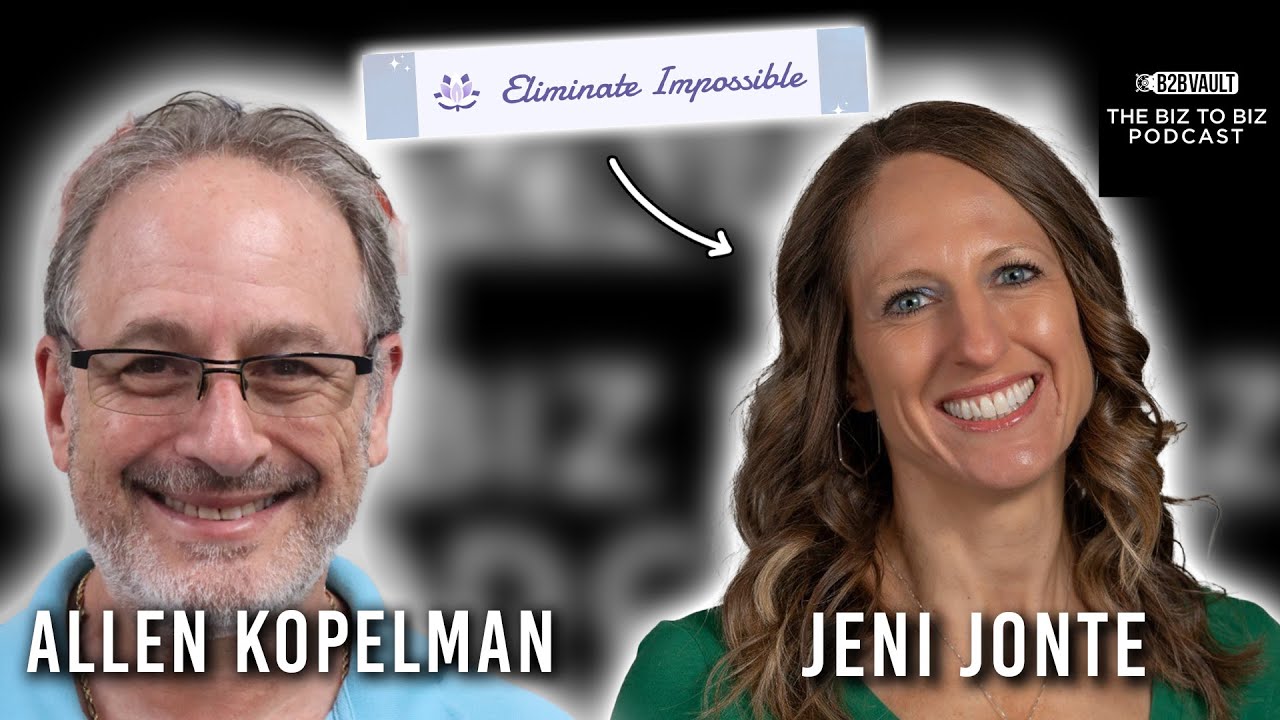
Jeni Jonte left physical therapy after 16 years to start Eliminate Impossible, a coaching firm focused on high-performance mindset. She talks about the "terror barrier" that hits when you set big goals, why specific time-bound goals matter, and how to reframe sales as a skill rather than something to fear.
Chapters
Welcome to the Biz to Biz Podcast, your number one source for all business news. Hey everybody, welcome to today's episode of B2B Vault, sponsored by Nationwide Payment Systems. I'm your host, Allen Kopelman, better known as the guy who's on B2B Vault. And today we have a special guest all the way from Colorado, Jenny Jante, and she has a company called Eliminate Impossible. Allen Kopelman, and we're going to talk about what's going on, how you can eliminate the impossible from your life. And, you know, business people are always dealing with, you know, different stuff. Salespeople are dealing with different stuff. Everybody's dealing with different things in their life from time to time, and we're here to talk about that and how to change your mindset maybe on what and that you can accomplish the impossible. So absolutely, what— tell us a little bit about yourself.
Yeah, absolutely. So as you said, I'm Jenny, and so my company is Eliminate Impossible. I am a high-performance mindset and prosperity coach, so I do primarily work with business owners and entrepreneurs as well as sales professionals in helping them to just pivot, to change the results, and to accomplish things that they didn't think were possible before. So I absolutely love it. And, um, I think you mentioned as we were talking off air, my background is actually I was a physical therapist for almost 16 years before making the switch to this profession.
Yeah, you know, sometimes in life, you know, your first thing that you're doing, first profession or first job that you're in, is not the thing that you're going to do for your whole life. Sometimes, like me, like I was telling you I used to be a chef, and then I decided I didn't want to do that anymore. And I got into the payments business, and there were lots of naysayers. Oh, that's not going to work. And people told me I couldn't be a chef also. That also worked out for me, and I was quite successful as a chef. And, you know, sometimes you just have to, you know, I always— my saying is no guts, no glory. So you have to go for it sometimes in life, you know.
Yeah, absolutely. So that actually brings me to something that I help people work through, is that terror barrier. So, you know, as you set big goals for yourself or you have these big visions or desires of what you want to accomplish, if you are not already programmed to do these things, then you're going to run into that terror barrier. And you have two choices at that point. You could either bounce right back off of it and go back to where you were before, where it's comfortable, but yet you're not getting the results that you want. Or you can push through that terror barrier into freedom and into this new life. So sometimes you just have to be— once you are aware that that's going to happen, I think that helps you to push through it to that next level.
No, definitely. You know, it's, it's scary when you go through a change in life, whether it's Moving out of your house when you're a young, uh, whatever, a young person, and you're going off to college or you're moving into your first apartment, you gotta, you gotta just, you know, you gotta wrap your head around it. As my dad used to say, you got to pull up your bootstraps.
That's what he used to tell me.
He goes, you gotta pull up the bootstraps and get to work, you know. You know, you have to, you know, sometimes I always say, you know, right, if you have a goal, write it down.
Yes. Yes. I know. See, I have my, my goal card right here. I keep it right next to me. So I always look at it and remind myself constantly of where it is that I'm going. I think that also it keeps, if you keep that in mind all the time and you know where you're going, it's a lot easier to push through these fears as they come up. Because you know it's just part of the growth and part of getting to that goal. But if you don't have that goal and if you haven't written it down, like, you've probably come across many people who don't have a goal written down, or maybe don't even have a clear goal of where it is that they're going. So I think that's one of the most important first steps.
Oh, definitely. Like, when I talk to salespeople, I go, okay, what's, what's, what's the goal you're trying to reach? Like, you're, you want to reach an income goal Right. So what do you have to do? What's the number? You know, and I tell them, you know, pick the first number is this is going to pay all my bills. And the next number is the next step. And the third number is where you really want to be. And you have to— you have to have the hunger to get there. I mean, I remember when I first started doing credit card processing and I was just working for somebody and I had to go out and make sales. I was sitting in my car sweating bullets, you know, thinking about how am I going to walk into this business and make a sale and talk to these people? I must be out of my mind, right? And I talked, I sat down and I just looked at, you know, I said to myself, you've got to do this. You got two little kids and you, you know, you don't want to go back into the kitchen and sweat. And work 7 days a week or whatever, 80 hours a week like a crazy person. So you're gonna have to just— you're gonna have to do this. And I did it. And you have, you know, you know, you have to— sometimes you got to step outside of your comfort zone, right?
Absolutely. Yes.
To get to accomplish what you need to accomplish.
Yes. And I might butcher this quote a little bit, but I was just reading this yesterday. You have In order to accomplish something you've never accomplished, you have to do something you've never done. So you have to grow, you have to stretch yourself, you have to do things that might not feel great at the moment, but it's a matter of what do you want to do? Do you want to be comfortable in the process or do you want to be comfortable with the results? So, so many people would rather give things up and live in a means that like, oh, it's okay. I can handle not going on those vacations. I can handle that if it means I don't have to get uncomfortable. Uncomfortable right now, but you need to be able to push yourself through that, through that discomfort. So, and the more you do it, the easier it gets, right? Like, I never thought that I could even sit here and talk to somebody on a camera before. Then now I lost track of how many different podcasts I've been on and, and how much speaking I've done. But the shy, quiet Jenny in the past would have never done this.
Yeah, when I first started to think about doing a podcast, I said, oh, I want to do a podcast. And when I started 3 years ago, it was, it was really hard to find all the tools that I needed. Now, if someone wants to create a podcast, they can do it. They can find what they need. They can find the camera, the mics, the lights, the put up a cool neon sign. You don't have to spend thousands of thousands and thousands of dollars to do it. But when I started, it wasn't that easy. There wasn't all this software and AI stuff and and all that. And I remember listening to this guy Noah Kagan, who started a company called AppSumo, and it's a company that sells software for startup companies on their website. And he said, oh, if you want to start a podcast, you can write to me why you want to start a podcast, and, and he's going to give me whatever. He gave me like $900 and suggested the equipment. To him, and I guess I was one of the winners that got to win.
Nice, that is so cool.
Yes, I still have the first camera and the first, uh, microphone that I recorded the podcast with. And he said, you know, you got to commit to do 100 podcasts. And he said, the first— in the beginning, it's just all gonna suck. And it did. They were horrible. They weren't good. Was not that good. And, you know, you just got to, you know, you have to persevere and you just got to work through it. You got to say, this is what I want to do. This is what I wanted to do. And I've done over 300 episodes and I get interviewed on podcasts all the time. Yes. And I enjoy it. And I remember—
but see, you had to get through that. You had to get through that first part, that discomfort at first.
Right. You got to get over that discomfort and you just got to go for it. Somebody else told me, oh, you're doing the podcast, you're dressed too casual. You've gotta wear a suit and tie. I'm like, no one wants to listen to a guy with a suit and tie on. I mean, even with, you know, I'll talk to founders of companies and, you know, they're a lot younger than I am and they'll be, you know, they'll be all, they'll be dressed in t-shirts and shorts.
I mean, yeah, I think the younger culture doesn't really get dressed up for much anymore, but I think that depends too on like just your image and who you want to portray as, right? So how do you want to show up? And if you want to show up as a casual, comfortable, like making it just a nice conversation between two people, then wear whatever you like, right?
Yeah, I think that you have to be relatable in whatever that you're trying to present when you talk to people, you know, be relatable, be approachable. Not to be this, like, person that, oh, I can't— I've had people call me on the phone and they're— they'll call the office and I'll answer and they'll be like, oh, you answer the phone? Yeah, what's the— what?
They're like, shocked.
Like, I'm not like this, you know, not a celebrity. No one's asking for my autograph.
So, well, I don't know. I think I'd love your autograph if you want to send it to me after.
Okay, I'll send you a swag bag.
Oh, that sounds great. That's awesome. Yeah. So you never got— go ahead.
No, no. I'm saying you have to, you have to do that step out of the, you have to, when you want to, if you want to, and this is one thing I tell everybody, I told this to somebody one time. I said, you want to make more money? They said, yes. I said, you're going to have to get uncomfortable. That's it. Yes, there's no way around it.
No. And there's— I love the saying, like, get comfortable with being uncomfortable. Like, just get used to the fact that things are going to feel awkward, they're going to feel uncomfortable at first. But if you have, like, you mentioned some of your why before as well, with you have the two daughters, to have a family that you need to support. So you have, you have to have a why behind your goal. So you make this financial goal, but you have to say, what is that money for, right? So if you've already allocated created in your mind why you want that big financial goal, what it's going to do, and what the purpose is behind it, and so much is going to go to each thing, then you say, okay, then this has to happen, right? So now you have a huge why, whatever that may be for you, and that is going to help pushing you forward when those moments of discomfort come in.
Yeah, that's what the goal, you know, what is the goal, the end goal? And you do that. It's like I told my— I have a son and a daughter. So I told my son, he was working in a job, and he goes, I love my job. And he was like the top sales guy, but they're not promoting him to be a manager. I said, they're not going to make you a manager. You need to go to a different company. So he found another job, and now he's a gen— you know, you know, he went to work for them, they started to promote him through the ranks, and now he's a general manager of large retail store. And, you know, my daughter 8 years ago called— it was probably like 9, I don't know, longer than that, 12 years ago— called me on the phone, says, Dad, I don't want to do chemistry, I want to be a meteorologist. I said, like on TV? And she goes, yeah. I said, well, then walk down to the office and go ask them what you have to do. So she called me back to tell me the answer, and I go, no, go back in there. And asked them, said, there must be a meteorologist here at the college. This is a big school, University of Florida. And they sent her to see the meteorologist, and she, she graduated. She got her master's degree. After that, she's worked at the same TV station in Iowa for 8 years, and last year they made her the chief meteorologist.
So now she gets to be the person on camera with the—
oh, she was always on camera.
Oh, okay. That's awesome.
She's the boss of the whole thing.
So that is so cool.
You know, I said to her, I said, you're going to be on TV. Like, really? Like, and she's on TV. She gets up at like 3, 4 in the morning. She's a hard worker. She's in there and she does her 3 hours of TV.
And that is so cool. But I love that. So she made that decision that that was what she wanted to do. And she didn't shy away. So she figured out, well, what do I have to do to make this happen? And then just— and went for it.
Yeah, they made this video of her called The First Freshman, and he saw the first— it reminds me of my first podcast, how bad they were, how bad it was, and, you know, to the end. And then, you know, she was— she was polished, but I mean, not like she is today. I mean, today she's just Boom, boom, boom. You know, with her doing her thing.
Yeah, that is so cool.
And no, but that's what I said.
See, everything is possible. That's what I always say. Everything is possible. We are only limited by the limitations that we put on ourselves with our own thinking, the own parameters. We put ourselves into a box sometimes without even realizing it.
Yeah, you don't have to be in a box.
Sorry, that's okay. You're making me want my water too.
I went to Vegas for my birthday, came back, I got a little cold, and I'm just finishing it up. I got the little aftermath. Yeah, but no, you have to, you have to set your eye on the prize. That's the whole thing.
Yeah, absolutely. And to not, you know, I feel like sometimes we, we see ourselves as a certain person, right? So even I went through this when I was trying to change careers from a physical therapist into coaching. I didn't realize just how much I had wrapped my own identity of who I was as being a physical therapist, right? I mean, every time you, you meet somebody, what's the first thing that they say? Oh, what do you do? I'm a physical therapist. And that was just And once I started to try to transition that, I was like, oh, well, now I need to— and I feel like I have to explain a little bit more, you know, when it comes to coaching, because people don't always understand what that is. They're like, oh, a life coach. I'm like, no, no, you know, it's different. But it took me quite a while, and I spent a lot of time trying to do both because I just couldn't completely let go of that idea that I was a physical therapist. I had to, like, hold on to it. And it wasn't until I I finally let that go and fully stepped into this role, that then things started to flourish and take off a lot more.
Yeah, it's, you know, I think anybody, you know, today we saw like during COVID right, people were out of their normal job and then they had to figure out like, oh, I can't go to this job because restaurants closed or the hair salon is closed, and what am I gonna do? And a lot of people, you know, went back to school or started just going for other jobs and changed their life, you know. And yeah, you know, it really adversely affected the restaurant business because it took all these people who were waiters and waitresses and bartenders, and all of a sudden, you know, they figured out, well, there's easier ways to make money than, yes, to do all that, or whatever they were doing, you know. Today we have a whole slew people that are, you know, working at home, that are freelancing, that are, you know, started businesses. I mean, we saw an explosion of entrepreneurship.
Yeah, which I think is really exciting personally. But yes, we do still need, you know, people in the service industries, which is very hard. But just the, the immense opportunity that is available to us now that was not available even just 10 years ago is pretty incredible. So all of these things that we can do now with this stuff at our fingertips and to be able to work from home and to be able to just, you know, create your own schedule and to be flexible and talk to people all over the world. I mean, I've talked— most of the people I talked to this week have been in the Southern Hemisphere. And it's just so cool to get to meet these people and have wonderful conversations where I would have never been able to do that before.
Yeah, it's interesting. When I first, um, I remember I started selling a software product probably about over 10 years ago, and the person who was showing me the software, they're showing it to me on the computer, you know, with the— with— there was no Zoom, it was something else at the time. And they're like, well, this is how you're going to demonstrate the software to people. And I remember the first person, I said, well, let me send you a link, click on it, and I'm going to show you this software. The guy thought I was crazy. He bought, and he's like, wow, that's insane. And I was like, yeah. And I, and I would— I remember I had to go to a company once, and I thought I was going there to do a demo for like 2 people, and they brought me into this huge conference room and there were like 40 people in there. I had to demo this thing in front of 40 people up on it. Wow. And you know, you just gotta— I mean, I was sitting there going Oh, this is like really kind of, you know, I wasn't expecting this, but I'll do it, you know. But that's—
yeah, very different than how you can do it now, right?
I mean, no, I'm just saying, like, you know, I was just really new at doing it, so I wasn't really— I was like, oh, I'm gonna get in front of this group. I mean, I've talked in front of groups before, so— but it's interesting, you know, here we record this, right? And then hundreds of people going, you know, listen on their phone, you know, on Spotify or Apple, and then they're— or they're watching on YouTube and they're learning something. So what would be 3 things, 3 pieces of advice or more that you would give people that are watching this now, that like how you can help them or how they can help themselves or Whatever you— however you want to put that.
Sure. And it's always hard to narrow it down to just a couple of things because it's so, so multifaceted. But I would say the first thing is that what we talked about before when it comes to goals, if you do not already have a very specific big— what I call a C-type goal, which sounds like the bigger goal you were talking about— if you don't already have that and have it written down, so you've got to have it written down. Gotta be specific and put a time to it. If you haven't done that yet, that's probably one of the most important things that you can do. And then the second thing is to really start evaluate your belief system, because if you don't believe, if you set this goal, but your belief system is not caught up to it, if you don't believe that you can actually achieve this goal, or you don't believe that you're worthy or whatever it might be. So if you haven't evaluated your beliefs before, I highly recommend it. It's so crucial because we can never, like, perform outside of what we believe it to be possible. And then also to start to look at your self-image because that's another area you just can't outperform yourself image. So if you do not see yourself as a person who is earning, you know, X amount, say $100,000 a month, then you will never earn that much. So if you haven't read the book Psycho-Cybernetics before, which I'm sure most I'm assuming most of your audience has, but if they have not yet, I highly recommend that book. It's really incredible and it really breaks down into a lot of great detail the importance of your self-image.
Okay, that's interesting. What other books do you recommend?
Oh, I mean, well, there's always— see, I have my copy right here. Think and Grow Rich, of course. So I love that one. And then any Neville Goddard work. So I don't know if you've read any of his before, but I really enjoy his. It's kind of a deeper look at things, and it might not, you know, it might take a few reads to really start to get it, but I really like Neville Goddard as well.
Okay, well, we'll have to get— you'll have to send me some links to the book.
Yeah, absolutely.
We can put it in the notes of the podcast. Always good for people to, you know, learn something. And, you know, you always have to— I always say, like, you have to be a lifetime learner, right?
Absolutely. Yeah.
It's like one of the things, like, I learned something every day. Like, when I'm doing a podcast, I'm learning from you. I'll learn— probably have to pick up a couple of books.
Yeah.
You know, Like, it's funny, like, I'll tell people, like, one of my favorite books, it's like a really quick read, is Who Moved the Cheese?
I love that book. Yes.
And I tell people, I go, when I first started in, in this business, me and my business partner Dave got a phone call and this guy's like, oh, we want you to come to Baltimore, Maryland and learn about this, our company, and, you know, you guys can resell for, you know, become resellers for us, blah, blah, blah. So we go there and the first day the guy's handing everybody the Who Moved the Cheese book, and then he did a little class on it the next day. And that's one, one of the most important lessons that I learned is that, and now like we see this accelerate, you know, that was in 2001, right? So now we're in 2024, but I'll just place myself in like 2020. When you look at 2020 and you look at 2024 and you look at technology, right, in that 4-year span, right, technology is moving at the most rapid pace that I've seen in my entire lifespan.
Yeah.
I mean, we see— we're just seeing, you know, especially with AI. I mean, every day there's something new going on. Cryptocurrency and all these different things. So there's so many opportunities out there for people to do things, you know.
Yeah, absolutely.
And it's just this acceleration. So like, Who Moved the Cheese, you have to think about— like, I used to think about it once or twice a year. Now we— I think about it like monthly. I'm like, well, where did it— you know, where— you know, here's this disruption going on In the, in business, how are we going to react to this disruption or that disruption? You know, how are we going to react to these disruptions?
Yeah, absolutely. Yes. And, and it just— but that too, right? Like reacting versus responding and understanding, like, yes, so things are changing, and then how can I change along with it to make sure that I don't get left behind and so that I can utilize these new things to make my life even easier? So that's kind of, I think, well, at least what I've seen so far, the push with AI. I haven't dove a lot into it yet myself. I know I need to start, um, but I know that that's, that's kind of the idea behind it, right? To help make life easier for business owners. So, but how is that going to happen? And there's a lot of learning to be done in these new areas. Um, you know what I was gonna say too, I forgot about this book because it's for free on my site, is, uh, You Were Born Rich by Bob Proctor. So, um, He's my mentor and who I learn everything from. So that's a wonderful book too, to help start changing the way that you're thinking about things.
Yeah, it's always good. You know, it's always good to reflect and think about like, okay, this is what, you know, you can't just say like, oh, I'm stuck in this one spot. You have to like see like, okay, where do you want to go? You know?
Yeah.
It's like I tell people, like, especially when it comes to sales, I like to talk about sales a lot, but especially when it comes to sales, sales is like the best job. You can set your own hours if you're 1099, but you have to be super self-motivated, you know, versus if you're just an employee, you know, if you're an employee. Yeah, you have to be motivated too. But you know, when you're earning on your own, you have to really motivate yourself to do what you need to do.
Yeah, absolutely. And, you know, sales is a place that I feel like it's very easy to have these, you know, negative, like, paradigms and self-image around sales without even being aware of it. Like, I, I could tell you my first job in sales was for Kirby vacuums, if you've heard of that. So trying to go door-to-door selling vacuums when I was in college, and we'll just say I didn't make a whole lot because I did not see myself as a salesperson, right? I just— it was a summer job, I was trying to make some money, and I just wasn't doing very well. And then I also tried Mary Kay, and, you know, they made you buy like tons of product which I still had 20 years later. And I was like, why do I have this? So clearly I— so from these experiences, I had these ideas that I'm not good at sales. I'm just not a good salesperson. And, you know, through listening to my parents and other people growing up, and they talk about the sleazy salesman, and they just— all these negative ideas were coming to me about being in sales and sales professionals, and I didn't understand it, right? So it wasn't until I started to sit down and look at that and what that really means that I understood that these were the paradigms that have been formed for me around sales and around who I was and my ability to sell. And so if you start to look at that, if you're not performing the way that you want to, so, you know, I, I actually, I love working with sales professionals because I think you can make some really huge leaps by by making these changes inside. And as you said, it really is up to you, right? If you are the one who's creating the, the revenue and the income, so it— you've got to be on your best and you've got to have all of these pieces in place, so you're probably not going to get to those higher levels.
Yeah. And one thing is, is, you know, I tell every person, if you're going to start a business, you're going to be a salesperson. Yeah, you might not like it, but you're gonna have to make a sale because, you know, I had somebody come to me once, they're like, oh, I want to get into your business. So I said, well, what are you gonna do? You're gonna go out and start selling? They're like, no, I'm gonna hire people, they're gonna go sell. I said, well, when they ask you a question about how to sell it, how are you going to tell them what to do? So you gotta, you know, you, you know, if you want to— the same thing, like You know, you're coaching people and somebody comes to you, you have to convince them you're the one they should hire.
Yep, absolutely. And when you start to think about it though, even if you're not in like a sales job, you're selling all the time, right? So even if you were— even when I was working as a physical therapist, I was selling my patient on the importance of them to do their exercises that I give them at home or to come to therapy or whatever it is. Like, you're always selling on something, right? So when you start to change that idea around what it actually means, then it's like, oh, it's actually— it's fun. And there's no ceiling to it. There's no limit to the possibilities of what you could do. So it's actually a wonderful, great profession to be in. But see, it's just that it has this negative connotation sometimes that we just have to flip and think about differently.
Well, that's why it's important to make sure, like, you're presenting yourself, you're, you're being forthright in what you're selling, and you're, you know, you're doing what you're supposed, you know, being ethical. Yeah.
Yes.
And you're, you know, ethical in what you're doing, you know. That's what it always comes down to. I mean, is doing, doing the right thing, you know, because it's karma. Karma can come back right?
Oh, 100%. Yes, it— whatever you put out, you're gonna get back one way or another. So if you look at it that way too, like, we do a lot.
We get, you know, I personally, you know, make, you know, do charity donations and things, and we donate as a company also. And it's important to do those things, to give back to the community, because we don't want to just take, take, take, take, take. We have to give back. Back, you know, to the community. And, you know, part of my giving back is, you know, doing the podcast, and I'm giving back to people, you know, so they can learn things. And also, you know, I write articles in a magazine. It's the same things, giving back to the payments community because it's a payments magazine. So it's important, you know, to do those type of things, you know, for, for your self, you know.
Yeah, absolutely. And I don't know about you, but I always just feel better. I, I love giving so much more than receiving, which actually is something that I had to work through for my business. I'm like, I'll give you free stuff all day long and then never ask for the money, you know.
That's not good. You gotta, you gotta get paid.
So you need a combination of the two. Uh, but yes, I also have, you know, my charities that I love to give to. And for me it's all around, or not all, but primarily around human trafficking because that's just something that has struck me hard and I just feel like it's really important to work on. So that's where I love to try to make an impact in the most way that I can.
That's definitely like something that's out of control right now.
It is.
Yeah. Hopefully that improves.
Mm-hmm.
So if people want to get in touch with you, what's the best way for them to find you, Jenny?
Yeah, so of course I'm on Facebook and LinkedIn. Um, the website bringonpossible.com is going to have whatever events are going on now as well as— excuse me, see, it is so dry here in Colorado— um, as well as that free book that you can get from Bob Proctor. And then it has links to some of my other stuff as well.
Okay, great. Well, we appreciate you being the guest on the podcast today. Thank you for being with us on B2B Vault. You can follow us on Spotify, Apple, YouTube, or on LinkedIn. And hopefully you got something out of this and we'll post links to some of the books that Jenny was talking about today and her website. And everybody enjoy your day. Thank you for listening to B2B Vault. Evolve. Carpe diem.
Peace out.
Peace the day.
More from Allen



How B2B Companies Can Turn YouTube Into a Lead Generation Machine | Featuring Samu Kovacs


How AI Is Transforming E-Commerce with Zero Code | Kumar Senthil, CEO of Firmly



Dre Baldwin on Discipline, Leadership, AI & Business Success | The Mindset Every Entrepreneur Needs

The Same Skills That Made Me a Pro Athlete Built My YouTube #podcast #entrepreneurship #success

