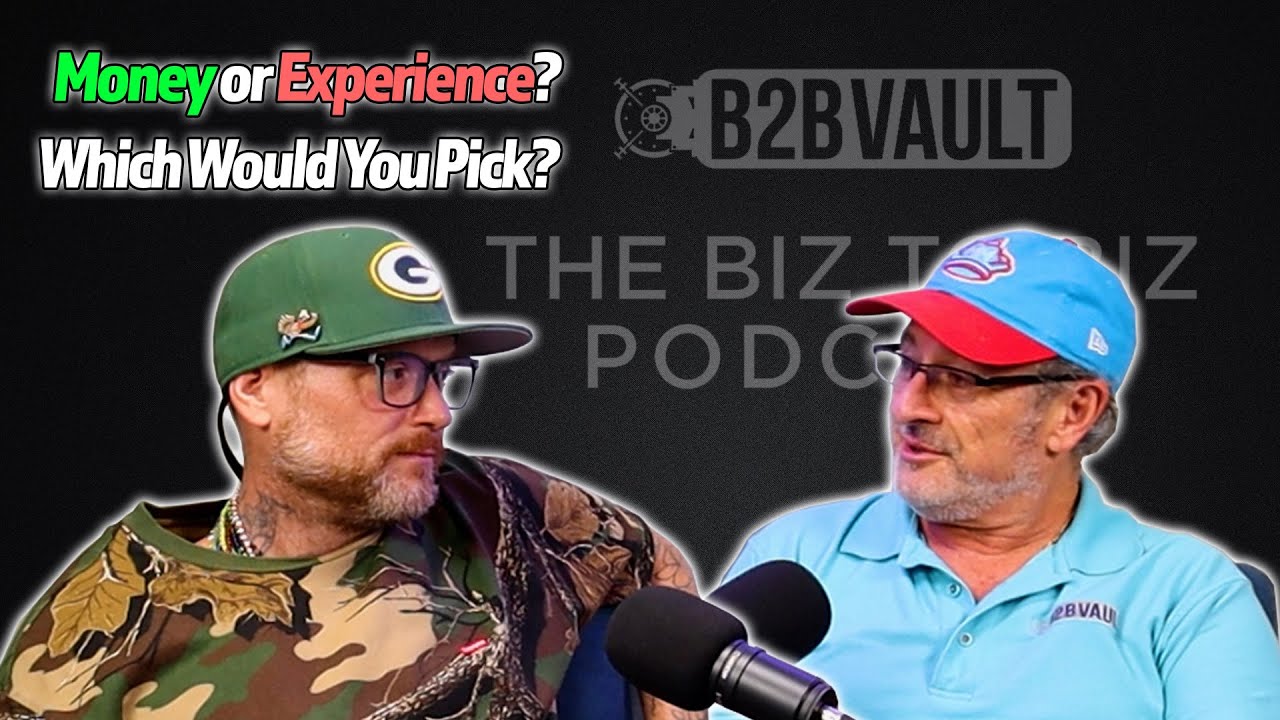
In this episode of the B2B Vault podcast, host Justin (with co‑host Allen Kopelman) explores the classic dilemma of choosing higher pay versus gaining experience. The conversation weaves through personal stories from both hosts, covering topics such as sweat‑equity arrangements, the critical need for written contracts, NDAs, and lease agreements, and the pitfalls of working for free. They recount early‑stage tech incubator work in Milwaukee, an early Bitcoin purchase, mentorship from figures like A‑Sun and Gerald Duran, and a culinary‑school background that taught them the value of hands‑on learning. The hosts also discuss career crossroads—whether to accept a higher‑pay corporate role or stay in a passion‑driven business—highlighting how freedom, family responsibilities, and personal health factor into the decision. Throughout, they stress that experience can be monetized later, but only if it’s protected by solid paperwork and a clear understanding of one’s goals. The episode ends with a call to listeners to keep learning, read every contract, and balance money with meaningful experience.
Chapters
Yo, what's up everybody? It's Justin live from B2B Vault, the biz to biz podcast sponsored by Nationwide Payment Systems, hosted by this guy, the dusty roads of payment processing himself, Allen Kopelman. And we'll be providing you educational information about fintech, small business payment processing, and the technology businesses are using in the world today. And in today's podcast, we'll be discussing a good question. Uh, is it money? Would you take money, more money, or over experience? Um, so it's a good question and it's a loaded question. Um, you can look at it a couple different ways for sure.
Well, I guess that you would go by the time in your life Right.
I mean, we're going to get into it. Yeah. How are you doing?
I'm doing pretty good. It's raining outside.
I like the rain.
So Rocky's not too happy. He doesn't like rain.
No, Rocky doesn't like anything besides dog treats. He loves his dog and his dad.
He likes when Anna gives him burgers and cheeseburgers.
Yes.
What's happening with you?
Uh, Hey man, life, life is lifin', dude, and I'm a lifer. So shout out to all my people on Death Row. Come to Death Row, man, if you don't want your manager dancing all up in the videos, taking all the limelight, all that. Anyway, I don't know, that's a Suge Knight reference. You know who Suge Knight is?
Yes, I know who that is, and he didn't murder Tupac.
Apparently Puff Daddy did.
They arrested some other guy.
Well, Keefe D, he got hired by Tupac. I mean, hired by Puff Daddy. Puff to— this is— hey man, I don't know nothing.
We don't know anything.
I don't know nothing.
Just what's in the newspaper.
Yeah, I just know, uh, you know, I'm just, just here, glad to be here, man. You know, I woke up this morning, some people didn't, you know, so We're here, man. Got to make the best of every day, no matter what you're going through. My teeth hurt. My shoulder hurts. Dealing with some stuff with my kids, you know what I mean? It's just, you can complain all you want, dude, but at the end of it, I don't want to say no one listens, but it doesn't matter. You got to, you know, you got to keep fighting, you know, go through them trenches. Get dig— get dig into that foxhole, man. And, you know, keep on persevering. You know, persevere or quit. You know, I'm not quitting no time soon. But, um, yeah, man. So money over experience. Now, right now, you ask me that question, I'm taking the money.
Okay.
You know why? Because I need it. You know, I got grandkids. And, and my kids, you know, like, I still got two at home. Life is not easy. But so I was thinking about this question, because being a web developer and involved in multiple startups, just, you know, being a part of tech incubators back in Milwaukee, always being involved with like entrepreneurship, right? There comes a time when you are like, either you're gonna, you're gonna, you like, you fall in love with a project, right? Or you meet someone that is extremely passionate about what they're doing. But they don't have the funding yet.
Right.
So in that sense, you know, like, I'm going to take that experience, right?
Right.
Because you're going to see, you're going to learn, you're going to grow, you're going to gain knowledge, your network, your network will expand, you know, it'll take you out of your comfort zone. It's all around good thing, right? Like, I've done this before. Is it easy? Hell no.
One mistake, like when you talk about that, is one mistake I've made in the past is, you know, helping people like with their business and everything. And, you know, I was talking to a friend—
I'm talking about putting sweat equity.
That's what I'm talking about.
Yeah.
And when you put in the sweat equity, you know, when you— when I look back at it, you know, I was talking to a friend of mine. Somebody asked me to help him with a project recently, and, you know, they don't have a lot of money. To, you know, they've dumped a bunch of money in and they still need some help, you know. So I went to them, and I was— after I talked to a good friend of mine, and he goes, you know, that's when, you know, you gotta ask them for an equity piece in their company.
Yeah.
Or their IP. Because sometimes people don't even— they'll develop some, you know, some tech, right? And then maybe they don't have the money to do anything with it, but they show it to enough people, and then somebody comes along like you know, Shark Tank type of deal, angel investors, right? Or somebody comes and just buys the thing, right? And then you help the person, they walk off with a bunch of money, and you walk off with nothing. And that's kind of a hard thing to swallow.
Yeah, I mean, I've been on both ends of the stick, you know what I mean? Like, I definitely felt abandoned, right? Like, oh my God, like, dude, what happened? You know what I mean? Like, you're good and, you know, I'm not, right? But, you know, that's business.
So no, but I'm just saying, I mean, that's a growth—
that was a growth, a growing— a growth moment for me too, because I learned like you can't, you know, take people's word, you know what I mean? Business is business. People have families, people, you know, stuff like that. So, you know, like if you don't have I say that to say this, like, get everything in paper, written contracts, NDAs, you know, make sure your agreements are on point, scope of work, you know, percentages, what you're owed, what you agreed upon, and get it in writing, man. That's it. But that experience of, you know, going through those, you know, those tough times are like, you know, they're great moments of my life. Like, I really, you know, I remember I was working with one of my mentors, A-Sun, and he had a— I talk about him a lot, you know, because he's an influential person in my life. He had a mobile ticketing app that was— it was so you would You could buy your ticket, you could get a coupon for, you know, the vendors or whatever, or you could buy vouchers right from one app.
Right.
It was great idea, Twicketer. We were working with a tech incubator in Milwaukee called Vet Transfer. It's still around, shout out to them. And yeah, man, I mean, it was like, he weren't really getting paid, right?
Yeah.
You know what I'm saying? Like, there was no, there was no money, you know what I'm saying? I was in a unique situation to where I was working with, uh, the DVR, the Department of Vocational Rehabilitation, because I got hurt on the job, right? This is where my shoulder injury comes from, for all of you guys that don't know. Um, so they were giving me a small stipend to go to, you know, to learn a new skill, right? Definitely not a, you know, a— to support your family type of thing, right? Nonetheless, I was extremely grateful. They, they bought me a laptop, you know what I mean? So right then and there, I hit the ground running. So the experiences that I got from, you know, being involved, and being around all that, like the great minds, right, of all the different businesses that were in that tech incubator, dude, there was My man Casey, man, I can't remember everybody's name, dude. You know what I mean? Casey Payne, shout out to you, bro. He's out in like Japan or Taiwan or something. You know, he struggles with some mental health issues, but I hope you're doing well, bro. He's like a super evil genius. I'm not evil genius, but you know what I'm saying? Like, he's one of those guys that are like super smart, right? But he struggles with the, you know, and like, I met all these really cool people. I had an opportunity to buy Bitcoin before it was, you know, we all passed. All of us passed. Like, I'm talking like when it was $25. Yeah, you know what I'm saying? And yeah, that was crazy. So that's like almost 13 years ago, 14 years ago, really. And all those great things that I learned from being around all those different type of businesses, you know, molded me into, you know, who I am today, right? As far as how I operate with business, the way I take on projects, who I work for, you know, it— those types of experiences, you can't put a money— you can't put a value on it. You know what I mean? No, you can't put like, you know, which we, you know, we pay all this money to go to school, right?
Right.
And there's a value put on that. But the real value is the experience you get from implementing those things that you learned. So like, I learned so much while I was there. I never really had a chance to implement it, right? Because I'm working on other projects. So then when I started my own business, I didn't— I won't say I hit the ground running, but I hit the ground walking at least.
Okay. You know, like, you know, when I was at— when I was, you know, when I was earlier in my life, I wanted to be a chef. So I went to culinary school.
Oh, we know.
I went to culinary school. You know, and I took a job and I worked at this place and they didn't pay. They were like the lowest paying of all the jobs you could get.
Right.
Right. But, you know, they had every single department, you know, in the building where I was working at this private club called Capital City Club. And I got exposed to top chefs because the people— it was like a private restaurant. It was dope.
Real quick, before you get finished, I just wanted to— they were talking about this on NPR yesterday. The Palms back in the day, do you remember that?
Yeah, the restaurant.
And it was like a club too.
Yeah, it used to be a private like restaurant.
And that's where like Sammy Davis Jr., everybody would go, like Sam Cooke. I mean like people from back, back in the day, and they would like perform there and stuff. So it's— and now there's like houses there. They, they tore it down and there's houses where they used to be.
I don't know about that. There's restaurant. And I don't know, in Miami. Yeah. Well, back in the day in Miami when I was growing up down here, I mean, you had like the Deauville Hotel, you had the Diplomat Hotel, you had the Eden Rock, the Fountain Blue. And my dad had a clothing store and all like, yeah, you know, Sammy Davis Jr.
and all, all that's what made me think of it because I remember you talking about Sammy Davis Jr. and they like, they, they mentioned like Sam Cooke Oh yeah, all these people.
I didn't even know—
talking about all kinds of people, and I'm like, what?
Oh yeah, they used to—
and they tore this place down.
Yeah, they used to perform. There was about—
probably the reason why they were talking about it was because the— he was saying in perspective that the corner that it was on is now like 8 houses.
I'm sure.
So like, it— you know, that's a big club, 8 houses. On a property.
That might have been a hotel. I don't know. No, but I'm just saying, like, back in the day you had all of these hotels, right, and nightclubs where all these, like, pretty famous people— I mean, we used to have the Jackie Gleason Show and the Jackie Gleason Theater.
A lot of gangsters.
And oh yeah, back— and like all those guys. My dad owned clothing stores on Miami Beach and they would come in there. I remember I would tell my big gazelles on I would tell my cousins like, oh, this person came in.
Or I remember, if you ever think about something that you want to get me for some, some— give me a pair of Gazelles. Okay, I'll take a pair of those.
So, you know, I would tell my cousins like, oh, some rock band came into the store today. And they'd be, who is it? I said, oh, some guys, Yes! Yes! They knew who it was. I didn't know who they were. Or Bad Company.
I'm sorry for getting you off your story.
No, no, but like when I was a chef, right? Dude, you had to learn. And guys used to say, oh, why do you stay late? Why do you do this? Why do you do that? Because the chef would be doing stuff and I would get to work with them and I'd just work for free.
Yeah, that one-on-one time is, you can't put a value on that, dude. I had another mentor of mine, Gerald Duran. I didn't realize how important he was to me until a long time had passed, right? Like we didn't, we don't keep up with each other or anything. I, you know, I wish him the best and everything. He moved out to the Cali. He's originally from Kansas City, came up to Milwaukee, started a school for tech. It was really cool. You know what I mean? Put me under his wing. He taught me a lot about believing in yourself and just like, not, you know, letting— he, you know, he had a tough background, you know, he grew up out in South Central, etc. Well, he's not right. He grew up out, out west in South Central, he moved to Kansas City, then to Milwaukee. That's how we connected, blah, blah, blah. So he grew up, you know, similar upbringing, you know what I mean? Totally different, but similar in its own nuances, right? So we connected on that level. And yeah, man, he taught me so much about like just believing in yourself and, you know, not, you know, going with the grain so much. Like, you know, if this is something that you want to do, specifically it was about my marketing company, right?
Right.
Like, he helped me start that.
Okay.
Um, he gave me the money to purchase the hosting for a year, the domain, you know, the email, etc. He, you know, he set me up, he got me set up to operate. And, um, you know, the things that he— one thing that he really wanted me to, you know, was like faith, right? To like have faith that what you're doing is a good thing, right? Like it's a good thing.
Well, you always want to feel like whatever you're doing in life that you're helping people.
Exactly. Right. So like, and that was because that's the one thing that he always would, he would ask me like, what are you doing this for? Like, what is the end goal? Like, and my thing was I was always trying to help the underdog, the small guy, you know, like the record shop that was next door to Best Buy, right? You know what I'm saying? Like back home in Milwaukee, we still had that type of stuff, right? And I hated seeing those places close. So how could I help them? Well, I could get them their shops online. I could get their businesses verified through Google so that people could find this stuff. And that's what my passion was. But unfortunately, there's no money in that. You know what I'm saying? So like, the experience again, for me operating my business, I operated like that for a long time. And it was, it was hard, you know, but I also gained a lot of knowledge and experience with like getting projects done like that. You know what I mean? Like my reputation for web design is, yo, you need a website tomorrow? JL get it done. But you gotta have some bread. You know what I mean?
Right.
Like, that's my reputation. Because when I say I'm going to do something, I'm going to focus on it, on that only. And that's it. You know, and I'm gonna be done. And that's just, that's like my, I guess my wife's, you know, like, you're ADHD. Like, I just get like, I don't take any medicine or anything. But when I, when I focus in on something, nothing, there's If there's all the other distractions are gone.
Well, you gotta focus in on your, you know, you gotta focus in on your business, your craft, what you're doing. You know, like even when, and then later, you know, like I graduated my chef school, shout out to Don Hamilton, who was my mentor in those days of going to school. But you know, then I was a sous chef, then I became a chef, then I was chef of a whole hotel. And there, you know, and I had a good reputation. Like in the industry in Dallas, I was named one of the top chefs. And, you know, guys, people would come to work at the hotel and everybody who came to work there, I used to tell them, I go, if you come to work here and you work here for a year, you're going to get into, go up to the next level, be a sous chef.
Right.
And then you could be chef somewhere, whether it's in the company. Right. And there was a lot of guys that I got promoted within the company and then guys who left and then later they became chefs, you know, other places all over the country. So I know that, you know, and then whatever. Then I got in this business in a complete accident, worked for somebody, learned, got ripped off. We won't—
I mean, at one point you're gonna have to tell the story. But what's it—
got ripped off about? Not that story.
Yes, you have to tell that story.
Well, the thing is, is when you don't know anything about a business, you're going to get ripped off. You're going to get ripped off. I mean, the thing.
I mean, if you have— if you're running a business and that hasn't happened to you, man, all praise is due to you. Like, I'm—
that's pure luck.
Yeah, like, I don't— I wouldn't call it luck. Whatever. Maybe you did get screwed over and you don't realize it, you know what I mean?
Like, I— like, I'll give you—
or you got screwed over and you just haven't caught it yet.
So, like, I'm in a few discussion groups on Facebook, right, that are for the credit card business, right?
I think it's like a par for the course, right?
Like, it's like you start a business, it's like a band, you got the bad record deal, right?
Yeah, at one point you're gonna get the bad record deal. Why did I do that? I signed that paper too.
So one of the things that gets asked all the time, like in the group, oh, what's the best company? Oh, who's the best? Where am I going to get paid the most? Blah blah blah blah blah. But the one thing that these people always do, and I'll never forget, I never forget this. We send people out contracts all the time, but our contract's very simple. It's 3 pages, just says we get paid, you get paid. Okay, you bring business, you're gonna get paid. If you send one deal in and you never send me another deal, every month you're getting paid. And we've paid people since 2001. We've been paying people every month. And, uh, You know, so the one thing that people don't do, they don't read the paperwork. And we've talked about it a million times.
Man, we talk about it all the time, dude, because it is annoying as shit.
And it upsets me so much, right?
Allen gets a stomachache.
He literally is like, "I'm gonna throw up this day." No, I'll get a phone call from somebody and they're like, "Well, I went to work for this company." They'll tell me the name of the company and I'll just, you know, I start to get ill when they mention 3 or 4 different companies. And they go, and they stopped paying me. And I said, well, you know what, why did, did you stop sending them business? Yeah. Well, where are you sending your business now? Oh, somebody else. Why'd you switch? Oh, well, they offered me more money. I said, well, did you read the contract? And they go, no. It's so important that you read whatever you're signing. Like I have people that send me a contract. Oh, are you gonna sign it? Did you sign it? Did you sign it? Dude, I gotta read it. You send me like a 25-page, document, like, I'm gonna read the whole damn thing. And if I don't— if I start to find 2 or 3 things in there that I don't like, I stop reading it because I already know that there's going to be more, a bunch of stuff, and I'm gonna have to give it to my lawyer and pay them $500, $600, and then I'm just gonna get a stomachache. And if they're that— if they're gonna have so many, like, clauses, clauses in there where they could get out of paying me probably don't want to do business with you.
No. And, um, read your paperwork, ladies and gentlemen.
So it's important whether it's a lease, whether it's a—
especially your lease, read your lease.
I'll tell you how fun— I'll tell you crazy. Wait, the first apartment that I got with roommates, right? The first time I got an apartment with roommates, I had 2 roommates. Okay, well, when we went in to sign the lease, they didn't make you sign for the whole lease like they do now. You signed for your It was 3 people and it was like $250 each a month, right? So I signed for my $250. The other 2 dudes both skipped out. One skipped out in the middle of the night and la ti da was gone. And then the other guy stopped paying rent and he left also. And then the people from the apartment complex come to me, they go, we're going to have to throw you out of the apartment. I go, why? I'm paying my rent. They go, well, you know, the other two people— I said, that's your problem. And, uh, they tried to throw me out. They couldn't throw me out because I was paying my rent.
Your lease there, right?
And they couldn't put just two random people in there because that— they couldn't do it because of the way the lease was structured, right? Right. And, uh, so it ended up like they took me to court. I didn't know what to do, so I was like, okay, I'll just show up. It was like a hearing, wasn't like court.
They try to scare you, right?
So I go to court, I go to the courthouse, and the guy goes— the judge goes, well, what's going on? They give their whole case and want to throw the guy out and blah, blah, blah. And then the judge goes, well, you know, you can't throw him out, he's paying you the rent. This is the way you have the lease structured, you know, you did it to yourself. There's nothing in here that says he's paying his portion of the, of the rent, blah blah blah.
Uh, you're gonna have to sue those other two guys.
So they end up, as, as a resolution, they came to me and they go, okay, they had a one-bedroom apartment instead of a three-bedroom apartment, and that was more expensive obviously, but they knew I couldn't afford it because I was young, I was, you know, not making a lot of money, and they ended up they knew they could rent that place for a lot more.
And so they gave you the one.
So they gave me the one-bedroom apartment. They moved, they moved me to the one-bedroom apartment. And, uh, but it was funny. And then I remember, like, I guarantee you, after that, that company didn't have leases like that anymore. Now when you sign a lease, like, if you have a roommate, you're— each one is signing for the whole rent.
No, I, I wouldn't know. But yeah, no, no, I'm just saying, it's nuts right now. But so, I mean, like, All the experiences. And yeah, man, you definitely need to read your contracts.
But all your experiences, because now, like, you know, it used to be like you went and got a job, right? You didn't usually sign any paperwork at a job. But today, most jobs make you sign some kind of work agreement.
You made me sign a work agreement.
I know that, but I'm just saying, like, a lot of jobs probably didn't do that 20 years ago.
Oh, no, no, no. Now everywhere you go, especially in tech, you got to sign an NDA or whatever. I mean, I've been signing NDAs for the past 15 years. Yeah, you're signing an NDA.
NDA, you're signing a non-circumvention agreement, you're signing work, you know, that the work belongs to the company.
I'm gonna be— this is, you know, I don't know. When I first started working here, I got a job offer for $82,000 a year to be the digital marketing director for Bright Star or something like that. I don't know, something in Fort Lauderdale. And I'm like, man, that's a game changer for me, right? It changes my life. But I'm a loyal person, right?
Yeah.
And when we first talked, we, you know, we talked, we said that we'd be up to here. We ain't got there yet, but whatever. But, you know, I was looking at— I was weighing these two positions, okay?
Yeah.
And being a digital marketing director for a small business versus being that for a medium-sized business with people underneath me, it's a lot of responsibility.
Yes.
This is pretty much what, right after COVID for the most part? And, um, yeah, it was 2022, right?
Yeah.
And I'm like, you know, I'm learning stuff, there's stuff that I didn't know about. I'm gonna be doing the same old shit over there. Losing my mind because people are like, I'm not a great teacher. I'm not a teacher. Like, I don't— my wife was telling me yesterday, like, when you correct someone, you literally make them feel like this very small person. And I do not intentionally do it. It's not my job, right? Like, that's not what I'm focused on doing. And when I'm explaining something, it's just not I just, I don't know, blame it on my parents. Um, so I declined. The owner of that company, I can't remember her name, I hope she's doing well, she was like sad. She was really sad. We had like 4 interviews, blah blah blah. I was supposed to come and see her. Um, my wife, I talked, you know, like, because I'm a loyal human, right? So I'm like, yo, this woman wants me to come work for her, so I have to talk to my wife about it. Like, this is weird. Like, she approached me, she— it was all like really random stuff, like LinkedIn, and then I got a text message. I'm like, whoa. Anyway, uh, I declined and I stayed, and, uh, I don't regret it. Um, I've learned a lot about, um, payment— the payment processing industry. Um, this is our 200th podcast. You know, I'm going to therapy, all these other things like, you know, that you— that we take for granted. I would not have been able to do working at that agency. Right, right. So I took experience over money. I don't know where that leads us. But you know what I'm saying? Like, I'm just trying to make more money. So we're all trying to make more money, right? But it's important to have a positive experience throughout the day too, right?
So like, believe me, I've been offered jobs where someone's come to me and go, hey, we'll buy your residual stream, right? Or part of it. And then you can come work for us, right? And I'm like, dude, I will be the worst employee. Like, I get up in the morning and I do my thing and I roll in here. When I feel like it, but I'm working the whole time. Exactly. But if you work for somebody and they say be at work at 8:00 or 9:00 in the morning, guess what? That's what you, you got to do. And then they say, oh, I want a report and I want this and I want spreadsheets and I need analytics and I need all this kind of stuff. The, you know, you got to go and produce all of that stuff.
Yeah, man.
And that can be difficult. You know, and, uh, certain, you know, that can be difficult to, you know, you have to weigh it out. Sure, I could have got more money, but then I would lose my freedom.
Yeah, that's a— is a— I mean, that's— I mean, having a business and then going to get a job, you know, it's like, that's the freedom, right? Like, anyway, but part of me, man Thanks for listening. I hope you got some something out of that. That was cool. That was a pretty good discussion, actually.
You could get— it's always good when you're younger, gain as much experience as you can.
Yeah, but don't screw yourself either, though.
No, don't screw yourself.
Get paid.
Yeah, get paid.
GPI, get paid instantly.
I guess if you can.
If you can, but take— don't not do something because If you really want to do something and it's really something that you're passionate about, but the money's not there, I would say take that experience and then use that to make money.
Yeah. And then use that to leapfrog into the next— into your next position or maybe a business because there's things, you know, it's, it's all out there. People, people, you can— you, you have to have— you have to commit yourself to grow. You know, you have to grow and keep learning and all, and all that. And, you know, that's why we do the podcast, because we're passing on, you know, our experience in life and business and sharing it with other people, the struggles we've gone through.
And then, you know, spit it out, the struggles we've been through.
That's it.
Yeah.
Struggles in my life. Yeah, no doubt. And, you know, up and downs. And, you know, and the same thing, you know, everybody want— everybody out there is trying to make, uh, money amongst the everything, and you have to weigh out money, experience. Sometimes the money is not worth what you might have to do.
All money ain't good money, right?
What you might have to do might not work out. So peace out, carpe diem. Hope you enjoyed the pod.
Hit subscribe, like. Every Wednesday and Friday for the most part, you know, we might miss a couple of them, but yeah, man, peace.
Peace out.
More from Allen



How B2B Companies Can Turn YouTube Into a Lead Generation Machine | Featuring Samu Kovacs


How AI Is Transforming E-Commerce with Zero Code | Kumar Senthil, CEO of Firmly



Dre Baldwin on Discipline, Leadership, AI & Business Success | The Mindset Every Entrepreneur Needs

The Same Skills That Made Me a Pro Athlete Built My YouTube #podcast #entrepreneurship #success

