Roger McNamara, Director of B2B Acceptance for Visa | The Biz To Biz Podcast
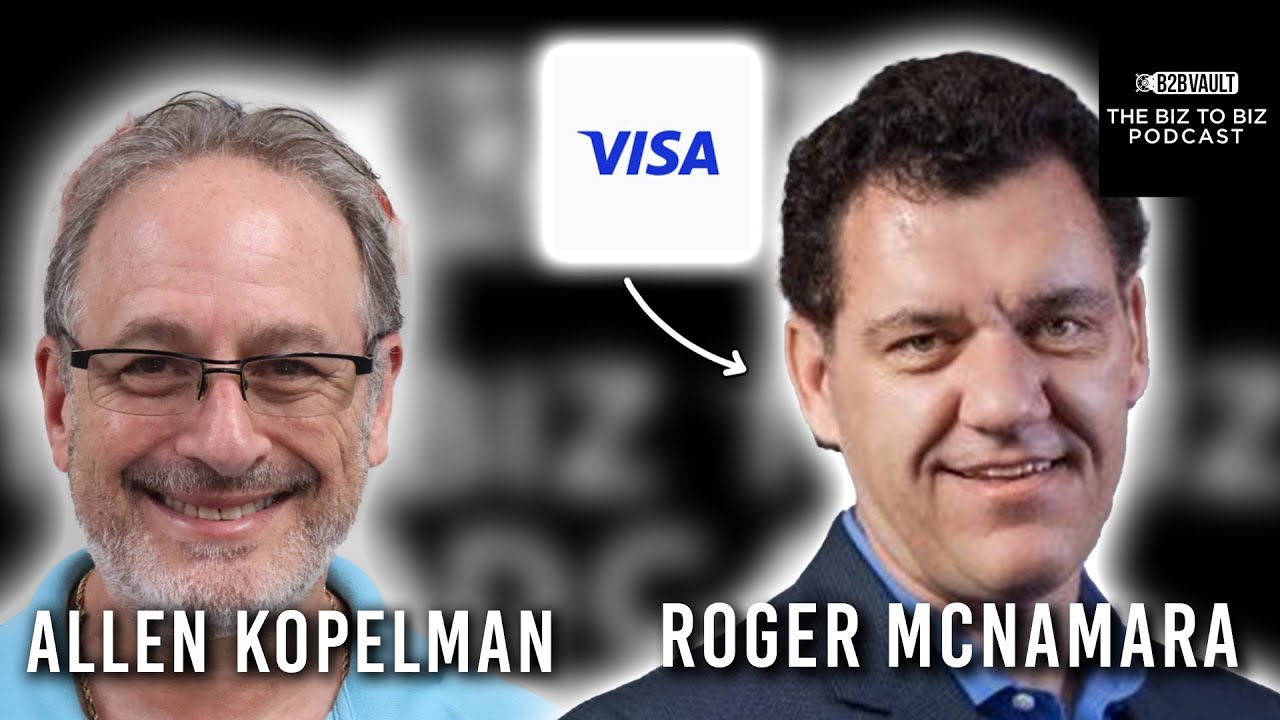
This content was created by Allen Kopelman. This content was uploaded by Allen Kopelman. This is a YouTube podcast episode titled "Roger McNamara, Director of B2B Acceptance for Visa | The Biz To Biz Podcast" (published 2025-05-02). It is an interview-style conversation hosted by Allen Kopelman with guest Roger McNamara (Director of B2B Acceptance, Visa). They discuss B2B payments topics including the economics of card acceptance, acceleration of payment terms and time value of money, Level 2/Level 3 data and interchange optimization, virtual/single-use card growth, fraud prevention and chargebacks, technology integrations (ERP/QuickBooks/NetSuite, APIs, webhooks) and no-code payment portals, and the large growth opportunity in B2B payments. The conversation is informal, targeted at merchants and payments professionals, and recorded in English.
Chapters
Welcome to the Biz to Biz Podcast, your number one source for all business news. Hey everybody, welcome to today's episode of B2B Vault, sponsored by Nationwide Payment Systems. And today we have one of— somebody that I know for a super long time. I'm going to tell the story in a minute. Roger McNamara, welcome to the podcast, Director of B2B Acceptance at Visa. How are you doing today, Roger?
Good, good, good to be with you, Allen. Great to see you.
So it's a funny story. I used to be— I used to own a restaurant in Boca Raton, and one day in comes Roger McNamara. Now this has to be close to 27 years ago because I'm doing this for 25, so maybe it's longer than that, about 28 years ago. Yeah, both way younger. And in comes this tall guy, Roger. He says, how come you don't take American Express? And he signed me up for American Express at my restaurant. Then about 5 or 6 years later, I'm in line at lunch at the Southeast Acquire Show in Orlando, and I hear, Chef Allen, what are you doing here? And there's Roger. And ever since, you know, we've been connected in the payments and, you know, we were connected in the restaurant industry and then in the payments industry. Yeah. For, you know, many years now. And today we're having Roger on the podcast and we're going to talk about B2B, which Roger knows is one of my favorite things to talk about. We love working with B2B clients and helping them, and Roger is the expert on B2B with Visa. So Roger, tell us a little bit about your career. It's been a long— you've had a long career in payments, just like—
yes.
Wow.
So yeah, again, great to be on the show, Allen Kopelman. Um, follow you on LinkedIn. You get a lot of great guests on here. So my, uh, journey in the payment space has been Incredible. So, um, 1992, I started with Amex in Florida. I was a local rep. Um, that's when I met you. I, uh, got in and out of the car probably 100 times a day because no one back then really took American Express. It was, it was not long after what they called the Boston Fee Party, which was when merchants revolted, uh, against, uh, Amex. Um, worked as a rep locally for about 8 years. Um, great market, South Florida, to be in. We referred to it as the 6th borough of New York because there were so many New Yorkers here at the time and then graduated up in '97 or '98 through national sales and then really hit my stride at the enterprise level with Amex, you know, for 15, 17 years, signing some of the biggest players out there, you know, SeaWorld, JetBlue Airlines, cruise lines, hotel chains. It was kind of a who's who. Um, in 2020, well, around the '15, 2015, we changed, uh, strategy at Amex and B2B became the, the, the flavor of the day. In actual fact, we kind of ran out of, um, business-to-consumer targets back then because, you know, once they're signed on the Amex network, it's over. And, uh, we shifted to B2B and that was a kind of a reinvention of myself and others in the organization. After that, you know, worked in, in B2B payments for a number of years, led the national sales team there, signed, you know, billions of dollars worth of B2B spend on the network. In 2020, I left. In 2020, I left. I started a company, Allen, you're very familiar with called Guide to Interchange.
Oh, he froze up.
One training independent sellers with the opportunity to sell in the B2B space. There were lots of guys out there talking about how to sell in business consumer, but no one was working with the independent channel to teach them how to sell in the B2B space. One of my clients happened to be Visa, and from that, I think a, a opportunity arose, and I was hired a little bit after that in 2021 to be a director there in the B2B acceptance space. So I've been there 3 years. Manage a portfolio of roughly about $60 billion in spend to some of the biggest B2B players out there. And who've never really talking to the network, you know, they talk to the acquirer processor, but don't really talk to the network and what it, what we do. So a lot of education work to talk to suppliers about how they should be accepting payments. And I know you and I'll probably get into that here in a little bit. But yeah, And I've been there to this day. So I'm in my third year at Visa, great place to work, tons of opportunity. And not to mention, you know, B2B is on the up and up. So, you know, plenty for us to do and talk about.
Yeah, B2B payments, you know, when we always, you know, we always dive in with clients and it's always interesting to find out like how do they do it? A lot of times they don't understand, people don't understand about chargebacks and, you know, it's so, it's, you know, it's always, you know, educational process of how to, how to thread the needle with, you know, B2B clients. You know, we have a ton of them at Nationwide Payment Systems. We work with a lot of B2B. So, so like what, you know, obviously, you know, I know we always talk about Roger's favorite thing is the time value of money, right? This is something I learned from Roger. But one of the things is, is that with interest rates going up and, you know, merchants having to access like their, you know, lines of credit, credit card processing is a lot cheaper than doing that.
Yeah, you raise a good point. So, you know, when I got into B2B, there was lots of volume that existed today. There's lots of volume out there today in B2B. So, you know, if you're an acquirer and you're going out and you're talking to a vendor today that's taking cards, it's very important to determine how they're taking cards. So let me give you a typical scenario of what I see when I go to market. I'll go into a merchant and we'll talk to them about accepting card, and they invariably will offer term to their buyers. So I buy steel and I buy $1 million worth of steel, and that steel provider gives me net 30, maybe net 45, maybe net 60. If they're really crazy, they give net 90. And, um, they're signed up for card. And then at the end of the term process, the buyer shows up and expects to be able to use card. Now let's think about that for a second. The supplier has financed the receivable. Now this is very different than our B2C world. As you know, Allen, right? In our B2C world, I go into Macy's, I buy a pair of pants, I walk out with them, the transaction is over. But in B2B, what is fundamentally different is the fact that That supplier is waiting to get paid for his money. And where I spend an awful lot of time with merchants today is to show them the economics of acceleration. So, you know, if you have a, a buyer on net 45 or net 30, and you say to them, listen, we're willing to take card from you, but we need an acceleration of that payment term to let's say net 15, that 15 days is huge to that supplier because as you pointed out, the cost of capital today is near record highs. So, um, in addition to that, when you accelerate, there are things that happen in the transaction that provide additional cost savings for that supplier. So if I'm getting my money faster, then by definition I'm more efficient because I probably don't have a duplicate invoice at the end of the month. I'm not chasing down a payment. I'm not credit risking that customer. All those things associated with it. In addition, we've gone through a period in this country of extremely high inflation, and when you get your payment sooner, you mitigate that inflation because as the invoice sits out there, you beat that inflation effect. You bring that cash into your business and you spend it out faster before prices rise. The fourth thing, and most people don't really even talk about this, is the cost of credit is a business expense. So as such, a business expense there are tax implications there. Now, I'm not a tax attorney, I never purport to be, but I am told by some pretty smart people that the cost of credit is a tax-deductible expense. Because the cost is higher, that write-off is significantly higher. And then the fifth benefit is, you and I talk about all the time, is in B2B, when you pass certain data in the transaction, rates are much lower. Give you an example, um, Level 3 interchange published is 1.90 and 10 currently. Large ticket interchange is 1.45 and 35. Now, by the time you look at those rates, you look at those benefits, and you present them to a client with acceleration, the cost of credit, when you do the numbers on it, is generally less than waiting for an ACH payment at 30 days. Now, this is astonishing to finance people when you show them this, because in their minds and what they've been taught by others and what they've seen in the marketplace is credit couldn't possibly be a better collection tool when in fact, under the right circumstances, card is the most effective collection tool that you can offer your clients.
Yes, card is definitely the most effective collection tool. The thing is also when, like, especially when we're setting up merchants, we make sure SIC code is super important. So that they qualify for these B2B transaction rates. 100%. And that they're using the Level 2 and Level 3 data so that they're inputting invoice numbers, POs, the product code, and things like that, that lowers that interchange down. So from maybe the mid-2s, you can be into the high-1s, mid-1s.
Yeah, it's a beautiful thing. And there are a lot of people out there through optimization or making sure that they're passing that correct data. And when you do, you can avail of those lower interchange rates that are out there. So yeah, this is one of the reasons that issuing banks are, you know, not stopping in their quest to issue more commercial plastic out there. You know, B2B payments are growing, virtual card payments are exploding today.
Oh yeah, we have a ton of merchants that get paid with virtual card payments and especially on like large ticket, you know, $100,000 to, you know, upwards into the $500,000, up to $1 million. Sure. Put on a card for B2B transactions on like wholesale electronics, plumbing parts, all kinds of, all kinds of things. And people will put it on a card because, oh, maybe the price is going to go up. On a product and they're like, okay, well, before price goes up, we're going to go and buy everything we can and just put it on plastic.
Absolutely. Absolutely.
To float it for 30 days.
Yeah, because that's the benefit to the buyer. The buyer uses card, he's getting rebate, he's getting reward, he floats with the issuer then, but the supplier gets his cash faster. So it's a kind of a win-win for everybody. You know, B2B payments is out, is about balancing out the approach. You can't have one person take all the spoils. That doesn't work. This is a different approach. And I think, you know, in our industry, we've fallen down a little bit because people in B2B without guys like you, Allen, that go out and explain this to them, think they're buying it like it's a retail transaction and they're not. They're buying a different process.
Yeah, we try to explain it to people and, you know, we also tell them like, hey, when you're selling big items, don't just send somebody a fax or an email and say, oh, fill this out. You know, you should be using DocuSign or Adobe Sign, getting them to sign off on the PO, the invoice, the authorization forms so that, you know, especially from somebody new that you don't know, it's super, super important to protect yourself to make sure, like, and making sure you're not shipping to addresses. This is something I explain to every client, whether B2B or B2C. You don't want to be shipping to an address that comes up and it's a freight forwarding office or anything crazy like that because you're probably about to get ripped off.
Yeah, yeah, for sure.
You got to be super, super careful, you know, because, you know, businesses that they don't— you have to train your employees like how to spot fraud so that you don't get defrauded because We've seen businesses and I'm like, what are you guys doing? Like, you didn't— you just took the card over the phone and, you know, and if the person's going to show up at your business, you know, or they're not showing up or the person's in another state, you know, that's why you need like DocuSign, PandaDoc. We just helped one of our clients and we were like, you know, they were getting bigger. They started getting some chargebacks. I'm like, yeah, let's look at your documents. And I said, you guys need to use it. I told them, you need to use electronic signature. Then they started using it and then they got a couple of chargebacks. They won right away.
Sure.
So it's important, you know, that you're doing, you know, we're in the electronic age.
Absolutely. Absolutely.
So, you know, the other thing that's crazy is AI has gotten so good right now that I guarantee you, if you took an image of a credit card front and back and put it into ChatGPT, and said, change the numbers on there. I guarantee you I haven't tried it yet, but I guarantee you ChatGPT can produce a front and back of a credit card that looks very real.
That's scary. But, you know, you mentioned, you mentioned chargebacks there, Allen, you know, so sometimes, you know, people frown upon the chargeback system. Let's, let's think about it in a different way. If you're a business today and you're conducting ACH payments and God forbid you send a payment to a wrong bank account. Trying to get that back is an absolute nightmare.
Oh yeah.
In our industry, we have a proven system between acquirer, buyer, supplier, everybody associated at the issuing bank. And you go through the process and it's documented and gets resolved. Um, and you know, it's there, that system is set. Unlike some other payments where, you know, if you have a wire fraud or you have ACH or you have something that goes awry, it's very difficult to recoup those funds.
Definitely. Yeah. It's, you know, with ACH also people can— or wire, they can do a clawback. So, you know, I think for me what I do is I just have a separate account and I sweep it.
There you go. Smart.
Especially if it's somebody I don't know who I'm doing business with. So what do you see as the growth potential in B2B? It's still growing because many customers in the B2B area are not taking cards still. There's still a lot of paper checks going on or send me an ACH kind of a deal. Yeah, they don't tell the customer, send the ACH to them.
Well, there, there is no doubt that B2B payments are growing. Um, we are, uh, at about 8% of total payments today. Um, ACH is still, uh, the king in this space. I think it's running around 38 to 40% of all transactions. Check, astonishingly, although it won't die, is still, uh, out there. 37, roughly 37, 36%. I see a payment still on check. Astonishing numbers. And I think it's more habit than it is people want to keep writing checks. The consumers have gotten rid of it. The businesses are having a little bit more difficulty, but, you know, I see huge growth in the B2B space. One of those things that I've said before is the massive growth in, in virtual card payments, single-use cards, no PCI liability, you know, having the ability to process though in an STP fashion is unbelievable. Visa even has its own product now for doing this called AR Manager. So, you know, you walk into a business today, they're taking virtual cards and they're saying, hey, I keep seeing more and more of these every day. And that's because the issuing banks are out there taking payment files and converting those payment files to virtual card spend. So that's where I see some huge growth. I see technology being a huge factor here, the processing of virtual cards, You know, and I see the value proposition is solid on both sides of the equation. There's a solid proposition for the buyer and there is, as I've explained, there's a solid proposition for the supplier.
And there's also like a lot more payment integrations into these B2B ERP systems like NetSuite, Acumatica.
Absolutely.
QuickBooks Enterprise level, things like that. Where we're doing, you know, a lot of integration. So it's not like on the side, it's within their system that they're already using.
Absolutely.
Even inside things like Salesforce or other CRM systems that B2B companies are using.
Yeah, yeah. You, you know, there's a ton of technology that's taking place today. You know, it doubles every year. It seems like the amount of players that are out there and excellent solutions in marketplace, you know, when you go to Southeast Acquires or Midwest or, you know, and Northeast, you're starting to see more and more representation from the B2B players. I, I like to say this about B2B. So I think of the business-to-consumer world that you and I cut our teeth in many years ago as fully subscribed. Let's think about this. There's not too many industries within business-to-consumer you can't use plastic. And I refer to that as kind of a swimming pool. And I say, wow, that swimming pool's a little crowded. A lot of people selling in it. Margins are compressed. And then I say, well, B2B is an ocean of opportunity, and there's very few people in this ocean. And, you know, if you look globally, it's about a $120 trillion opportunity. In the US, it's somewhere in the $20, $25 trillion, uh, opportunity size. Everything that's on ACH, everything that's on invoice, everything that's on wire, everything that's on check is capable of being put on card. So there's tremendous growth. You know, finding people out there to go out and capture that business on card is, is a real opportunity. And you're doing it, others are doing it. But I think if more people focused on B2B and really and truly understood the economics of it, there'd be much more success because it's a common question I get when I go see a large supplier is, you know, hey, why should we take card? And I say, hey, if you want to improve the economics of your business, here's what you should do.
And it's definitely— it's definitely a cash flow in the plus side on your cash flow. We even see companies that are doing millions of dollars a month that work with us and they're like, okay, we want to do the surcharge program. Because we'll pass— they'll pass something like 1%, 1.5%. And at the end of the day, when they do a mix like that where they're offering credit card and ACH, giving shorter terms like what you were talking about, instead of these 30-day terms, they're pushing out 7, 10-day, 15-day maximum terms. When they put that combination together, which we put into one portal now for them so you don't have to use you're not using two separate companies, you're using one company ecosystem for credit. And when they— at the end of the day, I had this client that does a few million dollars a month. They had their accountant call me one day. Oh, we're trying to figure out how much we're paying for acceptance. So I figured out— I said, well, you spend less than 1%. The guy was in shock. He's like, how is that possible? He goes, I was at another company previous to this. They're spending over 3%. I say, well, probably they don't have the right SIC code. You guys are passing a 1% fee. The people who want to pay it pay it because they want the miles. The people who want to use ACH just pay you anyway. And I said, well, how's your cash flow? And they said, oh, ever since they started using this system, which was right before COVID um, they said their cash flow, you know, increased like insane.
Yeah. Well, it, you know, as you know, I'm not a big fan of surcharge. I think people surcharge because they don't understand value. And I would say that a lot of the clients that I talk to in B2B, I give them the antidote for surcharging. And I believe accelerated cash terms are that. So if you're worried about cost, your line item cost is growing because you're accepting card post-term. You're accepting it at day 45. You've given away the house in, in term, and now you're paying the freight for the transaction. And we say, okay, back up that train a little bit, put terms out there for card that accelerate your cash flow, give you the value, and you no longer need to have to assess a surcharge to the buyer. Now, what does that do? That gives the buyer more opportunity to buy. More frequently, makes them a better lifetime value customer. It's just a better opportunity. It just rubs buyers the wrong way when they're pegged with a 3% or 2.5% surcharge.
Yeah, that's why I see like in B2B they ask much lower, a much lower fee, 1%, 1.5%. They're not doing 3% or 4% like you see in the, in the consumer world.
You know, 4% would be a problem, right?
4 is the maximum. But if you have a really low ticket, you have to pass 4 because—
Yeah, I think you might want to check that. 3 is the maximum that you can pass on our network.
Oh, on the network. Okay. So everybody, we won't get into a discussion about that because that can be an entire podcast. We need a lawyer. So what? So from a technology standpoint, like you were talking about, where there's so many tech, you know, a lot of businesses now, like we see them using a ton. I don't know why, but in the last 12 months we have converted a ton of people and I'm talking about businesses doing a million plus a month. They were that were using really, really old technology to process payments and to process because people don't realize like you can get an API AI and a webhook and just be sending out invoices with a link, with a one-time use link on it. Yeah, to your customers. And then webhook that back into your, into your software, and you're saving tons and tons of time on your accounting and all kinds of things and speeding up your cash flow. I think a lot of businesses are starting to realize like, hey, we need to put technology to work and stop using outdated technology. We even had a client that were getting a PCI fine from a processor I won't name that was 2% because they had computers in there that were on Windows 8. I was like, what are you guys doing? We did an assessment. We're like, listen, all you need to— you don't even sound like you got to spend $3,000 for a computer today. Sure, you buy a computer for a few hundred dollars unless you're storing a bunch of information on it. You don't need a giant computer, you know.
Yeah, yeah.
Well, with a terabyte on it, and we ended up saving them thousands of dollars a month and they just didn't realize like, oh, that, that, that matters, that they were out of compliance. Yeah. Yeah.
Well, yeah, there's a ton of technology. I think, you know, I divide the market up in my own head kind of in 3 ways. You know, there's the enterprise-level technology that is out there today for the big boys. Then there's the middle tier. And then you have small business technology. And I think in the small business space where a lot of independents operate in, we've seen a rapid deployment of really cool stuff, integrations that you mentioned before with QuickBooks and all these things, embedded payments so that people can, can settle invoices quickly and efficiently. I love your story about the link, sending out a link and hooking it back. You know, think of all the downstream effects of that, that that has. No PCI because you're not touching cards anymore, no fax machines burning up with card numbers on them. And expiration dates—
employees don't get access to the credit card numbers. And you're—
it isn't— yeah, super safe. So technology has really gone, you know, a long way towards it.
Um, one of the things that we're getting ready to release is— we already have it out there— where we can build basically it's a no-code payment portal for where someone has to log in You know, a lot of lawyers and accountants like it. You have to log in, create an account, and then make your payment. And literally it's a no-code portal. There's no coding needed. You just basically build it inside of the virtual terminal, put in your logo, put in your message, what you want there, you know, telling the customers what to do. And then boom, you just have your web guy just stick a hyperlink on your web page. Someone clicks it. And they pop into a branded page and you're on the payment processor's server, which is at the highest level of PCI. So you don't even have to worry about PCI compliance at all with this no-code, these no-code links that you can use. And that's— you're able to use them for e-com soon too. Yeah.
And that's huge because a lot of the perceptions about using card in B2B are things like that. I don't want to store a card. I don't want to see a card. And it's like, then you don't have to, you know, that was 1990s stuff, early 2000s stuff. Now we've evolved and now we've got much better systems in place to be able to streamline these transactions.
So for— so for, you know, for merchants out there that want to— you're not taking card right now, give Give us some good pointers on what— you know, give us the main pointers on why they should be accepting card.
Well, if you're a business out there today that you're carrying receivables, you know, 30 days or longer, if you're 45 days, if you're 60, 90 days waiting for your money, card is an excellent acquisition tool for your cash. You can use card to accelerate terms to your buyers. In other words, We have a lot of companies that come to us today and they say, hey, I'm having trouble with a certain portion of my receivables. Well, let's make a proposition to those folks. Hey, if you'd like to use card, the supplier will accept card and his term on card will be net X. And that usually is enough for those people to say, wow, hey, I didn't know I could use card there. I'd love to use it. Yeah, I'll accelerate my payment because I understand the value of what I'm getting on the back end of that transaction. So in B2B, I talk to players all the time and they're, they're saying to me, yeah, you know, the biggest issue I have is labor and collecting funds. And I'd say, well, talk to me about collecting funds. What are you doing? Well, we're doing the same as every other business. You know, we're dialing for dollars every Friday. We're looking to see which of our vendors, buyers are willing to pay us. And I'm saying, hey, make it easy for these people. Don't make it hard. And the barrier for them is they, they've been conditioned to believe that card is the most expensive option they can offer. And the reality of it is when you look at it holistically and you accelerate it, it can be mere basis points to accept it. You described before. So, you know, the, the notion that card is not a worthy adversary to ACH, check, and wire is absolutely false. I argue that is, as we've said twice already on this podcast today, it's the best collection tool you will ever have if you use it properly.
And when you're get— when you're talking about like giving terms, you know, when you're getting like new customers, that's— those are the best people to train. Okay, you got— we only take card, only take card, only. Then you got to work on your existing customer base to fold them in.
But the easy—
that's what I explain to my clients. I'm like, yeah, get all your new clients as they're coming in, right? You get them on the card train and then you at the same time you start working on your existing clientele.
The perfect business has no receivables. Now, businesses will tell you all the time, oh no, we can't do that. Our competitors do this or do that. Sure you can. New customers, they have the product you want, you buy it, you tell them what those terms are. Card is X, they'll settle their debt with you and use it. In fact, the opposite is true most of the time. They can't believe that you actually want card because they're so conditioned. They're so conditioned to be told no. But now when you say yes to them, it frees them up and it makes them, as I said, better customer. You know, let me give you— let me give you a great example. One of my leaders at Visa uses— if you have a customer and you have them risked for $1 million a month, that's $12 million a year. But if you move them to 15-day pay, you now have the ability to sell them $24 million worth of goods. So you double your exposure to that buyer. So think about that. If every business out there could look at their business and say, hey, I sell $1 million a year. If I could sell $2 million next year, how would that look? Sometimes they don't wanna sell to a business because they meet— meet the buyer has met their maximum exposure to the supplier. But a card gives them that opportunity to open that up because if the issuer gives the limit, then guess what? You've doubled your ability to sell to that buyer.
I've even had B2B clients ask me, they go, well, why would someone want to put it on a card? I'm like, first of all, they're getting the same float you're offering them and they're getting whatever they're getting because they're not going to pay you with a card, 10, 20, 30 grand unless they're getting cash back, miles or points. Yeah, they're getting something for that spend.
Yeah.
And a lot like we have this one, we have this one client, they have a guy, his bill was like $500,000 a month, every month. And the guy pays it on a credit card every month. The guy puts $500,000. It's a company they're paying for their accounting services.
Sure, sure.
And they have tons of customers who are on recurring billing. They don't even send them a link. They just sign the paper. Oh yeah, recurring bill. That's our, our retainer is $100,000 a month. We have attorneys' offices like that too. You just set it and forget it.
Yeah. And sometimes, you know, there are certain industries out there that are very reluctant card, you know, professional services is one. The gross margin in professional services is sky high. So these are people who should be able to afford, but by looking at accelerated payment terms, it gives them every option to accelerate that cash and even improve their gross margin. So an already high gross margin, you can improve it with cards. So that's a little counterintuitive for most people to grip. But when you get in there and you explain this to them, it kind of sorts itself out and they go, yeah, I didn't realize that.
Yeah, we had a client one time and they told us how much money they had in receivables And I was like, what are you doing? And, you know, we just set you up with this whole system. So he's— so the guy, the merchant says to me, he says, oh, why don't you come? He goes, I want you to sit down with my staff and explain it to them how to do it. So I explain it to them. About 3 months later, he invites me to his office. He wants to take me to lunch and we go to lunch and he tells me, he goes, you know how much money I was owed when you came in here? I said, how much? He goes, $250 grand. He goes, today we have nobody. Everybody is on automatic payment. There is no more floating and dialing. He goes, my cash flow is excellent. And he goes, I'm not yelling at my wife anymore. I'm not yelling at my staff. Collect money, collect money.
Why would you want to be a bank for your customers? You know, if you're in the widget selling business, be in the widget selling business. If you're in the steel selling business, be in the steel selling business. Don't be in the banking business. The banking business is loaning people money and then chasing it and collecting it and then handling it and processing it and doing all that stuff that you have to do. You know, think about today, businesses that are still handling check and the lockbox service to employ and what a lockbox does. And then those that don't employ a lockbox service and are having to take manual checks and take pictures of them from their desk or walk down to the bank. You know, I had this one client once upon a time that was very reluctant to switch to card, and I discovered that the person who was handling their check business used to like to go outta the office for an hour every day for a 5-minute walk to the bank and used it as an excuse to waste an hour. These are all things that businesses need to be looking at to refine, throwing money away. By doing unnecessary tasks that aren't cost effective. Automating it, as you said, and locking people into a card product, you know, once a month to pay their bill on an accelerated term. It's a beautiful thing. All right.
So any final words for us today? If you want— if you really like Roger, you can contact him on LinkedIn or you can reach out to me. I can help you also.
I appreciate that, Allen. You know, I appreciate the opportunity of coming on. You know, Allen, you're a grassroots-level guy with B2B. You're out there every day. I've seen you in action in the B2B space. There's so much opportunity. You know, you made a jump a few years back and you realized that this was a category that needed someone like yourself to go out and capture this business. I've seen your numbers. It's phenomenal what you've been able to achieve. Like I keep saying to you before, that pool that everyone else is swimming in, there's an ocean of opportunity over here where you and I are. And, uh, the more people that figure that out, uh, and, and by the way, you could stay awake for the next 300 years and we'll, we'll only scratch the surface of what's out there. Um, you know, if you think about business to consumer today is mature at about $9 trillion, and in B2B today we're at 8% with about a trillion and a half, it'll just show you the trajectory of upward potential that's there.
So there's definitely a lot— there's a lot of opportunity for people that are in credit card processing. There's a lot of opportunity for merchants to make their businesses healthier from a financial standpoint and give them better cash flow in their business.
Absolutely. But yeah, an honor to come on and hang out with you today. Even though we're only about 35 miles apart from one another, we're in two separate counties. But I feel like I'm pretty close to you. Yeah.
And I appreciate Roger coming on the podcast today. Longtime friend, all the way back from when I had a restaurant. And who knew that we would end up in the same— we'd be working in the same business for such a long time. I'm 25 years at Nationwide Payment Systems, and Roger's been in the business longer than me for payments. He's a real payments, a veteran in the payments industry. It's my honor today to have Roger McNamara on the show from Visa, Director of B2B Acceptance. Thank you for listening to B2B Vault today. You can find us on Spotify, Apple Podcasts, anywhere else you listen to podcasts, YouTube. You can follow us on LinkedIn, can connect with me on LinkedIn or Roger there. Everybody have a great day. Peace out from B2B Vault. Carpe diem, seize the day.
More from Allen



How B2B Companies Can Turn YouTube Into a Lead Generation Machine | Featuring Samu Kovacs


How AI Is Transforming E-Commerce with Zero Code | Kumar Senthil, CEO of Firmly



Dre Baldwin on Discipline, Leadership, AI & Business Success | The Mindset Every Entrepreneur Needs

The Same Skills That Made Me a Pro Athlete Built My YouTube #podcast #entrepreneurship #success

