SEAA AFTER SHOW ROUND UP 2024 | Green Sheet | Street Smarts
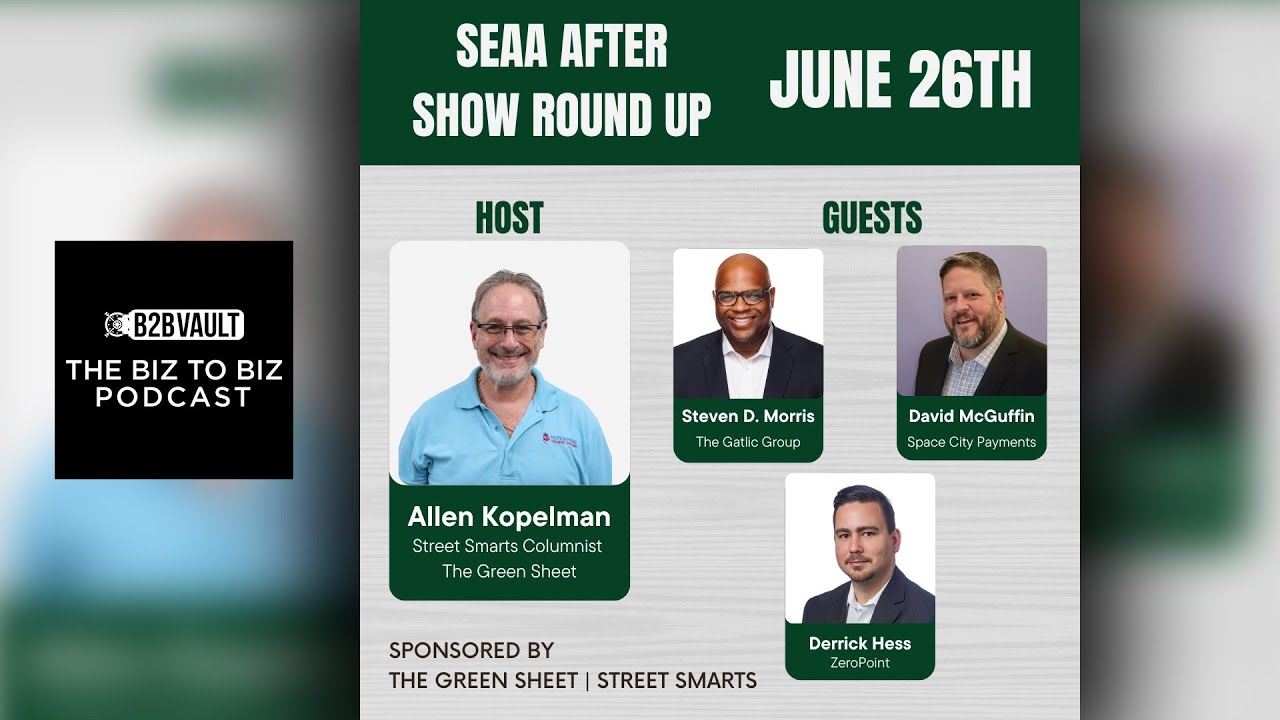
Allen Kopelman hosts a roundup of the SEAA trade show with Stephen Morris, David McGuffin, and Derek from Zero Point Electronic Payments. They discuss vendor takeaways, emerging tech like biometrics and tap-to-pay, AI in payments and underwriting, and advice for sales reps navigating the payments space.
Chapters
You are now watching the Biz to Biz podcast with Allen and Justin. Hey everybody, welcome to B2B Vault. This is a Street Smarts edition sponsored by The Green Sheet, and today we're going to be doing a wrap-up show all about the SEAA. And I have 3 guests which we're going to introduce right now, and we're going to talk about the SEAA and chop it up. Everybody, welcome to the show. So I'm gonna— and we have today Stephen Morris. So Stephen, what, what's your company name and where are you from?
I am the managing partner for the Gatlin Group. We are a small ISO out of Lexington, South Carolina. Been in the biz since '96. I'm an old head, hence why my hair is gray. I'm trying to begin with you, Allen.
Yeah, we're all catching up. And we have David McGuffin from Houston, Texas.
Right?
Yes, sir. I own Space City Payments. I've been in the business about 5 years, so.
All right, great. And then next we have Derek.
Hey guys, yep, there goes Rocky. Yeah, Derek is here, uh, Zero Point Electronic Payments, in the business since '05.
Yeah, one, one thing, you know, about this, you know, the show, you know, I've been going to this show since it started in 2001. One of the founders of SCAA, Judy Foster, who I met when I first started in the business, she called me up one day and she's like, oh, you got to attend a regional show. And I went to the first SCAA in 2001 in St. Pete Beach. And watched the show grow from whatever, maybe there was 100, 150 people there, and started off with Judy and Sonny Wooten was working for American Express in those days, and American Express has always continued to sponsor and support that show with the paying for lunch, and John McCormick, and then everybody else has kind of been rotating in and out of there you know, and helping with the, you know, on the board and all of those things for that show. And I've supported that show for a really long time. That's the one show that I go to. So, so David, you— this was your first show, so you never been to a show before. What did you think about going to your first trade show?
Well, it was my first trade show in this industry, um, Honestly, it was a little overwhelming at first just by the sheer volume of people and the vendors there and just seeing everything that was out there, what's coming down the pipe, all the, all the new technologies and vendors. And then of course, you're getting hit up by, you know, every ISO that was there, you know, trying to, trying to recruit me. And, you know, I have two of them that I write for, you know, that get about 95% of my business that were there. So, you know, I got to hang out with those guys and that was fun.
And, uh, and that's always nice when you get a— when you get a face-to-face, right, with your— oh yeah, with your vendor that you use, you know, they— you meet them in person, you know. I find that to be very important.
Yeah. And, and the fact that I got to meet you and Stephen and Derek and, you know, hang out with, with you guys, you know, for, you know, 3 or 4 days and get to know you. And, and, you know, that was, that was inspiring as well.
So, and I know Derek came to the show, and he's probably been to some shows, but he brought his son with him. Yeah. And what was kind of cool was, um, Derek brought his son. I met another guy who was there with his daughter, and then I met another guy who also brought his son to the show. And that was kind of interesting to see You know, I mean, I know D for like a really long time, and his kids are always at the show. They like grew up in the paint business.
Well, yeah, matter of fact, because yeah, the first time I met D was at the first— well, the first show I ever went to, which I think was '07 in New Orleans. So that was the first show I ever went to, and it was such a great contrast this year versus my first ever show versus, you know, 20 years now in the industry, pretty much. Um, I think I can, I can see where Dave's coming from. It's just like this eye of wonder, uh, when you come to the first show and it's the first, you know, you haven't been in the industry that long, it's your first real show. It's like, oh my God, I was— I just remember feeling so um, my, my knowledge that I thought I had was just, you know, wiped out in an instance. Once I— it was so much more to the industry that I had just no idea about. And, um, that was what was really fun, and that's what was very motivating actually at that time. And I met D at that first show in 2007, and I mean, I saw him at this show.
It's—
but that's pretty crazy.
Yeah, I mean, I've known D for—
no, no, I've known D for many years. And what's crazy is, is, you know, this year there was probably close to 1,200— there was well over 1,000, probably 1,200 people at this show. And that just shows you, you know, the growth over the years. I remember I was at that show in New Orleans, and there was probably maybe half the amount of people there. And, you know, it's just amazing how You know, I don't think enough sales reps— that's why I'm doing this episode, right? Because I want you guys to share this out on your Facebook and all the groups that we're in on Facebook so people can see like there's a lot of benefit to going to these shows.
So it's not only— yeah, it's not only for ISOs, which, you know, I'm sure, yeah, well, we're kind of getting into that, that aspect of it as well.
You know, we have Facebook groups.
I'm sorry, sorry, David, I'm sorry.
Good.
Yeah, we've got our Facebook groups and everything, and you know, we, we all kind of know each other from, from, you know, our groups. But man, you know, like that Monday, Stephen just walked right up to me, knew exactly who I was, and you know, that, that right there in itself was like, wow, you know, because, you know, Stephen, long-time veteran in the industry, somebody I, I totally respect. You know, I listen to what he says, and when he says something, I take it as pretty much, you know, a gold standard. So same with Derek, same with you. So it was, you know, getting to meet some, some, some of you guys has been, I mean, like I said, just totally inspiring, you know, and also making me realize that I got a lot more to learn.
That's that Dunning-Kruger effect, you know. Oh man, I know what I'm I know what I'm— you're enough to be dangerous until, you know, it really comes in.
For me, my first show was Midwest Acquirers back in 2017. I had been in the industry for quite some time and never went to a payments conference. And I'm glad you coordinated this call or this podcast or this video, Allen, because I think it's imperative that every person that's in payments go to these shows, whether you go to SEAA or NEAA or Midwest Acquirers OASA. I— what happened was when I went to Midwest and I realized that I wasn't by myself, that was key for me because a lot of people feel like you have this Lone Ranger mentality. You're trying to figure it out, you don't know if your ISO gives you good training, you're wondering if other people are dealing with the same objections and issues that you are. And like David said, we, we see each other through these groups on social media, and you know, we got all these different, Facebook groups and LinkedIn groups. But when you meet people in person, man, it really strengthens you to go back home and grow your residuals. And so a payments conference, um, it really encouraged me. So SCAA, I, like I said, I'll be honest, my first show was 2017 in Chicago, but I started going to WASA. I think that's where I met you, Derek, was WASA when it was in Huntington Beach. And we, we, you really, you really start to see how the payment industry, even though it's really large, it really is very small. And you get to learn from a lot of the players that are out there doing this business with integrity and honor. So for me, New Orleans was— it was a great show. It was reconnecting. Of course, like David said, you're going to get different people trying to recruit you. But if you look past that and just go out there for the knowledge and the camaraderie and the networking, you'll know who to partner with and who to talk to.
Yeah, there's always a lot of good information. And, you know, I walk around and every— a lot of people just walk up to me, hey Allen, they know me from Facebook, from LinkedIn, from the podcast, from writing in The Green Sheet. But it's amazing, like, I'm— I'll make a comment in some of the Facebook groups and people message me that never heard of The Green Sheet before. I'm like, this is, uh, one of the most important magazines in our business. Because it's probably the only magazine that really puts out articles for the sales reps, and it's not aimed at like general information or information for ISOs. So it's, you know, that's why, you know, and we can do one of these, Steven, after you do Midwest. We can get a few people on and do another one of these. It'd be really good to get one of the things.
Here's one of the things I would want to promote about Midwest. I am on the advisory board now, which is pretty cool. We're trying to make some changes. Trying to really be fresh and new. And like I said, the other shows, I love them and they're great. But when you're on the board or the advisory board for one of these shows— and Allen, you can relate because you are on SCAA— you want to get people to come to your show and you want to get them to be really engaged. That's the thing. A lot of these shows—
I just stole the shirt. I got a shirt. Jamie Garfield, shout out for hooking me up with the SCAA shirt. I'm not on the board.
Well, here's, here's the plug I want to promote. If anybody wants to go to Midwest Acquirers within the next— Midwest Acquirers is at the end of July, and if you want information, it's on MidwestAcquirers.org. I have a promo code for anyone that this is your first show. If you ever want to go and experience it, you can go for free. It won't cost you anything. The only thing you got to do is get your hotel, which we're already in the Overflow Hotel, and We're coming off the back of New Orleans, you know, SEAA, great, great attendance, great show. So if you weren't able to make it to New Orleans, you can make it to Chicago the very next month. And the promo code, I'm gonna give it to you on this, it's VIPMLS24. If you enter that when you go to register, you don't pay a dime. So now I take away the excuse for you not to experience your first payments conference, and then you can go check all the other ones out and compare them. Some of them are really, really good. Um, and some of them, you know, they're, they're regional. Like, I know it's a lot of people from Wasa. You're going to see a lot of people from the West Coast that may not come to Southeast Acquirers. Get out there and really find out who your network is. So VIPMLS24, that's the promo code. That was my question.
Yeah, so the thing is, is with these regional shows are much more affordable to go to than to go to the ETA, and you got to buy a ticket for like a couple of thousand dollars. And then, and the vendors at these shows it's more geared towards speaking to sales reps and people with a small ISO or an agent office, however you want to view your business. And you get to meet the people that run these companies, you know, the, the relationship managers are there and all, you know. So you get to meet key people from all these different vendors that come out. So Derek, how did your son— that was his first time at a show.
That was his first time. That's my middle son. My older son's been— went to, uh, the Atlanta show the year before. He's more of the sales-oriented. But my second son, this was his first show, and he's more—
he's a tech guy, right?
Yeah, he's a tech guy. So he viewed it in a totally different lens. He enjoyed more of the hardware, the equipment, the programming interfaces, more so than the than the sales-oriented, the sales aspect of it. So he, he, he could— he's not a go-out-and-sell, sale guy. He's a let-me-fill-a-hole-that-a-certain-software-needs-to-do-and-will-solve-the-problem. So it's just cool seeing these young people look at things through different lenses, and even though we're all presented with the same information. So it's— he, he enjoyed it. He enjoyed it.
Um, I think a lot of tech people need to go to payments conferences because technology is always going to be increasing. Like me, when I walk the exhibit floor, I like— I like— we saw Landy, they were there. I like, I like seeing what new products are out there. So for a tech person, let's, let's even remove the salespeople, because the salespeople, we're going out to network with one another. But your tech people need to go too. They need to know what's coming down the pike.
And look, you just— one piece of nugget that you could gain from those shows could be life-changing. I mean, An example, we have, uh, my son actually had like— we have like 4 or 5 Clover apps that he's developed, and we can't get Clover to push them through. So we had— guess who was there? Fiserv booth. We had a chance to speak with those guys, and what they— the insights they provided us, we could not find that answer no matter who you spoke with. So just simple little things like that could be the game changer at some of these shows.
Yeah, so what, what vendor, David, did you see any vendors there that you were like, wow, that was really cool, or anything that you saw at the show?
Um, well, meeting the guys from Deja Vu, that was, that was key right there. Just, just knowing, you know, that I now have a, you know, a direct contact, you know, with them. Um, I got to reconnect with, uh, Lala over at Quick POS. Her office was about 12 miles away from my house. I've been to their office before. I have a reseller agreement with them, but I haven't really pushed it too hard. And just being able to reconnect with her and seeing some of the enhancements they've made to their point-of-sale system was really cool. Talking to the guys over at SoundPOS, Corona, You know, I, I, you know, the guys over Corona, I know them, talk to them numerous times on the phone. So that was really cool. And then, you know, seeing, you know, Dustin over at Paybright, seeing him again. I've met him once before when he, you know, came through Houston, but, you know, him and, you know, Jonathan Young and going out to dinner with them Monday night and Steven and having a good time doing that and, and just talking and talking shop. You know, that just, you know, that basically, that solidified again why I write, you know, and put probably 80% of my, my, uh, deals over at Paperite.
You know, it's just, it's one of the only places, honestly, guys, where you can just go and, and speak your normal everyday language and everyone understands it. Yeah, versus, you know, we try to have these discussions with people and they're like, what are you talking about? You know, I mean, just simple things that they have no idea about. You can just have an open, straight conversation to a random person and they actually understand. Um, you know, someone that you've never met before at the shows, they understand what you're talking about, which is— that's, that's the coolest thing ever, because anyone you speak with, you can you know, have normal high-level and, and conversations for the most part. So that's what's fun as well.
For me, um, I, I kind of looked at it at a different route. The technology piece is cool. I wanted to partner with vendors that complemented what I did. So talking to like companies like GCF, like one of the things that we did, we sell paper to our merchants. And I know in this day and age people are like, oh well, we give free paper away, and they think that that's a sales point. Honestly, I think you're losing out on revenue because here's the thing, if you go prospect a merchant, let's say they say, I love my Heartland guy, I'm never leaving him. Well, our company, we will sell paper to that merchant and we, we will not walk away from that deal. So to talk to companies like GCF, talk to companies, um, you know, like we, we buy now pay later is a big thing for us. So there were companies there that were talking about that type of thing with, um, consumer financing You're gonna find that at the shows. Definitely fine, we're gonna have the Deja Vu, we're gonna have the Valors, we're gonna have all the, the, you know, the Corona and Sound POS. Those guys are there all the time. But I like talking to the new vendors, the new exhibitors, because you never know what they could bring to the table that's going to complement what you do already.
No, that's true. When you see like all these exhibitors there, it's important to just talk to them, discuss with them what what they're off, what they have, how you can put that into your playbook. You know, you know, you got to have today— I think merchants, and I've said this at the show at the one of the sessions, you know, merchants are more interested in buying technology today than they are focused on price so much. I mean, anybody can deliver on price. People want technology and service.
That's right.
And it's important, that's important. Day one is solving their problem. But, you know, we've been so focused on pricing that, um, you know, we need to, we need to step it up a notch.
And that's, that's the, that's another point that I want to point out. I'm so glad you mentioned the savings portion, because if you're that sales rep that's still going out there, oh, I can save you money, I can save you money on your processing, but if you're not giving them the right solution, then the savings is meaningless. Because you can save them all the money in the world. We all know how dual pricing will pass the fees to the public, but if I'm saving all the money in the world and the, and the solution you give me is cumbersome and clunky, then I'm not going to want it. And so that's the reason why going to these conferences is such a key advocate that if you're not going, you're missing out.
Well, like, I'm getting ready to add payrolls. I, I talk to the Magnify, uh, payroll people, so, you know, that's a perfect compliment for what we do. I already do consumer financing. That's about 30% of my book right now, you know.
So yeah, yeah, that's great. And Magnify people are good people too. I know those guys. So that's a good— that's a good add-on, you know. Heartland, that's, that's built into Heartland's deals, their payroll company. I mean, I don't know why, um, I mean, I do know why. It's a scary thing and we like to know what we're speaking about, and payroll is kind of like, oh my gosh, I don't know. But that's another arrow in your quiver that you, that you can talk to a merchant about and, and help solve, you know, an issue that they have.
So, so one of the things, one of the things at the show that I noticed, so the very first session was done by, um, Ashley Nagy from RSBA. Now, you know, I said a lot in that, had a big back and forth with them. Right. So one of the things that always comes up on Facebook and always comes up when I talk to reps is all this, all the talk about agnostic software and then ISVs. These are the two probably most discussed things, you know, along with whatever, 0% programs, right? These are the three most discussed subjects amongst everybody, right? So the first one, you know, I'll throw this out there— agnostic POSs. This is the scariest thing in our business today because over the last 5 years I've seen dozens of agnostic solutions completely disappear. Had a conversation with Derek about that recently. Um, it's not anything that we're in control of. One of these companies gets sold by— to an investment group you know, they're— the first thing they're going to do is put in their own payments. And I think that as sales reps, I think everybody needs to rethink that. We rethought it at our company. We partnered with people that own the POS and the processing. We might make a little bit less money, but we know like that solution is going to stay solid and it's not going to get ripped out from us. I mean, I don't want to talk about millions. And I'm— when I say millions, I'm not joking around. Millions in processing that I've been— that has been ripped out of my book over the last decade from acquisitions of point-of-sale companies.
That's why I don't focus on restaurants anymore.
No, I'm not just talking about restaurants. All types of any kind of POS, you know, point-of-sale system. So we kind of switched our gears into that kind of— and the restaurant business is very rough right now. The average restaurant, you know, is not staying in business. Tons of them are closing up. Uh, even one of the guys on that panel said his business— he almost— his ISO almost went out of business because they were solely focused on restaurants, and all of a sudden restaurants were closed for 3, 4, 5, 6 months, and they had to immediately regroup and start selling, you know, other other things, you know, non-card present, B2B, to get their business back on track. Because I don't believe— I tell everybody, you know, you cannot focus into one vertical, because if something happens to that vertical, you're, you know, you're done. Your, your business— I saw many people during the pandemic that restaurants and salons, like, that was their whole business, and then they had no business.
I mean, that International Bankcard sold half of their portfolio were hospitality and the other half were stadiums, right? In 2020, there were no restaurants and there were no games.
So yeah, it was— that was, that was pretty wild. That was pretty wild. Luckily, you know, our portfolio wasn't that mix, um, heavy on restaurants. Like, the majority of agents' ISO portfolios are very heavily restaurant focused.
Um, yeah, but I stay, I stay away from restaurants if I can. Yeah, you know, because, you know, invariably something is going to happen at 7:30 PM on a Saturday night when you're on vacation in Hawaii. And that was a true story.
Not even if you're on vacation in Hawaii, you could be home in the bed. Yeah, if you want your weekend to be ruined, have a whole portfolio full of hospitality.
Oh yeah, I like focusing on businesses that like to keep the same hours I do.
And the other thing at the show that was— this— there was a lot of booths, and there was a session about that with, um, Caleb from, um, I'm gonna mess up this— Tilled, right? You know, the, uh, the whole discussion about ISVs. And, you know, one of the things that I see with a lot of these ISVs is they go— I guarantee if we ask, you know, companies who sign up ISVs, they're going to tell you that a lot of them don't book a ton of sales because they haven't figured out how to make sales. Yeah, and that's, that's kind of the— that's kind of the— but, but I think that we're going to see a lot of ISOs start to try to acquire some of these ISVs and fold them into their business. Because I think that's the, that's the, that's the, um, the trend that we're gonna see in the next 5 years.
What do you guys— a lot of processors nowadays, um, you know, our processor, for if you meet a parameter, it's, it's an instant approval, instant mid, instant live. Like, what's the benefit of an ISV other than if mass boarding a ton of a ton of accounts. But I guarantee you, if you come to any of— any reputable full-service processor and say, hey, I have this ISV who's got 1,000 accounts, these are their parameters, let's create a jump on it, let's create a grid and auto-approve every one of them, you, you can do that. So to me, an ISV has always been about the boarding process. And yeah, and ISOs are actually catching up with them. So, you know, I, I don't— you know, we're not trying to go after Susie selling bows and ribbons at, you know, at the flea market.
That's not—
it has never been, at least never been— well, anyone that's ever tried to go after that business, that's a waste of time, period. So that's too small.
Micro business is too small. The micro business, right?
That's micro merchants. And that's where Square and Stripe started. Now, to give them credit, Square and Stripe started at those micro business built a name up and they're trying to attack, you know, our territory. But I'll digress on that one. So you get it.
So out of all the set— did you guys attend a lot of sessions? Which was the— which session did you get the most out of or like? Or tell me what—
for me was the biometrics one. Um, that one was pretty interesting because, um, it let us know where the industry is going. Um, right now the big thing— that's my son in the background, hilarious. Um, tap to pay is a big thing right now. Apple Pay, Google Wallet. We live in a generation where I call anyone under the age of 30 a kid, right? So 30-year-old kids don't know how to write checks anymore. They do everything on their smartphone and their smartwatch. And so with that being the case, it was interesting to see how biometrics— that's going to be a huge thing moving forward. Everything that we do on our phone, facial recognition, thumbprint recognition, retina scans, all that's going to come to payments in the next 10 to 15 years. I truly believe in the next 20 years when I'm in my 70s, I, I don't think credit cards will even be a thing anymore. Everything will be, uh, biometrics to avoid chargebacks. You know, right now if you're able to solidify a transaction by facial recognition there's really no way that the consumer can, can, can say that there was a chargeback if your face and your DNA was there. So that was pretty interesting. Some folks thought it was scary, but I thought it was interesting.
Yeah, I talked— I actually talked— I actually talked to those guys, and I was like, wow, this would be great, like, for high-risk industries. But they were like, no, we're not going there. We're not going—
we're not—
we're not going there. One thing I do know is Like, we work with one system and they have biometric for like the employees to like log in with their finger. And we actually work with a payroll company, and to sign in you have to go up to an iPad and do a facial recognition to sign in. And that kind of stops to make sure they know everybody's, um, everybody's on time. Nobody's, you know, Steven's not clocking in for Derek, etc., etc. So, you know, I think that we're going to see small steps with that. I know that, um, Amazon had that pay with the palm thing and that was not received very well.
So I don't think we're ready for that yet.
Yeah, I think it'll take time. You know, everybody's so worried about, you know, Big Brother watching. If you've got a smartphone, he's already watching anyway.
Yeah, he's already watching.
If you got an iPhone or an Android or any type of smartphone You know, ever since cell phones came out, he's been listening.
So now one of the, one of the things I was disappointed about with the session was that was the AI. That one was a little disappointing because everybody just kept talking about ChatGPT and artificial intelligence and payments. I don't know how that's going to progress, but I was curious to see what they were going to say, and it just kind of figured like everybody was just talking about ChatGPT, which What are your thoughts on AI and payments? I want to present that to the group. What do you guys think? How, how do you think it's going to progress?
One, one of the things is like with a, with AI and payments, I mean, you would think that they would be able to build like a better fraud engine using AI. They talked a lot about boarding, but I think automated boarding has been around for a couple of years, you know, and being, and the ability for the underwriters not to have to manually look everything up I mean, the place where I send most of my business, we've had that for a couple of years now, right? So literally, like, we can submit, put a client in the portal, send it to them, they sign it. Literally within 10 minutes of the underwriter getting that deal, they open it up and they literally have everything— the Google Street View, the, the credit, they've, they've verified the driver's license. The social, the federal tax ID.
Allen, what I'm hearing you say is AI will probably replace a lot of underwriter jobs. That's what I'm hearing.
No, I don't think— I think it'll just speed it up. I don't think it'll work. Like, today we were doing a podcast. Let's say there's 5 underwriters. Maybe you might be able to cut that down to 3, you know, or maybe you'll take those guys and put them on working on fraud. Versus, you know, risk, right? You know, we're risk, and you're going to reassess like, where are we putting people and how are they doing? Because at the end of the day, you got to have the human eye. Look at Stripe, they board everybody, it's all done with AI. As soon as someone runs a transaction, boom, they're shut off your money and they're holding your money. So we know like that exists, but is it— it's not that friendly when it, when it comes down to that. What session did you like David?
I think my favorite was the biometric one as well. Just, you know, seeing what's coming down. You know, granted, we're probably 8 to 10 years away from it because they've still got to, you know, build out the framework for it. And, you know, that's going to include a lot of AI as well. So, but yeah, I have to agree with Stephen, man. The biometric one, you know, in 10 years, we're going to be paying with a thumbprint or facial recognition or something like that.
So And what, what was this favorite session for you, Derek?
Um, really enjoyed the, the Not Afraid to Code or Technology or something for the ISO. The title was misleading, but it was more of about how to use technology building and developing apps. That's why I went that one with my son. And a nugget that I got from them was pretty amazing, I think, um, was you don't they don't— these, these developers don't even like to use ChatGPT because they, they know everything is being monitored, stored away, and used, used against us. So this is crazy. He gave us a, uh, the group— you can build your own ChatGPT. It's basically a, a higher learning model that you can run at your house on a server that essentially is ChatGPT, but you hold all the data. I was like, that's pretty freaking cool. And it— when you— anything you ask, it's never going to be given to the, the source, which are the oligarchs, you know, in Silicon Valley. So, uh, I thought that was a pretty, pretty neat one. But yeah, so I, I enjoyed that one quite a bit.
So, you know, talking about AI, so AI has been in the news a lot. So a couple things that have been in the news is all these people starting new AI companies. Uh, Elon Musk's building xAI. People are leaving, uh, OpenAI and building out AI. But the biggest thing in the news was that Apple— and I don't know what Google's doing— but Apple is going to put OpenAI into the operating system of the iPhone. Now Elon Musk came out and he said, well, he's not going to have his employees using iPhones anymore.
There's gonna be an X phone. I will buy an X phone.
What was his logic behind that? Why is he— why is he not going to do that? Because he feels like people are using their—
no, I mean, I mean, the AI, can it read your email?
Can it read your chat?
Are you going to be sharing sensitive company information? I mean, we're getting, you know, you're getting an app from somebody all of a sudden OpenAI is going to know who you get apps from.
Yeah, you're building these rockets and space things, you know, at SpaceX, and now all of a sudden China's gonna have all of our designs, you know, just from AI. I mean, I'm saying China, but anybody, you know.
We all know technology is going to be the death of us.
Yesterday I got a— I have, um, my computer is a whatever, Microsoft computer, right? The— and I get a note from them, oh, you want to trade in your computer? You can trade in the computer, and the new computer comes with built-in AI. They're offering me almost what I paid for the computer just to get this new computer as the Copilot AI built into the computer. Oh yeah, I'm not so sure I want that.
Well, you know, in 10 years, all we're gonna have to do is say, hey, create me a, uh, veterinarian software. Or, or whatever, and then they'll do it. You'll instantly create it. Or say, like, let's take, uh, Micros for example, or Toast. Here, here, AI, here's Toast point of sale. Duplicate that for me. 10 seconds, you'll have a duplicated Toast point of sale. So what's gonna happen with us?
You guys, you guys remember the movie Minority Report with Tom Cruise?
Yep.
Telling you, man, it's just so— it's so amazing what AI is. Make as much money as you can right now and invest because it's dangerous. But people feel like they want this automation. That's what it is. That's the reason why we fall in love with AI because it does what we needed to do in a fraction of the time frame. But we have to be wary about that when it comes to payments. I just feel that that's my personal opinion. But it's going to happen regardless. We're always going to try to do things faster, better, quicker. I remember the days when I used to have to pop popcorn on the stove. Those days are gone and we're never coming back. So it's the same thing with payments.
It's just all progress. You know, people are migrating more to AI because it gives you the one thing back that you can normally not get back. That's your time. You know, I mean, it, it cuts everything down by at least half. You know, I use it just for marketing. You know, I can put in a, a prompt and what I'm looking for, boom, I just spit something out. I put it through an HTML scrubber, paste it into a Word doc, and then I can modify it how I want to so it sounds like me. But I've got my, my marketing content already done for me basically, you know, a blog post, you know, stuff like that.
I mean, people might have like 6 or 7 fingers, but you know, I don't know if y'all seen those AI-generated images, but they, they don't have, uh, they don't have humans down quite right yet. It's hilarious.
True.
Yeah, some of that, some of the images need a lot of, need a lot of work, but it still can give a, a graphic designer a good start maybe on making a logo or an image or something like that. No, my favorite set— my two favorite sessions at the show were the very first one where they had three ISOs up there basically talking, and everybody was going over like what their struggles were in the— out in the field and things like that. So it was kind of nice to hear what people are, you know, that people are experiencing the same type of struggles all over the place. And the other one was when, you know, Caleb— they did the one with the ISV one, talking about ISVs. Although I think it kind of like went way over everybody's head a little bit on some of this, on some of this stuff, because some of the questions we get asked all the time is, oh, we just want to— we had to call this morning, oh, we want to put up this platform, we just want everybody to come on there. The guy's like, yeah, just like Stripe. And I was like, that's an underwriting nightmare. Like, we're not able to, you know, the, the payback model that the ISOs use is not geared towards that. It's geared towards, oh, we're going to board 1,000 plumbers and air conditioning guys and locksmiths and so on and so forth, or we're going to do a bunch of, um, veterinarians, dog grooming, and boarding places, you know. And it's a lot easier to underwrite something like that versus, you know, this vast variety of business businesses. And I don't think a lot of people understand that from that perspective. And what do you got— what do you guys think of the future of— I know I brought this up before, but what do you guys think of the— let's hear one at a time— the future of agnostic software? You think this is going to go away, or what do you think, Stephen?
I do. I think software providers and POS companies, what they do, they may start off agnostic in the beginning, but once they build their customer base to a couple thousand, if not tens of thousands of users, they're going to take the payments piece because it's too much money for them to ignore. You look at, you look at software vendors like Jobber and ServiceTitan. They, in the beginning, they're going to say, oh yeah, we'll let you integrate. After a while they're going to be like, all right, you got to migrate off. I've seen it with too many different software providers. I've seen it with too many different point of sales. And so that's why, like Derek said, it's best to just get in with the ISV from the beginning so that way you, you enjoy the ride from start to finish and they don't have to look for another partner. Um, they just look for one. And believe it or not, that's what Stripe is doing. Let's be honest, everybody integrates with Stripe because Stripe is going for those software vendors and they're getting in on the beginning. So we have to do the same. I think the agnostic POS and the software, it may start out that way, but eventually they're gonna go— they're gonna, they're gonna push you out.
Pick your partners wisely, right?
Um, yeah, yeah.
I'm just waiting for the— for, you know, uh, someone. And I don't know why any ISOs have not done it yet. ISVs, we We all have enough money. I say we all, you know, the, the, uh, the titans of the industry have enough money to where they could, they could sit there and purchase a vertical market of every single software and then have it all in-house to where we could recruit agents, build on agents, and say, look, go after veterinarians with software, go after puppy groomers software, go after this, this, this, this, this. We own all of that software.
Shift 4 is already starting it.
There's a company out there that, that— so, and ISO, that has— there is enough money to, to do this. And because we're— you bring up— and he's like, what's the software for this? What's the software for this? And, and Stephen's right, because the future is going to be so fragmented that an ISO can't survive because he's going to have a rep that has to write this software, has to write this software, has to write this software. So as a true ISO model, how are you going to survive off of payments alone? So that's the future.
Another thing you can add to that, I mean, look at some of the software providers that are actually at the payment conferences, Billergeni, Rectangle Health. These are software vendors and they're allowing us to work, but they're going to get a certain amount of basis points as profit. So they realize the advantage of partnering with the, of partnering with the individual agent. Because if I partner with an individual agent on ISO, I got my own sales team on the street promoting my product, and I'm going to get some basis points off of that.
Instant access.
Days of just giving you all the processing, that's, that's— those days are done.
Yep, agreed.
Yeah, there's a few companies with that business model where they want, you know, 25, 50 basis points. I think 50 is excessive. I even think 25 is excessive. Yeah, 10 might be livable and you could still write deals and be— listen, you know, you put 25 basis points on a doctor's office or 50, they're not, you know, they're gonna shy away from that real quick.
But the issue is they may shy away from the price of the processing, but if the software is doing everything that they wanted to do, they're not going to say anything. See, that's the thing, that's true. ISV partnerships, the software vendors, their job is to get you addicted to what the platform can do. If it could run my appointments, I can pull up charts, I can send text messages to remind my patients to come on their appointment. If I got it running my business, the payments piece, I'm just gonna have to— I'm gonna have to deal with it.
And that's why I tell everyone, I tell all my sales reps, sell the software and the solution first, okay? You can't sell on the price because once somebody falls in love with the solution And my answer to them is, look at Toast, okay? Let's all just take a look at Toast, okay? The software is okay. I wouldn't say it was the greatest of all times. I would say they built a very simple interface that's easy to use, okay, from the waiter standpoint, okay, or the wait— the wait staff. But they charge an arm and a leg for credit card processing. I mean, let's face it, If we walked in and said, oh, we're going to give you 4 Déjà Vu terminals and charge you 2.79%, a merchant would kill us, right? But people are getting toast and they're paying that much for credit card processing, and they're paying extra for the hardware too, or at least the hardware.
It's—
I don't believe it's free anymore.
No, no, it's not free. They tell you it's free, but you're signing a You're signing a 36-month—
in business, we know that there is nothing for free.
Ain't nothing in this world is free.
There's nothing for free. We gonna have to start paying for air soon. Trust me, there is nothing for free. They're going to get that money in some way, some shape, some form. And here's another thing, when they do have their customer base and they have you committed to what the software could do, it's running your business effectively, they also can manipulate the pricing on the payments later on down the road. We've seen instances with Toast where they will up the— let's say that, oh, we gotta— you gotta do your online ordering through us, well, they're gonna raise your, your, your, your fees for that, you know. Right. Once I got you, I got you. It's like, it's almost like, unfortunately, it's almost kind of like the drug game, you know. I'll give you the first hit for free, but once I got you, you're gonna keep coming back. And that's one of the things.
Yeah, one of the things with like Toast and also Clover You know, you get the base system, right? But then you got to purchase all these add-ons. Yeah, all these add-ons, right? Like Toast, they came out, then, oh, oh, online ordering, it's extra. Payroll, loyalty, time clock is extra.
Once I got you booked, I got you.
So, you know, that's the— that's the— that's where, you know, I was talking about in the very first session of the, uh, meeting, and I was like, yeah, I look around the room and I said, I don't see my competition in this room. I don't see it on the stage and I don't see it in the room. Right now we're having a podcast, 4 of us. I don't look at you guys to be my competition. I think our biggest competitor is the internet. And in the early 2000s, you know, Paul Green, who started the Green Sheet wanted, wanted the agents to have their own voice, and it never happened because the guys who got a hold of it— ISO's got a hold of it— and they basically tried to turn it into a buying group. And that's not, that's not what we need. What we need as a, as a group of agents is to have like an advertising co-op. I'm actually talking to some people about this, have an advertising co-op not— and everybody pay in, you know, a few hundred dollars a year to create like a huge fund of a couple million dollars to go out and promote, hey, buy from your local payment professional. That's what we need.
Because that's different, Allen. That's crazy. Okay, that's cool. Yeah.
And yeah, I'm talking to a few people about trying to organize that because I think that it adds value to the, to the sales reps in the industry. And if anybody's listening, they think that's a cool idea, listen, it's been estimated that there's somewhere between 10,000 and 50,000 people out selling payments.
If everybody put in a very small amount, right?
No, I'm just saying that's the estimate. It could be as, you know, fifth 50,000 could include a lot of part-time people, but if people who were full-time selling— if everybody put in— if you had 10,000 people and everybody put in $500 a year, which is not a lot of money, we could create a multi-million dollar advertising campaign. Let's just think about American Express puts out Buy Local, right? And I think Visa does something like that, Small Business. And, you know, we could have the same thing— buy from your local payment professional— because the internet's coming for us. And if we don't watch out, if we don't watch out, we got to protect our business because the ETA is not helping us. No, the regional shows are not set up to do that. And, you know, it was always a dream of Paul Green, who started the Green Sheet, to have that They, they had a thing, NAOPP, National Association of Payment Professionals.
I remember that. Yeah, yeah.
But it never, it never got going because the ISOs kind of hijacked the whole thing. And then a few guys tried to create buying groups and things like that. We don't need a buying group. As what we need is an advertising voice. I told Bart Kohler, who was in the very first session, He's been involved with the ETA and the CPP, and I told them, I says, if they cared about CPP, they would do an advertising campaign for it. They would do, you know, we, we as a group probably need to do this.
And I, and that was some, that was a, I would have, I wanted to stand up on that, on that presentation because I was in the first class. So was I of this, of this CPP with, remember, there was no, no study guide, nothing. It was We don't know. You'll know what the questions are when you take the test.
Exactly.
We— I passed.
I have—
it was like 2011, I believe it is. And you know, right, in Louisiana there was two other people and they're both like Capital One Bank or something like that. Other than those people, it was, it was me. And I tried to build value with it as a credential, but it's not a credential if no one knows about it. Anyone can put any letters behind your name and And I mean, it looks cool, right? But I mean, like, what is a certified payment professional? And people like, okay, that's great, are you gonna beat my rates? You know, so I was like, I mean, you know, at that point. But anyway, so I— that's why, you know, recognition and creating—
no, that's why I came up with the idea to have an advertising co-op. Everybody can have a profile on a website, you get a seal. Put it on your business cards, put it on your website. We're the local— we're a local payment professional. We don't need to be like the BBB, report complaints. We don't need to deal with any of that. You know, everybody can have a profile, and, and it's an advertising campaign.
Well, yeah, when you look for an attorney, you, it— you type in a name and it's always their like the first thing that pops up would be the attorney, their certifications, etc. That, that would be something interesting for the, uh, payment space. So cool.
Yeah, if you guys want to get involved in it, after I have a couple more meetings with people, I want to get a group of like 10 people and then put this thing, put this to the, to the, uh, to the test. Like Steven's doing a thing at his, at, at the Midwest show, the MLX Forum, right? This kind of advertising group could be the, could be the, the group that goes out and says, okay, we're gonna put— go to the regional shows and say, hey, let us put this on and we'll bring in tons of reps to your show because everybody's going to want to attend our session and join this, this advertising campaign. I don't think it's that hard to ask people for $500. We probably blow $500 on plenty of other—
$500 at the bar at the show, right? Trust me, that's nothing.
Dave would, that's for sure. Oh man, hey, before you go, you got to talk about how great the, um, the after hours— and sorry, missed you, uh, Stephen, on the after hours on the bar crawl.
But bro, I'll add this, you got to be, you got to be full of energy when you go to these shows from the time you wake up to the time you go to bed, it's gonna wear you out. Because we didn't talk about that. You're right, Derek, we didn't talk about the fun part of, of this, like the parties, the food. Like, you're gonna have a good time. It's, it's, you know, it's good to be educated, it's good to network, but you are right, Derek. The bar club— New Orleans was a, was a good city just to kind of hang out and try to see what was out there. Um, but yeah, I'm not built. I'm not— my 50-year-old legs couldn't keep up with my 20-year-old initiative. I was tired.
Yeah, I was about to fade too before it started, and then we got going, and I mean, Derek and I were both like, man, are they ever gonna stop? Are we ever gonna get to the first bar?
Yeah, man, I had 18,000 steps. I was like, okay.
Yeah, it was like 2 hours.
Yeah, okay, this is okay. It was kind of cramped. Oh yeah. But the last one we went to, that was, that was the, the fun one. That's where they were doing the karaoke and playing all the '80s music. And, um, you know, Derek and myself, you know, having a great time. We had Kevin O'Sullivan from Deja Vu with us. You should have seen him, he was in rare form.
So yeah, the first night there was a few people that, that had a few drinks. I'm sure they didn't show up for the show the next day. On time.
Yeah, you gotta, you gotta be careful with that hard drinking because you may not wake up in time for the, for the rest of the sessions.
Yeah, you wanna, you know, you gotta pace yourself at the shows, and there's always plenty of food to eat. And this year there was, you know, they had, um, one presentation where they gave 4 students money who went through a program. That was nice. And then they had the, uh, dog rescue there raising money for Derek. I don't know if you guys knew Derek, but I knew Derek for probably over a decade. So that was nice that they did something for him. And, um, listen, it was great meeting you guys. Was the first time I met all three of you in person.
I think I met you, uh, in, in Fort Lauderdale, Allen, didn't you go?
Oh yeah, I know you met me, but I'm saying like we didn't have a— we had a long conversation.
Oh yeah, I met—
I go to these shows, I'm walking around, everybody's like, hey Allen, Allen, Allen, give me your card. I mean, David, the first time you went to the show, wait till you see your email box at the end of next week.
I know, Allen, you're like, it's getting wrecked.
You tried beginning of this week.
I'm just like, yeah, it's already starting.
Just since we've been on this podcast, I think I've gotten 4 emails already.
I just unsubscribed.
I'm on everybody's list. So, so listen, don't unsubscribe from the emails. You can see what other—
I—
what your competition, your— the competitors are doing and offering and things like that.
So, man, I mean, that's, that's where I'm at in my career. I'm, I'm good. I'm, I don't need to know anymore about what everybody else do. My competition is who I look in the mirror at.
Well, that's what it is in this business. You got to get up. You got one important book I'll leave everybody with, then we'll jump off of this podcast. One of my favorite books that somebody gave me when I first got in this business was Who Moved the Cheese? And that business— that book's very important because I think in the beginning of me being in this business, that was something I looked at on a yearly basis. Now I look at that probably on a monthly, quarterly basis as to see what kind of— what, what, what kind of things— because technology is changing so fast. Boom, boom, boom, boom, boom. And, and we have to really pay attention to the technology changes. Any other last words, guys?
I had a, I had a great time, great hanging out with everyone. Everybody needs to go to the shows. Uh, yeah, any show is, is better than none for sure, and they're all great. Uh, it's, you know, you get to, you get to see so much. It's just truly, truly worth it. I mean We have to get the word out because there's people that have been in the industry 15, 20 years and just have never even heard of a show, right?
Exactly. There was a guy we met at the show. I met a guy at the show, 20 years in the business, that was his first show.
Yeah, Ben, me too. Yeah, Ben out of Greensboro was one of the guys that was like that. Um, I will, I will co-sign the sentiment of what Derek says. One thing I tell people all the time, doctors have to have to take continuing education. Accountants have to take continuing education. Look at the payments piece as— look at these conferences as being a continuing education for you in the payment space. We're one of the few industries where we can earn residual income and we don't need a license or certificate. Stock brokers, you gotta have a Series 7, Series 63. Health, life insurance, you gotta have a health and life license. Payments is the only industry where you can get in at 18, 19 years old and just go out there and start talking to people about their processing needs. So with that said, you need to be educated about what's going on in your industry. And like I said, network with some really, really great people. Hone your craft, learn your craft, and be better at it by networking with people that are good at what they do and teaching you, willing to teach you without a hidden agenda to be successful. ETA thousands of dollars to go. Some of these shows are a couple hundred, and then you can take your family and go to some really nice cities. So, um, make it happen.
Yep. David, your first time going to the show, what— you're gonna come back?
Oh, I'm already ready to book, uh, Orlando next year.
All right, great.
All right, I'll be there.
He dropped off— he kicked us out. All right, let's take it.
All right, it's over.
He kicked himself out, I think.
I've never—
we're still on, we're still recording. What's up, guys?
He didn't pay his StreamYard bill.
Yeah, yeah, yeah, we're gonna be like behind, behind the scenes here at the end.
Okay, well, that's the end of the podcast, and I don't know, I guess you guys can hear me but you can't see me, right?
Yep.
Okay, so thank you guys for being on here, and thanks for listening to B2B Vault, the Smart Streets Edition, sponsored by The Green Sheet. And I hope everybody enjoys this and share that.
When you guys— when we—
you'll get a— you'll get a nice little, uh, you'll get an email from us and you'll be able to, uh, you get an email from us and you got— and you guys be able to share this with a thumbnail to everybody on your social, on LinkedIn. Let's get the word out that everybody, all agents, need to attend shows.
You got it.
All right guys, take care.
Peace out.
Take care.
I'm gonna give you a call next week.
All right, sounds good.
All right, talk soon.
More from Allen



How B2B Companies Can Turn YouTube Into a Lead Generation Machine | Featuring Samu Kovacs


How AI Is Transforming E-Commerce with Zero Code | Kumar Senthil, CEO of Firmly



Dre Baldwin on Discipline, Leadership, AI & Business Success | The Mindset Every Entrepreneur Needs

The Same Skills That Made Me a Pro Athlete Built My YouTube #podcast #entrepreneurship #success

