The Revenue You’re Missing: Fixing Pricing, Retention & Growth with Roee Hartuv
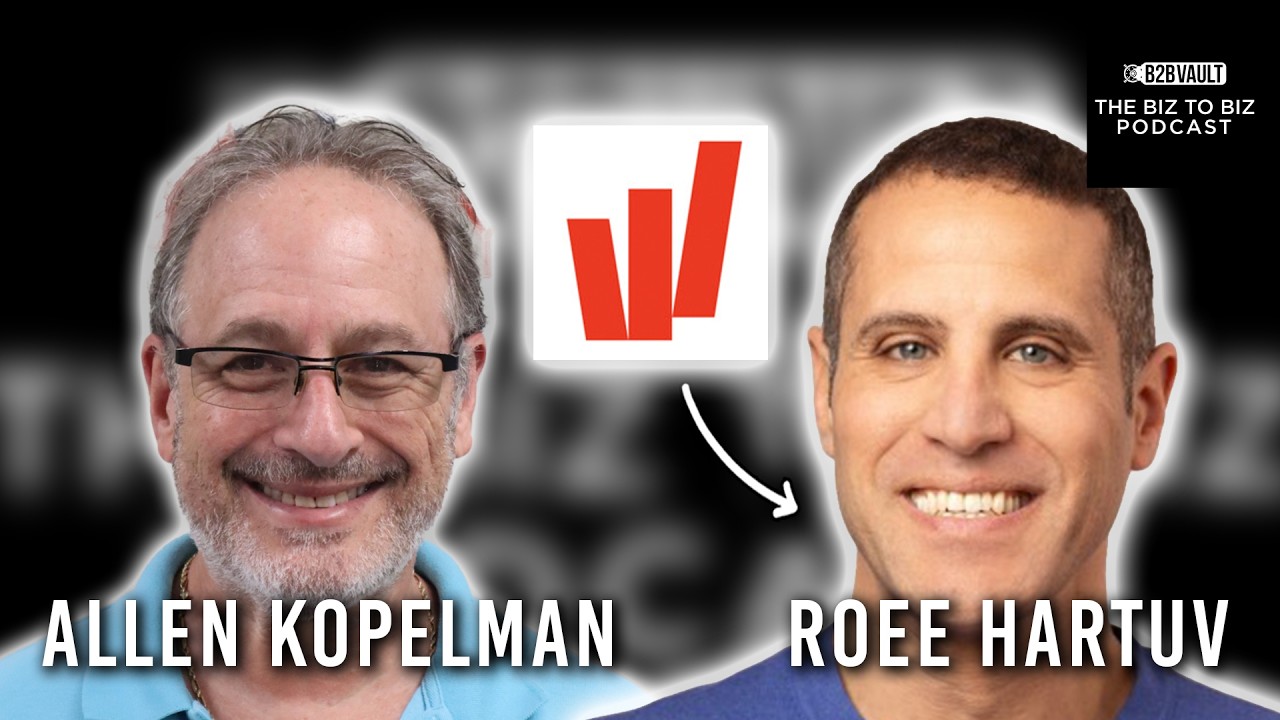
Roee Hartuv, founder of WillingnessToPay, explains why pricing and packaging deliver the highest ROI in B2B SaaS. He covers designing packages around customers' jobs-to-be-done, choosing the right pricing metric, and how AI is lowering SaaS margins and forcing new pricing models.
Chapters
You're now watching B2B Vault, the Biz to Biz podcast hosted by Allen Kopelman, powered by Nationwide Payment Systems, the number one solution for payment processing.
Hey everybody, welcome to today's episode of B2B Vault, the Biz to Biz podcast. And today we have a special guest. Today, all our guests are always special because we provide educational information for business owners and entrepreneurs. Whether you own a business or you're thinking about operating a business, starting a business, this is the podcast for you. And B2B Vault is sponsored by Nationwide Payment Systems and NPS1, our gateway that allows you to have an open API and all the payment links that you need to operate your business. And also our smart invoicing product called Smart Invoicing with NPS1. So we're going to dive in today with Roe Hartov from Willingness to Pay, and their website is willingnesstopay.com. We have all his information in the show notes, so if you need to reach out to him. So Roe, tell us about your— a little bit about yourself and about your company.
Yeah, so I think, uh, like many of our listeners, I started in software sales. I've done that for 15 years, climbed my way up, uh, some successful, some less. Uh, 6 years ago COVID hit and I decided to move to the dark side of advisory and consulting. I've been, yeah, I don't know if there's a term, but let's say, uh, generic go-to-market strategy, or not generic, generic sounds bad, but, uh, all, all type of go-to-market strategy, sales, customer success, a bit of demand generation. A year and a half ago, I came to the conclusion that focus is better, and I decided, or I chose to focus on pricing and packaging. I came to the conclusion that pricing and packaging has the greatest ROI out of all our go-to-market or growth levers. In our toolkit, and getting pricing and packaging right has the biggest ROI. In a lot of cases, it's the quickest time to see revenue.
Yeah, there's definitely, you know, when you're talking about software, we're seeing the software explosion right now. Yeah, right. Every day there's, you know, I monitor sites like Product Hunt and other sites, and and, and AI sites, and you see literally hundreds of companies launching.
Yes, it's easier with AI, right? So everybody is— can launch, uh, relatively easy a, a new software, test it out. So fantastic.
Whether it, whether it, whether it works or not is a whole nother story because, you know, we get people and they're like, oh, we got a merchant account and We got it on Stripe and then they shut us off. And I'm like, okay, well, we need to get a login to your software and we want to see that it actually works because that's, that's a huge issue sometimes is does this, does this work, right? Is this product a working product and is, are there bugs in it or whatever it is? And, you know, that's going to also, you know, but so willingness to pay. Yeah, like, who's like— so software companies come to you to figure out their go-to-market strategy?
Um, mostly, uh, focused on, on pricing and packaging. So B2B companies that, um, yeah, usually you feel it that you have a pricing or a packaging problem. So let's break it down. Packaging is how you bundle the different features and functionality. Within your product. So how do you sell? The classical setup is good, better, best, like McDonald's, right? We've got small fries, medium fries, and large fries. That's the classical way that companies did software. So let's take all the features that we have. Let's analyze 60% of the features that are used by most of our customers. Let's put them under the good kind of bucket. Second bucket, let's take 30% the more advanced features, and the 10%, the very, very advanced features, let's put them under the Advanced package. We've got a slightly different approach. It's focusing and building the packages around the customer's job to be done. When you think of it, let's package the features and functionality to serve our customers, and we have different types of customers. Most likely some are less mature, some are more mature, some need slightly more advanced capabilities, etc. So if we package around the customer's jobs to be done, around their pain points, we believe it's easier to sell, it's easier to expand, etc. So that's the packaging part. Pricing is the classical pricing. In B2B, however, pricing is a bit different. I think we all have intuition on how pricing works in the retail space because we're all consumers. However, B2B is slightly different because the price or the cheapest price is not always the best price.
Yeah, it's, you know, software. When you talk about, you know, when we talk about software sales, there's so many SaaS companies out there, software as a service. And then, you know, it's like, okay, you know, they have whatever, the gold, the silver, the gold and the platinum or the whatever. The basic, the plus, and then the, you know, uh, enterprise level, right? It's confusing sometimes. Okay, well, what do, you know, what do I need, you know, and what am I going to get for the— what am I getting from the price? And, you know, the other thing, a lot of, a lot— I see a lot of these companies, you know, especially whether they're B2B or B2C in the software industry, you know, a lot of them, they, they run very quickly to solutions like Stripe and other, you know, aggregators. And a lot of times, you know, payment processing, you know, today is all bundled together, you know. Like, we even have SaaS companies that work with us, so, you know, we, we enable them, like, okay, well, we can bundle that together with the payment processing. And I think, like, you know, I'm in this 25 years. 25 years ago, software was software. Hardware was hardware and merchant services. And you basically, you know, a merchant, a business owner would have 3 separate contracts to deal with that.
Yeah.
Today everything is bundled up so that, you know, the software company is offering their product. And if there is an element of payments, you know, that's also included in the software. You see that as well from your clientele?
Yes, yes, definitely. So first of all, specifically to your point, the entire payment process is something that we also touch, because obviously if you change how you bundle your features, products, if you change how you price it, the entire quote to cash, that entire payment collection process needs to also adapt. And that's a big part of what we're doing. Now, the crossover between software, hardware, both, obviously, right? And that's when you ask me, what do you guys do? It's not B2B software, not SaaS companies, it's B2B.
Right.
And there are differences, but there's a lot of common type. And when you focus on pricing and packaging, there's a lot of common elements into that.
Yeah, like we see a lot of companies today, even in the point-of-sale world, when they're bundling up their product, it's hardware and software as a service.
Yeah, to give you an example, I, I'm currently working on a, on a project, uh, they— this company has built a software, the scheduling software, for small, very small businesses. So clinics, take for example clinics, the Doctor, they start scheduling, needs a software, of course, and this is their software company. However, 2 years ago they decided to go into the payment or offer payment solutions. So they have a hardware component, point of sale component, and yeah, they take percentages of the transaction. And all of a sudden we're now talking maybe We no longer want to be a software company. We want to become a payment company because that's where the big money is. That's where you take percentage of every transaction, every appointment scheduled, scheduled, or an appointment that happened. And let's give the software for free.
Yeah, there's a lot of that. There's a lot of that going on now. We, we work with several companies and we You know, one of the things that we do, even our product NPS One, we bundle everything together. So you get the, you know, we have two packages, the basic package and then the smart invoicing package. So the basic package is $39 a month. The other package is $69 a month. And then we bundled in all the everything. So the statement fee, the PCI fee, there's no fees. That's it. One fee, one monthly fee, and you get everything. People don't want to see all this nickel and diming, you know, and I think that's important. And even like, we have a real estate SaaS company, and one of the things is, oh, if you process, you know, on each platform, because they have like 4 levels. So on level 1, it's $25,000. Level 2, it's $50,000. Then it goes to $100,000, and it goes to $250,000. So if you process that much then we waive the SaaS fee. Yeah, and there's no SaaS fee as long as you maintain the payments. If you want to use the software and then still get your rent through Zelle or whatever you're doing, you have to pay for the software.
Yeah, exactly.
We give it for free if you're processing a certain amount of payments.
That's right. Yeah, you mentioned nickel and dime, which is another point there's, there's a level of complexity with every pricing and packaging structure. And when you design a pricing and packaging, you want to play with that complexity because complexity could be an advantage in some cases. So from a design perspective, where do you want to add that complexity? Just to give you an example, as you said, If you're just taking, I forgot how you call it, your base package, right? Right. You just want it simple. $25. I didn't remember the number that it's $25. Just, yeah, simple to understand. You just need the basic stuff. Fantastic. However, you want the more advanced stuff. I can now start to introduce a bit more complexity. So it's not like a flat rate. Get it all, or in your case it is, but I'm saying like in other cases you would want to add a bit more complexity because the customer is more mature. They usually started off with the basic stuff and then now are educated and you can basically play around with that complexity in order to make sure that you capture, name of our company, the, each customer's willingness to pay.
And one of the things we do is everything like what we do with on our platforms, everything is white labeled for the customer. So they're uploading the portal, they're putting in their logo, and then once they put in their logo, the, the, the SaaS product will render the colors of the screen and, and everything around their logo. So if their colors are blue and orange, it's going to render a blue and orange dashboard. For them, not only for them, but when it goes to their customer, they're no longer seeing like, oh, I'm paying willingness to pay, and there's a big Stripe logo down there.
Uh-huh.
That's all gone. They just see the company name and that's it. The name of the company they're paying.
Mm-hmm.
And that's it. They don't see anything else. They don't see our branding. They don't see any extra branding. And, you know, for bigger, for even for small companies,, you know, that makes it bet— you know, it looks good. And people start a lot of times with our small package, and then they go and they say, well, we want— we're actually going to start doing more invoicing, so now we need this, or we need the more complex payment links that you get with the other package. So people go, you know, they'll go up, then, you know, you want to get people. And that's a lot of times how you get customers. I see it with other clients that we have, that people will get the basic package and then they'll go to the next package as they grow or become more comfortable with the software.
Exactly. And then that's the right way to design. Coming back to the topic of packaging, right? You want to have that natural growth. So as the customer grows, they grow with you. And yeah, as they mature, they want more capabilities, they want to extract more value. And of course, if you're giving more value, you're also getting more revenue.
Yeah, and the one thing I always talk to when I'm talking to founders of different software companies, I always tell— I ask them, I go, what's your implementation plan? And they go, what are you talking about, implementation plan? I'm like, well, you have to, you know, you make the sale, you sign the person up, now they're ready to start using the software. So you have to have the implementation process of how you're setting them up or training them? Is there a training call? Like, what are you doing? Because sometimes I'll talk to people and they'll go, well, we're having this bottleneck. And I go, what's the bottleneck? Okay, we did, you know, 20 demos, we signed up 10 people. And the problem is out of those 10 people, only 1 or 2 activated. And I go, okay, well, what's your process? And then they go, we don't have a process. So I go, well, you better get one, you know, or you do what one of my other clients we started doing with them is we have a $199 setup fee, and then once you start processing that, then you get your— basically it's like rebated back to you through the system, you know, so it gets rebated back. So That made— once people paid that, now they have skin in the game and, you know, and they're going to go through because in those cases we have to get data from them and put the data into the software, you know, do a data transfer for them. So you have to figure out like you don't want to go, oh, I did 20 demos, 10 sales, and then you're— those 10 people, they're not active. You got to activate at least 90% of them.
You know, that's a, that's a fantastic point. And there's a misconception in the SaaS world, uh, and this misconception I think relates back to how investors see SaaS. Yeah, in SaaS-specific, uh, investors don't want to like to see services, right? It's all about the software. And the way they evaluate the strength of your software is it like 'Can this be installed or managed without selling additional services?' And that used to be considered good. In your case, for example, you're talking with small businesses. They don't have that knowledge. You have to serve and sell professional services in order for them to properly onboard the system, because if you don't do that, they won't be able to use your product correctly. And I think that we're starting to see that shift and we're starting to see more and more companies understand that, yeah, the margins are much slower when you sell services. However, the stickiness and the retention rate is much higher when you do support your customers and how they use your solution.
So give me like 5 things, like when a customer comes to you, like What are the like main 5 things like you help them with so they're gonna have a more successful software launch?
Yeah.
So packaging is changing their pricing strategy.
Yeah. So we start off with packaging. Uh, our motto is, is it's, it's not how much you charge, it's how you charge. In B2B, it doesn't really matter if it's like $12 or $14 per user. It does, but it's less important than how do you bundle the different features and everything that we talked about earlier. So packaging is the first thing. This is usually where we start off. And then what are you pricing your— what are you charging on? What is that pricing metric? That's the next point. It's very important. Are you charging based on transaction? Are you charging based on users or seats? Are you charging based on outcome, maybe. So that's the other discussion. Obviously, the more connected to what drives revenue for your clients, the better the metric is. So for example, seats is not necessarily drives revenue for your customers. It's actually on the flip side. It drives more seats, more costs, and they don't like it. However, if you connect your metric to transactions, invoicing sent, that is already connected to a better type of metric. So I think that's number 2. Number 3 is testing it out. We know that pricing and packaging requires testing. You can't, or in most cases you won't want to roll it out to all your customers from without even testing it. So that's something that we help with. Obviously, how to roll this out, how to implement the entire quote-to-cash, uh, in B2B, in the payment process, how the entire FP&A team or operational COO, how they use it, it's something that we help with. So that's number 4. And number 5, migrating existing customers. At the end of the day, when we roll out new pricing, we have our existing customer base, and it's very difficult, um, if not done right, to not— sorry for the language— to piss off our existing customers that we're changing the pricing, which usually comes with a price increase. So that's something that we help.
Yeah, you know, you know, when you get a new customer, sometimes you have to migrate things, like migrate over— they're switching from a one payment company to now your payment company. You have to migrate not only their customers but sometimes some of their customer data over also. Mhm. You know, we have that all the time. Like some systems we have use inventory. So in our invoicing software, we're actually— we have an automated way to tap into their existing inventory system bring it all over.
Yep.
So that migration, of course, you know, so it's super important to be able to help customers with that or automate. You know, everybody talks about AI, but you know, a lot of it is just plain just automation. That's right. Okay, anything else that you want to share with us that people should know about that's important in this, in the industry? Right now?
Yeah. So again, looking at how AI, yeah, we can do a podcast without talking about how AI is influencing that. And AI is also changing how we price and how we package. So yeah, maybe I'll leave with this. In SaaS, our margins are 80, 90%. That's software margins. But with AI, we know that it comes with a cost and the margins there, numbers change, but let's say 50% is a good number to talk about. All of a sudden, serving a customer is not zero. It's not zero cost. And that really changes how the entire industry is now pricing and packaging. And I think there's a lot of conversation on what is the right pricing structure and mechanism. Incorporate those AI.
Yeah, I think also when you talk about AI, so let's say somebody's looking at 4 different software products, you know, prior to AI, you're probably sitting down making a spreadsheet, right? Today you go, okay, I'm looking at this company A, B, C, and D. You punch all their— you punch all their information into, you know, whatever you're using, ChatGPT, Perplexity, Claude, right? And you go, okay, uh, give me a spreadsheet breaking down these 4 companies. And in 10 minutes, in 5 minutes, you have like a whole, you know, a whole spreadsheet of, you know, what are the features of each one of these companies, their pricing, this, that, and the other. So it makes, you know, obviously if, if that's part of your competition, right, you need to be doing that too so you know what your competitors are charging.
That's right.
You know, sometimes that, you know, people don't always go for the cheapest company, you know, and they don't always go for that. And the other thing is, I think a lot of companies have gone to where, like, they don't answer the phone, everything's an email or a chatbot, and it's very difficult to get information. And, you know, I think that companies have to really rethink the— that they need human support sometimes.
And I think it's a fantastic point, uh, to, to finish off with. In B2B, it's not, it's not the cheapest option. It's a lot of other things that you could do in order to, to win a deal and then to be able to correctly acquire the right customers, right?
So people want to get in touch with you, um, what's— who are the best people that— what are the kind of customers that you deal with?
So again, B2B companies that, uh, would like to redesign their pricing and packaging. Uh, and the channel is LinkedIn. That's the fastest way.
Okay. And what's the best way to— for people to find you? You're on LinkedIn?
LinkedIn is the best, yeah.
Okay. And then you can go to his— Roei's website, Willingness 2pay.com and get more information there. And, uh, probably follow him on LinkedIn and you can see what's going on in the world of B2B SaaS and software because it's definitely a growing industry. Yeah, I don't even understand all the coding stuff. I keep reading about Vibe Coding. I'm like, I don't know. I sort of know what it is, but I'm like, okay, that's just go getting way out of hand. But with the amount of software companies that come out every day, you know, working with somebody like Roei is going to help you have a much better launch or reprice or rebranding or relaunching of your product and to be more competitive in the market. Because that's the whole thing today is what is your go-to-market strategy, GTM, a new acronym for everybody to learn. Right. Yeah.
Good. All right.
Well, thank you for joining me on the podcast today on B2B Vault and have a great day.
More from Allen



How B2B Companies Can Turn YouTube Into a Lead Generation Machine | Featuring Samu Kovacs


How AI Is Transforming E-Commerce with Zero Code | Kumar Senthil, CEO of Firmly



Dre Baldwin on Discipline, Leadership, AI & Business Success | The Mindset Every Entrepreneur Needs

The Same Skills That Made Me a Pro Athlete Built My YouTube #podcast #entrepreneurship #success

