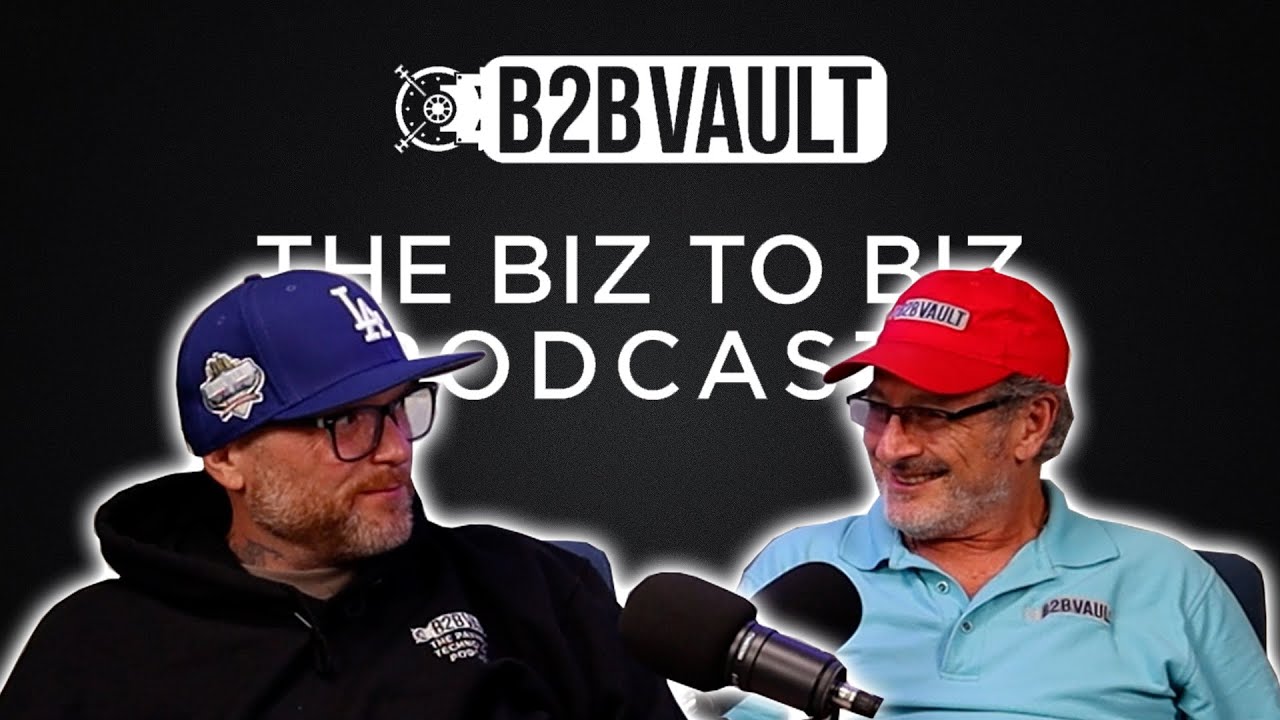
Allen Kopelman, a payment-processing veteran, explains what a value proposition is and why it matters. He traces how Nationwide Payment Systems evolved from "we fix credit-card machines" with 24-hour repairs to offering customized solutions that help merchants avoid account closures and chargebacks. Your employees need to understand and communicate your value proposition clearly.
Chapters
Yo, what's up everybody? It's Justin live from B2BVault, the biz to biz podcast sponsored by Nationwide Payment Systems, hosted by this guy, the Pat Riley of payment processing himself, Allen Kopelman. And we'll be providing you educational information about fintech, small business payment processing, and the technology businesses are using in the world today. And in today's podcast, we'll be discussing or asking a question and giving some insight about what is your value proposition as a business, meaning what, what, what makes you unique? What offerings do you provide that lets— that makes you stick out from the, from your competition and all the rest of the noise? And how do you, you know, find out what your value proposition really is? You know, there's a lot of different ways you can look at this. Um, sometimes it's really difficult, and we're gonna hop into that, get— take a deep dive into the value proposition things of business. How you doing, man?
I'm good. How are you doing?
You look tired.
Yeah, a little tired. Woke up too early today. It's Rocky's birthday. He's sleeping over there during the rainstorm.
He knew he had his—
and he had his, uh, birthday burger. He's not even bugging me for his jerky tree, his pod tree.
Yeah, that's a little interesting, but it's pouring and the poor dog loves—
he does not like the rain.
So I mean, I don't know any dog that does. I haven't ever met a dog.
Just relax and go, it's raining, I can't go outside, so I'm just gonna sleep. Yeah, so that's it. And then getting ready to head out to, uh Iowa for a few days and visit my daughter.
You leave this week or next week? This week, because I'm, I'm like a week behind because, yeah, next week is thank—
the Thanksgiving week, and my brother will be here. So, oh, that's cool.
So, well, for Thanksgiving, your other brother, because you— one brother was just in—
yeah, one brother was just here. The other one is coming.
Your older brother was—
no, he's— they're all younger. I'm the oldest.
Oh, that's right, that's right, that's right.
So the middle one was here, now the baby's coming.
That's what I meant too, though, in my head, the older brother, not meaning being your—
right, right.
I knew you.
So now the baby one is coming, 9 years younger than me, with his wife, 2 of his boys, 2 out of the 3 boys.
He came to the office that day.
Uh, he might have came.
I think he did. He came to the office one time when he was here when I first started working.
Oh yeah, he came to the office.
He had like a gray hat on or something like that. Maybe his company, his company stuff. He was wearing his company stuff.
Yeah, sure.
What's his name again?
Richard.
Shout out to Richard. And what's the other brother?
Mitchell.
Mitchell, he's funny.
And we'll shout out Mitchell, is funny. He was, uh, having a dance.
I met Mitchell before too.
Yeah, they both been here. Yeah. And, uh, yep, they're pretty— they're funny sometimes.
My mom and the older brother says sometimes because they constantly giving him shit.
No, listen, they're both accountants and I'm the payments guy.
So there you go. They might be looking for a lot of info.
So, you know, that's it. And how's your week going?
My week has been amazing. I got married yesterday. I've been with my wife for 15 years, so we never had like a traditional— not by because of me. I asked to marry her.
Yeah. What happened, dude? Like, you're getting married. You didn't like call us up and go, oh, we got to do the bachelor party.
Dude, I'm way past that.
I don't know.
I thought about like going out the night, you know, like on Saturday, but then I'm be going out by myself.
No, you would have called me.
Yeah, we could have definitely did it, but I mean, we would have had a bachelor party. My dad was a little upset that, uh, we did it this weekend, but he didn't even tell me he was going to Milwaukee, so like Whatever, bro. And yeah, so like my wife had this idea of, I'm gonna explain it. So her birthday is November 11th, mine is May 13th. 2 weeks ago she comes to me and she's like, "Yo, do you wanna get married?" And I looked at her like, "Sure, like what do you mean?" And you know, she's like, "Let's go to the courthouse and get married." I'm like, all right, whatever. I don't ask any questions, whatever. Like, there's obviously a reason why she wants to do this, right?
Yeah.
Um, and so she chooses yesterday, which is 11/13. You understand? Like, she was born in the 11th month, my birthday is May 13th. Okay, so 11/13, Justina and Justin Owings.
It's now official.
Yeah, on papers. Okay, on the papers.
On the papers.
I'm gonna go get the papers. The papers. Shout out to Tony two times. Um, yeah, uh, so we went to the courthouse early.
Is she get you a glass and then you can go mazel tov?
I'm down. Um, yeah, we woke up. She woke me up. It was something. The sun was not up out.
It's crazy now how dark it is when we leave and how dark it is in the morning.
Yeah, so she woke us. She woke picked me up and we ran down there. They open at 8 o'clock in the morning. I didn't, I didn't really think it was going to take really long, but that went like that. Like, it took us—
was there like a line of people to get married after us?
Because she was smart, she got us down there like early, right?
But I'm just saying, there was like—
oh no, yeah, there was already one person in front of us, right? The guy we got married in is in his like sanitization uniform.
Wow.
And I was— that was— I was like, see, man, you know, I don't want to get into a long drawn-out thing with this.
That could be a whole podcast.
Yeah. But one thing that always stopped us from doing this is was like the money thing. Like, in all reality, that's really like one of the main factors, right? And it cost us $91, right? Like, so I mean, well, you didn't make a party. You mean, I mean, we not, that's just like just one thing about the wedding part, right?
Yeah.
But I didn't know, like, I just don't, I just always over, we just always made this up to be way bigger than what we, what it really is. You know, when you come from poverty, man, you don't really plan these types of things. Planning. I don't want to get into it, man. But so it was beautiful. We went, we got married. Um, the lady— I'll show you the video when we're done. Um, then me and her went to take some pictures down by the Dania Beach because that's, that's our little— but in the nature park, in the national park type on the side. So that's our little area that we like to go and chill when it's just me and her and Did that. And then my little brother Zach finally, he reached out. He didn't make it to the courthouse. I thought we needed witnesses. You didn't. But, and yeah, so he works at this pizza spot and he hooked us up with pizzas. And then I had a doctor's appointment. I got some shots in my shoulder for everybody who's like asking me, I hope your shoulder's feeling all right. I mean, Yeah, we'll see. I mean, I don't really feel much of a difference today. You know, I, I feel I'm much more mobile, but like the pain's still there. But it takes a couple days for the medicine to start working. All right, all right. So what is a value proposition?
So I got some examples.
Interesting. So a value proposition is what? What is this? I want to hear what that says.
So No, I just looked up like what's a— so each business has like their own little value proposition. Like Uber, what's Uber? Convenient way to get around. True.
Grammarly fixes your text.
Yes, fixes your punctuation and all that.
Tells you, you know, it just fixes your, your, your, your writing. It assists you in your writing.
Right. So then I looked up another good example was like coffee shops. Like, how to— what's their general, um, you know, they try to be like a neighborhood place, know everybody's name most of the time. Sometimes they know your order. Huh, that doesn't work?
That value props out the window?
That's out the window?
I mean, the local thing.
Well, I'm just saying, it's like even for Starbucks, what's their—
what is their value prop?
Expensive coffee. They just make some fast coffee. That's right. No, but when you go in there, they always use your name.
It's the baristas, right?
They use your name. It's the way you order the drink. That's— and people, some people find value in paying $7, $8 for a cup of coffee. Not me.
So, right. So on that value prop, I see none, right?
Just— well, no, but that's their— that's kind of like their— so their business model.
I wonder what their value— was it like supposed to be like high scale coffee, but for fast food.
Yeah, more or less. And kind of like, but the way they do it is, we talked about it on the, on the podcast before when we did another podcast about how people use—
well, that's their real, that's their real value.
How do people use manipulation? I mean, the real value proposition is for you to put money on the gift card.
That's what I'm talking about.
And they have like $1.6 billion in the bank, one of the biggest banks in the United States, the biggest bank in the U.S. Is Starbucks with the most cash.
It's ridiculous.
I mean, like, another thing is like restaurants. What kind of value proposition do they give you today? Not so much on the, on the price of the food, but when you go places, you want to have consistency. When you go play— when you go somewhere, you want to know that it's consistent.
I look at value prop a lot differently, or like on a digital— on a, on a on a, you can keep going down your list, whatever. But like in my, the way that we look at value prop is like, so you're naming all those businesses, right?
Yeah.
So when you said the coffee thing, the first thing that makes me, that in my head like is okay, so Jay's Coffee Grabber, you know, like quick grab coffee. Whatever I'm gonna call it, right? And there's a Starbucks literally 3 blocks away.
Okay, maybe your coffee's less expensive.
No, well, right, so that's one, that's a value prop to me, right? So it's gonna be a cost, right?
And maybe you have a cool vibe.
Or maybe you don't wanna be douchey and you wanna be everything opposite of what Starbucks represents.
Right, that's what I'm saying. So it's got like a cool vibe.
Excuse me.
In the place.
Or, and then I think of it taking it even a step further, right? Like, how are you going to make your customers feel as welcomed, right, as Starbucks? You know, how are you going to individualize each one of these people? You know, like the value prop for you is like for a, for a, for a coffee shop is going to be so crucial in a sense of gaining traction and getting new customers.
Even when you go to Dunkin' Donuts, I've been to Dunkin' Donuts before. I've gone with like Dunkin' is the coffee of the working man.
It's the coffee of the middle.
Right, but there's people that go there all the time. That's what I'm talking about. And they know their coffee order. So that's part of the deal. Of course.
I love like, well, see, that's the difference too about Dunkin' is a lot of Dunkins are, you know, individually owned. Right. They're franchised out. You know, you don't see the owner of a Starbucks.
No, no.
So like, a lot of times you go to Dunkin', like, like back home in Milwaukee, uh, they're all family owned and operated.
Oh yeah, most of them are.
Yeah. And so you get to— not only do you get to know them, but you watch some of these, their kids grow up, all kinds of stuff. So like, literally Dunkin' is America's cup of joe, you know, cup of joe. Isn't that their slogan? America's Cup of Joe?
America's Cup, I guess, something like that.
No, but like America's Choice of Coffee, I don't know, some, some like—
but I mean like for pizza, like Domino's, what are they known for? Fast delivery, right? That's their value prop.
Oh yeah, right. Or you get it free, right? It's the 30-minute one, isn't that Domino's?
Yeah, 30 minutes. Although they stopped really advertising that because some Domino's driver got in like accidents and stuff.
They can't— yeah, no, that's— they can't guarantee it, right?
They just stopped guaranteeing it because of that. Like, I looked up, one of them said— because I wanted to see— Apple was one. They go, what's their value prop? Oh, that their user experience is so good, and that's why people just keep buying these iPhones even though the iPhone is now like some ridiculous—
the lie detector test came back and has determined that is a lie.
What, that the user experience is good on the iPhone, man?
What, when it's new? Like, I love my phone right now, but there's only one new phone above it, right? The next one, this phone turns into a paperweight, right?
That's the crazy part, you know.
My— all— there's like 7 iPads in my house, right? And they're like junk. Yeah, because they're old. They're old. They're like whatever, second generation.
Yeah, they won't run the new apps.
Nope.
Yeah, that's the one thing I don't like about it.
You can watch the internet, but you mean you can— what, watch the internet?
No, you can look up websites and play maybe a few different games, but that's it. Yeah, whatever. No, but like Amazon, the membership is there, you know, all the membership, uh, it's like fun, the benefits that you get from joining Amazon Prime, right? So like the Amazon Prime, like you can buy that stuff anywhere. Most of it. And their big value prop is, oh, we give you all these free movies.
Yeah, yes. And I mean, that's a part of it, right?
But I'm saying, because you—
so like, Amazon's really, in my opinion, Amazon's real value prop is the fact that it's a giant marketplace where you can buy anything and everything even your name brand products. Yeah, although you have to be careful, like you got to make sure that it's from whatever.
Yeah, you got to look at some, make sure it's stocked by Amazon.
I always check that it comes from, you know, Nike, you know what I mean? If you're even, you know, if you do that, I, I don't suggest buying products like that from Amazon because I don't believe you're really getting Nike anyway, but it is what it is. I mean, like They could get in trouble for that, for selling knockoff. Yeah, yeah, it's got to be tough.
It's a, it's a big violation if of the credit card processing, because like one thing we have, we have a, we have like one marketplace merchant, and, um, yeah, we had to give Read 'Em the Riot Act one time. We're like, hey, you got people on here selling stuff. If it's a resale item, that, that needs to be marked properly. That if they're reselling it, you know, that it's used, and then they can sell it. But they can't go on there and sell new pair of shoes. That's why a lot of those guys who resell the shoes do it on these weird apps.
Yeah, I mean, most of it is just Cash App, right?
That's the—
that's the problem for sure.
Yeah, that's a big problem.
All right, so I mean, if you're a new business coming up, right? Like, this is a good question for you. Like, what is your value proposition? What makes you, what makes you stand out, right?
Right.
So when you started Nationwide Payment Systems, what, what was, what was your value prop? What did you come up with for you?
So our value proposition in the beginning, and it hasn't changed that much, is we want to be able to provide personalized service to each client, right? So we make sure that the clients have email, phone, the processor's phone number, the help desk phone number. And we really did that. And when the— in the very, very beginning, when we would sign up—
client customer service.
Yeah, customer service was your number one, right? And then the very, very beginning One of the big things was people's credit card machines used to break all the time, right? So that was our big value proposition, like, oh, if your credit card machine breaks, we're going to replace it within 24 hours. Because, you know, we were selling mostly locally. Within 24 hours, we're going to get out to your business, replace your machine. And we used to get a lot of business because we put an ad in the Yellow Pages. Back then, you know, one-line ad said, "We fix credit card machines," and that used to get tons of phone calls. So their credit card machine was broken.
Yellow Pages was great back in the day.
No, they would call up, you know, their processor, and the processor would be like, "Oh, you want to buy a new machine?" Oh, Yellow Pages was the original Google. Yes.
And White Pages for people, right?
No, so people would get this big bill, right? And we'd say, well, if you switch to us—
Sean, have you ever seen— Sean, the video— he's the video guy and he's the shit.
Sorry.
Have you ever looked in the Yellow Pages? When you were a kid?
Yeah.
Just saying. Do they even still drop off Yellow Pages to people's doors?
No, they used to drop off little ones sometimes.
That was for business.
Right. But they know— I haven't seen one in years. I think they stopped printing.
I hope they did.
But, you know, but it was crazy that we used to get tons of phone calls. Oh, our credit card. We have— we had our— we got 2 or 3 very big customers, chains, because we caught— they called up and they go, oh, our processor can't fix our machines. Every time we want to— every time a machine breaks, they want to charge us $600, $700, $800. So we're like, listen, you go with us, we'll take care of everything. So this one guy gave us a big box of broken machines. We took it to the local place here. We're lucky that there is a local guy that fixes the credit card machines. Gave it to him, went back the next day, picked them all up, drove them down there. The guy's like, are you serious? We're like, yeah, that's it. Like, we can do it all day long, no problem. How much was it? Oh, $75 each. The guy wrote us a check. Boom. Then we said, we said, well, you know, we want to get your business. If you, if you do business with us, we're not even going to charge you to fix the credit card machines because it wasn't that expensive. Like back then, there were maybe $30 or $40 a machine to fix, right? So the guy starts giving us some stores, and before long we had about 20 stores because he was opening up new stores. Then we say, hey, why don't you give us the other stores that are already open? There was about 20 of those. Then we got all of those. And that all from just broken credit card machines. Yeah. And we got other leads like—
shout out to the Yellow Pages.
We got leads like that all the time. Oh, my printer's broken. For like that, a point of sale system. And then those printers back then, the printer, like a little Epson printer that prints the receipts, you know, next to the, next to the point of sale thing.
Right.
Okay. Well, those things back in the day, they were like $700, $800. One that would be like in the kitchen would be like over a grand. And there was a guy Allen Kopelman that literally had a repair shop for those in his garage, and he would fix them for like $150. Now today you just take them and throw them in the garbage because they're so— they're only a couple hundred bucks. It costs more to fix than it does to just—
yeah, technology is not that compatible either, right? You can't just swap things out like that, right?
The parts back then, they— the guy would just—
I mean, they're compatible for like the working, but it's just—
no, but there was like—
or it breaks. This is where it's just like a phone, you know?
No, but it was, there was like a couple of parts in it that used to break. They were like workhorses, but there was a couple of parts. It was like a cog, and then there was a little thing on the printer, and the guy would just literally, he would fix it right in front of you for $150.
That's—
then we take it back to the people and we go, okay, $250, and they're like, oh, what a bargain, because otherwise I have to spend $800, $900 on a printer. Charged them more. Well, we wanted to get the business. Still would have— then we got them more. Then we got business. All right, sometimes we charged more.
How is— so a customer service at Nationwide Payment Systems has not changed, right? Like, you pride yourself on fighting people's chargebacks, answering phones for everyone. Um, so it changed a little far.
It changed a little bit in that—
had to have, right?
The message changed now, like and you helped with that, to customize payment processing.
Yeah, see, we've been fighting for the time I've started working here, right? Trying to differentiate Nationwide Payment Systems from the rest of the payment processors, you know, the competition. And, you know, we going back and forth, back and forth, like, and then one day This guy says, custom, we, you know, we do customized payment point of sale solutions. And I looked at him and I'm like, that's it. Like, that is literally, that's it. Because when you, when I've been like doing the research and Googling, yeah, I've seen custom point of sale systems, but that is what Nationwide Payment Systems does. Like when someone calls like a business, most of the time it's a business they've been in business. They're operating. Things are changing drastically for banks. And so these merchants and these small businesses owners who have had these merchant accounts for many, many years, all of a sudden are getting shut off at a blink of an eye. All of a sudden they do an audit. They don't like that he sells adult toys. Bang, new ownership. Oh, he's selling hemp products that target marijuana businesses, nothing to do with it. Boom. And that's what Allen and Nationwide Payment System does, is that they customize the solution and find partners for these companies to actually flourish. And once we figured that out, holy shit. Like emails, phones ringing, contact forms, etc., etc. Like, so, you know, the value. And when I was saying it with him, he, he, you know, he's old school. So you never really got it. Like what I meant, like on a digital, like, what was the— how can we— because you're like, man, we do this, we do that. And I'm like, yeah, that's all fine and dandy. But still, So does PayPal.
But it's funny how the business— our business changed too, because in the beginning, right, we had the website NPS Bank, right? No, no. But I want to explain to you why that made sense. When you would go talk to somebody 23 years ago and I'd come into your business because it was a bank, you had no—
no, no, no, no.
I would come in your business. Oh, Justin, who do you do your processing with?
Quick.
Oh, who do you do your processing with? You'd say your bank. So most people went to their bank. Today, most people are going to PayPal, Stripe, and Square. We go to those customers and we go, why are you paying them so much money? I was listening to a panel discussion the other day, and there was a guy on there from one of the card brand companies. I don't want to say who, and because it might not be proper. And he said, oh, one of the problems we have in the market is that there's a special rate for debit cards. But because there's companies that bundle price, like PayPal, Stripe, Square, and others, give people a bundled price— because they're in a bundled price, they're not seeing the savings from those debit cards. And that's where we come in and we analyze what you're doing and give you— get you the best rate. And, and we I don't want to say we manipulate the interchange of how it works, but we are— you go to your accountant and they're an expert to save you money on taxes. We're an expert on getting you the best interchange.
Yeah, you're not manipulating anything, right?
We're just getting you the best interchange rate.
Allen knows. So like, there's so many— Allen's been in the business for so long. Like, anyway, that's a whole nother podcast.
Oh, yeah.
What you're talking about is a whole nother—
no, no, but I'm just saying.
So the value prop, man, right? It has changed. Like, When you started at MPS Bank, it made sense because why?
People went to their bank, right?
So when I started, I changed it. I fought and begged with you, right?
And we changed. Well, and we wanted to be more fintech and we got more fintech.
We compromised.
Yes.
We left MPSBank.com for other purposes and then we built out Nationwide Payment Systems, right?. And the difference in that for me is night and day, right?
Plus we got more people, or we got it more a lot focused on fintech, customized payment processing.
And that's what I'm saying.
Yeah. So we got—
we narrowed it down and we made people understand that Nationwide Payment Systems isn't a bank. You can come and buy an ATM. We do not have ATMs at our location. Right. So like, you know, like the— it's important, I guess I'm— what I'm trying to get at is so important to understand your value prop because in the age of digital marketing and search engines, you know, people Google bank and you're not a bank, right? What are you doing, man? You know what I'm saying? So it, you know, you have to understand how to market to your—
the way customers were buying the product also has changed from buying it in person to now they want to buy it on the internet.
They wanted it to be easy, right? No one wants to get in a car and go fill out an application at a bank to come to find out that they get denied, right? You know what I mean? You know, because at that bank you have to have a 650 credit score to open up a merchant banking account, right? So, you know, that's the other reason why PayPal, Square, and Stripe are so popular. Anyone gets approved, right? Well, we could keep going on that. And the value prop, like, in long story short, man, I really, you know, like, my company, my value prop was to aim for the underdog, you know, which is extremely a bad choice. Like, you know, like trying to help out the small— there's no money in it, like nonprofits and everything. I should have— I I should have did that later on, you know, but the value prop for me, I wish what I would get, you know what I mean, like success from was, you know, helping, being helpful.
Yeah.
So, you know, that was the, uh, that was my—
and that's our big thing. That's why I'm in business to help business owners with payment processing.
But, you know, you know, just what I was getting at is like, you know, find your value prop and make sure that it's valuable. Not only for the customer but also for you.
Yeah, and also make sure your employees know what it is too.
Educate your employees.
Yeah, your employees, they're, they're your messenger. So that's what you got to do. What's your value prop?
Tell us. Yeah, I love to talk about it. Like, if you don't understand, like, what it is, or, you know, let's chop it up.
Yeah, exactly. Yeah, man.
Well, that's today's podcast. What is your value prop? Hit that like button, smash the subscribe. Peace.
Peace out. Carpe diem.
More from Allen



How B2B Companies Can Turn YouTube Into a Lead Generation Machine | Featuring Samu Kovacs


How AI Is Transforming E-Commerce with Zero Code | Kumar Senthil, CEO of Firmly



Dre Baldwin on Discipline, Leadership, AI & Business Success | The Mindset Every Entrepreneur Needs

The Same Skills That Made Me a Pro Athlete Built My YouTube #podcast #entrepreneurship #success

