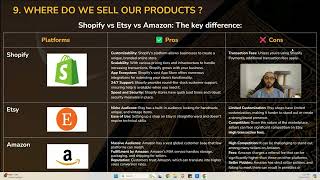
In this module Amine Ait evaluates the three main online sales platforms—Shopify, Etsy, and Amazon—highlighting their respective advantages and disadvantages for a Muslim/halal eCommerce brand. He argues that Shopify should be the primary channel because it enables a unique, branded storefront, offers scalability, lower processing fees at scale, global store capabilities, integrated apps via vetted partners, fast loading themes, strong security, and full ownership of customer data, which is crucial for remarketing and future exit valuations. Etsy is described as a marketplace with built‑in traffic focused on handmade, vintage, and print‑on‑demand items, but suffers from limited customization, high transaction fees, and intense competition. Amazon provides massive audience reach, trusted checkout, and fulfillment services, yet carries high competition, substantial fees (15‑30%), risk of account suspension, and loss of data ownership, with the added danger of Amazon replicating successful products. Ait recommends a multi‑channel strategy: use Shopify as the core brand hub, then add Etsy, Amazon, and TikTok Shop as supplemental sales channels to capture extra revenue while keeping the brand’s data and assets centralized. He also emphasizes the benefits of Shopify‑based brands in mergers and acquisitions, where private equity and family offices value the owned customer data and diversified traffic sources.
Chapters
So module number nine. Now we're asking ourselves, where do we sell our products? So the three main platforms are Shopify, Etsy and Amazon. Here I want you to understand the difference between three platforms, the pros, the cons. So I'm going to go briefly around the pros and cons for each platform and you can always go back to the slides if you want to go more in depth. So the reason why we actually go with Shopify as our main platform to build our Muslim ecom brand is because by using Shopify you're able to create a unique branded online store. A thing that you can't do on shop on, on, on Etsy or Amazon. That's the first thing. Second thing is the scalability. So Shopify grows with you. So the good thing is they you start saving on processing fees the more you scale and the more you grow your business. You can also open global stores, different regions in the world and the ecosystem that it provides. The apps like the one we're using with our vetted partners, they all have built in apps that integrate. So you remove all the challenges that you usually get with the WordPress programming and coding. Everything is integrated, everything is, the user experience is amazing. And also their customer service is top notch. 24 hours, 7 days customer service and then the speed and security. Shopify store, now they have improved their themes so the stores load very fast and you have a good security. A good security. You will see less, way more, less issues with hacking compared to WooCommerce. Let's say the only con is if you're using an external payment processor. Like if you want to connect your stripe or whatever payment processor to your store, there is an extra fee that adds up. But in our case we just use Shopify payments and save on those extra fees. Etsy, now let's talk about Etsy. Etsy is a marketplace. So that means they already have traffic. So they have traffic. They're looking for specific handmade, unique, vintage items. That's how Etsy was built around this exact client avatar. Handmade, unique and vintage items. But it grew to print on demand. You can find skincare products and a lot of also canvas apparel, lifestyle merchandise. The good thing, it's easy. It takes three minutes to set up your store. Cons is you have, you have limited customization. Like all the stores look the same. You cannot stand out. There is a lot of competition obviously and their transaction fees are super high. And then you have Amazon. Amazon amazing, massive audience, trusted source, high conversion rate. People trust Amazon. Obviously the checkout process Takes two seconds to check out. Especially if you have a prime account, all your data is already stored there and you have Amazon that takes care of all the fulfillment for you. Now let's talk about the cons. The cons is high competition, super high competition. The fees, the Amazon fulfillment fees, processing fees, it adds up sometimes between 15 to 30% and seller policies. A lot of nightmare stories with Amazon sellers that wake up and find their store closed. And then you see Amazon creating the same product and branding it as actually Amazon product. It happens to a lot of bestsellers. Whenever you crack the code, you find a good niche, great product. Amazon can actually take the same product and brand it and close your store. That's one of the. You know the bad things about Amazon except that you don't own your data on Amazon. You don't have the email, the phone number or the addresses of your customers. So you cannot remarket them, you cannot send them, you cannot do promotions and build your list on Etsy. You can have access to the email list, you can set up, you can plug an email software to send newsletters, to send promotions, campaigns, collect reviews, Shopify, you own your data, that's the good thing. You own your entire data. And if in the future you want to exit your brand, which I highly recommend, if you're looking for a high seven figure or eight figure payout in the next few years after you scale your brand and you're looking to start something else or just retire. When you look at in the space of the M and A, mergers, acquisitions, private equity firms and family offices, they pay extra for Shopify brands because it has the assets which are the data of your customers and you have different traffic sources. You can have organic, you can have Instagram and you can then when you have a strong brand, I recommend actually adding your Etsy and Amazon as extra channels, but not as a primary channel. You want your Shopify to be your primary channel and you can add your Etsy Shop, your Amazon and your TikTok shop as well and list all your products on these platforms. Those going to add extra revenue for you. But you want to build your brand mainly on Shopify and the three vetted partners that we went through on the previous model, they all have Shopify apps built in, integrated. And when you open your Etsy automation Amazon, they will take care of actually fulfilling even the orders that come from Amazon, Etsy or TikTok Shop for some of the products. So it's amazing that you can centralize everything and run your business on the go, even on your mobile app. You can run your store on your mobile app. So that's for the module 9.