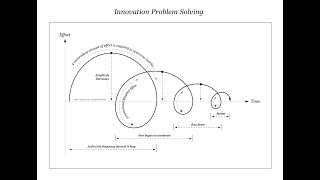
In this presentation, the speaker argues that effective problem solving starts with asking the right questions and then introduces an "Innovation Loop" that expands the classic build‑measure‑learn cycle into a three‑dimensional spiral. Using the Voyager spacecraft’s gravitational slingshot as an analogy, he illustrates how early iterations require high effort and time to overcome inertia, while each subsequent loop leverages learned successes to reduce effort and accelerate progress. The spiral visualizes effort on the y‑axis and time on the x‑axis, showing how startups can iterate faster, validate hypotheses, and gain clarity as they move through successive cycles. The talk emphasizes agility, rapid iteration, and the practical application of this framework for businesses and startups, and invites audience feedback.
Chapters
A lot of people think about solutions, and the way I think about things is that you really need to ask the right questions. And so the answers you get depend on the questions you ask. So solving problems well is not just about asking the right questions, but also asking them in a way that is, um, efficient and effective in making sure that you actually get, um, a response that really makes sense. And so, um, innovation problem solving that I'm thinking about leverages the natural laws of time and space. So what do I mean by that? A lot of time when we look at solving problems, we look at the different frameworks, but I've really not seen, um, the other factors that are related to problem solving. For example, the effort involved over time. And so what we're looking at here on this particular slide is the satellites that are heading out into space, right? And there are, um, the laws of gravity that are in effect, and really that, you know, leverages the idea of effort over time. And so this is an enlarged picture of the orbits of those satellites. And the— in this one particularly, it's the Voyager that is leveraging the gravitational pull of the planets in the solar system to accelerate through terminal velocity. Of course, at the heart of it, you know, in every framework and innovation. What we're trying to do here is to create a build-measure-learn loop. But what it doesn't tell you, because it's so simple, is that the how and the whys, right? How are you going to accomplish it? And the whys, um, it's kind of clear, but it doesn't give you prescriptively the details as to the why and the what. So I want to introduce to you the framework that I've been coaching businesses as well as startups, um, over the last 5 years. And so this spiral, um, really exemplifies the thinking behind how we do things. Um, and yes, at the heart of it, it's about agility. At the heart of it, it's also about iterating fast. Just like the build-measure-learn loop. But here in the innovation problem-solving loop, what I'm trying to get at is, in the case of a build-measure-learn loop, that's just a 2D representation of the innovation problem-solving process. Whereas in this particular infographic here, what I'm trying to get at is actually through 3D perspective. And what that really means is that not only are we iterating in a time continuum, we are iterating, um, on the x-axis, x-axis over time, but also on the y-axis, the increase in effort. And so let's take a look at this infographic a little bit more. When you're first starting out and trying to experiment and test if the problem you're solving is actually worth solving, that there's a market for it— in every startup there's a tremendous amount of effort required to overcome inertia. And what does that mean specifically in a startup? It means that, you know, you have to do all the early stage work of understanding if this is a problem worth solving. You have to build your team, you have to start figuring out who to talk to for your customers, potential customers, of course, not just identify people you think who could be your customers. Um, and so there's a significant amount of effort and there's a significant amount of time, which is why really if you look at the build-measure-learn loop, you want to iterate fast. But if you look at it from a series of iterations, um, you know, you have to overcome this immense value of effort to do that in the first cycle. And then as you proceed into the second cycle, you begin to succeed at certain things. You know, we have a number of assumptions, we have a number of hypotheses, um, that are— will be either validated or invalidated. And so these learnings will help you accelerate as you continue into the second curve here in the spiral. And if you see in the second spiral, you will see the gravitational slingshot effect. And so what that is, is the ability to learn in the iteration from your successes and failures. And as a result of that, you begin to accelerate to maximum velocity for that particular iteration. And what that means is that the amount of effort required as you head into— as you head around into the second iteration the amount of effort decreases after the first cycle, and additionally, the amount of time required to go into your second iteration of the experiment in understanding if this is a problem worth solving accelerates. And as you go into the third loop and so on, that is really where you're going to get clarity and focus. So I want to come back to the Voyager 2 slide animation, um, that's in the corner of the page. Interestingly, when we talk about the gravitational slingshot effect, that's at the heart of what we're thinking about in terms of the innovation problem-solving process. Um, these are two of many other factors that we can leverage and think about as we explore the problems that are worth solving in businesses that, uh, you know, plague us all the time, right? So if you look at the animation, when the satellite Voyager 2, uh, orbits around the Earth and then the Moon and then all the other different planets, um, It's that gravitational slingshot effect. And, um, at the point where they are at terminal velocity in that particular orbit, they're also— the satellites turn on their engines full blast to, um, accelerate to the next orbit. Um, and so that's similar to what we think about the effort that we've put in through the learnings as well as the successes, really the validations that are coming through, uh, the iterative cycles that we're putting, uh, the problems through its paces. And so really, I wanted to share this with you as and I guess an update in terms of my observations and how I think about problem solving. And I'd love to hear feedback from you as to whether this resonates with you. Um, so leave a comment, leave your feedback. You can reach me on all the different social media channels I love— I look forward to hearing from you.