One Person, Many Voices: How to Build Agents That Sound Like a Real Person
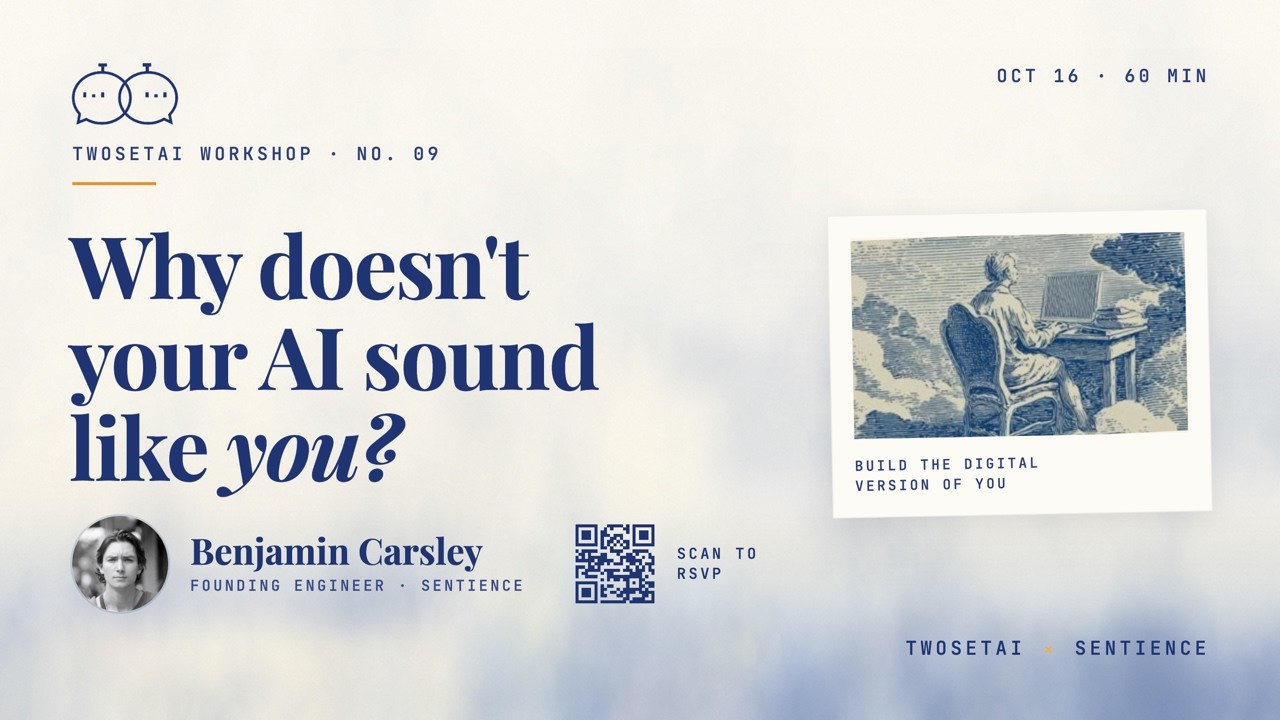
In this live workshop hosted by Angelina Yang of TwoSet AI, founding engineer Ben Carsley of Sentience explains how to create AI agents that capture the multiple registers, tones, and stylistic nuances of a single person. The talk begins with an overview of linguistic registers and visualizations of Ben’s own writing clusters using semantic and stylistic embeddings, showing how formal, casual, email, Slack, and other contexts form distinct centroids. He argues that traditional pre‑training on global benchmarks cannot learn personal voice because style is highly subjective and context‑dependent, making post‑training the only viable path. Sentience’s solution is a model‑per‑person architecture that keeps a shared backbone model while applying low‑rank adaptation (LoRA) adapters for each user, enabling scalable, isolated personalization and full data sovereignty. The session covers unsupervised clustering of a user’s corpus, creation of markdown guides for each register, and the limits of prompting‑only approaches (illustrated with a failed Norman Cousins demo). Ben discusses production challenges—GPU scaling, VLLM, hardware‑software co‑design, and latency targets—while emphasizing that users own their weight adapters (exportable as SafeTensors) and can delete them at will. He compares Sentience’s outputs to Claude and ChatGPT, noting that Sentience passes the Pangram AI‑detection test, sounding indistinguishable from human writing. The Q&A touches on prompting vs training, the role of AI “employees” versus extensions of self, privacy concerns, audio diarization and future voice‑cloning, job‑search advice for engineers, and the broader personal‑AI landscape. The workshop ends with a preview of the next session on founder valuation models.
Chapters
Can you? Can you see me now? Can you hear me now?
I can. We are live.
Yeah, we're live. Yeah, sorry.
Aha! Fun. Okay, and then we are live.
Yeah, we're leaving the studio. Sorry.
Aha! Fun. Okay,
and then. All right, no more echoes.
No more echoes. That was funny though.
That was funny. Like, I keep talking over each other. Yeah,
that was interesting.
All right, let me, let me share my screen first. Um,
that's great.
Yeah, okay, maybe I can make it bigger. All right, it looks bigger now. All right, let's get started. Hello everyone, I'm Angelina. I'm founder and host of TwoSet AI Podcast. And thanks for tuning in today. A little bit quick context if you're new here, TwoSet.ai, you know, I started with TwoSet, so meaning that I want to have 2 people talking about AI. And over the last year, I've interviewed more than 100 founders and domain experts on the show. And every one of those conversations actually opened the door. I realized that later on, it actually opened the door to a bigger world of engineering behind them. And it's the engineers and the researchers solving these real-world problems the founders were describing to me that I think that these technical nuances actually deserve its own stage. And that's why I started this workshop series. The frontier engineers are the heroes here, like my guest today, Ben Carsley from Sentience. My goal with TwoSet AI is to help builders, engineers, and anyone experimenting with AI like yourself Find your wedge the same way as the founders I interview found theirs and build what you're passionate about and be positioned to sell one day. And today's topic is one, you know, we've already run into, right? When we ask AI to write something for us on our behalf. You know, I shared my emails, maybe your writing samples, your skills, your contacts, but it's still coming back as sounding a little bit mechanical impersonation of you. And so I think knowing the facts about you is one thing, but writing the way you write or you speak is totally another different thing. My guest today is, as I said, Ben Carsley, founding engineer at Sentience Company, and I'll let him introduce himself to you shortly. Before All right, before I hand it over, a few quick housekeeping notes. Ben will talk about roughly 40 minutes and then we'll open it up for Q&A. So drop your question in the chat anytime and I'll bring them in. And once more, ask if you find this useful, hit subscribe on our channel. We really appreciate your support. And before we start, tell me in the chat, where are you joining from and what are you building? Ben, I'll hand it over to you. Tell us a little bit about yourself and Sentience.
Hi there. Thank you, Angelina. Yeah, so my name's Ben. I am one of the founding engineers at Sentience. We are building a digital twin of you for the purpose of kind of extending yourself. We talk about it sometimes like an exocortex, another layer of you and an extension of you to sort of scale your intelligence, your knowledge, your preferences and judgment. I've been working in the ML space for basically the past 4-ish years. My background is in linguistics. I studied at Columbia here in the city, and my fascination has kind of always been with modeling speech, whether that's in mathematical spaces or utilizing data science or, you know, text corpora processing, or even doing work with endangered languages and language reconstruction. So I've always been fascinated by this problem. I think just in recent years, uh, the AI sort of commercial space has become increasingly interested in the plurality of voices and not just, uh, sort of building towards sort of monolithic superintelligence, but rather something more like personalized and unique intelligence per person. And so that is really why I was brought on at Sentience by Sam and Teddy, was to lead the ML research efforts and kind of found like a proper stack for a future that in which there's like a model per person in which, you know, we're, we have a personal model of yourself and, and you own that and you own your data and your memory layer and, and your weights. And that's actually something that we like host and serve for you, but fundamentally you retain. So that's the promise of sentience is, is the idea of, of building your own personal superintelligence, but, you know, one that you retain and have sovereignty over. Yeah, that's about me. Should I just dive into the presentation perhaps? I don't— oh, hello from Portland.
Yeah, you can start diving in.
Okay, awesome. Great. Yeah, so let's get into it. I'm going to start with the high level here. Previously, I was working more in speech and audio. Which is like really started to give me kind of a groundwork for thinking about the differences of a human voice in terms of signal processing and doing a lot of phonetic analysis at the last company I worked at, BoldVoice. And when I came on at Sentience, I took a similar approach. So let's go ahead. I like want to go into my notes a little bit here on the one person, many voices. Oh, cool. Is that actually sharing properly for me? Oh, good. All right, I'm gonna go and talk over this. So this was part of a presentation, some small visualizations that I made for a presentation that I did at Modal Labs a few weeks ago. But basically what you're looking at here is an embedding space. It's a PCA, so dimensionally reduced visualization of a bunch of texts of mine from different registers of my life. My initial bet when I started working on this problem of make a model talk like me or make a model talk just like me and also make this service work so that every user who uses it, the model talks like them. There's obviously a number of approaches you can take here, but just looking at it from a data exploration perspective, the first thing that I observed is that humans talk very differently based off of what we might call pragmatic context. A lot of research in corpus linguistics on what we might call registers. So register is a term in linguistics that basically means, you know, sometimes I speak in a formal register, like I'm presenting on a talk. Other times I'm texting my friend, so I speak in a very casual register. And of course, we can even regard speaking and writing as different registers in a way, because contextually they actually look quite different. You know, if you transcribe my speech versus looking at how I write, those things are going to come out very differently. And one of the interesting things that you start to see is that you can actually cluster a reasonable amount of your writing into these very distinctive kind of buckets that form naturally in kind of the places in which those texts were made. So, you know, blue here being my actual iMessages, you know, you see that's kind of entangled up with Slack, which actually makes a lot of sense when you think about how you DM teammates casually at work. It's very similar to how you text, whereas academic writing exists in a completely different space that's like maybe closest at best to email. And email, you see also has kind of 2 very different centroids. I'd probably postulate that that's like my personal emails versus like my work emails or professional emails. But anyways, let's get a bit more into this. Um, what I want to kind of talk about here from a high level is that everything up until, say, maybe the past year, year and a half in terms of ML research has basically been pushing benchmarks or pushing models towards benchmarks that Optimized for what we would call maybe like a global minima, right? Like we assume that there is some like best case scenario output, um, for any given task. So any given writing task, there's like one and only one like best possible answer pretty much. So if you think about like a coding problem, like, yeah, maybe there's a few ways to solve a LeetCode problem, but there's like an optimal O way of solving that coding problem. That's what we're going to train the model to do. And up until recently, people approached training models for speech in much the same way, right? We optimize for grammaticality, obviously, in a certain language, which we might call like our MMLU benchmark, right? Like, so there's like multilingual benchmarks for being grammatical and intelligible in a variety of languages, and pretty much every frontier model trains for that. Um, and then also we might call something this other dimension like truthiness, right? Which is basically just like, You know, it's saying truthful content that we would like agree with, but that gets really murky, right? Because like, if I ask it like a question of opinion, it comes down to sort of the question of, okay, well, whose opinions are we regarding as the optimal truthy? And what you end up finding is that, you know, labs like Anthropic, you know, props to them, but like they have to develop things like ethical constitutions and philosophical principles and all sorts of like standards basically for what they consider optimal behavior or semantic content. And like, that's basically being decided by like a group of researchers in a lab at best. Um, maybe like a few people in like also the corporate and kind of managerial layer of Anthropic too. And certainly this is the case for companies like Google who have like huge liability concerns with their like Gemini product that is now shipped in all of our browsers. Like if Gemini tells you to like take a medicine or something, Like, obviously that's like a huge liability for them. So like they have very strong guardrails and like, you know, they, they post-train to align the model with certain behaviors. And like that largely comes from private and corporate interest of liability, not necessarily like serving you, the end user, right? But more like kind of covering their ass. So that's kind of something I just want to sort of like lay the groundwork for here, which is something that's kind of interesting to think about in this problem of speech, which is that like we don't really have global minima when it comes to human speech. Like, we have grammaticality, that's true, but like, truthiness is really complicated, and style and tone are completely subjective and have a lot to do with the user's intent, judgment, their relationship to the recipient of that writing. So it's really hard to take traditional machine learning of training a frontier model and apply that like directly to a problem like tone and style. So like Preference is a dimension of language, basically. So this is kind of interesting. This is just sort of a funny thing to think about, which is that if I'm writing an academic piece of writing, I don't really position myself in terms of like my emotional intent. We can call this sort of involvement, which is like I'm not involved with my audience when I'm speaking academically in the same way that I'm involved with my audience when I'm writing to a teammate or I'm writing a text to a partner. There's a lot more considerations pragmatically that go into how I communicate. So that's why we see that models can write a really persuasive academic paper because it's fundamentally fairly disinterested in aiming to be non-biased and kind of generalized and also generally intelligible. But when it comes down to model tasks that are like, draft me a Slack to my teammate or draft me an email to this important stakeholder or client, draft me a text to my partner. Those things it's going to really fail at because they fundamentally involve a dimension of language that we've never ever been interested in baking in or evaluating a model on. And so we just haven't been training models for this sort of end task. And so obviously everything that a model turns out is like much closer to sort of Wikipedia or academic writing than it's ever going to be to something like personal communications. So there's a number of interesting papers to kind of look at here in terms of the the work that Anthropic's been doing on persona vectors and things like that. A lot of research in my early months at Sentience centered around this question. Obviously, all of this comes down to just one final conclusion, which is you can't pre-train for voice. Obviously, there's just too great of a breadth of diversity in terms of people's tone and style and everybody's different inflections and registers. You know, one person contains many voices, which is really my sort of thesis here. And it— then when you imagine the diversity also of human voices, it sort of begins to become impossible to imagine a dataset which could actually, like, pre-train for something like voice personalization. So I started to realize pretty quickly that post-training was going to be kind of the only practical approach here. We'll get into what post-training really looks like in production because we now at Sentience have just released personal models as a feature. I'm actually able to speak with a bit more specificity about how that actually looks in production, which I hope we'll get to soon. We can talk about this. This is interesting. There's a lot of different embeddings models out there. There's a very interesting embeddings model that was developed by Anna Wegman for a research project. I think they're maybe one of the only people who has like ever really tried to tackle this problem before me in a public fashion. But it's really interesting just to look at what happens to embedding space when you look at it using a semantic embeddings model like Gemini embeddings versus looking at it with stylistic embeddings. So a model that has actually embedding model that's been pre-trained to actually distinguish between tone and style. It's really interesting, honestly, because what you begin to see sort of happen is that like, yes, the, there are like centroids in both and they do cluster distinctly, but they cluster very differently. And we begin to notice that like with tone and style embeddings, like as we begin to refine models to distinguish and classify between different registers and different forms of a person's tone and style, we can see there's actually a lot of overlap across some registers based off of recipient, which is like, I have my teammate Alex who I regard as like a close friend. And like the way I message him is actually quite close to how I text a lot of my friends. And you can really only see that sort of, uh, like overlap and, and kind of, uh, the actual cosine similarity of these items being quite similar when utilizing this encoder versus a semantic model, which is only really going to show you the actual content of what you're talking about. And of course, what I talk about at work is very different from what I talk about in my texts. And so fundamentally it looks as though those samples are quite dissimilar from one another. So this is more a sort of, again, data science observation about we don't really have the tools that we want yet to be able to understand tone and style as a problem in machine learning. And one of the first layers of doing that right is actually having an embeddings model and an encoder that can make those distinctions and has been pre-trained to classify those distinctions in human language, which is quite a challenge in the first place. Um, so this is fun. Um, these are me and my colleagues, and, uh, this is really just kind of, kind of fascinating to look at. I once again like looking at different models. Um, my writing in the team is regarded— I, I'm regarded as having a very distinct style. And if we look at a semantic embedding space, it looks like all of our texts are just like jumbled up. It looks like we all just talk about the same general stuff, like work, life, partners, that stuff. But then when you actually look at it through a stylistic encoder, a stylistic embeddings model, you can actually see that the data on me is off in its own isolate, which is very consistent with anecdotal experience. You can see that Sam, who also has this very curt unique style himself, a lot of his texts really cluster on their own. It's also interesting to note that you can get a much cleaner centroid or a much cleaner clustering of distinct voices using just a random tree classifier if you utilize a stylistic embeddings model versus a semantic one. Once again, just thinking about this purely from the perspective of early layers of sklearn data science and exploration, these are how we start honing in on evaluating and developing metrics like stylometric benchmarks that we could actually utilize to train or refine a model and reward it for certain types of alignments or behaviors. So yeah, I made this graph, fun little graph to explore. You guys should check this out on your own free time. It's here at voices, sentience.com/voices. Just kind of a fun thing to look at. A lot of references and interesting material here that people might be interested in checking out if this spoke to you. And this final thing is just kind of cool. interesting thing, which is just that you can also just use statistics to do a lot of this work. So of course you can use, you know, modern linear algebra and embedding spaces, but you can also just look at stylometrics from a perspective of statistics, which has been around for probably over 50 years. And you can see that, like, different registers have very distinct stylometric profiles, and you can do a lot just by classifying data this way using purely statistical evaluations, which, for those interested in this field, the product Echo, uh, being produced by Fulcrum right now, which is a sort of impersonator, uh, model based off of Kimmy K3, I believe. Um, this is really how they trained the model, was they used very, very few, um, actual sort of like machine learning metrics, and they did most of the reward and loss calculation using purely statistical evaluations of just like median word sentence length, you know, emoji usage, different types of Punctuation usage frequency. These sorts of things can actually tell you a lot about text and tone and style, just purely from statistics. So yeah, that's kind of the high level of like, this was the research problem. I was given the problem of make a model actually talk like me for reals. And this was the beginning of sort of the pre-work of the research in the field up to date, what's been built already, what sort of works, what can we start to figure out about the data that we have? And then now we can kind of like leap ahead a little bit to like, what did we actually do? Like, how did we actually turn this into something that was useful? So I'll like, I'll sit here on the diagram for now because it's pretty. And then this, this next section is sort of just talking through a little bit of our actual like implementation details of what all of this taught me. So Pretty much the, the, the baseline you'll get from a lot of competitors in the space, we could say, like personal AI in general has become a very explosive space in the past few months. I mean, Sam predicted this, say, about a year, year and a half ago, probably, maybe more, that personal AI was going to become kind of this new obsession of the frontier labs. But, you know, we've seen DOTS be released by OpenAI. We've seen Instinct really blow up with a huge evaluation and a lot of prospects of a future of AI commerce there. You know, we've seen, you know, like even smaller companies like kind of pop onto the scene like Town and Little Bird and things like that that have really like tried to get in on the personal AI space. GrokBot, obviously. And one of the interesting things about all of these tools, especially Muse, who I left out, is that they're all essentially OpenCLAW wrappers. I think for those who are in the audience who might be like a little bit familiar with the field, I think probably everyone's familiar with ClaudeBot or OpenCLAW or whatever you want to call it. But, uh, essentially an open source framework that, uh, all of us became quite familiar with that was an agentic harness designed for autonomous agent use, right? Um, and for a personal agent that ran on your computer. And if you look under the hood at a lot of these personal AI systems, they're fundamentally OpenCLAW wrappers. Not that that takes anything away from them, but it's just, it's fair to say that the, the backend architecture has not innovated that much in regards to the agent harness. And what they've really done to make personal AI is fundamentally give you a lot of connectors to connect to your own accounts too. They've applied browser use, which has come a long way in the past few years in terms of accuracy and performance. And they've also, you know, made a very nice commercial, you know, consumer UI. Um, that's like very easy consumable. You can personalize your guy's avatar, like that kind of stuff. So a lot of it functionally has been kind of UX and not really like R&D and like development of what a personal agent is. Um, and again, not a dig, but just interesting to, to know that that And I think that's kind of where the space has been innovating and how it's been exploding has been mostly through just kind of the more the, um, the Ford kind of approach to innovation, which is just like, make it really accessible, make it cheap, make it easy to sign up and put it in people's hands and make it fun. Um, and yeah, I mean, I think it's, you can see that people, consumers are suddenly becoming very, very normalized to the sense of having a personal agent that would book them a flight or would, you know, text their friend or would, shoot off emails to clients in an automated fashion. Like, this is becoming commonplace when probably 6 months ago people would have considered you like an outlier AI user for doing these sorts of things. So the question then becomes like, how, how do we actually innovate? What is the differentiation here? Like, what, what, what is personal AI beyond these things? And so one of the simplest approaches that I took when I first joined Sentience was, okay, let's start with this. Let's start with the fact that we can classify and cluster a person's writing style into different centroids, and let's attempt to distill what is unique about each of these centroids. So literally using embedding spaces, distilling down a person's huge corpus— so thousands and thousands of texts and emails and writing samples and slacks and distill each of these registers down to a series of exemplars, few-shot examples, and a general guide, um, in the form of a markdown document to actually provide the agent harness some context on how to write when in a particular context, right? So don't use the email guide when you're drafting a text, obviously, but like the email guide is very different from the texting guide. And I think what a lot of people are doing right now in the space, if you look at just any of the personal consumer AI apps is basically, you know, they have one guide that describes a person. You basically have a markdown document that is like the soul of the agent, and that's functionally all the personalization you get. And one of the first things that we did right away was say, hey, one person is many voices. We actually need to understand the nuances of each of your registers and distill these things down into separate corpora and separate register guides. And so that was one of the first things that I did. I think it's really interesting because we went with an approach of unsupervised. clustering, meaning that you don't necessarily know the N of your clusters ahead of time. All of this is being done blindly because we have ZDR and promise our users complete data governance. This isn't something you can really introspect on. We had to evaluate using just internal team data. But it's very interesting to see how unsupervised clustering can lead to surprising clusters. it distilled down all of my sarcasm, like the ways in which I'm sarcastic and jokey in like every context and was like, this is a whole cluster of Ben's writing of like this whole style of being sarcastic. And it, and it, and it was able to sort of distill down and pick out a number of examples that were like really kind of, you know, idiomatic to who I am and how I write. And that was really the target of this early first pass of differentiation in tone and style. But that still to me was still very naive. That's layer 1 of the interesting aspect of tone and style and sentience for a long time was really coming down to this unsupervised classification and clustering of human writing. Of course, it's happening in a continual and recursive way so that it moves in lockstep with you and learns your tone and style better and better over time. Then the question became, okay, so how can we do better than this? Also, how can we make this more than just a series of Markdown guides? Because I think as anybody knows, Context rot is real. And anyone who writes agent harnesses knows that like just giving agents like a shit ton of rules is just like a recipe for like punting, like just basically just kicking the can down the road. Like guardrails are good for some things, but fundamentally, like, they, as they begin to stack on top of one another, you get to the point of like rotting the usefulness of your agent with just purely all of these directives and imperatives of don't do this, do this, don't do this, do this. And I think over time, like, that is just not a sustainable solution for actually, uh, providing like a unique personalized service to a person. It's basically just kind of a bandaid. And so I knew this from the start that like, you know, prompt harnessing and retrieval are not like sufficient. And so I'll actually briefly show something that I think is really funny. to kind of prove my point about this. I'm going to stop sharing that screen really quick and I'm going to show one other thing. Share my screen here. Hopefully people can see Norman Cousins. So Norman Cousins is a little internal thing that we were fooling around with. My boss was working on this, Sam, and he was interested in kind of distilling a corpus of Norman Cousins as like a figure, a famous figure and writer. And I told him that he should post-train, uh, in order to attain what he wanted. And he was like, no, no, no, we're just gonna do like prompting and retrieval and like it's gonna basically just be like a RAG system and it's just like, it's just like a POC, like it's nothing crazy. I was like, okay, cool. So he puts it up just for internal and it was really funny because like then I immediately was like, okay, cool, write me a React app router component for my Next.js app about the mind-body problem. And because I referenced one thing that Norman Cousins is famous for, it went ahead and happily wrote me a React component, which is just an absurd misalignment and failure of something like this, right? So like, this is not, this is obviously not production ready and so on, but this was just like an interesting sort of tinker toy we were playing with. And I think it kind of goes ahead and exhibits the, uh, oh, let me, let me stop my screen sharing there. I think it kind of exhibits the point, which is that like retrieval and prompting have huge limitations in terms of what they can actually do for personalization. So we knew that. that post-training was going to be the only solution. So enter the personal model, which we can talk about over this little blog post. Let's share my window. Cool. Let's go to personal model. Nice. We're back. Okay. So yeah, the actual solution is a model per person. And this, this has like a few interesting implications. We can— this is definitely something that I would, would rather put to questions and like have people ask me questions about, but I'll give a kind of high overview and then we can go from there. There. Basically, it's very ambitious to say that we're going to train a model per person as a startup, but it's actually way more feasible than people imagine. And having worked for a long time in sort of more the side of infrastructure, productionalisation, and scaling huge GPU clusters, if people are familiar with Modal Labs, I've worked very closely with them as a beta user and pro user for years. And been really, really interested in how to, you know, sustainably scale GPU training and hosting optimizations, like at enormous scales. At BoldVoice, we dealt with a request volume per hour that was in like the hundreds of thousands of requests. And, and, you know, an average latency would have to be below 500 milliseconds for us to be satisfied. And like, just incredibly like low latency, high throughput systems. And I became very fascinated with just kind of the engineering problem of that. And so when we started to talk about a model per person at Sentience, I was very keen to obviously tackle the R&D side of the task, but also I think the larger, harder problem to solve is production, scaling, hosting, how you do all of that intelligently. And so we can get in a little bit into like the recent innovations in the field from a hardware perspective that have made this possible. Um, but so what it really comes down to for us is that, yeah, like a post-trained model is kind of the only way to go. Um, now that also means sovereignty. So we're not going to train some big monolithic model on your data, uh, for the benefit of us. Um, the, the, your data and your memory harness are for you. And the training that comes from that is something you own. And that, that was a huge sort of like differentiator for us as like, I think everybody who's talking about personal AI. They're still functionally talking about you renting back your own data as a trained service, right? So it's like you are renting your own, like, byproduct, which is just like so weird. Like, if you have like memory or something turned on in ChatGPT and you've like opted into training, which is like basically default, like you're training something that's making OpenAI a profit and then you're renting it back from them. And it's just like, that's just not a fair. Like sort of profit sharing system in terms of like, this is your human intelligence. And a lot of the early adopters of Sentience have been people at very, very, you know, powerful roles in important organizations around the world. And so one of the major concerns that we've been hit with by early users and the reason why they're using Sentience and not using Claude, and I think many people who are probably in enterprise companies would be familiar with this concept, but it's like, You putting your data and proprietary work into a system which doesn't promise zero data retention is like one. It's like a company concern. It's like a company intelligence and data security concern. But also, it means that whatever competitive advantage you might be working on as a researcher, as an analyst, whatever—that's suddenly leaving the loop of you know lockdown data governance. And I think people are starting to take data governance very seriously. I was the GDPR compliance. science officer at BoldVoice and was like starting to like learn and, and take data governance very, very seriously. And so at Sentience, you know, it's like we have per-user partitions for memory indexes and, you know, a, a ton of things to sort of push the frontier on what data governance really looks like, especially because we want people to feel comfortable to connect their entire life to this, right? So it's like my, my Sentience has complete access, read access to my Like, I'm not going to do that unless I am fully aware and reassured of the data compliance policies that we have in place and also functionally what we've been doing to go beyond those. That extends to training and that extends to evaluation and all of this long-term refinement. Model sovereignty is really the promise there. I'll just talk a little bit through— this is a fun example that I like to show to people, which is just that You can see kind of right away, just looking at a glance, that the Frontier is just not interested in solving this problem. From a little bit of post-training and some experimental work on my end, we got so much closer to my tone and style purely just through post-training a small model on my texts compared to the Frontier. And of course, like, the cost to run and host the thing that generated this text here, that's my sentience. is so much smaller and so much faster and so much more scalable in terms of like scaling this out to thousands and millions of people than like if we were like hosting an Opus 5 per person or something like that. So it's like, it's more scalable, but it's also way more personalized and like way more in my own voice. And the other major differentiator here is that Claude and ChatGPT have to ask me and elicit all of this context about who this person is in my life. Why we're talking about Astra and 3D modeling, all this stuff about my interest in what I'm working on in Blender and things like that. But like, my sentience knows all of that. It has complete retrieval of all of that information and has continually building context. Not just that it can like search through my text, but that it actually has like a series of wikis on my friend and knows who this person is and knows the history of our conversations. So it also understands like the relationship, which is a huge part, as I've mentioned, to getting tone and style right. And this was like a fun little game. I would encourage people to try to go through and play this. I think this is like very entertaining to me, um, just because you can pretty quickly pick out where ChatGPT and Claude lie, but it's actually really hard to start noticing the difference between the human and the sentience. And that's really what we hope to promise is like, we're not interested in like necessarily building a product that like texts your friends for you. I don't necessarily know if that's like the real value add. But if we go through here, uh, I'll just go— let me click through a couple of these. I don't— I, you know, whatever. Claude, uh, is that— is that me? That's me. And that's my sentience. Yeah. And go through. But I think this— this is a really interesting use case and example, which is just that, um, Claude and ChatGPT just do a terrible job at doing these like drafts, uh, like this here. Yeah, they just do a terrible job at drafting and synthesizing data and information from, you know, work-specific contexts. And they don't necessarily pick up how one communicates in a Slack, which Sentius was able to pick up a lot faster and to describe itself in very casual ways. This is, this is my Sentius here. Um, and, uh, yeah, so, you know, it's a, it's a very interesting problem to, to be tackling and solving. Um, I also have an interesting example here. Oh yeah, well, here's a great example. This was an email communication between Angelina and I about this very workshop, and you can see what Claude tried to do and what ChatGPT tried to do. Um, and the one that I actually sent, uh, is this one, which was actually my sentence. Um, and, and, you know, one of the other kind of like last things that I'll mention here is that we don't use AI detection tools as an evaluation. But for those who are familiar with Pangram, one of the interesting things that has been emergent from the work that I've been doing is that Sentience has started to pass what we call the Pangram test, meaning that like large sections of Sentience's outputs are flagged as human and not AI because we have begun to converge on the delta of human tone and style to the point that even cutting-edge AI detection tools like Pangram No longer flag it as AI. We're not trying to create a service that like obfuscates that, but it has been a very interesting emergent realization that as we get better and better at personalizing to people's tone and style, it begins to become almost impossible for even automated systems that are looking at like log probs and are doing like complex logistic, logistic regression models that classify AI versus human writing, like things that are very, very advanced systems at distinguishing AI and human writing, and they're still unable to really make the distinction between sentience and human. So, yeah, I think I'll kind of leave it there, honestly. And I'll, like, put it back to questions, because I think I've talked for, like, plenty long.
I'm back. And I didn't read your email. I did not notice that it's from Sentience. I couldn't tell.
Yeah, we took away the signature warning. Oh, okay. And so it's like, you don't even, yeah, you don't even know anymore. Yeah. Sam was like, you know what? Like, nah, like people can, people can add that if they want to, but we're just gonna leave it off by default. So yeah, now you don't even know.
I believe, I believe you. It is, it does sound like, you know, human written. Um, very interesting. We do have some questions. Uh, let me see, which one do you wanna do first? Maybe this one. Uh, what's the difference between prompting the model versus training?
Great question. Yeah, let's start there. That's super straight up. Let's put it this way. Prompting in all forms is feeding a text in at runtime. When you have a model, you have a model in its frozen form and its unfrozen form. Unfrozen basically just means that when I pass tokens through the model, I can then calculate the gradients, and perform backpropagation to actually tweak the model weights using whatever formula I want, meaning that the model is actually changeable or tunable based off of the input that I passed through. When I freeze a model, which is always what happens at runtime because it's much faster and you don't calculate gradients, there's basically no change to the model weights. Prompting provides context, meaning that the model now has more information about you, But it's not actually learning or refining from those things. So you're not adjusting anything about the model's underlying weights. When we train, we actually are adjusting. So we're saying, here's the ground truth, here is something that's slightly wrong, and we're going to actually calculate the loss. And basically backpropagation is an algorithm in which you apply blame to each of the weights in the network and say, this weight needs to get nudged a little bit. In order to correct for this mistake in the model's output. And so as long as you have something that you're considering a ground truth you're optimizing for, in this case, like a user's writing, and then you have something that's slightly wrong, like a synthetic AI model output, you simply pass those through the network recursively and adjust the weights, you know, using, like I said, stylometric, you know, formulations, different ways of basically calculating blame and adjusting the weights accordingly. So yeah, that's what we mean by post-training versus prompting. I hope that's like not too in the weeds. But yeah,
next one. Well, now the AI employees becoming real. They're asking who does this? There's so many products you said.
Yeah, we were talking about this before we went live, actually. Yeah, so we are at Sentience. We are very interested in the use case. of like having your sentience in Slack. Like we internally on the team all have our sentiences in Slack. And so someone like probably right now during this meeting, because I'm in a call, someone is probably asking my sentience something at work. And I think it's really useful for knowledge sharing and for like scaling your like judgment and like taste. Um, and those are things that we like really prioritize. I don't think like, for instance, if you're talking about like Devin, Like, oh, like we're just gonna like give some little coding bot like, @Claude, solve the bug, make no mistakes. Like, I have like skepticism about that. We have our own internal version of what we call Software Factory, which is sort of like automated, like, you know, Sentry bot auto-fixes and things like that. And like, there definitely is a lot that can be done with automations and coding agents these days. Like, don't get me wrong, but I think that Like, I think that the actual notion of replacing an employee or having an AI employee that like is like fully a replacement for a person is like very far off. And I don't think that's exactly what we're trying to do. They're like, Sam and I go back and forth about this a lot, but like him being away for a week and having a stand-in Sam from his sentience is great, but it doesn't like replace the utility of like having a Sam on the team, right? It's like, you need, like, this is what we kind of mean about model sovereignty. It's like, The thing that makes the model good and makes your sentience intelligent and like you is you. Like, you actually provided that data and, and have that intelligence. And so it's like, it's an, it's an exocortex. It's an extension of you, but it's not like, the goal here is not replacement in the least. As a matter of fact, what we're trying to do is design a network that is smart enough that it can actually grok and capture and encapsulate all of that. Because what we find as super users of coding agents and tools like that is that they do a very bad job at being us. Like, they're good when instructed, but they do a very poor job without, like, all the proper context and post-training. So yeah, that's really what we're trying to do. I can't speak to, like, other products too much. I will say that we tried Victor internally and I was super unimpressed, but that's, like, not, like, an expert opinion. That's just, like, me having tried it for, like, 5 minutes and being like, wow, this thing's voice Yeah,
there's a relevant question, but before I put that on the screen, you know, it reminds me of another guest I'm going to have, not yet, but I'm going to have another CEO. What they're building is they are building AI CEOs. So last year I've seen, you know, those products call themselves AI employees, right? It's very common last year. Yeah, it's very common. This year they're calling— well, I only see this once— AI CEOs. So it's really interesting. What they're doing is they're doing an experiment. What they're doing is they are acquiring medium to small business, like spend $1 million to acquire a small business. And then they are taking the human out of the complete system and then putting AI into the system to see see if they can run the whole company without a CEO and employees, which is quite crazy. So I think there are all kinds of experiments going on.
Yeah, I'll speak from a personal example on the team, which is, so my coworker and kind of like closest colleague on the team, Alex, like he and I work hand in hand basically every day. He went away for 2 weeks to like go with his girlfriend for like a wedding. And he wanted, he's an Android user. And so he wanted to build a web app, like a web client. so that we could have Sentience supported for Windows and Android. And the dude set up his software factory and like props to him, he is like a 100x engineer. And so he has like a great setup that we all like more or less learn and copy from. But like he went away and autonomously built the web client in 2 weeks with no attention paid at all. Like his guys were just shipping stuff. Like at one point I had to intercede and like write one of his agents about like, hey bro, don't do that. Don't test that in production. But other than that, like, he shipped a web client in 2 weeks. So like, there is a lot that can be done with automations. I don't think it will ever replace human taste and judgment, but I think that like, in terms of can an intelligent person create an extension of themselves? Yes, absolutely. That's possible now.
It's definitely very debatable and it just really depends, right? And, and, and there's a responsibility or accountability component towards it as well. Yeah, it's good for testing. I don't know. I'm looking forward to learn about some of the outcomes from experiments. And the other one is relevant. Someone says they want to build their own assistant because they can get privacy.
Yeah. Oh, sorry about that. It's coming over like a cold. Yeah, I completely understand. I was hired at Sentience Because I was building something like sentience on my own. I was like, like in the job search process in between roles. And I was like, huh, I really hate the job search process. This shit sucks. And so I built like this thing that I called Ballard that was this extension of me that did all of the work and daily upkeep. And I would just like wake up in the morning and make coffee and it would like read me from like the, you know, like the Daniel voice on your Mac. Mm-hmm. That like can like do speech, like text-to-speech. I would have it read to me in like the Daniel voice, like everything it was gonna do that day. And I'd just be like, yep, sounds good, bud. And then it would just like, I'd let it rip and then I would go out and like have a normal day in New York and like go take photos and like see friends and whatever. And it would just like send me updates on my phone about what it was doing. And like it booked the call with Sentience that ended up being like how I got recruited and, and hired. So like, I totally understand the push towards personal agents and that being on device. I think what we are assuming at Sentience, and I think this is a safe bet, is that not everybody is going to want to go through the trouble of like buying their own NVIDIA RTX and like self-hosting a model that's like good enough and like also has like a background as like an ML person and like a, like like, you know, sort of command line engineer to like design the entire suite necessary. Like, I think, like I said, I think Claude makes things very easy these days for people who are non-technical in coding. But as somebody who has like a long sort of technical background as a systems engineer, like you do actually need like judgment, taste, and guidance on designing these systems. And like coming to things like this is a great way to like start and kind of educate yourself on stuff like this. But like, yeah, there's a lot out there on how to build one. yourself these days. I think it's possible depending on your use case. Like, I'm definitely like an example of that. Um, I think what I get from Sentience that I didn't get from my like personal assistant is really the component of like convenience and interactivity, which is just like, I'm like, I have this on my iMessages. Like, I, I message my guy mostly. Um, and I think like having, like I said, The hosting and the infrastructure and like browser use. Like, this is something that is gonna be launching next week. I'm, I'm kind of leaking it, but I'm the guy who wrote it, so I kind of feel like I can leak it. But it's like we are shipping a full browser agent next week and it's like, you know, like that, that kind of stuff, like doing all of that self-hosted, like on your own is like pretty challenging. Like I am appreciative. That I have like an AWS cluster to connect to and like Modal to connect to, to like do these things. Because like as an individual, it would be very, very costly to like host and scale all of this myself. As an engineer, I have the resources to do so. And so I get to build a great product that like can do all of these things. But doing this when N is 1, it, it is a bit costly. That would be my only kind of like caution there. But you can do a lot with open And like, you know, if you have open code and you are like ripping a coding agent like locally, like it's super great. I've totally done that before.
And can you share, how did you get discovered by Sentience? How did you, how did you, what's the story?
It was a, it was like a recruiter call. It was super random. I was like, I basically just had this thing like auto replying to recruiters and who were like, seemed promising. Like obviously like did some background checks. that they were like legit. But like this one guy like reached out, super nice young guy, like my age. And I was like, oh, seems nice. Like chill, young, interesting. And we like got on a call and he was like, yeah, here are like 6 companies that I think you might be interested in that are a good fit for. And then I was like, oh, Sentient sounds interesting. And then he sent my profile over to them and I like mentioned in passing that I was working on Ballard and this one other project called Haifa that was like sort of like designed for like like optimized GPU inference, kind of like VLLM. And Sam immediately reached back out and was like, okay, we have somebody who's like doing serious ML work and also is like sort of low-key building our product like on their own. And so like then like we met and Sam and I hit it off right away. Like I really like his, his sort of philosophical disposition as a founder, like really resonated with me as someone who like has a background in, in philosophy and linguistics in undergrad. And I was just like, Yeah, I, and Teddy has a background in neuroscience for like MIT. And so we're like talking about human cognition and how to model it with agents. And it's like, that's so fascinating. 'Cause like, I, I worked, for context, I worked on LangChain and LlamaIndex in like the early days of them being like very, very like nascent open source projects. And for those who remember, I don't know how many people even remember this, but the term agent. Yeah. emerged in LangChain from this terminology around chain of thought or CoT, which was itself like a completely just like speculative attempt of like, what happens if we take the output of one Python function, feed it back into the top of the model and just like let it keep looping. And like even the very concept of like what an agent is came from that period of time. And like, I guess that would be like 2023 and like March. Um, and like, there wasn't really a lot about like impracticality of like agentic work until those sorts of things were being built. So yeah, like talking to Teddy and Sam about the actual mechanics of agentic loops and how they could be utilized to model human cognition is like a real interesting, like, intellectual bridge to talk about. Like, because that, and that is a whole separate conversation about like how agents do work versus how humans do work and like. Obviously, those are not super commensurable systems. Getting one to model the other is a really fascinating problem.
Do you have any suggestions for folks who are looking for jobs or who are graduating and then are struggling with the job market this year? Because I think you have a unique way of finding your job, your current job.
Yeah. So first things first, build an agent. No, no, no, no. Yeah, honestly, Especially, I can mostly speak to New York, but like, if you're, if you are interested in being involved in startups in New York, I would strongly, one, I would strongly encourage startups over trying to work in enterprise personally. That's like my, I'm a builder and I believe in like jobs that keep you, your brain busy and keep you building. And like, I've had that offer to go down the enterprise path and like, I just don't, I think that's a quick way to like get a lot of cash and be very bored. with your life and be very like, I feel like things are very dull and kind of depressing. I have many friends in that world and I don't necessarily think it's for everyone. If you wanna build things and you're just like really hungry and wanna prove yourself, like go to startup events, like especially things like Modal, like that kind of stuff where you're like, okay, I know these guys are like interested in Python GPU accelerated stuff. I wanna be interested in doing ML work. I didn't go to school to do ML. I went to school to do linguistics, and I taught myself Python and data science. And I think that's like a very feasible path these days. And I think that if you're interested in doing that, you should be ambitious and do that. I would also encourage people to contribute to open source projects or to work on their own, because I think one big differentiator as somebody who assesses a lot of inbound resumes and like applications these days as like an engineering Like in engineering leadership, like I think one big differentiator is just like looking at a person's GitHub and being like, oh, you're like actually using code to do things in your life that you're passionate about. Because I, it's like, obviously like anyone can Claude code a bunch of nonsense now and it can just be a bunch of slop. But like seeing the passion and motivation of like, oh no, I built a tool to solve a problem in my life. Like that's a huge thumbs up. Doesn't matter if you use Claude or not to do it, but like. If you're actually thinking creatively to solve problems in your life with code, you're the right type of person to work at a startup and people will like that.
I love it. There's a question, how do people write is one thing, but how they talk may be very different. So if we transcribe a call meeting, then it would be difficult to attribute the same person from just the text.
Yeah, very, very true. Very, very, very true. As somebody who was recently working in speech before this, Yeah. Oh my God. I am currently overhauling a lot about Sentience's audio stack for diarization, for speaker voice fingerprinting. Like, all of this is like wiring in audio into all of this is very interesting because, like, I'm a big audio capture person. I'm, like, capturing this meeting with my Sentience right now. Big person just believes in, like, dumping stuff into the archive so that it's there. At some point, just data capture. And we have a lot of people who are Sentience users who are the same way. They just wanna capture everything they can so that it's retrievable at some later state and it's somewhere in like a core knowledge index. And, uh, yeah, like diarizing that data and making sense of it is really, really challenging. I could happily do a whole other talk on the nuances of ASR. There is a lot. Um, I would just say from a technical perspective, if you are interested in learning more, I would recommend no other resource than NVIDIA's Nemo library for those who are like code inclined. Um, spent a lot of time in that repo, spent a lot of time forking that repo and patching that repo and making contributions to that repo. Um, and, uh, yeah, it's like, it's a really great rabbit hole to go down. Um, they are very different things. And currently I will say like audio data that we capture at Sentience cannot be used for tone and style. For just the reason that you're describing. There will be a future date where I marry the systems, but in a current state, it is very challenging to make sense of how audio data can be utilized for tone and style. And voice cloning, which is something that we are actively investigating and rolling out to people in the next month or so, voice cloning is a whole other thing and is a whole separate pipeline of interesting problems. So yeah, definitely. Great, great question for another conversation.
You should, you should definitely come back and talking about ASRs and, you know, voice cloning and all those privacy.
I love speech.
Fake, right? All those things related to, to it.
Yeah, I love audio stuff.
Yeah, me too. Um, yeah, this is a good question too. A model for every single person, maybe expensive.
Yeah.
Work.
Yeah. So scaling is such a fascinating problem. Um, we can now kind of, I'm glad that we got this question. Because now we can kind of talk about a bit of the, like the, the, the special sauce. I won't like get too much into the proprietary of the special sauce, but what I will say is that for people familiar with the lovely world of VLLM, which if you aren't, like, get familiar. If you're interested in doing things with agents and like hosting your own, you need to know what VLLM is. But like, they, they have done a lot of great work, props to them, in terms of what we call model adapters. Microsoft needs to be given credit where credit's due for once in that they developed something called low-rank adaptation. Essentially what this is, is it's a final layer stacked on top of a standard transformer architecture in which we have a lower-dimensional sparser space, vector space that we pass the final output the final log probs basically through before we actually decode to the tokens that we're going to release back to the user. Functionally, what this does is it fucks with the outputs in a way that has been fine-tuned to a certain reward. You're actually using one core spine, you can imagine, of the model for everybody, and you can pack other people's concurrent requests. So say I have like 6 users and they're all asking questions at once. They can all serve those requests at the same time on the same GPU on the same cluster. Do one forward pass through the spine. And then each of them can have hot loaded adapters that they then get personalized through. So while your inputs are going through shared hardware, nothing actually crosses cross-contaminates or shares information with one another. And the weights that are yours are still partitioned into separate adapters. So it's a very elegant system, honestly. Um, and I think a lot of people are going this way. Like, I mean, like I said, Echo and Thinking Machines have been like very forthcoming about the fact that they are like very bullish on the notion of LoRA. And, um, I, I would just say that the answer to this question Basically, you don't need to train a whole model. You just need to train a LoRA. And that makes scalability very feasible. But yeah, I mean, a lot of things have changed in the past year alone to make this possible. This sort of stuff was around, but it was not optimized in the common open source libraries that would have been used for hosting and inference. And I think that was a huge part of why I was excited about joining the team. at Sentience is that I, I have worked on this stuff for so long. I have worked on, in terms of like inference, it's not a matter of years, but in terms of like watching NVIDIA as a company blow up and then also really expand how they work directly with the open source community to like make sure that they are optimizing hardware for these libraries and that these libraries are keeping up in lockstep with like how they compile to hardware. languages, like super, super important. And like none of this would be possible without like that relationship between open source community and like how this stuff actually compiles and runs on a GPU. And like we've just seen in the past few years from companies like NVIDIA, like just this very open collaborative relationship in which they're developing libraries that allow us to do things that were like previously impossible.
Yeah, yeah. We have a few more questions. We don't have to answer. I guess we don't have to answer all of them. Maybe we can go with this one. This is relevant for one.
Yeah, very important. Wanted to get this question. Yeah. Where does my model live and what control do I have? Can I delete it? Yes, of course. Yeah. Right now we're just in an internal cohort of super users. I would encourage you to sign up and join Sentience if you want a personal model and want to do that. Basically how we do it right now is like you get to a certain level of usage. Right now you have to have your like iMessage and Gmail connected in order to be possible for the cohort because we just don't like have enough training data otherwise. And then you have like a weights adapter that like lives in its own like private like sectioned off S3 bucket. And then like you, if you want to delete it, it goes away. If you want to export it, you can also export it. And so like, that's one thing I'm very excited about rolling out to people is like, I'm going to make this very kind of like nice little like visual artifact that is like your weights that like we've even talked about like maybe sending people like a visual sort of like, you know, like physical artifact of their weights at some point. But like, yeah, the idea is that like you own your weights. And so if you want the SafeTensors file, Like, you can have the SafeTensors file and then like delete your account and like dip. Like, that's fine. Um, the goal here is that like we provide the hosting and infrastructure as a service, but like you own those artifacts that are made from your intelligence. So like, yeah, you know, nothing crazy here, just like standard data governance and security. And like, yeah, you can delete it if you want or export it.
Awesome. Yeah, I feel like our conversation's We can talk another hour easily, I guess.
Yeah.
But I'm gonna wrap up. So before you go, thanks for everyone joining us today. Our next workshop is Friday, October 30th at the same time. And we have our guest will be talking about how do you, as a founder or entrepreneur, solo founder, how do you set up your valuation cap based on what you have, how to build a model to do that. So you can scan the QR codes and then check it out. So we look forward to seeing you again. And I have Ben and my LinkedIn here. So if you have anything to— any questions, feel free to reach out. Thank you so much, Ben, for joining us today. I'll see you soon. And if you have any updates or breakthrough, please come back and tell us about it.
Of course. And everyone in the chat who still has like pending things wanted to ask me, feel free to reach out on LinkedIn and message me. Happy to answer all of those questions. Thank you guys so much. Really appreciate it.
Yeah, talk later. Thank you so much.
Okay, bye.
I'll end the— I'll end this.
More from Angelina


Why Solo Builders Should Sell to Enterprises, Not Just Consumers | Joseph Enochs, Chief AI Officer






The MrBeast Rule That Quietly Decides Who Wins on YouTube | Rox Codes, CEO @ Flightcast
