Benzinga Fintech Day & Awards 2025 - Stablecoins: Crossing the Chasm Into Real-World Finance
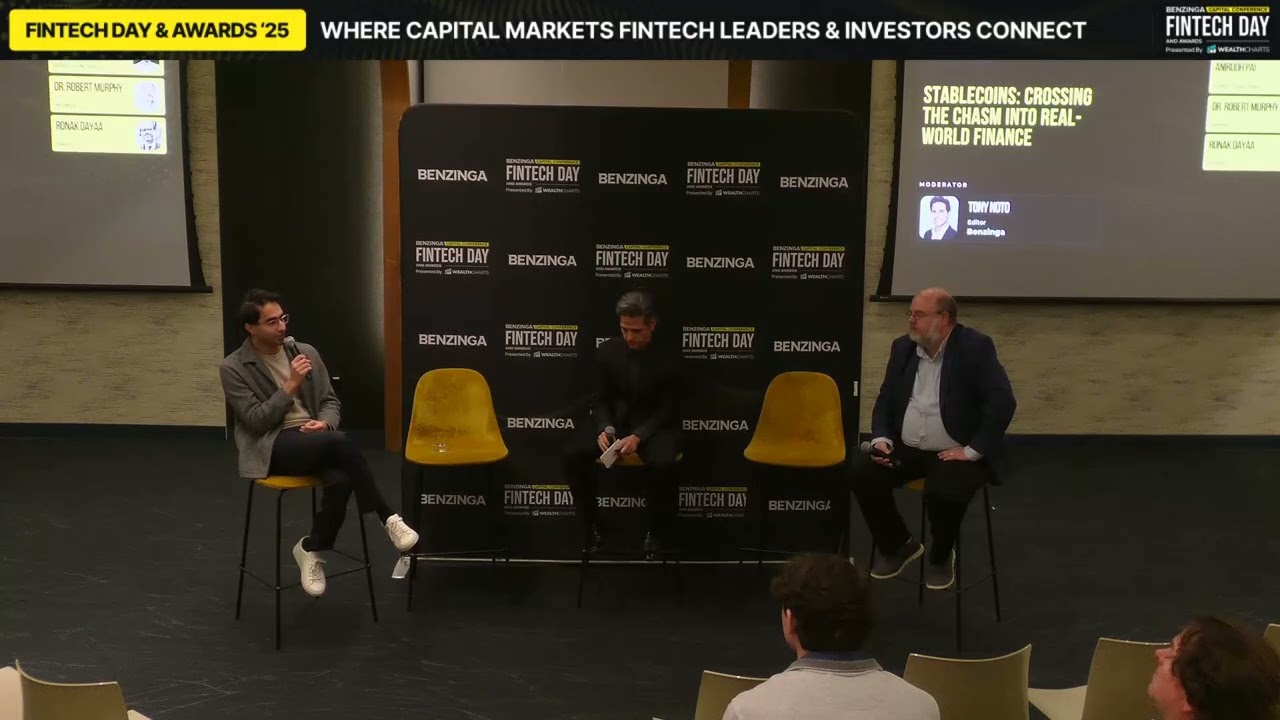
Dr. Robert Murphy and Ani discuss how stablecoins are moving into mainstream finance. The Bank of England capped individual holdings at £20,000, the U.S. Genius Act mandates 100% reserve backing, and stablecoins now hold the 14th-largest position in U.S. sovereign debt. A $93 million de-peg at Stream shows DeFi risks mirror traditional banking failures.
Chapters
Without further ado, let's introduce our guests. We have Dr. Robert Murphy from Infinio, and Ani from Robot Ventures. Come on up, folks. Comfy? Yeah, can't complain.
Excellent.
It's nice chairs. All right, so stablecoins is the topic for today. Uh, I want to start off a little bit with, um, some breaking news from this morning that the, the Bank of England published some, uh, guidelines that they have planned for stablecoins, um, capping it at, uh, £20,000 for individuals, uh, £10 million for corporates. And they're welcoming feedback from, well, I guess anybody who wants to offer feedback between now and February 2026. So I thought this was a good case study to start out with, uh, basically as an example of these central banks really leaning into stablecoins taking it seriously. And I thought if you had feedback for the central bank, what would it be? We'll start with Doc.
Okay, sure. Um, so I think, again, I'm the chief economist for Infinio, and I think that just looking at what's going on with the Genius Act and then other banks around the world, jurisdictions around the world trying to perhaps mimic what the US is doing here, one way to think about what's going on is that there's a sense in which stablecoins that are pegged to some major government's sovereign currency, there's a sense in which that's like online banking. Okay, again, like economically speaking. And so I think part of what happened and what you see in terms of all the various players— so I'm not here talking about like inside information that I have, but I'm saying as an external observer looking at the features of the Genius Act, for example, or what, you know, now the Bank of England's proposing, to understand, you know, how they're explaining to the public, this is why we're doing what we're doing. but then understanding behind the scenes the various parties that are affected by it. I think one way to think about it is that the traditional TradFi banks realized if we just sit back and let this new thing develop sort of just off in the corner, eventually that's going to put us out of business, right? Because from the average consumer's point of view, if they can go online, there's many advantages to using stablecoins, 24/7 access. Beforehand, there weren't as many regulations so that they could do more They could perhaps offer more yield than certainly you're going to get in a checking account anytime soon. And so I think a lot of the big banks realized we need to get into this space. And so just real quickly, in terms of some of the main things that we all know about the Genius Act, if you just think about the implications vis-à-vis conventional banks, that, oh, if you have a stablecoin, you can't pay interest, right? So right there, they're limiting the ability of non-bank stablecoin issuers to compete, right? Because if you can't pay interest, how else would you do it? And then, um, the other issue, like, in terms of, you know, reassuring the public— and I think this is legitimate and earnest— is to say, hey, if the public starts thinking these things are just like having money in the bank, like, oh, it's dollars, that's what it is, and it's online, who cares— that, you know, they were concerned if more and more people switch over and use that as their, like, online banking, just moving stablecoins in and out of their wallets, that, well, what happens when one of these things goes down? That's like a major bank failing. And this doesn't have FDIC. So that's why they have all the stuff about having the 100% reserves and all that. So I think that's the way to view it. And just again, to wrap up here, in terms of that one-two punch, they're limiting the interest they can pay. And then also, for the issuer's point of view, they're saying if you're not a bank, you have to put it in things like 3-month T-bills. Right. So that's really handicapping the scope and the ability of non-bank stablecoin issuers to really flourish in this space. So I think that was the sense in which the banks are kind of putting it in a corner. Oh, and the last thing is, Oh, you don't need to have it in 3-month T-bills. You can have it if it's checking accounts at a regular bank. So I think that was the way that this sort of keeps it that, hey, if you want to go use stablecoins, you can do that, but it kind of pulls it back into the conventional banking's fold. And then, you know, so there, here, when I saw those bullet points from the Bank of England's recommendations or proposal, I thought, okay, yeah, on the surface, that looks like it's protecting the public. We're not letting anyone get into something too crazy. We're limiting exposure. But also, that does hem it in. And so, yeah, if you want to still do large-scale banking, you still got to go through the traditional players.
Yeah, that was a very thorough answer. But I guess zooming out a little bit, I guess what I would say is banks writ large are in a very hard place. They're stuck between a TradFi past they don't control anymore and a crypto future they don't understand. So when you're, I think, in this precipice, it's really like, what do you do? And I think Um, like I said, zooming out, it's like money is the biggest market on earth and consumer choice is what drives these markets. And 50% of dollars are held offshore. So, um, in my case, I lived in the UK for 5, 6 years, started my first company there. And like, um, talking to policymakers there, it's very clear that they are worried because they know that if consumers can pick, like, I guess, more regulated US stables, why would they want to hold a digital pound? Right? It makes very little sense. And so they're right to be worried. And I think they're very scared that they don't have control or claims over the future. And so stablecoins, I think, are probably the biggest financial innovation in that sense since the rise of modern banking with Fugger 500 years ago. And like, they totally know it now. So—
Well, things do go wrong. I think a week ago today, um, there was, uh, $93 million loss at Stream. Uh, the stablecoin was depegged to 50 cents. And, uh, some friends of mine from Hacken said this isn't an isolated incident, that 55% of crypto losses are from yield providers. Um, $49 billion in losses over the last 5 years. And so their point was that DeFi doesn't really have solid independent risk assessment like TradFi does. And you and I talked a little bit about this before we got on stage. What are your thoughts based on what happened to Stream? It was a big mess last Monday.
Well, I agree it's a mess, but I think big is relative. Like, um, what I would tell, I guess, people in the audience is that like It almost seems that it feels like every other week there is just an insane regional bank collapse. I mean, to give people a sense of this, it's like I have a friend helping out the claimants of the Synapse and Evolve bank and trust disaster that only seems to keep becoming an ever more present disaster. For people who don't know, uh, regular, I guess, folks across America put their savings in Evolve, which is meant to be a very reputable bank, and Synapse went down. And so People lost hundreds of millions of dollars, and it got to the level of Elizabeth Warren, and people's banks, life savings are still locked down. And it's like the whole exec team is now going to jail. I think the CEO is going to jail for child pedophilia or something. It's really bad. But if you look at the media attention on this relative to crypto, it's like 0.1% less, even though the scale of absolute dollars lost is an order of magnitude or orders of magnitude way larger. So I'm not saying that it's good or, you know, this is normal, but it's crazy that like even though TradFi is meant to be safe in America, we can't even do that, right? So it's like, yeah, sure, you have FDIC protection, whatever, but it's like if you take, I think, the banking losses of the past 3 years, it is just an order of magnitude way larger than I think, uh, you've seen crypto losses through registered institutions in the West in the past few years.
Can I jump in on that?
Yeah, absolutely.
Yeah, just to, uh, if we just take a step back for a minute, and we do, you know, we're all in conferences like this, we're also hip deep in the, in the details, but just take a step back. There's a sense in which, like, you know, go back 10 years or something, you know, when Bitcoin was still relatively new to a lot of people, and if you said, hey, what if we had a blockchain-based thing that was pegged to, like, the US dollar, I think a lot of people would have said, well, why would you do that? The whole point of Bitcoin was to get away from these government-issued fiat currencies. And so there is this weird sense— so don't get me wrong, I understand why stablecoins are incredibly useful, and it's kind of funny how it sort of looped back, and now we're, you know, back to what we were, where we started in that sense. But there is this distinction, and, you know, hitting on the point that, um, we're talking about here, where Bitcoin by its nature, you don't need to worry. Like, that was the whole point, right? It's trustless, you know, to use that, that term, that you don't need anyone to prove anything because Bitcoin doesn't point to something else. It just, it is what it is. And if you can, you know, you got your private key, you can move around the things and tell the network, yep, I'm the rightful owner of these satoshis, and I can move them over here to that wallet. And that's all it means. It's not that it has to— it wouldn't make sense to audit it and say, hey, what's backing it up, right? Whereas with stablecoins now, because we're using that blockchain technology, but it's supposed to point to something else, some other asset besides the intrinsic thing itself, now that raises back the issue of trust. And so I think that was kind of this weird, you know, dichotomy that we've had as more and more, you know, uh, asset-backed coins, you know, tokenization, you know, broadly construed, coming up to like, well, how do you prove that you can back that stuff up? And again, so that's— I think before when it was like, hey, this is all crypto stuff, if someone wants to get into Bitcoin or Ethereum and normal people don't even know what that is, if that blows up in their face, buyer beware, what do we care? But now that it's, oh, people think they have US dollars and someone might, because of the convenience and yield and whatever, switch over Why would I have an online checking account when I can have $20,000 in this coin somewhere? I think that's where people realize that we can't just sit back and not do something about that.
And Ani said something interesting on a call we had recently, that TradFi and DeFi will be indistinguishable. And I guess you said like in a decade or something like that. And like, why don't you talk more about that? You made some interesting points and how they're, you know, like We don't want to get away from what Bitcoin started out as, but it is different now, and it does seem like there's this mesh going on. Um, what do you think?
Yeah, it's funny you bring that up because like, uh, obviously a lot of people in crypto have never read the Bitcoin white paper, but sort of within that, even Satoshi argues about the need for what he calls bitbanks. So like trusted intermediaries, I guess, people that want to use this for— and, you know, actual banks And for those paying attention, this quarter has seen record volumes and profits for Galaxy, for Robinhood. I think Coinbase just had like a staggering blowout. And for some reason, people think this is just going to stop, which to me is quite crazy. I don't know why that's the case. But like I said before, the biggest market on Earth is money, right? So it's like if you take derivative notational, it's something like on the order of $225 trillion. And in perspective, America's GDP, I think, is like 10% of that or something, maybe a bit higher. But it's the biggest pie that I think humanity has ever made, and so it makes very little sense to me why people will not go after the whole thing. But yeah, talking to Galaxy and all these people, we work quite closely with them. It's very clear that they see banks as essentially just very slow ways of storing ones and zeros and moving ones and zeros. I mean, effectively, that's what a lot of banks do, right? It's like they take your money, they kind of store it, they pay you really shitty yield, and then sometimes they go bankrupt. And and so it's like why? crypto institution not do that? It seems that, like I said before about consumer choice, Gen Z and Gen Alpha don't want to bank with Goldman and any of these places. They want to use Robinhood. That's why Robinhood is doing so well. If the staggering pace of runaway growth continues, it doesn't make sense to me that Robinhood will not just also get a banking license and go down the same path and throw down the gauntlet to, I think, all the big banks. You're starting to see that, I think, play out.
Yeah, I mean, just saying the obvious here, that as well, I think the institutional adoption, big boys getting into stablecoins and things like that, that I think eventually the idea of blockchain-based finance, that's not going to be weird. Like, whereas right now that's kind of like, oh, this one thing over here in the corner, but it's growing. And I think eventually that'll just be like, oh, online banking. Like, we don't even think that that's, you know, we just consider that banking now. Whereas there was a time in which a lot of people would be afraid to do that. Well, what if somebody breaks in and gets my password, takes all my money, right? Whereas now you just, you think, yeah, the fact that it's online, that's just an afterthought. So I think eventually you are seeing TradFi and blockchain-based finance merging.
Yeah, also one really quick thing there, it's like, uh, there, there was a lot of FUD or bearishness, I think, when the Bitcoin ETFs came out. I think in a year it was so successful that I think it's like 1 to 2% of like BlackRock's total revenue now, which is quite crazy. So it's like, you You had a very untested product that became so successful that I think the boomers, you know, in charge of these big institutions just don't know how to grasp it. Like, even Jamie Dimon, I think, capitulated a week ago saying, you know, he was the biggest Bitcoin, I think, bear. And even he now is like, yeah, our younger employees just want to talk about this all the time.
So is he worried that the new players are going to eat his lunch? And he's probably going to retire soon, and he's sort of worried that the bank he spent so much time building, including a giant skyscraper in Midtown, maybe these new DeFi players are going to give him a run for his money, or when he's long gone, the firms.
Well, I don't think it's that. I think all these people are somewhat sociopathic in the way that they just talk their book. It's like they wait till they're done buying, which I think everyone here understands. No one is going to obviously buy Hopefully when Jamie switches his mind like every other day. But it seems clear to me that they have the infra now, finally, and they're going to put their chips in. And so I guess to people here watching, it's like, okay, you have BlackRock, JP Morgan, obviously Goldman. You have all the biggest players in the world who have, I think, finally got a big enough stake of all these respective networks that it's worth their time. And so I think the next few years will look very different.
You know, this was like a sort of a milestone year for stablecoins. I mean, there was the legislation that we had, but also, uh, some, some big M&A deals, uh, including, uh, Stripe's— it was $1.1 billion. I had to write that down because my memory is awful. But, uh, yeah, there was a big M&A deal earlier this year. Uh, do you expect more? Like, do you expect there to be some consolidation in this space that and some big checks to be written.
Yeah, I definitely do. And again, just we sort of take stuff for granted and everything's moving so fast. But I mean, until, you know, not to make it political, but, you know, Trump won the last election, like there were, like what we're doing at our company, I think we were planning on building stuff for foreign jurisdictions and just get, you know, work out all the bugs and everything. And then maybe down the road think of US deployment. But then when he wins and then also starts talking about, oh, we're gonna make this the AI crypto capital of the world, you know, that just was a green light. Not in terms of like handouts or something, but just to know, okay, they want us building here, and then we're not going to have the rug pulled out, you know, with the choke point and all that stuff. So I, I think just that it— because with all this stuff, it's like a network effect, right? If you're issuing stablecoins but merchants don't take them and other parties won't recognize them as collateral and stuff like that, well, it's kind of pointless. But if all of us are kind of doing it and developing together, we reinforce each other. So, so yes, I think that this is just going to keep snowballing. And as more people do it, then it makes it not some crazy niche thing, but more and more people do it, it just reinforces itself.
Yeah, I mean, you must hear some M&A rumor stuff in the Bay Area. Are you getting a whiff of any sort of consolidation or dealmaking going on?
Yeah, I guess for context, the fund I was at before Dragonfly, we were, I believe, the largest venture investors in stablecoins in the world. And so Yeah, we were lucky, I think, to be a part of a lot of these stories. And I think to me it echoes a little bit of what I was saying before, which is there really is just no banking innovation anymore, right? Like there's no groundbreaking stuff in like Goldman Sachs research or whatever. And so yeah, it's like you have no choice, right? I mean, like I said before, the banking sector is effectively moving ones and zeros around, and that's 20% of America's economy, which is ludicrous. Right? You're paying a tax of 20% of all the money you make to move ones and zeros around, where crypto can do that in 5 seconds and like basically $0, right? Or as a percentage of GDP, it'll round to zero. So it's like, yeah, they have to keep doing this. And I mean, um, we, uh, were early investors in the 3rd biggest stablecoin called Athena, which I think for people who don't know here is a little bit of, uh, maybe a shot across the bow, where they have effectively built a synthetic dollar which uses the basis rate. So for those who don't know, it's like You can get a ton of yield. And this is the most popular hedge fund trade where you go short the future, long the spot, and you collect the yield. And consumers just love that thing, right? It's like whether you're old in finance or you're young, you're seeing the yield, you get how it works. It's transparent, it's clean, it's sexy. And like, yeah, people just don't want to hold, to your point, like a shitty pound stablecoin. So it's like, what are banks meant to do except partner, I think, with these future mammoths of finance?
Well, we talked a little bit about, uh, CBDCs when we, when we first chatted, uh, versus stablecoins. And, and like you talked about, Doc, about real-world utility, and like most people can't use stablecoins to pay for anything. I can't pay my mortgage with stablecoins. Uh, talk about— just give us a little bit of an overview, CBDCs versus stablecoins. What's better for real-world utility? And what's that race look like?
Okay, so I think on your last point, though, I think pretty soon you would be able to pay your mortgage with stablecoins. I think that's where things are heading, just like technically, your online checking account balance. There's a sense in which, as an economist, your $100 bill, a Federal Reserve note, is not legally the same thing as Bank of America saying, we owe that guy $100, you can see it in his checking account balance. But for most, you can certainly pay your mortgage by, you know, paying from Bank of America when you log in. So I think that's coming. Um, fundamentally, just to make sure, you know, we don't get mixed up with these terms, so central bank digital currency is sort of like a stablecoin that just happens to be issued by the central bank, right? Whereas a stablecoin per se is just— it's issued by a private company, and it's just saying that we promise that, or our goal is to make sure that the market value of this thing is stays pegged to something, you know, some anchor they pick. It doesn't have to be currencies. It could be like a, you know, ounce of gold or something if they wanted to. So that's the fundamental distinction. So I'm curious about your guys' thoughts, but I think a big reason— so I think originally what may have happened, or this is part of the story, is when powerful people saw the popularity of Bitcoin and they real— and I think first they tried to stop it and they realized we can't stop this, we gotta, you know, get involved in this game. And then they said, oh, let's have central bank digital. It's so much safer, and it's not unregulated like these crazy— like, look at what happened with Sam Bankman-Fried. But there was a huge freakout of people, like, especially like libertarian types, about CBDCs. Like, they just became like a dirty word. And so, like, if Trump came out and said, we're going to have a CBDC, that would, you know, a lot of his base would have like quickly said, no, you don't want that. So I think this was a pivot to say, okay, yeah, we can't just directly issue it. And so I think that's why now, oh, it's stablecoin. No, it's private. See, it's free market. I think that's— again, there's a lot more to the story. I'm sure you guys can fill in some details. But from my perspective, that's part of what happened here. And ultimately, why? Because there's a lot of privacy issues with CBDC that they're like the government's tracking what you could do with. If you're doing something they don't like, they could just turn it off. They don't have to convict you of something. They could just say, oh yeah, we're pending a review of something. And right now, your account limit is access. But if everyone you buy from is using the CBDC, then that's effectively turning off your money stock. So that's part of the issue and stuff people are worried about.
Yeah, to paraphrase Milton Friedman, there's nothing, uh, so permanent as a temporary government solution. And so, like, in this case, um, I think a lot of governments, at least the ones I've been fortunate enough to talk to, see this as like a Band-Aid over their wound, that somehow they'll be able to control inflation better and Target the money supply properly. Everyone here, I'm sure, is aware of like what Trump is trying to do with the $2,000 like tariff refund thing, and they hope that using CBDs will allow them to like track the money better and give it to the right people. But like I said before, it often just becomes a way of I think cracking down on people they don't like, and I think America's had like a recent history of that.
Do that? We don't do that, do we?
Who knows?
Yeah, we all know governments, the bad governments.
Right, right, only bad governments. Um, but, but the fact that this could even be possible, I think, is a sort of Democles we don't want to cross, right? Like, I think you have to be very careful of like allowing this to happen, and then, uh, who knows, it can just go way far beyond what people expect. So I would— yeah, at least I told, uh, these various governments to advise caution. And like, the effect you're kind of seeing of that is kind of what's going on in England right now, where I think they've had the highest high net worth drain of any modern country in recent history. So they're flocking to Italy, they're going to Dubai, and no one is IPOing anymore in London. So London was once, I think, the 3rd biggest IPO capital. Now it's the 13th. I think IPOing in Mexico is now more popular than going the way of England, which— I think— To many people here should be very scary because there's no reason that in 50, 100 years, 150 years cannot happen to American financial markets, right? So the fact that it could happen to what was once the pinnacle of the Western world is very scary to me.
Well, I'm glad you bring up the cross-border aspect of it. Give us an idea as to what the role stablecoins can play when it comes to global finance, when it comes to cross-border transactions, getting paid from companies that might be based abroad, why it's easier, why it might be more convenient. Is that an exaggeration?
Yeah. Yeah, I mean, I can take this. I think the proof is all in the pudding. So today, stablecoins make up— if they were a sovereign block, so if you just took together everyone that holds stables together, they are the 14th largest holders of US sovereign debt. That's just a micro drop. This was barely a thing 5 years ago. Now, it's the 14th largest holder of sovereign debt. What do people think is going to happen in 10 years? It's already above many Western countries in, I think, its prominence, pervasiveness. When it comes to businesses, I don't know how many people here have sent a wire. I'm sure everyone, but everyone knows, I think, what a crappy experience that is. It's like it can get rejected, the bank can hold your money, you can do something wrong, they can do something wrong. With stables, banks— I mean, recipients, individuals, businesses can move millions, if not billions of dollars instantly and pay no cost. I think, yeah, we're in the early stages of this. BVNK and Stripe now is working on this with Tempo. But I think the proliferation of all these companies makes it very possible for people to just live in the stablecoin economy. And I think that will be very Exciting.
Just real briefly on that, that, you know, we joke here in the United States about, you know, the dollar and money printer go brrr and stuff like that. But for people around the world, in some places, like, the US dollar is actually a relatively stable thing. Like, for example, as you may know, uh, President Milei in Argentina, you know, one of his plans was to dollarize. And so, you know, I was interviewing people down there just trying to figure— and something that came out is they said this, he's just kind of like acknowledging what's already happened. Like, most of the people down, especially like the wealthy people or whatever, They de facto already are using dollars to the extent they can get it. So this is just a way that all you need is an internet connection, right? Depending on where you are, it doesn't matter what your government's doing. You can, you know, get exposure to the US dollar and just have that as a relatively safe place to just store purchasing power.
He got $20 million in US dollars.
He does, yeah.
If I could quickly add to that too, there's about 57 countries on Earth experiencing hyperinflation right now, which means the second you get money in your bank, it's already inflated away. Which should be quite crazy to people. So people work for a few weeks, they get paid. By that point, it's already worthless. And we—I'm on the board of a few companies in Africa, and like what's interesting to me there is that the second they get their money now and they you know talk to their companies, they immediately convert it to U.S. staples for that reason. And for people here, America is about four percent of the world's population, and and so it's like yeah, we can have staples here, but it's really not going to affect. the, uh, way that the absolute amount of people on Earth, you know, live and move and work. But if you travel to emerging markets, like let's say even what's going on with Indonesia right now, which has a similar-sized population to America, stablecoins are just everywhere amongst young people there. It's like super exciting to see, uh, you know, people paying for rideshare and all these things using stables, and they don't want to touch cash.
But is there a future where one stablecoin sort of emerges and is supreme? And that, will we have as much diversity when it comes to stablecoins as we do now, or will one coin emerge? And don't say USD-1, please.
So, um, again, just to keep our terms straight, to be thinking about it the right way, I— again, with stablecoin issuers right now, with, you know, it's private companies doing it, they're not issuing dollars, right? So the analog would be there are multiple different banks. There's Bank of America, Wells Fargo, Citibank, or whatever. They're not issuing dollars per se. They're technically issuing claims on dollars that could be more or less reliable. And so I think that's what— so there's no intrinsic reason that I see that it should all consolidate and just be one giant stablecoin issuer. In fact, I think some people would want diversification, just like major wealthy individuals don't want all their money in one bank, particularly if it weren't for FDIC, right? So I think there's no intrinsic reason that it should, you know, come into one stablecoin issuer. Uh, now we could ask in terms of like the concentration, like 10 years from now, of all the stablecoins on planet Earth, what percentage are going to be in the dollar versus the euro or the pound or whatever? You know, that is a separate question. And I think this— the US moving forward on this is making the dollar more prevalent than it otherwise would have been if they hadn't gotten their act together.
I, I think the game here is less what currency do people want to pick versus what currencies are they running away from. So I remember a few years ago everyone was talking about the digital RMB, like somehow that was going to be a dominant currency. And, uh, money in many ways is an isomorphism for politics. And, and so I think all these people quickly realized they were, you know, lost in the head when, uh, the CCP crackdowns on Jack Ma started and All the major Chinese tech companies, and they quickly realized, wow, I need to go to someplace that believes in property rights. In many ways, I think people are running away from the crackdowns happening in Europe, across most of Asia, and they will probably hold whatever is the dominant currency that still believes in property rights with something very safe, whether it be— we've all seen the gold run-up this year, I think, to some degree, a lot of that risk appetite might shift over to crypto. But the barbell approach to me seems, I think, the most likely path for the future.
Last question. It's going to be 2026 before we know it. What are your hopes? What are your fears? What keeps you up at night when it comes to stablecoins?
So my hopes are just that this innovation continues and again, more people offering this, becoming more and more of a standard thing, because I just do think that the efficiencies are here and just allows so much innovation. The thing that concerns me about all this is just very briefly, That, like, for the Genius Act, you go through and look at it. I think a lot of people now are resting soundly thinking, oh, if I use, you know, a Genius Act compliant stablecoin, that means it's backed up by T-bills. And no, it could be backed up by bank account deposits. And even if it's FDIC insured, it doesn't mean that the issuer of the stablecoins has everything FDIC insured, right? So if you read it, like, that does not follow. And so just example, You know, when SVB went down, Circle was— you know, there was a period there where people weren't sure about Circle because they had so much parked there. And so, you know, that happened to be worked out. But my point is just, I think the Genius Act has given this false sense of security. Everyone's thinking they're backed up by T-bills, and not necessarily.
All right, Ani, 50 seconds, because they're going to drag me off
any less. I would say I hope all the smart people like you guys sitting in the audience quit your TradFi jobs and build something. Great.
That's my time, folks. Thank you so much.
