What if every child had access to music education from birth? | Anita Collins | TEDxCanberra

Anita Collins argues that music education is a powerful, universally accessible activity that can dramatically boost cognitive development, especially when begun before age seven. Drawing on two decades of neuroscience research, she describes how formal music training reshapes the brain—expanding the corpus callosum, activating motor, visual, and auditory cortices simultaneously, and enhancing executive function, memory, problem‑solving, and emotional regulation. She cites studies showing newborns use music‑processing networks to parse mothers' speech, and that early music training can raise IQ by about 7.5 points, translating into significant economic gains. Collins debunks the myths that music requires innate talent or high intelligence, emphasizing that all children benefit. She links music education to improvements in learning disorders, ADHD, literacy, and numeracy, and envisions how universal early music education could transform individual health, educational outcomes, economic productivity, and even political discourse across generations. The talk concludes with a personal anecdote of how learning a clarinet helped her overcome reading difficulties, and a call for policy change: make music education an essential, universally funded part of curricula, not a luxury or optional add‑on.
Chapters
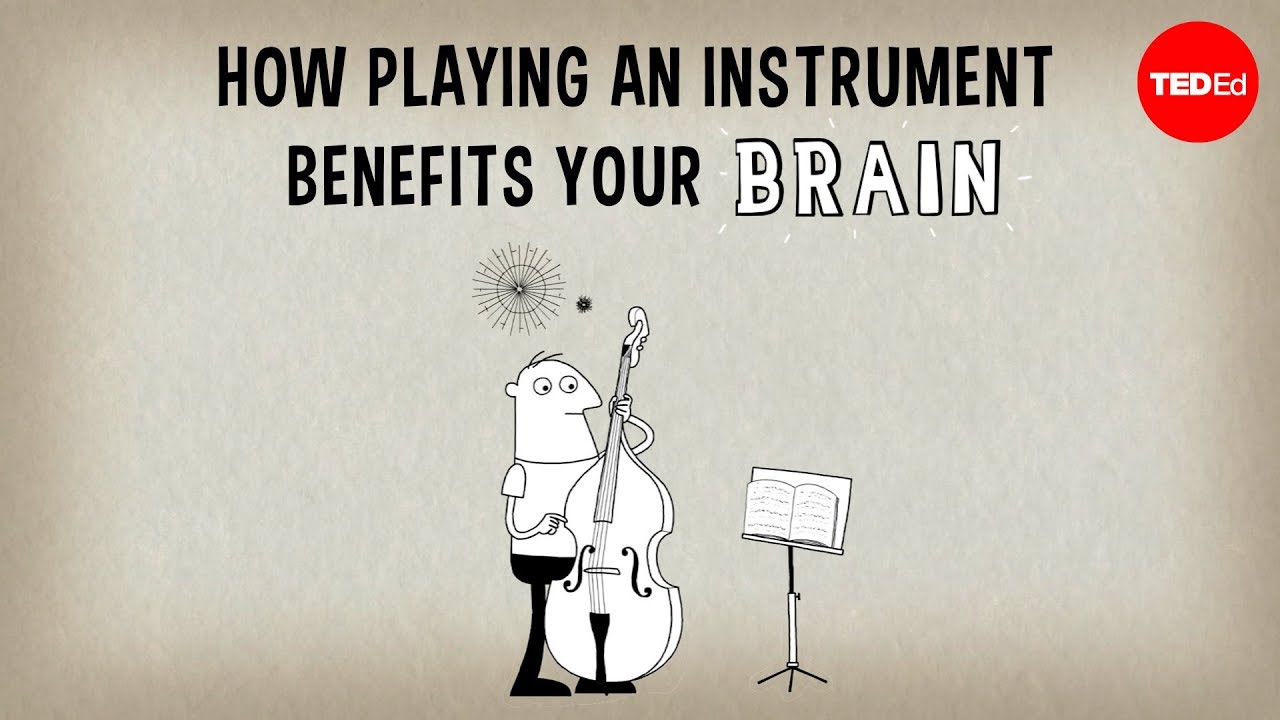
What if— what if a large number of scientific studies had found that there was one activity that could improve our cognitive function, help our memory systems to work, help us to learn language, help us to moderate our emotional states, help us to solve complex problems, and help our brains to be healthier into later life. What if that activity, while beneficial if undertaken at any time during our lives, was actually found by the scientists to be most beneficial if it was undertaken before the age of 7? What if that activity, unlike the momentary pain of a vaccination needle, is actually enjoyable for everyone involved? Now, you might be expecting me to reveal a new superfood we could eat some more of, maybe a pill we could take every day, or an exercise regime we could start. But actually, this activity is as old as our cultures and societies itself. And that activity is music education. Now, I may well be biased. I am a music educator, and I understand the world through the twin lenses of being a musician and being a teacher. But even before I became a teacher, I used to look around at all the people I was doing musical activities with, and I used to wonder why they seemed to be good at everything, why they seemed to do well at all of their studies, why they fit more into a day. And while many of them, most of them, never went on to be musicians in their professional lives, the careers they did choose were incredibly diverse, and they were so successful in them, and they continue to be so. What, if anything, did music education have to do with that? So when it came time for me to choose a topic for my PhD study, it became pretty clear pretty quickly. I wanted to know if music education benefited brain development. What I found was a huge amount of research, now 2 decades' worth, conducted by neuroscientists. And the neuroscientists had stumbled on something kind of by accident. They were looking at the brain functions and structures of musicians, Literally, their brains looked different, and they functioned differently, and in many cases, far more effectively. So the neuroscientists started to do experiments that compared groups of musicians with groups of non-musicians doing all manner of tasks. Now, it's important at this point to share the definition of musician that the neuroscientists use. They believe it was someone who learnt a musical instrument and had learnt it formally, meaning they'd had lessons from an expert every week. They'd learnt how to read music, they— most of them had been involved in ensemble music-making experiences, and they'd done it for a reasonably long period of time, 2 years at the very least. Now, to help me explain some of this research, I'm going to use, I hope, Hey, there we go. Thank you. I'm going to use some animation from a TED Education film that I wrote and I helped to create earlier this year. Now, the technology that helped the neuroscientists allowed them to see our brains working in real time. And what they did is they used fMRI machines and PET scanners to watch what was happening. They would get the participants to do all sorts of tasks: reading, maths problems, and they would see certain areas of the brain light up. But when they asked the participants to listen to music, they saw fireworks. They had never seen so many areas of the brain light up at the same time. So, why did music education have this impact on the brain? Well, what they found is that music education works 3 areas of the brain at once: the motor, visual, and auditory cortices. If we think about it, it's like a full-brain workout. It's like our legs, our arms, and our torso doing an exercise at the same time. Music education is exercise for the brain. And among many, many other things, they also found that musicians had a larger bridge, a larger corpus callosum across the 2 hemispheres of the brain, which allowed the messages to travel far more quickly and in very, very creative pathways. So what did this brain exercise mean for how musicians' brains actually functioned? Again, Among many, many other things they found, they found that musicians were able to solve puzzles and problems far more effectively and creatively. They found that musicians had higher levels of executive function. Now, executive function is a complex group of activities in our brain that solve those really, really complex problems that have logical, strategic, conceptual, emotional elements to them. They also found that musicians had much had very highly developed memory systems in their brain. And that they thought this might have happened because when a musician makes a memory, they actually put tags against it: an emotional tag, a visual tag, a conceptual tag, a contextual tag. And overall, so far, with these 2 decades of research that we now have, they have found that music education raises the general cognitive capacity. of anyone who undertakes it. And even further to that, they've found that music education helps us be comfortable with discomfort. Now, learning is uncomfortable. We're asking our brains and our bodies to do things we've never done before. So music education actually helps us be comfortable in that state. It helps us to feel comfortable with learning. Thank you. Now, I'd like to share with you 2 studies which, to me, highlight some of the many applications and impacts that music education could have. The first one involves babies. 18 very trusting mothers allowed their beautiful babies to be put into fMRI machines so the neuroscientists could monitor their brain functions as the mothers spoke to them, along with many other tasks. Now, I say trusting mothers because these babies were between 1 and 3 days old. What the neuroscientists saw is that the babies were using their music processing networks to understand their mothers' voices. Literally, they were hearing music in their mothers' voices. And this confirmed something that the neuroscientists had been thinking for a while, that music and language processing are very closely connected in the brain. That indeed at birth we need our music processing to understand our language. At birth, we are musical. The second study involves IQ points, and I know we could have a whole other TED Talk about IQ points, but they are a well-used measure of intellectual capacity. And in this study comparing musicians with non-musicians, They found that those that had undertaken music education before the age of 7 had around about 7.5 IQ points higher than those that had not. Now, 7.5 IQ points doesn't sound like much, but if we put it in context, an IQ of 100 is seen to be average or normal. An IQ of 130 is seen to be genius or entry— entry into Mensa. So 7.5 points is huge. It's over 20%. And even further to that, another study looked at the economic capacity versus IQ points, how much more we would earn per year on average per 1 IQ point that we had higher. What they found in today's dollars is that for every IQ point higher that we have, it's equal to about $700 per year. Let's take our 7.5 IQ points from music education. That's about $5,000 per year. Now think of that across 10 years, and suddenly we start to see that music education could have an enormous impact on every part of our society. Now in every area of scientific study, it is incredibly important to ask big questions, and to look at the myths that exist in that area. And there are 2 big ones in this area, and they are that to play music we need to be smart, and to play music we need to be talented. Neuroscientists have now done a large number of randomized studies that have shown that music education impacts everybody who undertakes it. You don't need to be smart to start with. And if we think back, to that study about babies. We're all born musical, we have to be to understand language. It is the experiences and the opportunities that we have in life that realizes that talent. And this gets me thinking even more about the fact that music education could be the glue that could bring together so many things that we are dealing with in our education system. Systems and our societies today. Let me give you some examples. Learning disorders. At the moment, many of them understood to be a miscommunication between the left and the right hemispheres of the brain. And as we saw earlier, music education actually makes those 2 sides of the brain work together really well. ADHD. Again, at the moment understood to be a mistiming between the motor, visual, and auditory cortices. And again, we saw before, music education actually makes the 3 areas of the brain work together incredibly well. If we take it another step further, music education has been found to help us acquire and understand language and to solve complex problems, many of which involve numbers. How might universal music education change literacy and numeracy in this country and in many countries around the world where it's a very hot topic. Now I think about all of these issues in light of my own daughter, who's just turned 4, and I think about her and her generation, and I wonder what could universal music education do For an entire generation. I think of in 10 years' time when she's 14, what might learning be like in her classroom if the general cognitive capacity has been raised of an entire generation? If literacy and numeracy levels have been raised? If many of the learning and behavioral disorders that we deal with today in classrooms have had the benefit of music education? How might our schools change? I jump again to 30 years' time when she's 34. She could be doing absolutely anything with her life, but again, if we've raised the cognitive capacity of an entire generation, how might that change our social, cultural, economic, political landscape? Dare I say it, how might the focus and quality of our political debate in this country change? If that's the generation of voters that they're trying to impress upon. I jump again to 70 years' time when she's 74. I wonder about the quality of her physical and mental health, if we've invested before the age of 7 in her brain health into later life. How might that impact our health budget? How might we be spending our money differently if we've made an investment back here in her generation that will impact in 70 years' time. And this gets me thinking about a much larger issue with education. Too often, we play the short game with education. It is a political football that gets hit back and forth with every change in government. What if we played The long game. What if we invested now in my daughter's generation before the age of 7, in ways that now the science has showed us we can absolutely predict the benefits, and in so many ways we absolutely cannot predict the benefits? Now, music education is not the only answer. It's not the silver bullet that we've heard of earlier. There is no single answer. But I know it was the answer for me. When I was 7 or 8 years old, I was struggling to read. I could not untangle words and letters. And it wasn't through a lack of trying. My mother was a specialist reading teacher. And at the age of 9, someone handed me a clarinet. By mistake, I might add. I was meant to get a flute. There was none left, so they said, here you go, have a clarinet. And I learned how to play, and I learned how to read music. And within about 6 months, I'd untangled those words and those letters. I have no proof that those 2 events are connected, but from all the research that I have read and from the work that I continue to see the neuroscientists undertake, I'm sure they are connected. Thank you. So, now with all of this research and all of this knowledge, what can we do? I think the first thing we can do is think differently. Music is a beautiful and wonderful art form that almost every human being on the planet enjoys in so many different ways every single day. But maybe we're missing an opportunity with music education that could change our world in ways we have no idea of? I think we could listen differently. When we hear that scratchy, out-of-tune sound of a beginner violinist, don't think about how it offends our ears. Think about the fireworks that are going off for that young child as they try so desperately to get the right note. Think of the learning that is going on for them. I think we could act differently. Instead of just going along to our child or grandchild's end-of-year concert, ask the music teacher if you can go to the rehearsal beforehand. See the learning happening, see the learning to be comfortable with discomfort going on. See the fireworks. And if you have a child or a grandchild who's been playing trombone for about 6 months and doesn't feel like they're really getting anywhere, and they ask you if they can give up, don't let them. Make a choice for them that they will thank you for in the decades to come. Music education should be essential for every child. And if you look at our national curriculum and many national curriculums around the world, it is a core part of it. And yet, in research, a research study recently released here in Australia, 1.4 million children today do not have access to a music teacher in their school. Music education is not for the talented. It is not a luxury, it's not an add-on, it's not a bonus, it's not a nice thing if we had some extra money. It is essential. We take deliberate steps to teach our children how to care for this planet so that they may enjoy it in the future. We take deliberate steps to teach our children how to eat well, exercise, and look after themselves and make good choices so that they may live a full life. Why can't we take deliberate steps to raise the cognitive capacity through music education of the next generation so that they can build a better world for themselves. Thank you. Thank you.