4 Key Events In Global Markets In The Next 16 Days!
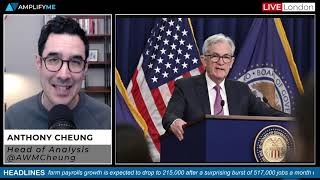
The S&P 500 gained 1.9% as markets bet the Fed won't raise rates further. Four events could shake markets in the next 16 days: Jerome Powell's Senate testimony, Friday's jobs report (expected 215k versus last month's surprise 517k), the February CPI report on March 14, and the March 22 Fed meeting where a 25-basis-point hike is priced at 72% probability.
Chapters
Welcome to the outlook for global markets for the week ahead. Gonna start where we finished last week, and this was the performance of the S&P 500 on Friday. You can see pretty much green across the board, and in fact all three of the major averages in the US finished in positive territory, a winning week overall. The S&P 500 closed up around 1.9%, and in fact on the week that means it's its first positive week that it's had in the last four, and it's been chiefly driven by speculation that the Fed won't raise interest rates beyond peak levels already priced in. However, as I'm going to discuss in the first portion of this, um, quick briefing, is 4 key things that we're going to be looking out for over the next coming trading days. And starting off with the first one is this. This is one of the biggest events of the week. Jerome Powell, the Fed chair, he is going to be delivering his 2-day biannual monetary policy testimony on Capitol Hill. Now, the first one will be a report to US Senate Banking Committee on Tuesday. That's always the one that the market looks at the most and therefore has the most market-moving potential because generally then it gets reiterated, basically repeated text to the House Financial Services Committee on the Wednesday. And what we're looking for are any hints in regards to the economic outlook in the US, specifically around inflation, wage pressures, and employment. So ultimately trying to get a sense check of how is the market priced and does he need to move the dial at all, because it's probably going to be one of the last times he's going to be able to make public remarks before they go into the blackout period, the Fed meeting happening on March 21st, 22nd. So that's the kind of first thing to watch on the radar. The next thing then this week is going to be nonfarm payrolls. That is coming out on Friday, and you'll remember we had a barnstorming figure last time out. Real surprise for the markets. The actual median consensus this time around is it is expected to drop to 215,000. That's according to the median estimate on the street. This was after the 517,000 absolute knockout surprise that we had, well and over and above the most bullish estimate on the street last time out. Ultimately though, the data does come down to wages and whether or not the Fed thinks that they're slowing fast enough in order to drive inflation lower is going to be quite key. And in the typical standard format, we're going to get the ADP national employment number on Wednesday afternoon UK time. So that's the second major thing of four to look out for. Looking a little bit further afield, going to the following week, this is March 14th, US CPI. Any signs of persistent inflation could push the Fed to raise rates higher than is currently priced, and that would be very destabilizing as far as equities are concerned, particularly exacerbated in growth-related stocks, and could likely then give support to the greenback, weigh on major dollar-based pairs like euro cable, and also see higher yields in the US start to, to be priced in. So inflation still is very much critical. The forecast at the moment for February CPI, which we'll get on March 14th, is 6%, an improvement from January 6.4%, i.e., it's coming down a little bit. But core CPI, which obviously strips out some of those volatile components, is you can see here, has moderated far less, or moderated more so, than the big drops that we'd been more accustomed to in the prior months. The important reading though, of course, is the one that the Fed watches the most, which is their preferred measure of inflation, which is PCE price index. And you can see that last figure that we had for the month of January actually went up, and hence the reason why the Fed have been sounding quite hawkish more recently. And despite the more better week that we've had in US equities last week, the reason for the downturn that we've had through the period of the month of February overall. Now, one of the things that came out over the weekend was a comment from a Fed speaker, albeit a non-voting member, which is Mary Daly. She is the San Francisco Fed president. She had an audience on Saturday at Princeton University where she said, in order to put this episode of high inflation behind us, further policy tightening maintained for a longer time will likely be necessary. So very much sticking to the script she does stand slightly more on the hawkish end of the spectrum in terms of the hawk-doves on the FOMC. Taking a look then, the final of the four things, of course, is ultimately then the decision-making, which will happen in 16 days' time. So these four events are really quite critical over the next two weeks. And that, of course, is going to be the March 22nd FOMC meeting, not only because we're going to get then the rate decision with the normal press statement, we're also going to get the latest quarterly projections, of course, but we'll be looking out for the dot plot updates Powell will also hold his regular press conference. In terms of the market's expectation for that, at the time being, this is what we're looking at. So just shrink this down a little bit. Markets are currently priced in federal funds rate futures at a 72% probability for a hike of 25 basis points. However, things are subject to change, and here's a quick look at, um, the forward implied volatility data. This was something that I saw Citigroup analysts put out over the weekend. Forward implied volatility is a measure of expected future volatility volatility for a financial asset, and this is based on prices of options with expiration dates further in the future. So it gives us a bit of an indicative taste of where markets already here today see potential future volatility in the future. And as you can see labeled here are these key events, the FOMC one being the highest forward implied volatility at this point in time. I would say the payrolls one's probably a little bit underpriced in that, in that respect. Last time out it was a real shocker, and I'd say then that kind of means that there's probably likely to be a greater variance of expectation and a lack of real direction as how the markets will position itself for that release. So I'd expect that to all tick up as we get closer to it. So you can see everything is ratcheting up into the main event, which we'll get on 22nd of March. So definitely a few things to look out for. Bringing things back to this week, just to wrap things up from a news perspective, China have come out, they've said a modest economic growth target of around 5% for the year. This comes as Premier Li announced a goal for GDP in his final report to the Communist Party-controlled parliament, which kicked off its annual meeting today, Sunday. Economists had expected a more ambitious target of 5% following a rebound in consumer and business spending. We've also seen that quite substantial U-turn on the zero tolerance COVID policy, so the aggressive reopening. Some might have thought then they might be a little bit more ambitious here, but I would say it's probably quite a calculated move from the Chinese government cautious outlook this year would likely then see them exceed that, and they're looking to then restore some credibility around this target that they put out on an annual basis. And it will give President Xi Jinping and his new economic officials more policy room to focus on some other key objectives as well. The other things over the weekend, uh, ECB's Christine Lagarde, she's been pretty vocal of late, and again, same thing, talking about inflation. She warned in Spanish press this weekend that underlying inflation pressures will remain sticky in the short term and signaled that further interest rate rises from ECB are very likely, as the inflation is a monster that we need to knock on the head. Those were the actual words that she used. And as you can see here, the blue line is eurozone HICP, but the red line is the key one, and that is eurozone core inflation, which you can see here shows no sign as yet of slowing down despite the pull-off that we've seen in the headline rate. So for now, the ECB needs to keep hiking, and that's what Christine Lagarde was telling us at this weekend. It's the same as what she told us last week, so nothing really too new there to— but to be aware of. The other things happening this week are BOJ's meeting, particularly symbolic, I guess, because Kuroda, who you can see pictured here, the governor, it's his last meeting and he could deliver a parting shot. Whether or not that materializes is yet to be seen. The chief focus, of course, is on any adjustment to the BOJ's yield curve control policy, otherwise known as YCC, the mechanism by which the central bank has attempted to fix the level of 10-year Japanese government bonds. Remember, in December, very much to the surprise of markets and out of keeping with his generally resolute dovish stance that he tends to have, Kuroda tweaked the yield curve control to widen the scope for 10-year rates to fluctuate around the targeted level. The idea here is that in the end, that yield curve control will probably cease to exist under the new leadership. Whether he'll want to rock the boat this time round, I'm not so sure. The other thing then from a rate decision perspective, we do have the Bank of Canada. Analysts generally a little bit more confident that we're probably going to see an unchanged decision from them. And that's because at the January 25th BoC policy meeting, the Governing Council stated explicitly that they hold the policy rate at its current level while it assesses the impact of cumulative interest rate increases at the upcoming meetings. And so although we've had a little bit of variance in some of the key data points domestically, probably not enough to really shift the dial for them to make a change this time round. The final thing I'd mention on the calendar is UK GDP, just a quick shout out, that comes out at the end of the week. The economy is expected to have marginally expanded in January, partially recovering from the contraction we registered at the end of last year in December, but continuing generally the underlying weaker trend that we're anticipating for the UK economy going forward. Analysts do expect, of course, a technical recession most likely in the UK in the first half of this year. However, it might not be that much of a surprise. Obviously, this has been very much well priced into markets, and if anything, the fall in wholesale gas prices should help consumer bills start to fall by the summer, which could limit some of that damage to consumer spending in the more longer term. So it might just soften a little bit the deepness of that recession, which we've seen markets reprice in slightly, uh, in recent weeks. That is it from me. So again, thanks for listening. Have a good week out there. Any questions at all, feel free to leave a comment and I'll see you next time. Take care.
More from Anthony


Inside the Biggest Banking Stories You Need to Know This Week (Anthropic, Diageo, Private Credit)


Inside the Biggest M&A Deals You Need to Know This Week (UniCredit, GameStop, eBay, Eli Lilly)







AI Breakthrough or Hype? Anthropic’s Claude Mythos, Tim Cook Steps Down & LIV Golf Collapse