A Brexit Update, what to look out for next!
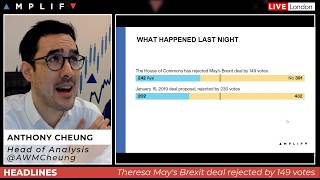
On March 13, 2019, the host assigns a 10% probability to a no-deal Brexit and walks through the GBP/USD levels traders should watch: 128, 125, and 120 pips if it happens, or 132 pips if the market stays bullish. JP Morgan's latest odds show no-deal dropping to 20% while second referendum chances rise.
Chapters
Okay, very good morning. Hope everyone is well. Welcome to the briefing for Wednesday the 13th of March. Um, going to take a bit of a different tact for the briefing for today. What I'm going to do is rather than drill down into every single story, there's probably one kind of dominating theme, and of course that is Brexit. So what I've done is I've put together a series of short slides, what I felt was the easiest way to kind of consolidate both what happened last night, what's happening tonight, what potentially will happen tomorrow, and how the market's kind of perception has changed. And then maybe we could look at the chart of sterling, of what the potential moves and scenarios could be. So going to focus pretty much entirely on, on that situation, uh, to start with. I mean, in terms of the overall, um, kind of cross-asset class sentiment this morning, I'd say it's relatively neutral. The dollar index is flat, um, both major currency pairs, uh, kind of reflecting that as well. We'll get into sterling in a little bit more detail shortly. Uh, the only real mover, gold breaking, uh, top right here, the R1 on the upside, just adding to a bit of an extension there. That was a breach of the high of the Asia-Pac session, so up about $8 there. US index futures though pretty flat, a negative open for Europe, but it has been recovering ever since the cash markets got underway. And then similarly in crude, not too much movement going on at the moment, price sitting just above pivot with about 29-cent gains. So, um, First of all, let's get the sterling chart against the dollar, the cable, bigger, and that can act as our kind of reference point to get us up to speed of what's been going on. So obviously you've had various different parts of this, this move. Of course, you've had the news that we had at the beginning of the week when it was looking likely then that Theresa May got on the plane to Strasbourg, managed to get together some kind of concession And that resulted in then, could she get her deal over the line? And the positive reaction that followed. Then came the biggest move from the last 24 hours, which was this kind of second phase one, which was the one of which we were kind of anticipating. Does what she was able to achieve really change the needle enough to get the backing from the attorney general? If you remember, people like the DUP, the ERG were all awaiting his kind of assessment on whether or not they'd throw their weight behind the changes that Theresa May had secured. That wasn't the case, and so the pound came shooting lower. Interestingly, then, off that, this is when Sam and I were on the mic early yesterday afternoon. We were talking about the fact that, you know, we quite like, quite like buying it down at those levels fundamentally, on the point that, well, if her deal's not gonna be accepted And as we'll get into shortly, the likelihood then of the no-deal motion passing tonight, I think, is incredibly small. And then we go into the idea about an extension, and as a net consequence, things like a second referendum, for example, the odds of that increase. And so therefore, that's a sterling positive kind of narrative. Although we've had some ebb and flow of the move, we are, you know, still edging up this morning. Um, the third phase of the move then was this one, and that was the actual vote that came last night, um, of which we're going to look at in a second. And then that takes us all the way up to where we are right now, which is we've just tested the upper bound of the volatility on the move that was seen last night when the initial vote came out. So trading up, uh, in positive territory, it's outperforming in fact the euro at the moment. So a bit of sterling strength. And we're going to get into some of the reasoning behind that and potential options and avenues going forward. So here we go. Put together then a short sequence of slides that I thought could be potentially quite useful. And here we have what happened last night. If you remember, about a week ago there was reports in weekend press talking about the fact that they were suggesting that she could suffer an even heftier defeat than she had back on the 15th of January, so when she lost by about 230. But the fact that she was able to get some kind of concession through some of the legal wording around the backstop, of course, managed to get a few more people over the line, but nowhere near enough. So very much as we were discussing here on the desk at Amplify yesterday, we didn't give much credibility to that deal going through. We were quite bearish on that move, on the gap up that happened when she secured that late on Monday night, and that played out. So she lost by basically 149 votes. So certainly there was a little bit of improved situation. This is the two votes overlaid with one another. So this was how many people rejected it last time. The middle center needle, if you like, is the line of which was to threshold for her to pass it, so she was nowhere near last night, but a little bit improved, albeit it's a bit of a moot point. That leads us on then to the next thing, which is what is next for Brexit. And again, hopefully this will make— I've kind of summarized a few different articles here to keep things as simple as possible. What's next for Brexit? So, point 1: tonight MPs vote on a parliamentary motion about about whether the UK should leave the EU without an agreement, i.e., this idea of a no deal. So remember, it's almost a reverse vote if you are monitoring this after 7 PM this evening when the vote comes out. The motion is for no deal, so if it loses, then that's the positive one for the pound, not the other way around. So just to be clear, the second bullet point here is If rejected, PM May has said MPs will vote on Thursday on whether UK should request an extension to Article 50. So this is the one that Theresa May is already being clear upfront with the fact that should the no-deal motion fail, she's already committed herself then that there will be an extension of Article 50 discussion held, amendments chosen by the Speaker Speaker and then voted upon on Thursday night. So we've still got plenty more potential Brexit headlines to come. What is the most likely outcome tonight? So I guess that's the next most important question, and markets expect the no-deal motion to fail. I think we've got to make that evidently clear right from the beginning. There's a circa 10% probability is what I'm assigning to the motion passing tonight. So overwhelmingly, I think, um, I think if I was wrong and my assessment of 10%, let's say, was too small, well then it would be reflecting in the pound already. Typically, to come to these assumptions, not only is it an assessment of the kind of fundamentals, political kind of detail, but it's also the price of the chart is pretty indicative for what most people are thinking in market. So if I just remove some of these, just to make the picture a little bit more clearer, is if people were assigning a real high probability to keeping no deal and that vote on the table right now, well then, I think the pound would be lower. And the fact of the matter is, is that the pound is stable, and if anything, it's moving higher this morning, which is indicative of the fact that most, the majority of people think that that motion tonight will fail. If it does pass, well, that's an unexpected event. And you remember the rule of, of 90/10. It of course was 90/10 that people thought that people would vote in June 2016 to remain, and we know what happened there. You had a near-on 12-13% correction in the price. So if we did get a no deal tonight and that motion passed, you've got to see an immediate aggressive downside. So by that, um, well, the first port of call would be the low print that was seen at the beginning of the week, then targeting that low that was seen back in mid-Febr and then pushing down to the low that was seen in these areas here. Um, 125 is a long way off, I think, in an initial move. I mean, you're talking about a 5-point move or so to get down to that lower bound. So it's really here that I'd be looking at if that were the case, but that would be an immediate large-size reaction because that is not what the market is expecting. Let me transition the, the charts. So here, here's what I'm talking about here. So this is the current price, that's the, the daily or the weekly low. Then you've got that 128 handle, which is probably the most prudent target that I was suggesting here, which was the mid-Feblow. And then that's the bigger level on the downside, the 125 handle, which was the December 11th low, that double bottom that we had on those two consecutive days. So again, given the fact that no one's expecting that really to fail, if it did, or for it to pass. If it did pass, the pound's got to come under some severe pressure to reprice in that new prospect. I think that sees a 1.28 push towards that area. Again, I think that's unlikely to happen, just to be crystal clear. Going back to the slides then, so that covers kind of bullet point 1, bullet point 2. Bullet point 3 Theresa May has said that this is a quote, "a free vote." And what that means is basically how the parliamentary system works in the UK is you have the whips who are incredibly important in order— it's not Theresa May that will go around kind of getting everyone in line of all the hundreds of MPs. It's the whips that actually control quite a lot of the sway, let's say, in Westminster. And so what's happening here is she has said that this is a free vote. There is no whip action, so to speak. And that means then it reduces the possibility of Remain-minded cabinet members resigning in protest, because if they were being forced to support the Prime Minister into a 'you follow my lead' or, you know, you kind of 'put up or shut up,' what that means then is that we've had people like Amber Rudd, for example, threatening that she could resign, and that's not what she wants to happen. So ultimately, that's the reason why, from an actual kind of granular, granular level, that I do not think that this no-deal motion will pass, because everyone is not being pushed in the background. They can actually make a conscious decision on their own behalf. Now, the fourth bullet point: it's unclear how Theresa May herself will vote, but according to what I was reading in the FT this morning, the majority expectation in Westminster is that she will oppose a no-deal Brexit. Remember, as I've put there on the final bullet, she's got a plan. Why, you know, why risk the worst economic consequence? Just support my plan, which she's already put out there. So I don't think it would come as a massive surprise that if she does that and says that actually, you know, I'd rather have my deal than a no deal in that situation. Issues on an extension. So if we follow this logic through, then the likely outcome is that we go forward to voting for an extension, and this will take place not tonight but on Thursday. Now, point 1, the PM needs to agree an extension with the EU. So this is by no means a a no-brainer here. All 27 member states need to agree to the extension. Now I was reading a couple of tweets on my way into work this morning, and quite a few people just putting out there, what if Macron becomes the real spanner in the works here, and through his push for kind of European unity and show strength because he has been the opposite of Angela Merkel, which has been quite friendly to the movements that have been made on the Brexit side. For Macron, he's been a lot more anti this kind of ability to negotiate and give the UK anything that would be beneficial for them, because obviously it increases risks of potential European disintegration in that sense. So it's not a done deal that Europe they have kind of in general said that they would support an extension. Important for them has always been an extension for what? We gotta know that. And that then rises to the second point: MPs will have to determine what the aim of an extension is. And that in itself carries some complication, uh, whether it be— and as we'll discuss, there's multiple different avenues we could go through which would probably define different time frames. Now, could an extension be used to— that should say to buy, excuse the typo there— to buy more time for her deal? Um, so essentially we still could see her deal go through even though it got voted down and it seems like we should have moved beyond this. Now, if we can't find an alternate avenue, then we either then go down that route, or will Parliament take control in a series of indicative votes? And for me, this is what we were discussing yesterday, which is why I think Theresa May has played this fairly well, and why I think that the risk of her resignation is close to zero, is because now she's done her, her, you know, kind of her her course. She's managed to secure a deal, she's brought forward an improved one, the people in Parliament have rejected it for a second time, and so she can now go back and say, "Well, I'm trying to deliver Brexit for the people of Britain, which is what on balance the country decided." So again, follow the democratic will en masse. But then if the parliamentary MPs take control, she can say, well, it's not my fault, it's their fault. So she comes out of it win-win net. There's no point her resigning. Why should she? She's probably, I would say, in a stronger position now than she's ever been, despite what the media are probably saying en masse this morning about how she's failed. That's definitely not how I see it. Moving on then, next thing to be aware of: alternatives to May's deal. Okay, so you've got May's deal, and then the second point was parliamentary members start to take more control over the next possible ways forward. Now there's 3 things here that make it more simple. Point 1: the opposition leader Jeremy Corbyn tries to secure MPs support for the opposition party proposal about the UK being tied to a permanent customs union and the EU. Now I'd say that's highly unlikely. That's what Corbyn's been pushing. However, obviously this is absolutely against what people like the ERG and the more Brexiteer, those who represent a more Leave-minded area, would want. And therefore I think he'd have a lack of support within Parliament for that option. So then we go to option 2: cross-party consensus emerges for a so-called Norway Plus model, something you've probably heard mentioned before. This is about where the UK would be a member of the single market as well as having a customs union with the bloc. So it's kind of a, a little less onerous than the first and trying to mimic the way that Norway kind of operates. Big problem with number 2 I would say is, well, you're going to need a considerable extension in order to execute that because essentially it's a brand new negotiation from start. So if I put numbers on this, I don't know, 12 months, 2 years. This obviously runs into lots of complications about the European parliamentary elections and so on, so forth, that are coming up in the months ahead. Ahead. So if you can't go down point 1 or point 2, it gets to point 3. Now point 3 is if there's no Commons majority for either of the above, well then what next? Gotta have a second referendum. And so then you have the independent split, that new party under Chuka Umunna, the People's Vote, and the prospects of that got to go up at that And at that point, Option 3 becomes all the more pound-friendly on the prospect then of a rising possibility of no Brexit, entire reversal of the entire, entire thing. Okay, important thing to note here, and I thought I would mention this just to be crystal clear: even if MPs vote against the UK crashing out of the EU, i.e., tonight, tonight's vote, it goes as expected, the no-deal motion fails, their decision will carry no legal force if Britain and the other member states cannot finalize an Article 50 extension. So even though we're saying we don't want a no-deal, if we cannot secure an extension and, and Europe needs to unanimously agree on what terms, which, as I've just said, is quite complicated, and we've got only 2 weeks, then basically we have a no-deal Brexit as a, as a basically a consequence of not being able to finalize things. And the whole thing crashes. And the pound in that scenario, if we were to get there, and again I think it it is incredibly low probability. But forget 125, hello 120 and below. That's when you get that 10% depreciation of a currency. Let me just switch over my chart. So this is when, you know, you don't get these targets here with the votes that are happening right now. This is when you get the absolute worst scenario, we crash out at the end of the month, hit 120, that double bottom, and when that breaks, opens up the trapdoor and we go down. You know, this is where those banks are calling for big moves to the downside. So the point being here is that a no deal, irrespective what's going to happen the next couple of days, there is a possibility possibility that this could happen. Do not forget though that in this scenario, I think this is absolutely close to zero probability of this occurring. Uh, my reasoning for this is because of the fact that Europe in itself does not want this to happen. It's going to reverberate across Europe, which are already economically struggling at this point in time. They will not want that to happen at all. So just to put it into some context, here is what one of the big US banks have been saying this morning. This is JP Morgan, and as you can see here, they've got old on the right and on the left-hand side the new probabilities of what they're saying. So I just thought I'd share this. They've shifted the balance then from what's happened in the last 24 hours towards an exit on terms specified by current withdrawal agreement, that's decreased by 10%. A no deal remains consistent as the lowest case probability, and that 10% has been shifted 5% each into the general election column and a second referendum column. So if anything, what's happened here is that the possibility of a second referendum and general election have gone up a fraction. And hence, probably why you've got a little bit of a positive read across in the pound, because I think the market shares that view. Here's, um, average implied probabilities, and this overlays then two lines. Uh, the darker blue line is the probability of a second Brexit referendum in the UK, and the light blue line is of a no deal. So I thought what was quite good to visually show you here was about how different probabilities have changed and where we are now in comparison to history. And if you look, I mean, go back to this time last year, or even not even that, go back 6 months, the average implied probability of a no-deal Brexit it was up at 75 on the, on the scale, and obviously now it's down to 20. So this is looking things like the betting markets, for example. I think if you went on any of those, you'll find a similar type of probability. So no deal, as we go forward, it's getting less and less likely that will materialize. A second referendum has been higher, but if you can see is climbing back up again, and I would expect that probably to continue to do so going forward. And then finally, uh, and again, I've literally just put these slides together in 10 minutes this morning, so again, I apologize for any typos here, but good people to follow on Twitter. And there are multiple good journalists that are infinitely faster than the traditional financial newswires like Bloomberg and Reuters, for example. Here are just a selection of 4 people that if you don't follow them on your Twitter account, you absolutely should. Beth Rigby of Sky News, Paul Brand of ITV, Laura Koonsberg of BBC, and Tom Newton Dunn of The Sun. So if you don't follow these people, you should find them on Twitter, and it's a no-brainer a brainer, you need to add them. And obviously, if you're going to be using, um, if you're going to be entertaining the idea of trying to tackle what is a high volatility product at the moment, obviously capturing news fast is absolutely critical. And so you're going to have to use systems like TweetDeck, which the guys here, a lot of them do use, in order to capture that information. So yeah, All right, that's it on Brexit for the moment. Few other things though that I did want to just cover with you guys, and that is we do have the spring statement coming up. This is going to take me the grand sum of probably 30 seconds to talk about because frankly I think it's going to be a non-event. It really is from a broader kind of sterling currency point of view. It tends to be more isolated towards the debt funding requirements for the government, so it influences the UK gilt market, the bond market, or it can influence individual single stock sectors within the FTSE should there be changes on, I don't know, legislation on, on certain taxes, on alcohol or housing stamp duty, and so on and so forth. So unless you're looking at the market in that way Um, potentially then could have an influence for the FTSE if it was a meaningful enough shift, but we're not really expecting too much. The spring statement's usually divided into pretty clear categories. The economy— I think their economic assessment will come as absolutely no surprise. Not anticipating this to move the pound on that specific point at all because things are deteriorating. They'll just try to sound a little bit more upbeat about it in general. Public finances is the big one, obviously, that Philip Hammond, the Chancellor, will discuss. And he's going to talk about how he's basking in the improved forecast from the Office of Budget Responsibility for public finances. This is kind of that tip that we've had in the various national press about how he's going to use a windfall in order to then put the way of Leave-minded areas that were potentially targeted at getting the support Theresa May's deal. Brexit— this is May's deal's obviously been rejected, and he will have known that. In those circumstances, Mr. Hammond is expected to highlight in the OBR government assessments that the economy would be hit hard by a no-deal Brexit. So if you think about it, it's almost in the Chancellor's interest to talk up the negative impacts of of a no deal, of which are realistic in a sense, but obviously it fits a political narrative. Well then, why aren't you following Theresa May's deal? Because it's a better option. So that's what you can expect from that. Consultations on reform and spending review. So again, I wouldn't be looking at this really too much from a pound point of view, possibly from a FTSE depending on what's gonna be said, but I I've not really read anything that really stands out, to be quite frank. And then if you are a gilt trader, then obviously the, the issuance of supply from the, from the Debt Management Office could be quite key. The other story I just wanted to mention briefly was this one, and this is Australia. Australian consumer sentiment dropped overnight. This is based on the fact that GDP has been weakening considerably. We've been seeing this in recent data in Australia. Consumer confidence is getting severely knocked and households spooked by the fact that the housing sector in particular has been so hit hard. I mean, the last 12 months, Sydney and Melbourne house prices are down 10% and 9% in one year. I think from the peak that they were at 2 years ago I think it's down about 13.5%, 14% in Sydney, for example. And this obviously is making households very nervous and consequently impacting consumer sentiment. This comes as well as lots of other developments happening for the Australian economy at once, which is all leading to the idea that they could be cutting rates, as we've seen from a lot of these RBA watchers pricing in over the last 2 weeks or so. All right, quick look at the calendar. And then I will give you to Sam to wrap things up. So this morning, pretty quiet, um, there's not too much going on in all honesty. Um, you've got the European industrial production numbers. Remember, Germany has been a bit of a disappointment on that front, so be interested to see how strong or not that area is. Then this afternoon, durable goods from the US. You've got PPI numbers, but this comes after CPI uh, which was a 0.1 miss yesterday, so I don't think it's going to be particularly that market moving. Then you've got the oil inventories this afternoon, so of course we'll recap the, uh, the APIs that came out last night closer to that time. Okay, so that is it from my side. Let me just get Sam over and then we can swap and he can look at the charts and talk things over. Okay, thanks guys.
Hi guys, hope everyone is doing well. Yeah, just having a quick look at that calendar, just come— gone past 10 past 9, so yeah, a bit of data at 10 o'clock, and then obviously with the clocks having changed over the weekend in the US, that 12:30 for the usual 1:30 data is still something something to keep an eye on. And then the oil numbers at 2:30 will be, uh, key. So we'll have a quick look over the, the euro to begin with. I know obviously the pound is the main focus right now, but just ahead of those numbers, not expecting the, the biggest move to come from it. Last couple of briefings we've talked about how, uh, it, it's not the worst strategy in the world to look for the ECB reversal, like the Canadian dollar sometimes does as well, of, uh, of an interest rate decision. And we have continued to go higher. Those lows of each day are getting higher. The highs are also continuing that way. It wouldn't surprise me that we've already seen the low. However, of course, negative Brexit headlines, poor 10 o'clock data, and then, you know, if we also get some decent numbers out of the US, that can change. But in terms of that sort of full-scale reversal, we'll be looking up just above yesterday's high. So quite a key resistance point in the mix there. You've got the, uh, the R1 as well. So as an area of resistance, you know, that's, uh, not a bad place to, to sort of look. I've drawn a trend line on this last sort of couple of days, and obviously now that's, you know, starting to, to get a bit higher up. So yeah, not too far from that low of the day, perhaps, if it was to come down. And, and that might be the change of trend that people could well be looking at. Uh, on a 2:40 4-hour chart, we're— and let me just remove the, the pivots here, clearing it up for you. It's not the worst trend sort of channel in the world to have a look at. I'm just going to draw it roughly to save a bit of time, but you can see those highs, they're quite well respected. And then we are also respecting the downside as well. So off this, you know, wouldn't be too surprising to see a bit of dollar weakness or euro strength in this pair to see us go higher. But going back to that lower time frame, the important resistance point around 113.15 on the, on the futures. Having a look at the pound, I mean, technical levels are going to be slightly trickier if a comment does come out. But again, just to look at the extremities, uh, of where price could go— I know Anthony mentioned a couple of scenarios and what could get to maybe 125, 120. I mean, today, you know, for— I mean, if there was no headlines to come out at all, probably worth getting, you know, some trend lines on. The level that we're trading at now is, is quite significant. So a breakthrough of here, you might get a a follow-through to 132 as well would be something that, uh, I'd also be bearing in mind. If we drop it down to 15-minute, you can see those lows of the day, and obviously we are now quite a distance off, but I've been fairly well respected by this trend line. So if that was to continue, when we were to drift lower, the opportunity to get short could be from underneath here. Going above here in 31, 32, it's having a look at the R1 today. You've got quite area of resistance from yesterday as well. So above, we're trading 132. R1 yesterday afternoon's high looked quite good. The trend line and the pivot have offered good support so far, and then maybe a breakthrough of that is, is a sort of line in the sand where the bears might start to take over. But look, comments are really what is going to drive price ahead of those oil numbers. Let's have a quick look at how we're trading. New high, and I Yeah, just to, to say for the millionth time, that 58 handle is the one you guys want to be keeping an eye on. Obviously just a bit, bit low that you got the, the high of yesterday, you've got the high of the, uh, the year so far, and as a zone going to be quite important to, to keep an eye on. R1 looks interesting from a sort of take profit potential area for a short. You can see how we respected it back on the first of the month in the afternoon, and then of course yesterday, wouldn't be all that unusual for a little reversal there. Using the trend line for, uh, this market at those lows, let's have a look. And we had a little false breakout there earlier, probably worth having a go to see if anything has been respected. Uh, there we go, that's not a bad one, going back from the 8th. Uh, got good level support breakthrough, that might be where you want to get short. I think for this market, and as we'll come on to see of equities, we've kind of changed direction from a recent, uh, downtick, and we're now focusing again on going higher. And oil, the numbers will dictate it short term. But yeah, 58, getting another test wouldn't be out the question today. Speaking of equities going higher, let's have a quick look at, you know, yes, last week's price action, day down we go, weekend happens, and up we go to test the high, uh, that we had really at the back end of last week. 2800 almost been tested this morning. I think we're one tick below on the futures. Key resistance area though was yesterday's high, also the high that we had back on the 5th. Keeping an eye on that because if that goes from a technical point of view, you know, we could really go 9 handles quite quickly, I would suggest. I don't really fancy R1 providing too much resistance. Actually, no, it's not a bad area, potential resistance point there. But yeah, breakthrough 2803.5, and I think we can look to continue higher. Uh, from a point of view of, of where the, uh, the bears might start to get interested again in, in this market, the high that we have back on the 7th is a zone really. I think you want to see us below 2785 to to, to get interested in this market. Again, the NASDAQ, as I saw people talking about yesterday, did make a high for the year briefly yesterday, quite incredibly. And, you know, worth having a, a quick look while it is still behind the S&P and perhaps closest to its high. Key resistance point next to be looking at is that high that we have back on the 8th of November, not too distant the way. Dow Jones, to wrap up the trio, you can see lagging behind. Boeing obviously weighing on that a bit, a down day yesterday. So one to, to sort of have still marked up on the chart. That high that we— or sorry, the retest of the, uh, well, pre-10th of October sell-off in global equity. So the 8th of October low, the high that we had back on 8th of November, and then we tested it again as the higher this year, remains a very key point of interest. 25,000 on the Dow Jones, I also like the look of, um, as a, as a place to potentially look to, to get in. But it's almost stuck within that range, and for a clearer direction of trend, I think S&P and NASDAQ might be the ones to, to favor there. Gold, to just have a quick look at as well. So yesterday we had the, the US numbers, which was slightly worse than expected. We did get a push higher initially at 12 130, and that continued into the back end of the session, as you see here. And we've now really broken through that 1300. We tested it on Friday, again yesterday broke through. We did get a retest, albeit within the hour of that, and since then it has continued to go, uh, from strength to strength for the initial support of resistance at the R1, and that's gone through. Uh, so yeah, seems like gold turned a bit of a, bit of a corner, having broken through— if we remember a few Thursdays ago— that trend line overnight, breaking through. I think it was the— what was that— the 27th. So gold remains, uh, bullish this morning. The dollar is actually weaker today so far. If we have a quick look over how we are trading, uh, just across the board, European equities have ground higher really since the early Asian session. US equities just starting to find a bit of resistance, 2800 in the S&P seeming to be a bit of a hurdle to, to get through. Oil, keep an eye on, on the R1 because it was also yesterday's high, but the numbers may well be the ultimate sort of driving force for the remainder of the day. European numbers of course coming out at 10, something to keep an eye on. I hope you all have a great day ahead of you, and if you're trading the pound, obviously be careful. But looking at yesterday, it was obviously some good opportunities there. So I hope you have a good trading day, and any questions, please do let me know.
More from Anthony


Inside the Biggest Banking Stories You Need to Know This Week (Anthropic, Diageo, Private Credit)


Inside the Biggest M&A Deals You Need to Know This Week (UniCredit, GameStop, eBay, Eli Lilly)







AI Breakthrough or Hype? Anthropic’s Claude Mythos, Tim Cook Steps Down & LIV Golf Collapse